• Skip to primary navigation
  • Skip to main content
independent left logo

Independent Left

Environmentalism, socialism, freedom and equality. #liveablecity

  • About
  • Featured Articles
    • How Farming Must Change to Save the Planet
    • The Housing Crisis: Causes and Solutions
    • Socialism in Ireland
  • Contact Us
  • Podcast
  • Animal Rights
  • Archive
    • Irish Socialist History
    • Dublin City Council Housing
    • Ukraine
    • Protests Ireland
    • Reviews
    • Irish Political Parties
    • All Posts
    • Independent Left Policies
  • Why join?

An inspiring book about dyspraxia

12/11/2020 by Eoghan Neville 2 Comments

Book about Dyspraxia
Eoghan Ó Nia of Independent Left talks about an inspiring book about dyspraxia

Victoria Biggs, Caged in Chaos

Eoghan Ó Nia interviewed by Conor Kostick

CK: What is dyspraxia?

E Ó N: In very general, broad terms, dyspraxia is a learning difficulty which has to do with your hand-eye coordination. It can be very basic stuff like even reaching out to pick up a cup. Depth perception can be quite difficult. Enough times I’ve reached to grab a cup, I’ve not grabbed onto it properly and dropped it. It’s very basic things like that. Things like walking in a straight line can be quite difficult. Also, fine and gross motor skills. Gross motor skills are things like driving a car, riding a bike, very difficult things to do, and then fine motor skills are using your fingers, like eating food. For example, eating something like chips. I prefer using my hands to eat them rather than using a fork because that’s just very difficult for me. There’s a lot of different things that you can drill into, but in a general broad context, that’s what dyspraxia is.

CK: How common is it?

E Ó N: I don’t know other than in Ireland where the prevalence is six percent among five to twelve-year-olds. When I’ve said it to people, ‘I have dyspraxia’, the majority of those I’ve said it to do seem to know what dyspraxia is or have a basic understanding of what it is. Certainly enough people have it. And I have a good few friends who have it. I would say it’s relatively common enough and people have a good understanding of what it is.

CK: I’m going to get round to how to be inclusive if you’re campaigning or a political party, but having dyspraxia must present learning challenges?

E Ó N: Very much so. Even when you mentioned there about political campaigning. The manifestos and publications that parties put out can be very wordy. You have these big, long articles that someone with dyspraxia or dyslexia definitely would not be able to access. I think in a general sense you need to make the actual material – the manifestos and leaflets – you don’t have to simplify the ideas but you do have to express them simply. Don’t use over-complicated words and make the material something that’s easy to understand and gets to the point.

CK: Do alternative formats like audio and video help?

E Ó N: Definitely. I have dyslexia as well as dyspraxia, so that adds another layer to it because there are people who just have dyspraxia. I’m a kinesthetic learner, which basically means I learn by doing. For example, I learned a lot about politics from just being out in the general election and canvassing. That’s how I learned and picked up things and absorbed the information. Just having a mix of things and having a varied amount of consciousness.

Reviewing Caged in Chaos by Victoria Biggs

Cover of the book about dyspraxia Caged in Chaos by Victoria Biggs
A book about life with dyspraxia: Caged in Chaos by Victoria Biggs

CK: You’ve been reading an important book about dyspraxia to review for Independent Left.

E Ó N: Caged in Chaos by Victoria Biggs. When Victoria Biggs wrote the book – originally in 2005 – she was a teenager. She was sixteen-years-old, so still going through secondary school. And she’s struggled with dyspraxia most of her life, since primary school I think. She got the diagnosis of it quite young. The book itself is mostly about her experiences in secondary school, because at the time that’s what she was still going through when she was writing the book, although there are a few mentions going back into the past of primary school.

CK: Did you find it helpful reading it? Did it resonate with your life?

E Ó N: The comparisons were really just astonishing, at times it felt like I was looking in a mirror in a way. Because even in the first chapter it was almost like pretty much looking in a mirror between me and her. Just the struggles, the fact that the basic things that she struggled with really resonated with me. Because the main point about the book that I would make is that it was written by someone with dyspraxia who, when she was writing it, was still going through school and struggling with all the bullying and all that sort of stuff. It’s written by someone who’s actually been through it, so it’s quite raw. It’s quite emotional. It’s very real. It’s just brutally honest about it.

CK: You mentioned bullying there. Do you want to say a bit more about that?

E Ó N: This is a good point which I’ll tie in with my own experiences. There’s a whole chapter in the book about bullying, about the things that people in general with intellectual disabilities are bullied for: the inability to spell, obviously the bullies would jump on that. ‘Ha, ha, you can’t spell a word.’ But Victoria Biggs would respond by saying, ‘Look, I can’t spell a word, but I do at least know what the word means.’

What I found in the bullying chapter was quite amazing because obviously I didn’t have the book when I was in secondary school and I wish I did. I really wish I did, because that would have been so helpful. Victoria Biggs, like me, developed a coping mechanism around making fun of herself, which helped lessen the impact of the bullies laying into her because she was making fun of herself. And that’s exactly what I did. And without even ever reading that book before or knowing about her, I did the exact same thing.

CK: Did you pay a price for that? Did you have to lower your self-image by doing that? Or was it a way of just deflecting?

E Ó N: It was a way of deflecting it. She mentions that although it’s a good coping mechanism, you have to have a high opinion of yourself to be able to do it right. Because when she started doing it, and especially when I started doing it as well, I would have felt like that. Very negative about myself, and it wasn’t helping, but as time went on and I got used to it and I was able to build myself up. It’s just been a part of my humour which means when they would insult me, it would deflect the impact and it was the same for Victoria Biggs. Of course, not many people get the whole thing of the self-inflicted humour. Some will say, ‘Oh, don’t insult yourself,’ and you have to explain you’re not really doing that.

CK: And it’s proven to be a good skill because you’re now pretty sharp at humorous political memes. Maybe developing a strategy of humour has been a bit of training for that.

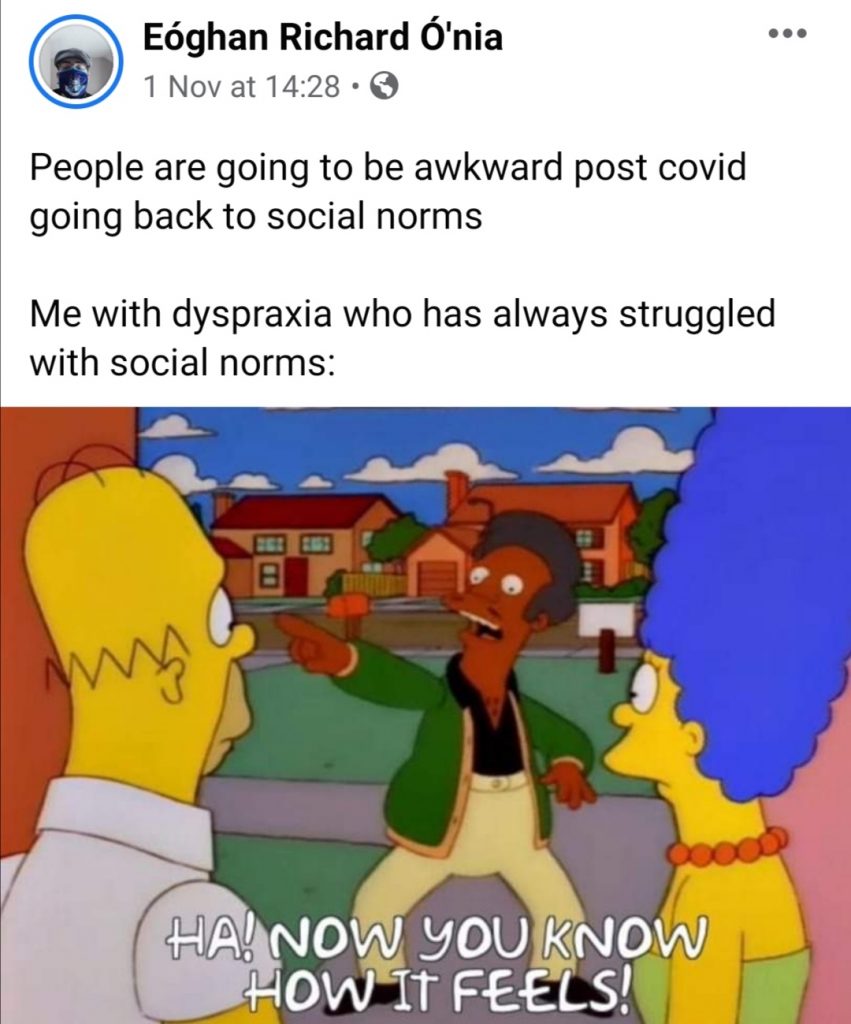
E Ó N: I think so. Like when an article in the Irish Times covered how people are going to have difficulties with social norms post COBID: like shaking hands. And I put up a meme in Simpsons fans and I just said, ‘Me as someone with dyspraxia who struggles with social norms.’ And it just said, ‘Ha, now you know how it feels.’

Simpsons meme for book about dyspraxia feature
Social norms have always been a struggle for people with dyspraxia

An awkward moment for Aodhán Ó RÍordáin during an RTÉ interview:

Tweet of Awkward moment for Aodhán Ó Ríordáin
This difficult question for Aodhán Ó RÍordáin gave Eoghan Ó Nia of Independent Left the opportunity for a Simpsons’ meme
Simpsons meme by Eoghan Ó Nia
Humour was a way of dealing with bullying related to having dyspraxia for both Victoria Biggs and Eoghan Ó Nia

What does Victoria Biggs’ book about dyspraxia say about school supports?

CK: Did you and Victoria get any support in school?

E Ó N: Victoria Biggs had a good deal of support from her parents and from her family. One of her teachers supported her indirectly without her knowing. Which she said in looking back on it all now, annoyed her. She would have preferred if that teacher had just been honest with her. For example, they’d have to clean up their dormitories. The teacher would make sure that Victoria Biggs was alone when she was doing that because otherwise the other kids would judge her for taking longer to do the cleaning. But she makes the point that she would have preferred if the teacher had have actually been open and honest about it instead of just being helping in a sneaky kind of way.

As for me, I got the usual learning support. That was very good. In fact, actually it was the learning support teacher in my third year of secondary school (I already had dyslexia at that point) who spotted my dyspraxia. I was doing a test in relation to dyslexia and I was struggling with using blocks to make words. I was finding it hard to actually pick up the blocks. And the support teacher rang up my mom and said, ‘I think he has dyspraxia’. I was referred for an assessment and sure enough was diagnosed with it. If it wasn’t for the learning support teacher, I wouldn’t have even been diagnosed with dyspraxia.

CK: Does Victoria Biggs end up advocating for change or policies? What would she like to be different about the world to make it more inclusive for people with dyspraxia?

E Ó N: The main conclusion that she draws with the book is the need to raise awareness for dyspraxia itself and getting people to understand what it is and all the different aspects to it. Obviously, the book was written originally in 2005, so the supports and services in place then were very poor. Dyspraxia was only really a relatively kind of new thing. A lot has changed since then.

I think another point is that when you do the assessment of needs and all the different supports that are there outside of school, they are all designed for children, which isn’t great for teenagers or adults with dyspraxia. Increased support after childhood is also something Victoria Biggs is calling for. We don’t have any supports for anything designed specifically for teenagers or adults.

Advice for inclusive political parties and campaigns

CK: Any tips – this is probably more for you than from reading the book – but any tips for people who are running campaigns to make sure that they’re inclusive and that people with dyspraxia can be fully involved?

E Ó N: First of all, I’d say each intellectual disability presents its own challenges and for someone with just dyslexia and someone with just dyspraxia, there’s going to be two different approaches. But at the end of the day, the experts on this are the people with those particular disabilities. They’ll know what they need and they’ll know where they’re struggling. It’s probably not very enlightening what I have to say, but sometimes – and with the dyspraxia especially – I focus my brain on doing the basics right first, rather than trying to do anything over-complex. And sometimes I feel like people in politics miss that, that they don’t do the basics right. Talk to people with dyslexia, talk to people with dyspraxia and ask them to look at your campaigns and your parties. And ask them: is this something that, regardless of whether you agree with it or not, that you could engage with? That you could involve yourself with? That you can understand what we’re for?

Also, if you have someone in your party or organization that has an intellectual disability, again, talk to them. Let them speak for themselves. I remember after the general election Sinn Fein had a couple of Facebook ‘live’ on intellectual disabilities. Which were good. I liked them. But again, it was mostly just the representatives and the ‘experts’, not really anyone with a disability. Parties have to involve the people with the disabilities in the actual discussions.

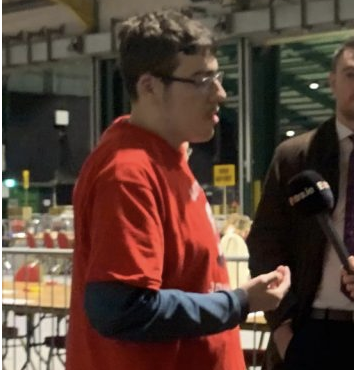
Eoghan Ó’Nia addressing the media for Independent Left
Eoghan Ó Nia speaking to the media on behalf of Independent Left after the general election of 2020

CK: It’s a simple tip, but it’s really important. And it’s surprising how often that doesn’t actually happen. Is there anything about the book you particularly wanted to highlight?

E Ó N: I don’t agree with how there’s always a focus on the famous people that have a particular disability. But Victoria Biggs was saying that although not confirmed, they believe that Churchill presented with symptoms of dyspraxia, or development cognition disorder as it’s known now. And so did Eisenhower and Montgomery. So although I’m not a fan of Churchill, I did like the quote in the book that three disabled people kicked Hitler’s arse. That was brilliant, to be fair.

Most of the chapters are obviously about people with dyspraxia themselves, so it’s going through things like how you struggle at home, how you struggle with exams. Growing up and trying to be an independent person. But the thing I would say about the book itself is it’s a good read for non-dyspraxics, because it gives everyone a good idea of what people with disabilities struggle with. And when you read through the book, you appreciate things that you wouldn’t come across otherwise, like tying a shoelace: for someone with dyspraxia, that can be a daunting task.

Like myself, she has that kind of self-inflicted sense of humour. You do get a lot of jokes where she’s poking fun at herself. It’s a very good read. Obviously it’s written by someone with dyspraxia, so it’s not difficult to read through. It’s a very approachable book. As someone who struggles with reading myself, I read one chapter a day, but obviously someone who’s more advanced in reading skills could get through it in a day. It’s especially good for parents of children with intellectual disabilities in general, not just dyspraxia. I know that this book is about people with dyspraxia, but I think it gives you a broader understanding of any kind of intellectual disability. It gives tips for everyone who’s around that person as well. Like, ‘Here’s good tips for parents when it comes to exams’ or ‘Here’s four tips for teachers when it comes to exams’.

She makes an interesting point about growing up in Saudi Arabia. Surprisingly, it wasn’t as bad for her there as when she got to England. The Saudi’s accepted her for who she was, the culture was dyspraxic-friendly; it’s quite a difference in culture that a conservative country like Saudi Arabia, without even trying, was dyspraxic-friendly.

Another important point she makes as well is that you can really do anything. As much as it can be disheartening talking only about all the different struggles that we go through, she says you can achieve a lot. Certain jobs like working in a supermarket might not be feasible but with education, there’s no reason to limit yourself. A lot of people with intellectual disabilities do actually go on to become teachers. Victoria Biggs gives ideas for different careers that you can put yourself into. Now, she doesn’t mention politics, but I’d recommend politics myself. She encourages you to push yourself. Herself, she’s just completed her doctorate in the University of Manchester (on storytelling and memory among Israeli Jewish and Palestinian youth), which is very impressive. Obviously, the main points she makes is you have to think in a different way than most and do things differently, but really, as long as you’re willing to push yourself in what you believe in, you can do almost anything really.

It’s also very good that she gets a quotes from other people with dyspraxia and they address their struggles in relation to the different chapters. I find that’s very good. There is one of these quotes that struck me: ‘If I could attach a printer to my brain, I could prove to people I’m not stupid.’ We have such an issue getting our thoughts and beliefs across, but our brain, it’s all up there, it’s just getting it out. That was my favourite quote from the book.

Dyspraxia resources and further reading for a good book about dyspraxia

Victoria Biggs has a blog here.

Dyspraxia Ireland has a wealth of resources here and a reading list of books about dyspraxia here.

Filed Under: Reviews

The poet John Clare: Freedom and Anguish

26/10/2020 by Ciarán O'Rourke 3 Comments

Poet John Clare by William Hilton
The poet John Clare witnessed the enclosure of the commons and sympathised with the dispossessed

The poet John Clare was born on 13 July 1793, on the same day that Jean-Paul Marat, the zealous Jacobin revolutionary who believed that ‘man has the right to deal with his oppressors by devouring their palpitating hearts’, was assassinated. John Clare died 20 May 1864, a week before the United States Congress formally recognised the Montana territory of settlement (in a region long-inhabited by Crow, Cheyenne and Blackfeet indigenous peoples) and at a time when Union and Confederate forces waged bloody warfare in Virginia and Georgia over the question of American slavery, its legitimacy and continuation.

Throughout his adult life, Clare disapproved of those he called ‘the French Levellers’ for the violence and upheaval of their programme, and he never left England, but his life and poetry nonetheless stand in an opposition to the dispossessions, divisions and labours of the nineteenth century, the age of capital.

In contrast to the majority of his literary contemporaries, John Clare, born in Northamptonshire to a family of tenant farmers, experienced the privatisation of common land that swept across Britain (and British-controlled regions around the globe) in the wake of the 1801 Inclosure (Consolidation) Act, converting communally tended and lived landscapes into real estate, while intensifying the precarity and dependency of an entire population of rural workers. ‘There once were days, the woodman knows it well’, Clare writes in The Village Minstrel, ‘When shades e’en echoed with the singing thrush’:

There once were lanes in nature’s freedom dropt,

There once were paths that every valley wound –

Inclosure came, and every path was stopt;

Each tyrant fix’d his sign where paths were found,

To hint a trespass now who cross’d the ground…

John Crome Mousehold Heath Norwich 1818-20
Mousehold Heath was common land near Norwich that was largely enclosed by 1814. Painting by John Crome

The Inclosure Acts were presented by parliamentary advocates as a form of ‘improvement’ in land law and distribution. John Clare, however, perceived first-hand the violence of the new order, resulting in an entrenched disparity of privileges and resources, forcing newly created ‘parish-slaves’ to ‘live [only] as parish-kings allow.’ ‘Enclosure came, and trampled on the grave / Of labour’s rights’, Clare resoundingly asserts in The Moors, ‘and left the poor a slave.’

John Clare’s landscape poems observe the social as well as the natural

In the work of William Wordsworth, the foremost ‘Romantic’ of the era (and later, Queen Victoria’s poet laureate), the natural world is celebrated and explored primarily as a metaphor for ‘the mind of man’  – with all the gendered connotations of that concept intact – and indeed as a screen on which the artist’s own life and fancies are projected and presumed as universal truths. Even the relatively radical (if also aristocratic) George Gordon Byron and Percy Bysshe Shelley follow Wordsworth’s lead in this respect, albeit with the more combative aim of inspiring political and individual regeneration through a renewed apprehension of natural cycles: the revolving weathers of the world coming to symbolise the human capacity for agency and change.

Poet John Clare was attentive to the lives of the commoners such as those working under the harvest moon. Painting by Samuel Palmer.

The work of poet John Clare, however, is of a different variety and intensity: an intimate, achingly powerful poetry of natural and social portraiture, grounded in both literary and vernacular traditions, as well as the earth- and sky-scapes of his native locale. His landscape poems have a luminous observational precision, as well as a rambler’s colloquial flow (from Summer Images):

[A] wind-enamoured aspen – mark the leaves

Turn up their silver lining to the sun,

And list! the brustling noise, that oft deceives,

And makes the sheep-boy run:

The sound so mimics fast-approaching showers,

He thinks the rain begun….

John Clare’s biographer, Jonathan Bate, has drawn attention to the poetry’s oral character and technical ease, while also noting Clare’s work (for the fiddle-playing poet, a kind of pleasure) of preserving local melodies as an added dimension and possible source of the famed musicality of his verse. ‘The clock-a-clay is creeping on the open bloom of May, / The merry bee is trampling the pinky threads all day’, reads Summer, ‘And the chaffinch it is brooding on its grey mossy nest / In the whitethorn bush where I will lean upon my lover’s breast’.

As a young man, Clare in fact filled two notebooks with transcriptions of ‘gypsy’ tunes and dances. His instinct, then and throughout his life, was to celebrate and learn from the richness of those folk cultures that fringed the world he grew up in, which (as Tom Paulin reminds us) was ‘no backwater’, but very much alive with its own artistic and intellectual customs.

The poet John Clare’s sympathy for the commoners

‘My life hath been one love – no blot it out’, the poet John Clare urges in Child Harold: ‘My life hath been one chain of contradictions’. And so, if he was cautiously conservative in his formal politics – rejecting what he viewed as the historical extremism of both French and Cromwellian revolutions – his respect and affection for the ‘gypsies’, as well as other groups who suffered disdain and marginalisation from English officialdom, are arguably more indicative of his fundamental social sympathies. ‘Everything that is bad is thrown upon the gypsies’, he writes despairingly of the prevailing attitudes in the Northampton press: ‘their name has grown into an ill omen and when any one of the tribe are guilty of a petty theft the odium is thrown upon the whole tribe.’ Countering this trend, in his poem, The Gipsey’s Song, Clare adopts the voice of the travellers themselves, whose vagrancy and ‘liberty’ (not to mention, their music) he admires.

And come what will brings no dismay;

Our minds are ne’er perplext;

For if today’s a swaly day

We meet with luck the next.

And thus we sing and kiss our mates,

While our chorus still shall be –

Bad luck to tyrant magistrates,

And the gipsies’ camp still free.

As here, Clare’s rhythmic, vibrant verse is also a form of subtly layered social observation. ‘Religion now is little more than cant’, he writes in The Parish, blending satire and poetic rage at the sight of ‘Men’ who:

… love mild sermons with few threats perplexed,

And deem it sinful to forget the text;

Then turn to business ere they leave the church,

And linger oft to comment in the porch

Of fresh rates wanted from the needy poor

And list of taxes nailed upon the door…

In a few lines, Clare exposes the entire edifice of hypocrisy and greed undergirding Britain’s burgeoning bourgeoisie, as represented by the ‘business’-oriented land-holders in the local parish. Tellingly, once again, the poem’s critique is made from the perspective of ‘the needy poor’: a recurring feature of Clare’s work, which repeatedly voices solidarity with those in his society for whom poverty, eviction, exploitation are palpable and perennial realities. Indeed, he writes as one of them such as in Inpromptu on Winter.

Winter could be a terrible challenge to commoners in the nineteenth century. Painting by Johann Jungblut

O winter, what a deadly foe

Art thou unto the mean and low!

What thousands now half pin’d and bear

Are forced to stand thy piercing air

All day, near numbed to death wi’ cold

Some petty gentry to uphold,

Paltry proudlings hard as thee,

Dead to all humanity. 

Ecological protest in the poetry of John Clare

The acute, eye-level understanding of both social relations and seasonal change is part of what makes Clare so unique a figure in the Romantic literary movement. E.P. Thompson designates him ‘as a poet of ecological protest’ on this basis: an artistic consciousness almost preternaturally attuned to any ‘threatened equilibrium’ in the rural world – shaped by long-standing customs of free movement and shared access to natural space and resources – into which he was born, and which ‘Enclosure’ definitively ended.

Importantly, Clare’s poetic conscience seems always primed to detect and diagnose cruelty as such, whether with regard to the victims of social ‘improvement’ or more broadly. The Badger, for instance, offers an accurate (and brutal) portrayal of baiting day, a village tradition Clare himself thought cruel and disturbing. Indeed, the poem seems propelled by a pained identification with the torment of the titular animal, up-rooted from its den and eventually routed in the street by a crowd ‘of dogs and men’. It finishes:

Though scarcely half as big, demure and small,

He fights with dogs for bones and beats them all.

[…] He tries to reach the woods, an awkward race,

But sticks and cudgels quickly stop the chase.

He turns again and drives the noisy crowd

And beats the many dogs in noises loud.

He drives away and beats them every one,

And then they loose them all and set them on.

He falls as dead and kicked by boys and men,

Then starts and grins and drives the crowd again;

Till kicked and torn and beaten out he lies

And leaves his hold and cackles, groans, and dies.

‘Poetry is the image of man and nature’, Wordsworth had declared in the preface to Lyrical Ballads (1800), ‘a homage paid to the native and naked dignity of man.’ Far from idealising humanity and nature (and the relations between them), however, Clare’s ecological sensitivities and ‘customary consciousness’ together helped him to depict life as he found it, and with a realism few other writers were socially equipped or emotionally inclined to engage.

Famously, Clare spent the last twenty-three years of his life at what was then The Northampton General Lunatic Asylum, having previously been hospitalised in a similar institution in Essex (his wife, Patty, and surviving children, remained in the family home in Northborough). As Bate notes, ‘Clare was perceived as an anomaly within his culture’ throughout his career, and after, with the result that there has ‘always [been] a tendency to attach labels to him: mad poet took over where peasant poet had left off.’

Such classifications have obscured the achievements and concerns of the work itself, while also reducing the artist to a cliché (and a potentially harmful one at that). At any rate, Joe Clare continued composing poems throughout this time: cataloguing personal spells of both depression and nostalgia, as well as producing erudite and witty works in the style of Byron (Clare claimed to have been and/or known a number of prominent world figures, including Byron and Napoleon Bonaparte). ‘I am–yet what I am none cares or knows’, he says in this period in I Am!,

I am the self-consumer of my woes,

They rise and vanish in oblivious host,

Like shadows in love’s frenzied stifled throes

And yet I am, and live–like vapours tossed

Into the nothingness of scorn and noise,

Into the living sea of waking dreams,

Where there is neither sense of life or joys,

But the vast shipwreck of my life’s esteems;

Even the dearest that I loved the best

Are strange–nay, rather, stranger than the rest.

Northampton-County-Lunatic-Asylum
Poet John Clare spent twenty-three years at Northampton County Lunatic Asylum

The anguish of the poet John Clare

John Clare is a poet of psychic anguish, as well as ecological critique and music. A similarly potent atmosphere of sadness and isolation looms in another late, autobiographical piece, one of his greatest works: The Journey out of Essex. The prose letter was written as a personal account of his spontaneous departure, in the summer of 1841, from the asylum where he had been admitted as a patient, heading for Helpston in search of his first love, Mary Joyce, who was in fact deceased by this time.

It was a four-day journey of ‘hopping with a crippled foot’ in ‘old shoes [that had] nearly lost the sole’, with little food or water, during which he slept out-of-doors more than once, including in a sodden ditch. ‘I was very often half asleep as I went on the third day’, Clare writes (with a characteristic minimum of punctuation), ‘I satisfied my hunger by eating the grass by the road side which seemed to taste something like bread I was hungry & eat heartily till I was satisfied’.  In itself, the combined vividness and loneliness of the text makes for haunting reading.

The Journey also quivers, however delicately, with the pulse of history-at-large. It is difficult not to trace in Clare’s chronic hunger and homelessness, the crippling pain of his ninety-mile trek – expressed with unparalleled literary intensity – the spectres of alienation and displacement that accompanied Britain’s industrialising drive and imperial rule throughout the nineteenth century.

In a chronicle written in the late 1830s, after two tours of the island, French magistrate Gustave de Beaumont noted how ‘every year, nearly at the same season [the] commencement of a famine is announced in Ireland’: a pattern of colonial mismanagement and market-exacerbated scarcity that would reach a new nadir of devastation in the mid-1840s, following the failure of the potato crop. In the same period, hundreds of thousands of peasant and labouring populations from Ireland, and across Britain and Europe, sailed to America in search of a more secure future, often in turn forcing indigenous tribes into conflict or internal migration.

When situated in such a world-historical vista, Clare’s desperate meal of roadside grass, his powerful yearning for home (which is, for him, both a physical place and a memory of a time, now lost, before enclosure), seems almost a parable of universal dispossession, in a decade of civilised disasters.

‘Oh, who can tell the sweets of May-Day’s morn / To waken rapture in a feeling mind’, the poet John Clare asks his readers in the poem The Village Minstrel: celebrating not only the turning seasons, or his own sensations, but the joy and “plenty” promised by the specific community-in-nature he knew in his youth, and which in later years he hoped always (at times despondently) to reclaim. Clare’s poetry is one expression of that elusive but palpable awakening. Our politics might be another, drawn from nature, from rapture, from one another, and (as historians like Peter Linebaugh have contended) from May-Day itself, both a political and a seasonal tradition. If a future commons is possible, it begins now, with Clare: as we shape our lives and relationships through labour, song, compassion and respect. These are the principles by which we make the world.

FURTHER READING

John Clare: A Life by Jonathan Bate

Crusoe’s Secret: The Aesthetics of Dissent by Tom Paulin

Minotaur by Tom Paulin

John Clare: Major Works by John Clare, edited by Eric Robinson and David Powell

Filed Under: Reviews

Peter Linebaugh Interview

22/10/2020 by John Flynn 7 Comments

Peter Linebaugh watercolour portrait
Peter Linebaugh interview for Independent Left. Portrait by Anastasya Eliseeva for New Frame.

Peter Linebaugh interviewed by Johnny Flynn of Independent Left

Johnny Flynn: The first question I had to ask you was about  the subtitle to your Red Round Globe Hot Burning: a tale at the crossroads of commons and closure, of love and terror, of race and class, and of Kate and Ned Despard. I saw you did a video that is up on the P. M. Press blog where you were talking about crossroads and you referenced Robert Johnson and the idea of being at the crossroads. The time of Edward Despard and Catherine Despard was one of commons and closure and race and class: the beginnings of this horrible white supremacy that we’re beset with now (with all these kinds of fascist berserkers that are all over the world gaining strength). The Despard’s attempt to overthrow the industrial capitalist system and restore the commons failed, and we ourselves are at the crossroads now between our plague-ridden current times and what they call the Anthropocene or the warming climate. Could you talk about that a little bit? How the two are related, if that even makes sense as a question?

Peter Linebaugh: It does make sense. The Anthropocene is basically putting carbon dioxide into the stratosphere, so taking what was underneath the earth and putting it on top of the earth has really messed the earth up, to be simple about it. But Despard, of course, was executed or hanged and decapitated in 1803 and this is at a time when – based on ice samples from the Antarctica – some geologists date the beginning of the pollution of the stratosphere with CO2. Carbon dioxide that’s still up there of course, that has led to global warming, planetary warming, species destruction, desertification and so on. So this is a planetary crisis now that we face.

The USA – or Turtle Island as I’ve taken to calling this part of the planet (based on the first names of the first peoples here, they say Turtle Island) – the USA is basically a product of Despard’s time, that is the 1790s. That’s the same as the UK, the United Kingdom. This was also the time of the Anthropocene. You take these two Uniteds – United Kingdom, United States of America – and try to understand how they are related to the factory and then how is the factory related to the plantation.

Taking the republic, the Anthropocene, white supremacy, the modes of production and put them together and it’s a massive attack, it’s a massive counterrevolution, I would even say, on the planet and on social life of not only two-footed critters but horses, livestock, other species. This is really mind blowing in the sense that it contradicts so many standard narratives, you know, of the scientific revolution, of industrial progress, of secular life, of the enlightenment.

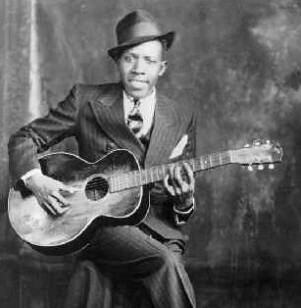
Robert Johnson blues guitarist
Blues guitarist Robert Johnson is evoked by Peter Linebaugh’s idea of the crossroads

I said four things. Let’s see: Anthropocene; the republics; white supremacy; modes of production. I’m sure I’m missing a few other fundamental pillars that had their foundations knit together in the 1790s. Thank you for remembering Robert Johnson and the crossroads because it was that blues tune – or rather the blues man – that was definitely in my mind. This Robert Johnson, the blues man from the Mississippi Delta, who was said to have made a pact with the devil at the crossroads where he was granted genius at the guitar and in music at the price of his soul. And far be it from me to do a sociology of the blues but it is one of the cultural expressions from Turtle Island that arose out of the plantation and against white supremacy.

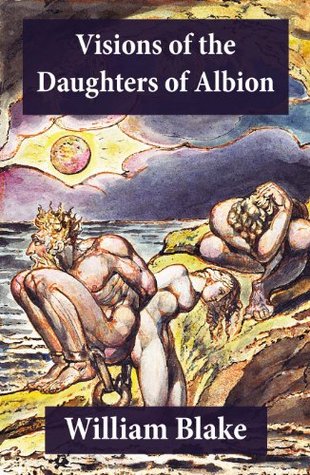
The dominant religion of white supremacy was this dualistic view of the devil versus Yahweh or a king of the universe, and Robert Johnson defied it in his music. And I see a direct relationship between that and William Blake. William Blake’s Visions of the Daughters of Albion is a beautiful meditation against white supremacy, against political domination, against the love of the body, against Eros, against the alienation of labour. It’s a great poem inspired by the Haitian revolt of 1791.

I’m trying to write a tale of the crossroads and I see that in Edward Despard, the last of many children of an Anglo Irish in County Queens or County Laois, and in Catherine Despard, who was really totally forgotten in history and was a descendant of Africans. They met in the Caribbean or somewhere in North America, maybe Central America, and they formed a revolutionary team, a partnership in the age of revolution, in the age of the United Irishmen and the age of the Haitian revolt, against which I think the United Kingdom and the USA were both formed. I see Ireland and Haiti, or the Caribbean islands, the Caribbean plantation, as kind of the one side of the barbells and the other side of the barbells is the UK and the USA, but again, this is perhaps an undialectical image.

The USA and the UK are past their sell-by date

Johnny Flynn: I remember your extraordinarily provocative statement in one of your talks where you were talking about the United Kingdom and United States. You said that they were both formed as a kind of destruction of the commons, especially in the case of the United States and the United Kingdom: let’s say against the 1798 revolution or attempted revolution of the United Irishmen. So the restoration of the commons would be predicated upon the destruction of what we know of as the United Kingdom and the United States. If I remember correctly, in one of your talks you said something like that?

Peter Linebaugh: I think the USA and the UK are definitely hanging on, gasping for life towards the end of their sell-by date. They’re no longer political organizations that can solve the problems that are facing us, beginning with the effects of the Anthropocene or planetary warming. Their answer, at least, has been to intensify class inequalities and to intensify white supremacy and they’re totally at a loss about what to do against very vibrant forces from the assemblies of the Occupy era from 2011, to the attempts at, quote, ‘socialist constitutions’ in Latin America, against the George Floyd uprising of this last summer. They’re not able to meet these challenges. Hey Johnny, by the way, thank you for saying the whole title, Red Round Globe Hot Burning.

William Blake Visions of the Daughter of Albion cover
Book cover based on original frontispiece of William Blake’s ‘Visions of the Daughters of Albion’, which inspired Peter Linebaugh’s book title for ‘Red Round Globe Hot Burning’

Johnny Flynn: It’s a great title, sure it comes from Blake, the Visions of the Daughters of Albion.

Peter Linebaugh: It does.

Johnny Flynn: There is a great selection of literature in that book. Ciarán O’Rourke and I were thinking you could read through your book and just have people read from different texts that are assembled in the book, because it is like a kind of omnia sunt communia of radical culture and art. It’s like this extraordinary coming together of traditions and texts and everything. It’s just a fabulous work of art, historical art. Not many history books are works of art.

Peter Linebaugh: Thank you for sending me two of Ciarán O’Rourke’s poems.

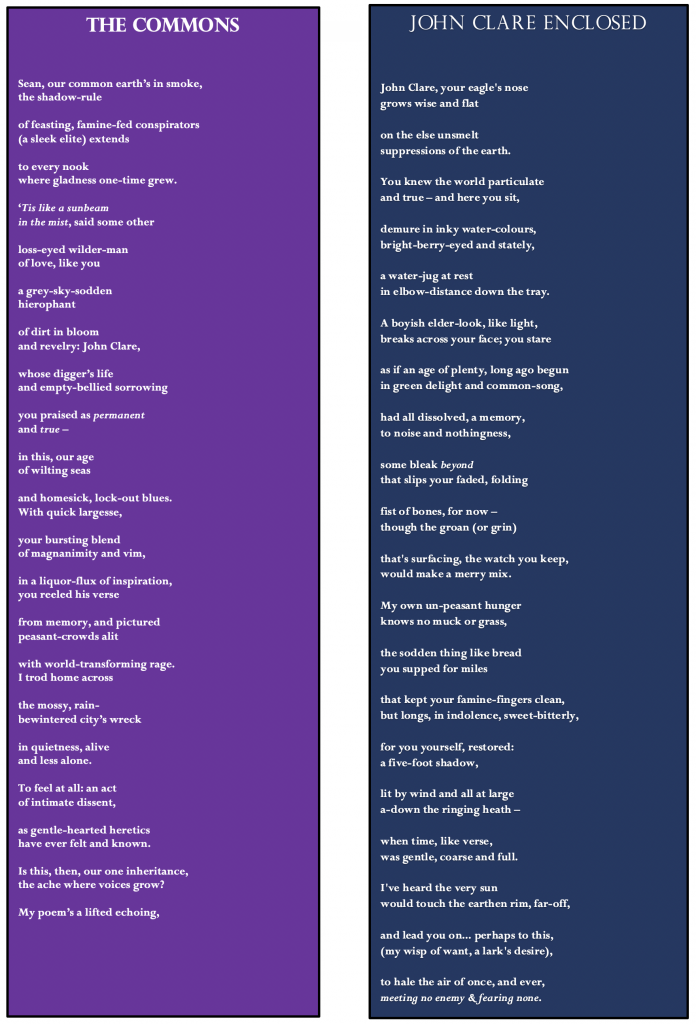
The Commons and John Clare Enclosed Two Poems by Ciarán O'Rourke
‘The Commons’ and ‘John Clare Enclosed’ two Poems by Ciarán O’Rourke inspired by the writings of Peter Linebaugh. First published in ‘Irish Pages’

Johnny Flynn: He’s a great poet. He’s a political poet as well, so he’s totally in love with the poetic tradition like Blake and John Clare and he’s a great source for me. It’s good to have a friend who’s a poet, you know?

Peter Linebaugh: Yeah, Edward Thompson kind of had a view of poetry as oracular, you know. As related to the prophets who were able to denounce the powers that be and the world as it is.

Peter Linebaugh on Thomas Spence

Johnny Flynn: Thomas Spence is like that. It’s incredible stuff. As you’re reading it, you feel like starting to shout or whatever because it’s so powerful, the stuff he’s saying and the way he says it. The rights of infants or when he’s talking about, ‘Yes, Molochs!’ And all this amazing stuff.

Peter Linebaugh: Yeah, I think Thomas Spence is in a different league. He’s in the streets rather than the drawing rooms, and I’m not saying Blake was not in the streets. He was. He would read aloud in the garden with his wife and they wouldn’t have their clothes on, which in good weather sounds… You’d want to have short poems! And he was also seen wandering around the streets of Lambeth with a bonnet rouge. But Spence definitely, he’s not only on the streets, he’s lying on the streets to do his chalking on the pavement.

Johnny Flynn: Just compelled to resist and in these imaginative ways, through songs and graffiti and his incredible pamphlets.

Peter Linebaugh: And his songs were to the tunes of popular tunes that remind me of the Wobblies, of the IWW, who would … or of Joe Hill who would take Salvation Army tunes and turn them into working class fighting songs.

Johnny Flynn: Who’s the guy who had, They go wild, simply wild over me? Not Joe Hill but the other great songwriter for the Wobblies. T-Bone Slim? Didn’t he have that one where he’s like, ‘They go wild, simply wild over me’? Where he’s saying the cops keep beating me up, the judge keeps putting me away all because I’m a class warrior.

Peter Linebaugh: T-Bone Slim spoke of civil insanity. I won’t say Spence started that tradition, because I think that goes back to Aesop and it goes back to Commedia dell’arte in Italy, or popular forms of song and popular forms of street actions, but definitely Joe Hill and T-Bone Slim are part of that, and it comes out of Spence. I love it.

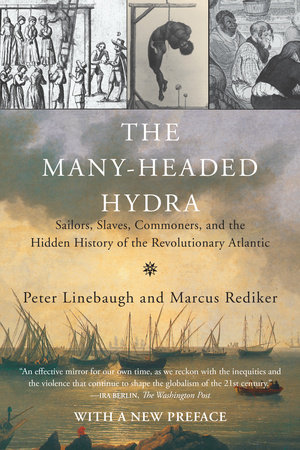
Many Headed Hydra for Peter Linebaugh interview
The Many-Headed Hydra by Peter Linebaugh and Marcus Rediker

Johnny Flynn: Spence, he kind of radicalized Robert Wedderburn, didn’t he? You and Marcus Rediker have a great passage in your Many-Headed Hydra that describes Robert Wedderburn as a linchpin of the revolutionary Atlantic. It’s a great metaphor it’s brilliant. He’s a fascinating character, Robert Wedderburn. He’s a kind of Jubilee enthusiast like Spence as well: a big believer in the Jubilee.

Peter Linebaugh: That’s right, he was.

Johnny Flynn: Get rid of debts, free the slaves, all this kind of great, great vision, you know?

Peter Linebaugh: And leave the earth fallow for a year. That’s also in Jubilee, and that definitely pertains to our point in the crossroads. I was reading Nature Magazine yesterday; it has released this report that 30% of farmland needs to be turned into wild in order to preserve the planet. That notion of fallow, I think, is essential, and it’s in Jubilee as you were saying, along with debt forgiveness.

Capitalist separation and destruction of the commons

Johnny Flynn: You said that the commons is more forgiving or it’s more friendly to women and children and when it comes, the theft of the commons and the rise of industrial capitalism, women and children were prime victims, whether it’s in slave labour like the reproduction of slaves or actually in the factory system where children were literally being fed into machines at the behest of these capitalist. Whereas the commons was a place of love and solidarity but it was also a formidable place with all these different Commoning traditions. And as with your book, Red Round Globe Hot Burning, it’s not explicitly called an international but it is kind of an international of these different Commoning traditions as Despard and Catherine’s journey is navigated through all these different traditions: from Ireland, to the Miskito Indians to the Mayans and the Iroquois, all these different, great Commoning traditions.

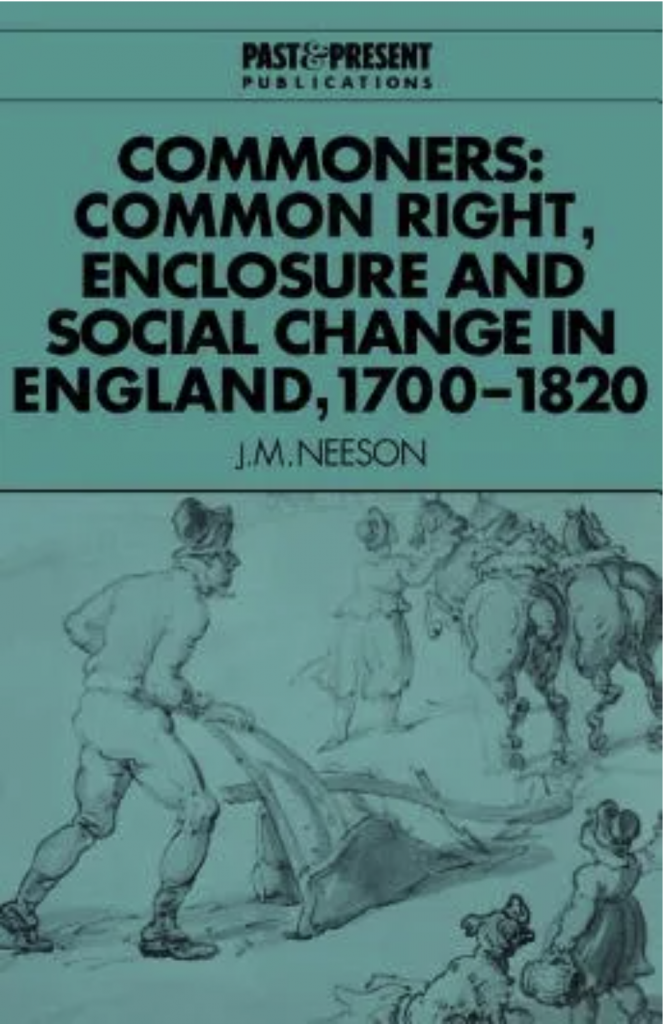
Peter Linebaugh: It is, but they never do quite get together. That was the point of his execution: to demonstrate to the world what happens if you try to get them together. But I want to get back to your other point about how the commons is friendlier to women and to children, because that’s a thought that I learned from my colleague, our colleague, Janet Neeson, who wrote the wonderful book called Commoners, which I think is probably the finest book on the commons in England during this period, during the eighteenth and early nineteenth centuries. She’s the one who taught me that the work of gleaning, the work of pasturage, is something for children as well as for men and women. In fact, just as I was talking, I was thinking of James Joyce. I think as a kid he used to go up into the hills – what do they call it? Booleying? – to look after pasturage of, I suppose, sheep. I’d like to read more about it, but I know he did that. But getting back to the commons and the family life, the family is not just around the kitchen or not just around the hearth, it’s also outside. It’s in the field or in the woods, and here, the family will go. I’m not sure the ramifications of that have been sufficiently explored by historians. I may want to attempt it here with the chapter on the goose, to describe children’s, quote, ‘literature.’

Cover of Commoners by Janet Neeson
Commoners by Janet Neeson praised by Peter Linebaugh as the finest book on the commons in England.

Long before it was literature, it was oral songs and rhymes, not for the nursery but for children, and it took place outside where lessons of cooperation and of sharing would be taught in practice by parents to children. So, then as you say, the factory will put an end and will start to create the divisions between the, quote, ‘public sphere and private sphere’ or the women’s realm and the public reserve for men. We’re still, of course, suffering the ramifications of that, as men can no longer rely on domination as their form of leadership and women are no longer consigned just to compliance and obedience. These are cultural remnants in our psychologies from this era of the capitalist separation and destruction of the commons.

Johnny Flynn: That’s a great way of putting it.

Peter Linebaugh: Well, we need much more work about it, I think, or I’d like to learn more about it, but Janet Neeson, I definitely recommend her.

Johnny Flynn: Would you say it’s a flaw in Marxism, that no one ever talks about how the worker is reproduced? It’s like the worker arrives at the factory to do the work or whatever. You know, do you think Marx overlooked the whole social reproduction? The stuff that was considered women’s work within the kind of capitalist system?

Peter Linebaugh: Johnny, you’re going to make me defensive. So, I think I’ve got to acknowledge that, because I have such admiration for Marx.

Peter Linebaugh photo portrait
Peter Linebaugh interview: ‘I have such admiration for Marx’

Johnny Flynn: Me too.

Peter Linebaugh: And he has so many enemies that to look at his limitations is … Well, it’s necessary and it’s true, he’s got a chapter on reproduction but it’s not social reproduction. In our era there have been such great debates from Maria Mies or Mariarosa Dalla Costa or Sylvia Federici or Margaret Benson, who have pointed and worked with this huge absence from Marx’s political economy, the other half of the human race.

Myself, I think what’s missing in so much of Marxism has depended on his political economy through the disparagement, on the one hand, of the philosophical anthropology of the young Marx, but also the neglect of (and even a failure to publish) the old Marx. Not all the ethnological manuscripts and notebooks have been published or translated. And they are about the commons, whether it’s the Russian obshchina or the peasant ‘mir’ or the Iroquois ‘longhouse’ here in Turtle Island.

Also Marx spent two months at the end of his life in Algeria and there he was investigating also the practices of the Algerian remnants of forms of Commoning. Now, all of this is not to say that just because he’s interested in commons, he’s therefore interested in women’s labour, but the definition of Marxism, I think, has to do with unpaid labour and that phrase that I think has really gotten in the way of many people’s thinking, which is free wage labour. They use freedom in contrast to slavery. I think that’s a hindrance to further thought because when it is labour of reproduction, of raising children, of her care work, whether it’s raising children, looking after the old or getting the breadwinner through the day, that labour is totally unpaid.

Johnny Flynn: What David Graeber, the late David Graeber, calls the bullshit jobs are paid for but the care work is disparaged.

Peter Linebaugh: His death, unexpected, is a great loss to us. He described bullshit jobs definitely. I haven’t read Bullshit Jobs but I did read Debt and I admire it.

Johnny Flynn: We were just speaking about the Jubilee too.

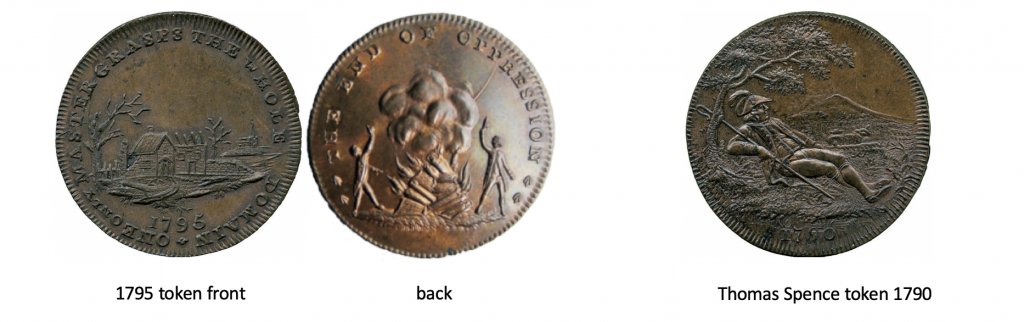
Peter Linebaugh: I think Thomas Spence also confronted this issue of money and wanted to turn money or token into political coin.

Johnny Flynn: Incredible: class war coins. They’re all over your book, Red Round Globe Hot Burning. There are all those different coins in the book.

Thomas Spence radical tokens
Tokens, used as coinage were a form of revolutionary messaging as highlighted in Red Round Globe Hot Burning by Peter Linebaugh

Peter Linebaugh: I like that [1795] one because the top one is a quote from the Irishman Oliver Goldsmith. ‘One only master grasps the whole domain’ and it shows this village that’s just wrecked and these trees that are dead and the squalid nature of the road. The other side of the coin is called The End of Oppression and it shows two people burning deeds, burning property deeds. So, it’s just like when a Zapatista showed up and led by women, they burnt the property deeds there in San Cristobal.

Peter Linebaugh interview: the Charter of the Forest

Johnny Flynn: You told a story about the Zapatistas where you said that you misunderstood Subcomandante Marcos about the Magna Carta, something like that, and then you ended up doing a whole Magna Carta book. Was that correct? I think I remember reading that and thought it was a pretty funny story.

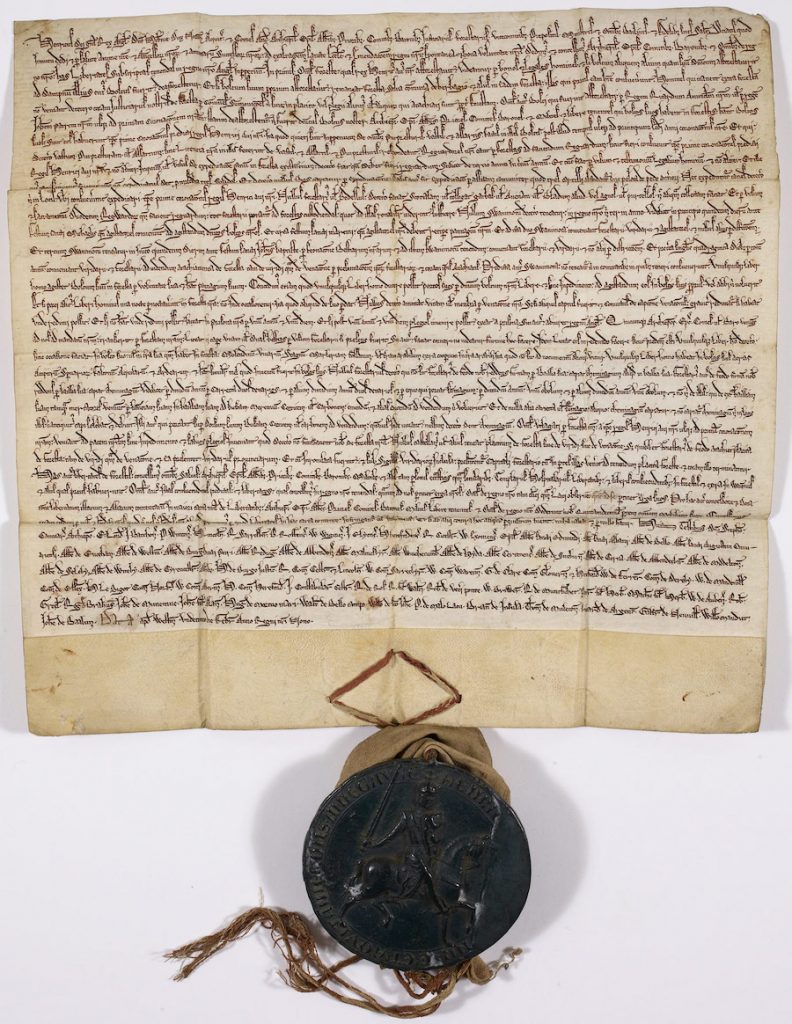
Peter Linebaugh: You’ve got to use your own ignorance to advantage. I’m lousy at language. I don’t speak Irish or can’t pronounce it, same with Spanish and all other languages, so when I saw Subcomandante Marcos referring to Magna Carta, I thought, ‘Oh boy, this is the 1215 charter of liberty,’ but it wasn’t at all, it was the Mexican Constitution he was referring to. But, despite that mistake, it made me pay attention to the Mexican Constitution which was all against the ejido. And that had been the beginning in 1994 or the year before the ejido was removed from the Mexican Constitution: ‘no more commons’. That caused me to go think about the English Magna Carta, what had been its relationship to the commons? And as a result discovering its sister charter, the Charter of the Forest.

The Forest Charter of 1217
The Forest Charter of 1217 obliged the English king to give back the use of the forest to the people

Johnny Flynn: You did very well, actually, because there was some great stuff about the Magna Carta. The Magna Carta Manifesto was brilliant. There’s a video of you on YouTube at Sherwood Forest talking about these great oaks, and you are almost channelling Spence or someone. You get into a real kind of rhetorical power.

Peter Linebaugh: It was like a dream to be in a place where it felt like Robin Hood was going to pop out somewhere and to be surrounded by all these powerful militants from all over the midlands of England, against fracking and for the preservation of the woodlands. There were some wonderful people there and also, Johnny, the most amazing trees I’ve ever seen.

Johnny Flynn: You said to be among these great oaks…

Peter Linebaugh: It was like out of a Hollywood fantasy movie. I expected these oaks to start talking or their limbs moving like arms at any moment.

Peter Linebaugh on thanatocracy

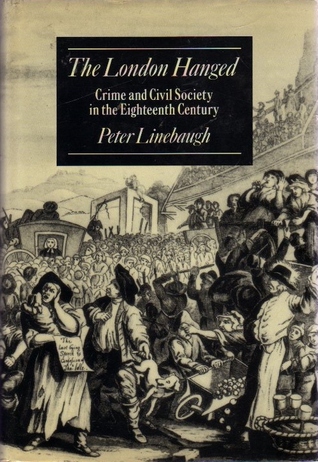
Johnny Flynn: Beginning with The London Hanged you talk about ‘thanatocracy’, which I presume means rule by the spectacle of death, or the threat of death or hanging and executions, as a way of disciplining the common folk who have been kicked off the commons. It’s in Red Round Globe Hot Burning as well, you talk about the thanatocracy. It seems like a key concept for you in the rise of capitalism: red in tooth and claw.

Peter Linebaugh: I’ll talk about it but then I want to know what you think about it, because thanatocracy, I guess it’s Greek, government by death, like you have democracy, government by the people. It comes from John Locke. He defined sovereignty as the ability to pass laws with the punishment of death, and so if that was his notion of sovereignty, that’s the Roman notion of sovereignty too. When Caesar is displaying himself in the city in a procession, he’s preceded by a person carrying a bundle of sticks and these sticks were the fasces and they sit with an axe among them, they indicated sovereignty and the axe was a tool of decapitation.

So capital punishment and the ability to murder or to kill another person was the essence both of the precessions of Caesar but also of John Locke and the foundation of the liberal era. The foundation of law was capital punishment. Of course I wanted to tie it into Marxism. Surplus value, as interest, rent or profit provides bankers, landlords and capitalists and entrepreneurs with their wealth, but it’s always at the expense of those whose value, that is their wages or their receipts of subsistence goods is reduced lower and lower and lower and lower until death arrives.

There is a constant reduction on the value of a human being and the value of work. In fact, work itself is deathly, as Marx showed in Chapter 10 of Capital with the story of Ann Walkley who died from overwork. I learned more about this last night from hearing Mike Stout talk about the struggle at the Homestead Steel Works in Pittsburgh, a factory that produced the steel for the world for a couple generations. He said between 15 and 20 people were killed every year at Homestead at these steelworks in Pittsburgh. And then this summer we saw the police knee on the neck of George Floyd, and this, again, was to demonstrate the power of police. And you look at the policeman’s face and you can see that he’s sort of taking satisfaction in his work, unlike a lot of executioners such as Jack Ketch, a lot of them do not take much satisfaction in that work and it leads to illness. So, there’s a spectrum, I think, from John Locke to George Floyd, and we also see it in the management of the coronavirus, of the pandemic, I think where African American people, poor people, old people are targeted in a kind of triage, an unspoken triage, are left to die, are left to be more susceptible to this disease, and certainly less able to obtain relief.

Cover of The London Hanged by Peter Linebaugh
Cover of The London Hanged in which Peter Linebaugh addresses the idea of a thanatocracy

And then going back to the theories of capitalism in the eighteenth and early nineteenth centuries, especially to Malthus, there is a new form of reasoning, of calculating the deaths numerically across a whole demographic spectrum, a whole society, and I think that method of reasoning had its origins in Ireland with the English conquest of Ireland, with Gregory King and William Petty of the Down Survey. People were beginning to calculate and enumerate populations as a whole. They were beginning to study social reproduction for a whole society. So some of them also anticipated and try to manage deaths. Who is going to starve and who won’t starve? Who is more likely to obtain, get a disease and who isn’t? And this is also, I think, related to thanatocracy. But mainly, of course, thanatocracy refers to capital punishment, which I define not just legally but as the punishment of capital, so it’s trying to broaden the meaning. Now, my question to you, Johnny, is if I had some different essays on this, which I’ve written over the years and I want to put together in a book, do you think I should call it Thanatocracy?

Johnny Flynn: I think it’s an extraordinarily suggestive concept. I think it’s brilliant. For me it gives me a good picture in my mind, everything I think about, the rise of capitalism and through your works I can get a really vivid picture of just the sheer brutality of the enterprise, because often as leftists, you’re always on the back foot. People say, ‘Oh, what about Stalin? What about the brutality of the Soviet experiment or whatever?’ You’re like, ‘Absolutely. I’m not denying it. But let’s also concentrate on this extraordinarily brutal couple of hundred years which is just unparalleled in the terms of the amount of savagery.’ I think thanatocracy is a theme in your works from The London Hanged to tales like The Many-Headed Hydra: such as when Francis Bacon is talking so genocidally about working class people and plebeians.

COVID and the US election from the perspective of Peter Linebaugh

Johnny Flynn: It’s interesting you just brought up the issue of quarantines and COVID. I actually had that as a kind of second question I was going to ask you. Did you think there was any relation to the idea that how people are almost expendable now under this plague system? Does it in any way relate to what you discussed as thanatocracy?

Peter Linebaugh: It’s already part of a mainstream debate in this election year here in the USA. How many lives did Trump sacrifice? Is it 100,000 or is it tens of thousands? There’s sort of a debate, but the assumption in both of them is that those policies led to deaths. But what’s missing from that debate, at least in the mainstream, is those deaths were socially targeted towards a population that’s either dangerous or useless from a standpoint of producing surplus value, from the standpoint of producing wealth or riches for the ruling class. Trump has no use for nursing homes. He has no use for the urban proletariat of cities, and is willing to … I was going to say sacrifice, but it’s more than that. Well, I don’t want to get into his psychology, but politically the morbidity of the coronavirus targets African American, brown people, immigrants and the elderly. That’s common public health knowledge.

What makes a criminal?

Johnny Flynn: I was reading Stop, Thief! where you published, ‘Karl Marx, the Theft of Wood, and Working-Class Composition’, and discuss the essays that alerted or turned Marx towards a more class analysis eventually. You also discuss criminology and especially in The London Hanged and Red Round Globe Hot Burning, it’s like you turn the tables on what is called the criminal and criminality. You basically say the theft of commons was the crime and then this whole architecture of law was built in order to defend that. And then criminalise the customs of the people who were commoners. Let’s say if you worked in the docks you had customary perquisites, you took a certain amount of coffee or tobacco: that was criminalized. You had the police there to ensure that. So now we have this huge architecture of law, this carceral state with the police at the front of it. So I like in your work how you subvert what was traditional in criminology to go, ‘Actually, the real criminals are …’ It’s a bit like the peasant ditty of prison for the man or woman who steals the goose from off the common, but the greater villain is let loose, who steals the common from the goose. I think that’s a great kind of aspect of your work. It’s only one aspect but it’s a very important one because you’re thinking about the whole of capitalism. It really wrong-foots the apologists of capitalism. So if you could talk a little bit about that. That seems to be one of your early kind of entries into this work of yours was that kind of thinking about the whole idea of criminalisation.

Peter Linebaugh: This goes back for me to what I learned from people, other historians like Edward Thompson or Eric Hobsbawn or George Rudé who were writing in the early 1960s. Also, in the early 1960s in the USA there were the municipal uprisings that began in, let’s say, 1962 or ’63 in Harlem and Rochester and then expanded to Detroit, to Watts, and these were rebellions against white supremacy, rebellions against poverty, against slum housing conditions and against a future with no hope, basically no future at all. Those rebellions led to a huge counter-movement of law and order, where it was assumed the only law and order was the law and order of property and of US entrepreneurial individualism. In California it is Ed Meese who becomes the attorney general for Ronald Reagan who then, years later, becomes president under that cultural sign of law and order, which a couple months ago, Trump dragged out and tried to use against the protests of the murder of George Floyd.

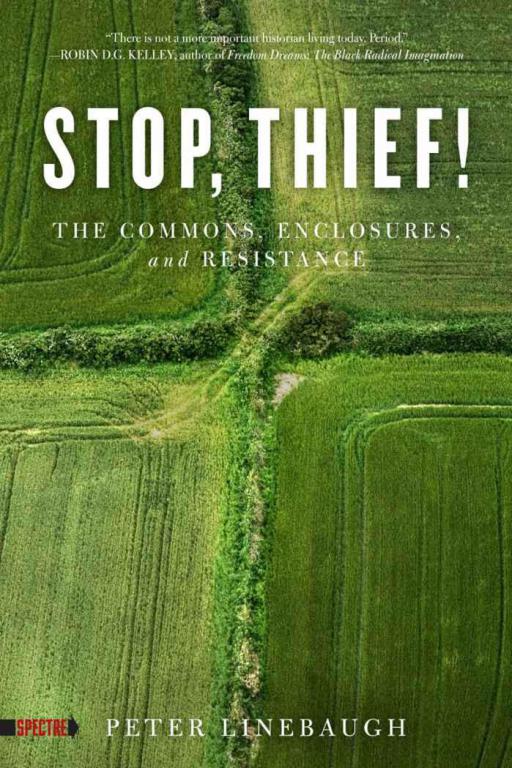
Cover of Stop Thief! by Peter Linebaugh

That was the context back in the ’60s, this demonization of African American people, and the man who showed that to me and has showed it to the world as being a phony, slanderous labelling was Malcolm X, Malcolm Little, who himself had been a criminal, a burglar, who did time in prison and who learned in prison in the late 1940s, perhaps from Wobbly teachers in the Massachusetts prison. Anyway, over the years, he begins to turn the tables. So, all you have to do is see what he does and then do it yourself. And I wasn’t the only one, like the other historians. I’m trying to say that my knowledge came out of the movement. What I learned was already being put into practice by the African American working class in the USA. And of course it’s worldwide.

You in Ireland would know it, like in South Africa or India, the different forms of humiliation and degradation which the ruling class always uses, whether it has to do with table manners or whether it has to do with racism, whether it has to do with educational opportunities or living conditions. People from colonial settings learn how to be compliant and how to have that double consciousness, of how to get along with the man, how to get along with authority on the one hand and on the other hand it’s ‘save yourself’, to have some kind of dignity, some kind of solidarity with others who suffer. So taking that quatrain that you quoted: the law locks up the man or woman who steals the goose from off the common but lets the greater villain loose who steels the common from the goose. There’s a story in there that Foucault told us about the carceral society but also in there is the story of Malcolm X, the story of how the prison can become the university of liberation. This happened of course with H-Block in Ireland.

The ruling class will always try to criminalize its opponents and when it comes to property or to subsistence life, then it gets very desperate, and then the famine, early death, morbidity arises. But in Red Round Globe Hot Burning, I got two chapters at least about the criminalization of the commons. Usually we think of the commons in rural or agrarian settings or settings of the woodlands or wetlands or pasture but what these two chapters try to help us see is that the so-called criminality in the city is also like a form of opposition to enclosure, forms of opposition that are analogous to the estovers, the pannage, the herbage, the agistments, these old concepts of the agrarian commons. So that’s what I was trying to do.

Johnny Flynn: You were talking about getting radicalized in prison. I love your idea that maybe Thomas Spence met Edward Despard in prison. I was thinking about that for ages afterwards, just imagining the two of them meeting in prison, because Spence was imprisoned at the same time as the Mutineers or the 1797 naval mutiny. And weren’t the United Irish involved in it?

Peter Linebaugh: Yeah, Valentine Joyce.

Edward Despard and Thomas Spence

Johnny Flynn: When they were in prison, Despard was in prison then as well, wasn’t he? Was he locked up?

Peter Linebaugh: He was locked up in those cells in the Clerkenwell or the Stille. They called it the Bastille or the Stille for short. But Despard also had been in Shrewsbury Prison, another new prison, and his life was a time of prison construction. I think Spence had been there in Shrewsbury Prison, or I know he was, but I’ve wrote the Shrewsbury Record Office because I didn’t have the wherewithal to make a personal visit, because you’re always dependent on the generosity of the archivist as a historian, but they couldn’t date an overlap between Spence and Despard in Shrewsbury Prison. But that’s kind of a vain search, you know, Johnny? They wouldn’t know about each other. Like I never met Malcolm X even though he taught me, you know what I mean? Certainly, there would be plenty of songs that Despard would know.

And I think Spence was very expressive and Despard was not. Despard didn’t write much. Spence wrote quite a bit. That was his method of communication. That, then chalking and music. Despard was a military man. He was a leader and could see many different forces at play at once. He saw the city as a target, as an insurrectionist. He’s more like Auguste Blanqui in French revolutionary history. I don’t know Irish politics well enough to know in the Republican tradition who are those who are most apt to go for another Easter Rising, of just attacking, say, the post office as a first step. But Despard certainly had a tradition of this. He was a skilled artilleryman because of his knowledge of geometry, but he was good at: ‘Where do you put a cannon? What do you point it at? How do you get it there?’ This is largely a question of organizing livestock and human beings to move ordinance around. That’s a big job of labour. And so he in a way was a manager, you know what I mean? We have to look at his life, what he was trained at doing. Then, when he’s jailed in prison all through the 1790s in one prison after another, Newgate, Shrewsbury, the Tower, the Coldbath, Stille and several others, he meets a lot of people and they want to shut him up. They want to prevent him from getting food. They want to make sure that there’s no glass in his windows. They want to make sure that the door doesn’t go down to the floor, so that wind and snow and rain can flood his cell. They want to work on his malaria and see him perish.

Peter Linebaugh: That’s where Kate is so helpful in organizing not just her alone but the relatives, the wives, the women of other political prisoners. They formed support groups, and I think as you emphasise in a review you wrote, she was intrepid.

Johnny Flynn: She put the fear of God in them.

Peter Linebaugh: She did. Horatio Nelson, she’d speak back to him. These people lived in fear of this woman’s tongue and of her righteousness, quoting her in parliament and also trying to subvert her by saying a black person could not write good grammar.

Johnny Flynn: That they were too well written or something.

Peter Linebaugh: When they say, ‘Oh, public schooling,’ what they mean is, ‘You’ve got to come and learn the way we spell, the way we think, the way we write.’ Anyway, there she is, helping to write his last speech at the gallows.

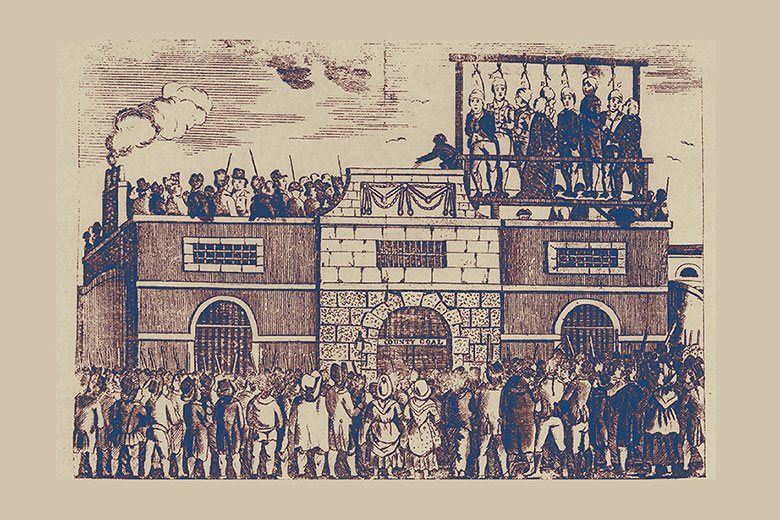
Mass hanging Horsemonger Lane jail of Edward Despard and others
The mass hanging at Horsemonger Lane jail of Edward Despard and other radicals

Johnny Flynn: That speech at the gallows, that’s a good speech. I like that one. She probably must have written the bulk of that, as he doesn’t seem to be the man of words, was he?

Peter Linebaugh: I think he learned that you want to put things in threes.

Johnny Flynn: I love your rumination at the end of the book, ‘What is the human race?’ You end the book with these real bravura chapters, it’s like the red crested bird and the black duck. Allegorical kinds of interesting mise en scene, like the guy who decided he was sick of urban life and went over to live with a Native American and has come back and is telling this story, and how you connected that story with the Irish and the Native Americans. It’s a fascinating chapter, that one. And then ‘what is the human race?’ is brilliant way to end the book because it brings all the themes together.

Peter Linebaugh: Well, the Irish defeat in 1798 meant a lot. Thomas Jefferson would not have been elected president without the effort of former United Irishmen, who were editors of newspapers in South Carolina, North Carolina. The splendid historian of Ireland taught me that.

Johnny Flynn: Who is that, Kevin Whelan?

Peter Linebaugh: This book could not have been written without the writings of very fine Irish scholars and historians and poets, especially from the Field Day tendency. Kevin Whelan is a big part of it and I was very grateful to him and others who invited me to Ireland at the time of the Good Friday Agreement and we had a grand meeting on the commemoration, the bicentennial of the 1798 rebellion. So I really want to thank them very much. And also Patrick Bresnahan at Maynooth who wrote an appreciation of Red Round Globe Hot Burning in the journal Antipode.

We let a point slide by that I want to return to, which was Catherine Despard was active in preventing the foundation of a panopticon. I just wanted to emphasize that. That was one of Jeremy Bentham’s favourite projects.

Johnny Flynn: I’ve one last question, which is about the Diggers and Winstanley and, ‘the earth is a common treasury for all’. If I understand your book correctly, Winstanley and the Diggers, True Levellers, the Ranters, they come from an earlier tradition as well, like maybe Wat Tyler? And the message from the English Revolution, the radical message, stays alive. So when Edward Despard is accused by the prosecutor, Lord Ellenborough, of being a Leveller, of believing in this equality, this terrible stuff. This is Winstanley’s message back again. It’s come back through Edward Despard and his revolutionary conspiracy essentially. It’s gone around the Atlantic and it’s come back as this conspiracy to restore the commons.

Peter Linebaugh: And Despard is only one of the vectors. There are many others.

Johnny Flynn: It’s fascinating that, like you said in the book, that stories help keep alive the memory of defeats or help us understand defeats, and I think your book kind of does that. If you took your book as a story, it pieces together all these things and all the different things happening at the time and it helps us make sense of defeats, but defeats aren’t the end of the story. In the twenty-first century we could still restore the commons, you know?

Peter Linebaugh: I think the crossroads isn’t something that just happened back then. It’s still here, and the alternatives are for us to revive.

Peter Linebaugh in conversation with Johnny Flynn of Independent Left

Filed Under: Reviews

Socialists and Scottish Independence

17/10/2020 by Colm Breathnach 6 Comments

Socialists and Scottish Independence
What should socialists say about the movement for Scottish Independence?

Socialists support Scottish independence because it would create better conditions for short-term working-class victories and the long-term struggle for socialism. It would also herald the end of the imperialist British state. Socialists support the right of self-determination – in this case the right of the people of Scotland –  to decide their own future democratically.

The left and Scottish Independence

Over time, the left’s position on Scottish independence has evolved. Originally the Labour movement in Scotland favoured Home Rule (limited self-government within the British empire), though this morphed later into a strong commitment to an exclusively British, parliamentary reformism. The source of this Labour unionism lay in a gradual integration into and acceptance of the imperial British state, as well as suspicion of an originally rural based and conservative Scottish nationalism. 

Scottish Labour, fatally weakened by corrupt urban boss politics, Blair’s neoliberal turn, and the failure of Corbyn’s final iteration of the British road to socialism, seems to be entering its final stage of disintegration. Even its left flays about helplessly, claiming to respect the democratic right of self-determination while opposing another independence referendum, crouching on the shoreline while a huge progressive national independence movement flows by. Only a decisive turn to independence could have saved Scottish Labour but it is too late for that now.

John Maclean was a Scottish socialist in favour of independence
John Maclean (1879 – 1923) was a Scottish revolutionary socialist who was in favour of independence for Scotland

Although some early revolutionary socialists, such as the legendary John Mclean, advocated independence, this was a minority position until the turn of the twenty-first century when, mainly grouped in the broad-left Scottish Socialist Party, the radical left took a strong stance in favour of independence. Today, almost all of the Scottish radical left is pro-independence, a view shared by most of the radical left in the rest of the UK.

Why Scottish Independence matters for Socialists

There is no possibility of radical reform, not to mention revolutionary transformation, within the British state. If there was any doubt about that, the defeat of the Corbyn project has shut that door decisively. The archaic mixture of feudal left-overs, undemocratic political structures, powerful security services etc., that constitute the British state, mean that a decisive break with it would open up huge possibilities for the working class in Scotland. From the start, the terrain would be different given the class structure, political culture and dominant trends in pro-independence ideology in the new Scotland.

In an independent Scotland, a struggle for democracy would be on the table from day one: with the issues of constitution, monarchy, membership of NATO and the EU all now open for real debate. The shape of the new state’s economy, the abolition of anti-trade union laws etc, would also come to the fore. And all this in the favourable context of a weak new-born capitalist class and a dominant political party, the Scottish National Party, that has thrived on signalling left but would have to face the challenge of having to live up to those signals. It would be foolish to think that independence would immediately give birth to a Scottish Socialist Republic but the struggle for that goal would be greatly strengthened in the context of the breakup of Britain.

What we are currently witnessing is the end of the long arc of the British state from its origins in medieval expansion, Tudor conquests of Ireland, and the union of Scotland and England (and later Ireland).  The birth and rise of the UK, an imperial state, from the seventeenth century onwards, was intimately linked to the emergence of capitalism and imperialism. The decline and fall of British Empire has gradually opened the fault lines in the British state itself. Future historians will view the current crises of that state as heralding the end of the process: the final breakup of the UK. Scottish independence would be a severe blow to the British ruling class, the last pulses of British imperialism and, in Northern Ireland and Scotland, to the the sectarian reactionaries of loyalism.

The Irish and more recently Scottish struggle for self-determination has developed in a dialectic relationship with the fall of the British Empire and decline of the British state: the long view of history will reveal that the loss of southern Ireland and the loss of Scotland book-ended the British Empire from zenith to nadir. So central was imperial expansion to the creation and sustenance of the British state and British capitalism, that with the end of the Empire and consequent gradual loss of world power status the crisis of the core was inevitable. Socialists welcome the end to this former pillar of global capitalism and imperialism, whose demise will open up opportunities for potentially transformative social and political struggles.

A British Working Class?

Some on the left are animated by a fantasy of ‘the British working class’ but if the workers of these islands ever shared a broad identity, it certainly no longer does. The objective fact is that the only section of the working class in Scotland who now strongly identify with Britishness are a shrinking loyalist rump. In any case, internationalism does not require a certain configuration of states. Breaking up a state does not break up the links of class solidarity. It is in the interests of the working class of all of these islands to break up the British state. In this context, the myth of a large anti-English element in the Scottish independence movement must be challenged: it is simply empirically incorrect.  Certainly, a tiny element of anti-English fanatics do exist but they are an embarrassment to the movement as a whole and unrepresentative in the extreme. Anti-Englishness plays no role in the main movement, even its more populist pole. In fact, the number of English people living in Scotland who support independence is significant and even finds an organised expression. 

Socialists and the struggle for Scottish Independence

Socialists do not advocate independence for Scotland on the basis of subsuming their struggle under the leadership of the SNP nor on the basis of an independence first, socialism later. These arguments are made, not by socialists but by those nationalists who berate socialists for daring to raise radical demands or stand in elections or work independently during the independence struggle. Socialists are well aware of the balance needed to advance within the broad movement while maintaining distinctive socialist positions.  This is not rocket science: socialists in different contexts have always grappled with this challenge in national and democratic struggles, that of supporting all those fighting oppression while developing socialist tactics to bring the movement forward.

The united front is the classic formula that applies here: in the broader independence movement there are thousands of working class activists who see themselves as socialist (even within the SNP) who revolutionary socialists can work with to advance independence and also our own radical agenda. The facts speak for themselves: during the 2014 Scottish independence referendum this interaction between socialists and independence for Scotland was managed very successfully through the Radical Independence Campaign, which caught the SNP and official Yes campaign off-guard by focussing on radical democratic and socialist demands and which mobilised thousands of activists.

The Radical Independence Campaign moved the whole discourse of the pro-independence campaign to the left and was instrumental in the massive shift in urban working class opinion towards Yes through its targeted voter registration and canvassing in the large urban working class areas. Far from being won over by atavistic nationalism, a gradual shift of working-class opinion arose out of the arguments that the left made linking the struggle for equality and social justice to the opening that independence would provide. It is no coincidence that the only regions that voted for independence in 2014 were the great working-class heartlands of the greater Glasgow region and Dundee.

Scottish Socialist Party were in favour of Independence
The Scottish Socialist Party were in favour of Scottish Independence in the referendum of 2014

Like any movement for national independence there are number of overlapping tendencies in the Scottish independence movement, reflecting its broad social base. At its centre are the bourgeois nationalists of the SNP leadership and its allies. In ideological terms these people are social liberals and they represent the interests of the incipient independent Scottish ruling class: a potential national capitalist class composed mainly of medium and small business in addition to elements of the devolved state bureaucracy etc. Increasingly strident are the nationalist populists, a disparate grouping that includes in its ranks followers of former SNP leader Alex Salmond and disgraced former socialist leader Tommy Sheridan, as well as right-wingers associated with the Wings Over Scotland blog: heavy of Braveheart style symbolism veering towards simplistic romantic nationalism.

The populist Scottish nationalists have played a key role in mobilising the huge pro-independence demonstrations of recent years, which, while demonstrating the growing popularity of independence, have no real strategic or tactical goals. To the left is an influential, though disparate, wing of the movement ranging from Marxists to social democrats.  This left, numbering in thousands, include many new SNP members who identify as socialists, the Scottish Greens, ex-Labour activists, those involved in activist websites such as Bella Caledonia, as well as the radical left grouped around the Radical Independence Campaign and in the small revolutionary socialist organisations.

Scottish Independence as a Stage on the road to socialism?

Stages theory, with its origins in Stalinist strategies for national liberation, theorises that socialists should confine their demands and actions to winning the immediate goal of national independence, then proceed with a national democratic revolution, until moving on to the final goal of socialism. In practice, the application of this approach has often had disastrous consequences as socialists subordinate themselves to bourgeois nationalist movements and often end up as mere left-mudguards to corrupt, neo-liberal formations, as has happened to orthodox communist parties in South Africa and various Middle Eastern states.  But the alternative to this discredited theory is not to withdraw from democratic struggles but to engage in the struggle for self-determination without subordinating to bourgeois nationalism and without ceasing to engage in class struggle: all the while pushing revolutionary demands.

No radical group in Scotland has called a truce with the forces of bourgeois nationalism, none have suspended their activism on all the other issues that affect working class. In fact, the pro-independence left is to the forefront of all the major social struggles in Scotland today: whether it be the organisation of low-paid workers, land reform or renters rights. No one on the radical left is arguing that we suspend our criticisms or activities until independence is achieved, we know full well that if we did this socialists would have no credibility when we belatedly raised our red flag on the day after independence. 

The amazing case of invisible British nationalism

There are two nationalisms operating in Scotland: the reactionary but dominant one seems strangely invisible to many commentators.  Unfortunately, it is not unusual for liberals and even some on the left, to see all the flaws of small-nation nationalism but to be oblivious for the monstrous elephant in the room, imperial nationalism.  While modern Scottish nationalism cleaves to a decidedly non-ethnic civic version of what defines a country, British nationalism is racist and reactionary to its core.  It is no coincidence that the far-right are the most virulent opponents of independence, embedded in the sectarian loyalist sub-culture of west of Scotland, allied, of course, to the Conservative Party and their rear-guard of alt-right fan-boys spewing the usual trail of vitriol, much of it aimed at the SNPs government’s tame pro-LGBT/anti-racist policies.

The ‘celebration’ in Glasgow’s Georges Square, by far-right loyalist thugs the night after the referendum in 2014 graphically displayed the real nature of British nationalism in Scotland. Ironically right-wingers and their new ally, the former Labour MP George Galloway, are now demanding that all Scots, regardless of their place of residence in the UK, should have a vote in any future referendum, therefore wielding ethnic definitions of Scottishness in the cause of the preservation of the imperial state, in contrast to the demand of the pro-independence movement that all those living in Scotland regardless of origin or nationality have a vote.

Of course, central state nationalism usually reflects the interests of the ruling class of that state. Any socialists in doubt about the progressive nature of the struggle for independence only have to look at the positions taken by the British ruling class which is firmly opposed to independence. This is the class that pulled out all the stops to oppose independence during the 2014 referendum, explicitly threatening a flow of capital out of the country, in a classic move that ruling classes deploy when faced with a major threat to their interests.  The monarchy, security services, banks, big business, have all lined up clearly to oppose independence. Why such a clear and open position?  Because their interests are intimately linked to the structures of the British state and independence would destabilise that state decisively.  Of course, there is also control of Scotland’s oil and gas and the ownership of vast swathes of the Scottish countryside, but the key here is the threat to the central state. The British ruling class had no direct economic interest in Northern Ireland yet they engaged in a bloody thirty year conflict because of the kick-back that would ensue if they ‘lost’ that territory to a united Ireland. And now, they correctly perceive that the loss of Scotland would herald the end of the United Kingdom destabilising their rule even in the metropolitan core.

Eyes on the Prize of Socialism and Scottish Independence

Since the surprisingly narrow victory of the ‘No’ vote in the 2014 referendum, the demand for independence has grown rather than faded. The question of when exactly a new referendum should be held is one of tactics: optimising the chances of winning and wrong-footing any attempt of the state repression. But as support for independence soars (especially amongst the working class and youth) in the face of the most right-wing government in decades, whose disastrous response to the Covid pandemic and desire to reshape the British state radically in the mould of Viktor Orbán’s illiberal democracy, the democratic demand for the right of all the people of Scotland to decide their future now rises with renewed urgency.

Some socialists daydream of fantasy battles where they lead the massed ranks of the working class against forces of capitalism in an apocalyptic final conflict. Marxists eschew such millenarian thinking; instead they plunge into the messy battles that confront us in real life. In fact, here, Marx’s position on the democratic struggles of his time are instructive. Imagine Marx instructing socialists not to engage in the great democratic struggles of 1848, because these primarily entailed the immediate demand for democratic republics? Imagine Marx opposing the struggle foor Irish freedom on the grounds that it would disunite the working class of the UK? Marx analysed conflicts carefully, identified the most progressive outcome and advocated socialist engagement without proposing subordination to bourgeois forces. Hence, he saw the victory of the capitalist North in the American Civil War as a progressive outcome but he did not confine his demands to a simple support for the North: he, along with many other socialists and trade unionists, galvanised English industrial workers to support the North on the basis of the most daring positions: solidarity with ‘labour in a black skin’!  In the same way, socialists in Scotland today have thrown themselves into the battle for independence with their eyes wide open, refusing to lower, even temporarily, the banner of socialism, putting the demands for working class interests at the centre of that struggle.  As that struggle speeds towards a decisive vote for Scottish independence, socialists are keeping their eyes on the prize.

Independence for Scotland may be the end of the struggle for nationalists, but it is only the beginning for socialists.

Supreme Court Judgement on Scottish Independence Referendum

On 23 November 2022, the UK Supreme Court ruled that an independence referendum is illegal unless it is expressly approved by Westminster, a decision that was received with predictable gloating by the forces of unionism.  Some on the pro-independence side, especially the social liberals of the SNP leadership, seemed surprised at the decision, perhaps because of a misplaced trust in certain institutions of the British state, such as the judiciary or civil service.  But despite a qualitative difference between institutions of British bourgeois democracy – which are populated by those committed to the rule of law, separation of powers etc. – and those in the Tory Party, right-wing media etc. who believe that they can dispense with such niceties and reconstruct the British state on more Orbanesque lines, the fact is that an institution that broadly serves the interests of the ruling class made a very unsurprising decision to defend the interests of that class.  After Camron’s miscalculation that a referendum would put the issue of independence to bed permanently, the establishment has learned not to take any unnecessary risks. The simple fact is that the British ruling class can and will refuse to provide any routeway to holding a referendum.

While one can’t rule out the possibility entirely, a legal way out now seems nigh impossible.  The SNP’s leadership’s strategy of using legal manoeuvres has manifestly failed.  The latest constitutional gambit, to treat the next general election as a referendum and a SNP/Green majority as a mandate for independence will run into the same roadblock; the British state will simply refuse to accept this or any other legal/electoral manoeuvre. 

So what of the unilateralist propositions of an “illegal” referendum organised by the Scottish Government or even full-scale UDI.  These are largely the fantasies of the ultra-nationalists of the Alba Party: the product of existing in a political bubble that has no real connection with the mass of people, but also a naïve underestimation of the coercive abilities of the British state and its security apparatus.  These fantasies go down well in an online world of saltire emoji’s and hero worship of an  assortment of discredited politicians and cranks such as Salmond, Tommy Sheridan and Craig Murray, but they just don’t wash amongst the general public, even those who constitute the 45-50% of Scots who generally support independence.

Socialists and Scottish Independence Bin workers strike 2022 Glasgow,Scotland
Glasgow, Scotland, 28 August 2022: a strike against low pay by bin workers in Unite, Unison and GMB quickly takes effect.

So there is no easy way forward but the anger generated by a number of factors may serve to open a new route for socialists and Scottish independence.  Firstly, the deeply undemocratic nature of the British State and the lie of a “voluntary union” are now plain to see.  Second, that relying on the SNP and its cautious social liberal leadership to pull a rabbit out of the hat at the last minute is just not a viable strategy anymore.  Building on that reality, a combination of developments could renew a viable mass movement that takes the initiative, forcing the British state into a choice of retreat or full-scale coercion. The impact of the cost-of-living crisis is already evident in the growing wave of strikes across Scotland, but as people feel the full force of the crisis there is the potential for a full scale mass movement, which could dovetail with demands for independence. 

Glimmers of renewal on the pro-independence left might form the basis for the possible merging of these currents.  The unionist left is entirely bereft of influence, withdrawing into a doomed struggle to transform Starmer’s New-New Labour back into Corbyn’s Bennite project.  On the pro-independence side, the old Radical Independence Campaign leadership, that played such a positive role in 2014, has drifted increasingly rightward into Spiked-style “anti-wokeism”, campism etc. The stage is now open for more radical and democratic elements such as the reconstituted RIC, the Republican Socialist Platform and Socialists for Independence to step into the gap.  The existence of these open, democratic, groups could herald a renewal of the pro-independence left, a renewed left that might just drive that linkage between the popular struggle for independence and the overflowing anger against the absolute failure of the British State (and the capitalist social system in general) to meet the most basic needs of workers.

FAQ

Do Socialists support Scottish Independence?

Yes, almost all radical socialists, greens, feminists, LGBTQ, anti-racists etc. support Scottish Independence while all of the far-right and centre-right oppose it.

Why do Scottish Socialists support Independence?

Because it will end the imperial British state and advance the struggle for socialism in Scotland.

Who would gain the most from Scottish Independence?

The Scottish working class: strengthening its ability to win short term gains, while decisively tilting the position of class forces in Scotland in its favour.

Filed Under: Independent Left Policies

The Kilmichael Ambush

15/10/2020 by Conor Kostick 16 Comments

Tom Barry leader of the Flying Column, Cork III Brigade.
Tom Barry planned and carried out the Kilmichael Ambush

The Kilmichael Ambush took place on 28 November 1920, when Tom Barry, Commandant of the Third West Cork Flying Column, led his Irish Republican Army unit into battle against two lorries, each carrying ‘Auxiliaries’, veteran soldiers especially recruited to support the police and organise reprisals against the Irish national movement. The ambush was a major victory for the IRA.

Background to the Kilmichael Ambush

In November 1920, the War of Independence between the Irish national movement and the British authorities was at its height. Determined not to make any concessions in Ireland, partly for fear of the consequences for the rest of the empire, the British Cabinet had embarked on a policy of repression and intimidation. From 25 March 1920 a new military force, the ‘Black and Tans’ (called after the colour of their uniform) began to arrive in Ireland and their aim, as the Police Journal put it, was to make Ireland ‘an appropriate hell for rebels’.

Burning property, torturing suspects and assassinating whoever they chose without fear of legal consequence after the Restoration of Order in Ireland Act of August 1920, the Black and Tans attempted to crush the daily acts of resistance by Irish nationalists. The police were also supplemented by a 1,500 strong Auxiliary Division of soldiers, known as the ‘Auxies’, who were recruited from officers who had been in the Great War and who from August 1920 took the lead in attacks on suspected nationalists.

Yet despite the violence of the policy of reprisals, the national movement continued to undermine British rule. Everywhere, British courts, centres of administration and barracks were being boycotted in favour of Dáil Eireann, a new parliament for Ireland created by 73 Sinn Féin TDs elected in 1918. Mass strikes forced the release of political prisoners and protested the imposition of military rule. Dockers and railworkers refused to unload ships or move trains with military personnel or equipment.  And the Irish Republican Army – Volunteers now recognised and organised as the official troops of the Dáil – began to arm and strike back.

In the month before the Kilmichael Ambush, eighteen-year-old Kevin Barry had been hung in Mountjoy Jail, leading to huge popular anger and dismay, while on 21 November 1920, ‘Bloody Sunday’ had seen fourteen British agents shot dead by Michael Collins’s intelligence group. In reprisal, British troops went to Croke Park and fired on the crowd and players, also killing fourteen people. In Dublin castle, three prisoners were beaten and killed.

Preparing the IRA for the Kilmichael Ambush

From about the end of September 1920, the Cork III Brigade of the IRA had been operating a ‘flying column’. This was a full-time unit that was prepared to remain under arms and travel considerable distances, unlike the more typical IRA company, which mobilised for a task but then returned to civilian life when the mission was over. On 21 November 1920 a meeting of the Brigade Council took place with representatives from all the battalions. There it was decided to put the flying column on a regular footing with Tom Barry as Officer Commanding. The new Flying Column assembled at Clogher, Dunmanway, with an empty house for its headquarters. There, the thirty men received training from Tom Barry, although lack of ammunition meant they could only fire three rounds each. Three days training was all the preparation the unit obtained before facing into battle.

Tom Barry was only twenty-three at the time of the Kilmichael Ambush. But then, most of his men were in their 20s. When they were joined at the ambush point by Cornelius Cotter of Curradringagh, Cotter was much the oldest at 39. Although young, Barry had been in the Great War and until radicalised by news of the Easter Rising of 1916, had not considered himself to be in any way political. He did, however, see active service in Turkey and Egypt before his discharge on 7 April 1919.

The Cork III Brigade Flying Column had rifles from two sources. On 17 November 1919, Maurice Donegan, O/C 5th Battalion, Cork III Brigade had organised a successful raid on a British Naval Motor Launch in Bantry, through which he had obtained ten rifles, ten revolvers and plenty of ammunition. He reckoned that, ‘without them the Kilmichael Ambush could not have been carried out in the following year.’ Another cache of rifles came from the Volunteers of the post-1913 period. Denis McCullough, IRB Supreme Council, recalled how the Ancient Order of Hibernians had seized control of Volunteer rifles in Belfast,

… and hid them in the pavilion in Celtic Association Football Club grounds. They remained there for a long time, but sometime about 1919/20, the IRA traced their hiding place, raided Celtic Park, recovered the guns and sent them back to Dublin. I gather from Frank Thornton that they eventually were brought to Cork and were in use at the famous ambush in Kilmichael and other engagements in the West Cork area, where they were used to good effect.

A Mills bomb was used at the Kilmichael Ambush
The Kilmichael Ambush began with Tom Barry throwing a ‘Mills bomb’, a popular grenade used by the British army.

Each member of the flying column had 35 rounds of ammunition and in addition, the unit had two ‘Mills bombs’, i.e. hand grenades with an effective range of about 15 metres.

Setting off for the ambush

The local Auxiliaries had made Macroom Castle their base and IRA intelligence noted that on four successive Sundays two lorry-loads of Auxiliaries had travelled from Macroom to Gloun Cross, after which they varied their journeys. It seemed possible to plan an ambush of these lorries, provided the vehicles were intercepted north of Gloun Cross.

Location of the Kilmichael Ambush with respect to Cork
Location of the Kilmichael Ambush site, south of Macroom, west of Cork

The problem was that the deforested landscape made it impossible to find a spot sufficiently far from Macroom Castle that had any realistic line of retreat. Vice Commandant of the flying column, Michael McCarthy, and Tom Barry therefore picked an ambush position that gave a fair chance of victory in a battle that was likely to be a fight to the death. It was a stretch of road near Kilmichael where a couple of sharp turns in the road would help with slowing the lorries and some sizeable rocky outcrops provided cover near the road.

On the night of Saturday 27 November the IRA men gave their confessions to Canon O’Connell, P.P., Ballineen, who arrived for that purpose. The priest wished the men luck and referred to their being ‘in the middle of the Sassenachs’, that is, in an area heavily occupied by imperial forces.  Very early, around 2 a.m. under a sleet-filled night sky, on Sunday, 28 November 1920, Barry paraded the men and then led them towards the Kilmichael Ambush, avoiding all houses on the way and skirting junctions.

The Flying Column deploys at the ambush spot near Kilmichael

Having walked through the night and wet weather for over five hours and nearing their destination, it was discovered that fifteen-year-old signals Lieutenant Pat Deasy had followed the column. Although Pat was ordered home, his appeals, fatally, won through and he was placed in the company of Michael McCarthy.

Map of IRA deployment at the Kilmichael Ambush
A map of the Kilmichael Ambush, showing IRA positions and those of the lorries of the Auxiliaries

Parading the men, Barry gave a speech about the importance of the battle to come. The Auxiliaries had been built up in British propaganda as undefeatable. This would be the first encounter between Auxiliaries and the IRA and for the sake of the whole nation, they had to win. It would be a fight to the end, the landscape did not permit retreat. With that, the flying column deployed in three sections for the ambush. At the east end of the road was Section 1, under the command of Barry. Their big challenge was to slow the enemy lorries so that rifle fire and possibly a Mills bomb would be effective in stopping the first vehicle. Since they had no land mines, Barry decided on a tactic that was highly risky for him personally, which was to simply stand on the road while wearing an IRA officer’s tunic and field equipment, which he had borrowed from Patrick O’Brien, Adjutant 3rd (Dunmanway) Battalion, Cork III Brigade. Surely, if only out of curiosity, the lorry would brake to examine such an unfamiliar sight? The rest of Section 1 were close to Barry, hidden behind a narrow stone wall which jutted out as far as the road.

IRA officer uniform as worn by Tom Barry at the Kilmichael Ambush
IRA officer uniform of the type worn by Tom Barry at the Kilmichael Ambush to cause the lorries of the Auxiliaries to slow down when approaching him.

Section 2 were to deal with the second lorry. They took up positions near to the road on the north side, but had to spread out in case the second vehicle did not come around the corner. The east end of this position was to witness the heaviest exchanges of fire and it was just as well that Jack Hennessy, Adjutant of Ballineen Company and Section Leader, of the Flying Column took measures to improve the natural cover.

My particular position was on a clump of rocks overlooking the road, but there was no protection on either side. We were in position at 8 a.m. and I built a wall of dry stones around our position and covered the stones with heath. This gave us a box to fight from in case the Auxies made an attempt to surround us if anything went wrong with our attack.

A third section was placed on the south side of the road, which was essential to ensure that as the Auxiliaries entered the Kilmichael Ambush they were caught in a cross-fire and would find it hard to obtain cover.

Having learned about the ambush, at 9 a.m. John Lordan, vice Officer-Commanding of the Bandon Battalion arrived with his rifle and was warmly welcomed by Tom Barry, being assigned to No. 2 section. With local Cornelius Cotter present with his side-by-side double barrel shotgun and assigned to Section 1, and with young Pat Deasy the ambush party was 34 strong.

All day long, the IRA soldiers lay in cover in the cold, damp air. No provision had been made for a supply of food, although nearby was a poor farming family whose girls brought the men a bucket of tea and shared what little bread they themselves had. Finally, as dusk was spreading over the wintery sky, between 4 p.m. and 5 p.m., there came almost simultaneously two sounds: that of a horse drawn cart and the distant rumble of lorries.

In the cart were five armed Volunteers who were replacements for the Flying Column from companies who had rotated their contribution to the column in order to share the experience of training. Shouting, ‘get them off the road. Gallop up the passageway. The Auxies are here. Keep galloping,’ a disaster was narrowly averted by a matter of seconds. After all the painful, freezing and starving hours of waiting, the ambush could have fallen apart had the Auxiliaries come across these IRA men prematurely.

The galloping horse took the late arrivals down the passage past the house at the western end of the ambush position, where they dismounted too late to participate in the battle. No sooner had these soldiers moved off the roadway when the first of two lorries came around the corner.

In 1946 the Irish army re-enacted the Kilmichael Ambush
In 1946 the Irish army re-enacted the Kilmichael Ambush at the exact site

The Fighting at the Kilmichael Ambush 28 November 1920

Merry and singing, the officers of the British army who had been gathered together at very high rates of pay to smash the Irish national movement were indeed curious as they saw a lone figure in uniform on the dusky road. The first lorry slowed down to a crawl at fifty yards from Barry, still edging towards him. Whistle in mouth, finger of the pin of his Mills bomb, Barry waited until the vehicle was thirty-five yards away. This was a long distance for the bomb, but there was a generous size of target, the uncovered cabin area of the lorry behind the windshield, and to wait for an even closer target was to risk the enemy acting first. He pulled the pin, threw the bomb and drew his automatic, the first shot of which signalled everyone else to open fire.

With a stunning explosion, the grenade landed perfectly beside the driver, killing him and another Auxiliary, probably District Inspector Francis Crake, the commanding officer. The lorry continued to roll on to within a few yards of Section 1 who had leapt into the road and were all firing furiously. The seven Auxiliaries in the back scrambled out and did their best to return fire but in a matter of minutes were all dead or wounded.

Witnessing the battle ahead and under fire himself, the driver of the second lorry tried to reverse but got stuck. The Auxiliaries in the vehicle threw themselves from it and began to return fire toward the rocks from where Section 2 were based. This exchange lasted some time, for one participant it felt like twenty minutes, although in reality it was probably more like ten.

Jack Hennessy was in the centre of the storm.

I was wearing a tin hat. I had fired about ten rounds and had got five bullets through the hat when the sixth bullet wounded me in the scalp. Vice Comdt. McCarthy had got a bullet through the head and lay dead. I continued to load and fire but the blood dripping from my forehead fouled the breach of my rifle. I dropped my rifle and took M McCarthy’s. Many of the Auxies lay on the road dead or dying. Our orders were to fix bayonets and charge on to the road when we heard three blasts of the O/C’s whistle. I heard the three blasts and got up from my position, shouting ‘hands up’. At the same time, one of the Auxies about five yards from me drew his revolver. He had thrown down his rifle. I pulled on him and shot him dead. I got back to cover, where I remained for a few minutes firing at living and dead Auxies on the road.

The battle was won when Barry and the rest of Section 1 reloaded as fast as they could, or picked up rifles and ammunition from the dead Auxiliaries around their lorry and then hurried along the road to within close range of the second lorry. Once these IRA men were able to open fire, the position of the Auxiliaries was hopeless and several of the British ex-officers shouted that they surrendered, throwing away their rifles. This was the moment Barry blew his whistle three times, summoning everyone to the road. But the fighting was not, in fact, at an end. Pulling revolvers, some of the Auxiliaries who had surrendered started shooting again, wounding two IRA men, including young Pat Deasy who had stood up at the whistle and took a bullet through his stomach.

Merciless now, Barry ordered an all-out attack and the Section 1 men continued to advance, shooting as they did so, until within ten yards of the last of the Auxiliaries to be killed. Then, in the silence, Barry blew his whistle again.

Jack Hennessy came down to the road with justified caution.

When I reached the road a wounded Auxie moved his hand towards his revolver. I put my bayonet through him under the ribs. Another Auxie tried to pull on John Lordan, who was too near to use his bayonet and he struct the Auxie with the butt of his rifle. The butt broke on the Auxie’s skull.

Seventeen of the eighteen Auxiliaries killed

As the members of the flying column dragged the corpses of their enemies into the road and searched them, the driver of the second lorry escaped. He had been hiding under the lorry and choose this moment to make a run for it. He chose well and despite being fired upon, escaped into the deepening gloom. Michael O’Driscoll, Coomhoola Company, 5th Battalion Cork III Brigade saw him making off across country.

I fired a couple of shots at him before realising that my sights were down. When I had my sights right, he had got into cover among some cattle and I lost him.

Unfortunately for the driver of the second lorry, despite an almost miraculous escape from the scene of the ambush, he was later seen at Droumcarra, where he arrived at nightfall. A group of unarmed men sympathetic to the IRA took him on with sticks and found his revolver was empty. Made a prisoner, the Auxiliary driver was handed over to Cornelius Kelleher, Officer Commanding Tarelton Company, Cork I Brigade. He was subsequently executed and buried in Andhala bog. Kelleher had been out riding his biycle with a dispatch for Barry and gone to investigate the ambush scene, witnessing the burning lorries before turning back to assist with the two bodies of the IRA dead and the dying Pat Deasy.

Of the eighteen Auxiliaries to have set off in the two lorries from Macroom Castle that day, seventeen were killed. The only survivor was an Auxiliary so badly injured that he never recovered the use of his limbs.

Having set fire to the lorries, the men of the flying column gathered seventeen rifles and seventeen revolvers, seven or eight Mills bombs, other military equipment and large weight of rifle and revolver ammunition. Perhaps most valuable of all was a sandbag filled with the papers and notebooks that were recovered with detailed information about the British military presence in the locality. As a result, when the column left the scene to march towards their safe house at Granure via Manch Bridge, progress was very slow and it was not until after midnight that they reached their billet, an abandoned cottage. The whole column slept on bundles of straw strewn about the floor after a late meal prepared by members of Ballinacarriga company.

Other IRA men and women from Cuman na mBan assisted the recovery of the flying column by mounting guard and acting as scouts despite the pouring rain. Mary O’Neill (later Walsh), Captain, South Bandon area, Cumann na mBan helped treat the wounded the following day when the column had moved on to Kilbrittain.

After the Kilmichael Ambush a number of the Column came into our area [Kilbrittain Branch] to rest. John Hennessy had a scalp bullet wound which was not dressed for two days. I cleaned and dressed the wound and he remained until it was healed. A Doctor said, later, only for the care he might have been blood poisoned.

Meanwhile the bodies of Michael McCarthy and James O’Sullivan, who had been short during the heavy fighting around the second lorry were taken by cart, with the wounded Pat Deasy to a farmhouse near Castletown-Kinneigh owned by the Buttimer family. At around 10 p.m. the teenager died. Understandably, the Buttimer’s were anxious to get the three bodies out of the house, anticipating that they would be burned out of their home as a reprisal. The corpses were temporarily buried in a bog for three days until they could be properly buried in Castletown-Kinneigh.

A burned out lorry after the Kilmichael Ambush
A burned out lorry in the aftermath of the Kilmichael Ambush

The trauma of warfare

It might be expected that this extraordinary victory led to a sense of triumph among the members of the flying column. Among the wider Irish national movement and internationally among opponents of the British empire it was hugely celebrated. But among the men themselves, the reaction was almost the opposite. And no wonder. All warfare is disgusting and this battle was particularly grim. James O’Sullivan had died when his face was smashed in by a ricochet from the bolt of his rifle. Pat Deasy had bled out in pain for hours. The Auxiliaries had been shot, some at very close range; they had also been bayonetted, or had their brains smashed out. One IRA man had received a mouthful of arterial blood from his enemy. The Auxiliaries had gone down screaming and cursing. Every combatant would have horrific memories for the rest of his life.

As Michael O’Driscoll observed. ‘Some of our men were pretty badly shaken. The fight had been short, sharp and very bloody.’ Tom Barry had noticed the cooling down of the men in the aftermath of the fight and that ‘a few appeared on the point of collapse because of shock.’ He gave orders for drilling and marching, to rally them. But even an experienced veteran like Barry was not immune to the consequences of violently destroying other human beings and his heart trouble in the days that followed might well have been a result of trauma as well as the marching and waiting for hours in the cold and wet.

Far from going on to relish battle, the victorious IRA men of the Kilmichael Ambush were disinclined to go through similar experiences again. Peter Kearney, Lt Battalion Staff (Scouting), 2nd Battalion, Cork I Brigade noted: ‘The 3rd Dunmanway Battalion had been falling away rather badly since the Kilmichael ambush. A number of men out of that battalion had fought at Kilmichael, but the strain had affected their nerves to such an extent that a number of the battalion officers were practically useless from that time on, and no resistance was being shown to the enemy who were very overbearing.’

Very few of the men ever showed any inclination to celebrate the ambush; they did not talk to their families about it and it is noticeable in RTE interviews around the anniversaries how curt they tend to be, as well as somewhat mocking of myth making.

Violence and Revolution: was the Kilmichael Ambush justified?

There is no doubt that the victory of the IRA against the Auxiliaries on 28 November 1920 was a massive blow to the morale not just of the British forces in Ireland but also their hangers-on. It was a justified action in that it contributed to the decline of imperial rule in Ireland. Those nationalists operating secretly within the British administration were able to observe the effect of the IRA’s action at Kilmichael. Liam Archer, a telegraphist at the G.P.O. described how, ‘one night I took a phone call from Auxiliary HQ, Beggars Bush. The Auxie led off with “Oh hell”. I said, “what’s up?” He answered, “my nerves are bad – we are all in a bad way,” and he then gave me the story of Kilmichael.’

Ned Broy, operating for Michael Collins within the police wrote,

During the second half of the year 1920 the Auxiliary force of the R.I.C. began to come into action against the I.R.A. In July, 1920, they numbered 500 and by 26 December of that year their strength was 1,227. British propaganda in Ireland lauded the new force to the skies. They were invincible; they were almost bullet proof, and the I.R.A. would never dare to attack or even face such redoubtable adversaries. The hangers on of Dublin Castle began to take new heart. They had found a trump card at last after having had to endure such a succession of disasters.

Just when this propaganda was at its height, on 28th November, 1920, a force of 18 Auxiliaries was annihilated at Kilmichael, near Macroom, in the Co. Cork. British propagandists alleged that, not satisfied with merely killing the Auxiliaries, the I.R.A. had then mutilated the bodies with axes. What really happened was that some of the Auxiliaries called out that they were prepared to surrender and when the I.R.A. moved forward in order to accept the surrender the Auxiliaries again commenced firing and killed three Volunteers. The remaining Volunteers resumed firing and did not desist until the whole Auxiliary force was wiped out.

This axe propaganda thus contradicted the main propaganda. The Volunteers, who were alleged to be afraid of attacking such supermen according to the new propaganda, were in so little dread of antagonising the remaining 1,200 Auxiliaries that they used axes on the dead Auxiliaries. This secondary propaganda again made the hearts sink of all the friends and minions of Dublin Castle. It caused an immediate loss of all cocksureness amongst these human barometers.

To recognise that armed resistance to the empire played a part in forcing Britain to the negotiating table is not at all the same thing, however, as saying it was always the right strategy to pursue or that it was the most effective one. Had the conflict between Britain and Ireland been a purely military affair, Britain would have won without any difficulty. With up to 100,000 troops available for the suppression of Ireland and with the IRA struggling to find arms and ammunition for more than a few thousand fighters, there was never any possibility of escaping the empire by conventional war. Insofar as the IRA were effective, it was because they were complementing a mass popular movement, one that was making Ireland ungovernable.

1919 – 1921 saw a risen Irish people refuse to acknowledge British authority in many facets of their lives. Taxes were paid to the Dáil, not to Britain; general strikes undermined internment and prevented the uncontrolled export of food for the empire; workers took over Limerick at the imposition of military passes; police and army premises were boycotted and struggled to function without the supplies; the courts collapsed with no one using them, preferring instead the new republican justice system. This background popular militancy was the context for IRA actions where the fighters could depend on support from the people around them, especially the working class.

Moreover, conservative nationalists were horrified by this independent spirit among the workers of Ireland and came to learn that a crucial instrument for regaining control of the situation was the IRA. When British authority collapsed outside of major towns and cities, it was the IRA that the landlords and richer farmers turned to in order to protect their property. And within the army, the distinction between those at the top and the rank and file grew more marked. Tom Barry observed this when he went to Dublin during the Truce of 1921 and,

could see the way headquarters was carrying on in Dublin – big carpeted suites of rooms in the Gresham Hotel and bottles of whiskey and brandy all round. I went in and told them they should be ashamed of themselves.

Those who chose the path of being a member of the IRA during the War of Independence deserve recognition for risking their lives and making enormous sacrifices to help the whole country escape a tyrannical and exploitative imperial power. It was not, however, a path that could even achieve temporary success without other people organising radical popular protests, especially among the working class.

Monument at the Kilmichael Ambush site

Was there a false surrender by British forces at the Kilmichael Ambush?

A section of Irish society has always hated the idea that the country was established out of revolutionary struggle against empire. Those at the top of business, civil service, media and government are a relatively close network who want nothing more than to be able to decide upon and implement policies that suit their interests without opposition from below. Figures like Leo Varadkar have a strong interest in history for this reason, to draw conclusions from the past that suit Fine Gael today, conclusions that discourage the idea that revolutionary change is possible. And they easily find supporters in academia who will assist them.

One such was Peter Hart, who as a PhD student under Professor David Fitzpatrick of Trinity College Dublin advanced an idea that was seized upon with much enthusiasm by his supervisor and which gathered considerable momentum. The IRA’s actions in the War of Independence, argued Hart, were sectarian. They were not revolutionaries but reactionaries, who targeted Protestants as ‘deviants’ and were engaged in ethnic cleansing against the Protestant community. As part of building up this hostile picture of the IRA, Hart delved deep into the events of the Kilmichael Ambush and did his very best to prove that there was no false surrender. His point being to portray Tom Barry as motivated by savagery and relishing murder. Just as the British newspapers at the time claimed that the Auxiliaries had been dismembered by axes in order to undermine the notion of the 1920 IRA as being champions of the Irish people, Hart was doing the same in the 1990s, with everyone eager to isolate the modern IRA (or find a permanent job at an Irish university) rushing to agree with him.

The biggest weakness to Hart’s contention was that to make it at all plausible, he had to cite eyewitness sources. Yet none of the eyewitnesses ever contradicted the surrender story and several supported it. So Hart got around the problem by making up the sources, something which as Niall Meehan points out, in other candidates would have led to a questioning their entitlement to a PhD.

In concentrating on undermining the account of Tom Barry, Hart overlooked the fact that many other people had written about the false surrender before the publication of Barry’s account. Niall Meehan explains that for this reason, the false surrender cannot have been his invention:

Seven months after the ambush, Lloyd George’s imperial adviser, Lionel Curtis, published one in the June 1921 edition of Round Table. Piaras Beaslaí published the second in 1926. The third was in 1932 from former Auxiliary Commander, FP Crozier. Fourth was Ernie O’Malley in 1936. The first published veteran account of a false surrender was by Stephan O’Neill in The Kerryman in 1937, reproduced in the first edition of Rebel Cork’s Fighting Story in 1947 (currently available from Mercier Press). McCann’s War by the Irish published one also in 1946. Finally, Barry’s appeared in 1949 in his internationally celebrated Guerilla Days in Ireland.

There was indeed a false surrender by at least some of the Auxiliaries at the Kilmichael Ambush, something which is supported by a variety of sources and contradicted by none once the fabricated ‘evidence’ is stripped away.

Public Meeting on the Centenary of the Kilmichael Ambush

Independent Left commemorated the centenary of the Kilmichael Ambush on Saturday 28 November 2020.

Public Meeting on the Kilmichael Ambush
Public Meeting to commemorate the Kilmichael Ambush 28 November 2020

Below is a recording of the commemoration, with the talk by Dr Níall Meehan and subsequent discussion. Over 70 people attended.

Here is Níall Meehan’s text of the talk.

Frequently Asked Questions about the Kilmichael Ambush

When was the Kilmichael Ambush?

About 4.30 p.m. on Sunday 28 November 1920

Was there a Kilmichael Ambush Commemoration 2020?

Unfortunately, due to COVID restrictions, numbers had to be very limited at the site. About 1,500 gathered, suitably distanced. But the planned re-enactment could not happen. There were online events such as by the Independent National Commemoration Committee. At 9 p.m. on the 28 November 2020 via Zoom, Independent Left held a public talk by Dr Níall Meehan (recording above).

Will there be a Kilmichael Ambush Commemoration in 2021?

Yes, and it will be huge and significant. Follow the Independent National Commemoration Committee on Facebook for details.

What’s the location of the Kilmichael Ambush?

The site of the Kilmichael Ambush is a stretch of road about 2km south of Kilmichael, 12km south-west of Macroom, some 50km west of Cork. See the map above.

Were there any British survivors of the Kilmichael Ambush?

Of the eighteen Auxiliaries who were ambushed at Kilmichael, sixteen were killed in the battle, one escaped only to be captured and executed the following day while one survived with terrible wounds.

Is there a book about the Kilmichael Ambush?

There is a vivid account of the ambush by the leader of the flying column in Tom Barry’s Guerilla Days in Ireland. Meda Ryan’s Tom Barry, IRA Freedom Fighter (2003) gives the best discussion of the issue of the false surrender and refutes the assertions of Peter Hart.

How many casualties were there in the Kilmichael Ambush?

Sixteen Auxiliaries and two members of the IRA’s flying column were killed at the battle. One more IRA man, the fifteen-year-old Pat Deasy died of his wounds at 10 p.m. that night and the following day the driver of the second lorry was executed, having been captured after running from the scene.

Is The Wind That Shakes the Barley based on the Kilmichael Ambush?

Yes, loosely, at this point:

https://www.youtube.com/watch?v=wC0NKIYf2zY

If you found this an interesting read, you might like The Connaught Rangers Mutiny, an account of the 1920 events in which Irishmen in the British Army refused to continue serving in the light of the repression of Ireland.

Filed Under: Irish Socialist History

  • « Go to Previous Page
  • Page 1
  • Interim pages omitted …
  • Page 8
  • Page 9
  • Page 10
  • Page 11
  • Page 12
  • Interim pages omitted …
  • Page 23
  • Go to Next Page »

Copyright © 2026 · Aspire Pro on Genesis Framework · WordPress · Log in