• Skip to primary navigation
  • Skip to main content
independent left logo

Independent Left

Environmentalism, socialism, freedom and equality. #liveablecity

  • About
  • Featured Articles
    • How Farming Must Change to Save the Planet
    • The Housing Crisis: Causes and Solutions
    • Socialism in Ireland
  • Contact Us
  • Podcast
  • Animal Rights
  • Archive
    • Irish Socialist History
    • Dublin City Council Housing
    • Ukraine
    • Protests Ireland
    • Reviews
    • Irish Political Parties
    • All Posts
    • Independent Left Policies
  • Why join?

What is the lesson of the Irish War of Independence for Ukraine?

22/11/2026 by Conor Kostick 1 Comment

What is the lesson of the Irish War of Independence for Ukraine?
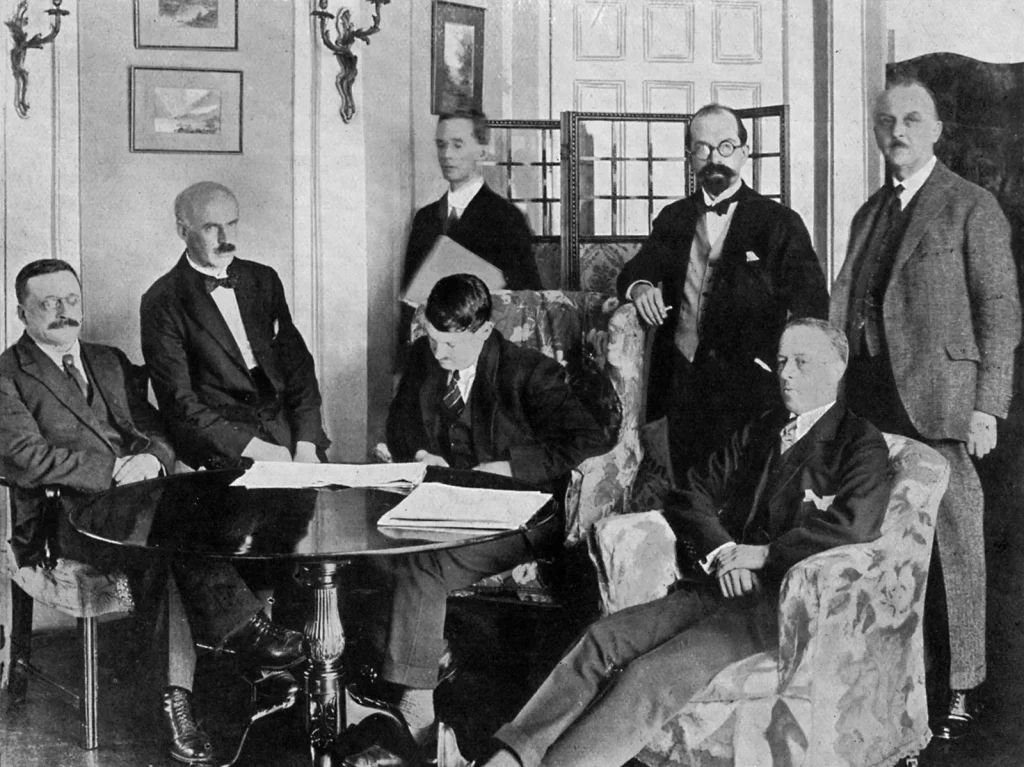
Michael Collins signing the Anglo Irish Treaty – is this a lesson for Ukraine?

At noon on 11 July 1921, a truce came into effect between the republican movement in Ireland and the British government, allowing for negotiations that led to the Anglo-Irish Treaty of December 1921. That treaty resulted in six counties of Ireland remaining as part of the British Empire and decades of oppression of the minority Catholic population.

According to Richard Boyd Barret of People Before Profit, on 12 November 2026, this historical example is relevant to Ukraine today and in particular, answers the question of whether Ukraine should give up occupied territory as part of a peace deal: ‘When this country signed a peace agreement with Britain, we didn’t give up our aspiration to unite this country.

‘We did recognise that the military conflict was going absolutely nowhere. The same clearly applies, except on a bigger scale in Ukraine, with hundreds of thousands dead on both sides and there is really no movement. The military road has been a disaster, but we need to look at peace and negotiation.’

The Irish radical left traditionally has been against the partition of Ireland arising from the Anglo-Irish Treaty, going back to James Connolly, who although he did not live to see the Treaty, was alive when the partition of Ireland began to become a serious prospect. Connolly, writing in 1914, pointed to the disastrous example of Poland, which was ‘Torn asunder by the brute force of their alien oppressors, its unity ruthlessly destroyed.’ And his conclusion was that ‘Such a scheme… would mean a carnival of reaction both North and South, would set back the wheels of progress, would destroy the oncoming unity of the Irish Labour movement and paralyse all advanced movements whilst it endured.

‘To it Labour should give the bitterest opposition, against it Labour in Ulster should fight even to the death, if necessary.’

When the Treaty was signed, Countess Markievicz described it as a ‘deliberate attempt to set up a privileged class’ and Big Jim Larkin was also against it, wanting to undermine it through working class methods of protest rather than taking up arms.

So it is quite a significant departure from the usual radical left perspective on the Treaty for Richard to align himself with a position that sounds much like that of Michael Collins, rather than that of Markievicz or Larkin. Michael Collins was the Bonapartist figure of the time, indispensable to the Irish elite but not part of the elite, who was for the Treaty (and willing to start a civil war to enforce it) and who was key to accepting the Treaty, even while not giving up Ireland’s aspiration to unity.

Someone should ask Richard this question: if you were negotiating the Anglo-Irish Treaty of 1921, would you sign it to save lives? Even at the cost of partition?

If the answer is yes, which it seems to be from the Irish Times interview, then this might be Richard working through the logic of playing the pacifist card.

What he hasn’t worked through, though, is how he can use Irish events at all to help understand what the left should advocate for in Ukraine today. People Before Profit believe that the conflict in Ukraine is an inter-imperialist war (NATO vs Russia) and therefore that Ukraine’s aims and Putin’s are equally bad (on the same day as his Irish Times interview, Richard even went so far as to say on RTÉ radio that the current war was ‘Zelensky’s War’).

In the Irish case, no one claims Ireland was a proxy for Germany and that Irish people were risking their lives in an uneven conflict as dupes of German manipulation. We all understand that Irish people were fighting to escape the empire and determine their own fate. In that context, Connolly’s analysis was right and the partition of Ireland was worth opposing. It only looks otherwise if you are viewing the 1919-21 period through the distorting lenses of glasses you’ve picked up labelled ‘inter-imperialist war’. Once you realise this is a mistake, I don’t think you have any grounds for revising the normally accepted anti-Treaty position of the Irish left and this is so obvious that I predict Richard will have to backtrack from the attempted analogy.

There are people who can make the analogy with Irish events without ending up sounding like Michael Collins, and we are the anarchists and socialists and non-aligned activists in Irish Left With Ukraine. For us, this is not Zelensky’s War. It is an invasion by an imperial power, with the goal not only of obtaining crucial economic resources but of crushing trade unions, women’s organisations, LGBTQ+ rights, and all the other civil rights that were setting a destabilising example to Russia’s dictatorship.

Much worse than Richard’s position on the partition of Ireland is his neglect of the very constituency he claims to represent: the working class. It’s not at all difficult to go on fact-finding journeys or even have online conversations with workers and civil rights activists from Ukraine. And as soon as you listen to what our fellow workers have to say, you realise how patronising it is of People Before Profit (in this case, the RISE wing) to say that the “Ukrainian working class is, overwhelmingly, a tool of its ruling classes in this war.” The dismissal of millions of people fighting for their lives and for the kinds of rights – to be in independent trade unions, to be able to vote in free elections, to be in ecological and LGBTQ+ activist groups, etc. – we have in ireland is offensive, outrageous and simply an assertion that PBP would like to be true, because they know that to listen to such voices would collapse their political stance like a bubble being burst.

They won’t want to listen, for instance, to Social Movement’s recent criticism of People Before Profit, which I’m proud to share below.

Social Movement (Ukraine) post 14 November 2026

What lies behind the “anti-imperialism” of the Irish left?

Ireland’s left proposes a Ukraine “peace” its own rebels never accepted

The Irish Times article of 12 November 2026 [1] is a telling example of how part of the Irish “left”, under the guise of neutrality, love of peace and anti-imperialism, in effect promotes narratives that benefit the Kremlin. Richard Boyd-Barrett, a People Before Profit TD (member of the Dáil, the lower house of the Irish parliament), says that the war is “going nowhere”, that Ireland should be offering peace, and that Ukraine must recognise that military resistance is futile.

But let us apply the same logic to the history of Ireland. Should the Irish, for the sake of peace, have laid down their arms, remained within the British Empire and abandoned rebellion and the struggle for independence [2]? Should pressure have been put not on the British authorities, who crushed uprisings, executed people by firing squad, threw them into prison and carried out punitive operations, but on the Irish who refused to submit? By that logic, the guilty party in the conflict would not be those who occupied and oppressed, but those who resisted.

That, in effect, is what is being demanded of Ukraine today. Russia occupies territory, destroys cities, abducts children and systematically bombs civilian infrastructure. Yet instead of demands addressed to Moscow to end its aggression, Ukrainians are urged to give up their resistance, and support for their defence is labelled “escalation”.

It is particularly telling that People Before Profit and the Ireland-Palestine Solidarity Campaign combined, at the same rally, slogans calling for a boycott of Israel and the fight against apartheid with demands to end military support for Ukraine. In both cases the same logic can be traced: resistance to Russian imperialism is declared “escalation”, while Russian aggression itself is presented as a conflict that has supposedly simply reached a stalemate. Such an approach can hardly be called consistent left internationalism, since it blurs the responsibility of the aggressor and in effect shifts it onto those who are defending themselves.

At the same time, the very forces that loudly criticise Trump’s policies and the United States are promoting a position that objectively coincides with the interests of the current US administration: weakening Ukraine, reducing pressure on Russia and opening the way to restoring trade relations, notably in the gas sector. According to Reuters and other media, in October 2026 Trump’s special envoy and son-in-law Jared Kushner held talks with Kirill Dmitriev, who is close to Putin, on the possible involvement of an American investor in the Nord Stream pipelines [3]. These are schemes that could allow American capital to profit from the resumption of Russian gas supplies to Europe once a peace agreement is concluded. It turns out, then, that some of Ireland’s “anti-imperialists”, who oppose American influence, at the same time support a position in which Ukrainian territories and people’s lives become the object of deals made to restore trade with Russia.

When, in 2026, a politician offers Ukraine a “peace” that in effect means recognising Russia’s territorial conquests, and justifies it by Irish neutrality, the outcome is to strengthen the aggressor at the expense of the state that is defending itself. It matters little whether this is a conscious political position or an unwillingness to apply one’s own anti-imperialist principles consistently.

Genuine left internationalism means supporting the right of oppressed peoples to self-determination and their resistance to imperialism. This applies to the Irish in their struggle against the British Empire and to Ukrainians in their struggle against the Russian one. One cannot demand that Ukrainians capitulate by invoking neutrality while considering the Irish struggle for independence just. Whoever demands of Ukraine what they never demanded of Irish rebels applies double standards. And whoever, under anti-American slogans, supports deals that benefit the Kremlin and part of American capital displays a contradiction between their own rhetoric and their political position.

Peace without justice is not peace but capitulation under another name. The Irish once understood this well. It is strange that part of their “left” today has forgotten it.

From Ukraine to Palestine: Why Double Standards Have No Left Sign

  • Author: Manen
  • The entry was published: 20.11.2026

The “Social Movement” consistently condemns both Russian and Israeli aggression. We proceed from a simple principle:

“From Ukraine to Palestine, all occupations are criminal.”

That is why we demand sanctions and international pressure on states that wage wars of aggression, regardless of who their allies are and under what slogans they justify their actions. At the same time, we are concerned that among those who consistently support the Palestinians’ right to armed resistance, there are also those who deny Ukrainians the same right when it comes to Russian aggression.

Among some of the Irish left today, we observe just such a contradiction. The protest on November 12 in Dublin, organized by the Irish Anti-War Movement with the support of the Ireland-Palestine Solidarity Campaign during the European Political Community summit, was indicative . About a thousand people took to the streets, speaking out against further military funding for Europe, increased spending on NATO, and the militarization of Ireland. However, the protest was not limited to these issues: one of the main speakers, People Before Profit MP Richard Boyd-Barrett , declared that the war in Ukraine “is leading nowhere” and that Ireland should advocate for peace, not further funding for the war. Moreover, he suggested that Ukraine should focus on the Anglo-Irish Treaty of 1921, effectively allowing territorial concessions for the sake of stopping hostilities. It is precisely such a position, which, instead of demanding that Russia stop its aggression, invites Ukraine to come to terms with its consequences, that arouses justified criticism.

Against this background, the position of another representative of People Before Profit, MP Paul Murphy , who has also repeatedly spoken out about the war in Ukraine, is indicative. In particular, after Volodymyr Zelenskyy’s speech in the Irish Parliament in April 2022, Murphy explained why his party members did not support calls for stronger sanctions against Russia. He stated that they stand with the Ukrainians in the fight against the Russian imperialist invasion, but at the same time added : “We cannot welcome calls for new sanctions that harm ordinary Russians and only strengthen the Putin regime inside the country.” This argument is especially interesting when compared to how Murphy calls on the Irish government to act against Israel.
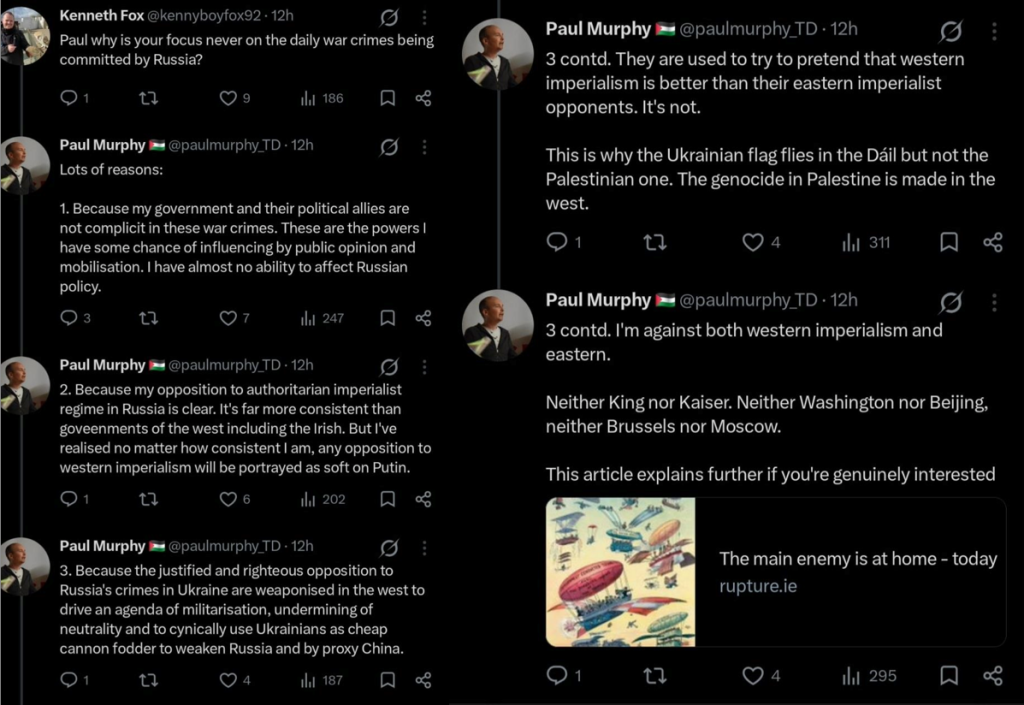
Murphy tweets on Russia

But in the case of Israel, Mr. Murphy does not limit himself to considerations about the possible harm of sanctions for ordinary citizens. He advocates for full economic sanctions, the expulsion of the Israeli ambassador and the severance of trade relations. In particular, People Before Profit has achieved the introduction of comprehensive sanctions against Israel, comparing them to the measures that were applied against apartheid in South Africa. Murphy also demands that the Minister of Finance withdraw state investments from Palantir, a company involved in the activities of the Israeli army. That is, he quite rightly believes that Ireland should use the political and economic levers available to it to put pressure on the aggressor state. We share this approach. However, it is unclear why it ceases to act when it comes to Russia.

This inconsistency is also noticeable in Murphy’s position on sanctions. The Irish government should put pressure on Moscow, in particular through the Aughinish Alumina plant, owned by the Russian company Rusal, associated with Oleg Deripaska (we wrote about this earlier – ed.). The investigation by The Irish Times and OCCRP found that significant volumes of alumina produced at the plant were supplied to Russian aluminum enterprises, whose products, through intermediaries, ended up in arms manufacturers.

So the argument that sanctions harm ordinary people and at the same time strengthen an authoritarian regime, it uses to defend Russia, but does not apply to Israel. Why is economic pressure necessary in one case, but unacceptable in another?

At the same time, the question arises of whose interests such a policy might serve. According to Reuters, in October 2026, Trump’s special envoy and his son-in-law Jared Kushner discussed with Putin’s adviser Kirill Dmitriev the involvement of an American investor in Nord Stream. The scheme was about a scheme under which American capital could earn on the resumption of Russian gas supplies to Europe after a peace agreement was concluded. 

It is the leftists who criticize American policy and the influence of big business who should be especially attentive to such processes. Instead, they propose cutting aid to Ukraine, which effectively means supporting Putin’s demand to withdraw Ukrainian troops from Donbas, which Russia is unable to completely seize by military means. At the same time, Ukraine is ready for a ceasefire along the current front line.

We do not claim that Murphy or his party members are consciously working for the Kremlin or specifically advocating a pro-Russian position. However, the consequences of their policies coincide with the interests of Moscow and part of American capital, and it is for these consequences that they must bear political responsibility. They recognize the right of the Palestinians to resist, while they question the right of the Ukrainians to resist. They consider the Irish struggle for independence to be just, but they propose completely different rules for the Ukrainians.

True left internationalism does not divide occupations into “ours” and “others’,” since its foundation is solidarity with the oppressed and opposition to imperialism, regardless of where it comes from: Russia, Israel, or the United States. A peace that demands that the occupied abandon resistance cannot be just. It is just capitulation by another name. The Irish once understood well the price of such “peaceful” logic. It is a pity that some of their leftists today have forgotten this.

Filed Under: Ukraine Tagged With: Ireland

Irish Left With Ukraine Newsletter 28 August 2026

28/08/2026 by Conor Kostick Leave a Comment

The Irish Left With Ukraine group was established involving activists from different traditions of the left in Ireland, but united in support of Ukraine’s right to resist invasion.

Protest at the Russian Embassy
The Irish Left With Ukraine will join the existing daily protest at the embassy on Orwell Road, Dublin 6.  This protest has been mounted on a daily basis since the outbreak of war in February 2022. Our ILWU group will bring out banner and good wishes to support the protest.  Check out our socials for updates.  You can come too!

An Irishman in Ukraine by Garrett Mullan
Ternopil is in the west of Ukraine, about 120 km from Lviv, which is 30km from the Polish border.  It is a city of 220,000 in a region of just over 1 million.  As it is in the west of Ukraine, there is a perception that it has not been affected by the war.  There are even derisive comments about people going on holidays to Ukraine. Yes, we did go on holidays because people need to see their families.
The war has affected every region.  In the city, just over 800 have died as a result of being killed in action and that number rises to over 5,000 dead.  Multiply that by at least three times and you have tens of thousands injured. On November 19th 2025, 38 died in the city in one of the single most deadly attacks by Russia in the war.  They died sleeping in their apartments.
In every large village, town and city of Ukraine, there are memorial boards in the centre to remember those who had been lost.  In the village where we stay of Hrymalliv, 40km from Ternopil, there are 29 boards.  My wife Iryna remembers four of the soldiers as local boys from the village.  She was a teacher in the school for 10 years and taught two of the martyred soldiers.  She remembers Anatoliy has lively and funny.  Now all we can see is the memorial board.

For years, we travelled to Ukraine each year to visit my wife’s family.  After the full scale invasion we halted our visits and did not expect to return until after the war.  However as months and years of war went by, we decided in 2024 to visit Iryna’s family in Ternopil and we did so again this August.  Now I am back in Dublin and she is still in Ukraine to attend a wedding, which I am told will be not be attended by military aged men.
The electricity blackouts have not been as bad in the Summer of 2026 as 2024.  This is because there has been a significant increase on the reliance of solar and also the importing of electricity from Europe.  There is dread though as to what will happen in winter.  Last Winter was the most challenging of the war and this year it is expected to be worse because the relentless attacks on the energy grid has had an impact.
I met two English guys in Hrymalliv sitting outside a local bar. They were nice guys.  Both had been in the British army for four years.  They came to Ukraine at the same time in April 2022, just after a call for international volunteers.  I asked one ‘how did your family and friends react when you decided to volunteer?  That must have been difficult’.  His reply was disheartening as he said ‘people would blow off steam and say don’t go, you will die, but then once I had gone, they dropped all contact.  I got no texts, nothing’.  
Still they seemed in good spirits.  The interaction with them and a few other of their comrades was brief but I could see togetherness.  They have been through a lot.  England is now not only a different country but a different world to them.  
At a local swimming pool war veterans were present.  We knew they were war veterans because some were in wheelchairs and others had dressings covering wounds and others had missing parts.
On the platform at Ternopil station as we waited to head to the Polish border, my sister in law indicated a family nearby ‘they are saying goodbye as he is going to the frontline’.  The scene on this hot August Sunday was a father, his wife and two young boys.  It was tearful farewell.  How did we know that he was heading to the frontline?  The train destination was Dnipro, which is on the frontline 815km to the east.
This scene we have witnessed in many films and it was a scene reminiscent of World War 2, but this was no film and it was not World War 2.  Also reminiscent of World War 2 and the films. I didn’t expect to hear an air raid siren in the countryiside, but it happens regularly.  In response, people check Alerts.in.ua   It is Ukrainian reality in 2026.

Protest at City West
The government has shifted to right wing populism, as the mood towards Ukrainians has hardened.  Their cack handed measures to cut accommodation costs and show their toughness on immigration has caused disruption and distress for Ukrainians in state accommodation, particularly those who are vulnerable and those with disabilities.  Jim O’ Callaghan TD as Minister for Justice has referenced appeals systems which are akin to the worst Soviet bureaucracy, in addressing the needs and concerns of Ukrainian refugees in state accommodation.
Many people comment in justifiying harsh government policy ‘sure it was only meant to be temporary’. It is true that measures applied in support of Ukrainians in Ireland in 2022 were under the programme of International Temporary Protection.  However, the war is still ongoing and more of the country has been destroyed and more will be destroyed.  There is nowhere for people to return.  
We appreciate the efforts of Liam Quaid TD and Ivana Bacik TD of Social Democrats and Labour who have been actively engaging with Ukrainians impacted in Trabolgan and City West.  However, we call on the Department of stice to open dialogue with residents and enter a process of meaningful dialogue.
 
Ukraine solidarity discussed at ICTU Global Solidarity Seminar
More than 100 representatives and officials from different unions participated in the summer seminar of the Irish Congress of Trade Unions Global Solidarity Committee.  Gregor Kerr spoke on behalf of ILWU on why trade unions should show solidarity with Ukraine.  Chris Ford from the Ukraine Solidarity Campaign UK, spoke of their experience in harnessing the support and solidarity from the trade union movement in the UK with partners in Ukraine.  Speaking through a zoom link, Kateryna Maliuta Osaulova from the Trade Union of Education and Science Workers told the meeting of the impact on the ground for workers in Ukraine and how they as a trade union are responding to the impact of war on the ground.

A full report of this meeting will follow in the next newsletter.

Solidarity Convoy to UkraineThe Irish Left With Ukraine has signed up to support the International Solidarity Convoy due to depart from different parts of Europe and arrive in Ukraine in November.  It is an initiative of the European Network of Solidarity with Ukraine.  The Solidarity Convoy to Ukraine is an initiative that brings together trade unions, civil society organisations, grassroots organisation to deliver aid requested by Ukrainian partners to strengthen solidarity with Ukraine.  Join us and build solidarity with Ukraine.  Check out the link here- https://solidarityconvoyukraine.com/


Email us at irishleftwithukraine@gmail.com
Follow us on x, facebook and instagram: irishleftwithukraine.blog

Filed Under: Ukraine

“Women, Life, Freedom” Against War

27/06/2025 by admin Leave a Comment

A Statement against Genocidal Israel and the Repressive Islamic Republic

Women Life Freedom feminist protest Iran

By the Roja collective, comprised of Iranian, Kurdish, and Afghani internationalist feminists.

This statement was issued on 16 June 2025, the third day of the war. It was originally published in Persian and was translated and published by Crimethinc. We are reposting the English version on the Independent Left website with their approval.

Much has happened since then, including the direct attack that the United States carried out against Iran on 21 June 2025. Nevertheless, this text provides valuable analysis on the strategy of the United States and Israeli governments to reshape the Middle East.

For background on the Jin, Jiyan, Azadi (“Woman, Life, Freedom”) movement in Iran, read this; for more information on the uprising that broke out in 2022, start here. You can read another statement from Roja here.

Against Israel, the US, and the Iranian Regime

We stand against both of the warmongering, patriarchal, colonial powers. But this is not passivity. It is the starting point of our active struggle for life.

If Israel drives Gaza’s children to the slaughter with a queer rainbow flag, the Islamic Republic of Iran drenched Syria in blood under an anti-imperialist guise. One commits genocide against Arabs in Palestine, the other subjugates non-Persian ethnicities within its borders. Netanyahu seeks to usurp the meaning of “Women, Life, Freedom” in order to disguise his colonial expansionism and military aggression as “freedom,” while Khamenei has poured all resources into building a Shia empire supposedly to combat ISIS and defend Palestine.

Indeed, these two longstanding foes mirror each other in killing and malevolence. We must not equate these two capitalist regimes in terms of their positions within the global order: the Islamic Republic’s capacity for military aggression is undoubtedly far less than the capacity of Israel and its Western imperialist backer. Still, the suffering it has inflicted is as absolute as the violence of Zionist fascism. Any attempt to relativize this suffering, quantitatively or qualitatively, is reductive and misleading. That suffering spans multiple forms of oppression, including the exorbitant costs of its nuclear project and taking human dignity a hostage.

This asymmetrical war between Israel and the Islamic Republic is, above all, a war against us.

It is a war against what we have created in the “Jin, Jyain, Azadi” uprising, what we’ve achieved, and what lies at its potential horizon: a feminist, anti-colonial, egalitarian uprising that did not emerge from state power, but originated in the popular struggles of Kurdistan—especially those led by women—and then echoed across the geography of Iran.

It is simultaneously a war against the oppressed and working classes: against the nurses at Farabi Hospital in Kermanshah and the firefighters of the small town of Musian in Ilam, who were struck by Israeli air attacks—the former on June 16, the latter twice, on June 14 and 16.

This war targets the infrastructure and networks that sustain daily life in this region.

Taking a clear, uncompromising stance on the war—condemning Israel’s assault and saying “no” to the Islamic Republic—is the minimum strategic foundation for shaping a collective campaign demanding an immediate ceasefire. “Women, Life, Freedom Against War” is not just a slogan; it draws a sharp boundary around a set of tendencies whose contradictions and conflicts are clearer today than ever.

On one side are opportunistic advocates of regime change who, for years, have supported Western and US sanctions, beaten the drums of war, denied Gaza’s genocide—and now plead for “liberation” in abject subservience to their master, Israel. In short: those who minimize Western imperialist warmongering, above all the far-right Persian-nationalist royalists.

On the other side is campism, the political position that lends its support to any project—no matter how authoritarian—that opposes the Western bloc, presenting it as “resistance.”

In addition, there are forces that prioritize the struggle against Israel’s criminal assault by appealing to a “state of emergency” or “the people’s interest.” This latter group ends up either whitewashing the Islamic Republic’s crimes at home and abroad or adopting a strategic silence regarding them. These are the ones who, after October 7, 2023, issued warnings about the danger of indifference to the shared fate of Middle Eastern peoples—but instead of emphasizing grassroots internationalist struggle, blurred the line between popular resistance and state power. They correctly noted that Iran comes next after Lebanon and Palestine in the so-called “new Middle East order,” but only to downplay and deprioritize the struggles of women, ethnic minorities, and the oppressed classes in this “moment.” Their warnings remained abstract because they did utter not a word about the Islamic Republic’s longstanding appropriation—and ideological monopolization—of anti-colonial discourse since the 1979 revolution.

We believe that only by drawing these boundaries—emphasizing the mutual and inseparable relationships between multiple social struggles in the region—can we form a solid front against Israel’s genocide and simultaneously wrest anti‑colonial discourse from the Islamic Republic’s monopoly while confronting ethno‑nationalists who deny the existence of ethnic minorities and “internal colonialism” within the Islamic Republic.

In solidarity with the shared fate of Middle Eastern peoples—from Kabul to Tehran, from Kurdistan to Palestine, from Ahvaz to Tabriz, from Balochistan to Syria and Lebanon—which is the material basis of internationalist struggle, we address this statement to the oppressed and the downtrodden within Iran and the region, to the diaspora, and to the “wakeful consciences” of the world.

A sign at a demonstration in Paris organized by Roja, Feminists4Jina, and Socialist Solidarity.

13 June / 23 Khordad: Death by Bombs and Missiles

The ethnic cleansing perpetrated by the criminal Israeli state is not confined to this day, this year, or even this century. Yet the geopolitical fault line that opened up on October 7, 2023 now threatens to swallow the Islamic Republic and the people of Iran from within—at a staggering speed and with shocking intensity—casting a darkening horizon that strains our emotional and psychological limits.

These may be the most critical days of our lives since the 1979 Revolution.

From the dawn of Friday, June 13, to Monday, June 16, the Israeli military carried out 170 attacks, striking 720 targets across Iran.

  • Phase One: Nuclear facilities, missile bases, air-defence systems, and assassinations of researchers and military commanders in residential areas—targeting dozens of senior commanders in the Islamic Revolutionary Guard Corps [a branch of the Iranian Armed Forces], inflicting an unprecedented blow to the IRGC’s military-security structure.
  • Phase Two: Coordinated strikes on refineries and fuel depots (Shahran in Tehran and Pars South in the Persian Gulf), ports, airports, and critical infrastructure affecting not only military arteries, but social reproduction and everyday life.
  • Phase Three: Assaults on symbols of governmental authority—ministries, official buildings, and the Islamic Republic’s main broadcasting agency in Tehran—the central hub of interrogators, torturers, and hate propagators. A media institution with a four-decade record of fabricating dossiers, spreading lies, and slandering the poor, women, Afghan migrants, and political dissidents.

Across all of these phases, contrary to the seductive promises of fascist propagandists selling bomb-delivered freedom, what has unfolded is not “pinpoint strikes” on military targets, but the indiscriminate slaughter of civilians, women, and children. As of June 15, at least 600 people have been killed and 1277 injured. [On June 23, as we publish this, the numbers are considerably higher.]

In response, the Islamic Republic had launched over 350 missiles and drones at Israel by June 16. One major strike targeted northern Israel, including Haifa—the strategic industrial core and an energy-logistical hub. Although most of the projectiles were intercepted by the defense systems of the Israeli military and its allies, several reached civilian areas. As of this writing, 24 Israelis have been killed, including four women from a single family.

In this dire situation, the Islamic Republic has not only abandoned a terrified populace—failing to provide even the most basic services such as transparent public information, air raid shelters, or alarm systems—but has also escalated state control: deploying riot squads, erecting checkpoints across cities, and sharpening its blade for executions under the pretext of “spying for Israel.” While this is unsurprising during wartime—indeed, it is symptomatic of the regime’s inability to ensure safety—it carries with it the whispered threat of “hanging traitors from every tree.” Such logic flows naturally from a regime whose very survival depends on internal repression, executions, the militarization of daily life, and relentless regional expansion.

Women Life Freedom Israel Iran
The Roja banner at a demonstration in Paris on June 14 against the genocide of Palestinians.
Women Life Freedom Israel Iran 2
A demonstration in Paris organized by Roja, Feminists4Jina, and Socialist Solidarity.

Colonial Representation and the Normalization of War

The “War on Terror”—the imperialist project which unleashed bloodshed across Afghanistan and Iraq at the dawn of the 21st century—has now passed the torch to Israel: a “preventive” strike aimed at containing the Iranian nuclear threat.1 Once again, the dominant media script is repeated: Israel targets only “military sites,” deploying “precision missiles” and “smart drones” to deliver freedom and democracy to the Iranian people.

But this narrative does not address Parnia Abbasi, the 24-year-old poet killed in Sattarkhan, Tehran. It makes no mention of the murders of Mohammad Ali Amini, the teenage taekwondo athlete, or Parsa Mansour, a national padel player. Not a whisper of Fatemeh Mirheidar, Niloufar Qalewand, Mehdi Pouladvand, or Najmeh Shams. These were neither “military targets” nor “nuclear threats”—only human beings, their bodies dismembered in global media silence, shredded by Israeli missiles. This is merely the tip of the iceberg of the “freedom” that Israel—backed by the West—intends to introduce by heaping up corpses and devastation.

Reactionary forces that reduce “regime change” to a mere political reshuffling from above—without any real social transformation—are now openly embracing their longtime savior, Israel. Monarchists have turned bombing victims into statistics, shamelessly declaring, “The Islamic Republic executes thousands annually, so the killing of dozens or hundreds by Israel is justifiable.” This is the same dehumanizing logic—the quantitative calculus of death—that the United States deployed to justify destroying Hiroshima and Nagasaki: “If the war continues, more will die, so drop the bomb.”

The killing of civilians in Israel’s recent assaults, the heightened state control within Iran, the destruction of social infrastructure—none of these are “unintended mistakes” or collateral damage. They are the logic of war, especially when waged by a regime like Israel’s. The familiar claim that civilians or non-military sites are being used as “human shields”—once invoked in Gaza, now used to justify attacks on Dizelabad Prison and Farabi Hospital in Kermanshah—is a deliberate distortion, deployed to mask and invert the truth of this exterminatory logic.

There is no such thing as a “just strike” or a “fair bombing.” The historical experiences of Iraq, Afghanistan, and Libya—yes, the very Libya that Netanyahu openly cites as a model for regime change in Iran—testify in blood to this truth.

Women Life Freedom Israel Iran 4
A demonstration in Paris organized by Roja, Feminists4Jina, and Socialist Solidarity.

“The New Middle East Order”: Why Did Israel Attack Iran?

The unprecedented scale of Israel’s attacks indicates that Israel is attempting to achieve full-scale regime change—or regime collapse. We cannot dismiss Operation “Rising Lion” as a mere extension of the longstanding hostility between the two states. It is rooted in a broader regional process that began on October 7 with a blow to the so-called “Axis of Resistance” and has now reached deep into the core of Tehran’s power structures.

Israel’s strike on the Islamic Republic marks the latest chapter in a broader transformation of Middle Eastern geopolitics and economics.

Gaza, for Israel, is not merely a battlefield—it is a colonization project. The assault on Gaza is a campaign to exterminate or expel over two million Palestinians and transform the blood-soaked coast into Trump’s vision of a “Middle Eastern Riviera”—luxury beaches, casinos, and a free trade zone for white people.

Step by step, Israel has driven Hezbollah from southern Lebanon, destroying its infrastructure, killing commanders, and dismantling its war machine. The same is now unfolding with the IRGC. In Syria, a regime propped up by Russia, Hezbollah, and the IRGC—at the cost of half a million deaths and twelve million displaced—has abruptly collapsed under Turkish-backed rebels. The Tehran–Beirut Shia Corridor, once a strategic artery linking Iran to the Mediterranean, has become its Achilles’ heel—the runway via which warplanes now strike it.

In the newly imposed order of the Middle East, a bloc of Israeli–US capitalist power is aggressively reshaping the region via logistical-economic routes (the India–Middle East–Europe Corridor), political-economic normalization (the Abraham Accords), and expansionist militarism in the form of the genocide and annexation of Gaza.2

Amid the disintegration of the “Axis of Resistance,” the Islamic Revolutionary Guard Corps’ longstanding doctrine of “neither war nor peace”—a strategy of manufactured crises and calculated brinkmanship—has collapsed. For years, the regime weaponized limited, controlled confrontations to forestall both total war and genuine peace. Today, it finds itself exposed on a battlefield where the rules have irrevocably shifted.

This collapse, compounded by the regime’s total loss of domestic legitimacy—marked by the mass uprisings of December 2017, November 2019, and the “Women, Life, Freedom” movement—amounts to a final blow. The Islamic Republic can no longer manage, defer, or externalize its crises. It commands no legitimacy at home and holds no strategic leverage in the region. It is a scorched remnant in an emerging militarized, multipolar order.

In this vortex of blood, the United States—racing against China and maneuvering through Russia—is striving to reclaim its fractured hegemony. Netanyahu clings to endless war as his ticket to domestic survival. And within the Islamic Republic’s ruling apparatus, many now aim to become instruments of regime change themselves. Meanwhile, the people remain hostage—trapped in a war that is not theirs, a war that offers no horizon of liberation.

No to the Repetition of Libya, No to the Summer of 1988 Massacre

Recalling the path from the “blessing” of the Iran–Iraq War for the Islamic Republic’s consolidation in its infancy to the regime’s mass execution of political prisoners in the summer of 1988 is as urgent today as remembering the imperialist course that led to the “Libyaization” of an entire society.3

The history of “humanitarian interventions” in Iraq and Afghanistan—whether under the pretext of “weapons of mass destruction” or “crimes against humanity”—must be read alongside the history of those struggles in Iran that, from before the 1979 Revolution to today, have wrongly prioritized anti-imperialism above all else. Similarly, the settler-colonial history of Israel—from the 1948 Nakba to Nasser’s betrayal of pan-Arabism in 1967—must be understood from the vantage point of Turkmen Sahara and Kurdistan, sites of internal colonialism.

For over a decade, ideologues of the “island of stability” (the name that the campists once gave to the Islamic Republic of Iran) have used the fear of “Syriaization” to shame independent popular struggles and call people to the ballot box, selling the IRGC’s bloody intervention in Syria as a deterrent strategy to prevent the “Syriaization” of Iran. Just recounting this history is enough to justify a decisive “no” to the discourse of campists—a discourse that, rather than relying on organized popular power from below, stoops to realpolitik and, in the name of anti-imperialism, treats the enemy of the enemy as a friend even when they are just as bad.

Nearly 45 years ago, at the onset of the Iran–Iraq War, some progressive groups fell into nationalism—treating the war as a “national” event. That only served to consolidate Islamic authoritarian rule. Some remained silent as the Islamic Republic threw around the word “imperialist” to justify imposing mandatory veiling on women and deploying troops to Kurdistan; others, though they spoke up, failed to mobilize public opinion against the internal enemy fashioned in the image of an external one, thus helping to normalize a hierarchy centered on man/Persian/Shia.

Right now—when the “state of emergency” narrative suggests that this is some exceptional, disconnected moment—there is no greater imperative than invoking a plural, multi-layered historical memory. Only from a heterogeneous, multi-voiced historical memory—from the standpoint of oppressed peoples—can we say “no” to imperialism, war-based state control, and campism all at once. The project of remembering that layered history—from Kabul to Gaza, across shared fates and differences—we call internationalism.

In a world oscillating between fascist militarization and seemingly endless wars, our path lies in active, mass organizing for an immediate ceasefire, for peace, and for the reproduction of life against the machinery of death. Our field of action is neither aligned behind states nor invested in casting hopeful glances toward them—it lies in caring for one another, in mutual aid, and in building a network of support, awareness, and solidarity—from elders and children to the marginalized and disabled—as we witnessed magnificently in the Woman, Life, Freedom uprising, in which solidarity among the oppressed became a force for living, resisting, and creating.

Transparency of information and consciousness-raising—without reproducing either Israeli or Islamic Republic narratives—must be the pillars of this cultural and political resistance.

Submitting to fatalism and painting an apocalyptic future in which everything is already over—these are ways of reproducing the logic of death. Against that notion of the future, what is vitally urgent is to shape an all-out campaign aimed at immediate ceasefire and at opening a horizon of liberation:

Women, Life, Freedom Against War
Berxwedana Jiyan e
Resistance is Life
Free Palestine
Roja
18 June 2025

The bombing of Iran
  1. Although the Islamic Republic’s nuclear program has, from the very beginning, been a costly and undemocratic process with serious ecological consequences—pushed forward by the Revolutionary Guards to secure the regime’s survival in regional and global geopolitical competitions, at the expense of impoverishing society and destroying the environment—and although we recognize no “right” for the Islamic Republic or any other state to acquire nuclear weapons, and believe that nuclear arms and the global race for them must be entirely dismantled, Netanyahu’s attack is nonetheless based on a false narrative, reminiscent of the US invasion of Iraq under the pretext of eliminating “weapons of mass destruction”: namely, that Iran is only a few steps away from building “the bomb.” While the Islamic Republic has indeed significantly increased its stockpile of uranium close to weapons-grade, there is no evidence of a decision to build a nuclear bomb. Even if we assume that the Islamic Republic has acquired a bomb, it is the peoples themselves within the political geography of Iran who must decide their own fate with autonomy and self-determination—and this in no way justifies Israel’s military assault. ↩
  2. The “Al-Aqsa Flood” operation of October 7 can be interpreted within the context of this new architecture of domination: as an attempt to disrupt Israel’s normalization project through the Abraham Accords, and to interfere with one of the most vital routes of transnational capital flow—beginning in India, passing through Saudi Arabia and the UAE, reaching Israel, and extending from there to the shores of Greece in the Mediterranean. ↩
  3. Libyaization refers to an imperialist strategy in which a state is first diplomatically pressured into disarmament—often under the guise of international agreements or humanitarian concerns—then subjected to military intervention, and ultimately pushed into state collapse and prolonged chaos. The term draws from the case of Libya, where the Gaddafi regime was persuaded to abandon its weapons programs, later targeted by a NATO-led military campaign in 2011, and eventually disintegrated into a fragmented, war-torn country without a functioning central government. ↩

Filed Under: Iran

Vote No. 1 John Lyons Dublin Bay North 2024

12/11/2024 by admin 1 Comment

John Lyons Dublin Bay North 2024

John Lyons Dublin Bay North 2024

I am asking for the privilege to represent you at national level as an Independent TD for Dublin Bay North.

My pledge to you is to act in a principled, consistent, transparent, accountable and focused manner in addressing the issues of most importance to you, your family and community. 

Councillor John Lyons

It has been an honour to represent communities across Dublin Bay North as a Dublin City Councillor since 2014. Over that time I have seen firsthand  many people, families and communities struggle, yet I believe that if we genuinely address the issues in housing and health, community investment, childcare and climate action, we can improve peoples’ lives by creating a more inclusive, healthy, sustainable and caring society.

Born and reared on the northside of Dublin, I have been politically active in the area for the past 15 years, campaigning against water charges and  local property taxes; for better public transport and cycling infrastructure; the Repeal of the 8th Amendment; public and affordable housing on the Oscar Traynor Road site, workers’ and pensioners’ rights; the Save Moore Street Campaign; the need for new community, sporting and cultural facilities as well as being involved in the campaign to bring our bin service back into public ownership.

John Lyons Dublin Bay North 2024 on Housing

The lack of public and affordable housing is having such a detrimental impact upon so many thousands of people across Dublin. Far too many people are faced with unaffordable, insecure housing or are stuck at home, unable to get on with their lives whilst thousands of people are currently enduring the horror of homelessness. This must change.

I will continue to fight for the following:

  • A comprehensive five-year programme of public and affordable homes to rent and purchase delivered directly on public lands by the Dublin Local Authorities via a new state home-building agency
  • A ban on no-fault evictions
  • The proper planning of new residential developments with the parallel delivery of key infrastructure and services
  • Empowering local authorities to comprehensively address vacancy, dereliction and housing maintenance issues more rapidly 
  • Significantly increase the supply of affordable student accommodation.
John Lyons Dublin Bay North 2024 on Housing

On Health

I believe in a universal public health service which is centred on treating patients’ medical needs rather than their financial status and insurance cover.

Significant investment in primary care is required to ensure children can access speech and language therapists, occupational therapists, psychologists and other necessary therapies and supports in a timely manner.

Mental Health services require significantly increased funding from the current 5.8% of the health budget to a minimum of 10%.

Drug policy: The holistic, health-led approach to drug use must be extended. Significant additional funding on a multi-annual basis for drugs services across the statutory, community and voluntary sectors is required.

The decriminalisation of drugs for personal consumption and improved education and prevention awareness campaigns are essential.

A Dual Diagnosis approach to substance misuse and mental health must be embedded across all services via the implementation of the HSE’s Dual Diagnosis National Clinical Programme. 

On Creating Safer Communities 

We need to Strengthen Local Government, Fund Youth Services and Invest in our Communities: our areas need and deserve more community centres, sports facilities, arts and cultural venues, well-maintained areas and playgrounds. Such facilities help foster a sense of community and add life and vibrancy to our areas. Without them and the proper funding for the essential Youth Services, anti-social behaviour grows. The volunteer work that people do in the community is inspiring and it should be backed by investment at the local and national level. 

On Workers’ Rights

Workers in Ireland need better rights, protections, pay and conditions. Collective action is the only way to guarantee these entitlements. I will work with the trade unions to introduce legislation to provide for the introduction of a statutory framework and protection for collective bargaining. 

The minimum wage must become a Living Wage of €15 per hour.

On Early Years Education / Childcare

I believe we can do so much better for families when it comes to the provision of early years education and childcare. We need to create a  publicly-funded and managed system of early years education.

John Lyons Dublin Bay North 2024 on Disability Rights

People living with a disability know from their own experience that the Irish government has failed to provide for their needs.

People with disabilities should be able to live independently and with the same access to jobs, education, and amenities as everyone else. I will continue to support the goals and campaigns of Disability Power Ireland, the Independent Living Movement Ireland, Neuropride Ireland and all those campaigning for disability rights.

On Climate Action and Animal Rights

The climate emergency is an existential crisis. At a bare minimum, Ireland needs to implement the recommendations of the Climate Change Advisory Council on a cross-sectoral basis as a matter of urgency.

As part of this socially just and sustainable transition to a low carbon future, we must reappraise our relationship to animals: 

I want to see an end to the mistreatment of animals and if elected would introduce legislation to ban fox hunting, live exports, puppy farming, pheasant shooting and the importation of exotic animals for the pet shop industry.

John Lyons Dublin Bay North 2024 on Animal Rights

On Education

All our children deserve the best education possible. It should be genuinely free from primary, post-primary to third level and adult education.

Schools should be funded to ensure that all students and teachers are learning and working in the best equipped classrooms and labs in quality-built, energy-efficient school buildings.

Higher education requires increased funding and third level students need the abolition of the contribution fees.

On Unity Over Division

The difficulties we face as a society are the result of government policy which always prioritises the wealthy over the rest of us. The far-right want people to punch down but we know it is only by standing together that we can win better services and create safer communities for everyone, no exceptions. 

No matter who we are, where we are from or how we identify, we all deserve a secure warm place to call home, and the chance to live to our fullest potential. 

John Lyons Dublin Bay North 2024 on Palestine and Peace in the World

The genocide of the people of Gaza and the war in Ukraine are two of the most horrific events of recent times. As a neutral country with a proud record of opposing imperialism, Ireland is an important voice in world affairs. I want to use that voice to stand with all people whose lives are being torn apart by war.

John Lyons Dublin Bay North 2024 on Palestine

John Lyon’s Experience

– Director of the Dublin North-East Drugs & Alcohol Taskforce and Chairperson of its Finance Committee; 

-Member of the Special Inter Local Authority Committee on Fire/Ambulance Services and Emergency Management; 

-Member of Dublin City Council’s Local Community Safety Partnership (formerly Joint Policing Committee);

– Member of Dublin City Council’s Community, As Gaeilge, Sport, Arts & Culture Strategic Policy Committee (SPC);

– Member of Dublin City Council’s Local Traveller Accommodation Consultative Committee (LTACC);

-Member of The Darndale Implementation & Oversight Group

-Chairperson of Darndale F.C. 

I have the audacity to believe that peoples everywhere can have three meals a day for their bodies, education and culture of their minds, and dignity, equality, and freedom for their spirits.

Martin Luther King

To give a donation to John’s campaign, please visit his GoFundme page.

To join Independent Left or sign up for our newsletter please click the link.

Filed Under: Elections

In Memory of Sergiy – Support Solidarity Collectives

24/08/2024 by admin Leave a Comment

Support Solidarity Collectives Remember Sergiy
Bez of Solidarity Collectives

At the end of June of this year I learned the news from Ukrainian military front about the death of one special person. It was my former beloved. Our relationship lasted about two years. He was much older than me. I loved him very much when we were together.

He was talented in sports. He taught me to swim breaststroke and crawl. He also taught me to love summer. I used to think that summer was not for me. This man, Sergiy, loved when nature blossomed, when fruits ripened and when it was warm, so that you could walk in shorts and sandals, when you could just go out on the road and walk and walk, feeling freedom. He also loved to read. And he loved his son very much.

He had some disappointment with life, but nevertheless there was fire in him, there was some talent. Probably, it didn`t fade away from his youth. He definitely had a style: in clothes, in behavior and in life. 

He was quite ironic. Sometimes even cynical. But at the same time he was a sensitive person. We were very attached to each other.

Shortly after Russia’s full-scale war on Ukraine began, Sergiy called me, although we had not spoken for a long time. I am grateful to him for worrying about me. Then I called him when I was leaving Ukraine, and a couple of times from the EU.

When I first met Sergiy, I couldn`t remember who he reminded me of, but there was a feeling of someone very familiar. I still can`t remember.

Sergiy went to the front as a volunteer. This is the first person close to me who died in the war. And I hope the last one.

Take care of each other, bring the end of the war and the victory of Ukraine closer by all means available to you, donate to the Solidarity Collectives, promote funding for Ukraine from Western governments. And in the most difficult times, remember the good.

Vita from Kyiv

24 August 2024

2.5 years of full-scale war in Ukraine

A message from Solidarity Collectives

Hello, I’m Bez, an anarchist who has been helping anti-authoritarian fighters at the beginning of the full-scale invasion.

For more than a year now, I myself have been fighting in the Defence Forces. I just joined the newly created unit to counter enemy UAVs. Even though our team is new, we are already performing combat missions in Donetsk region.

But as is the case with new units, we lack a lot of things. Most of all, we need the pick-up truck. We need your support – help us save lives!

Link to the Monobank: https://send.monobank.ua/jar/349oybUfYt

Card number: 5375 4112 2188 5523

PayPal: kseniia19.beziazychna@gmail.com

Filed Under: Ukraine

  • Page 1
  • Page 2
  • Page 3
  • Interim pages omitted …
  • Page 23
  • Go to Next Page »

Copyright © 2026 · Aspire Pro on Genesis Framework · WordPress · Log in