• Skip to primary navigation
  • Skip to main content
independent left logo

Independent Left

Environmentalism, socialism, freedom and equality. #liveablecity

  • About
  • Featured Articles
    • How Farming Must Change to Save the Planet
    • The Housing Crisis: Causes and Solutions
    • Socialism in Ireland
  • Contact Us
  • Podcast
  • Animal Rights
  • Archive
    • Irish Socialist History
    • Dublin City Council Housing
    • Ukraine
    • Protests Ireland
    • Reviews
    • Irish Political Parties
    • All Posts
    • Independent Left Policies
  • Why join?

Art and Politics: One Big Union

24/09/2021 by John Flynn 1 Comment

One Big Union Ciarán O'Rourke
One Big Union, essays on art and politics by Ciarán O’Rourke

An interview between Johnny Flynn and Ciarán O Rourke, author of a new collection of essays on art and politics

JOHNNY FLYNN: Will we start with that quote from your essay on Martín Chambi?  You say that what most attracted you to artists in particular, and their techniques, is that they “draw on their chosen traditions skilfully” but “also with a view to making a statement on reality.” Throughout your book, even in your theses on poetry, you’re eager to say: “look, don’t give me any of this, he’s in love with language… that’s a rarefied métier you’re creating, with none of the grubby material reality of money-making, or whatever”. So you’re against that?

CIARÁN O’ROURKE: I could also have quoted someone you introduced me to, Eduardo Galeano, who said that “in an incarcerated society, free literature” –or free art, free cinema– “can only exist as denunciation and hope.” The idea that denunciation and hope should be connected together, but also that they would be legitimate artistic goals or aspirations, is very much out of favour today.

Many years ago, as you know, I was working as a student shelver in the vaults of TCD library, off-site, in a warehouse without windows but full of forgotten books, where you were ensconced, surrounded by the most radical authors of all time! I would arrive [every day] after an hour’s cycle, very sweaty and dishevelled, into the cavern of forgotten books, where you would recommend all of these beautifully incendiary authors to me… and so I think you bear a great of the responsibility for the kind of anarchic communism that I’ve embraced and decided to enjoy in the years since. So thank you, belatedly, for that!

JOHNNY FLYNN: It was a funny thing. I think our first conversation was about Shelley: we both liked The Pursuit, the [Richard] Holmes book. We’ll get onto Shelley, but to go back to Galeano for a second: he talks about “centres and subjugated outposts”.

CIARÁN O’ROURKE: That’s the phrase exactly. He gives you an entire paradigm for understanding the world, but he does it with total lightness and ease. He says that “we live in a world of powerful centres and subjugated outposts”, which, when you extract it, might sound a little bit vague or abstract, but actually it helps you to make sense of town and country, of the first world and so-called global south, and of indigenous cultures within the global south as well. It’s got layers upon layers to it.

JOHNNY FLYNN: And there’s the ‘stages of history’, too: if you’re in the metropolitan centre, that’s where the important part of life takes place, where the fine art and culture is, where all the wealth will be taken to feed this metropolitan world. And then on the periphery, which may be a peasant society, they can be dispossessed, expropriated, or fed into a factory: basically, pushed aside. In your essay on Roxanne Dunbar Ortiz, you mention ‘The Trail of Tears’: you’re supposed to euphemise it, but it was basically genocide and dispossession.

CIARÁN O’ROURKE: We’re in the belly of the beast here, and quite comfortably, too, relatively speaking! But you’re right. Roxanne Dunbar Ortiz, whose work you were referencing there, she makes the point that the defining question for the American political class, over the entire history of the US of A, has been (in her words) “how to reconcile democracy and genocide, and characterize it as freedom for the people.” And she says (again, brilliantly and provocatively) that this has been true of everyone from Andrew Jackson to Barack Obama, and beyond. It may sound like there’s some polemical extravagance to that, but when you immerse yourself in her analysis and narrative – of the formation not just of America, but of this modern world we live in – you realise that it’s not just a chaotic and violent vista where terrible things happen, but that there’s actually a political calculation and a kind of political culture behind it, driving these conquistadors, these expropriators, into the world, and at the expense of indigenous people, indigenous cultures, and all the rest.

JOHNNY FLYNN: That formulation of “genocide and democracy” is disturbing, but it reminds you of ‘the ethno-state’: how people refer back to Andrew Jackson and the creation of the ‘white republic’ (Portland, Oregon was going to be for whites only). That legacy lives on: you still find iterations of white nationalism and white supremacy in those areas: they draw on this tradition. Just as you might draw on an indigenous tradition, or a tradition of resistance, white supremacists draw on the ideas of Andrew Jackson, and other presidents like Woodrow Wilson, the ‘liberal’ who said about the film Birth of a Nation, about the Ku Klux Klan, “that’s how it happened.” And that was Woodrow Wilson! Of the League of Nations!

CIARÁN O’ROURKE: It was actually when I was reading and then trying to pay tribute to Roxanne Dunbar Ortiz, and also Ursula Le Guin, two figures you might think are poles apart, I felt that I wasn’t just tramping through history or wandering through science fiction, but that the kinds of questions that they were raising, struggles and forms of violence that they were bringing to light, were very much present in the world we’re living in now.

You mentioned there about the ‘ethno-state’, and the history of white supremacy in America (coming from Europe, of course). Ursula Le Guin, in one of her late essays, non-fiction essays, asks, “What does it feel like to be an oak?” And then she expands and expounds on that: it’s a beautiful piece of work. But I came away from it conscious, not only of the fact that Ireland’s native woodlands and oak groves had been razed as a way of controlling and defeating indigenous cultures, but that similar processes are being on the Amazon, and the peoples of the Amazon, that the olive trees in Palestine are being uprooted as a way of clearing the Palestinian people, to make space for Israeli settlements. There are similar processes still being carried out, still destroying communities and cultures that in the future we may depend on, but will be a distant memory.

JOHNNY FLYNN: And then somebody says, imagine yourself as an oak tree! In classical education, someone might say, think of yourself as Julius Caesar crossing the Rubicon,or think of yourself as Napoleon, or put yourself into the imperial mindset. Either you’re theorising for people to be subjugated, because they’re ‘non-essential’ to the broad march of Western civilization, or that everything can be consumed in the capitalist process. In your essay on Jason W. Moore, you talk about what he’s saying: that capitalism is a way of organizing nature, so the earth is almost like a machine for producing (as well as the workers) surplus value that will then go into these monuments that the bourgeoisie create in honour of themselves.

But to think of yourself as an oak, it’s a very political thing, but almost elliptically so: the long durée approach of putting humans back into nature, as opposed to thinking of ourselves as entitled to re-shape nature in our own image.

Art and Politics and the Future

CIARÁN O’ROURKE: Ursula Le Guin: I just can’t say enough about her. The easy clarity of that question, what does it feel like to be an oak? and yet the gorgeous complexity that it demands of us to even attempt to answer it is wonderful.

You mentioned Jason W. Moore there. He describes himself as a “world-ecologist”, which sounds like the ideal occupation! Although I’d imagine it’s quite precarious these days. But again: I love the fact that he takes Marx’s observation that capitalist civilization and capitalist agricultural progress is only possible “sapping the original sources of all wealth, the soil and the labourer”… both Le Guin, in her own way and in her own genre, and Moore, in his deep analysis of our present moment, they’re taking interrelationship and complexity and feeling, the capacity for human feeling and critical thought, as the starting point for a new way of living collectively, which is inspiring, and also audacious. It’s kind of a bugbear of mine: I’m always complaining about how sloganized and often pompous and power-hungry Left-wing formations and their discourses can be. Whereas with Le Guin and Moore, it’s the opposite: there’s a rejection of sloganeering or regurgitation as a virtue in itself, and, again, a recognition of the complexity of present circumstances as the starting point for whatever future we might be able to build.

JOHNNY FLYNN: But also, imagining yourself as an oak, it’s cautious but from her point of view, I don’t think she’d ever come out and say she was an anarchist, even though she did have a utopian imagination, but I think she was always very cognizant of the fact that a utopian project could be derailed, to create something that in some ways would be an exacerbated version of what you’re trying to overthrow.

CIARÁN O’ROURKE: Her novel The Dispossessed explores that, and again with total clarity, but also real depth: exactly that conundrum or dialectic that you’ve mentioned, about needing, say, an alternative to capitalist civilization, and yet at the same time needing to hold whatever power dynamics exist within that alternative to account – how to make it human and keep it human. By turning to oak trees!

JOHNNY FLYNN: It’s an inspiring, metaphorical way of thinking… and a natural way of thinking! We’re looking at a planet destroyed. I think the Moore essay brings that out: it’s what happens when you just treat the earth as something to be plundered (and I suppose capitalism is a history of plunder). Even with your Shakespeare essay, in the background is both the class struggle within England, the rise of what becomes a bourgeoisie, and official piracy. Le Guin mentions the ever-present search for El Dorado, likewise.

CIARÁN O’ROURKE: That reminds me: the book has an obituary for Derek Mahon, who described himself, or his poetic impulse, as being in opposition to what he called “the bedlam of acquisitive force / that rules us, and would rule the universe.” This seems very resonant in the age of Jeff Bezos shooting himself off to space, but I think the idea that “acquisitive force… would rule the universe” is Mahon’s recognition that capitalism needs conquistadors, people who will keep expanding the frontiers, and the formations of exploitation and expropriation, in order to exist. Again, there’s a strange pleasure in the fact that we have to turn to poets and fantasists, science fiction writers, to get that kind of clarity.

David Graeber, as well, is one of the people I try to pay tribute to. I know you have a lot of admiration for Graeber.

JOHNNY FLYNN: It was a huge loss…

CIARÁN O’ROURKE: The shock of his death was something else…

JOHNNY FLYNN: I used to go onto his Twitter page every day! It was a refreshing thing, because he always had an irreverent attitude… kind of like, despair is easy, don’t despair! Here’s why.

CIARÁN O’ROURKE: Even when he was lecturing and speechifying, he seemed thoughtful, and funny, and humane. He was that rare creature on the Left, where he was actually a human radical… which isn’t really allowed. We’re all supposed to just repeat the party line. 

JOHNNY FLYNN: He didn’t seem cynical. I think because he wasn’t pursuing a narrow project. He believed in the horizontality of everyone engaging, which, like a person claiming to be an oak, might seem like my God this is going to take forever… where’s your plan! Whereas he was saying that you can continually enrich your project if it’s engaged in participation like that.

CIARÁN O’ROURKE: That sense of deep world-history, the fact that he would write a five thousand-year history of debt, or that Le Guin would try to reconfigure our sense of time and time-spans in terms of the life of an oak, I mean, that’s rare. Even on the Left, I think: because everything’s about winning the local council seat, or getting on the six o’clock news, or whatever it may be. Whereas Graeber comes in and says that “the ultimate hidden truth of the world is that it is something we make, and could just as easily make differently.” And then he’s got the anthropological background to point to some of the ways in which that’s been possible in the deep past. And not just in the deep past: I think it was that consciousness, which for him was also a kind of conscience, that drove him into the Occupy Wall Street movement, and to support the Kurds in Rojava, and the list could probably go on of movements and campaigns that he offered explicit support to, including the Corbynistas.

JOHNNY FLYNN: Which is surprising for an anarchist, to be so sympathetic. I think he thought that around the Corbyn project, there was a lot of very positive, progressive thinking, maybe less traditionally top-down, some actual listening to the constituencies that were being included… none of this ever got implemented, but it did create a huge (for the Labour party, quite incredible) breakthrough.

CIARÁN O’ROURKE: I imagine Graeber had a realistic sense of the political landscape in Britain as well. I mean whatever about the United State of America as a somewhat monstrous political entity, the so-called United Kingdom, or Great Britain, is something even more toxic and bloated, and deep-seated.

JOHNNY FLYNN: Sure. They’re like failed entities now. I think it was Peter Linebaugh who said that they were both born out of the theft of the commons, in different ways, and if we’re to have any future they need to be disbanded.

CIARÁN O’ROURKE: So Graeber probably interpreted the Corbyn moment for what it was, which was a kind of upsurge of possibility, a levelling moment, or potentially a levelling moment. Either way, I think it’s to his credit that he didn’t hold to a rigid, ossified, abstract anarchist credo in place of throwing himself into the fray of political action.

Poetry as Way of Thinking

JOHNNY FLYNN: You were saying that you can turn to poetry as a way of thinking about the world. On the train over, I was reading William Carlos Williams. I think he’s addressing a lover, and he says, look, you don’t get your news from poetry, but some people die in misery because they’ve been starved of what’s in the poetry. He seems to imply two things: daily life can drain you, and something in poetry can replenish your willingness to live. We were thinking about Shelley, who wrote a poem that commemorates a horrific event like Peterloo, and yet its last lines are resonating in the Corbyn campaign, as they did in the 1909 garment workers’ strike. Poetry can keep alive the memory of struggles (defeats and struggles), like with Thomas Kinsella’s poem that references Shelley.

CIARÁN O’ROURKE: The Masque of Anarchy, yeah absolutely… I often find myself haunted by the final section of Shelley’s Prometheus Unbound, where he describes the task ahead, for these hell-raising rebels of mythology and history, as “to hope till Hope creates / From its own wreck the thing it contemplates”. On a parochial level, that could be a pretty apt metaphor for the state of the Left, post-Corbyn or even in Ireland, the endlessly fractured and rancorous Left. But more broadly, I think it gets to grips with the reality of catastrophe, of wreckage and devastation, as historical forces, that it’s against this and within this vista that the struggle has to happen.

You mentioned Williams, and you put it beautifully: this idea that poetry can replenish our human sources in ways that perhaps aren’t noticed or given proper credit. When Sacco and Vanzetti were executed, the fact that Williams was aware of this and incensed by it is probably telling enough of what kind of poet he was. But he wrote a long poem, at the end of which he said: “No one / can understand what makes the present age / what it is. They are mystified by certain / insistences.” I love the idea that Williams’s often exuberant attempt to bring us back to the gut-rooted, mouthy, sassy realities of our lives is also an effort on his part to dismantle the myths and mystifications that surround us in our society, that prevent us from living our lives.

JOHNNY FLYNN: And which are replicated in high poetry sometimes. High modernism can sometimes seem like a Latin and Greek world of learned quotations, the Pound/Eliot type of thing.

CIARÁN O’ROURKE: Absolutely. Williams was motivated by an unapologetic hatred of Eliot in particular, for political reasons. He thought this was reactionary, conservative and elitist, the impact that Eliot had on modernist poetry, whereas for Williams, the moment of modernism (in the 1910s and 1920s) was one of democratic possibilities, of bringing the tradition and the canon to the streets, and vice versa. Whether he succeeded in that is an open question, but I think the impulse was true.

JOHNNY FLYNN: And that’s what he saw in Joyce. He responded really strongly to Joyce, even the more forbidding work like Finnegans Wake, he was an enthusiast for it.

CIARÁN O’ROURKE: Absolutely. He and Sam Beckett, then unknown, were contributors to the first ever roundtable pamphlet or panel on what was then Joyce’s Work in Progress, which became Finnegans Wake. The fact that you can have this New Jersey doctor, working fifteen hours a week as a paediatrician and doctor-on-call, enthused by this exiled Irish writer, this modernist across the waters, there’s a wonderful humanity to it.

JOHNNY FLYNN: And it makes it sound very exciting. Sometimes even the great critics writing about modernism can be quite off-putting: it can be about intellectual posturing, and a display of learning. It seems divorced from any kind of day-to-day reality. But from what I’ve read of Williams, he seems to be coming at it from the opposite way: he hears the buzz of the street in James Joyce, and thinks it’s great! It’s like a huge repository of jokes and puns and daily references.

CIARÁN O’ROURKE: And in that sense he probably helps us to recuperate a Joyce that is maybe less enshrined in the archive, the shackles of academia! Actually, Mike Gold, who I know you’re interested in, the one-time editor of New Masses, he said that “when someone writes the future history of proletarian literature in America, William Carlos Williams will be somewhere large in the table of contents.” I think that hasn’t come to pass: insofar as Williams’s proletarian sympathies are recognised as part of his aesthetic, part of his politics, it’s on the fringes, it’s not really included in the mainstream image of him.

JOHNNY FLYNN: The Lowell quote comparing Williams’s poetry to a “homemade ship, part Spanish galleon, part paddle-wheels, kitchen pots, and elastic bands and worked by hand” is a great image, and a fun idea… bringing everything together.

CIARÁN O’ROURKE: Yeah, that the poem might be as anarchic and colourful and joyous as life itself. Not necessarily joyous: maybe I’m sentimentalising it slightly. But I think that’s a quality you also find in Langston Hughes’s work: they remind me of one another sometimes.

Langston Hughes is always presented and praised as the poet who said, “I, too, sing America”, but it’s important to remember that Langston didn’t just expand the inclusivity of American poetry and American democracy: he also articulated in his poems a lifelong critique of white supremacy, and came to view, in his poems, blackness (black power, black culture, black community) as a portal into history-at-large. He said, “The Belgians cut off my hands in the Congo. / They lynch me still in Mississippi.” It’s almost unsettling to read Langston Hughes today: seventy years after he was recording and condemning police brutality in the North, at the same time that he was bearing witness to the lynching of black bodies in the South. In the age of #BlackLivesMatter Langston Hughes is not just a prophetic voice, he’s a necessary witness to the world that we’re still living in.

At the same time he didn’t resort to two-dimensional sloganeering, I think. His poems are full of the sass, and the wit, and the jazz of his people, who are black and brown, bohemian and proletarian, and living their lives.

JOHNNY FLYNN: He tried to understand what the Blues is, and how it came about. And he describes it in a way that it becomes a depository of a tradition, but also a kind of intellectual thinking about the work process. It fits very well with your book, because you’re saying, I want to talk about poetry as carpentry, the way Hughes talks about the work song, the way the Blues are related to the work song: you can hear these rhythms from the work, the sometimes-coerced work, coming through. There’s his humour, but behind it the horrible reality that you were talking about, of #BlackLivesMatter and white supremacy. His poem, “Ku Klux Klan”, describes the poet dragged to this isolated place and being told I want you to recognise the greatness of the white race, and the man has an irreverent response: I’ll say anything if I can get out of here. That, to me, was pure Charlottesville.

CIARÁN O’ROURKE: And the emotional current in that poem, of mockery of the white supremacists combined with pained sympathy for this person who could be his own, with at the same time this kind of perfectly expressed retort to the culture he’s living in (and writing against)… this idea that a change is gonna come, it’s a difficult faith to hold.

JOHNNY FLYNN: Isn’t it incredible that some poem you can look at and think, that looks like a very simple poem, still carries such a political and cultural and emotional heft… it’s only however many lines long, but there’s so much history in it.

 CIARÁN O’ROURKE: It’s sometimes enjoyable to remember that both T. S. Eliot and Langston were Missouri-born modernists. So if you compare their sources and their instincts, the content of their poems: you have the kind of Euro-centric, classically allusive poetry of Eliot… when you compare it to the streets-up, jazzy, deep-delving, human verse of Langston Hughes, you realise there’s actually more than one kind of modernism out there, and we can make it our own if we try.

JOHNNY FLYNN: I think at the end of your essay on Langston you suggest that his poetry is close to the streets, it’s still fresh: you could see how new ways of speaking and writing could be created, as well as understanding him as a very politically relevant character. A bit like Williams, he’s listening to the voices of the street.

CIARÁN O’ROURKE: And in an odd way I think that’s actually relevant to Shakespeare as well. I’m generalising a bit, but if you were to summarise Shakespeare’s plots, the narratives of his plays tend to end with the restoration of some kind of social order that is feudal or patriarchal or hierarchical in some way: a status quo that is mellifluous in its verbal expressions and effects, but at the same time totally brutal and punitive in the power dynamics that sustain it…. And yet when you immerse yourself in the cut and thrust, and tumble and dance, of the vast array of characters that he created you suddenly start encountering these secondary, or subaltern, outsider figures, each one of whom articulates a totally compelling and eloquent view of the world. They’re living in the state, and close to nature, and with one another, and so they have to be observant, and witty, and sceptical, and eloquent in their own way. It’s telling that someone like the inn-keeper in Henry IV Part 2, or Shylock, is as eloquent and compelling in the moment of their own self-articulation – which is a kind of moral self-articulation, as well as just chat – as a Hamlet, or one of the kings or princes or lords who also march across the stage. So I think there’s an implicit democracy and also a kind of demotic exuberance, at times, in Shakespeare’s work that can be quite thrilling: similar to what we find in Hughes and the others you mentioned there.

JOHNNY FLYNN: Do you think, then, that if you were a reader of Shakespeare, a scholar, there’s history-from-above and history-from-below, so you can get a very formal criticism of Shakespeare, talking about the language and metre, but you’ll never really meet the streets in it. You never get a sense of what Shakespeare’s work looks when examined from below, like you get in these histories that came from Communist historians in the fifties. In your Shakespeare essay, you do talk about the social tumult and resolution, the power plays at the top of society, and how language can be beautiful and violent at the same time. Often, the characters who are evil, or whatever, are totally disabused of any kind of belief in the grand project: they’ll say, I’m going to use a religious verse to cover over my bloody deeds…

CIARÁN O’ROURKE: There’s a total scepticism of mellifluous, flowered language, of well-wrought sentences, that pervades Shakespeare’s work, I think. There’s a lovely irony to that, but it’s worth remembering that the scepticism is there.

JOHNNY FLYNN: Is it in Richard II that John of Gaunt has his famous speech, “this sceptr’d isle, this England”? It goes on forever! In your essay, you talk about a tumult in one of the history plays, the commoners getting mobilized, and some character tries to turn it towards patriotism instead.

CIARÁN O’ROURKE: Old Clifford. Similarly, Cardinal Wolsey as he appears in Shakespeare is haunted and terrified by what he calls “the ragged multitude”. That’s a fear that you encounter again and again, stalking the minds of Shakespeare’s men of power – wonderfully!

JOHNNY FLYNN: Oftentimes they’re the ones dispossessing the commoners, who go on to haunt their dreams… a bit like the many-headed hydra: for all these ruling-class people, if you cut off one peasant insurrection, another one will rise not too long after.

CIARÁN O’ROURKE: Absolutely: that embedded terror at the heart of this supposedly impenetrable and indomitable system of power is something that Shakespeare taps into all the time, and it often drives the bubbling, seething conflicts that are going on in the background of his plays.

JOHNNY FLYNN: All of this is in there. I’m thinking of how in the tv show, Deadwood, everyone gets great speeches, the good characters, the crazy characters who could be murderers, and yet you’ll get this brilliant soliloquy… Deadwood is basically a mining town, so there’s nothing good about it: it’s just destroying the earth, and so the language is full of swearing. The only things you can do in Deadwood are drink, go to a bawdy house, probably get into a fight, and if someone else is always running away with the money.

CIARÁN O’ROURKE: I’d love if you started a podcast about Deadwood, specifically. I think you’d be the ideal MC for drawing out the pure, horrible beauty of the Deadwood vision.

JOHNNY FLYNN: That would be great. And actually, speaking about tv, you have one essay in there, which is political in the way you talk about Dublin, the whole landscape of the city being changed, where any cultural institution gets closed down and then some hotel or office block goes up instead. It’s your Screen Cinemaessay.

CIARÁN O’ROURKE: Well I was asked to write an essay on ‘space’… you know. It was in the Architectural Review or wherever. So I thought I’d write about the Screen Cinema. And this was around the time – I can’t remember the exact week or month, but it was around the same time – when you and I were both members of a Marxist reading group. You may remember this: we had our last reading session for Das Kapital (book 1) in a pub in the Liberties in Dublin, just around the corner from where Robert Emmet and the many Dublin weavers who had taken part in the 1798 and 1802 rebellions had been crushed (Emmet had been executed, obviously). This is the area of Dublin where Shelley had visited in honour of Robert Emmet in 1812. So you’re walking these red-brick, crumbling streets back home from the pub, after talking about Marxism for the afternoon, and you realise that old Dublin is still alive here, physically and spiritually, and yet at the same time that the city has been wrecked and pulverised. You’ve got the faces of poverty and addiction and defeat around you in these bustling streets… the demolition of the Screen Cinema is very much a part of that Dublin, which is, not just disappearing, it’s being quelled and uprooted and replaced by something glossier, emptier, and more neoliberal.

With regard to the essay about the Screen Cinema and movies, I think it’s also a bit polemical, trying to recognise this Dublin, this homeless capital that we’re living in now. And of course just around the corner from the Screen, Apollo House, which has now also been demolished, obviously that was occupied in glorious, insurrectionary protest against the sadistic housing policies of the government at the time… all of these ghosts still inhabit the city, although that’s not necessarily comforting.

JOHNNY FLYNN: The autobiographical aspect of the essay comes from your film-love: you’re looking at Thompson’s History of Cinema and Ebert’s Great Movies.

CIARÁN O’ROURKE: And I’ve graduated since then to Pauline Kael, and people that you’ve recommended, like J. Hoberman and A. S. Hamrah. I think I had the good fortune to be born into a family of movie buffs or film enthusiasts.

JOHNNY FLYNN: Your grandfather was big into Westerns.

CIARÁN O’ROURKE: I think one of the first movies I watched, and which is still one of my favourite films, was Stagecoach, which I know James Baldwin excoriates as a vision of, as you were saying, a vision of the ‘white republic’ that was to be. But I absolutely love that film: everything from the complexity of the characters to the thrill of the chase scenes… I think chase scenes are very difficult to film, or to find appealing or novel, especially today. John Ford’s slightly confused democracy. 

JOHNNY FLYNN: Is it ‘democracy and genocide’ again?

CIARÁN O’ROURKE: I’m not sure. Do you think? I feel there’s enough complexity in Ford’s best pictures… maybe in the same way that we approach Shakespeare, we can use his films as a way of critiquing that system…

JOHNNY FLYNN: There’s kind of a rough-and-tumble life in Stagecoach, a working or proletarian life.

CIARÁN O’ROURKE: Even the sex-worker is given her due, and is actually a real character in it. But also, the cinematic sweep of it I absolutely love. Stagecoach was filmed in six weeks, so it’s an epic film (it won an Oscar or two, I think), but at the same time you’re not at this hyper-curated and stylised mode of epic film. I don’t want to knock David Lean, or more recent directors, because often their cinematic visions are quite aesthetically pleasing, but I think you’ve got a roughness to Ford’s movie-making style, which is part of the thrill of it.

JOHNNY FLYNN: He’s kind of like an art-film-maker as well, though, isn’t he? He’s got a real art-film sensibility: I remember the first I watched The Grapes of Wrath, I thought, wow!

CIARÁN O’ROURKE: In Citizen Kane, Orson Welles rightly is given a lot of credit for the fact that he had the camera drilled into the floor, looking upwards… whereas Ford before that stuck the camera-man in a hole in the desert! And then ran the stagecoach over him! Not unlike the train coming towards the screen, in that early film. There’s a classical audacity to the film-making… I owe all that, my acquaintance with Stagecoach, to my grandad, my grandparents.

You’re the supreme movie-buff, as far as I’m concerned. I’m not just saying that. Honestly, I’ve never encountered anyone with the kind of encyclopaedic enthusiasm for movies that you have. I’m following in your footsteps.

JOHNNY FLYNN: When you think of some of the stuff we were talking about at the beginning (An Indigenous Peoples’ History), there’s a whole mythologising of the West in those movies.

CIARÁN O’ROURKE: The strange thing was that when I was a teenager I read Dee Brown’s Bury My Heart at Wounded Knee, and I think because I had been, in a small way, immersed in the whole mythology of the West on-screen, which is normally more complex than it’s given credit for… I mean, Dee Brown’s book just blew me away: it wasn’t that it dispelled all the prejudices I had been accumulating, it’s that it confirmed a sense of struggle, or human history, that the cinema had helped me to realise before.

I think I’ve mentioned this to you before (it’s probably a terrible film), but when I watched They Died with Their Boots On, where Errol Flynn plays General Custer… I could have the films mixed up but I think there’s a moment in that movie, the only scene I can remember, when they’re worried that they’re going to get ambushed by “Indians” and a wagon-driver says something like, “well, they were here first”. So maybe I was being brainwashed but somehow there are these small moments that stuck with me from the Western genre which were enough to light the fire later on.

JOHNNY FLYNN: Maybe some Left-wing, Popular Front-type screenwriter smuggled in an acknowledgement line in there…

CIARÁN O’ROURKE: You don’t want to whitewash anything, but if you go in with your head screwed on… I think it’s possible to enjoy cinema and still think critically about the world in which cinema exists, you know?

JOHNNY FLYNN: Of course. Definitely. Art like that is complicated, like you were saying about Shakespeare. Same with Deadwood: over the course of an episode, you accidentally end up feeling warmly towards a villain, just through the mise-en-scene! Some guy might leave the site of a bloody murder and then walk through a happy scene… the show will end and you’ll be accidentally smiling at this villainous character.

CIARÁN O’ROURKE: And you know, that may be true to life. We live in a brutal world, with complicated people. It’s quite difficult to maintain a kind of purism of political categories when you’re actually living in this rough-and-tumble world.

JOHNNY FLYNN: So do you think you’ll look back on this book autobiographically? In the Chambi one, you say, “just before the third lockdown, I went to the library and found myself a store of books”.

CIARÁN O’ROURKE: Well that’s the truth. In some ways the book is a homage to Carrick-on-Shannon library, or the Irish library system: all these books and movies and other resources that you can get for free… you have this national network of service centres that provide you what you need, it’s almost utopian to describe. But yeah, I didn’t edit out those autobiographical references.

JOHNNY FLYNN: I think they add to it. It seems like it’s a political book of essays, but political in different ways: political in the moment of the pandemic, political in your life…. At one point you’re in the sea in Seapoint: you’re talking about the ebbs and flows and tides, about Michael Hartnett, but then you get angry! You look over and you see the incinerator… I like that!

CIARÁN O’ROURKE: Ha, it’s a true story!

JOHNNY FLYNN: I think that’s the one that begins with Napoleon crossing the Alps, supposedly on a horse but actually he was on a white ass.

CIARÁN O’ROURKE: Not inappropriately! I said earlier that David Graeber actually seemed to be a human as well as a radical, and I think there’s probably a lesson in that. As well, because I’m obsessed with poetry, I think it’s far too easy to try to present yourself or other people as icons. I’m not a great writer, I’m not saying that. The point is that it’s easy to strike a pose when you’re writing, even when you’re paying tribute to other figures, which is just unhelpful. Why not acknowledge where you’re at and what you were doing, the banal details of my life when I was writing these essays.

JOHNNY FLYNN: Well, it fits. It’s as if the theme of the essay fits in around it. You even, in that particular essay, have not exactly a despondent reflection of politics, not even that you’re disabused of utopian possibilities, but just a realisation that you’re in a period of withdrawal. I mean if you wrote the book, you must be still engaged politically.

CIARÁN O’ROURKE: As you know, I was a member of a socialist organization. I was actually an active member for about a year and a half, so not particularly long. I act in the essay as if I’ve had this epic experience of engagement over the years, whereas it was about a year and a half. And the rest is cultural dressing: that’s my politics.

But after my period of disillusionment and despondency, you, actually, helped me to discover rambunctious joys in the Wobblies, and other areas of political struggle outside of party-oriented campaigns. So thanks!

JOHNNY FLYNN: That’s probably reflected in your approach in the book, where the Left-wingers you pick are the Wobblies, or Rosa Luxemburg. But the Rosa Luxemburg passage you quote is when she’s writing a letter, in prison, when she’s seen water-buffalo in the yard and how they’re being tormented by the overseer, and she empathetically enters into where they came from, their daily life before they were wrenched away, and here they are.

CIARÁN O’ROURKE: She writes this absolutely luminous and heart-broken letter from prison, as you’ve described there. We always hear about Nietzsche responding to the Turin horse, and this is a big moment in European philosophy. Whereas I find Rosa Luxemburg’s humanity and eloquence totally stirring. It’s a little bit glib, but I say in the essay that there’s more poetry in this one letter by Rosa Luxemburg than most writers manage in their entire life. But in some ways it’s beyond poetry. Derek Mahon has a line somewhere, saying that we shouldn’t make a fetish of the printed page. And that letter by Rosa Luxemburg and her writings in general are just stray residues of this luminously human life that she was living, that she embodied. You can catch glimpses of it in that letter, when she feels a total empathy for the wounded and exploited water-buffalo from Romania.

I’ve gone off on a tangent now…. But I think whatever combination of poetic Marxism or Marxified poetics is possible, that’s the way to go.

Social Relations in Visual Art

JOHNNY FLYNN: That’s probably why she would resonate with someone like John Berger. It is a materialist thinking, but it’s almost elliptical. You wonder where he’s going, how he’s getting there. He’s thinking about a country doctor, or farming or painting or sketching, he goes about it by circuitous ways and then draws a whole picture, which is fascinating. But it is materialistic: he’s thinking about the physical work and the craft, the social relations that are always there.

CIARÁN O’ROURKE: I think his writing is also lit by the recognition that moments of warmth and connection and nurturing are possible, even in this world, which he doesn’t shy away from calling out for what it is: exploitative, ruthless, militarised, a disaster-zone. Berger didn’t dissolve his own humanity in a kind of academic despair, which I think you sometimes find in certain Marxist traditions. I’m not knocking Marx, but you sometimes find these well-storied intellectuals giving up on everyone else. Whereas Berger seemed to draw some kind of sustenance or solace from life.   

Maybe that sounds cheesy! But even the fact that he could ask himself, similar to Le Guin, why look at animals? or explore some of the ways in which he was already living and working with animals (killing them for food while at the same time living somewhat humanely with them)… there’s an admirable embrace of complexities that we all live with anyway in Berger’s writings. It’s probably what made him such a compelling art critic (although he probably wouldn’t have described himself with that moniker).

JOHNNY FLYNN: There’s a lovely section in Bento’s Sketchbook, where he’s in a community pool in Paris. He’s going there, swimming away, and he brings you through it: he sees a woman swimming, I think one of her legs was damaged (she was a victim of the Khmer Rouge), and anyway eventually he put a Japanese pencil into her bag (she used to draw), and that’s grand. And the next day she approached him in the pool and said, bird or animal? And she did a special painting of a bird for him. It’s very beautiful and only he could adequately include that passage.

CIARÁN O’ROURKE: I’m not sure if it’s in the same essay, or book, I might be mixing up with a section in his late book, Confabulations, but he describes swimming in the swimming-pool and thinking, it’s almost impossible to imagine the limitless cruelty that we inflict on one another, when doing your twentieth lap in the pool, surrounded by people who are bobbing against you as they go. And the reason, I think, that has meaning and pathos coming from Berger is the fact that he spent so much care and time actually investigating, trying to recognise in close-up, those very cruelties, those infrastructures of cruelty, that are constructed around us. There’s a kind of heroism to that(I don’t want to inflate it too much): living in the world we have, and yet at the same time reaching for those small pockets of connection.

JOHNNY FLYNN: I think there’s a Berger book called The Size of a Pocket, which is partly a pocket of resistance.

CIARÁN O’ROURKE: Of course. Exactly. And on which all the world depends, whether we realise it or not.

JOHNNY FLYNN: At the end of it he’s corresponding with Subcomandante Marcos. There’re a few pictures of them. He did a sketch of Subcomandante Marcos, which is pretty good.

CIARÁN O’ROURKE: It occurred to me that the legacy of Rosa Luxemburg, or in Ireland of James Connolly, even the 1798-ers, it doesn’t live on in whatever commemorative group or self-aggrandizing political formation that claims those legacies. Their radical fire is still sparking in the anti-neoliberalism marches in Chile, or in the autonomous, self-organized Kurdish zones in Rojava, or in Palestine, where artists are still composing their poems and doing their paintings and swimming in the sea… I think in Berger you get that world-historical sense of continuity between the past and today, rather than that itemised, and again, somewhat fetishized, pompous sense of political continuity that you sometimes find (I don’t want to sound too rancorous here) in the formal Left-wing, party-oriented branch of the resistance, which is always presenting party success as an end in itself, or a revolution in itself. But when you’re reading Berger, or Le Guin, or whoever, you get a wider and deeper picture of struggle and of human possibility.

JOHNNY FLYNN: Franklin Rosemont? You include him in the ‘further reading’ at the end of the title essay, his Joe Hill book. 

CIARÁN O’ROURKE: Well, once again, I first heard of Rosemont through you. All the good bits in this book, Johnny, are actually inflections from your own enthusiastic self-fashioning as a radical.

JOHNNY FLYNN: What I like about that Joe Hill book is that it’s so untidy, it just goes everywhere. He actually spends very little time on Joe Hill. He’s filling out anecdotes and stories, it’s very free-wheeling. He’s always commemorating the rank-and-file, and he has a kind of surrealist mentality anyway, so I’m sure he just followed whichever way he wanted.

CIARÁN O’ROURKE: So it’s a collage-portrait of Joe Hill and his times.

JOHNNY FLYNN: He didn’t have any love for the Popular-Front Communist Party, which would have been the time when Langston Hughes and William Carlos Williams…

CIARÁN O’ROURKE: And Woody Guthrie!

JOHNNY FLYNN: And Woody Guthrie. I think Rosemont says that Woody Guthrie couldn’t avoid having some of the narrow qualities of that Communist Party iteration, even though he does respect Woody Guthrie. But he does say, look at T-Bone Slim and Joe Hill. They seem so irreverent, even though the class politics is there. It’s a bit like Langston Hughes with the Ku Klux Klan poem… responding to the brutalities of life with an irreverent spirit.

CIARÁN O’ROURKE: Which can seem indomitable, when the stultified slogans of yesteryear have long been forgotten.

JOHNNY FLYNN: That was the Wobblies. I think it’s said that no trade union could have been less patriotic than the Wobblies. Even the Communist Party were arguing to get behind the war effort in the Second World War, or some trade unions in the First World War were lining up, dutifully… while the Wobblies were saying, you can do what you want, but we’re not for it.

CIARÁN O’ROURKE: Apparently Williams was ostracised in his middle-class community in Rutherford, New Jersey, for his open opposition to the first world war. He said that the same people who were calling me a German-lover, twenty-thirty years later they were calling me a Commie during the witch-hunts.

JOHNNY FLYNN: Names change, but the arguments are the same. Sure, poor Rosa Luxemburg was tarnished as well.

There’s a part in the book when you talk about The Tollund Man, comparing Williams and Heaney. I thought that was very interesting.

Poetry, Politics and Art

CIARÁN O’ROURKE: A couple of weeks ago the London Review of Books did a retrospective article on Seamus Heaney’s work, and again the bog bodies, those poems of the late 60s and early 70s, were almost the centre-piece, they were the hinge that this LRB article was turning on in trying to assess Heaney’s legacy. So: he wrote this poem, “The Tollund Man”, based on photographs by P.V. Glob, the archaeologist, which were published in the late 60s in book form. But Williams, fifteen years earlier, came across the same pictures and the same story, in truncated form, in an article in The National Geographic Magazine, and wrote a completely different, chirpier, more exuberant response to The Tollund Man. He’s even echoing Hamlet in it, Hamlet the Dane, jumping in graves; and talking about the seeds in the stomach of the recovered bog-body… so Williams’s medical sympathies and bright-eyed approach to the world shine through: it’s a totally different image of atrocity. And there’s also hints, in Williams’s poem, that this lynched body has a kind of after-image in our own time, in the 50s when he’s writing.

JOHNNY FLYNN: The two of them counter-posed was good, because in the North of Ireland you had sectarian killings, in “the old man-killing parishes” of Jutland (that Heaney line), and then what Williams says is that yer man swallowed the grains, but he didn’t chew them.

CIARÁN O’ROURKE: And Heaney… one of his poems is called “Strange Fruit”, which is a deliberate echo of the Abel Meeropol song that Billie Holiday and then Nina Simone made famous, about the brutalization and lynching of black men, mostly, in America. So I think Heaney, in fairness, was alert to other, potential resonances that these murdered bodies, millenia-old bodies, that had been found in the bogs might have. 

JOHNNY FLYNN: That was interesting, your review of Foster’s book on Heaney. You were critical, you needed to be, but you did parenthesise your criticism well… I didn’t expect to feel so upbeat about a Roy Foster book!

CIARÁN O’ROURKE: Thanks, that’s generous. I think maybe I’m warmer to Seamus Heaney and his work than other Left-wingers might be…

JOHNNY FLYNN: It really came across in that essay.

CIARÁN O’ROURKE: I think his work is profoundly human, which gets diluted by the brandification of Heaney, which he participated in himself, of course. I have a good deal of time for Heaney as a poet.

JOHNNY FLYNN: I love the lines you quotes from “Requiem for the Croppies”. Terrific stuff.

CIARÁN O’ROURKE: He’s a great poet, at the end of the day. Again, you can catch these glimpses of radical sympathy throughout. For Heaney, it was more of a moral sympathy, I think, rather than a fully-fledged political identification. But I think it’s there, in the work.

JOHNNY FLYNN: I saw him one time at a Chomsky lecture. He was, I think, openly anti-war.

CIARÁN O’ROURKE: Oh, absolutely! And similarly, Kader Asmal of the Irish Anti-Apartheid Movement specifically thanked Heaney for his contributions to the cause. He wasn’t the only one, of course, but again: there’s that moral impulse that shines through Heaney’s work, which means that he can never become just a brand.    

JOHNNY FLYNN: Despite being appropriated by what you could call the ‘culture industry’, in the way that Joyce, and even poor Beckett is appropriated…

CIARÁN O’ROURKE: Beckett, with his face beamed up on Front Square of Trinity College. Could you imagine a less appropriate tribute to the man?

JOHNNY FLYNN: I know. But you do address it in the book, excoriating writers, or even the likes of Poetry Ireland, who have forged an alliance with Facebook…

CIARÁN O’ROURKE: That was a couple of years ago. Poetry Ireland, to celebrate Ireland’s National Poetry Day, partnered with Facebook. It was at the time when the Apple tax case, and Ireland’s status as a tax haven, was really to the forefront of news coverage. I think I say in the essay that Poetry Ireland was siding with the enemy, which may have been a bit over-blown or self-righteous, I’m not sure.

The general infiltration of the world of culture by the corporate/commercial sector, it’s quite disturbing. Everything from the BP Art Prize to the Booker Prize for Fiction, and of course the Nobel… you wonder whether these masters of war and degradation, these institutions, are encouraging the arts or just using culture as a way of whitewashing and covering up the crimes that have made them rich.

 JOHNNY FLYNN: You speak approvingly of Harold Pinter’s Nobel (no bull!) outburst…

CIARÁN O’ROURKE: Absolutely. He says that a writer has to “smash the mirror”, which actually reminds me that Williams, in the late 30s, wrote a poem that suggests the revolution will be accomplished when noble has been change to no bull… 

JOHNNY FLYNN: That’s where I got it from. You quote the poem in the book.

CIARÁN O’ROURKE: It was because of that, I think, that re-reading Derek Mahon’s work was almost a revelation to me.

JOHNNY FLYNN: I did not think of him as so overtly political, or in (as you say) the avant-garde of anti-capitalist poetry.

CIARÁN O’ROURKE: The Irish Times obituary for Mahon described a “truculent” poet and yet an “ironic” master of his craft. But if he registered any kind of truculence or irony, it was towards his fellow literati, with their complacency and insulation. This is someone who, in his essays and his poems, is quoting Chomsky, Naomi Klein, and Gramsci, he’s translating Pasolini, the Italian film-maker and radical poet, he’s writing a homage to Shane MacGowan in one of his last books of poetry. This is someone who is alive to the demotic, he believes in the democratic: both of those impulses are at the core of his work. And yet it’s written off. That whole dimension of Mahon’s work is either dismissed or ignored by the literary-critical establishment, I would say…

I probably need to engage more fully with Mahon, to be honest. Even re-reading the essay… there’s a lot to his work!

JOHNNY FLYNN: You’re saying that The Irish Times and criticism in general leaves out ‘the political’ from Mahon’s work, but from reading your review that seems like a considerable aspect of his work.

CIARÁN O’ROURKE: Then again, if you approach poetry in terms of its metrics, the formal sophistication of the work, Mahon is a master: because he does have a stylish command of the forms that he’s using. He’s a linguistic virtuoso, if you want. But that whole approach to literature ignores the fact that you can express support for fascism, or rape culture, in a mellifluous way, in a formally sophisticated manner. Those are extreme examples, but the point is that you have to examine the content of the work, and especially in the case of a poet who’s saying, don’t make a fetish of the printed page.

Maybe it goes back to Williams’s line about literary critics being deliberately “mystified by certain / insistences.” So it’s up to the rest of us to try to cut through, to lift the painted veil.

JOHNNY FLYNN: Cleanth Brooks and others always wanted to take away the content and examine the form, which seems like a really limited way of reading. Think of one of those old, seventeenth-century Irish poems: even read in translation there’s a tremendous verve to it, but it’s got very political content. I mean, how could you just discuss a poem like that in terms of style and metre, and completely ignore that the whole movement of the poem comes from the content… the anger being expressed?

CIARÁN O’ROURKE: That’s a great example. I think John Berger comments on the art of the translator, and suggests that translators have to return to the pre-verbal emotion or experience that the original poem was attempting to express, in order to get to the heart of the work. I think that’s probably true: that the verbal and formal paraphernalia of a poem are just the vessel that holds the real thing.

JOHNNY FLYNN: Or Langston Hughes saying that Blues verses carry the memory of the field, or the work-gang, in the rhythm. You almost have to do a material and political analysis of a Blues song. It carries so much political and cultural and historical weight, you couldn’t just analyse it as a piece of music.

CIARÁN O’ROURKE: I totally agree. A couple of years ago, Trinity College Dublin hosted a conference on the work and legacy of Ezra Pound, notoriously one of the openly fascist modernist poets, and he was punished and incarcerated for that. But there was an article in The Nation magazine in the States, criticising this conference for the fact that there was not one mention of Ezra Pound’s fascist sympathies. Which I think ties in to your emphasis just there on the totally vacuous emphasis on poetic form. Of course, from a formal point of view, Pound is a reasonably interesting poet. But it occurred to me that the same people who expound on the virtues of poetic form will also blithely quote Pound’s aphorism, make it new. And yet if you excise the political undercurrents to some of Pound’s thought, then suddenly you miss the fact that Trump made it new. There are other kinds of modernists who are tapping into Pound’s legacy, or the traditions that he was engaging with, and they’re making it new.

I’m probably not expressing that very well, but it’s not just that there’s complacency, there’s also a danger and an ugliness to eliminating ‘the political’ from our sense of poetry and what it’s about.

Art and Politics in Poetry

JOHNNY FLYNN: Frederic Jameson, of all people, addressed that brilliantly in The Modernist as Fascist, his book on Wyndham Lewis, which I actually read in Santry book depository. He does examine the content and the form, but then decodes the writing of Wyndham Lewis. One of the novels in particular, he says, you gotta read it, it’s brilliant, but know that all these things are in it. This is the same guy who went to Italy and wrote a book ‘explaining Hitler’ to the English middle classes. He was incredibly reactionary, although he became an anti-Nazi during the Second World War, because he had to support his country. But he never changed his core beliefs: violently misogynistic, nationalistic, totally xenophobic, intensely racist. His imagination was really very violent… dazzling on the page sometimes, but very disturbing.

Jameson does a brilliant decoding of Lewis as a fascist, but he references Pound as well. Hugh Kenner, one of the great scholars of modernism, wrote 900 pages without once mentioning that Pound was a fascist! I mean, Pound went back to Italy in 1950 doing his fascist salute. Now, in Italy, there’s an explicitly fascist organization called Casa Pound.

CIARÁN O’ROURKE: But the point is not to burn the books of Pound as a result. I know you’re not suggesting that. In our engagement with Pound’s work, which we can value if we want to, we have to challenge ourselves to reckon with what this guy was about.

JOHNNY FLYNN: Do what Jameson does. Do an in-depth reading, but know everything that’s in it. 

CIARÁN O’ROURKE: Exactly: don’t pretend! I think that’s a worthwhile adage: don’t pretend!  

JOHNNY FLYNN: Or Jameson’s always historicise. Let’s get onto the people you didn’t include in the book. I expected to see Adrienne Rich in there.

CIARÁN O’ROURKE: Oh, I know. She appears almost in parenthesis once or twice. In some ways my approach to poetry in particular is so overtly influenced by Rich, by her essays on art and social justice, that I find it difficult to pay any kind of original tribute to her. But it’s something I have to do. Maybe I could write about her poems, that would be the way to go: close-read the work in light of her general theorisation of poetry and politics.

In some ways the book is full of gaps. I mentioned Galeano, John Berger, Adrienne Rich… I’d also love to write a book of essays purely about movies. I might try that over the next year or so.

JOHNNY FLYNN: In the J. Hoberman style? Where it’s like a social chronicle, but through the movies. He’ll compare Warren Beatty in Reds to Warren Beatty in Bonnie and Clyde as a way of talking about American history. It’s fun!

CIARÁN O’ROURKE: I love the idea of creating a miscellany or kaleidoscope of essays that gives a distorted, partial view of the moment, which at the same time gets to the truth.

Mary Wollstonecraft is someone I’d love to write about. Her travelogue, Letters from Scandinavia, is an astonishing piece of work. That series of letters she wrote while she was travelling solo, with her child, through Scandinavia, seems like the distillation of critical thought, of romantic aspiration and rebellion… you can see how she influenced the likes of Shelley a generation later and, of course, her daughter. I’d love to pay tribute to her properly. She really came alive to me as a person, in those letters, and in a way that happened when I was reading her political treatises, which are brilliant and incisive in their own way. But it was nice to discover the human behind the oil painting, if you like.

JOHNNY FLYNN: The title of your book is obviously more than just a reference to the Wobbly slogan, “One Big Union”, but the reference is there.

CIARÁN O’ROURKE: It’s a throwback. Of course, the IWW still exists as an organization. But it’s a throwback to the heyday of the Wobblies, when they dared to imagine, but also to demonstrate that “the wage system” could be torn apart by humour, and song, and community, through uncompromising solidarity with their fellow men and women.

JOHNNY FLYNN: Fellow workers.

CIARÁN O’ROURKE: Fellow workers, yeah, but a lot of them were drifters.

JOHNNY FLYNN: Sure. I love that they addressed each other as “fellow workers”. But they were welcoming to drifters and hoboes.

CIARÁN O’ROURKE: The supposed outsiders and disregarded were suddenly a new coalition, a new community. They were making waves. This probably an unusual thing to say, but the true testament to their radicalism, the explosive possibilities that were inherent in their vision, is the brutality with which they were met by the state (through executions), by mining and docking companies and their Pinkertons, their hired hands. The Wobblies were lynched, they were executed, they were deported, they were beaten.

I think if can still manage to resurrect the Wobbly spirit in some way, we’d be doing well. But as I mentioned earlier, it still exists in the work of the Zapatistas, in Gaza: it does live on, but we have to keep trying to find it.

JOHNNY FLYNN: We do know of one Pinkerton who repented.

CIARÁN O’ROURKE: Dashiell Hammet?

JOHNNY FLYNN: Did he have some connection with the Frank Little murder?

CIARÁN O’ROURKE: I’m open to correction on this, but I think Dashiell Hammet was one of the private eyes, one of the heavies, who was sent to take care of this trouble-maker, this rabble-rouser. And as you say, he repented, or at least he recognised the reality of what they were doing later. And we can acknowledge that.

JOHNNY FLYNN: Red Harvest is his great novel on that topic.

Politics, Art and Photography

Turning to your images, the ones on your website where each essay appeared. Let’s start with Chambi’s photo: Andean Giant. So here’s your Peruvian photographer.

El Gigante de Paruro, Martín Chambi

CIARÁN O’ROURKE: This is a photograph by Martín Chambi, the first indigenous Peruvian photographer… That’s the Andean Giant, who was seven feet tall. Chambi, I think, managed to meet his people ­– indigenous people, labourers, peasants, what you could call the wretched of the Earth, although I think that phrase has some academic baggage attached to it at this stage – he paid tribute to the people he knew with his art.
Martin Chambi picture
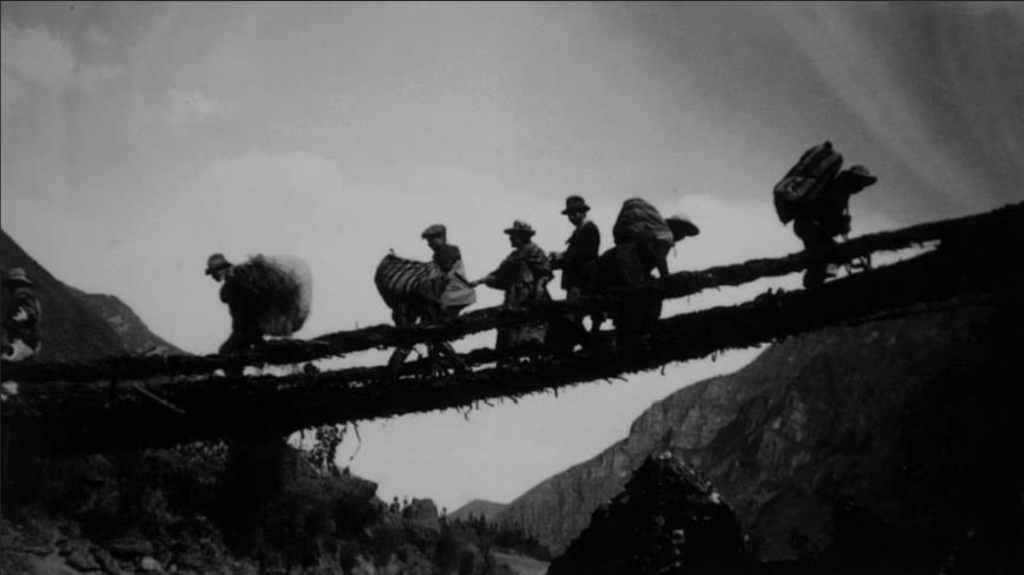
Martin Chambi Rope Bridge

JOHNNY FLYNN: Another Chambi photo: rope bridge. Am I correct in saying you see Chambi in this photograph? Is this the right one?

CIARÁN O’ROURKE: Yes, well found on your part. This is a hand-woven rope-bridge. And you can see Chambi standing slightly taller than the people who are carrying the loads. He’s got his hat on. He obviously had one of his assistants to take the photo.

I love the sweep of the sky, the fact that it seems just a very casual photograph, and at the same time this back-breaking labour is going on… in this non-place. If you were to look at the map of industrial modernity at that moment, in the 20s, none of these people, this landscape, would appear on that map. Whereas Chambi is actually living it.

Martin Jerónimo Chambi Jiménez: Migue Quiespe.
Martin Jerónimo Chambi Jiménez Picture

JOHNNY FLYNN: A Chambi photo: Miguel Quiespe. This is the land-organiser, the guy who walked the hills organising for land rights?

CIARÁN O’ROURKE: Miguel Quiespe is holding two cocoa leaves, which have been outlawed, in the way weed is outlawed today. He’s deliberately about to chew on them. He’s wearing his indigenous garb. I think he was later a member of the Communist Party, but a couple of years later again was found quite brutally assassinated in Lima.

I think in this photograph you get his determination, his hunger (in every sense). You can understand something of the threat he posed to the schematic, modernising forces of the moment. I think Chambi managed to capture something of his power.
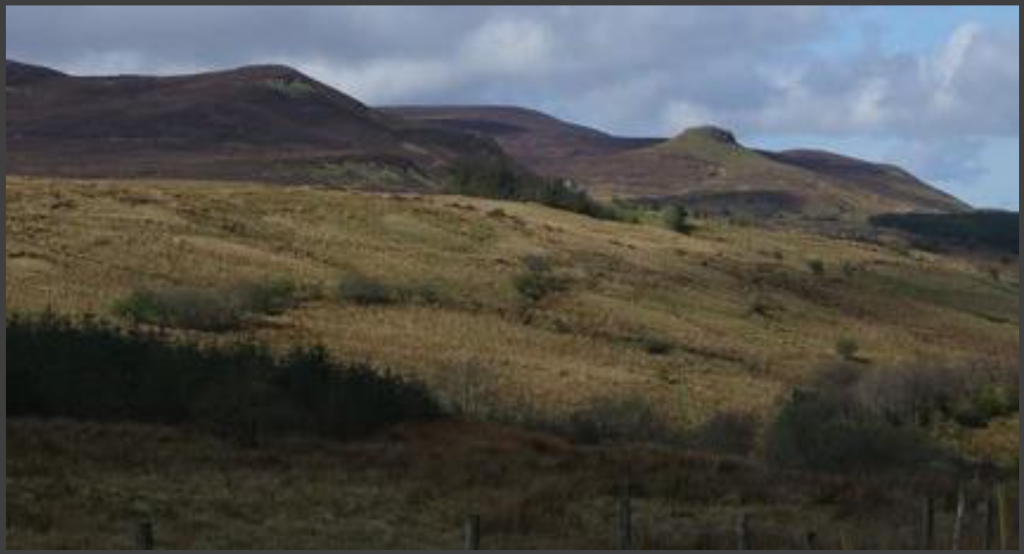
Rossinver Leitrim hills.
Rossinver, Leitrim hills.

JOHNNY FLYNN: Rossinver/Leitrim hills.

CIARÁN O’ROURKE: Thank you for including this photo. This is of the Rossinver braes in Leitrim, near where my grandparents were from. I’ve a short piece in the book…

JOHNNY FLYNN: “On the Verb ‘to be’”, which has a hilarious moment in it. You write: …John McGahern, whose stories and often mordant essays my Grandad used to quote with admiring precision. “It takes some skill”, I recall him saying, definitively, “to finish a sentence with the verb ‘to be’”: a feat the Leitrim author had managed to do, with his adage that ‘all understanding is joy, even in the face of dread, and cannot be taken from us until everything is.’” That’s a great line.

CIARÁN O’ROURKE: Another thing that my grandad used to say is that the longer you live, the sooner you’re going to die, which had its own wisdom to it. And all of that is represented in this photo.

Actually, I know you’re a traditional Irish music fan, so there’s a track called Rossinver Braes, which I think was written by the Leitrim fiddle-player, Ben Lennon. There’s a version of it on Spotify somewhere.
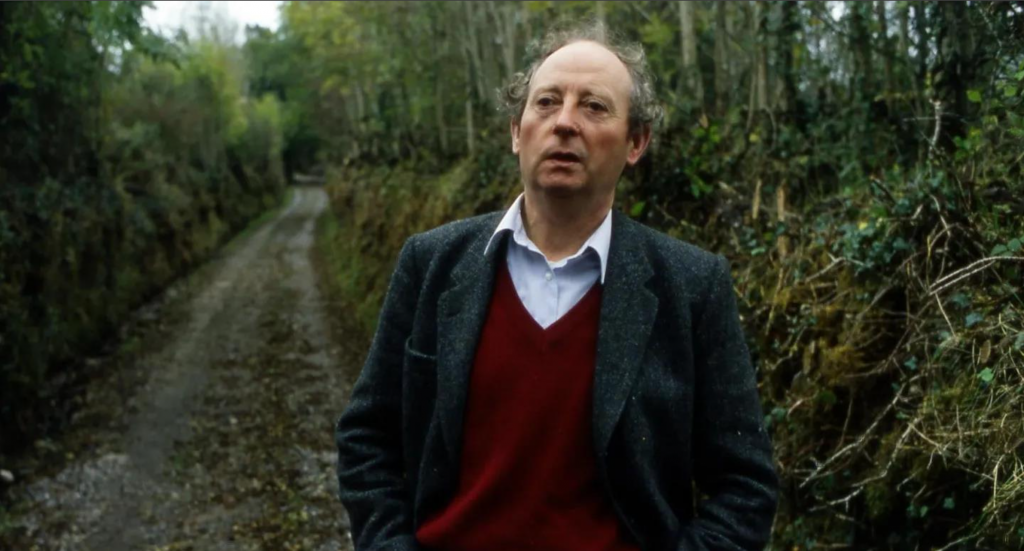
John McGahern
John McGahern

JOHNNY FLYNN: John McGahern. The man himself.

CIARÁN O’ROURKE: John McGahern, looking quizzical and somewhat unimpressed by whatever Irish Times photographer has been sent to document the native life, the life of the natives. I think, as you said, the mordant wit and exploratory impulse that you find in McGahern’s work is probably something to learn from.
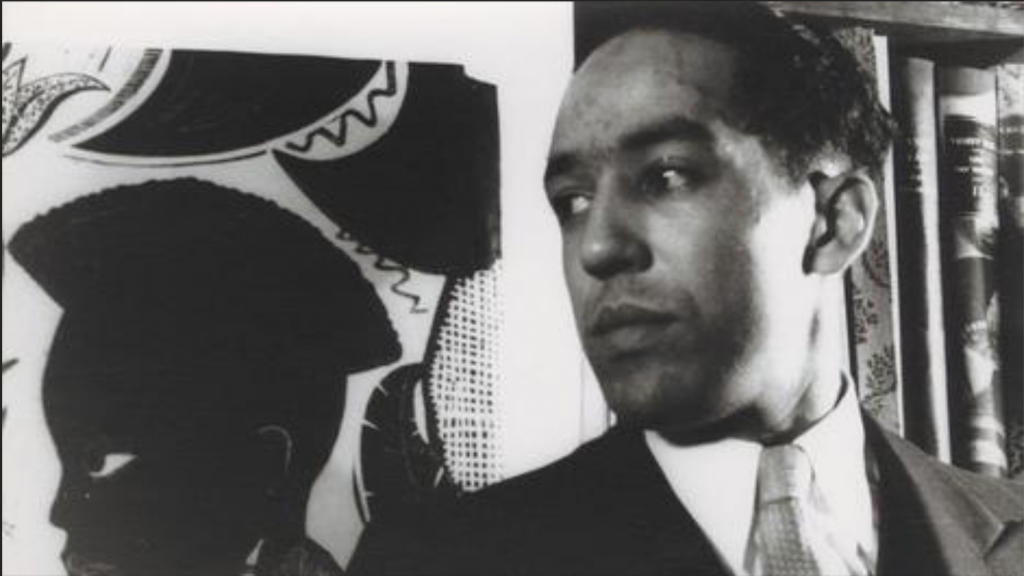
Langston Hughes
Langston Hughes

JOHNNY FLYNN: Langston Hughes.

CIARÁN O’ROURKE: This is young Langston, looking very handsome, I think. And also, you can see the fire in his eyes.

 JOHNNY FLYNN: There’s a good painting in the background as well.

CIARÁN O’ROURKE: Indeed. I agree.
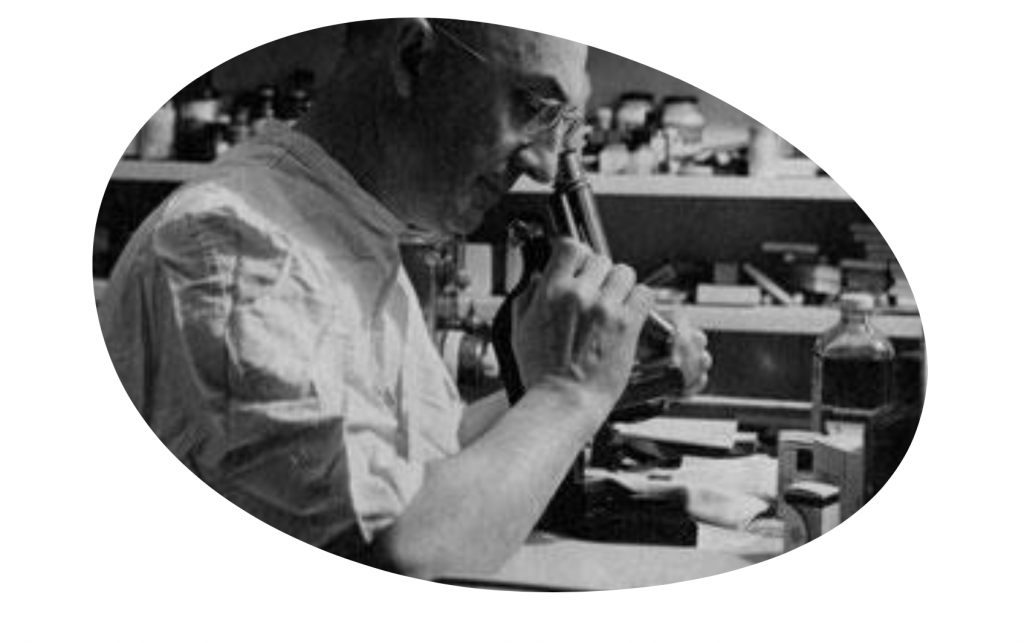
William Carlos Williams

JOHNNY FLYNN: William Carlos Williams photo one.

CIARÁN O’ROURKE: That’s Dr Williams, doing his thing. I’m not sure exactly what date was taken, but when he was in his sixties, after working for a doctor for forty years, and after he started getting a series of terrible strokes (he lost the movement in half his body at one point, I think), anyway when he was in his sixties he was interviewed about his poetry and was even asked about his politics. Obviously, I don’t have a recording of it, but I imagine he sounded something like this: “I’m a radical! I write modern poetry, baby…”. The idea that ultimate proof of being a radical is that you write modern poetry, as he understood it, is very affirming. I’ve a real fondness for his chirpy humanity, and his hard work. He’s working hard here.
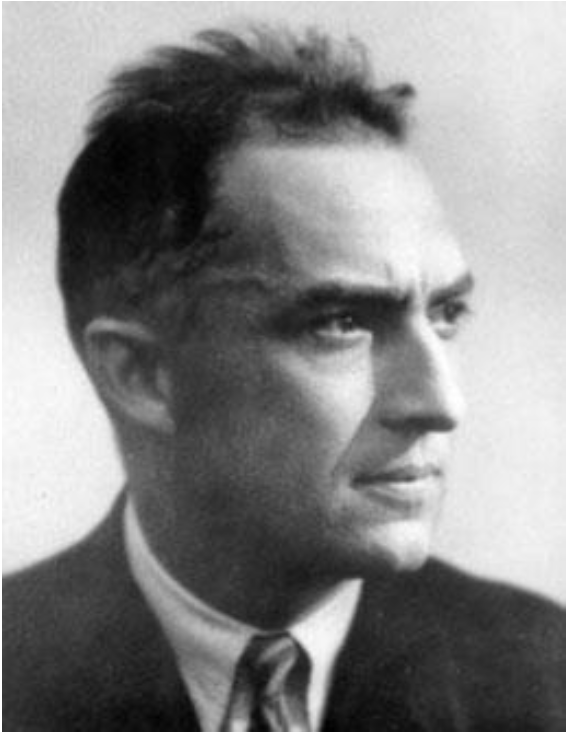
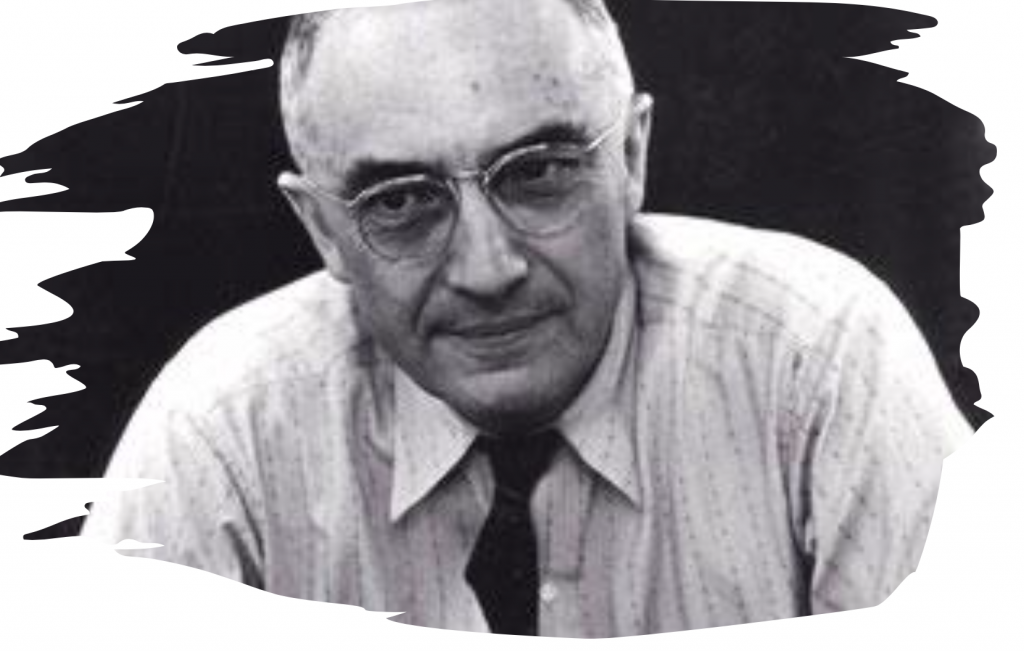
William Carlos Williams 3
William Carlos Williams
William Carlos Williams 2
William Carlos Williams: hard wisdom

JOHNNY FLYNN: Williams photos two and three.

CIARÁN O’ROURKE: There’s a kind of hard wisdom in his eyes there.
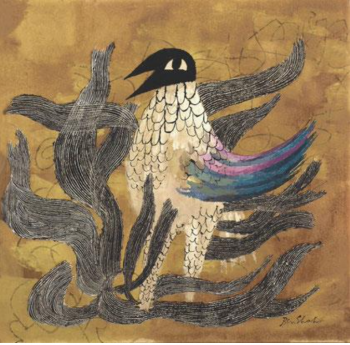
Ben Shahn The Phoenix, c. 1952, gouache and ink on board

JOHNNY FLYNN: Ben Shahn painting.

CIARÁN O’ROURKE: This is Ben Shahn. He was one of Diego Rivera’s assistants on the Rockefeller mural that was later obliterated for being too radical (it depicted Trotsky and Lenin, among others). Anyway, Shahn worked in the tradition of Rivera. He was a first-generation Russian immigrant and a friend of Williams! A social photographer and a kind of radical, strange painter; when Jackson Pollock arrived on the scene I think he supplanted Ben Shahn as America’s so-called leading painter.
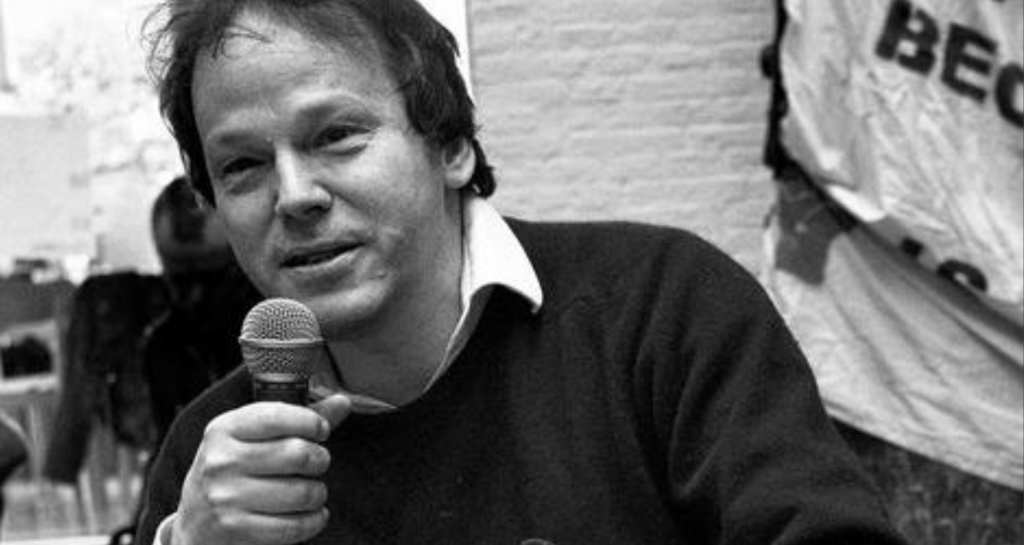
David Graeber
David Graeber

JOHNNY FLYNN: David Graeber.

CIARÁN O’ROURKE: David Graeber, with his soft eyes and thoughtful face, encouraging the revolution wherever he went.
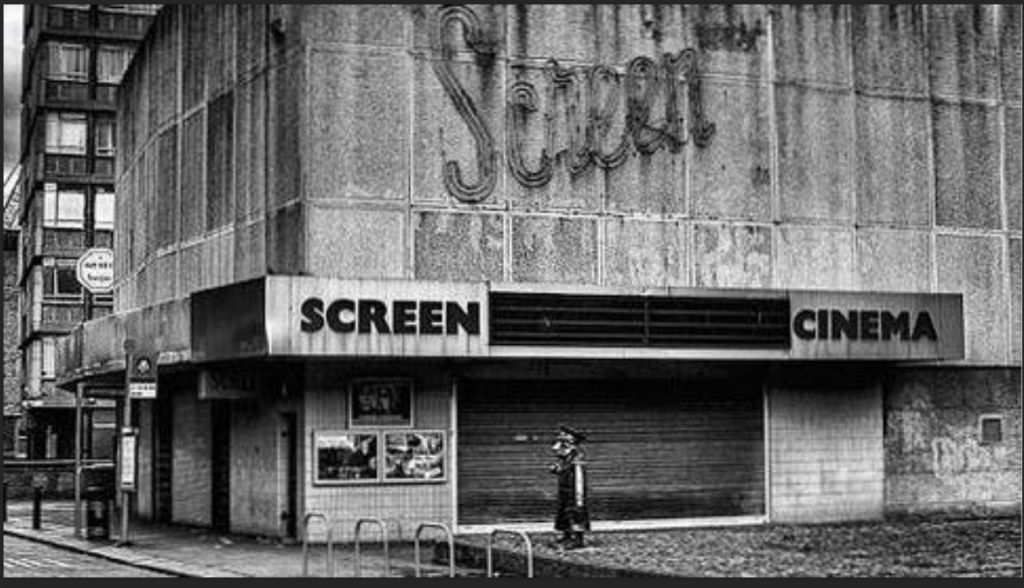
Screen Cinema
Screen Cinema

JOHNNY FLYNN: The Screen Cinema.

CIARÁN O’ROURKE: The Screen Cinema that is no more, with its nice, stocky, brass usher outside.

JOHNNY FLYNN: I like that passage in the essay.

CIARÁN O’ROURKE: You can see the run-down, down-to-earth Dublin there. I think that picture is of when the Screen was derelict, awaiting demolition, but I have very fond and delightful memories of going to the movies there, as you do yourself, I’m sure.

St Patrick's Day images
St Patrick’s Day images

JOHNNY FLYNN: Paddy’s Day in America pictures.

CIARÁN O’ROURKE: I think this somewhat polemical collage is supposed to illustrate a certain relationship between Irish politics and the imperium that is the United States of America. When I used it on my website, in the essay “Smashing the Mirror”, quoting Pinter’s idea that we need to break in our politics and our literature from the empire and its prerogatives, I think I was trying to suggest that Ireland’s literary and artistic scene is very much complicit in whitewashing and normalising the reign of the war-mongers, the Masters of War.
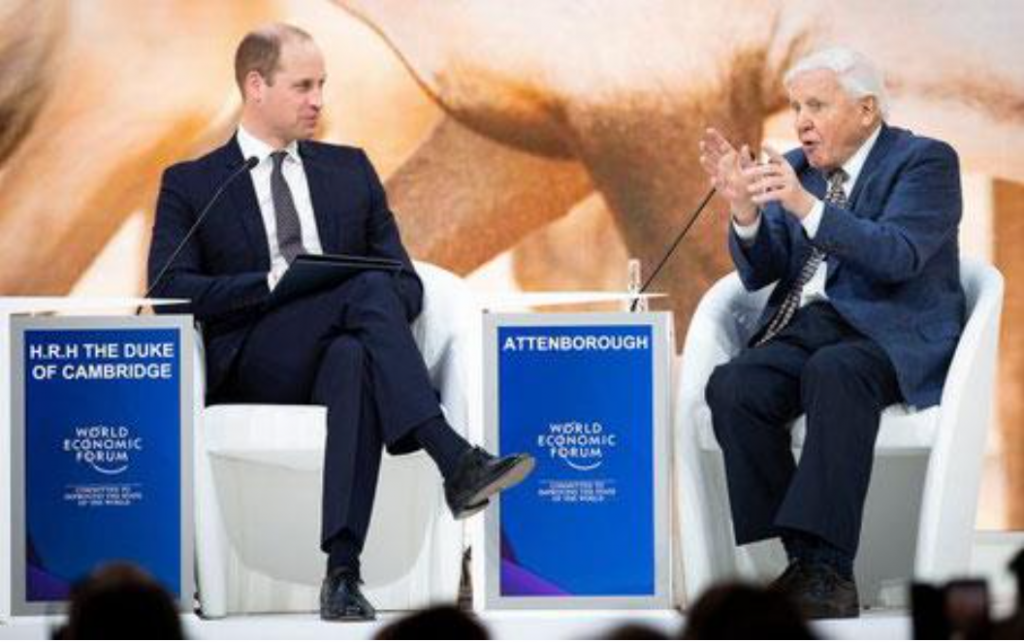
William Windsor and David Attenborough

 JOHNNY FLYNN: Photo of the two Malthusiasts!

CIARÁN O’ROURKE: Jason W. Moore in his book, Capitalism in the Web of Life, at one point articulates a thorough critique of David Attenborough and his BBC-approved approach to climate crisis. He also digs up some of Attenborough’s previous opinions on famine, specifically in Africa, as being a welcome natural check to so-called ‘over-population’.

Moore makes the point that when we say we’re living in the “Anthropocene” and that global warming is somehow symptomatic of that epoch or era, we’ve made a category error. Because it’s the expropriators-in-chief, it’s the drive towards capitalist accumulation, and to increase profits, that have produced some of the most ecologically and humanly damaging industries, which have led to the situation we’re in now. The two individuals on the screen tend to obscure that point, for the most part: they prefer to emphasise people voting every couple of years, and using recyclable bags, and all the rest.
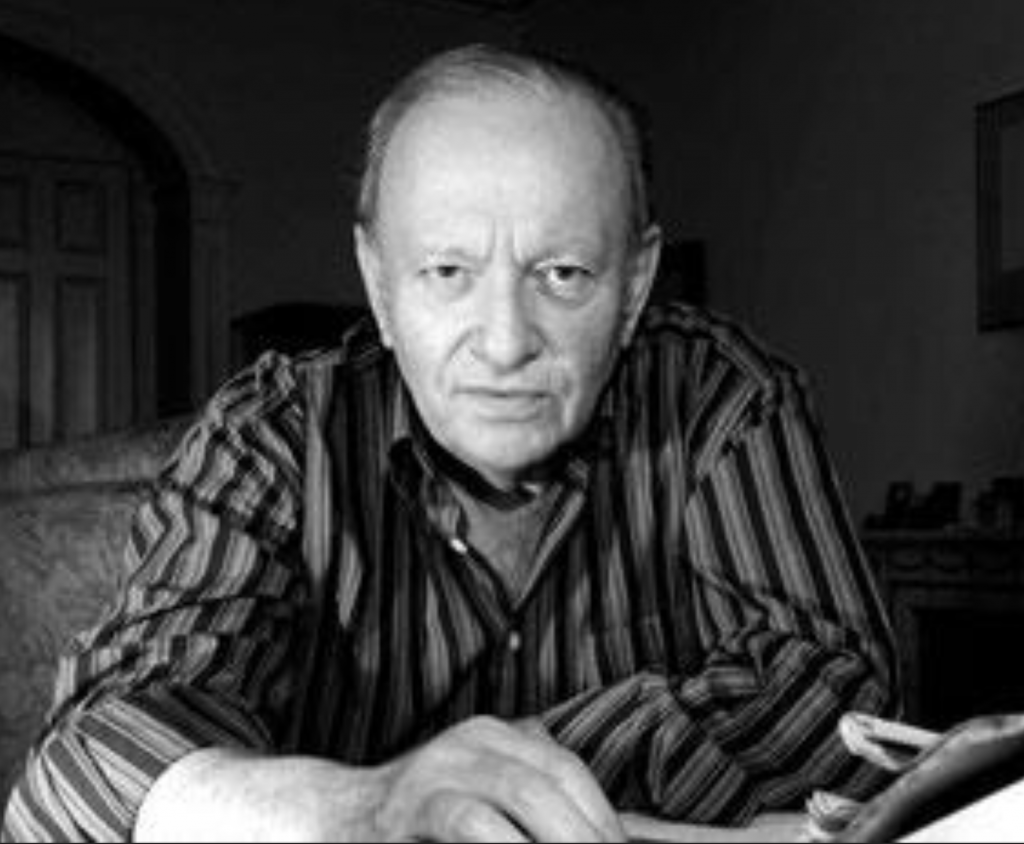
Derek Mahon
Derek Mahon

JOHNNY FLYNN: Derek Mahon photo.

CIARÁN O’ROURKE: This is Derek Mahon, admittedly looking somewhat truculent, and maybe ironic. And also formidable. I think there’s a formidable vision behind that gaze that he’s directing at the camera, and we would do well to learn from.

Naomi Klein
Naomi Klein

JOHNNY FLYNN: Naomi Klein photo.

CIARÁN O’ROURKE: The kindness in Naomi Klein’s face and voice I always find warming, and assuring. And that’s before we get to the powerful and deep-delving critiques of neoliberal civilization that she has managed to articulate.

JOHNNY FLYNN: Derek Mahon calls here “the great Naomi Klein”, in the poem you quote in your essay.

CIARÁN O’ROURKE: You’re right, I should have picked up on the relationship there. So Derek Mahon quotes Naomi Klein, her book The Shock Doctrine, as a way of accusing, in his poem, “the Chicago Boys” in Chile, who facilitated and then allied with the Pinochet regime.
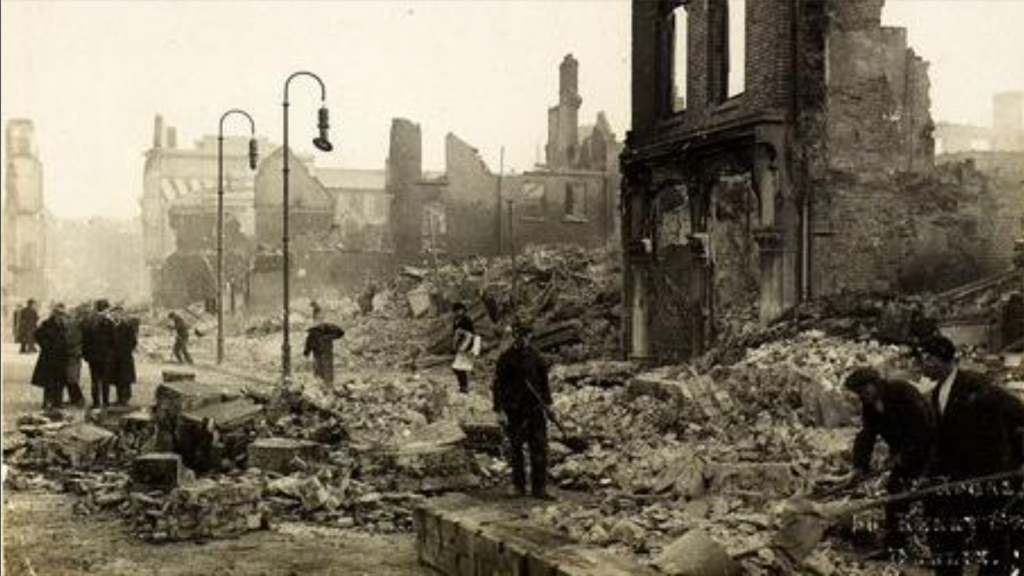
The burning of Cork by the Black and Tans

JOHNNY FLYNN: The burning of Cork.

CIARÁN O’ROURKE: That’s Cork after being burned to the ground by the Black and Tans. It could be Balbriggan. It could be Gaza. Unfortunately, there’s been far too many sites of colonial and imperial plunder and destruction since then, the 20s.

Roy Foster's On Heaney skirts the Seamus Heaney's Political Poems
Roy Foster’s On Heaney

JOHNNY FLYNN: Roy Foster On Seamus Heaney.

CIARÁN O’ROURKE: This is Robert Fitzroy Foster’s tribute to Seamus Heaney, who looks somewhat trepidatious on the cover.
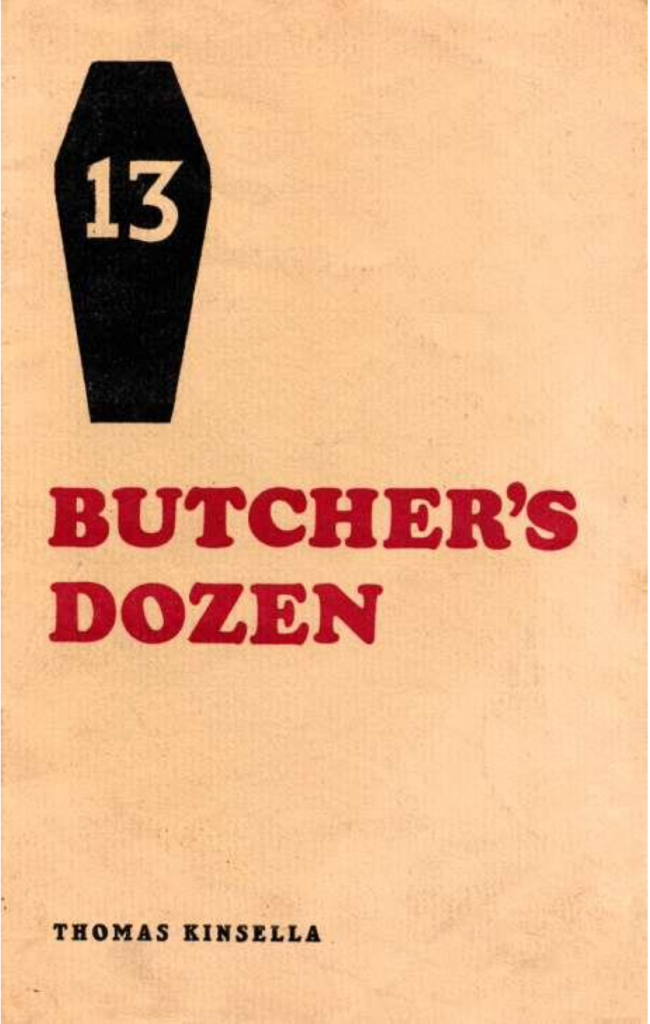
Butcher's Dozen Thomas Kinsella
Butcher’s Dozen Thomas Kinsella

JOHNNY FLYNN: Butcher’s Dozen.

CIARÁN O’ROURKE: Butcher’s Dozen, Thomas Kinsella’s accusation of empire, in the metre and form of Percy Shelley’s Masque of Anarchy. I was saying to you the other day that it’s ironic, in a way, that one of the most radical poems of the Irish poetic canon in the twentieth century was written by a civil servant, someone employed deep in the apparatus of the state. He managed to fight the power nonetheless.

Roxanne Dunbar-Ortiz

JOHNNY FLYNN: Roxanne Dunbar Ortiz.

CIARÁN O’ROURKE: Roxanne Dunbar Ortiz, smiling, I presume, for the critique of American power she’s articulated in an unanswerable fashion in An Indigenous Peoples’ History of the United States. She’s helped us to demystify our understanding of how we got to where we are now.

Napoleon on horseback

JOHNNY FLYNN: Napoleon.

CIARÁN O’ROURKE: Napoleon, looking consequential, and conquering.
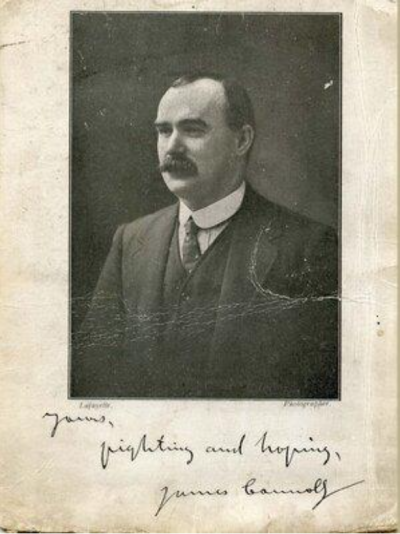
James Connolly Yours Fighting and Hoping
James Connolly: Yours Fighting and Hoping

JOHNNY FLYNN: James Connolly.

CIARÁN O’ROURKE: James Connolly, one of the co-founders of the IWW, head of the Irish Citizen Army, militant trade unionist, a very eloquent writer… who despite all of the above is sometimes accused of not having “a revolutionary party” behind him, oddly. Anyway, here he’s described himself as fighting and hoping. I think we can all aspire to that particular condition.
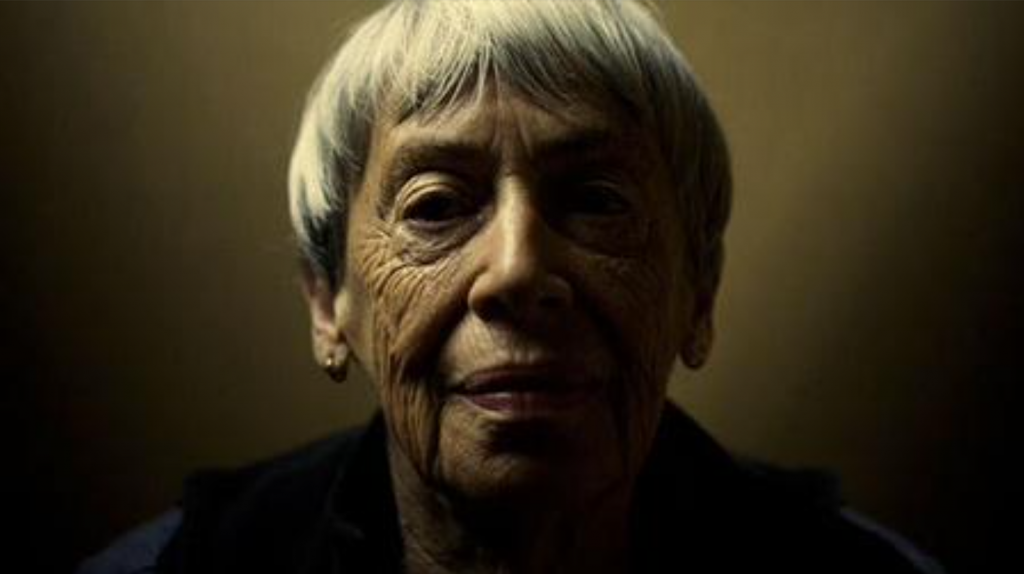
Ursula Le Guin
Ursula Le Guin

JOHNNY FLYNN: Ursula Le Guin

CIARÁN O’ROURKE: The elder, the sage, Ursula Le Guin, one and only.

Rosa Luxemburg
Rosa Luxemburg

JOHNNY FLYNN: Rosa.

CIARÁN O’ROURKE: Red Rosa, who has a glint in her eyes, as I imagine she always did…

Harold Pinter
Harold Pinter

JOHNNY FLYNN: Pinter.

CIARÁN O’ROURKE: Harold Pinter, looking like he’s about to take off.
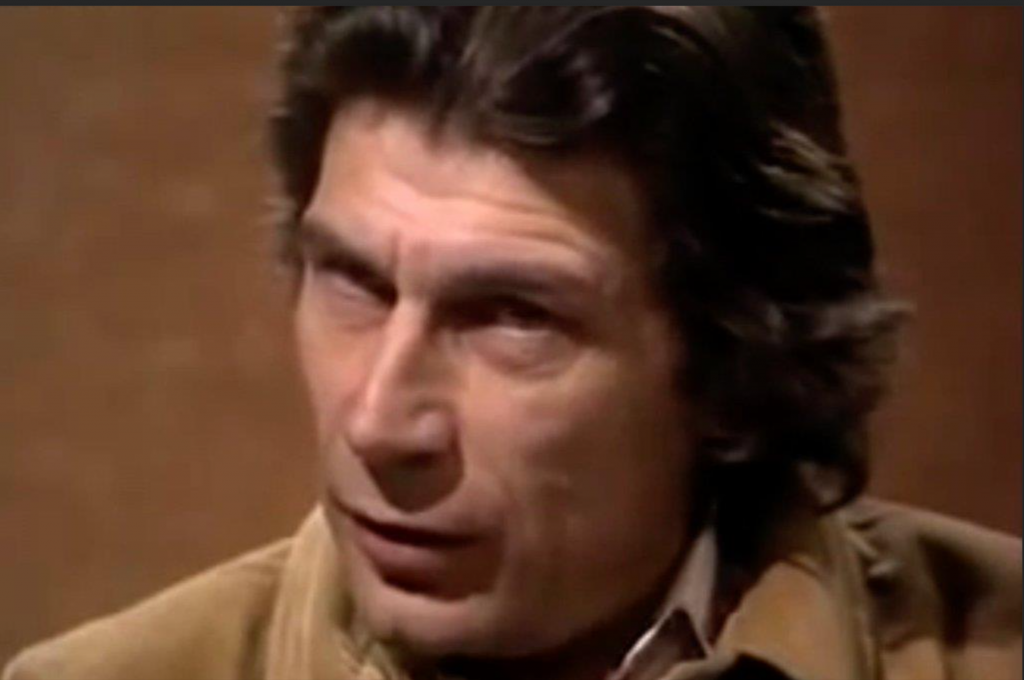
John Berger
John Berger

JOHNNY FLYNN: Berger. That was the time of the Black Panthers, a picture from then.

CIARÁN O’ROURKE: When Berger won the Booker Prize he donated half the prize money to the Black Panther Party in the UK, which was thought to be very provocative and ungrateful on his part. But he was drawing attention to the fact that the Booker Foundation previously profited from the slave trade.

William Shakespeare mural.

JOHNNY FLYNN: Shakespeare. Is this psychedelic or rainbow Shakespeare?

CIARÁN O’ROURKE: He’s a visionary anyway. And I like his pirate ear-piece in this image.

JOHNNY FLYNN: I do as well! I think this is my favourite picture of Shakespeare.

Ran
Ran

JOHNNY FLYNN: Ran.

CIARÁN O’ROURKE: This is Kurosawa’s adaptation of King Lear. Specifically, the moment when the Lear figure puts himself on the side of, or (if you like) in the shoes of, the poor, naked wretches in the storm of history, the carnage of history, who are bare-backed and abandoned by the mighty and powerful. So it’s his moment of either redemption or revelation, one or the other.

JOHNNY FLYNN: I think your Hamlet/Polonius explanation needs to be discussed further.

CIARÁN O’ROURKE: Well, it occurred to me that Hamlet and Prince Hal aren’t very different. Their supposed moral crisis is actually about the necessity they sense, that they have to acquiesce to the will of the court and integrate to their assigned positions in the state. Prince Hal does, he assumes his power, whereas Hamlet can’t, because, I think, he’s terrified that he’ll be the next Polonius, who like him is verbose and subtle, a former actor, and powerful, but utterly impotent in many ways.

JOHNNY FLYNN: Polonius is like someone who collaborates with a totalitarian regime. Didn’t Miroslav Holub write a poem about the Poloniuses?

CIARÁN O’ROURKE: I think Hamlet’s conundrum, or predicament, is “to be or not to be” a collaborator, to collaborate in the new regime. And Polonius is the ultimate exemplar of that style of politics. And the fact that he is beloved of Ophelia, whom he also keeps watch over, he surveils, is quite resonant.
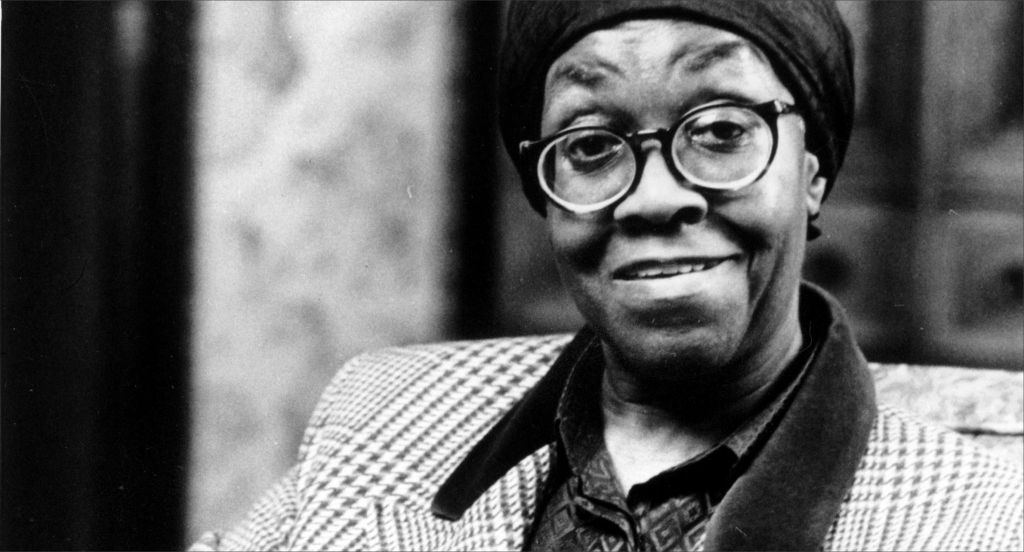
Gwendolyn Brooks
Gwendolyn Brooks

JOHNNY FLYNN: Gwendolyn Brooks.

CIARÁN O’ROURKE: Gwendolyn Brooks, who pays tribute to Langston Hughes, and is a fabulous poet in her own right. She has a [poem] called “We Real Cool”, which extend the Hughes mode into the late 60s. She’s one of the greats, certainly in the second half of the twentieth century in American poetry.

Poet John Clare by William Hilton
Poet John Clare

JOHNNY FLYNN: John Clare. I had to put in John Clare.

CIARÁN O’ROURKE: I associate John Clare’s poetry with conversations with you, in and around the time of that Marxist reading group. So the ghost of John Clare is still lost and love-lorn in the Liberties of Dublin, in my mind.

JOHNNY FLYNN: I guess we could conclude there. How should we sign off?

CIARÁN O’ROURKE: Maybe I’ll just reiterate David Graeber’s point. (I wrote it down before we started, just so I wouldn’t get it wrong!) “The ultimate, hidden truth of the world is that it is something we make, and could just as easily make differently.”

Filed Under: All Posts

Peter Linebaugh Interview

22/10/2020 by John Flynn 7 Comments

Peter Linebaugh watercolour portrait
Peter Linebaugh interview for Independent Left. Portrait by Anastasya Eliseeva for New Frame.

Peter Linebaugh interviewed by Johnny Flynn of Independent Left

Johnny Flynn: The first question I had to ask you was about  the subtitle to your Red Round Globe Hot Burning: a tale at the crossroads of commons and closure, of love and terror, of race and class, and of Kate and Ned Despard. I saw you did a video that is up on the P. M. Press blog where you were talking about crossroads and you referenced Robert Johnson and the idea of being at the crossroads. The time of Edward Despard and Catherine Despard was one of commons and closure and race and class: the beginnings of this horrible white supremacy that we’re beset with now (with all these kinds of fascist berserkers that are all over the world gaining strength). The Despard’s attempt to overthrow the industrial capitalist system and restore the commons failed, and we ourselves are at the crossroads now between our plague-ridden current times and what they call the Anthropocene or the warming climate. Could you talk about that a little bit? How the two are related, if that even makes sense as a question?

Peter Linebaugh: It does make sense. The Anthropocene is basically putting carbon dioxide into the stratosphere, so taking what was underneath the earth and putting it on top of the earth has really messed the earth up, to be simple about it. But Despard, of course, was executed or hanged and decapitated in 1803 and this is at a time when – based on ice samples from the Antarctica – some geologists date the beginning of the pollution of the stratosphere with CO2. Carbon dioxide that’s still up there of course, that has led to global warming, planetary warming, species destruction, desertification and so on. So this is a planetary crisis now that we face.

The USA – or Turtle Island as I’ve taken to calling this part of the planet (based on the first names of the first peoples here, they say Turtle Island) – the USA is basically a product of Despard’s time, that is the 1790s. That’s the same as the UK, the United Kingdom. This was also the time of the Anthropocene. You take these two Uniteds – United Kingdom, United States of America – and try to understand how they are related to the factory and then how is the factory related to the plantation.

Taking the republic, the Anthropocene, white supremacy, the modes of production and put them together and it’s a massive attack, it’s a massive counterrevolution, I would even say, on the planet and on social life of not only two-footed critters but horses, livestock, other species. This is really mind blowing in the sense that it contradicts so many standard narratives, you know, of the scientific revolution, of industrial progress, of secular life, of the enlightenment.

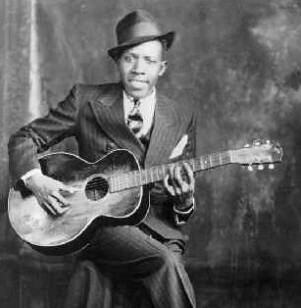
Robert Johnson blues guitarist
Blues guitarist Robert Johnson is evoked by Peter Linebaugh’s idea of the crossroads

I said four things. Let’s see: Anthropocene; the republics; white supremacy; modes of production. I’m sure I’m missing a few other fundamental pillars that had their foundations knit together in the 1790s. Thank you for remembering Robert Johnson and the crossroads because it was that blues tune – or rather the blues man – that was definitely in my mind. This Robert Johnson, the blues man from the Mississippi Delta, who was said to have made a pact with the devil at the crossroads where he was granted genius at the guitar and in music at the price of his soul. And far be it from me to do a sociology of the blues but it is one of the cultural expressions from Turtle Island that arose out of the plantation and against white supremacy.

The dominant religion of white supremacy was this dualistic view of the devil versus Yahweh or a king of the universe, and Robert Johnson defied it in his music. And I see a direct relationship between that and William Blake. William Blake’s Visions of the Daughters of Albion is a beautiful meditation against white supremacy, against political domination, against the love of the body, against Eros, against the alienation of labour. It’s a great poem inspired by the Haitian revolt of 1791.

I’m trying to write a tale of the crossroads and I see that in Edward Despard, the last of many children of an Anglo Irish in County Queens or County Laois, and in Catherine Despard, who was really totally forgotten in history and was a descendant of Africans. They met in the Caribbean or somewhere in North America, maybe Central America, and they formed a revolutionary team, a partnership in the age of revolution, in the age of the United Irishmen and the age of the Haitian revolt, against which I think the United Kingdom and the USA were both formed. I see Ireland and Haiti, or the Caribbean islands, the Caribbean plantation, as kind of the one side of the barbells and the other side of the barbells is the UK and the USA, but again, this is perhaps an undialectical image.

The USA and the UK are past their sell-by date

Johnny Flynn: I remember your extraordinarily provocative statement in one of your talks where you were talking about the United Kingdom and United States. You said that they were both formed as a kind of destruction of the commons, especially in the case of the United States and the United Kingdom: let’s say against the 1798 revolution or attempted revolution of the United Irishmen. So the restoration of the commons would be predicated upon the destruction of what we know of as the United Kingdom and the United States. If I remember correctly, in one of your talks you said something like that?

Peter Linebaugh: I think the USA and the UK are definitely hanging on, gasping for life towards the end of their sell-by date. They’re no longer political organizations that can solve the problems that are facing us, beginning with the effects of the Anthropocene or planetary warming. Their answer, at least, has been to intensify class inequalities and to intensify white supremacy and they’re totally at a loss about what to do against very vibrant forces from the assemblies of the Occupy era from 2011, to the attempts at, quote, ‘socialist constitutions’ in Latin America, against the George Floyd uprising of this last summer. They’re not able to meet these challenges. Hey Johnny, by the way, thank you for saying the whole title, Red Round Globe Hot Burning.

William Blake Visions of the Daughter of Albion cover
Book cover based on original frontispiece of William Blake’s ‘Visions of the Daughters of Albion’, which inspired Peter Linebaugh’s book title for ‘Red Round Globe Hot Burning’

Johnny Flynn: It’s a great title, sure it comes from Blake, the Visions of the Daughters of Albion.

Peter Linebaugh: It does.

Johnny Flynn: There is a great selection of literature in that book. Ciarán O’Rourke and I were thinking you could read through your book and just have people read from different texts that are assembled in the book, because it is like a kind of omnia sunt communia of radical culture and art. It’s like this extraordinary coming together of traditions and texts and everything. It’s just a fabulous work of art, historical art. Not many history books are works of art.

Peter Linebaugh: Thank you for sending me two of Ciarán O’Rourke’s poems.

The Commons and John Clare Enclosed Two Poems by Ciarán O'Rourke
‘The Commons’ and ‘John Clare Enclosed’ two Poems by Ciarán O’Rourke inspired by the writings of Peter Linebaugh. First published in ‘Irish Pages’

Johnny Flynn: He’s a great poet. He’s a political poet as well, so he’s totally in love with the poetic tradition like Blake and John Clare and he’s a great source for me. It’s good to have a friend who’s a poet, you know?

Peter Linebaugh: Yeah, Edward Thompson kind of had a view of poetry as oracular, you know. As related to the prophets who were able to denounce the powers that be and the world as it is.

Peter Linebaugh on Thomas Spence

Johnny Flynn: Thomas Spence is like that. It’s incredible stuff. As you’re reading it, you feel like starting to shout or whatever because it’s so powerful, the stuff he’s saying and the way he says it. The rights of infants or when he’s talking about, ‘Yes, Molochs!’ And all this amazing stuff.

Peter Linebaugh: Yeah, I think Thomas Spence is in a different league. He’s in the streets rather than the drawing rooms, and I’m not saying Blake was not in the streets. He was. He would read aloud in the garden with his wife and they wouldn’t have their clothes on, which in good weather sounds… You’d want to have short poems! And he was also seen wandering around the streets of Lambeth with a bonnet rouge. But Spence definitely, he’s not only on the streets, he’s lying on the streets to do his chalking on the pavement.

Johnny Flynn: Just compelled to resist and in these imaginative ways, through songs and graffiti and his incredible pamphlets.

Peter Linebaugh: And his songs were to the tunes of popular tunes that remind me of the Wobblies, of the IWW, who would … or of Joe Hill who would take Salvation Army tunes and turn them into working class fighting songs.

Johnny Flynn: Who’s the guy who had, They go wild, simply wild over me? Not Joe Hill but the other great songwriter for the Wobblies. T-Bone Slim? Didn’t he have that one where he’s like, ‘They go wild, simply wild over me’? Where he’s saying the cops keep beating me up, the judge keeps putting me away all because I’m a class warrior.

Peter Linebaugh: T-Bone Slim spoke of civil insanity. I won’t say Spence started that tradition, because I think that goes back to Aesop and it goes back to Commedia dell’arte in Italy, or popular forms of song and popular forms of street actions, but definitely Joe Hill and T-Bone Slim are part of that, and it comes out of Spence. I love it.

Many Headed Hydra for Peter Linebaugh interview
The Many-Headed Hydra by Peter Linebaugh and Marcus Rediker

Johnny Flynn: Spence, he kind of radicalized Robert Wedderburn, didn’t he? You and Marcus Rediker have a great passage in your Many-Headed Hydra that describes Robert Wedderburn as a linchpin of the revolutionary Atlantic. It’s a great metaphor it’s brilliant. He’s a fascinating character, Robert Wedderburn. He’s a kind of Jubilee enthusiast like Spence as well: a big believer in the Jubilee.

Peter Linebaugh: That’s right, he was.

Johnny Flynn: Get rid of debts, free the slaves, all this kind of great, great vision, you know?

Peter Linebaugh: And leave the earth fallow for a year. That’s also in Jubilee, and that definitely pertains to our point in the crossroads. I was reading Nature Magazine yesterday; it has released this report that 30% of farmland needs to be turned into wild in order to preserve the planet. That notion of fallow, I think, is essential, and it’s in Jubilee as you were saying, along with debt forgiveness.

Capitalist separation and destruction of the commons

Johnny Flynn: You said that the commons is more forgiving or it’s more friendly to women and children and when it comes, the theft of the commons and the rise of industrial capitalism, women and children were prime victims, whether it’s in slave labour like the reproduction of slaves or actually in the factory system where children were literally being fed into machines at the behest of these capitalist. Whereas the commons was a place of love and solidarity but it was also a formidable place with all these different Commoning traditions. And as with your book, Red Round Globe Hot Burning, it’s not explicitly called an international but it is kind of an international of these different Commoning traditions as Despard and Catherine’s journey is navigated through all these different traditions: from Ireland, to the Miskito Indians to the Mayans and the Iroquois, all these different, great Commoning traditions.

Peter Linebaugh: It is, but they never do quite get together. That was the point of his execution: to demonstrate to the world what happens if you try to get them together. But I want to get back to your other point about how the commons is friendlier to women and to children, because that’s a thought that I learned from my colleague, our colleague, Janet Neeson, who wrote the wonderful book called Commoners, which I think is probably the finest book on the commons in England during this period, during the eighteenth and early nineteenth centuries. She’s the one who taught me that the work of gleaning, the work of pasturage, is something for children as well as for men and women. In fact, just as I was talking, I was thinking of James Joyce. I think as a kid he used to go up into the hills – what do they call it? Booleying? – to look after pasturage of, I suppose, sheep. I’d like to read more about it, but I know he did that. But getting back to the commons and the family life, the family is not just around the kitchen or not just around the hearth, it’s also outside. It’s in the field or in the woods, and here, the family will go. I’m not sure the ramifications of that have been sufficiently explored by historians. I may want to attempt it here with the chapter on the goose, to describe children’s, quote, ‘literature.’

Cover of Commoners by Janet Neeson
Commoners by Janet Neeson praised by Peter Linebaugh as the finest book on the commons in England.

Long before it was literature, it was oral songs and rhymes, not for the nursery but for children, and it took place outside where lessons of cooperation and of sharing would be taught in practice by parents to children. So, then as you say, the factory will put an end and will start to create the divisions between the, quote, ‘public sphere and private sphere’ or the women’s realm and the public reserve for men. We’re still, of course, suffering the ramifications of that, as men can no longer rely on domination as their form of leadership and women are no longer consigned just to compliance and obedience. These are cultural remnants in our psychologies from this era of the capitalist separation and destruction of the commons.

Johnny Flynn: That’s a great way of putting it.

Peter Linebaugh: Well, we need much more work about it, I think, or I’d like to learn more about it, but Janet Neeson, I definitely recommend her.

Johnny Flynn: Would you say it’s a flaw in Marxism, that no one ever talks about how the worker is reproduced? It’s like the worker arrives at the factory to do the work or whatever. You know, do you think Marx overlooked the whole social reproduction? The stuff that was considered women’s work within the kind of capitalist system?

Peter Linebaugh: Johnny, you’re going to make me defensive. So, I think I’ve got to acknowledge that, because I have such admiration for Marx.

Peter Linebaugh photo portrait
Peter Linebaugh interview: ‘I have such admiration for Marx’

Johnny Flynn: Me too.

Peter Linebaugh: And he has so many enemies that to look at his limitations is … Well, it’s necessary and it’s true, he’s got a chapter on reproduction but it’s not social reproduction. In our era there have been such great debates from Maria Mies or Mariarosa Dalla Costa or Sylvia Federici or Margaret Benson, who have pointed and worked with this huge absence from Marx’s political economy, the other half of the human race.

Myself, I think what’s missing in so much of Marxism has depended on his political economy through the disparagement, on the one hand, of the philosophical anthropology of the young Marx, but also the neglect of (and even a failure to publish) the old Marx. Not all the ethnological manuscripts and notebooks have been published or translated. And they are about the commons, whether it’s the Russian obshchina or the peasant ‘mir’ or the Iroquois ‘longhouse’ here in Turtle Island.

Also Marx spent two months at the end of his life in Algeria and there he was investigating also the practices of the Algerian remnants of forms of Commoning. Now, all of this is not to say that just because he’s interested in commons, he’s therefore interested in women’s labour, but the definition of Marxism, I think, has to do with unpaid labour and that phrase that I think has really gotten in the way of many people’s thinking, which is free wage labour. They use freedom in contrast to slavery. I think that’s a hindrance to further thought because when it is labour of reproduction, of raising children, of her care work, whether it’s raising children, looking after the old or getting the breadwinner through the day, that labour is totally unpaid.

Johnny Flynn: What David Graeber, the late David Graeber, calls the bullshit jobs are paid for but the care work is disparaged.

Peter Linebaugh: His death, unexpected, is a great loss to us. He described bullshit jobs definitely. I haven’t read Bullshit Jobs but I did read Debt and I admire it.

Johnny Flynn: We were just speaking about the Jubilee too.

Peter Linebaugh: I think Thomas Spence also confronted this issue of money and wanted to turn money or token into political coin.

Johnny Flynn: Incredible: class war coins. They’re all over your book, Red Round Globe Hot Burning. There are all those different coins in the book.

Thomas Spence radical tokens
Tokens, used as coinage were a form of revolutionary messaging as highlighted in Red Round Globe Hot Burning by Peter Linebaugh

Peter Linebaugh: I like that [1795] one because the top one is a quote from the Irishman Oliver Goldsmith. ‘One only master grasps the whole domain’ and it shows this village that’s just wrecked and these trees that are dead and the squalid nature of the road. The other side of the coin is called The End of Oppression and it shows two people burning deeds, burning property deeds. So, it’s just like when a Zapatista showed up and led by women, they burnt the property deeds there in San Cristobal.

Peter Linebaugh interview: the Charter of the Forest

Johnny Flynn: You told a story about the Zapatistas where you said that you misunderstood Subcomandante Marcos about the Magna Carta, something like that, and then you ended up doing a whole Magna Carta book. Was that correct? I think I remember reading that and thought it was a pretty funny story.

Peter Linebaugh: You’ve got to use your own ignorance to advantage. I’m lousy at language. I don’t speak Irish or can’t pronounce it, same with Spanish and all other languages, so when I saw Subcomandante Marcos referring to Magna Carta, I thought, ‘Oh boy, this is the 1215 charter of liberty,’ but it wasn’t at all, it was the Mexican Constitution he was referring to. But, despite that mistake, it made me pay attention to the Mexican Constitution which was all against the ejido. And that had been the beginning in 1994 or the year before the ejido was removed from the Mexican Constitution: ‘no more commons’. That caused me to go think about the English Magna Carta, what had been its relationship to the commons? And as a result discovering its sister charter, the Charter of the Forest.

The Forest Charter of 1217
The Forest Charter of 1217 obliged the English king to give back the use of the forest to the people

Johnny Flynn: You did very well, actually, because there was some great stuff about the Magna Carta. The Magna Carta Manifesto was brilliant. There’s a video of you on YouTube at Sherwood Forest talking about these great oaks, and you are almost channelling Spence or someone. You get into a real kind of rhetorical power.

Peter Linebaugh: It was like a dream to be in a place where it felt like Robin Hood was going to pop out somewhere and to be surrounded by all these powerful militants from all over the midlands of England, against fracking and for the preservation of the woodlands. There were some wonderful people there and also, Johnny, the most amazing trees I’ve ever seen.

Johnny Flynn: You said to be among these great oaks…

Peter Linebaugh: It was like out of a Hollywood fantasy movie. I expected these oaks to start talking or their limbs moving like arms at any moment.

Peter Linebaugh on thanatocracy

Johnny Flynn: Beginning with The London Hanged you talk about ‘thanatocracy’, which I presume means rule by the spectacle of death, or the threat of death or hanging and executions, as a way of disciplining the common folk who have been kicked off the commons. It’s in Red Round Globe Hot Burning as well, you talk about the thanatocracy. It seems like a key concept for you in the rise of capitalism: red in tooth and claw.

Peter Linebaugh: I’ll talk about it but then I want to know what you think about it, because thanatocracy, I guess it’s Greek, government by death, like you have democracy, government by the people. It comes from John Locke. He defined sovereignty as the ability to pass laws with the punishment of death, and so if that was his notion of sovereignty, that’s the Roman notion of sovereignty too. When Caesar is displaying himself in the city in a procession, he’s preceded by a person carrying a bundle of sticks and these sticks were the fasces and they sit with an axe among them, they indicated sovereignty and the axe was a tool of decapitation.

So capital punishment and the ability to murder or to kill another person was the essence both of the precessions of Caesar but also of John Locke and the foundation of the liberal era. The foundation of law was capital punishment. Of course I wanted to tie it into Marxism. Surplus value, as interest, rent or profit provides bankers, landlords and capitalists and entrepreneurs with their wealth, but it’s always at the expense of those whose value, that is their wages or their receipts of subsistence goods is reduced lower and lower and lower and lower until death arrives.

There is a constant reduction on the value of a human being and the value of work. In fact, work itself is deathly, as Marx showed in Chapter 10 of Capital with the story of Ann Walkley who died from overwork. I learned more about this last night from hearing Mike Stout talk about the struggle at the Homestead Steel Works in Pittsburgh, a factory that produced the steel for the world for a couple generations. He said between 15 and 20 people were killed every year at Homestead at these steelworks in Pittsburgh. And then this summer we saw the police knee on the neck of George Floyd, and this, again, was to demonstrate the power of police. And you look at the policeman’s face and you can see that he’s sort of taking satisfaction in his work, unlike a lot of executioners such as Jack Ketch, a lot of them do not take much satisfaction in that work and it leads to illness. So, there’s a spectrum, I think, from John Locke to George Floyd, and we also see it in the management of the coronavirus, of the pandemic, I think where African American people, poor people, old people are targeted in a kind of triage, an unspoken triage, are left to die, are left to be more susceptible to this disease, and certainly less able to obtain relief.

Cover of The London Hanged by Peter Linebaugh
Cover of The London Hanged in which Peter Linebaugh addresses the idea of a thanatocracy

And then going back to the theories of capitalism in the eighteenth and early nineteenth centuries, especially to Malthus, there is a new form of reasoning, of calculating the deaths numerically across a whole demographic spectrum, a whole society, and I think that method of reasoning had its origins in Ireland with the English conquest of Ireland, with Gregory King and William Petty of the Down Survey. People were beginning to calculate and enumerate populations as a whole. They were beginning to study social reproduction for a whole society. So some of them also anticipated and try to manage deaths. Who is going to starve and who won’t starve? Who is more likely to obtain, get a disease and who isn’t? And this is also, I think, related to thanatocracy. But mainly, of course, thanatocracy refers to capital punishment, which I define not just legally but as the punishment of capital, so it’s trying to broaden the meaning. Now, my question to you, Johnny, is if I had some different essays on this, which I’ve written over the years and I want to put together in a book, do you think I should call it Thanatocracy?

Johnny Flynn: I think it’s an extraordinarily suggestive concept. I think it’s brilliant. For me it gives me a good picture in my mind, everything I think about, the rise of capitalism and through your works I can get a really vivid picture of just the sheer brutality of the enterprise, because often as leftists, you’re always on the back foot. People say, ‘Oh, what about Stalin? What about the brutality of the Soviet experiment or whatever?’ You’re like, ‘Absolutely. I’m not denying it. But let’s also concentrate on this extraordinarily brutal couple of hundred years which is just unparalleled in the terms of the amount of savagery.’ I think thanatocracy is a theme in your works from The London Hanged to tales like The Many-Headed Hydra: such as when Francis Bacon is talking so genocidally about working class people and plebeians.

COVID and the US election from the perspective of Peter Linebaugh

Johnny Flynn: It’s interesting you just brought up the issue of quarantines and COVID. I actually had that as a kind of second question I was going to ask you. Did you think there was any relation to the idea that how people are almost expendable now under this plague system? Does it in any way relate to what you discussed as thanatocracy?

Peter Linebaugh: It’s already part of a mainstream debate in this election year here in the USA. How many lives did Trump sacrifice? Is it 100,000 or is it tens of thousands? There’s sort of a debate, but the assumption in both of them is that those policies led to deaths. But what’s missing from that debate, at least in the mainstream, is those deaths were socially targeted towards a population that’s either dangerous or useless from a standpoint of producing surplus value, from the standpoint of producing wealth or riches for the ruling class. Trump has no use for nursing homes. He has no use for the urban proletariat of cities, and is willing to … I was going to say sacrifice, but it’s more than that. Well, I don’t want to get into his psychology, but politically the morbidity of the coronavirus targets African American, brown people, immigrants and the elderly. That’s common public health knowledge.

What makes a criminal?

Johnny Flynn: I was reading Stop, Thief! where you published, ‘Karl Marx, the Theft of Wood, and Working-Class Composition’, and discuss the essays that alerted or turned Marx towards a more class analysis eventually. You also discuss criminology and especially in The London Hanged and Red Round Globe Hot Burning, it’s like you turn the tables on what is called the criminal and criminality. You basically say the theft of commons was the crime and then this whole architecture of law was built in order to defend that. And then criminalise the customs of the people who were commoners. Let’s say if you worked in the docks you had customary perquisites, you took a certain amount of coffee or tobacco: that was criminalized. You had the police there to ensure that. So now we have this huge architecture of law, this carceral state with the police at the front of it. So I like in your work how you subvert what was traditional in criminology to go, ‘Actually, the real criminals are …’ It’s a bit like the peasant ditty of prison for the man or woman who steals the goose from off the common, but the greater villain is let loose, who steals the common from the goose. I think that’s a great kind of aspect of your work. It’s only one aspect but it’s a very important one because you’re thinking about the whole of capitalism. It really wrong-foots the apologists of capitalism. So if you could talk a little bit about that. That seems to be one of your early kind of entries into this work of yours was that kind of thinking about the whole idea of criminalisation.

Peter Linebaugh: This goes back for me to what I learned from people, other historians like Edward Thompson or Eric Hobsbawn or George Rudé who were writing in the early 1960s. Also, in the early 1960s in the USA there were the municipal uprisings that began in, let’s say, 1962 or ’63 in Harlem and Rochester and then expanded to Detroit, to Watts, and these were rebellions against white supremacy, rebellions against poverty, against slum housing conditions and against a future with no hope, basically no future at all. Those rebellions led to a huge counter-movement of law and order, where it was assumed the only law and order was the law and order of property and of US entrepreneurial individualism. In California it is Ed Meese who becomes the attorney general for Ronald Reagan who then, years later, becomes president under that cultural sign of law and order, which a couple months ago, Trump dragged out and tried to use against the protests of the murder of George Floyd.

Cover of Stop Thief! by Peter Linebaugh

That was the context back in the ’60s, this demonization of African American people, and the man who showed that to me and has showed it to the world as being a phony, slanderous labelling was Malcolm X, Malcolm Little, who himself had been a criminal, a burglar, who did time in prison and who learned in prison in the late 1940s, perhaps from Wobbly teachers in the Massachusetts prison. Anyway, over the years, he begins to turn the tables. So, all you have to do is see what he does and then do it yourself. And I wasn’t the only one, like the other historians. I’m trying to say that my knowledge came out of the movement. What I learned was already being put into practice by the African American working class in the USA. And of course it’s worldwide.

You in Ireland would know it, like in South Africa or India, the different forms of humiliation and degradation which the ruling class always uses, whether it has to do with table manners or whether it has to do with racism, whether it has to do with educational opportunities or living conditions. People from colonial settings learn how to be compliant and how to have that double consciousness, of how to get along with the man, how to get along with authority on the one hand and on the other hand it’s ‘save yourself’, to have some kind of dignity, some kind of solidarity with others who suffer. So taking that quatrain that you quoted: the law locks up the man or woman who steals the goose from off the common but lets the greater villain loose who steels the common from the goose. There’s a story in there that Foucault told us about the carceral society but also in there is the story of Malcolm X, the story of how the prison can become the university of liberation. This happened of course with H-Block in Ireland.

The ruling class will always try to criminalize its opponents and when it comes to property or to subsistence life, then it gets very desperate, and then the famine, early death, morbidity arises. But in Red Round Globe Hot Burning, I got two chapters at least about the criminalization of the commons. Usually we think of the commons in rural or agrarian settings or settings of the woodlands or wetlands or pasture but what these two chapters try to help us see is that the so-called criminality in the city is also like a form of opposition to enclosure, forms of opposition that are analogous to the estovers, the pannage, the herbage, the agistments, these old concepts of the agrarian commons. So that’s what I was trying to do.

Johnny Flynn: You were talking about getting radicalized in prison. I love your idea that maybe Thomas Spence met Edward Despard in prison. I was thinking about that for ages afterwards, just imagining the two of them meeting in prison, because Spence was imprisoned at the same time as the Mutineers or the 1797 naval mutiny. And weren’t the United Irish involved in it?

Peter Linebaugh: Yeah, Valentine Joyce.

Edward Despard and Thomas Spence

Johnny Flynn: When they were in prison, Despard was in prison then as well, wasn’t he? Was he locked up?

Peter Linebaugh: He was locked up in those cells in the Clerkenwell or the Stille. They called it the Bastille or the Stille for short. But Despard also had been in Shrewsbury Prison, another new prison, and his life was a time of prison construction. I think Spence had been there in Shrewsbury Prison, or I know he was, but I’ve wrote the Shrewsbury Record Office because I didn’t have the wherewithal to make a personal visit, because you’re always dependent on the generosity of the archivist as a historian, but they couldn’t date an overlap between Spence and Despard in Shrewsbury Prison. But that’s kind of a vain search, you know, Johnny? They wouldn’t know about each other. Like I never met Malcolm X even though he taught me, you know what I mean? Certainly, there would be plenty of songs that Despard would know.

And I think Spence was very expressive and Despard was not. Despard didn’t write much. Spence wrote quite a bit. That was his method of communication. That, then chalking and music. Despard was a military man. He was a leader and could see many different forces at play at once. He saw the city as a target, as an insurrectionist. He’s more like Auguste Blanqui in French revolutionary history. I don’t know Irish politics well enough to know in the Republican tradition who are those who are most apt to go for another Easter Rising, of just attacking, say, the post office as a first step. But Despard certainly had a tradition of this. He was a skilled artilleryman because of his knowledge of geometry, but he was good at: ‘Where do you put a cannon? What do you point it at? How do you get it there?’ This is largely a question of organizing livestock and human beings to move ordinance around. That’s a big job of labour. And so he in a way was a manager, you know what I mean? We have to look at his life, what he was trained at doing. Then, when he’s jailed in prison all through the 1790s in one prison after another, Newgate, Shrewsbury, the Tower, the Coldbath, Stille and several others, he meets a lot of people and they want to shut him up. They want to prevent him from getting food. They want to make sure that there’s no glass in his windows. They want to make sure that the door doesn’t go down to the floor, so that wind and snow and rain can flood his cell. They want to work on his malaria and see him perish.

Peter Linebaugh: That’s where Kate is so helpful in organizing not just her alone but the relatives, the wives, the women of other political prisoners. They formed support groups, and I think as you emphasise in a review you wrote, she was intrepid.

Johnny Flynn: She put the fear of God in them.

Peter Linebaugh: She did. Horatio Nelson, she’d speak back to him. These people lived in fear of this woman’s tongue and of her righteousness, quoting her in parliament and also trying to subvert her by saying a black person could not write good grammar.

Johnny Flynn: That they were too well written or something.

Peter Linebaugh: When they say, ‘Oh, public schooling,’ what they mean is, ‘You’ve got to come and learn the way we spell, the way we think, the way we write.’ Anyway, there she is, helping to write his last speech at the gallows.

Mass hanging Horsemonger Lane jail of Edward Despard and others
The mass hanging at Horsemonger Lane jail of Edward Despard and other radicals

Johnny Flynn: That speech at the gallows, that’s a good speech. I like that one. She probably must have written the bulk of that, as he doesn’t seem to be the man of words, was he?

Peter Linebaugh: I think he learned that you want to put things in threes.

Johnny Flynn: I love your rumination at the end of the book, ‘What is the human race?’ You end the book with these real bravura chapters, it’s like the red crested bird and the black duck. Allegorical kinds of interesting mise en scene, like the guy who decided he was sick of urban life and went over to live with a Native American and has come back and is telling this story, and how you connected that story with the Irish and the Native Americans. It’s a fascinating chapter, that one. And then ‘what is the human race?’ is brilliant way to end the book because it brings all the themes together.

Peter Linebaugh: Well, the Irish defeat in 1798 meant a lot. Thomas Jefferson would not have been elected president without the effort of former United Irishmen, who were editors of newspapers in South Carolina, North Carolina. The splendid historian of Ireland taught me that.

Johnny Flynn: Who is that, Kevin Whelan?

Peter Linebaugh: This book could not have been written without the writings of very fine Irish scholars and historians and poets, especially from the Field Day tendency. Kevin Whelan is a big part of it and I was very grateful to him and others who invited me to Ireland at the time of the Good Friday Agreement and we had a grand meeting on the commemoration, the bicentennial of the 1798 rebellion. So I really want to thank them very much. And also Patrick Bresnahan at Maynooth who wrote an appreciation of Red Round Globe Hot Burning in the journal Antipode.

We let a point slide by that I want to return to, which was Catherine Despard was active in preventing the foundation of a panopticon. I just wanted to emphasize that. That was one of Jeremy Bentham’s favourite projects.

Johnny Flynn: I’ve one last question, which is about the Diggers and Winstanley and, ‘the earth is a common treasury for all’. If I understand your book correctly, Winstanley and the Diggers, True Levellers, the Ranters, they come from an earlier tradition as well, like maybe Wat Tyler? And the message from the English Revolution, the radical message, stays alive. So when Edward Despard is accused by the prosecutor, Lord Ellenborough, of being a Leveller, of believing in this equality, this terrible stuff. This is Winstanley’s message back again. It’s come back through Edward Despard and his revolutionary conspiracy essentially. It’s gone around the Atlantic and it’s come back as this conspiracy to restore the commons.

Peter Linebaugh: And Despard is only one of the vectors. There are many others.

Johnny Flynn: It’s fascinating that, like you said in the book, that stories help keep alive the memory of defeats or help us understand defeats, and I think your book kind of does that. If you took your book as a story, it pieces together all these things and all the different things happening at the time and it helps us make sense of defeats, but defeats aren’t the end of the story. In the twenty-first century we could still restore the commons, you know?

Peter Linebaugh: I think the crossroads isn’t something that just happened back then. It’s still here, and the alternatives are for us to revive.

Peter Linebaugh in conversation with Johnny Flynn of Independent Left

Filed Under: Reviews

The best revolutionary film of all time?

10/09/2020 by John Flynn 1 Comment

A review of Gillo Pontecorvo’s The Battle of Algiers and Queimada

Queimada Poster: Marlon Brando, Evaristo Marquez directed Gillo Ponecorvo
Queimada is an awesome-looking spectacle; a neglected classic, one of the best revolutionary films of all time

If you are looking for a recommendation for socialist or revolutionary cinema, then you should start with The Battle of Algiers and Queimada by Gillo Pontecorvo, both of which are contenders for the best revolutionary film of all time.

He’s the most dangerous kind of Marxist, a Marxist poet.

Pauline Kael

Pontecorvo’s The Battle of Algiers (1965-66) and Burn! (1969) are, in my opinion, the two greatest political films ever made.

Edward Said

When I’m asked if the film was difficult to make. I honestly explain that it wasn’t as difficult as it looks, even though you see a lot of people, because, once you have chosen this theme, you decide you must tell the truth.

Gillo Pontecorvo, talking about The Battle of Algiers
Gillo Pontecorvo on the set of The Battle for Algiers in front of a demonstration
In 1965-6 Gillo Pontecorvo directed the best revolutionary film to date, The Battle of Algiers

Despite a long career as a director, Gillo Pontecorvo made only five dramatic feature films and a dozen or so documentaries. In a profile of him written by Edward Said, ‘The Quest for Gillo Pontecorvo’, Pontecorvo described how he found it difficult to commit to a project. In the 1960s, however, Pontecorvo collaborated with screenwriter Franco Solinas to make two imperishable classics about the dialectics of imperialism and revolution: The Battle of Algiers and Queimada (or Burn!). The first of these is revered as one of the all-time great political films while the latter has been criminally neglected.

Together, both films still have so much to teach us about the age of anti-colonial revolutions in the 1950s and 60s as well as about the insidious stranglehold of big capital over post-colonial countries.

In the late 1930s, Gillo Pontecorvo was transformed from a handsome, young, tennis-playing bon vivant into a communist militant and resistance leader when confronted by the existential threat of fascism (‘the cancer of humanity’). His elder brother, Bruno Pontecorvo, was both a dedicated communist and a renowned nuclear physicist who defected to the Soviet Union in 1950. Gillo Pontecorvo, like many another, left the Italian Communist Party in 1956, after the Russian invasion of Hungary; Franco Solinas remained in the party until his death in 1982. Pontecorvo remained an independent leftist for the rest of his life. After Queimada, he made only one further feature film, Ogro (1979) about the Basque separatist group ETA.

Cover of Algiers Third World Capital
Elaine Mokhtefi’s Algiers, Third World Capital is a beautifully written book that gives some context to the great political film, The Battle of Algiers

I was reminded of Pontecorvo’s two films while reading Elaine Mokhtefi’s beautiful memoir, Algiers, Third World Capital. Mokhtefi was an assistant to the press and information adviser to Algeria’s president from 1963 – 5, Ahmed Ben Bella. Algiers was then ‘the capital of revolutions’. As Amilcar Cabral (a major figure in Africa’s anti-colonial movements of the 1960s) famously observed at the pan-African festival in Algiers in 1969, ‘Pick a pen and take note: The Muslims make the pilgrimage to Mecca, the Christians to the Vatican, and the national liberation movements to Algiers.’

Elaine Mohtefi’s memoir and the making of The Battle of Algiers

Mokhtefi writes ‘Every imaginable liberation organisation had an office in Algiers, from the National Liberation Front of South Vietnam (the Vietcong) to the ANC, SWAPO, FRELIMO, the MPLA, student hijackers from Ethiopia and Palestinian liberation organisations’. The world she moved in was hectic and exciting, which she describes beautifully: ‘life was exciting and eventful. I was a fly on the window, looking in, beating its wings.’ Her memoir is unique both for its lack of bitterness or self-aggrandizement. She writes with love for Algeria and its people, one of whom, Mokhtar Mokhtefi, she married.

During the filming of The Battle of Algiers, there was a coup by General Henri Boumediene who ousted President Ahmed Ben Bella. This caused some consternation among supporters of the revolution. Fidel Castro was indignant. In France the former Trotskyist turned libertarian communist Daniel Guerin was equally perplexed. He was close to two advisers of Ben Bella who were the theoreticians of the autogestion movement in Algeria. Daniel Guerin was a fabulous character who had great faith in the people of Algeria to self-organise towards something vital,

You should make the land of Algeria a fertile experience of true socialism, that is of libertarian socialism. I have no confidence in your leaders, whoever they are. But I have always confidence in the depth and authenticity of the Algerian revolution.

There is a fascinating book published by AK press called Eyes to the South: French Anarchists and Algeria that discusses Guerin’s deep, lifelong engagement with Algeria. The author, David Porter, posits that Guerin’s classic text Anarchism: From Theory to Practice (1965) maybe have been in part influenced by the self-management experiments post revolution.

With the coup of 1965 there was a purging of left wingers in the government, but Boumedienne was eager to underline his Internationalist credentials by his open support for liberation movements worldwide. Algiers became a mecca for anti-colonial revolutionaries.

Elaine Mokhtefi describes as her brief cameo in The Battle of Algiers as her claim to fame: ‘I appear in that film of films for at least thirty seconds (!), clearly visible in the lower right-hand corner of the screen’. She also worked closely with Frantz Fanon whose writings are the theoretical underpinning for both of Pontecorvo’s films. According to Mokhtefi, a dying Fanon told Claude Lanzmann, ‘the lumpenproletariat of the cities and the poor, illiterate peasantry will take up arms and transform the world’. She also shares a lovely anecdote of another side of Fanon, in Ghana, where he was the first Algerian ambassador.

One night Fanon and I went dancing. A Ghanaian photographer focused his camera on us. Frantz caught him on the edge of the dance floor, and warned him to destroy the photo (it appeared nonetheless in an Accra newspaper a few days later). The FLN had placed a boycott on all French cigarettes. When I shared my Gauloises with him, we became partners in guilt, breaking the ban together.

Poster La Battaglia di Algeri The Battle of Algiers
Poster for the powerful revolutionary film, The Battle of Algiers

People’s opinions of The Battle of Algiers can be radically divergent. I remember reading an egregious attack on Edward Said by Clive James who smeared him as a terrorist sympathizer. His proof: Said’s favourable opinion of The Battle of Algiers and no doubt his lifelong commitment to the Palestinian struggle. The Pentagon screened the film in 2003 to prepare its troops for the invasion of Iraq. It is often said the Black Panthers treated The Battle of Algiers as a manual of urban insurrection.

For every person who thinks that it offers excuses for terrorism someone else will point out that it takes away any imprimatur for violent revolution. It is tempting to quote the Wilde line: ‘diversity of opinion about a work of art shows that the work is new, complex and vital.’ As Sohail Daulatzai writes in his book Fifty Years of “The Battle of Algiers”: Past as Prologue,

The Battle of Algiers is an itinerant film, a nomadic text that has migrated around the world, and has, echoing Edward Said’s ‘travelling theory’ been embraced by a diverse group of revolutionaries, rebel groups and leftists, as well as revanchist, right wing dictators, military juntas and imperial war machines. The film has always been a battleground for competing ideas about power and politics at different historical junctures and in varying places around the globe.

The importance of Franz Fanon’s revolutionary liberation theory for The Battle of Algiers

It is the writings of Frantz Fanon that inspire both films. Obviously The Wretched of the Earth is a key text, but also A Dying Colonialism, a work that Daniel Guerin compared with Trotsky’s A History of the Russian Revolution. The portrayal of female revolutionaries in the film is very influenced by Fanon’s essay ‘Algeria Unveiled’, which is the first chapter of the book. This examined the vexed question of the veil in the colonial situation. Fanon says that,

There is thus a historic dynamism of the veil that is very concretely perceptible in the development of colonization in Algeria. In the beginning, the veil was a mechanism of resistance, but its value for the social group remained very strong. The veil was worn because tradition demanded a rigid separation of the sexes, but also because the occupier was bent on unveiling Algeria. In a second phase, the mutation occurred in connection with the Revolution and under special circumstances. The veil was abandoned in the course of revolutionary action. What had been used to block the psychological or political offensives of the occupier became a means, an instrument. The veil helped the Algerian woman to meet the new problems created by the struggle.

Gillo Pontecorvo on the set of The Battle for Algiers
Gillo Pontecorvo directing veiled women on set of the revolutionary The Siege of Algiers

We can see this dramatized brilliantly in a stunning sequence where three women make themselves up in European dress in order to carry bombs to three locations. Originally this scene had a lot of dialogue but Pontecorvo made the audacious decision to cut the dialogue and instead to use baba saleem music, a ‘piece that closely resembles a heartbeat’. 

There is so much tension in the scene but also a depiction of solidarity amongst the women. Pontecorvo manages to balance so many different elements: the humanity of colonised and colonisers within the pitiless logic of this struggle. We see assassinations, bombings and torture but nothing is ever crude or simplistic. I don’t think it will shock anyone to discover Pontecorvo’s support for anti-colonial revolution, yet the director of The Battle of Algiers doesn’t hesitate to show the horror of bombing a café or cold-blooded assassinations. In the café, before one of the women leaves her bomb under someone’s chair the camera lingers on the face of a child eating ice-cream. It is one of the many instances where Pontecorvo points to the awful toll of this kind of struggle. We see images of bodies under rubble and mourners keening the dead. The same music is played for the French and Algerian dead.

Jean Martin From Battle of Algiers
Jean Martin played the part of the ruthless commander of the French imperial forces, Colonel Mathieu in The Siege of Algiers. Ironically, Jean Martin was a radical and an opponent of French policy in Algeria.

In 1964, two years after the achievement of independence by Algeria, former revolutionary fighter Salah Baazi arrived in Italy looking for a suitable director to make a film about the revolution. Italy was the biggest film producing nation in Europe at the time. He had three directors in mind: Francesco Rosi, who had recently made the masterpiece Salvatore Giuliano; Luchino Visconti, director of neorealist classic film about a Sicilian fishing community,La Terre Trema; and Gillo Pontecorvo, recently Oscar nominated for his harrowing concentration camp drama, Kapo.

The whole story of how Pontecorvo and screenwriter Franco Solinas came to make the film is fascinating. They had a project called Para, about a former parachutist in Indochina who is working as a journalist in Algiers during the war. The two even made a surreptitious trip to Algeria disguised as Journalists during the last months of the war. What became The Battle of Algiers is based on Saadi Yacef’s memoirs. He was the FLN commander in Algiers and, fascinatingly, plays a version of himself in the film. Thanks to Yacef’s prestige, Pontecorvo gained unprecedented access to the Casbah.

Pontecorvo was a most fastidious filmmaker. He worked on every aspect of the film to ensure it had the look and feel of a ‘found’ document of a struggle.  The Battle of Algiers is often discussed in relation to the Third cinema movement which proposed the decolonization of both the world and the medium of film. In the end, though, Pontecorvo was probably too much of a European auteur to fit into this film movement. Though he advocated a collectivist politics he was somewhat autocratic in his artistic approach. This would cause considerable turbulence on the set of Queimada when his working methods clashed with those of Brando. But every decision he made on The Battle of Algiers seems the correct one. It is a perfect a work of film art, if such a thing is even possible.

Brahim Hadjadj in The Battle of Algiers
First time actor Brahim Hadjadj is stunning in the major role of Ali La Pointe, a new revolutionary recruit to the National Liberation Front (FLN).

The Battle of Algiers is traditionally described as having two stories: one is the story of the defeat of the FLN in ‘battle of Algiers’ (1954-1957) by the Paras and the second is the chorale portrait of the growth of collective consciousness of the Algerian people that eventually culminates in victory over the French, the fourth biggest military power in the world. The closing scenes of the film are justly revered as some of the most astonishing ever captured on film. The pitiless logic of an anti-colonial struggle is represented by Ali La Ponte (a stunning performance by Brahim Hadjadj), unemployed boxer and street hustler turned implacable revolutionary versus Colonel Mathieu, the leader of the Paras. An intriguing aspect of Pontecorvo’s film is the very sympathetic portrayal of the Mathieu character whom film critic J Hoberman describes as ‘a Marxist in reverse’. Ironically, the actor who plays the representative of imperial authority, Jean Martin, was a leftist and a signatory to the petition of the 121 against the Algerian war.

Of course, the logic of Colonel Mathieu’s position is horrific: if you believe that Algeria belongs to France then you must accept to use of torture to defeat the secretive cell structure of the FLN. The film opens on a scene of a man who has been broken by torture to reveal the location of Ali La Pointe. Later, in the film, we see incredibly stark images of torture which recall the grisly scenes at Abu Ghraib.

Queimada an unjustly neglected classic revolutionary film

After the huge critical success of The Battle of Algiers, Pontecorvo was offered and turned down countless projects. With the war in Vietnam raging he was still keen to tackle further the topic of imperialism. Screenwriter Franco Solinas developed a story around the transition to a post-colonial situation. Queimada dramatizes the Hegelian master-slave dialectic in the curious Pygmalion-style relationship between Brando’s Sir William Walker, a British agent, and Evaristo Márquez’s Jose Dolores, a water-carrier.

Brando and Gillo Pontecorvo on set Queimada
Marlon Brando (William Walker) and director Gillo Pontecorvo on the set of Queimada, a powerful film about empires and revolutions

Brando’s character is a variation of William Walker, the US adventurer who invaded Nicaragua in the nineteenth century. In the film, he molds the Dolores character into an anti-colonial revolutionary who overthrows Portuguese rule on the Island of Queimada, which ultimately helps facilitate the exploitation of the Island by the Royal Antilles’ Sugar Company. Jose Dolores and his band of revolutionaries eventually rebel against this new post-colonial administration and Sir William Walker (now under the pay of the Royal Antilles Sugar Company) has to return to the Island to put down the revolt.

Queimada is an amazing big-budget spectacle, a leftist Conradian style epic that has a fascinating central relationship between Brando and Marquez. Franco Solinas’ dialogue is brilliant: there are several bravura speeches by Brando, who plays a seductive, villainous, super-intellectual. There are traces of this character carried over from Solinas and Pontecorvo’s abandoned Algerian screenplay, Para. This was to have starred Paul Newman.

Marlon Brando is superb in the film, ‘the greatest actor in the history of cinema’ according to Pontecorvo. The filming process was notoriously difficult, with locations being switched from Columbia to Morocco late in the shoot. Also, fascist dictator Franco’s ludicrous preciousness about the perception of Spanish imperial history meant that the film became about the Portuguese empire and not the Spanish. Thus, the title changed from Quemada to Queimada.

Evaristo Márquez as Jose Dolores Queimada
Evaristo Márquez as the heroic Jose Dolores in one of the best revolutionary films of all time: Queimada

Queimada dramatises both the transition from slavery to wage labour and from colonialism to post-colonialism. The film uses Brando’s incredible acting skills to great effect in two particularly powerful scenes. In one, Sir William Walker utilizes a very patriarchal metaphor to make the argument in favour of wage labour and freedom from foreign domination. In the other, he outlines the transformations than can occur over ten years and how these can reveal the contradictions of a century. He concludes: ‘and so often we have to realize that our judgements and our interpretation and even our hopes may have been wrong – wrong, that’s all’.

In the intervening ten years, Sir William has become ‘a changed man’, disillusioned, but he still pursues Jose Dolores with the savage counterinsurgency where he burns the island in a similar fashion to the behavior of the Portuguese centuries before. When the representative of Royal Sugar objects to this, Walker responds with a speech to General Shelton about the dangers of ships transmitting messages about successful revolutions around the Antilles,

Do you know why this island is called Queimada? Because it was already burnt once, and do you know why? Because even then, it was the only way to conquer the resistance of the people and after that, the Portuguese exploited the island in peace for nearly three hundred years.

That’s the logic of profit, isn’t it, my dear Shelton? One builds to make money. And to go on making it or to make more, sometimes it’s necessary to destroy.  You know that fire can’t cross the sea because it goes out! But certain news, certain ideas travel by ships’ crews.

The revolutionary politics of the film Queimada

Queimada features some extraordinary Carnival scenes that lead up to the assassination of the Portuguese governor of the Island. It is the world turned upside down. As historian Natalie Zemon Davies writes of the scene, ‘it is infused with African motifs, the slaves are brilliantly costumed, their children covered with white fluid to make them look like ghosts, and their cries and dances transfix the soldiers until it is time for the attack’. There are scenes of both ceremonial keening (after the death of the rebel Santiago) and brilliant celebratory scenes around the dead Portuguese soldiers.

We know from histories of the Haitian revolution that Voodoo songs and spirits played a huge role in consciousness raising. Historian Carolyn E Fick writes, ‘insofar as voodoo was a means of self-expression and of psychological or cathartic release from material oppression’ it was still necessary to ‘translate that consciousness into active rebellion and, finally, into the life-and-death struggle of revolution aimed at the total destruction of their masters and slavery, that emancipation could and did become a reality’.

Queimada dramatizes this brilliantly, when Jose Dolores looks on at the villagers dancing in celebration around the bodies of the vanquished Portuguese soldiers. When we see Dolores and his band of revolutionaries’ marching along the beach it is with a realBlack Jacobin–style majesty of a people transformed. Ennio Morricone‘s beautiful music provides perfect accompaniment.

In some ways the scenes of Jose Dolores’ capture from his mountain redoubt and transferal into custody recall similar scenes in Viva Zapata, which also starred Brando. Though Walker is seemingly the victorious character in this long dialectical tussle, it is Jose Dolores who seems the wiser, he is quoted by a villager as saying,

José Dolores says that if what we have in our country is civilization, civilization of white men, then we are better uncivilized because it is better to know where to go and not know how than it is to know how to go and not know where.

Walker, one the other hand, is essentially a spent, cynical character. Dolores refuses to concede to Walker when offered a chance to escape: Sir William is conscious of the implications of Jose becoming a martyr and then a myth. Speaking to General Shelton, Walker makes the observation,

Walker: The man that fights for an idea is a hero. And a hero who is killed becomes a martyr and a martyr immediately becomes a myth. A myth is more dangerous than a man because you can’t kill a myth. Don’t you agree, Shelton? I mean, think of his ghost running through the Antilles. Think of the legends and the songs.

General Shelton: Better songs than armies.

Walker: Better silence than songs.

Earlier, after the initial vanquishing of the Portuguese, Walker spoke to Jose Dolores,

Walker: Who’ll govern your island, José? Who’ll run your industries? Who’ll handle your commerce? Who’ll cure the sick? Teach in your schools? This man? Or that man? Or the other? Civilization is not a simple matter, José. You cannot learn its secrets overnight. Today civilization belongs to the white man – and you must learn to use it. Without it, you cannot go forward.

Walker’s questions strike at the pernicious reality of the post-colonial situation. European civilization is based on the predation of other countries (‘what civilisation?’ asks Jose Dolores). This recalls Eduardo Galeano’s passage about ‘Europe’s legacy’ in Mirrors: A History of the World, Refracted,

When Belgium left the Congo, a total of three Congolese held positions of responsibility in government.

When Great Britain left Tanzania, the country had but two engineers and twelve doctors.

When Spain left Western Sahara, the country had but one doctor, one lawyer, and one specialist in commerce.

When Portugal left Mozambique, the country had a 99 percent illiteracy rate, not a single high school graduate, and no university.

A systematic underdevelopment of the colonies they exploited was a feature of empire. When the slaves of St Domingue made the greatest slave revolution in history they were ever after punished cruelly by the French and the Americans.

The ending of the film is ambiguous: Walker is stabbed as he walks along the port towards his ship. He hears a voice saying: ‘your bag, senor?’ which is exactly what Jose Dolores says to him on two earlier occasions: once, when he first arrives; the second, when he first leaves the island. This time, it is another, who stabs him, perhaps in revenge for Jose Dolores?

The Battle of Algiers and Queimada are two very different, yet revolutionary, films. Whereas Battle has the incendiary bite of third cinema combined with Italian neorealism, Queimada is an awesome-looking spectacle, more expansive and intellectual. Together they make a fabulous double feature. Hopefully, someone will produce a restored version of Queimada in the future. Until then, you can watch it on Youtube, either the American or European version.

Filed Under: Reviews

Review: The Retreat by Conor Kostick

09/04/2020 by John Flynn 1 Comment

The cover of Conor Kostick's novel, The Retreat. A knight on horseback rides through a mysterious dark green forest. He seems despondent, to judge from the lowered lance.
Conor Kostick’s new book The Retreat is a ‘thrilling tale set in the Middle Ages during the crusades’

Conor Kostick’s new novel, The Retreat, is a thrilling tale set in the Middle Ages during the crusades. It is narrated by Guibert of Rocadamour, a naïve aristocratic youth, who joins a crusade expedition having soaked up the propaganda of the chansons and the chronicles. He is swiftly disabused of his illusions when the expedition is derailed at the outset, with the would-be crusaders sacking the castle of Devinium and stealing its wealth. From there, the novel follows a course of violent actions and reprisals all determined by the cupidity of the characters. So exciting is this tale that it is easy to overlook the political dimensions to the novel and the intriguing ambiguity at its centre. 

This is not a history. I write because I feel a dark geas upon me: almost as though I have been condemned to search my own memories and relive these experiences.

Throughout The Retreat, there are references to Hades, the underworld. The narrator, Guibert of Rocadamour, references the line that Achilles’ shade gave to cunning Odysseus: ‘you told him to choose one day of life as a slave in dusty fields over an eternity of death as the ruler of Hades’. Later, he imagines himself as Orpheus, another voyager to Hades. Geas is a Gaelic word that the dictionary defines as ‘(in Irish folklore) an obligation or prohibition magically imposed on a person.’ This central ambiguity about whether the narrator is dead provides a fascinating lens to interpret the novel. 

Historical accuracy is subtly present in the novel 

Kostick is also an historian of the crusades who has written works like The Social Structure of The First Crusade, which built on his doctoral thesis, ‘The Language of Ordo in The Early Histories of The First Crusade’. So, there is considerable historical erudition subtly introduced in the story. In Chapter 5, Guibert writes:

The news of an expedition travelling to the Holy Land had attracted peasants and burghers of all ages. Entire families of poor people had joined the enterprise: grandparents, parents, and infants. Some of these farmers and city dwellers bore arms, worthless rusty scythes or spears with flimsy points. Most didn’t. Then too, we had monks and nuns of all ages marching with us. 

The narrator is a noble who is forced to confront his class bias. This is fundamental to the story. Why? In part it is because the heterogenous make-up of the expedition’s members eventually upend his world view. Guibert often must rely on the good advice of Gerard, a commoner, for example, ‘I did not resent the fact that Gerard, a footsoldier, gave the orders for our army. Unnatural as it was by the standards I was used to at home, we were a long way from Rocadamour’. The is a double meaning in the word ‘unnatural’, implying both a break from the strict hierarchy but also ‘not existing in nature’. The excellent Song of Count Stephen which appears in chapter 16 captures the notion of a world turned upside down in one of its verses:

A monstrous roar comes from the trees. 

Another army has appeared where none should be. 

It is the cook, the nurse, the old and the sick. 

The smith, the washerwoman, the former serf. 

In their hands are tools not weapons of war. 

The world has turned upside down. 

To the monks, the nuns, adolescents and wives. 

Count Stephen and his knights owe their lives. 

There are some great conversations in the novel that quite subtly fill in the background realities of life in the middle ages. In one instance, there is a tantalizing glimpse of religious heterodoxy when Robert, a knight tells Jacques, a mercenary, about his experiences in the Holy Land. ‘Did you know the Bible doesn’t have all that should be in it?’ Guibert’s tart appraisal is, ‘his voice had in it the enthusiasm of men and women who carried obsessions in their hearts’. ‘Enthusiasm’ conjures up images of religious heresy which was rife in the middles ages.

Later in the novel, Gerard offers an amusing summary of the situation in Ireland, 

There are a hundred kings in Ireland, each with a dozen princes, each with a dozen lords and each of them has at least a dozen followers. But every one of these men reckons a descent from the high-kings and that he would make a great and famous king himself one day. So fortunes rise and fall there faster than anywhere else in the world. 

An historical novel about the crusades that shows how myths begin

We witness in the novel the myth-making process of the middle ages: the creation of chansons and chronicles which celebrate the valorous deeds of lords and knights. Through a single reference to a chronicle entitled The Deeds of Count Stephen the novel hints of the existence of a history of these events and the reader gets to witness the performance of a section of a chanson, The Song of Count Stephen, which exaggerates the bloody battle that we witnessed in the Beserkir chapter. Guibert is apotheosised as follows: ‘I am thunder and lightning. I am / Storm and wrath. I plunge my blade through iron / And bone. Unquenchable heat burns through me, / Like a forest fire.’ Guibert is slightly dismayed at the liberties that the poet takes with the truth. But the poet is unperturbed, ‘the song requires it. If you want history, speak of your deeds to a scribe. If you want fame, then have me leave the verse as it stands’ 

Turning the world upside down is probably one of the most enduring leftist slogans of all time, so it’s not accidental when it appears in the work of a left-wing writer. But here, its impact is compounded by the ambiguity at the heart of the novel. That is, the continual reference to ‘Hades’, the underworld, in lines like: 

And I had not rid myself of the sensation that the shadows of the forest were those of Hades and we were all dead, that perhaps we had all died in the field with the rest of Shalk’s army, it was just that we did not know it.

Or, 

 ‘…then the sky beyond the windows changed to a silvery grey and I knew we were now in Hades.’

Interestingly, this description occurs during the narrator’s nightmare episode in the chapter entitled:  ‘A Dream That Affrightens’. I count ten references to Hades in the novel. Is the narrator in fact dead, hence his susceptibility to the levelling of class distinctions? 

Class and gender are brilliantly interwoven in the relationship between Guibert and Cataline. Our narrator, the young knight, is full of the cliches of courtly romance while the peasant girl Cataline has already lived through a life of hardship and the savage death of her parents. Her post-coital words are profound: ‘Hush. It’s done. It’s all done. We live.’ Her later brusque rebuttal of his oppressive proprietary romanticism is brilliant and deeply problematic. 

I lay with you because you deserved it, for what you did for us. And also because I think we will all be dead soon. Why not enjoy a little sweetness while we can? But I’m not some farmer’s daughter with designs upon a local knight.

Guibert’s relationship with the woman Cataline is a lens through which to view the class differences in medieval society. Noble women did not go on crusades, whereas Cataline and Melinde (a powerful wife of a mercenary leader) are active participants. Guibert is full of romantic clichés, no doubt gleaned from chansons, whereas Cataline is alert the hard reality of life. Her experiences provoke Guibert’s observation that ‘a lady who had never experienced the certainty of her own death, never witnessed a battle, nor carried a knife to slit the throats of wounded enemies, such a lady could never understand and comfort me like this’. 

The Retreat is a tragedy driven by greed

Cupidity is the undoing of the expedition. Greed for loot provokes atrocities that propel the group towards disaster.  The ‘Mutur’ leader, Rainulf, murders the rapacious Bishop Wernher later in the novel and steals his treasure.

One of the most interesting aspects of the novel is the very just criticisms that characters direct towards their class enemies. For instance, when Rainulf disdains the contempt of Count Stephen (and Guibert, too), ‘do I need to witness the contempt of a man whose refined ways are paid for by the toil of a thousand serfs?’ While they are tracking down the forest dwellers that kidnapped Cataline, Guibert offhandedly makes a stunningly revealing statement of his cruel class position: 

‘Sometimes a serf runs. But they hardly ever get far. One time though, Count Theobald sent one of ours all the way back from Troyes. Runaways would never manage to set up a home or village of their own.’  

This is a savage world where the innocent are slaughtered by paid mercenaries, ‘when a man is paid to wield a sword, he loses the right to follow his own wishes’. There is a dark irony in an expedition ostensibly travelling to Jerusalem to ‘lift our sins’ (as Melinde says at one point), which perpetrates atrocities along the way.  

The Retreat is a great novel which merits a second reading to really get to savour the morally complex and brilliantly rendered ambiguity of this failed expedition. I read it the first time as a gripping and violent adventure tale. But then, looking through it again, I began to appreciate the novel’s many subtleties. It is fascinating how the novel successfully condenses so much of the world of the Middle Ages in the text.

The Retreat is currently available as an ebook or as an audiobook.

An online book launch for Conor Kostick’s novel took place on 2 May at 9pm (Dublin) via zoom.

The online launch of The Reatreat by Conor Kostick

Filed Under: All Posts, Reviews

Review: Red Round Globe Hot Burning

14/02/2020 by John Flynn 3 Comments

The book cover to Red Round Globe Hot Burning by Peter Linebaugh, which Independent Left review as a masterpiece of radical literature. It has the title in white text against an image of a human figure on a cloud, holding a black double-headed hammer, which is head down towards a deep red globe beneath the cloud. In yellow are the words: A A Tale at the Crossroads of Commons & Closure, of Love & Terror, of Race & Class, and of Kate & Ned Despard.
Peter Linebaugh‘s Red Round Globe Hot Burning is a masterpiece of radical history.

By John Flynn

Peter Linebaugh’s 2019 book Red Round Globe Hot Burning is his greatest masterpiece yet in a lifetime of triumphs. It is a mind-blowing contribution to his lifelong quest for the commons. This is a quest begun through his apprenticeship to the late Edward Thompson (whose copy of The Trial of Edward Despard Linebaugh has carried with him in his luggage all his life), and deepened with his stunning work The London Hanged. Then there is Linebaugh’s utterly miraculous collaboration with ‘fellow shipmate’ Marcus Rediker on The Many-Headed Hydra. Throw in his unforgettable Mayday Essays and his work on The Magna Carta Manifesto, not to mention his Stop Thief, a wonderful, Wobbly-inspired titled collection of essays and you have a writer of such extraordinary power that reading him can move you to tears (and will always lift your spirits). His subjects are the picaresque proletariat of the revolutionary Atlantic: some of the boldest, most irrepressible characters to ever walk the earth.

The title of this recent book is taken from William Blake’s Vision of The Daughters of Albion

They told me that I had five senses to inclose me up,

And they inclos’d my infinite brain into a narrow circle,

And sunk my heart into the Abyss, a red round globe hot burning

Till all from life I was obliterated and erased.

Linebaugh, like his mentor Thompson, is a Blake enthusiast. He writes perceptively about Blake’s work, seeing the revolutionary thinking in Blake’s complex prophecy in The Book of Urizen which he interprets as an allegory designed to describe the Atlantic transition to child labour and slavery.

It is how Linebaugh glosses the phrase ‘Red Round Globe Hot Burning’ that speaks to everything about our world today, beset as with are with fascist berserkers and a climate out of whack. In his tale ‘at the crossroads of commons and closure, of love and terror, of race and class, and of Kate and Ned Despard’ Linebaugh, ‘the people’s remembrancer’, depicts two revolutionary lovers who broke through the hardening walls of white supremacy and made a valiant attempt to overthrow the still nascent industrial capitalist system and restore the commons. In the words that they wrote together while Despard was in prison, and that he delivered from the scaffold not long after other legendary heroes from the United Irishmen suffered similar fates:

But, Citizens, I hope and trust, notwithstanding my fate, and the fate of those who no doubt will soon follow me, that the principles of freedom, of humanity, and of justice, will finally triumph over falsehood, tyranny and delusion, and every principle inimical to the interests of the human race.

Edward Despard was an Anglo-Irish officer in the British army who once saved the life of Nelson and was greatly respected for his abilities as an engineer. He  married Kate, an African American woman, and turned revolutionary in part because of his experiences among indigenous commoners in Nicaragua and Honduras. It was Despard’s open sympathy with people of colour that provoked the baymen of Honduras ‘to take arms in Defence of our lives and properties against an armed banditti of all colours’. Kate, ‘the fearless abolitionist, the tireless prison reformer, the United Irish woman, is the hero of this story’. She visited Ned in three prisons, was a terror to the authorities, for to quote Nelson, she was ‘violently in love’ with Ned. In one awesome campaign she successfully prevented Jeremy Bentham from building his panopticon on Tothill’s Fields commons.

A blue-tinged watercolour shows an eighteenth century imperial warship on a calm sea. To the right of the frame, filling the height of it, is a portrait of Peter Linebaugh by Anastasya Eliseeva: he is wearing glasses, has a slight smile and wears a scarf.
Portrait of left-wing historian Peter Linebaugh by Anastasya Eliseeva for New Frame.

The themes of Linebaugh’s latest book

The methods that Linebaugh uses to tell this tale are bold and well suited to his themes. He roams like a true commoner through space and time and across many disciplines (History, Literature, Climate Science, Thermodynamics, Engineering, Mycology, Zoology, etc) which makes his book such an incredible read. I have been through it now six times and each reading offers fresh delights. He makes great use of the poetry of John Clare and Blake, two fervent lovers of the commons, and of the poetry of the ‘hidden Ireland’ where insurrectionary thoughts were never far from the surface. He employs both statistical and anecdotal evidence to illustrate the truth behind his favourite peasant ‘koan’:

The Law locks up the man or woman who steals the goose from off the commons,

But leaves the greater villain loose that steals the commons from the goose.

Also, like a true Blake enthusiast, he has an uncanny knack for reading hostile official sources in a ‘Satanic light’ to provide brilliant evidence of the class struggle. What always stands out in Linebaugh’s work is his love of language, particularly the language of poets and proletarians. You really get the sense of Linebaugh relishing the language of each quotation he uses. There is one from an extraordinary passage: part Linebaugh, part William Covel, execrating the enclosers of Enfield commons, which nicely illustrates how much of ‘a true Leveler’ Linebaugh has become through his years of thinking and writing about a tradition inspired by Winstanley and the diggers.

[Covel’s] class consciousness was vivid. He inveighed against the possessors, their fat and scornful eyes, their taunting speech – “What lyings! What cheatings! What blood! What murders! What divisions! What tumults! What pride! What covetousness!” “Oh how the buyers and sellers are guarded, fenced with walls, and defended with Laws!” He said that the wicked of the world rule by three principles: 1) strength united is stronger, 2) “divide and spoil,” and 3) “make poor enough, and you will rule well enough”. In particular, he denounced lawyers, clergymen, corporations, and great tradesmen. Gold and silver were their signs of glory “but to others [they were] a sign of death.” In contrast, mariners, those who follow the plough, and those who practice handicrafts were useful, for on their labors all others depended.

You could with great success and much happiness for yourself practice bibliomancy with Linebaugh’s book. It would be a great spiritual defence in these frightening times to open the text at random and read his glorious prose or the many brilliant quotations he has selected. His discussion of the different kinds of love, for instance, is marvelous,

This is a story both of a couple and of the commons. Doubtless eros was part of their love – Ned and Kate had a son- and so was philia, or that egalitarian love of comrades and friends. The love of the commons was akin to that love the Greeks called agape, the creative and redemptive love of justice, with its sacred connotations.

So, what is the commons that Linebaugh writes of? I would say a permanent revolution in social reproduction inspired by the history of commoning. He advocates for the omnia sunt communia of Thomas Müntzer, the great religious communist leader of the German peasants’ revolt. The great digger, or ‘true leveller’, Gerard Winstanley’s ‘the earth was made a common treasury for all’ inspires his thinking. Linebaugh distinguishes between the radical claims on the commons made by Winstanley to those of Thomas Rainborough.

Winstanley propounds a communist theory of land. Rainborough is all about government and the nation, whereas Winstanley is all about land and subsistence. Rainborough was a Leveler, while Winstanley called himself a “True Leveller”. Rainborough is deferential (“truly, sir”), while Winstanley is declarative (“freedom is the man who will turn the world upside downe”).

We see the same differences between Tom Paine and Thomas Spence which Spence himself brilliantly outlined in his  A CONTRAST Between PAINE’s AGRARIAN JUSTICE, and SPENCE’s END OF OPPRESSION. 

Spence is one the most beautiful, awe-inspiring, irrepressible radical worker intellectuals from the British Isles. He wrote brilliant tracts like the extraordinary work on social reproduction, The Rights of Infants.

Aristocracy (sneering): And is your sex also set up for pleaders of rights?

Woman: Yes, Molochs! Our sex were defenders of rights from the beginning. And though men, like other he-brutes, sink calmly into apathy respecting their offspring, you shall find nature, as it never was, so it never shall be extinguished in us. You shall find that we not only know our rights, but have spirit to assert them, to the downfall of you and all tyrants. And since it is so that the men, like he-asses, suffer themselves to be laden with as many pair of panyers of rents, tithes, &c. as your tender consciences please to lay upon them, we, even we, the females, will vindicate the rights of the species, and throw you and all your panyers in the dirt.

When he wasn’t revisiting his plans for a commoners’ republic, Spencer was singing revolutionary songs, like A Song to Be Sung at the Commencement of the Millenium. 

Hark! how the Trumpet’s sound,

 Proclaims the Land around The Jubilee!

 Tells all the Poor oppress’d,

 No more shall they be cess’d

 Nor Landlords more molest

 Their Property.

And, if not that, he was chalking slogans on walls and roads (“You rogues! No landlords!” “Fat Barns! Full bellies!”). He minted these class war coins with slogans like “Let tyrants tremble at the crow of Liberty”. When he was arrested, as he was many times, he used his trial to restate his plan for an egalitarian society. As Linebaugh writes, ‘Spence was for all creatures – animals, as well as humans – regardless of gender, race, or age’. His thinking which evolved from the commons into ‘a precursor of communism’ was made up of many strands:

Spence combined the practicalities of the commons’ customary rights with the ideals of universal equality. He drew on several ideas and traditions, the Garden of Eden, the golden age, utopian, Christian, Jewish, American Indian, millenarian, dissenting. All of these ideas were experienced in a context of a commons of the sea (his mother was from the Orkney Islands) and of the land (the Newcastle Town Moor), not yet enclosed.

Linebaugh on the great slave revolt of San Domingue (Haiti)

One of the ‘Atlantic Mountains’ that is a towering presence in the book is the Island of San Domingue (Haiti). The greatest slave revolt in human history which was begun on the night of August 22 1791, at the Bois De Caiman (a commons), ‘an all-out war began that culminated twelve years later – at the time of the Despard conspiracy – in the abolition of slavery and the independence of Haiti. It is a great and horrifying story of human freedom that reverberated throughout the Atlantic mountains, shaking every peak and valley’. The successful ‘black Jacobin’ revolutionaries led by Toussaint Louverture taunted their French adversaries (who were sent on a genocidal mission of extermination by Napoleon) by singing songs of the French Revolution, now in Thermidorean decline. Jean-Jacques Dessalines, who took over as leader following the capture of Louverture named his army ‘the army of the Incas’ in a fabulous salute to the failed Tupac Amaru revolt in the Andes of 1780 which had first caused the Atlantic Mountains to shake. Linebaugh refers to the work of Susan Buck-Morss, whose book Hegel, Haiti and Universal History, underlines the vital influence that the Haitian revolution had on Hegel’s development of the Master-Slave dialectic. It is incredible to think of the Haitian revolution as a root of the Marxist dialectic when you consider that Marx’s great hero of world history was another slave revolutionary, Spartacus.

A nineteenth century colourised engraving of Toussaint L'Ouverture, the revolutionary former slave who helped the successful slave revolt of 1791 achieve independence for Haiti. He stands in a uniform similar to that of a French contemporary officer, but with a straight hat with a feather in it. In his right hand, a sabre is drawn, tip resting on the ground. In his left if a proclamation.
Toussaint L’Ouveture, former slave and leader of the great revolt of 1791

Another of the great revolutionary movements of the time was that of the United Irishmen with whom Despard would eventually intersect. He became a member of the United Englishmen and of the London Corresponding Society. After Despard’s hanging, Kate disappears into the fold of the surviving cohort of United Irishmen. The United Irishmen was a glorious moment in Irish history made up of the amazing characters, a movement for ‘the men of no property’, although there were bourgeois figures like Valentine Lyons (whose mansion Kate found refuge in). The military leader was Edward Fitzgerald, ‘scion of the most privilege strata of aristocracy’. But the mass of the people was ‘helots’, a term used by William Drennan, who also coined the phrase ‘the emerald isle’ and composed the oath of the United Irishmen. These were the dispossessed, many of whom seethed with revolutionary discontent. ‘In Ireland’, Linebaugh writes,

We witness popular mobilization for the cooperative production of subsistence, in a powerful political practice known as “hasty diggings”. The Northern Star, the Belfast newspaper of the United Irish, reported that when William Orr of county Antrim was imprisoned, between five and six hundred of his neighbours assembled “and cut down his entire harvest before one o’clock on that day – and what is passing strange, and will no doubt alarm some people, would accept of no compensation”.

Revolutionary influences coursed through the Atlantic. In The Many-Headed Hydra, Linebaugh and Rediker describe the picaresque proletariat as transmitters of revolutionary messages. In an extraordinary passage that beautifully describes how Robert Wedderburn who was radicalised by the ideas of Thomas Spence became a ‘linchpin’ of the revolutionary Atlantic: they write,

Like the linchpin, a small piece of metal that connected the wheels to the axle of the carriage and made possible the movement and firepower of the ship’s cannon, Wedderburn was an essential piece of something larger, mobile and powerful.

Linebaugh has often referred to the ‘boomerang’ of the revolutionary ideas from the Diggers and the Ranters from the English revolution of the seventeenth century as they hurled about the Atlantic and returned to the British Isles in the eighteenth century. Both Despard and the United Irish were part of this movement influenced by the revolutionary currents of the time and attracted to the commoning traditions of indigenous peoples. Edward Fitzgerald was inducted into the society of the Iroquois having been saved from near death by his servant Tony Small, a freed slave. The revolutionaries of Haiti and Ireland were greatly influenced by the writings of Constance Volney, ‘one of those aristocratic Frenchmen whose enlightened outlook contributed to the breakdown of the old regime and whose thinking soared with the revolutionary waves that began to break in 1789’. In 1799, Captain Marcus Rainsford, an officer in the British army, who had served during the American revolution got to experience firsthand revolutionary Haiti: ‘the sons of revolution, American and Haitian, ate from a common dish’. The ‘dish with one spoon’ that the Iroquois leader, Joseph Brant spoke of is an inspiring example of radical egalitarianism in dialectical opposition to the refinements of fine dining. Linebaugh writes:

The meal may be the basis of human solidarity or a mirror of social hierarchy. By the seventeenth century, at least among European nobility, eating from a common dish was finished: everyone had a spoon and a fork and their own plate. Such became the bourgeois savoir vivre by the eighteenth century. These notions of civilite and politesse slowly became a means of differentiating humanite.

Captain Rainsford meets a black labourer who keeps a copy of Volney’s Travels, one of the earliest European texts to posit the African origins of human civilization, much as Martin Bernal did in the late twentieth century. It is one of the many beautiful pieces of anecdotal evidence that Linebaugh presents where humans transcend the pernicious barriers of racial supremacy. Ironically, Volney’s Ruins includes ‘the revolutionary invocation’: 

Hail solitary ruins, holy sepulchers and silent walls!….confounding the dust of the king with that of the meanest slave, [you] had announced to man the sacred dogma of equality.

This text, beloved by the United Irish, was definitively translated by Thomas Jefferson and Joel Barlow, two inveterate racists. Such are the contradictions of history.

Climate Crisis in Red Round Globe Hot Burning

‘Red round globe hot burning’ refers to the effects that our climate is now experiencing from our carbon-based economic system. The rise of Industrial capitalism was intimately tied up with the theorization of the earth as a machine. Linebaugh quotes from James Hutton’s Theory of the Earth, published in 1795:

When we trace the parts of which this terrestrial system is composed, and when we view the general connection of these several parts, the whole presents a machine of a peculiar construction by which it is adapted to a certain end.

Linebaugh writes,

‘A geological epoch commenced with a machine, the steam engine, at the same historical moment that the study of the earth, or the science of geology, conceived of the earth as a machine with heat energy at its source.’

But Linebaugh is rightly wary of an uncritical use of the term ‘Anthropocene’ which puts equal blame on the coal miner forced to labour long hours in hellish conditions with the big mining interests who were at the apex of a brutal class society, whose rise (per Karl Marx) was written in the annals of mankind in letters of blood and fire. Any reading of Marx’s Capital, especially the utterly horrifying sections on ‘The Working Day’ or even more pertinently his section on primitive accumulation would lead one to recoil from a catch-all term like the ‘Anthropocene’ which avoids any mention of class struggle, the very motor of historical materialism. Andreas Malm’s Fossil Capital provides a brilliant Marxist analysis of this intense period of class struggle and technological change. 

Linebaugh is also scathing of the ‘stages’ theory of history.

Historical determinism is the law of empire: knowledge of the future is gained by its stadial methods, and its signs are the machines of social production.

Stadialism put the imperial centre and the colonial periphery in different time frames: civilised and primitive. ‘In the new United States, the stadial theory anticipated extirpation.’ It is interesting that the one text of Karl Marx that Linebaugh includes in his bibliography is The Ethnographical Notebooks, described by the late, great Labour historian, Wobbly biographer and Surrealist Franklin Rosemont as one of those ‘works that come down to us with question-marks blazing like sawed-off shotguns, scattering here and there and everywhere sparks that illuminate our own restless search for answers.’  Rosemont’s essay ‘Karl Marx and the Iroquois’ is a fascinating and provocative look at late Marx who was seriously inspired by his reading of anthropological texts. Rosemont writes:

The neglect of the notebooks for nearly a century is even less surprising when one realizes the degree to which they challenge what has passed for Marxism all these years. In the lamentable excuse for a “socialist” press in the English-speaking world, this last great work from Marx’s pen has been largely ignored.

Rosemont bemoans the fact that few Marxists had bothered to take up the challenge laid down by these notebooks which both radically altered the traditional ideas of stages of history on evolutionary progress through class struggle and technological change and looked back to the excitement of Marx’s 1844 Manuscripts.

Fragmentary though they are, the Notebooks, together with the drafts of the letter to Vera Zasulich and a few other texts, reveal that Marx’s culminating revolutionary vision is not only coherent and unified, but a ringing challenge to all the manifold Marxisms that still try to dominate the discussion of social change today, and to all truly revolutionary thought, all thought focused on the reconciliation of humankind and the planet we live on. In this challenge lies the greatest importance of these texts. A close, critical look back to the rise and fall of ancient pre-capitalist communities, Marx’s Ethnological Notebooks and his other last writings also look ahead to today’s most promising revolutionary movements in the Third World, and the Fourth, and our own.

I would argue that Linebaugh is a worthy successor to this late Marx. This book, Red Round Globe Hot Burning, is a wonderful testament both to revolutionary and creative writing and to the forgotten heroes of the working-class movement. 

Ned and Kate were colonial subjects who lost their bid to put humankind on a different path, a road not taken. Their love for each other was part of their love for the commons. Eros, philia, and agape met their downfall in the Malthusian love of calculated breeding, or ektrophe, which serves the state and capital.

But in the words of the lovely poem by Thomas Russell, quoted by Linebaugh,

The golden Age will yet revive

Each man will be a brother

In harmony we shall all live

And share the earth together.

You may also like to read the Peter Linebaugh interview with Johnny Flynn.

Filed Under: All Posts, Reviews

  • Page 1
  • Page 2
  • Go to Next Page »

Copyright © 2024 · Aspire Pro on Genesis Framework · WordPress · Log in