Conor Kostick of Independent Left, former member of the SWP, and Kevin Doyle, a long time anarchist, former member of the Workers Solidarity Movement (WSM), in conversation about the question of how socialists and revolutionaries in Ireland – and beyond – should organise in order to be effective. And how Irish anarchists can contribute to left politics in answering this question.
What are the prospects for revolutionaries in Ireland?
CK: The conversation I’m hoping to have is about how socialists in Ireland can build a radical organisation. But what should it look like? A far left organisation that’s democratic, that involves everybody, that doesn’t have a hierarchy and a controlling small group of people with material interests in keeping the thing going? So, we’ll get onto all that. But maybe first we can start with something that I’m sure we agree on, which is that the world right now feels that it’s very much in need of a deep and profound change, a complete reorganisation, away from a capitalist society. It’s got all sorts of crazy things happening, as we record this. What’s your take on the state of the world today and the need for change?
KD: Well, I think one of the things that’s framed my current perspective is, on the one hand, there appears to be a growing sense out there generally, that there is no alternative to this capitalist system that’s there, despite the fact that it’s leading us to ruin, certainly in terms of the climate crisis. When I was first getting involved in politics, left ideas had a strong currency.
CK: When was that?
KD: I guess it would be the late 70s; I got involved in the Social Society in University College Cork. That was my early involvement. It was mainly Marxism, but there was a very good debate between Marxists and anarchists that I was just listening to, a bit gobsmacked because I didn’t really know too much about it. But, I learned a huge amount back then, about the debates in the socialist movement generally, between Marxist and anarchists, about how could you bring about fundamental change, could you use the state or not? They were very informative.
To me – I think maybe it was just my youthfulness – I certainly felt very optimistic then. I think a lot of left-wing people felt there was real opportunities ahead, but of course, very serious things happened, like Thatcherism and the defeat of the miners: these were milestones along the way that saw the collapse of the Soviet Union, which to some extent is a big issue, and which played a big part in undermining the dream of an alternative world being possible. Certainly, I feel I’ve come through a period in my life where left-wing ideas now are much more sort of marginalized to the big debate in society, on the one hand, and are not out there offering a real concrete alternative anymore like they were.
I certainly believe a revolutionary change is possible, and also a very credible alternative. But, I do think it’s a big uphill struggle for us to get ourselves better known, get our ideas more influential.
CK: Right. But, looking at the speed at which emergency measures had to be taken to cope with COVID, I think society has had a shock. You were saying people kind of just accept life as normal: that you can change a little bit here, a little bit there, but nothing fundamental can change. Then suddenly, people are talking about, ‘Well, can we nationalize all the private healthcare?’ ‘Can we give everybody 350 Euros a week?’
KD: Absolutely.
CK: If someone had told me five years ago that Leo Varadkar was going to give everybody in the country 350 Euros a week if they needed it, forget it. That would have seemed impossible.
KD: Impossible. They’d have locked you up and said, ‘He’s lost his head.’
CK: So, this is heartening to me because we keep talking about the ‘new norm’ in terms of our behaviour under the COVID rules. There could be other types of ‘new norm’, including our behaviour under socialism; our behaviour under anarchism. The idea that we’re so inflexible, that we’re locked into one way of behaving, I think that’s weakened considerably.
I suspect – although no one carries out these interesting surveys – that young people in particular will be quite open minded to the idea that there could be other ways of living, a new normal, where it’s normal to be kind and generous and not greedy.
KD: I think there’s always been surveys coming out every now and again, but I think there is a feeling among younger people that things should be different, and it could be different. We saw a bit of a glimpse of that in the recent election and so on and so forth. There is a fatigue with the way things are.
Let’s face it, people are being impoverished in the sense of their future, given the way things are now at. You’re going through an education system that ultimately can leave people with lots of debt, and the opportunities when you come out the other end of it are becoming much more difficult, much more limited, and the job market is extremely difficult for people. I think there’s a build-up of frustration that I think is there, and as perhaps you’re seeing, can easily tip off into quite a different way of looking at things.
CK: Now, when people start looking around for alternatives, what’s on offer? Well, it’s Sinn Féin here in Ireland, which occupies the space that Social Democracy occupies in a lot of other countries. Then, there is a very weak Social Democracy here in the form of – literally – the Social Democrats and Labour. Anarchists and revolutionary socialists would have a much more fundamental message than these parties. Do you want to just say a little bit about the end goal for you, if you could transform the world? If you could achieve an anarchist’s world; what are the main features of that?

What is the goal of anarchism?
KD: I think it is the idea of communism, but it’s communism with freedom. So, what do we mean by communism? I think the best way now to consider communism – if we leave aside the jargon and the extent to which the word has been hollowed out – what we’re seeing is that there is huge wealth in the world, and there are vast resources there. It would easily be possible for the reorganisation of how society is being run, to be done in such a way as to give everyone on the globe, a decent, comfortable living, and at the same time, not end up destroying the planet. I think anarchism is the idea that we could organise things better; we could give everyone more or less a lot of what they want; and also let people have a say in the type of society they are in. Abolish of many of the ills that are there: which is massive poverty, dreadful catastrophes that are happening to people, that are all really solvable.
Anarchism is about creating a very democratic, free form of socialism, that is probably very decentralised in terms of its organisational base, but does have a lot of coordination. A co-ordination that’s based on a participatory democratic model and sort of a horizontal form of democracy.
CK: That’s a fine aspiration that I would share and I think the technology that we have today makes it much easier to have a transparent, democratic mass movement. The examples in history we always look to would be the Soviets in Russia, the Workers’ Councils in Hungary in ‘56, and the Spanish takeovers, and even going back to the Paris Commune. But, imagine you could see those reps on your phone debating in the assemblies, all of it unfolding live in front of everyone.
KD: Technology is a massive boon to an alternative form of organisation. Twenty-five years ago it was like you would be thinking, ‘Oh, that’s science fiction,’ but there’s so much that is possible now.
CK: When we talk about democracy, we’re talking about a different kind of democracy to voting every now and again, one with real-time consultations, debates, forums, the ability to recall people who you can see misrepresenting you. So, that’s our shared aspiration and it’s a much deeper transformative vision than is offered by Sinn Féin, Labour, the Social Democrats and the Greens obviously.
So, let’s go into the question of how are we going to get this vision across, because the revolutionary left have an opportunity to articulate this more radical idea of a classless society, of a free society, and of a society that gets rid of poverty.
How do anarchists organise? Are there lessons for Irish socialists?
CK: The possibilities are amazing now, but how can we get that kind of socialist – really radical socialist – idea across now? A lot of people in Ireland are currently discussing how to do this. How does anarchism go about organising the radical left? How do you build… what I would call a ‘revolutionary party’. I don’t know if you would even share that language, but how do you coordinate this voice?
KD: In the Workers Solidarity Movement, we basically set about building an organisation. We didn’t describe it as a political party, but it was a political organisation and it sought to engage in all current activities in terms of what political struggles were happening. It was very much based on education, organising, explaining, trying to popularise our vision. We didn’t engage in standing in elections, but we did engage in the discussion around parliamentary elections or council elections, and tried to talk to people about why we weren’t interested in those particular avenues.
In terms of day-to-day work, it was very much about trying to spread ideas and then meeting probably every week. We were doing it in a very democratic way, and we spent time talking about meeting properly and meeting in a non-hierarchical way, inclusive of people. So, it was very much that sort of an engagement.
CK: I’ll just pause you just there because I’m really interested in that last point. Independent Left want to do this.
And I think other groups around the radical left now, such as RISE, are trying to think about this as well. You just said that you’d spend some time making sure that the organisation wasn’t hierarchical, and that it was inclusive. So, could you spell out what you’ve learned about how you do that?
KD: I’ll talk about the positives first, and then I’ll also just talk about what I think were definite problems. I think it probably is an important part of being an anarchist that you try and create an environment where people do feel they can participate. We put this into a lot of our organising political statements for the Workers Solidarity Movement: that we would try and keep each task practical and real, not just simply an aspiration. That is an important thing I feel myself, and I think it’s one of the attractive things about anarchism: that, there is a sense that you must actively try to work against the evolving of any hierarchy. Because, you can have the organisation changing all the time. Maybe some people are more experienced; maybe others get a bit more media attention than others, maybe different things can happen.
I think there’s obviously particular problems with the parliamentary model where, if you’re standing a candidate, it can change the dynamic. As an anarchist organisation, we try to actively work against hierarchy and we set that down in our written work.
CK: Apart from being conscious of the problem – which is valuable in itself – were there any actual structural procedures that you arrived at that helped give an equality of voice to every single member?
KD: Well, we rotated as many of the administrative positions and also as much of the practical political work as we could, and that was really almost everything. We did have elected personnel, a secretary or treasurer for periods of time, but no one was in these positions for longer than a couple of terms. Generally, it was about the more experienced or longer-involved members in the branches, taking a bit of an interest in involving other people. So, that meant just looking after people that they didn’t feel isolated.
I think there are a lot of basic things that can be done. It surprises me often that they’re not. I think people need to be treated decently. I’ve seen people in political parties been treated appallingly, and I just don’t understand how people put up with it. You do see people being treated very roughly and we would be completely against that.
The importance of Irish anarchists and socialists being part of the working class
CK: Bullying inside of revolutionary parties is not just a psychological phenomenon, it has its roots in what you were saying about the elected members: if there’s a status to be achieved, especially if with that status comes material effects on your lifestyle – employment by the party, celebrity roles in terms of meetings, publications and so on – that’s a very negative pull, and it gets people to behave badly, to jockey for these kinds of positions.
I think class comes into this question as well, because working class communities and activists are much less tolerant of bullying and generally inappropriate behaviours. You know the way that several of these far left parties recently have been wobbling because of sex scandals, because of abusive men? Now, I think if there was a closer connection between these socialists and the working class communities that they claim to be representing – a reality that they should be living and breathing – that kind of stuff is much less tolerated, it’s called out and it’s knocked on the head. So I wonder, if part of the solution is to be rooted, is to be connected. Not living in a lefty bubble.
KD: I think you’re absolutely right. The anarchist kind of movement as much as anyone else, can easily find itself within a ghetto of its own making. Probably one of the best experiences for me as an activist and as an anarchist was when the water tax campaign really started to get going. I think that was a very good thing for us as anarchists as well.
We played a part in it in Cork and Dublin, and in a few other places, and you’re absolutely right that, I think it sort of gave us a breath of fresh air as to how politics were connecting with people, and also about just taking us out of a slight sense of, “Oh, we’re part of the anarchist community,” so it’s a slightly rarefied environment that was immediately dispensed when you’re out there and you’re in a very big campaign, and people are interested in radical ideas, and they’re interested in the fact that you’re part of the campaign, and you’re saying things that are actually useful for them.
But, they’re also much more down there and they’re saying things, they’re challenging you all the time such as, ‘well, why aren’t you standing for election? For Christ’s sake, explain why?’ That’s good for people. It’s no longer theory, it’s actual, you’re being challenged, and it’s really good.
Can anarchist organising principles help left politics in Ireland work at large scales?
CK: Now, something we might disagree on, but maybe not, is, we’ve got this group (Independent Left), we are conscious that no person should dominate this organisation, that everybody – we mean this sincerely as opposed to rhetorically – that everybody has got life experience and skills that add something to the group. Therefore, you don’t have a guru, you don’t have someone who gives the line. We formulate our positions by kind of workshopping the ideas. So, we’ve got this model of complete involvement. Is it scalable to thousands, which it’s going to need to be? Or is this a model that only works when you have a small group?
KD: We have to practice a politics that is participatory, that is to some extent like the society we’re trying to create in the future. We have to like where we’re going. That’s part of the whole process, where we’re in a form of kind of pre-figuring the society of the future. The society of the future has to be a generally very positive, good place for people, that’s empowering to them.
But, the amount of work we used to have to do in the WSM, the pace at which we were trying to do things, I think in some ways the unrealistic aims we often had, created a dynamic that was very difficult to engage all the time in a very good way. We also had a lot of pressures. Work did fall on too few people. We had issues with the same people being too often the people who wrote the articles, and not enough time was put into other people learning skills, developing in ways that they wanted to. So, we had all those problems too. I think the Workers Solidarity Movement didn’t spend enough time resourcing itself as an organisation, because I think you get so caught up with the aims of growing, building, getting more of whatever is your next step, whether you want to get a counsellor elected or whatever: these become the only things that you judge yourself by.
But, the actual health of the organisation at a local level, is actually more important, and can get left behind if you spend too much time on pressing goals. A big thing for us back then used to be getting out newspapers. We were almost judging our progress by how many newspapers we could get out.
CK: I used to write the internal bulletin for the Socialist Workers Party in England. It was just all about that. About putting pressure on the branches to deliver. ‘Doncaster sold 70 papers on Saturday, York 42’, and it was always like trying to twist the arms of the branches that hadn’t done so well. It does create an atmosphere that is not fun. It’s hard work, and it’s a very dour, kind of serious, ‘we are sacrificing ourselves’ tone, which is actually a form of elitism.
Whereas, the revolution is going to be full of memes, it’s going to be funny: we’re going to mock the other side and we’re going to be inspiring each other with humor, instead of this whip lashing, ‘did you get out on the Saturday stall and get enough names?’
So, you’re saying that there are problems when you’re trying to scale. That there’s a minority perhaps really doing disproportionate amounts of work. Is there any way around this? Imagine you’ve got 1,000 anarchists in Ireland. Is there any avoiding having some sort of elected group of people running the show, some sort of apparatus of full timers, some sort of infrastructure with bank accounts and income?
KD: I think so. What’s very interesting, even if you look, say, at the Spanish anarchist movement (of the 1930s). It had really positive aspects in the fact that it had a very empowered, grassroots space. It was a big mass space, a working mass space, and when the revolution came, or when it came to taking on Franco, it was really that grassroots that won the day. People from that movement were ready to run and take on the fascists. And in certain areas the revolution followed. But there was no leader within the Spanish anarchist movement; there were personalities who were dominant, and there were all the sorts of problems that you get at scale: which are some areas being ignored, and other areas being far more influential.
I think when things do get big, it’s probably naive to think we won’t have these things. The point is that we don’t ignore them. I think we have to actively work against them and recognize that they are a problem of the society we’re coming from, and we need to deal with them if we’re ever going to get to the society we want to get to. Because definitely those personality issues and uneven power dynamics within the Spanish Anarchist movement certainly did have a negative effect when it came to the key moments of the revolution. So, it’s in the interest of all of us: if we put in all this effort to be successful, we don’t want to be beaten at the last hurdle because we haven’t dealt with these issues of participation and a horizontal organisation in the lead up to the revolution.
CK: Well, I do see the general spirit of what you’re saying, but I’d like us to think through what does it look like, a mass revolutionary party in the 2020s? I don’t think it looks like the Bolshevik model. I do think it could draw something from anarchism, because we could use technology to genuinely have constant levels of participation: no discussions behind the backs of the members. There’s no reason for that anymore. If you’re operating in a police state, fair enough, but we’re not. Even if we were, we could still have horizontal communication through different technological tools. On the other hand, I’m not advocating a kind of free for all. For example, do you remember, let’s take as a case study, there was someone in the name of anarchism, van Spronsen, attacked a US detention centre last year? He was openly anarchist and got himself killed.
People will come, especially when you’re a mass movement, with all sorts of baggage, some of which has to be called out. We don’t tolerate bullying, sexist behaviour and so on. If someone’s doing a solo run in the name of the WSM or mass anarchist movement, what does everybody else do about that?
Is anarchism individualist?
KD: Obviously for us in the WSM, we were very clear that we’re part of the ‘platform tendency’, which I suppose really is in essence that you agree principles and you agree to abide by them and you agree to work for them. Now, that might seem like a very straightforward proposal, but there are obviously currencies within anarchism that are individualists. There has been a tradition in anarchism where there is no authority, but this is a very marginal side to the anarchist movement actually. It gets far higher profile than it should do.
I think the general collectivist traditions of anarchism are very clear, that you cannot have people going off doing things that are harming other people in the name of the movement, or the revolution. The organisation has a right and a role in either reigning people in or removing them.
CK: Revoking their membership.
KD: That’s very necessary I think, and actually it’s a reality that one has to deal with. We’ve all come across people who go off doing a bad thing, and you can’t ignore that.
CK: So, a code of conduct basically, that people agree to, and if they don’t adhere to it, then they’re out. But, the decision making again has to be transparent because one of the ways in which the SWP controlled the breaches of code of conduct, both in the UK and Ireland, was through lack of transparency in that process, in fact literally, they had a body called the ‘Control Commission’ (a bit of a giveaway in hindsight), which would be four or five people who would meet in judgment in a very secretive way. That’s not going to work. It has to be the decision of everyone pretty much.
KD: The left: anarchists, socialists, Marxists have to have that as the bottom line.

Irish revolutionaries, anarchists, left politics and elections
CK: Let’s look at election strategy, because we differ on this. I actually enjoyed my last two election outings a lot. I got a lot out of them when talking to people. We met some people who joined us, so lots of positives came out of it. In certain patches, we are pretty strong. John Lyons in particular and Niamh McDonald have a voice that’s heard, which is for the good when you’ve got all sorts of crazy right wing ideas surfacing now as well.
But you’re against it still, are you?
KD: Well, I suppose I see where you’re coming from in a sense. I was there during the ‘Together For Yes’, the Repeal movement, and we were all out as well. I found it actually a great experience to be knocking on people’s doors and talking to them. So, I totally identify with what you’re saying, that elections, whether they are for the councillor or for the Dáil, the parliament, they are great opportunities to get out there, and people are thinking and talking about politics. What’s the harm in that? That’s a great thing.
In the WSM, we never had the attitude that we should ignore elections. We tried to engage in them, but obviously we didn’t stand candidates. I don’t think anyone ever proposed that we even stand sort-of straw candidates. We always engaged with what was going on, but said, ‘Look, it’s not the way to bring change.’ I can see why many people are attracted to standing candidates, because you do get a lot of media attention, what’s wrong with that? It is an opportunity to measure a bit of your support, it’s an opportunity to engage with people. But parliamentary democracy is also there to draw resistance into a safer channel. I think that’s without a doubt the case, that the state is happy that many on the left and the far left are engaging with the state on its terms.
I think probably for us, there’s maybe a couple of points in addition there. First of all, look, it’s a very limited form of democracy that we’re asking people to adopt and buy into. Parliamentary democracy is a bit of a media circus and has become more so. It does create a bit of a dynamic, and then, it does tend to focus a lot of the resources of organisations. Now you might say, ‘well, that could be contained. We could keep that just to a small section.’ But generally, there has often been a tendency that organisations that start out small and with a bit of a parliamentary interest, then gradually become more and more orientated towards the parliament. The German Greens will be the classic example of how far that went in the end. A very grassroots, direct actionist movement in the beginning, and then towards the end they voted for coalition with the SPD and all that.
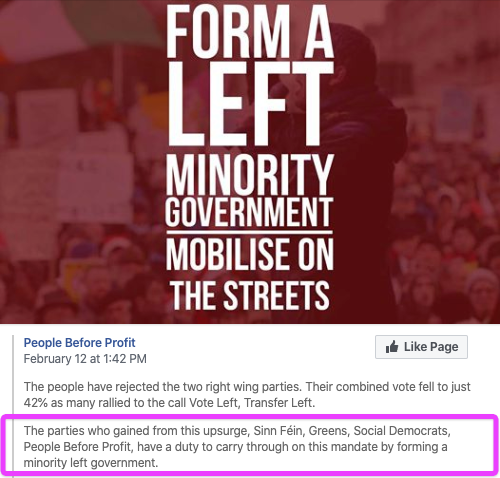
CK: No, I totally share your critique of that trajectory. I’m concerned that People Before Profit are pulling like this on people like Richard Boyd Barrett. I knew Richard as a revolutionary for years, but I was quite shocked after the last election, when he came out with the idea of a left government in which they would participate. That’s just crazy, going into a coalition with the Sinn Féin, Greens, Labour and Social Democrats.
KD: I remember seeing a very good interview with Claire Daly a number of years back, I think it was just after she first got elected and she was saying, ‘Look, there’s no doubt. I won’t deny it. Once you go into the Dáil, you feel different. It’s a different place, and there are people looking at you and they’re watching you, and they’re interviewing you.’ She was just making the point quite well, that frankly, it is different when you get elected. No point in saying it’s not. They end up in this bubble of their own in this rarefied environment of the Dáil, and the media, and the whole array.

CK: I’ve known these people for decades and been side by side with them when we had nothing. In fact, I saw an old picture from the Irish Anti-Nazi League of 1991 recently, with Richard in it, and we’re all wearing scruffy jumpers with holes in; we were all on the dole. I think that what happens is not that they ever say, ‘I’m a reformist now,’ of course they don’t say that. It’s more like: ‘I’m a revolutionary, but you’ve got to understand this is where people are at, people want a left alternative right now, so we’ve got to go along with that. But, we’re going to come out as revolutionaries when the right time is right.’
The problem is, if you commit to that kind of a strategy, you’re sending the wrong message. You’re not giving the critique that you used to give of the parliamentary system, of the need for a radical, fundamental alternative. You’re hoping to spring out like a Jack-in-the-box, and announce that you’ve actually been revolutionary all along. That’s not going to work because you’ve recruited a load of people who aren’t following you in that direction. Then, you end up accommodating them.
KD: An important point for me was with the water tax campaign, Cork is a little bit of a fish bowl in its own way. We had quite a good grassroots movement, very community based, but there was the Socialist Party running Mick Barry and so on, very much in the sense of, ‘Look, Mick’s involved in the water tax campaign in Cork,’ and he was. He was very involved and the party was very involved. But, you could see that very strong factor developing within the campaign after a while, which was the question: is the campaign going to really keep focusing on direct action and spreading its influence among communities, or is it more about getting Mick Barry elected for the Socialist Party?
It’s unrealistic to think that’s not going to happen, but certainly it created a bad environment inside the campaign.
CK: I’ve absolutely seen this dynamic at work myself. I’ve sat in committees where the issue is a campaign or strike or something, but the conversation gets skewed towards how the party is going to benefit from it. So if your goal, concentration and focus is about winning seats, it’s very distorting on your campaigning. You inevitably start to jockey for position with potential rivals, which is not conducive to a healthy alliance between different people within the socialist left.
KD: I gather it was a much bigger problem in Dublin. It was limited enough in Cork, but it certainly had its own negative impact that I think we could have done without, that’s if it was going well enough anyway.
Revolutionaries, anarchists and hierarchies
CK: Moving on from elections, I suppose the main thing I wanted to gain from the conversation was advice on the involvement of all the members, of avoiding hierarchies. I haven’t really taken that away in any deeper way, at the moment. Your emphasis has been on the spirit, which is right I think. If you have the right spirit, that does go a long way towards keeping an organisation on track.
KD: I suppose what I could add from some of the things that came up, say, in the Workers’ Solidarity Movement over the years is that there was definitely instances where we put more into a written document, to say, ‘Look, bad behaviour is unacceptable. Here are the procedures for dealing with complaints in the organisation.’ We didn’t have that in the early days. It was much more of an aspirational thing, a couple of lines stating that there can’t be any bullying, sexism, anything, just a revolutionary organisation, and so on and so forth. But, it was necessary with time to put in more detailed procedures. I think that was a good thing. Some of that arose out of things that had happened outside the campaign, or outside the WSM I think, but had involved, I think in one case, an activist who was sexually assaulted, and then that made us all think about this.
It was difficult. I think not everyone was on-board right away with some of the things. It was a good example of how within revolutionary organisations you’d think, ‘Well, we should all be on one page on these things,’ but often that’s not what happens. Many women comrades will say it’s simply not that straightforward. We all have to deal with sexism in the organisation. These things don’t just go away because it’s a revolutionary organisation. They’re real problems and you have to actively campaign against them. Actually, I think it’s often been around issues of gender that these aspects of unspoken power in organisations are now appearing.
CK: I think that’s right. That’s been the weak link for the people who are controlling these far left groups.
KD: I think that maybe we on the left haven’t faced up to the challenge that the ideas of revolutionary change are the possession of a minority of people. Now, this is a bigger problem I think in some traditions than others. But it can often be the case that some people do know a lot more about the theory and are more articulate and so on. In a way, they are often the people who come to control an organisation over time.
I think we’re naive in any organisation not to see that that’s a possible problem, and being vigilant about it. Having a good way with ideas, or being able to talk about them and being able to be articulate about them, has to be really watched, because it can be the biggest pull. That’s a very significant issue I think, that perhaps within the Leninist tradition was hidden under the whole notion of the ‘cadre’ and that cadre based on the Vanguard and a great deal of ill was caused by that hierarchical format.

Lenin, the revolutionary party and anarchism
CK: I’m actually a fan of Lenin. But, the Lenin I’m a fan of is not the Lenin that you get in the SWP. I wrote about this, about Tony Cliff’s version of Lenin.
KD: Which part do you like about him?
CK: This is very relevant for us now. When really big events are unfolding, you start with the Larry Goodmans and the billionaires, and they influence the government, and they influence the heads of the media. They have their agenda and their policy, and it’s very, very powerful. That pulls the middle class, the well-meaning, the liberal. The liberals then pull the left and everybody ends up being drawn behind the solutions to the crisis of the most powerful. It’s like when the Great War began, the left got pulled in behind the agenda of the capitalist powers, and very few people stood out against it. Lenin was one of them. That’s just to take one of the biggest issues.
So, he was fiercely independent of capitalism. When he thought something was right, he stuck to his guns, and he didn’t cave in to the pressures that we talked about earlier in terms of electoral pressure or any softening of the revolutionary message. At the same time as holding to his revolutionary position, he strove to try and communicate that. People don’t read Lenin that much anymore, but I do, and I find him inspiring. It’s inspiring that you can face such incredible odds and believe in such fundamental change, and then see it realized.
KD: He had a decisive influence.
CK: I’m not going to defend him after the revolution, but especially in the build up to it, and particularly when he’s quoting anarchists and Marx in State and Revolution – which is a brilliant anarchist pamphlet – that’s all great stuff. Lenin did some terrible things as the revolution was going down, that I absolutely wouldn’t stand over. But that’s not who he was for most of his life, coming up to 1917 and in 1917 itself. In 1917, he’s brilliant. He was really brilliant. Like I was saying about the Great War, somebody in Russia had to say, ‘Down with Kerensky’. ‘All power to the soviets’. ‘Down with the constitutional assembly’. And even his own party weren’t saying this. So, that’s a very big difference with anarchists, because they hate Lenin, right? They don’t see any good in any part of his life, because they’re retrospectively viewing him back from Kronstadt, all the way to 1903 and the split with the Mensheviks, they are seeing a dictator. But there’s quite a big difference in my mind between Lenin and Stalin. I would never make the same case for the young Stalin. When you read about the young Stalin, he was still a thug. He never had the kind of integrity that I find in Lenin’s writings.
KD: I’ve been recently reading some material connected with the Kronstadt Rebellion and so on, so I was looking again at the period after, once the revolution had happened. I agree with you to a considerable extent about Lenin’s role in the lead up to the revolution, but I think you could certainly see the real dangers of his format of organizing, and his personality, and how they had a catastrophic effect on the revolution afterwards, because they very much did, I think, undermine the grassroots or the factory committees and so on. Now, I think it was a difficult time for the revolution…
CK: When you frame it that way, yes. But when you say it was a difficult time, it was an awful time. As early as 1919, only ten percent of the people who made that revolution were still in the factories. So, the possibility of having a recallable delegate system had collapsed. All the faults, all the poison that may have existed in embryonic form flourished without being checked, without being challenged.
KD: We’ll have to go through it another time.
Leadership within revolutionary and anarchist organisations
CK: Yes, because what I’d like to keep the focus on is something that you said there before we got into this, which is that the Leninist model as propounded by the Socialist Party, the Socialist Workers Party, and so on, had this guru-like effect. It has a language that justifies leadership in very revolutionary terms, ‘cadre’, the ‘university of the working class’. There’s a self-importance which is reinforced by this kind of political model. ‘We are the university of the working class’, and therefore within that, we’ve got our university lecturers.
So, I’m agreeing with you that this kind of model of Lenin that’s been adopted since whenever, probably from the ‘80s, probably post Miners’ Strike, has distorted them. Therefore, you’ve got this dynamic inside of an organisation where people who’ve read a lot and have maybe been around a lot are very influential inside of their organisations, very. To the point that they’re not challenged as much as they should be.
Your approach to dealing with that is to consciously say, ‘it doesn’t matter how much you’ve read, you’re going to make mistakes. Who is going to correct those mistakes?’ It’s got to be the new members and the class itself, the communities you’re in, calling you on your mistakes, right?
The internal history of the Socialist Party and the Socialist Workers Party, is seamless. They never made any mistakes . Whereas, human history or individual history is full of painful mistakes. So I think you’re on the right track in saying you want to have a spirit that does not ever defer to that figure (who is usually male) and is the authority in these parties. Now, having said all that, obviously we’re very respectful of people’s experience and of their passions and their interests. If someone has had an interest in revolution, and is maybe a big fan of Rosa Luxemburg, and has really read a lot about her, obviously we defer to that. We listen to that. We want to benefit from that, not just in an educational way. The pace at which the world changes means you’ve got to make quick decisions and they’ve got to be right. If you’re on the streets in Seattle, or somewhere in Portland and Trump invades with the National Guard, you may be heading towards insurrection in a matter of weeks.
You’ve got to call that. You can be in a situation that’s moving very, very fast and people lose their bearings in those situations. Sometimes someone who has read a lot about revolutions, and has had maybe a certain amount of life experience and glimpses of revolutionary struggle, is a very good person to have in your party to call it. So, there’s a contradiction here between needing expertise in revolution, which doesn’t come easily, and not giving that expert free license.
KD: I agree there’s a tension there, but I don’t think it’s a problem that can’t be handled because I do think, if one puts in place the ethos, and, also, if the process of involvement of people in an organisation and in the campaigns that your organisation is involved in is one of empowerment, and one where they’re listened to, then they won’t become passive to the process of being in a political organisation. They’ll become what we want people to become, which is more empowered and more likely to speak up. It’s not to say that setting things up the right way is the solution, but it certainly is half the battle, because I think then the process of keeping people more involved will occur. One of the things I would say that I feel now from my years of involvement is that I think it’s vital to spend more time on resourcing organisations than we do.
I think we get too caught up in winning the next battle against capitalism, which is always a great thing to do if you can win them, but our organisations are vital in terms of their inner harmony, but also in terms of their inner health, in terms of what we want. Because if we don’t have health in our own organisations, it becomes a toxic environment. As you say, we all know where that can lead.
CK: I think we’ve arrived at somewhere which is helpful to me now. This is good. We’ve got past the obstacles. I’ve suddenly got an image of what a mass revolutionary left looks like as opposed to our small little ones. Because, for years, the Socialist Party and Socialist Workers Party, they elect the same committees (insofar as it’s an election). It’s a contrived form of election, because it’s a presented panel, which has never had serious opposition in twenty years. But if you’re conscious that this is a problem and alert to it, then I think that the contradiction I drew attention to is solvable. I agree with you. It’s solvable partly technologically these days, because you could rotate those positions, so you can have a completely different leadership, whilst still involving the experienced members. Why not give new people the experience of leading a party?
KD: In the long run, it’s better. The whole thing about that system is that the other side can say, ‘Take me to your leader so we can cut your head off’. The many-headed hydras are much more difficult, if I’m using the right analogy.
CK: Yeah, exactly. So why would the TDs and the counsellors necessarily be the leadership? They don’t have to be. Let’s have a fresh, exciting new leadership. Maybe they will make mistakes, but because we’re in a constant flow of dialogue with one another, we’re chatting on Facebook, we’re swapping memes on WhatsApp, therefore we can have an argument about it. We can have a special Zoom meeting about it in the COVID era, and we all come. You can have no problem calling 50 people at 24 hours’ notice. The older people who maybe have got some experience could win the argument. You don’t have to be the general secretary – with your hands on the purse strings, appointing the full timers – to still have political leadership.
So, I absolutely do see that it should be a model where we’re sharing these roles, and there’s no person who stays in a significant position for long. What is sad to see is my old comrades who seem to have a policeman in their heads so that it’s not that the leadership of these parties is unchallengeable because they’re manipulating the democratic structures. It’s because people have become so accustomed to a lack of really passionate arguments, and a lack of voting, and a lack of swapping things around, they’ve just sat still through it all. They think that’s the best revolutionary practice. The best revolutionary practice is for me to go along with what the long-established leadership is saying.
KD: That’s the thing, isn’t it? I think you’ve hit upon another important thing as well is that, I think you’ll attract certain people to certain things. You do attract more passive people to more hierarchical party structures. I know of a number of individuals within parties I won’t mention, but I often do feel like saying, ‘Look, why have some of them stayed in there and allowed themselves to be treated so badly?’ I think that’s the other side, the flip side of the coin is that, sometimes these hierarchically structured parties actually attract in people who accept an awful lot of things that they shouldn’t be accepting, because they’re in parties of social change, but they end up with very passive, meek people, who then get further bullied.
So in a way, if you create that sort of party at the beginning, you’re going to have the two sides. You’re going to attract power hungry people, and you’re also going to attract meek people who will be bullied. But, we can flip the whole thing upside down and create the opposite type of a political organisation, and really create the environment where people who are sort of megalomaniacs don’t thrive in it. The opposite happens actually, they leave because no one’s listening to them.
CK: That’s a good note to end on!