
| The Irish Left With Ukraine group was established involving activists from different traditions of the left in Ireland, but united in support of Ukraine’s right to resist invasion. Protest at the Russian Embassy The Irish Left With Ukraine will join the existing daily protest at the embassy on Orwell Road, Dublin 6. This protest has been mounted on a daily basis since the outbreak of war in February 2022. Our ILWU group will bring out banner and good wishes to support the protest. Check out our socials for updates. You can come too! An Irishman in Ukraine by Garrett Mullan Ternopil is in the west of Ukraine, about 120 km from Lviv, which is 30km from the Polish border. It is a city of 220,000 in a region of just over 1 million. As it is in the west of Ukraine, there is a perception that it has not been affected by the war. There are even derisive comments about people going on holidays to Ukraine. Yes, we did go on holidays because people need to see their families. The war has affected every region. In the city, just over 800 have died as a result of being killed in action and that number rises to over 5,000 dead. Multiply that by at least three times and you have tens of thousands injured. On November 19th 2025, 38 died in the city in one of the single most deadly attacks by Russia in the war. They died sleeping in their apartments. In every large village, town and city of Ukraine, there are memorial boards in the centre to remember those who had been lost. In the village where we stay of Hrymalliv, 40km from Ternopil, there are 29 boards. My wife Iryna remembers four of the soldiers as local boys from the village. She was a teacher in the school for 10 years and taught two of the martyred soldiers. She remembers Anatoliy has lively and funny. Now all we can see is the memorial board.  For years, we travelled to Ukraine each year to visit my wife’s family. After the full scale invasion we halted our visits and did not expect to return until after the war. However as months and years of war went by, we decided in 2024 to visit Iryna’s family in Ternopil and we did so again this August. Now I am back in Dublin and she is still in Ukraine to attend a wedding, which I am told will be not be attended by military aged men. The electricity blackouts have not been as bad in the Summer of 2026 as 2024. This is because there has been a significant increase on the reliance of solar and also the importing of electricity from Europe. There is dread though as to what will happen in winter. Last Winter was the most challenging of the war and this year it is expected to be worse because the relentless attacks on the energy grid has had an impact. I met two English guys in Hrymalliv sitting outside a local bar. They were nice guys. Both had been in the British army for four years. They came to Ukraine at the same time in April 2022, just after a call for international volunteers. I asked one ‘how did your family and friends react when you decided to volunteer? That must have been difficult’. His reply was disheartening as he said ‘people would blow off steam and say don’t go, you will die, but then once I had gone, they dropped all contact. I got no texts, nothing’. Still they seemed in good spirits. The interaction with them and a few other of their comrades was brief but I could see togetherness. They have been through a lot. England is now not only a different country but a different world to them. At a local swimming pool war veterans were present. We knew they were war veterans because some were in wheelchairs and others had dressings covering wounds and others had missing parts. On the platform at Ternopil station as we waited to head to the Polish border, my sister in law indicated a family nearby ‘they are saying goodbye as he is going to the frontline’. The scene on this hot August Sunday was a father, his wife and two young boys. It was tearful farewell. How did we know that he was heading to the frontline? The train destination was Dnipro, which is on the frontline 815km to the east. This scene we have witnessed in many films and it was a scene reminiscent of World War 2, but this was no film and it was not World War 2. Also reminiscent of World War 2 and the films. I didn’t expect to hear an air raid siren in the countryiside, but it happens regularly. In response, people check Alerts.in.ua It is Ukrainian reality in 2026. Protest at City West The government has shifted to right wing populism, as the mood towards Ukrainians has hardened. Their cack handed measures to cut accommodation costs and show their toughness on immigration has caused disruption and distress for Ukrainians in state accommodation, particularly those who are vulnerable and those with disabilities. Jim O’ Callaghan TD as Minister for Justice has referenced appeals systems which are akin to the worst Soviet bureaucracy, in addressing the needs and concerns of Ukrainian refugees in state accommodation. Many people comment in justifiying harsh government policy ‘sure it was only meant to be temporary’. It is true that measures applied in support of Ukrainians in Ireland in 2022 were under the programme of International Temporary Protection. However, the war is still ongoing and more of the country has been destroyed and more will be destroyed. There is nowhere for people to return. We appreciate the efforts of Liam Quaid TD and Ivana Bacik TD of Social Democrats and Labour who have been actively engaging with Ukrainians impacted in Trabolgan and City West. However, we call on the Department of stice to open dialogue with residents and enter a process of meaningful dialogue. Ukraine solidarity discussed at ICTU Global Solidarity Seminar More than 100 representatives and officials from different unions participated in the summer seminar of the Irish Congress of Trade Unions Global Solidarity Committee. Gregor Kerr spoke on behalf of ILWU on why trade unions should show solidarity with Ukraine. Chris Ford from the Ukraine Solidarity Campaign UK, spoke of their experience in harnessing the support and solidarity from the trade union movement in the UK with partners in Ukraine. Speaking through a zoom link, Kateryna Maliuta Osaulova from the Trade Union of Education and Science Workers told the meeting of the impact on the ground for workers in Ukraine and how they as a trade union are responding to the impact of war on the ground.  A full report of this meeting will follow in the next newsletter. Solidarity Convoy to UkraineThe Irish Left With Ukraine has signed up to support the International Solidarity Convoy due to depart from different parts of Europe and arrive in Ukraine in November. It is an initiative of the European Network of Solidarity with Ukraine. The Solidarity Convoy to Ukraine is an initiative that brings together trade unions, civil society organisations, grassroots organisation to deliver aid requested by Ukrainian partners to strengthen solidarity with Ukraine. Join us and build solidarity with Ukraine. Check out the link here- https://solidarityconvoyukraine.com/ Email us at irishleftwithukraine@gmail.com Follow us on x, facebook and instagram: irishleftwithukraine.blog |

About Conor Kostick
Hell: Timothy Morton

Timothy Morton is a prophet, and in their latest book Hell, speaks as a specifically Christian prophet. Coming out as a Christian (‘There, I said it. You’re really interested to read this now, aren’t you? Or at any rate to get on Twitter and go “Fuck, Tim Morton is a born-again Christian.” Go on. Knock yourself out.’) means they are of little interest to certain types of leftist: those with the correct understanding of society thanks to an exegesis of Marx provided by their Communist or Trotskyist-flavoured educationals. Being a prophet means Morton is an incomprehensible Christian and therefore of even less interest. And yet.
Everyone knows we are experiencing ecological disaster and that the human experience is going to get worse, hellish even. It feels like we are on a runaway train, where even the people in first class can see the disaster ahead, yet the train has no driver to appeal to, or rather, to draw on one of the resonant images from the book, it’s an AI one. What’s needed to save us is more than a rush from the third class carriages to sweep the second with us into sharing the silverware of the first. Something more fundamental is needed: a realisation we can step off the train and everything is going to be alright.
If you like depth to your revolutionary prose, you should read this book. It’s more daring, fundamental, and radical than any book about the environment written by an ecosocialist. It’s also incomparably more entertaining.
What’s it like to listen to a Christian prophet? It’s thrilling, because you can’t anticipate what they will say next; fascinating because each sentence is vibrating with energy; and disturbing because if you were to fully agree with what they are saying, you’d have to allow your atheist defences to relax and allow the possibility of your beliefs being transformed. No one wants that, right?
Hell: Timothy Morton is a Brave Book
Hell is a brave book in that Timothy Morton is an academic and it’s not currently fashionable to own up to being religious in academia. Nor is it fashionable to talk about your own life and your feelings, especially in being frank about having had an abusive father. It’s a book that is powerfully ecological, yet it’s not out to persuade us that the planet is an inescapable hell.
One of the key ideas of the book, one that helps transcend the ‘scientism’ shared by both right and left is that, ‘there is no meaningful metaphysical difference between a human and a nonhuman lifeform’. This is a philosophy that animal rights activists should welcome and it is one also to be found in the works of the Christian poet, artist and prophet William Blake. Blake features so heavily in Hell that the book could easily be read as an homage to him.
Gnosticism is the belief that we are already in hell and that the god whom most Christians worship is an evil being presiding over this hell. Escape for a Gnostic involves criticism of the existing church for making puppets of us all, Carpet Crawlers even. On first glance, Hell might seem to be a book in this tradition. Morton, however, repeatedly states that they are not a Gnostic.
Morton’s Hell is ‘flipped Gnosticism’. While the Gnostic wants to achieve escape velocity from this hellish existence to a higher one, to an ultra-Heaven where they believe the real God resides, Morton sees the possibility of escape in our being embodied right here. In the spirit of William Blake: a model of Nature as existing outside of us is oppressive; an embracing of our physicality is emancipatory. It makes no sense to want to conquer nature when there is no outside and when ‘the biosphere is the body of Christ’.
Naturally, Morton reads and rereads Martin Luther King and their thoughts on King caught my attention for reasons that are probably selfish but which might just be zeitgeist. When you are educated about someone through the works of their critics and not their own works, you come late to the party. I’m there now. And I relished how Morton explains the power of the phrase, ‘I have a dream’.
The Reverend Martin Luther King (italics mine) knew what he was doing: evoke the dreaminess, evoke God. The subjunctive “might be” quality of “I have a dream” resist the activity of the indicative (“I dream of…”) and the passivity of the infinitive (“Oh, to dream of…”). “I have a dream” undermines master versus slave, active versus passive binaries… “Having a dream” is in the middle voice, neither active nor passive. I am not the victim of the dream, nor am I its puppet master. It’s just how my brain flows when I’m not being me.
Moreover, ‘love is the basic format of this dream-feel.’ Not so long ago, Independent Left members discussed the slogans to put on our banner. We decided to include ‘love’.

This was a good call and reading Hell helps explain why. ‘How we treat each other is how we treat the biosphere. Speciesism is keyed to racism and patriarchy. It’s huge. It’s the hugest thing. It is weirdly both daunting, and as easy as pie. It’s a time of shuddering panic and soul-collapsing grief, and yet it’s a time when one can see what is true and what is required without much effort.’
Or Blake,
Love seeketh not itself to please,
Nor for itself hath any care,
But for another gives its ease,
And builds a Heaven in Hell’s despair.
The Feeling of Reading Hell, Timothy Morton
Hell is a very unusual book. It is one to be enjoyed rather than studied and fought over. If you want to have a go at Morton – and a surprising number of people do – there’s plenty of material to use since they write at top speed and with soul bared. Often, I lost the thread of an idea under discussion. But that never mattered too much because I soon came across a different idea that was criss-crossing with the earlier one and bringing it back in force. Moreover, there’s something profound about this reading experience that resonates with Lacan’s statement, ‘I think where I am not.’
As soon as you put a thought into words, you descend into a trench. You have channelled an idea; cut it out of the flow of the universe so as to grasp it. Now maybe this trench takes you where you want to go. And maybe by grasping the thought in this way – placing shutters and obstacles in the way of it spilling out again – helps you get someone else to the same place. Language is powerful like that, ideas spread faster than infections. Yet the enormous, underappreciated, downside to expressing even the most brilliant idea in words is that it is all too easy for the trench to become a well-worn path in a labyrinth. In other words (yes words, but how else can I say this? Through poetry perhaps) even the most effective and emancipatory use of words can quickly lead to a state of mind where no thought is happening. There’s a risk of you having the same thought, with it running around the trenches you’ve created for yourself like a car on a Scalextric track. Meanwhile, the universal flow is happening where you really are and you can’t feel it, you can’t jump off the tracks.
What had truth-feel yesterday might not today, but are you receptive enough to that signal to change or are you now stuck?
Unlike animals, who exist perfectly well without filling their heads with belief systems that they are willing to die for, humans are susceptible to constructing ruinous thoughts (e.g. it’s impossible to take the savings of the top 100 people and share them out). And it’s the thoughts that pose as ways forward that can be especially ensnaring.The importance of Hell is that it is written with an urgency to help us think, rather than an urgency to persuade us that the situation is becoming more and more desperate, or with an urgency to recruit to a party that has the roadmap to saving the Earth. Desperation is exhausting and depressing; roadmaps are only useful if you really understand the landscape. It’s books like Hell that we need at this time, books that will help us become unstuck.
You can read more about Hell: Timothy Morton at their blog Ecology Without Nature.
Ireland and Ukraine’s Struggle for Independence 1916 – 23

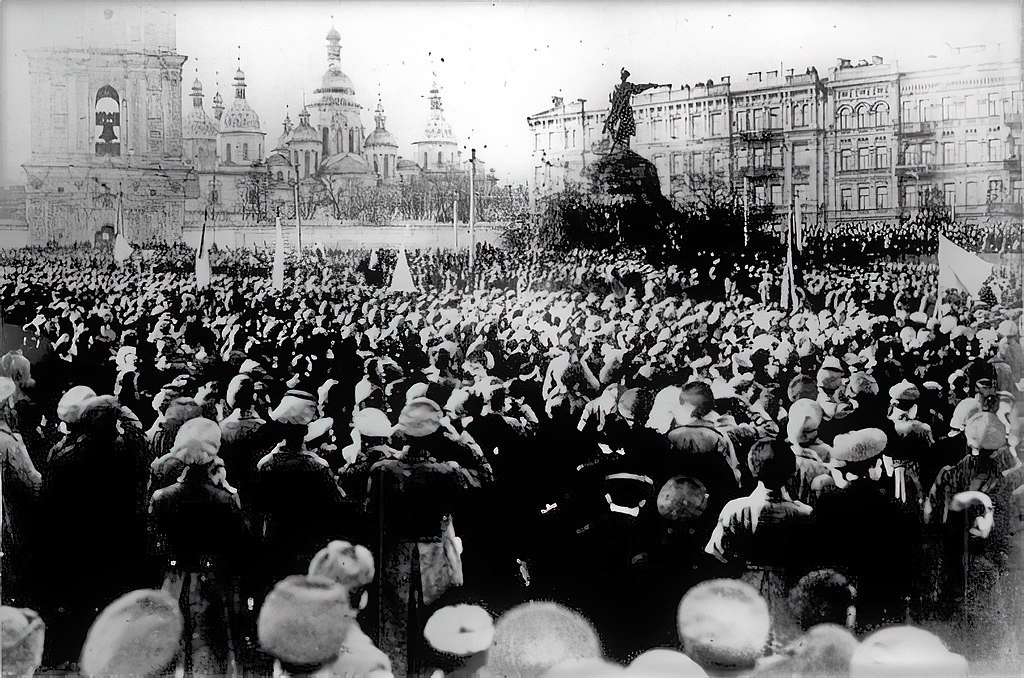
Ireland and Ukraine had similiar challenges in the period 1916 – 1923. Conor Kostick, Irish writer and historian based in Dublin and Vladyslav Starodubtsev, a social activist and a historian from Kyiv answer questions about the period and compare the experiences of the left in that era.
For Ukrainian readers, the discussion is published here.
Ireland and Ukraine 1: What was the challenge facing your respective nations?
CK: Ireland had been the first colony of the British Empire and throughout the eighteenth and nineteenth century, British control over Ireland had been enforced with considerable brutality, not only in the repression the catholic religion of the majority of the inhabitants of Ireland, in making the use of the Irish language illegal, and in the exclusion of the majority from political power, but economically, Britain had suppressed the emergence of Irish industry in all but the northeast corner of the country, and, in the years 1847-53, had overseen an avoidable famine that reduced the Irish population through death and emigration from over 8m to 3m.
In 1916 the leading figures of the British Government were adamant that while Ireland might be allowed a level of ‘Home Rule’, it must not have independence. They were prepared to be ruthless in preventing a breakaway. At the height of the War of Independence, 1918-1921, Britain adopted a policy of ‘Reprisals’, burning towns and killing activists with a specially recruited fascistic force, the ‘Black and Tans’. Their thinking was expressed by a key figure, Sir Henry Wilson, who said that Britain must get a grip on Ireland or risk losing territory all across the empire. Towards the end of the war, Winston Churchill, a member of the government, had a plan drawn up for the re-occupation of Ireland by 100,000 troops.
An additional challenge was internal. The business elite of the northeast corner of Ireland, around Belfast, were running the largest shipyard in the world, along with associated industries like ropeworks and engineering. They were loyal to their source of wealth, the British Empire, and formed the Unionist Party as well as a mass-movement sectarian organisation, the Orange Order, to make sure that nationalists would not force them into an independent Ireland.
VS: Ukraine was a divided nation between two empires: Austria-Hungary and Russia. In the huge territories of Ukraine Ukrainians were the poorest strata of the population, denied education and self-governance, and being actively assimilated. The Ukrainian language was repressed, and Ukrainians only recently de jure were ‘freed’ from serfdom but in fact, still lived under not-so-different conditions of exploitation. At the same time, the Russian state in the East and the Polish elites tried to realize a settler-colonialist project. Urban centers were used to control the Ukrainian population. In 1919 (a few years after the revolution) Ukrainian capital, Kyiv, was only 23% Ukrainian, and 42% Russian, with an absolute majority of the rural population being Ukrainians — with none of the access to education, representation, and power that the urban centers provide. Ukrainians were a peasant nation, without its landlord or capitalist classes, divided, and actively assimilated and colonized. Small political circles existed, mainly focused on cultural work — giving peasant education, learning the language, and spreading Ukrainian culture, but were actively persecuted. Ukrainian cooperative movement too was blooming and focused on ‘economic self-defense’ against poverty, as well as was engaged with Ukrainian culture and literacy organizations. First political parties were formed. The Austria-Hungarian dual monarchy was far more liberal than the Russian monarchy, so Ukrainians could realize their ambitions there at least semi-legally. That defined a more robust development of political life in the West. In 1890 in Western Ukraine — a Ukrainian Radical Party was formed, and in Central-Eastern Ukraine — a Revolutionary Ukrainian Party in 1900. Activists of those parties were active in cultural societies, co-operatives, and illegal trade union and peasant movements.
Ireland and Ukraine 2: What were the various strands of nationalist politics in the period?
CK: The main nationalist party before 1916 was the Irish Parliamentary Party. A party of landlords and business elites, it advocated a limited form of independence: local government powers within the empire. This party committed themselves to helping Britain win the Great War, in the hope of a reward afterwards.
More radical but much smaller, Sinn Féin was founded by Arthur Griffiths in 1905 and while not necessarily being in favour of a complete separation from the empire, it was popular for championing Irish culture in the face of British domination. A huge public enthusiasm to recreate the Irish language was shown by the turn-of-the-century with the Gaelic League growing to 100,000 members and similar numbers joining the Gaelic Athletic Association, to revive Irish sports. The backbone of these movements and Sinn Féin were the Catholic middle class and intellectuals.
Within Sinn Féin – and sharing its social base in the revived Irish nationalism of the middle class – were the secret society, the Irish Republican Brotherhood. The IRB planned to rise up against Britain as soon as the opportunity arose, which they believed was the case as a result of war. In this they were helped by the development of an Irish volunteer national army from 1913, which although largely followers of the IPP and therefore supporting Britain during the war, split with about 13,000 soldiers refusing to help Britain and instead preparing for a rising against the empire.
Then there was working-class nationalism, which although largely channeled behind either the IPP or Sinn Féin, did find a voice in James Connolly, Ireland’s most significant socialist leader.
The women’s movement, seeking votes for women and equality more generally, trusted to independence to secure their goals and – excepting the Unionist women of the north – a lot of key activists for independence were women members of Cumann na mBan, a movement along the lines of Sinn Féin but for women only.
VS: In Western Ukraine, the Ukrainian Radical Party, the first Ukrainian party in existence was formed.
Ukrainian Radical Party in its program declared: “We are striving to change the way of production following the achievements of scientific socialism, i.e. we want a collective organization of labor and collective ownership of the means of production” “In political affairs, we want full freedom of the person, speech, union and associations, conscience, provision for each person, without distinction of sexes, the most complete control on all issues of political life in matters that affect only that person; the autonomy of communities, municipalities, regions and provision of every nation with opportunities for the fullest cultural development”. The ideology of the Radical Party was comprised of non-marxist socialism, federalism (decentralization), feminism, constitutionalism, and romantic nationalism akin to the one expressed by Italian republicans such as Mazzini and Garibaldi. An important part of Radical Party appeal and ideology was oriented towards specific problems of peasant organization, which they learned from different agrarian movements in the world, including the Land League in Ireland.
The second Ukrainian party was the Revolutionary Ukrainian Party, which was formed in the Russian-controlled part of Ukraine. It had a wide socialist appeal, but in the end, the social-democratic (Marxist) faction won the internal party struggle and kicked out all the non-marxist members. Thus, the party renamed itself to the Ukrainian Social-democratic Workers Party. It was a completely illegal underground party, it struggled both against the Russian Social-democratic Workers Party which was against Ukrainian national demands, peacefully fighting for the influence in Ukrainian land; and against the tsarist secret police, who constantly were developing new and more modern methods to fight against agitators. In 1905 USDWP had its first revolutionary experience, participating in revolutionary soviets and strikes.
After the revolution of 1905 and following the reaction, the non-partisan Society of Ukrainian Progressives was formed to defend against the rising tide of Russian nationalism. The main members of society were moderate progressives and a minority of members of the Ukrainian Social-democratic Workers party
All influential parties of the Ukrainian Revolution (with one prominent exception — still which was strongly connected to the Revolutionary Ukrainian Party — Ukrainian Party of Socialist Revolutionaries) were formed from these two parties.
Ukrainian Radical Party split into three: the Ukrainian Social-democratic Party — an austro-Marxist party; the Ukrainian Radical Party — a non-marxist Socialist Party, and the Ukrainian National-democratic Party — a progressive center-to-center-left national-democratic party. They become the leading parties of the revolution in the Western Ukraine.
The Revolutionary Ukrainian Party accepted the Marxist platform and became USDWP. Non-marxist socialists in the Russian-controlled part of Ukraine formed their party only in 1917, based on the so-called ‘narodnik’ and agrarian-socialist, federalist ideology. The new party was called Ukrainian Party of Socialist Revolutionaries, and it became the biggest party in Ukraine. The majority of the Society of Ukrainian Progressives formed a Socialist-Federalist Party — a moderate progressive group, socialist in name only, and similar to an ideology that later would be described in the US as “New Dealers”
Ireland and Ukraine 3: What role did the left play in the fight for independence?
CK: The working class played a vital role in Ireland’s eventual part-escape from the empire. Four huge general strikes took place in this period and there were hundreds of factory occupations that, inspired by what they thought was happening in Russia, called themselves soviets and flew red flags. Thanks to mass boycotts, especially on the railways, Britain found it extremely difficult to govern Ireland or stamp down hard on the flying columns of the Irish Republican Army (IRA), the volunteers who had become the official army of a national parliament that had set up in 1919 in defiance of Britain.
Had it been a straight battle between British forces plus Unionists against the IRA, Britain would have won easily, but with no one paying taxes to the empire, no one attending British courts, and boycotts refusing to deliver food or help the administration of the imperial administration, Ireland was able to sustain a guerilla struggle and ultimately force a serious negotiation upon the British government.
VS: Ukrainian Central Rada, a revolutionary provisional government formed in Russian-controlled Ukraine, was completely formed by the left-wing forces. The biggest part of the Rada were Soviet deputies and peasant union representatives, national minorities, and two Ukrainian parties that changed each other in the ‘ruling seat’: the Ukrainian Socialist-Revolutionary Party and the Ukrainian Social-democratic Worker’s Party. In the course of the revolution, by these forces, Ukrainian People’s Republic was formed
With your strength, will, and word, Ukrainians on Ukrainian land became free in thePeople’s Republic. The old dream of our parents, fighters for workers’ freedom and rights, came true (…)
We, the Ukrainian Central Rada, elected by congresses of peasants, workers and soldiers of Ukraine, we cannot stand for that, we will not support any wars, because the Ukrainian people want peace and the democratic peace should be as soon as possible (…)
At the same time, we call the citizenry of independent Ukraine, we call on the People’s Republic, to steadfastly stand guard over what has been gained [To defend] the will and rights of our people and to defend our destiny with all our might against all the enemies of the Peasant-Worker Independent Republic.
— 4th Universal of Ukrainian Central Rada
Against the Ukrainian People’s Republic Bolsheviks mounted imperialist aggression, starting the expansionist war while Ukrainians were agitating for ‘peace without occupation and contributions’. Where the Bolshevik forces came, they organized mass violence, and more often than not repression and centralization. Local Ukrainian Soviets became party-controlled and cooperatives nationalized, as something that posed a threat to the Leninist idea of one-party rule and the Russian state.
Ukrainian socialists, students, cooperators, peasants, and workers of all sexes, organized massive resistance against the Bolshevik invasion but faced an unequal struggle, where they were left alone.
Western Left organized campaigns against the Ukrainian People’s Republic, already idealizing Russian bolshevik-imperialist conquest of countless colonies of the Russian Empire, grain requisition from minorities, national-cultural and political repressions, and one-party dictatorship as a spread of a “socialist revolution”. Entente embargoed Ukraine, preventing supplies for civilians suffering from epidemic and hunger, as well as ammunition and shells for the army. Poland invaded Western Ukraine, and Romania moved to occupy the small Ukrainian region of Bukovyna. Even the French army organized a naval invasion in Crimea. Ukrainian Revolution was left alone against imperial and colonial forces from all sides, with nearly no weapons and ammunition, a state apparatus and army built from nothing in a matter of a year without proper officers or experienced government workers, with a complete lack of control of urban centers and lack of education. In such conditions, Ukraine showed deeply phenomenal resistance, and fought from 1917 until 1921, with Ukrainian left-wing forces, peasants, and workers organizing partisan movements and independent revolutionary republics even after the collapse of the Ukrainian People’s Republic itself.
Ireland and Ukraine 4: What different left traditions and parties were there at this time?
CK: The biggest left tradition active in Ireland was syndicalism. The Irish Transport and General Workers Union was modeled on the Industrial Workers of the World and at its peak had 100,000 members. Transport union organisers led mass strikes and ‘soviet’ takeovers. Unfortunately for the left, the two main figures in building the ITGWU were absent during these critical years. James Connolly had been executed following his leadership of the Easter Rising of 1916, a failed insurrection largely driven by the IRB. Jim Larkin, founder of the ITGWU had been jailed in America.
After the Russian Revolution a small Communist Party was created but it was tiny and nearly irrelevant.
There was a Labour Party, which was to become a reformist party of the Second International type and is mainstream in Europe today. During the war of independence, it wasn’t really distinguishable from the ITGWU, being mostly the ITGWU executive and others running for election in the name of Labour. In the north, mostly in Belfast, was the Independent Labour Party, a radical social democratic party that was quite influential until smashed by a unionist pogrom in 1921.
VS: The Ukrainian revolution didn’t have a right wing, as Ukrainian identity was seen as mostly the identity of the Left, while the Right was the one associated with Russian rule and monarchy. The governments of the Ukrainian People’s Republic were nearly always ⅘ Radical Socialist and ⅕ non-socialist, usually still in some way left or progressive. Thus, the biggest differences were between the factions of the Left.
In the Ukrainian People’s Republic (in Western Ukraine was separate Western Ukrainian People’s Republic) the biggest party was the Ukrainian Party of Socialist Revolutionaries. From 1918 it adopted a Soviet\Syndicalist program and agitated for the creation of a democratic, independent Soviet Ukrainian republic. A smaller, but more intellectually influential was the Ukrainian Social-democratic Worker’s Party. Its radical wing supported the Soviet government type, while its moderate, democratic-socialist wing supported a Parliamentary socialist government, giving the Soviets a place to co-govern locally, but not to form a government solely on their basis.
The influence of the Socialist-Federalist Party was minuscule, it never was even close to forming a government.
Both the Ukrainian Social-democratic Worker’s Party (USDWP) and the Ukrainian Party of Socialist Revolutionaries (UPSR) had their radical splits. UPSR split into UPSR (Borotbist faction) and UPSR (Central Current). Both UPSRs adopted the Soviet platform but differed concerning foreign policy towards Bolsheviks. Borotbists thought that there was still a possibility to convince the Bolsheviks to abandon their imperialist project, while Central Current was staunchly anti-Bolshevik. A similar split occurred with USDWP but also on the ground of the Soviet or Parliamentary system.
Ukrainian People’s Republic then was moving in a confusing direction — adopting a half-soviet, half-parliamentary government system. Its economy was nearly fully co-operative with a state sector acting on proto-Keynesian principles and with a substantial degree of worker’s control
Split parties tried to create a ‘Third center’ — a communist-independentist (Borotbists and radical social-democrats then renamed themselves to Ukrainian Communist parties) — fighting Bolsheviks, and being neutral towards their more moderate ex-party comrades. They even temporarily organized a union with the Anarchist militia of Makhno. Later, communist-independentists abandoned the idea of a “third center” and decided to join the Bolsheviks. However, that decision ended tragically. Their parties were dissolved, a huge majority of their membership repressed (usually not physically repressed. Such repressions against communist-independentists will follow later) as “nationalists” and only the most loyal to Bolsheviks were allowed to be incorporated into a one-party state.
At the same time, in the Russian Bolshevik party (there was no Ukrainian Bolshevik party) existed a Ukrainian communist-independentist faction. Its members were kicked from the party after comparing Lenin’s style of government with one of Louis XIV, “L’état c’est moi” and criticizing the Russian chauvinism of Bolshevik policies in Ukraine.
In the Western Ukrainian People’s Republic, the National Democratic Party formed a government, with the Radical Party being the second in command, and the Social-democratic Party as the third. As a government existed in a spirit of deliberation, a right-wing social-catholic party also was to co-govern, having 1% of the government seats (which was still a lot more than its real influence – which was less than 1%). Government forces were proportionally represented somewhere as 60\30\9\1. 60% of National-democrats, 30% of Socialist-Radicals, 9% of Social-democrats and 1% of Social-Catholics.
National Democrats in the process of Revolution moved their platform to the left. Being influenced by the British Labour Party, they changed their name to the Ukrainian People’s Labour Party and adopted a moderate-socialist program.
What was different with Western Ukraine, as after the experience of semi-democratic rule, the idea of government based on Soviets was (and usually rightfully so) seen as less democratic than a parliamentary republic, and even the socialist Radicals discussed how to improve and make more robust socialist parliamentary republic, not the Soviet one. The idea of a Soviet republic was obscure, which provoked lengthy and sometimes heated discussions between Western Ukrainian People’s Republic and Ukrainian People’s Republic politicians.
Ireland and Ukraine 5: Did the left succeed in being the voice of the national struggle? If not, why not?
CK: No, unfortunately it failed. It is sometimes argued that no particularly radical result could have come from those years, because rural Ireland was too conservative. It’s true that deeply conservative values came from some of the larger farmers. They set up a Farmers Freedom Force, modeled on the KKK in the US and the Farmers Party spokesperson said in parliament there were ‘not enough lamposts to hang the agitators from Liberty Hall’. They were met on the left, however, by very radical mass movements of poor farmers and land labourers, who around Waterford created a red army to counter them and who in the west took over large estates and worked them co-operatively. In general, there was no lack of daring and imaginative mass activities from the left at this time, such as general strikes and soviets e.g. the brief time Limerick City was run by workers.
I believe the main reason the left failed to at least come out of these years as a significant force in Ireland (and I think it was within the realms of possibility they could have come to power) is that right-wing social democracy – embodied by Labour leaders Wiliam O’Brien, Tom Foran, and Tom Johnson – set the agenda for the whole of the left and working class militants. They were particularly brilliant at sounding like out-and-out revolutionaries when they needed to and they had the credibility of being former comrades of James Connolly. It took years for the genuine revolutionaries to realise that these officials were more interested in preserving trade union assets and creating a role for Labour in a new Ireland than revolution. Right wing social democracy gifted the energy of the strikes and occupations to Sinn Féin, who used it to help win a limited form of self-rule at the cost of the partition of Ireland, with the north-east corner broken away to remain in the empire. Sinn Féin had become more conservative, with the southern elite moving over to it en mass when it was clear the Irish Parliamentary Party had been destroyed by its support for Britain in the war. Only a radical vision of Ireland could have appealed to northern workers in sufficient numbers to prevent the partition of Ireland. The Sinn Féin version was catholic and socially conservative and when that was all that was on offer, the Independent Labour Part of Northern Ireland were trapped (effectively, they had been betrayed by their comrades in the south settling for a partitioned and Sinn Féin-led Ireland).
VS: The Ukrainian left was the only real force to fight for national independence, but was facing overwhelming forces of imperialist countries or conflicting projects of national self-determination. Poland immediately waged a conquest against Ukrainian ethnic lands to realize the idea of “Greater Poland”, and Bolsheviks under Lenin became a regional counterrevolutionary force against indigenous socialists — in Eastern Europe, Caucasus, Central Asia, and Far-East, facing numerous self-determined democratic socialist and progressive republics. The Western forces placed their bets on Poland and the Russian White Army and treated Ukrainians as harmful separatists and radicals.
Russian right-liberal politician Milyukov even compared Ukrainians with “Sinn-Feinites bands”, saying that “independent from Russia Ukraine” is as unthinkable as “Independent from Britain Ireland”.
Nonetheless, the struggle of Ukrainians did something that no one could imagine. The existence of Independent Ukraine now is a direct achievement of Ukrainian socialists then, who by immense sacrifices put Ukraine and the Ukrainian people on the map. Even Bolsheviks, who spoke of Ukraine as an “Eastern Russian province” in 1917, and Lenin, who agitated for centralism during that period, radically changed their position, facing massive peasant and workers’ rebellions of Ukrainian national movement, agreeing to create a pseudo-republic for Ukrainians and recognize us a separate nationality. Ukrainian People’s Republic became a rallying cry for all the future generations struggling for Ukrainian freedom, however, ravished of its “radical left-wing substance” by the next generations, who associated socialism with the Bolshevik project.
Ireland and Ukraine 6: Having read each other’s answers, what do you think are the differences and similarities between the Irish left and the Ukrainian left 1916-1923?
CK: It seems to me that the similarities are that the same kind of left politics was active in both Ireland and Ukraine, except that in the Irish case there was a much bigger influence of syndicalism and less of anarchism (no equivalent to Nestor Makhno). Although both countries experienced tragedy and defeat for the left, a part of Ireland, 26 from 32 counties, did at least get concessions, which ultimately led to the country being fully independent from the empire by the mid 1930s. Perhaps the reason for this was the strength of the nationalist middle class? I get the impression they were much more coherent in Ireland, both culturally and politically. With the Land League of the 1880s leading to much greater land ownership by Irish farmers than by absentee imperial landlords; with an economy that allowed the service industry to thrive in the form of many small businesses; and with a cultural sense of identity stretching back centuries, the nationalist middle class was a substantial force and after the elite nationalists abandoned them and went all in for the Great War, they found their own voice. Poor farmers, teachers, white collar workers and small businesses provided a very strong network of support for Sinn Féin and a guerilla war waged by the IRA. This, plus the ungovernability of Ireland in the face of mass popular protests forced concessions from the empire in the form of a treaty that allowed limited self-government (the concessions were so limited that the national movement split over whether to accept them, with the elite scurrying back to power by being in favour of the treaty and the poorer middle class and working class losing out).
The other very interesting difference is that the Russian empire experienced a revolution that brought people to power who claimed to be socialists and to be fighting for a world transformation to a classless society where all would be equal. This very appealing vista seems to have split the left in Ukraine, because it took some time to appreciate that the Bolsheviks’ deeds were not matching their claims. In Ireland there was only one enemy and that enemy was very clear indeed. The British deployed a fascist-type of hastily created army, the Black and Tans, with a remit to crush every nationalist action via the policy of reprisal. If the IRA burned down a barracks, the Black and Tans burned down a town. If the IRA killed a leading figure of the empire, the Black and Tans killed many activists during raids. Pretty much all of Ireland united in refusing supplies to these people, in not paying taxes to the empire, in not using imperial courts, etc. How much more complicated it must have been in Ukraine, when some of the armies approaching your town offered to side with the working class and help bring about global revolution. You would have to have had farsighted intuitions to out-maneuver the circling imperial powers as well as domestic enemies and the reds. I can imagine the debates among the left parties were extremely bitter
VS: It seems that Ireland was more lucky in terms of geography and facing the enemy — the exhausted British Empire. By sheer sacrifices and immense collaborative work Ireland won concessions that led to the Independence. It seems to me that the relatively compact geography of Ireland, together with one defined enemy that acted brutally were defining features of Irish victory. It was a great national struggle for independence. Unfortunately, conservative identity of big part of Irish population prevented mass left-wing movements to lead struggle for Independence. I think that there were real possibilities for the Left to lead the fight, but only if previous actions would manage to create a distinct and attractive Irish left-wing peasant identity. It is a great difference that in Ireland a big national coalition fought for its independence, while in Ukraine it was purely a left-wing coalition, I would say a radical left-wing coalition, which is quite huge difference, and highly affected strategy. From the similarities, Ukrainian and Irish socialists practically faced the same problems — of activities in peasant-majority land controlled by the empire, and that unique experience of peasant organization we can see only in Ireland, Ukraine, Mexico and a few more countries. The same mindset was also in creating cultural organization and in connecting national, democratic and left identities. Ukraine lacked organized syndicalism as a movement, as Ukraine didn’t develop a proper trade-union movement to that time.
Ireland and Ukraine 7: Are there lessons from this revolutionary period for today?
CK: The more the working class movement comes to the fore in Ireland, the more likely that the outstanding issues created by partition will be resolved in a united Ireland that northern people are glad to be part of. The more Ireland slides towards racism, anti-immigrant feelings, and the more it accepts the argument coming from the elite that luxuries like disability rights, a role for trade unions, a transition to sustainable agriculture, etc. are simply not affordable, the less it will appeal to workers in the north, whether catholic or protestant. Although it is likely we will soon see Sinn Féin in power north and south, it’s not clear that a ‘Border Poll’ – a vote for reunification – can be won with pro-market values as dominant in the south.
VS: It is the memory of revolutionary transformations and radical democratic ideas that attract us. Experience of fighters for freedom and visions of the world that could be. The value of such visions for today are immense — they give us ground to stay on and give the platform to think from — and to develop, and create a better movement. I hope that experience of both revolutions would be better known. In Ukrainian, we have a few translations of James Connolly, including articles of Kostick himself. It means that there is something to learn and motivate. And Ukrainian People’s Republic of course is the dividing point of Ukrainian history, the strongest moment when Ukrainians stood up, it is remembered and immense part of our identity. And how the right-wing wouldn’t try to wash Ukrainian People’s Republic of all of its “radical socialism”, its legacy still lives on.
***
Conor Kostick is a founder member of Irish Left With Ukraine. Also on X here.
Is Ecosocialism a Fraud?
Is ecosocialism a fraud? It’s a harsh question, but it arises because the term ‘ecosocialist’ has been gathering momentum among the Communist and Trotskyist left for the past two decades and now there’s hardly a party on the left that doesn’t describe itself as ecosocialist. At the same time, none of these parties, to my knowledge, advocate an end to animal farming, only an end to factory farming. To radically alter our disastrous relationship with the environment, we have to phase out the farming of animals – and fish too for that matter. If these parties baulk at such a step, then they fall short of being radical enough to provide a solution to the age of mass extinction that we are living through.
The question of whether ecosocialism is a fraud also arises from the following consideration: if the term ecosocialist carries any substantial meaning then the parties adopting it should have a different practice to when they were not ecosocialists. Do they? It’s surely reasonable to wonder whether we are witnessing fresh thinking by Marxists opening themselves to learning from ecological politics or whether they are simply rebranding to signal that they tick the environmentalist box. For the latter, ecosocialism is all about proving that Marx has the best analysis of the causes of the environmental crisis and that therefore they are the best ‘fighters’ for our future, as they always were… In that reading, nothing has changed except that climate warming is now added to the list of problems that will be solved come the revolution, along with racism, sexism, homophobia, etc.
One prominent author in the ecosocialist milieu whom I believe is a fraud is Kohei Saito, author of several works on the topic, most notably the 2020 book, Capital in the Anthropocene. By offering a critique of that book I hope to point to a wider problem on the left, which is that instead of trying to find a new way forward they are snatching at the environmental movement, pulling it towards failed strategies, whether of a Stalinist or Trotskyist flavour.
The core claim by Saito is that Marx was an ecosocialist. The fact that so many people have missed this is because Engels made a hash of understanding Marx’s late writings. One wonders why nobody since then spotted this. Fortunately, Saito can explain where Engels went wrong and what Marx meant to say. The evidence to prove this is extremely flimsy, and most of the book is simply conjecture and speculation, despite it being presented as firmly grounded. Any sentence that begins, ‘it is unfortunate that Marx did not elaborate on…’ should be a red flag. It is a warning that what is about to follow is not, in fact, in Marx. Ditto sentences like, ‘if Marx were able to finish Capital there are good reasons to assume that he would have elaborated on…’ This is speculation, not interpretation.
According to Saito, the ‘ecosocialist project for the Anthropocene is also supported by recent philological findings, thanks to materials published for the first time in the Marx-Engels-Gesamtausgabe (MEGA). The MEGA publishes in its fourth section Marx’s notebooks on the natural sciences, and the scope of Marx’s ecological interests proves to be much more extensive than previously assumed.’
Reading this, you might expect these notebooks to be full of rich evidence for Marx’s ecosocialism, and plenty of material that didn’t make it into Capital when Engels drew on it. I use the term ‘fraud’ because when it comes to actually quoting Marx, Saito only has one example to back up his claim that what is in the notebooks is significantly different to what we have been familiar with all these years.
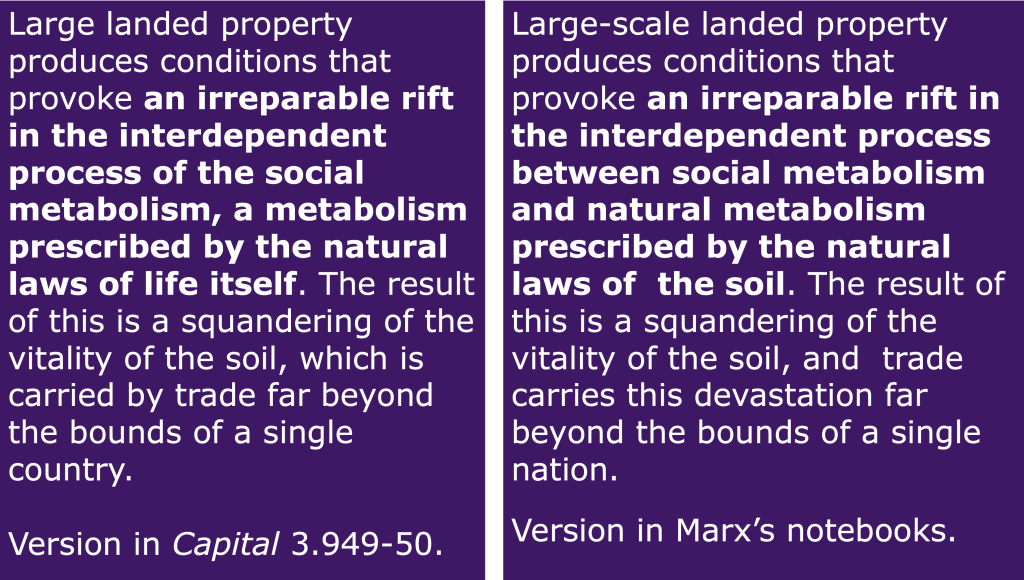
This is it. The great revelation. The big reveal. On this subtle rephrasing of two similar ideas, Saito invites us to climb an edifice so tall that we can look down at planet Earth and see its past, present and future. His entire course of argument has only this single difference at its foundation. I wouldn’t dare climb such a rickety structure, but for the fact that I am wearing a jetpack provided by Timothy Morton.
According to Saito, the importance of the phrasing in Marx’s notebook is that there are two metabolisms mentioned, not one. On the left, we see that landed property produces a rift in the process of social metabolism; on the right, that landed property produces a rift in the process between social metabolism and natural metabolism. Social metabolism is, according to the brief mention of it in Capital (1.198), the process by which commodities change hands, moving to the person who purchases a commodity for its use-value, at which point the commodity finds its ‘resting place’ and drops out of circulation.
Really, there’s very little profound or significant about how Marx was using the term ‘social metabolism’ here. Unlike ideas such as use-value, exchange-value, and surplus-value, Marx didn’t bother to define the concept further, nor did he employ it other than in the quote above. What about ‘natural metabolism’? This refers simply to the processes in nature that exist outside human activity. For Saito, the failure of Engels to acknowledge the difference between social metabolism and natural metabolism is a fundamental mistake in communicating Marx’s method. Marx’s ecology, says Saito, is all about the dichotomy between the two and especially in properly understanding his theory of ‘metabolic rift’.
Did Marx Have a Theory of ‘Metabolic Rift’?
Everyone on the left – from out-and-out Stalinists to more humanist Marxists and Trotskyist socialists – is singing the same chorus on this point and it is quite deafening. Marx was a profound ecologist, and he remains relevant to ecology thanks to the importance of his theory of metabolic rift. Monthly Review editors John Bellamy Foster and Brett Clark talk about ‘Marx’s famous theory of metabolic rift’. In the UK, SWP external faction RS21 go all in on the concept as central to Marx’s relevance today; ditto the Irish SWN with their view that Marx and Engels’ notion of a metabolic rift shows that they had ‘plenty to say’ on environmental degradation. And Saito is the strongest champion of the existence of this theory:
Marx’s theory of metabolism was the central pillar of his political economy. In other words, his intensive engagement with ecology and pre-capitalist/non-Western societies was indispensable in order to deepen his theory of metabolism. Marx attempted to comprehend the different ways of organizing metabolism between humans and nature in non-Western and pre-capitalist rural communes as the source of their vitality. From the perspective of Marx’s theory of metabolism, it is not sufficient to deal with his research in non-Western and pre-capitalist societies in terms of communal property, agriculture and labour. One should note that agriculture was the main field of Marx’s ecological theory of metabolic rift. In other words, what is at stake in his research on non-Western societies is not merely the dissolution of communal property through colonial rule. It has ecological implications. In fact, with his growing interest in ecology, Marx came to see the plunder of the natural environment as a manifestation of the central contradiction of capitalism. He consciously reflected on the irrationality of the development of the productive forces of capital, which strengthens the robbery praxis and deepens the metabolic rift on a global scale.
Kohei Saito, Marx in the Anthropocene (Cambridge University Press, 2023), p.200.
I’ve highlighted in bold how Saito repeatedly asserts that Marx had a worked out ecological theory of metabolic rift, which in turn was derived from a theory of metabolism that was the central pillar of his political economy. This is somewhat like a hypnotist planting ideas against an inchoate background drone. You would be forgiven for reading text like this and taking away one idea: Marx had an ecological theory.
Marx, however, never used the term ‘metabolic rift’, not once.
Just think about this fact for a moment. If you want to say that Marx had an original theory of the falling rate of profit, you can easily provide plenty of evidence. If you want to say that Marx had an original theory about the forces and relations of production, or that Marx had an original theory about the contribution of labour to the value of a commodity, you can provide plenty of evidence for that too. But for Marx’s ‘famous’ contribution to ecological thinking, the theory of the metabolic rift we have… just one sentence in his massive corpus of writing that includes both the word ‘rift’ and the word ‘metabolism’.
It is dishonest to claim anything more than that Marx, when taking notes on a book about how farming degrades the soil, attributed this degradation ultimately to large-scale landed property. That’s what his sentence means and Engels wasn’t far wrong when phrasing it the way he did in Capital. For those like Saito who think this was a disastrous amendment that hid a profound ecological theory from readers of Marx for over a hundred and fifty years, then you have to assume that Marx kept Engels in the dark about his theory of metabolic rift. The two friends chewed over a vast range of topics over many years, from fundamental laws of economics down to the art of snowball fighting, but not ecology. Or if Marx did broach the subject, Engels simply forgot all about it.
If you want a theory of metabolic rift, help yourself. But do so on the basis of the writings of those who genuinely developed the concept, especially István Mészáros and John Bellamy Foster. A theory of ‘metabolic rift’ does not exist in Marx. I’m not sure you should want to deploy Foster’s theory, by the way, because for him, the ‘rift’ that is ravaging the planet occurred when capitalist production separated use values from exchange values and pursued the latter. The problem with this model is that it doesn’t fit the historical facts. Human societies were destroying forests, depleting natural resources, and converting wilderness into mono-crops and regions for animals to feed on for millennia before capitalist production accelerated these processes. Timothy Morton is much more in tune with the actual course of events when they writes of a ‘severing’ some seven thousand years ago that created a logic that is playing out dramatically today. As a matter of fact, Marx himself is better than the ecosocialists on the pre-capitalist alienation of humans from the natural world.
If Marx had a powerful ecological theory, then how is it that Marxists were far less able to predict the crisis engulfing the planet than non-Marxists? Until now, Marxist parties predicted a crisis of overproduction and underconsumption. Their focus was on the falling rate of profit and the various economic contradictions of capitalism, such as those which produce a boom-bust cycle. Where are the predictions about the catastrophe that we are now living through? They are everywhere in the environmental movement but almost nowhere in Marxist writings until after the fact.
Here’s an example that struck me, written in 1972:
As you abrogate all mind to yourself, you will see the world around you as mindless and therefore not entitled to moral or ethical consideration. The environment will seem to be yours to exploit. Your survival unit will be you and your folks or conspecifics against the environment of other social units, other races and the brutes and vegetables.
If this is your estimate of your relation to nature and you have an advanced technology, your likelihood of survival will be that of a snowball in hell. You will die either of the toxic by-products of your own hate, or, simply, of over-population and overgrazing. The raw materials of the world are finite.
If I am right, the whole of our thinking about what we are and what other people are has got to be restructured. This is not funny, and I do not know how long we have to do it in. If we continue to operate on the premises that were fashionable in the pre-cybernetic era, and which were especially underlined and strengthened during the Industrial Revolution, which seemed to validate the Darwinian unit of survival, we may have twenty or thirty years before the logical reductio ad absurdum of our old positions destroys us. Nobody knows how long we have, under the present system, before some disaster strikes us, more serious than the destruction of any group of nations.
Gregory Bateson, Steps to An Ecology of Mind.
Isn’t it powerful? Deep too, in that, based on a philosophy of what a mind is, Bateson predicted the world we have arrived at. This is not, however, in the slightest way influenced by Marx. In fact, it might even be anti-Marxist in that for many Marxists the human mind is so qualitatively different to the rest of nature – which, they say, is not dialectical in any important sense – that moral and ethical considerations apply only to human behaviour.
There’s nothing in Monthly Review before the late 1990s that remotely comes close to this prophetic writing by Bateson.
What was Marx’s Ecological Thinking?
Having devoted an entire book to Marx’s concept of metabolic rift and how it is an ‘indispensable conceptual tool for the ecological critique of contemporary capitalism’ (in other words, a whole book about a theory that cannot be found in Marx), Saito fails to mention some more famous passages in Marx that shed light on his actual ecological thinking.
In Capital I.8, Marx wrote: ‘The coal burnt under the boiler vanishes without leaving a trace, so, too, the tallow with which the axles of wheels are greased.’ Far from applying a theory of metabolic rift to appreciate that burning coal is going to have serious implications for life on Earth, Marx hadn’t the faintest concept of runaway carbon emissions leading to global warming. For him, there was no environmental consequence to burning coal. Only if you are dedicated to the project of repackaging Marx to sell to the ecological generation will you squirm at the passage. Everyone else will shrug. Why should Marx have been a powerful ecological thinker? Most of the processes that have led to the crisis we are facing only really took off after his death.
For example, the crisis of agricultural soil, which so many ecosocialists raise to prove Marx’s credentials has emerged in a very different form to anything envisaged by Marx. Marx firmly believed that large-scale capitalist production on the land would lead to a depletion of the fertility of the soil. That didn’t happen because of the discovery of techniques to refertilise the soil with chemical processes. Today, food production is ten times greater than when Marx made his notes on the soil. Below, for example, is the trend of the corn crop in the US.

There is a soil-related catastrophe unfolding, but it was not one that Marx could reasonably have anticipated. The production of nitrogen for use on the land has contributed to global warming and the runoff from chemical fertilizers has devastated life in rivers as well as created enormous and growing dead zones in the seas of planet Earth.
What are we to make of the statement in Marx (Capital 1.7) that: ‘A spider conducts operations that resemble those of a weaver, and a bee puts to shame many an architect in the construction of her cells. But what distinguishes the worst architect from the best of bees is this, that the architect raises his structure in imagination before he erects it in reality.’
Isn’t it clear that Marx had a model that considered humans fundamentally different to animals and insects? This is no longer a sustainable model. There is plenty – and growing – evidence that bees are sentient: they engage in play; they suffer stress; they warn each other of hazards. Spiders, too, are not Cartesian automata: they have dreams as they sleep. The definition of mind here in Marx is very anthropocentric: it requires the mind to create a structure in the imagination before acting. As it happens, we share an evolutionary path all the way back to before the branch leading to birds that allows for this kind of mind to evolve and we are not alone in being able to raise a concept in our imagination before acting on it. Ravens, for example, have been proven to engage in exactly this kind of imaginative planning. But there are other types of mind on planet Earth. The octopus is a fascinating creature with undeniable sentience but its mind has evolved on a different path and it does its thinking by manipulating objects with its extraordinary limbs.
Is Ecosocialism a Guide to Action?
On 6 June 2023, Russia blew up the Kakhovka Dam causing a massive flood of water to wash away large nature reserves and national parks. The Trotskyist-controlled ecosocialist websites like that of the Global Ecosocialist Network have had literally nothing to say about this. Monthly Review, on the other hand, backed Scott Ritter’s arguments that this act of ‘ecological terrorism’ was the work of Ukraine.
The people most behind the ecosocialist brand are apologists for Russia and, indeed, you will search in vain for criticism of China’s harmful environmental policies in Monthly Review. Instead, the founder of the ‘metabolic rift’ theory is hugely positive about Xi Jinping of China and his environmentalist credentials.
What kind of ecological theory has a practice that is aligned to a geopolitical approach to world politics? One that praises China, tries to explain away Russian imperialism, and focuses entirely on the west? Clearly it is one that is deeply flawed. Either we save the planet through a global transformation or we all go into the void together. Picking a side among the powerful nation states of the world is to remain hopelessly enmeshed in a lethally narrow, limited and fatally incomplete kind of ecological politics.
The Stalinist thinkers who developed the ecosocialist brand have dragged the Trotskyists in their wake. ‘Ecosocialism’ in this guise is an utterly contaminated political program. The attempt to rebrand Marx as a powerful ecological thinker is a fraudulent exercise and points to a fraudulent practice, where optics are more important than recognising the true depths of the transition that we have to manage. We don’t just have to undo the harm created by capitalism, we have to rethink our relationship to nature in a way that is not permeated by seven thousand years of treating everything non-human as exploitable. That’s not going to be easy, but being dishonest about Marx’s limitations means even advocates of revolution remain trapped in a way of thinking that will prevent our escape from the harm we are doing to the planet.
For an interview about this topic with Andy Wilson of Traveller in the Evening, see here.
James Connolly and Ukraine
The war in Ukraine is a political earthquake. It has divided the left internationally. I am one of those who believes that the defeat of Russian imperialism by the people of Ukraine is vital for the future of humanity. Either the far-right and authoritarian governments are going to be strengthened or they will be thrown back and Putin toppled.
Does thinking about the conflict through the perspective of James Connolly’s politics help understand it? I believe so and – interestingly – so do those who take a very different approach to the war in Ukraine.
In Ireland the Socialist Workers Network controls a broader party called People Before Profit. The position of the SWN on the war in Ukraine is therefore that of PBP and it is what I have termed evasionist. It condemns Russia but refuses to support Ukraine’s efforts to force Russia to withdraw and prides itself on preventing arms and even anti-mine assistance going to Ukraine. This is because the SWN see the war as an inter-imperialist one, with Ukraine acting as a proxy for US imperialism.
Kieran Allen has written about Ukraine through a lens that purports to be inspired by James Connolly in a feature for the Rebel website, the website of the SWN. I’d like to use the opportunity of this talk to rescue Connolly’s reputation from the harm that Allen does to it. Allen presents Connolly’s thinking on the Great War accurately enough: it was the result of rivalry between the great powers, especially Germany and Britain and the outbreak of war should have heralded a working class rebellion in the cause of internationalism.
The violence to James Connolly’s politics happens because of what is not said. Allen concludes: “Connolly’s message that war is a product of capitalism and that the overthrow of that system is necessary could not be more relevant today.” Well yes, capitalism is bad, it creates wars, and Connolly wanted socialism. But what about the very specific and relevant questions arising out of the occupation of smaller nations by stronger imperial powers. Specifically:
- When those smaller nations fight for independence, should socialists support them?
- Does that support cease if the leadership of the national independence movement is pro-capitalist?
- Does that support cease if the leadership of the national independence movement seek weapons from other imperial powers?
James Connolly and Ukraine: Questions Answered
As soon as you pose these questions instead of evading them, there can be no argument over the answers that James Connolly would and did give to them. One. Yes, socialists are in favour of the right of nations to self-determination and not to be ruled by imperial powers. Two no, that support does not cease if the leadership of the national independence movement are pro-capitalist. In fact, Connolly’s major argument here, powerfully expressed in his book Labour in Irish History is that because Ireland’s elite are bound by a thousand golden threads to the capitalism of the British empire, they will betray the national movement. Not only should Irish socialist fight for independence, they should appreciate that the working class are the class most fit to achieve it. And Three, yes, you should take advantage of divisions among imperial powers to get arms for the national movement of an oppressed nation.
On this last point, I just want to emphasise how far Connolly was prepared to go to get military assistance from Germany, whilst retaining his opposition to all empires including the German one. Germany allowed the sale of 900 rifles and 29,000 rounds of ammunition to the Irish volunteers in 1914, brought to Ireland on a yacht, The Asgard. In 1916, Germany sent a ship, The Aud, with 20,000 rifles, 10 machine guns and a million rounds of ammunition to the west coast of Ireland. Roger Casement, the negotiator for the volunteers, was brought to the same area by U boat. These were welcomed by Connolly, who also forwarded to the readers of his Workers Republic, letters from leaders of the Irish Brigade, which was being trained in Germany.
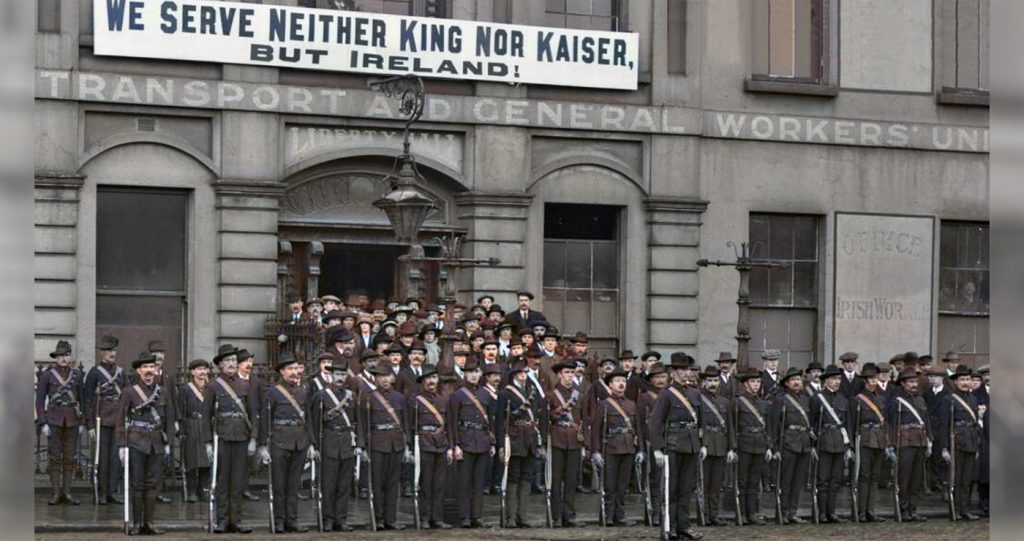
Of course Connolly had political opponents who he knew would condemn him for dealing with Germany and approving of German assistance. The same kind of socialists who say they are against all capitalist powers and that to support Ukraine is to support NATO. He therefore had a huge banner made to make it absolutely and unmistakeably clear that you could take advantage of German willingness to promote rebellion in Ireland without supporting German imperialism: We Serve Neither King Nor Kaiser but Ireland.
I’m confident therefore, especially given the many similarities of history in the relationship between Ukraine and Russia and Ireland and Britain that Connolly would be on the side of Ukraine’s workers in their resistance to invasion, their willingness to use whatever weapons they can obtain and to fight alongside Zelensky, even while making the point that the fight would be more effective without neo-liberal policies holding it back.
My last point is one of method. Connolly had a simple but powerful way of assessing where he stood in novel situations. He started by listening to those affected. As he put it in 1915 after engagement with the nascent women’s movement in Ireland, None so fitted to break the chains as they who wear them, none so well equipped to decide what is a fetter.
Connolly gave voice to the working class and the oppressed more generally. The truly shocking evasion is that in over 500 days of the invasion not one voice from Ukraine has appeared on the websites of SWN or been articulated by the politicians of PBP. This is in stark contrast to Connolly’s approach to politics. Even if he disagreed with an opponent, he’d present their views, in order to swipe at them with relish. He was a master polemicist and very funny too. I believe Connolly would have sided with the Ukrainian left and helped working class refugees find their feet in Ireland, as he did for Jewish workers at the turn of the century. But let’s suppose he had a disagreement with them, it’s impossible to imagine him carrying out the cowardice and deception necessary to pretend that the millions of Ukrainian trade unionists, feminists, socialists, anarchists, etc. are not fighting as hard as they can to get the Russian rapists out of their country. To suggest Connolly would have ignored the Ukrainian left in the name of a vague opposition to capitalism is where the real violence to his legacy happens.
This feature arose from a talk I gave to Workers Liberty‘s conference Ideas For Freedom on 15 July 2023. Thanks to the organisers for the invitation.
If you agree with this view of James Connolly and Ukraine, please consider joining Independent Left and / or signing up for our emails.