• Skip to primary navigation
  • Skip to main content
independent left logo

Independent Left

Environmentalism, socialism, freedom and equality. #liveablecity

  • About
  • Featured Articles
    • How Farming Must Change to Save the Planet
    • The Housing Crisis: Causes and Solutions
    • Socialism in Ireland
  • Contact Us
  • Podcast
  • Animal Rights
  • Archive
    • Irish Socialist History
    • Dublin City Council Housing
    • Ukraine
    • Protests Ireland
    • Reviews
    • Irish Political Parties
    • All Posts
    • Independent Left Policies
  • Why join?

Capitalism and Disability

17/08/2022 by Eoghan Neville Leave a Comment

The Neuro Pride Ireland festival 2022 took place in August and Eoghan Neville of Independent Left prepared a webinar on capitalism and disability for Neuro Pride Ireland, based on his reading of Roddy Slorach’s A Very Capitalist Condition: A History and Politics of Disability. He spoke to Conor Kostick about the book and disability rights.

Conor: What do you think is the main value of the book?

Eoghan: This book acts as an introduction to socialism, to anti-capitalist thought, to all kinds of left-wing discussion. When you’re introducing someone to socialism, more experienced left-wingers will have a list of books that they say, “Oh. These should be your introduction.” This book should absolutely be there among them because I think if you can understand disability under capitalism, you can understand why the system doesn’t work for anyone.

If you take a particular issue – in this case disability – you can really begin to understand how capitalism fails us. This book really goes into a lot of details about disability under capitalism, and how this contrasts with disability before capitalism and why it has to be addressed with the social model. The book helps you connect the dots and say, “Well, if capitalism doesn’t work for this group, it doesn’t work for this other group, and it actually doesn’t even work for non-disabled white people.” You know? The stereotypical privileged people. Capitalism only works for the very people at the top, the very top.

Conor: Capitalism constantly seeks to divide the working class; it is a system that promotes racism, and sexism, and so on. Would you think there is a difference, though, to how capitalism treats people with disability? Despite discrimination, big business still wants women in the workforce and still wants black people in the workforce. But with disability, maybe the governments and companies don’t want the cost of providing equality of access to the workforce?

Eoghan: On the one hand, I think capitalism doesn’t want disabled people. No one would say it, of course, but they want to cure us. They want to make us normal. That’s what capitalism wants to do ideally, which is what it was doing in the late 1800s and the early 1900s with the eugenics movements. That’s what eugenics was: either curing or exterminating. There is a very important chapter in the book – Chapter Seven ­– about eugenics and Nazi Germany, that is well worth reading to understand the point about eugenics and Nazism when it comes to disabled people. But note that it is very distressing, a very hard read. I actually had to put the book down myself halfway through the chapter because of how just shocking it was, the details.

A trigger warning about that is key, but the main point of the history is that eugenics was just so normalized. A lot of people took Darwin’s theory of evolution and twisted it into eugenics. They said, “This is where evolution is. This is what nature is, and this is where we should arrive at,” and from that view, disability is kind of like a glitch, like when your computer stops working. It’s not meant to be, so we have to either fix this or delete it like you would delete broken files on a computer or something.

There were famous people at the time who had those views, such as George Bernard Shaw and Winston Churchill. There was an American scientist in the early 1900s who was doing openly eugenics experiments. Charles B. Davenport was getting praised in all the newspapers being described as, “This great humanitarian.” And they openly talked about him doing eugenics.

The only reason that eugenics fell out of favor is because of Nazi Germany, but now it’s kind of coming back. There’s more than a tinge of it around. It’s like with how capitalism kind of reinvented itself into neo-liberalism. There’s almost a kind of reinvention of the crude eugenics of the past into what I’d call neo-liberal eugenics. It’s like they’re trying to put a bow and tie on it or something and trying to make it look nice.
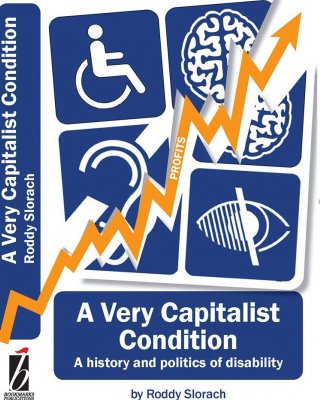
Capitalism and Disability A Very Capitalist Condition
Roddy Slorach, A Very Capitalist Condition: A History and Politics of Disability

Conor: Is this just the far-right – the sort of Trumps, and Le Pens – or is there a kind of mainstream return to isolating and pushing aside people with disability?

Eoghan: It definitely is the far-right because obviously they are the successors to the Nazis, but you have elections in various countries where a center-right government will need the support of the far-right to make up the numbers electorally, so then they have the usual thing of, “Oh. We have to make concessions,” and that’s where it can appear.

Often, disability is one of the first areas that’s targeted by any kind of government because if you go after disabled people, there’s not so much of an uproar. They kind of think, “Well, this is something we can concede to the far-right and not get much backlash on.” Social welfare benefits for disabled people are often the first to be cut by an incoming government. That’s the playbook of going after disability. Again, it’s in a new way. It’s in a neo-liberal way.

Conor: What I see is less of an overt eugenics position but discrimination around the question of resources. A lot of organizations like universities, hospitals, and so on have on paper really good policies. We want to be inclusive. We want to be diverse. We want everybody to have an access to education, health, and so on. They would like that, they say, but then when it comes to what does that actually mean, that’s when I see all the obstacles pile up really fast.

Just 24% of visually impaired people in Ireland have employment and when you go to find out why, it’s not that anyone says aloud, “Well, it’s just not worth investing in you. It’s a waste of money,” although I think ultimately that’s the logic, but no one that I meet expresses it that way.

What they say is, “Well, we can’t give you that magnifier. No. I’m sorry. We don’t have the resources or the staff to install it.”

Eoghan: I’m talking about the more political sphere when I’m talking about eugenics, but in terms of wider society like, say, access to education or something, Ireland very much has the charity model. Again, this is capitalism trying to reinvent itself moving away from the medical model, shutting down the ‘insane asylums’, and moving towards a charity model, so now you have the care homes. I mean, they have the approach in the name. They call them care homes.

Another example would be with respect to refugees. You’re not putting them in ‘refugee centres’. No. No, no. These are ‘community hubs’ or whatever term is acceptable by the charity model. The message is that these are resources we generously provide for you. You should consider it a privilege to be given this. You should be thankful you’re getting this. Rather than it being a right. It’s like as if accommodations that allow for equal access or independent living are a luxury. This is a luxury good. We can’t really give you this. That’s what I think it comes down to.

Conor: The book covers the rise of disability rights of people with disabilities organization despite the difficulties and challenging the system, so do you want to say a bit about that?

Eoghan: The main change it covers is the rise of the social model of disability, that was movement in England in the 80s with Mike Oliver and Vic Finkelstein. On a side note, Finkelstein is an interesting character because he was actually arrested for being involved in the anti-Apartheid movements in South Africa and then went to England. Basically, he was kicked out of South Africa. The book covers a great example in the US of a battle over a university who were trying to select members for a board and when it came to having someone with knowledge of disability they picked someone who had studied the subject rather than someone equally qualified who had a disability. Just because you’ve studied disability doesn’t prevent you having a negative view of disability or disabled people.

Anyway, a campaign sprang up that occupied the university until someone with a disability got the position. The book covers a lot of direct action like this, and that feeds into the social model of disability in a sense because the social model is created by disabled people. It’s a radical model made by socialists, by the people on the far-left.

Conor: Could you just give us a very quick recap on what the main points of the social model of disability are?

Eoghan: The main point is that disabled people should be able to live independently: so no care facilities; no medical model; none of that; not being ‘cared for’. Obviously, you have to have supports, like having a personal assistant. That’s what groups like the Independent Living Movement in Ireland are pushing for, so you’re able to live, work, and contribute to your community in whatever area you want. You can get an education, get a job, volunteer, do as you want. It’s very much focused on a disabled person-led approach.

We are the ones who are choosing. Living independently is us employing the personal assistant. So it’s not a case of that person coming in and saying, “I’m going to do this or that for you”. We are saying, “I need help with this. Can you assist? Grand.”

Also, that point about direct action such as occupying buildings to actually get rights for disabled people is part of the idea. It contrasts with a centrist government-funded disabled persons’ organization that has people in it who are not disabled. These just making a few gestures and shake their fist but without forcing change on the government. You need actual, radical change and the radical approach to it as.

Conor: Presumably there are allies for disability campaigners, perhaps in trade unions? Are there any case studies of where good alliances ran successful campaigns?

Eoghan: In relation to Ireland, I think a good link that you could get is between disabled people and travellers because these are the most oppressed communities in Ireland, and there have been recently people, disabled travellers, who have spoken about linking the two in together.

In terms of specifically here and now, those are two communities that could link in together, but I think in terms of history the movements that have been led by disabled people are a recent enough thing, like from the 80s, and 90s. It comes back to a kind of intersectionality because there will be people in other campaigning communities who have disabilities.

In America, you’d have people in the Native tribes that are also disabled, so they will have the dual understanding of why both communities are oppressed, and they can act as the link between the communities.

Other than this intersectionality though, I can’t really think of any kind of proper, big mass movement where you’ve had a proper coming together. The book does look at the Soviet Union and their disability movement before Stalin came to power. It is really interesting because it really goes into depth about how there were proper discussions, actual empowerment of disabled people and disabled academics and serious studies and research to understand various impairments and disabilities. But that really comes to an end when Stalin comes to power.

Conor: That is interesting because it’s not well known, that history. When you look at modern post-Communist countries, they seem to be particularly bad, in fact, for people with a disability. They seem to have a model that institutionalizes people with disabilities rather than hold out the prospect of them being able to play an equal part in society.

Eoghan: It’s kind of ironic. When Khrushchev comes to power and he’s trying to distance himself from all the failings of Stalin, he’s like: “We can’t do this anymore. We can’t do that anymore,” but he didn’t think about disability. He probably just went, “Oh, no. That’s grand. That’s fine. Disability doesn’t matter. We don’t need to distance ourselves from Stalin on that. That wasn’t too bad.”

Conor: Returning to today, you mentioned them earlier but the Independent Living Movement Ireland (ILMI) campaign seems to have a lot of energy and a lot of potential to be able to win progress for people with disabilities. Do you know something about that campaign and where it’s at?

Capitalism and Disability ILMI
Independent Living Movement Ireland. https://twitter.com/ILMIreland #nothingaboutuswithoutus

Eoghan: This has been going on since 2018. They’re trying to get a motion passed in the Dáil that basically calls for the independent living structure to be the model of disability: so to have a personal assistant service, to have that fully funded; to allow for the social model of disability basically.

I think it’s gone back and forth through the Dáil. It gets passed, but it then just gets hung up. Recently they did have a good win at least with the all the councils of Ireland, with the exception of Dublin City Council, passing the Independent Living motion unanimously.

Of course passing the motion is purely symbolic act, but it is one that says, “We’re calling on the government to bring in a model of independent living for disabled people.”

Conor: Well, it’s valuable that the groundwork is being laid. You can’t win equality without winning the argument and being clear on what you need, so that’s really important work, but in terms of then going the next step of actually trying to get some funding for the implementation of this, how do things stand? What’s the plan for the next step of the campaign?

Eoghan: Well, the funny thing is that we already have the personal assistant service. We’ve had it since the early 1990s, but it’s still in a trial phase. It is very hard to access, unless you have a good amount of money on yourself and can go through all the bureaucracy because there are a lot of hoops.

The structure is there in a sense, but obviously the funding isn’t and that’s the sticking point. The government saves 15 to 20 billion euro a year from carers. So they don’t have any incentive to replace family carers with paid assistants.

Conor: How does the book conclude?

Eoghan: They wrap it up with a rallying cry that if you are going to bring about change, disabled people are going to have a campaign for this themselves. It’s a simple point, but it’s often missed. The movement needs to be disabled-led. As simple as that. The book lays it out very clearly.

Conor: Whilst we want to win as much as we can at the moment and make as much progress as we can, is there ever going to be equality for people with disabilities under capitalism?

Eoghan: No. Simple answer. It is an obvious answer, but there’ll never be equality for disabled people under capitalism because there’ll be never equality for anyone under capitalism. It’s as simple as that, and what it all comes back to is linking the struggle of disabled people with the struggle of any other group, any other group throughout history, like women, like people of colour, the LGBTQ+ community. They cannot get equality under capitalism, and we cannot.

Conor: Is there anything else that my questions haven’t given you a chance to talk about that you wanted to talk address?

Eoghan: A very interesting point is made in the book about disability and war veterans. People who go off, fight war, and get a particular injury and end up in a wheelchair or losing a leg, lose an arm, they’re venerated. They’re lifted up on a pedestal and seen as good. This is what the Nazis did, actually. It’s quite ironic. For the Nazis, who were all about eugenics, put disabled people on a pedestal, and they were there with Hitler.

Disabled people have been divided in that regard, and especially with the mainstream media now. It’s a weird thing because disabled war veterans generally speaking are quite well looked after and generally there is an expectation that they be given and afforded anything they need, and as soon as there’s discrimination against a war veteran like, say, someone with a guide dog or a support animal is kicked out of a building there’s uproar in the media. National media is covering it. Everyone is going on social media and saying, “This is disgraceful. How dare they do this? This is shocking,” but if a non-war veteran disabled person was to be discriminated against, nothing.

The war veterans themselves may not want to be used in this way. But their disability is seen as a mark of honor whereas other people’s disability is portrayed as a shame. It is a bad thing. It is a scar. You should hide that.

Conor: On the question of shame, is Neuro Pride a new development? Can you say something about that?

Capitalism and Disability
Neuro Pride Ireland have an annual festival to celebrate neurodivergent people, community, and culture

Eoghan: Neuro Pride Ireland were founded last year. They held a festival last year, and they’ve done one this year, and now they’re doing kind of meetups as in public meetups in person which is for neurodivergent people, various impairments. Autism especially I think. Well, obviously all neurodivergencies, but I think a particular focus on autism because I think that’s the one that’s really stigmatized in the media.

At the moment, they’re trying to organize to end Applied Behaviour Analysis, ABA, which is a negative kind treatment plan often used by non-autistic ‘experts’ who are trying to cure autism or make the impairment lesser. If you look at kind of the people who founded the modern kind of medical model of autism, how to approach it, they have a eugenics mindset.

Neuro Pride has a community-led, bottom-up approach. They’re very much going down the route of being an NGO, which is grand. There’s nothing wrong with that. I mean, you can still work with that because they genuinely want to change things, and also they’re community-led which is a radical thing in and of itself, but there’s loads of people in that movement who are radical, who are anti-capitalist.

When I joined that group, I started talking about the book and everyone was genuinely interested. It’s actually really great to be in that community.

Read Eoghan’s review of an inspiring book about dyspraxia here. Learn more about Neuro Pride Ireland here and about ILMI here.

Filed Under: Reviews

Capitalism and Gaming

08/12/2020 by Eoghan Neville 2 Comments

Capitalism and Gaming Esports Marxism Monetization of Gaming
Capitalism and Gaming: the drive to monetize is underming playability

How Monetisation Destroys Good Games

Eoghan Ó Nia interviewed by Conor Kostick

Conor: We’re going to talk about capitalism and gaming. And I suppose we’re framing the discussion by saying that we live in a strange world where whenever there’s anything that human beings do that’s fun, somebody thinks, ‘oh, I could make some money out of this’. And sometimes they can make enormous amounts of money off of it. Very often by doing so they end up destroying the fun. This has happened in so many areas of human culture and I think it’s happening in gaming in a really quite stark way right now. For example, with micro-transactions inside of games. Can you start by talking about these?

Eoghan: There’s a hundred different terms that are used from game to game, but essentially micro-transactions work via in-game currency that you have to pay real money to get. Then you can use that in-game currency to go for additional items, such as a loot box. And through these purchases you have the potential of getting good items that can help you in the game. This gives you an immense advantage over people who don’t pay to use the system. So often the games get called a pay-to-play, because if you want to make any progress in the game, level up, you have to take part in making micro-transactions. If you don’t use them, then your progress is actually slowed down. It’s designed that way, obviously. They manipulate the system to push you towards having to make purchases.

And the most worrying aspect of this is in games like FIFA, which obviously are played by a lot of children. So you’ve got children getting money off their parents to buy this in-game currency for them. With loot boxes there’s a chance that you might get a good item or not. It’s risk-reward. It’s basically a form of gambling, and kids are doing this, which is what is the real concern.

I mean, there’s a whole debate around gambling and the morality of it and all this sort of stuff, but I think anyone can agree that children taking part in any form of gambling is just wrong.

Conor: As a case study, can we look at FIFA in a bit more depth then. What can a player buy in FIFA?

Eoghan: For FIFA, the loot boxes are called packs. There’s a mode in the game called ultimate team where you have to build up a squad of players: your ideal football team. That’s the basic premise of it. You’re building up your dream football team. You buy packs, and the packs have players in them that may want to use or not. Again, it’s risk-reward. You spend FIFA points that you use real money to buy. And it’s a risk-reward activity because the more money you spend, the better the pack, the better the chance of getting a good item.

FIFA packs are an example of capitalism and gaming
FIFA packs costing up to €99.99 are a form of monetization that arisis from capitalism and gaming

Conor: And does this mean if you’re playing it online with your friends, or with strangers, it makes a big difference if you’ve spent any real money?

Eoghan: Yes. Because you’ll have better players. It’s as simple as that. You’ll have better players, and then if you don’t get the players you want, you can sell them to make more coins, which is the other in-game currency, which is used to buy players individually. But you’ll basically have more of an advantage over someone who doesn’t use that system, because if you play the game without taking part in the micro-transactions, you earn solely on barely any money to be able to buy anything. You have to play hundreds of games to even get one pack. It’s ridiculous.

Monetization is everywhere in gaming

Conor: We’ve used FIFA here as the case study, but this type of monetization is everywhere now, isn’t it?

Eoghan: Yeah, pretty much. I mean, you can take the example of FIFA, change around a tiny bit and you can pretty much make the same point about any other game that has this system. The names for the items you are purchasing change – in FIFA they’re called packs, or in a game like Fortnite it would be loot boxes – but it’s the exact same thing. One study in 2019 found that over nine years the percentage of loot boxes in the bestselling games on Steam rose from 4% to 71%.

Conor: Most combat games give you better weapons if you’ve paid real money. So if you’re duelling other people, it’s a big advantage if you’re ploughing your cash into them.

Eoghan: Exactly.

Conor: And is this spoiling the pleasure of the game?

Eoghan: Yes, because it basically means that you have to use your real money to give you an advantage. For people who just don’t bother with that, who are just trying to play the game for fun and want to switch off for a few hours, there’s no fun to be had because you’ve got these players who have this massive advantage over them. A lot of games are designed so you need to be on it every day and spending money to actually get anything out of it.

Conor: Back in 2004, this wasn’t around so much, but you could see it coming. Because that year I wrote Epic. The premise of Epic is that everybody on the planet in the book is playing an online game, and it’s corrupt. There’s a small elite who’ve rigged the system. Epic won an award that took me to China. And what I learned on my trip to China was even then – sixteen years ago – there were factories where people were farming all day inside the games: accumulating in-game coins, and then selling the packs of bundles of coins to players in the West. It’s massively accelerated now, but even then people were paying up to $2,000 for a top-of-the-range character who’d been levelled up by these platinum farmers and level grinders. And so they would be doing that nonstop, playing the game, if you can call it play when it’s working for long hours.

Eoghan: And I’m sure they weren’t paid too much.

Conor: I’m sure the pay was terrible. In fact, I remember reading a really good short story of a trade union organizer who goes inside a game as an elven warrior to talk to the people doing it. And they join the union and prepare an in-game strike.

You can imagine the harm that plat farming did to the games, creating shortages for casual players and forcing committed players to spend more money. And the same trends have really grown since. Something that is new, however, is the growth of mobile gaming. Can you say something about that?

Capitalism and Mobile Gaming

Eoghan: With advances in the technology of mobile gaming – the fact that your phone can process more – you’re able to actually have games on your phone. But you can’t have the kind of complex games that you’d be able to have on an Xbox or a top-of-the-range PC. So companies have made very bare bones, simple but addicting games for phones. Social media can be addictive and mobile games are designed around the same features. I think some of the first mobile games were actually Facebook games. They began by being offered for Facebook users and then became more general.

Conor: Can you give us an example?

Eoghan: Candy Crush Saga is a good example. It began on Facebook in 2012 and soon spread everywhere. It showed games companies the power of giving players only a limited amount of turns, with the option of buying more energy to keep going. Some of these ‘freemium’ games are massive, earning over a billion a year. Another example is Simpsons Tapped Out, where you build your own Springfield. Essentially you have to pay in-game currency to speed up the time of the building because the buildings take a real day to complete. Not an in-game day, a real day, twenty-four hours to build one building. So that’s where you are encouraged to buy in-game currency with real money so as to speed up the building time.

Conor: The need for speed-ups is a big feature of these games. These games are addictive, with millions of people playing them. But it must be frustrating to have constant interruptions unless you pay.

Eoghan: Mobile games are even worse than the regular games with regard to these features, because these games are simply about the money. That’s all they are. There’s almost nothing to do when playing them, besides just sit around and wait and pay real money. They are so basic. At least with the games on Xbox and PC they try to hide the fact that it’s capitalism at work.

Add-ons as another monetization flaw in gaming

Conor: Some of the console games are works of art, quite amazing in how they look and their storylines. But they’re distorted works of art that are flawed because of the monetization aspect. Wouldn’t it be brilliant to have people making games just for the joy of it, just for the pleasure of building immersive stories that we can play?

Despite Capitalism gaming can be art
Every year games set new standards for the beauty of their graphics, such as in the 2016 game Skyrim

Eoghan: You look at the older games, and you can see that. There are no micro-transactions; there’s no major content that’s brought out as a separate bundle. In the older games, they gave you everything with the game. And there obviously are still some who make games because they love making games. But I think what happened with the rise of the internet and more people playing online, was that business just saw an opportunity as more and more people played video games: this is something we can exploit.

Conor: Well, you mentioned about unlocking extra content. So that’s another big monetizing feature of modern games that didn’t used to be around. So the add-on basically. Can you give us more examples maybe of unfair add-on?

Eoghan: For some games you’ll get extra missions to play through. There’s the very popular Assassin’s Creed for example. So that’s a game where you play as a member of the order of Assassins up against the Templars. Assassin’s Creed Valhalla is set in England during the Viking age. In the DLC (downloadable content), they’re going to add Dublin. It’s good that players will be able to go around Viking Dublin, but why wasn’t that part of the release considering Dublin was a very important trading centre? You could talk for hours about why Dublin or Dubhlinn,  was a key centre of the Viking trading network, not just for us as Irish people, but in general, as a major city of the Viking era. It was very important. Why is it only there as an add-on? Because there’s Irish people around the world, Irish people living in England, in America, people with the Irish connection or just with an interest in Ireland: they’ll buy that for the DLC. Ubisoft know that. And so they make it add-on rather than core content because they know they can make money off that.

Pro-Gaming, sponsorship and capitalism in ESports

Conor: Another topic that seems to be relevant to what’s happening in the strange world of gaming is the growth of pro-gaming. What is it, in the last twenty years maybe?

Eoghan: Esports really took off around 2000 with millions of people following Starcraft tournaments. Again it is associated with social media, the growth of the internet, and all the people playing online, obviously.

Conor: What games are popular for ESports and what kind of audiences can they attract?

Eoghan: A good example is Call of Duty. That’s very popular and recently a pro-league was launched for it. The teams of players all have annual salaries and there’s a million dollar pool for the winners to share.

eSports are a massive growth industry, with professional teams of salaried staff

Then there’s the FIFA eWorld Cup. So you have all these different FIFA players come together, over two million in 2016. They have qualifying rounds and then the tournaments. The final games are played out in convention halls. Pre COVID there would be thousands of people present to watch the games. And then of course, they stream it, so everyone is watching online around the world.

Conor: I gained some insights from my nephew, who has the same name as me, who is an occasional Rocket League commentator. As with conventional sports, eSports have paid commentators telling viewers what’s going on in the game. It’s a bit like the YouTubers who just play their games and comment and get millions of followers.

Eoghan: Although with the YouTubers it’s a bit different because the YouTubers, they’re gamers who just happened to record it and obviously commentate on it.

Conor: Some of the popular YouTubers are quite critical of capitalism in gaming.

Eoghan: Some of them have come out. Say, like Critical Nobody, who has around 100,000 followers:

Critical Nobody made a powerful critique of the monetizing policies of Ubisoft

He recently posted a strong argument against Ubisoft and how they monetize games, ruining them as a result.

And then, on the other side, you’ve got the YouTubers like Ali-A who started off quite modestly before growing to 17.5million followers and taking sponsorship money. A lot of them started getting sponsorship deals because basically YouTube dried up advertising revenue via demonetization. Now YouTubers have to get sponsored by someone to make any money, which leads to their broadcasts become dishonest or cynical. You can almost hear the lines from scripts they’ve been given by their sponsors.

Marxism, Adorno and Capitalism in Gaming

Conor: Let me run a Marxist theory by you in this regard, because since we’ve been talking, it’s reminded me a bit of what Adorno wrote about music, because I think some of his ideas cross over into gaming. Adorno said that capitalism is destroying music in two ways. One is by destroying the audience for really cutting-edge, brilliant, profound music. Capitalism makes us too tired to engage with really challenging music because we are overworked and outside of work, our time is used getting ourselves and our families refreshed for the next day’s work. We only have time for something easy to grasp, something catchy. When it comes to music, capitalism creates a mass market of zombies. Similarly, I think in the world of gaming that means neglecting really edgy games where there’s quite difficult moral decisions and strange outcomes. I remember playing a Phillip K. Dick Blade Runner one, which had different endings where you could be the Replicants.

Adorno’s other point about capitalism and music was how it had become very big business. Companies, having invested a lot in a product (in his case musical product), cannot afford for it to fail. So they foist it on the public, even if it’s complete rubbish. And they have a wide array of tools, such as marketing budgets, friendly relationships with critics, purchased air-time, to push that music, no matter if it’s great or not. So you get this tsunami of rubbish basically. And it’s very hard when nearly all the critics (and especially those with the biggest platforms) are saying, ‘oh, this is great’ to orientate yourself and find the good stuff. I think we can say the same about gaming, and it fits with what you were just saying there about sponsorship. If they’ve invested a lot in a product, they are not going to listen to critics, they are going to double down with promotion, sponsorship, and paid reviews, obliging gamers to invest time in something that isn’t any good.

Eoghan: IGN are a company who have built themselves up solely around reviewing video games: they are really multinational, really successful. And what you were saying about reviews is evident there. Of course, they don’t take money directly for a good review but I’d guess that if you did a study of who took out adverts on that site and who got good reviews for their games, you’d find a strong match.

Revolution and the Gaming Industry

Conor: I have a critique of Adorno, which might be worth exploring for what it means for games. For me, Adorno’s theory of music is a bit too bleak because what it doesn’t appreciate enough is the constant bubbling up, especially from within our communities, of new forms of music. Invention, over-stepping boundaries, profundity. And these little bubbles can be amazing. They rarely last, because once big enough to attract the attention of marketers they are accelerated into a monstrous brand that then collapses again. So even punk, which was a fantastic working class, revolutionary musical movement, even that ends up with Johnny Rotten selling butter or something.

It’s not that these movements can ever break capitalism and achieve socialism, but they’re constantly happening. So let’s think about that in terms of gaming. Can we say the same about gaming? Are there small games companies perhaps? Or collaborative forms of gaming?

Eoghan: Absolutely. Obviously you’ve got people involved in small, independent games companies, down to individual game-making on certain platforms. The Stanley Parable is an interesting example. It was essentially the work of one person, Davey Wreden, using a popular gaming engine. The concept is basic: you are an employee in an office and working through your day and you get called to a meeting, but everyone in the office is gone. And as you play the game more and more, you’ve got all these different outcomes you can go to and different endings. The more you explore it, the crazier it gets and there are more outcomes. You’ve got this narrator as well and one of the outcomes arises if you do the opposite of what he suggests. Eventually the narrator just gets really mad and the character goes, ‘right, I’m leaving’. And he leaves. He actually gets up from his desk and he walks out of the game. And then there’s another outcome where he restarts the game because he gets really angry with you. ‘No, you’re not doing the game properly. Restart’. And then he restarts the game so many times he breaks it.’ And so he was like, great. We have to play a different game’. So he puts in something like Minecraft instead. It was the best thing ever.

Crucial to the success of indie games is crowdfunding. Crowdfunding is basically large numbers of people making small donations to the production of a game. It’s a community effort rather than an investment by a large business or financial backer. And the people who want to make a game in this way have to put the idea before gamers and convince them that this is going to be worth giving money towards. It’s just ordinary people giving them a fiver or a tenner who have to be convinced.

With these forms of games you have community involvement, you have a sort of a community ownership, because they actually gave money to that person to make that game. In this model there’s more incentive to reward backers by making the game good and less need to answer to the banks and introduce in-game monetization features. So although capitalism often ruins games, there are always good new ones coming though.

Filed Under: Reviews

An inspiring book about dyspraxia

12/11/2020 by Eoghan Neville 2 Comments

Book about Dyspraxia
Eoghan Ó Nia of Independent Left talks about an inspiring book about dyspraxia

Victoria Biggs, Caged in Chaos

Eoghan Ó Nia interviewed by Conor Kostick

CK: What is dyspraxia?

E Ó N: In very general, broad terms, dyspraxia is a learning difficulty which has to do with your hand-eye coordination. It can be very basic stuff like even reaching out to pick up a cup. Depth perception can be quite difficult. Enough times I’ve reached to grab a cup, I’ve not grabbed onto it properly and dropped it. It’s very basic things like that. Things like walking in a straight line can be quite difficult. Also, fine and gross motor skills. Gross motor skills are things like driving a car, riding a bike, very difficult things to do, and then fine motor skills are using your fingers, like eating food. For example, eating something like chips. I prefer using my hands to eat them rather than using a fork because that’s just very difficult for me. There’s a lot of different things that you can drill into, but in a general broad context, that’s what dyspraxia is.

CK: How common is it?

E Ó N: I don’t know other than in Ireland where the prevalence is six percent among five to twelve-year-olds. When I’ve said it to people, ‘I have dyspraxia’, the majority of those I’ve said it to do seem to know what dyspraxia is or have a basic understanding of what it is. Certainly enough people have it. And I have a good few friends who have it. I would say it’s relatively common enough and people have a good understanding of what it is.

CK: I’m going to get round to how to be inclusive if you’re campaigning or a political party, but having dyspraxia must present learning challenges?

E Ó N: Very much so. Even when you mentioned there about political campaigning. The manifestos and publications that parties put out can be very wordy. You have these big, long articles that someone with dyspraxia or dyslexia definitely would not be able to access. I think in a general sense you need to make the actual material – the manifestos and leaflets – you don’t have to simplify the ideas but you do have to express them simply. Don’t use over-complicated words and make the material something that’s easy to understand and gets to the point.

CK: Do alternative formats like audio and video help?

E Ó N: Definitely. I have dyslexia as well as dyspraxia, so that adds another layer to it because there are people who just have dyspraxia. I’m a kinesthetic learner, which basically means I learn by doing. For example, I learned a lot about politics from just being out in the general election and canvassing. That’s how I learned and picked up things and absorbed the information. Just having a mix of things and having a varied amount of consciousness.

Reviewing Caged in Chaos by Victoria Biggs

Cover of the book about dyspraxia Caged in Chaos by Victoria Biggs
A book about life with dyspraxia: Caged in Chaos by Victoria Biggs

CK: You’ve been reading an important book about dyspraxia to review for Independent Left.

E Ó N: Caged in Chaos by Victoria Biggs. When Victoria Biggs wrote the book – originally in 2005 – she was a teenager. She was sixteen-years-old, so still going through secondary school. And she’s struggled with dyspraxia most of her life, since primary school I think. She got the diagnosis of it quite young. The book itself is mostly about her experiences in secondary school, because at the time that’s what she was still going through when she was writing the book, although there are a few mentions going back into the past of primary school.

CK: Did you find it helpful reading it? Did it resonate with your life?

E Ó N: The comparisons were really just astonishing, at times it felt like I was looking in a mirror in a way. Because even in the first chapter it was almost like pretty much looking in a mirror between me and her. Just the struggles, the fact that the basic things that she struggled with really resonated with me. Because the main point about the book that I would make is that it was written by someone with dyspraxia who, when she was writing it, was still going through school and struggling with all the bullying and all that sort of stuff. It’s written by someone who’s actually been through it, so it’s quite raw. It’s quite emotional. It’s very real. It’s just brutally honest about it.

CK: You mentioned bullying there. Do you want to say a bit more about that?

E Ó N: This is a good point which I’ll tie in with my own experiences. There’s a whole chapter in the book about bullying, about the things that people in general with intellectual disabilities are bullied for: the inability to spell, obviously the bullies would jump on that. ‘Ha, ha, you can’t spell a word.’ But Victoria Biggs would respond by saying, ‘Look, I can’t spell a word, but I do at least know what the word means.’

What I found in the bullying chapter was quite amazing because obviously I didn’t have the book when I was in secondary school and I wish I did. I really wish I did, because that would have been so helpful. Victoria Biggs, like me, developed a coping mechanism around making fun of herself, which helped lessen the impact of the bullies laying into her because she was making fun of herself. And that’s exactly what I did. And without even ever reading that book before or knowing about her, I did the exact same thing.

CK: Did you pay a price for that? Did you have to lower your self-image by doing that? Or was it a way of just deflecting?

E Ó N: It was a way of deflecting it. She mentions that although it’s a good coping mechanism, you have to have a high opinion of yourself to be able to do it right. Because when she started doing it, and especially when I started doing it as well, I would have felt like that. Very negative about myself, and it wasn’t helping, but as time went on and I got used to it and I was able to build myself up. It’s just been a part of my humour which means when they would insult me, it would deflect the impact and it was the same for Victoria Biggs. Of course, not many people get the whole thing of the self-inflicted humour. Some will say, ‘Oh, don’t insult yourself,’ and you have to explain you’re not really doing that.

CK: And it’s proven to be a good skill because you’re now pretty sharp at humorous political memes. Maybe developing a strategy of humour has been a bit of training for that.

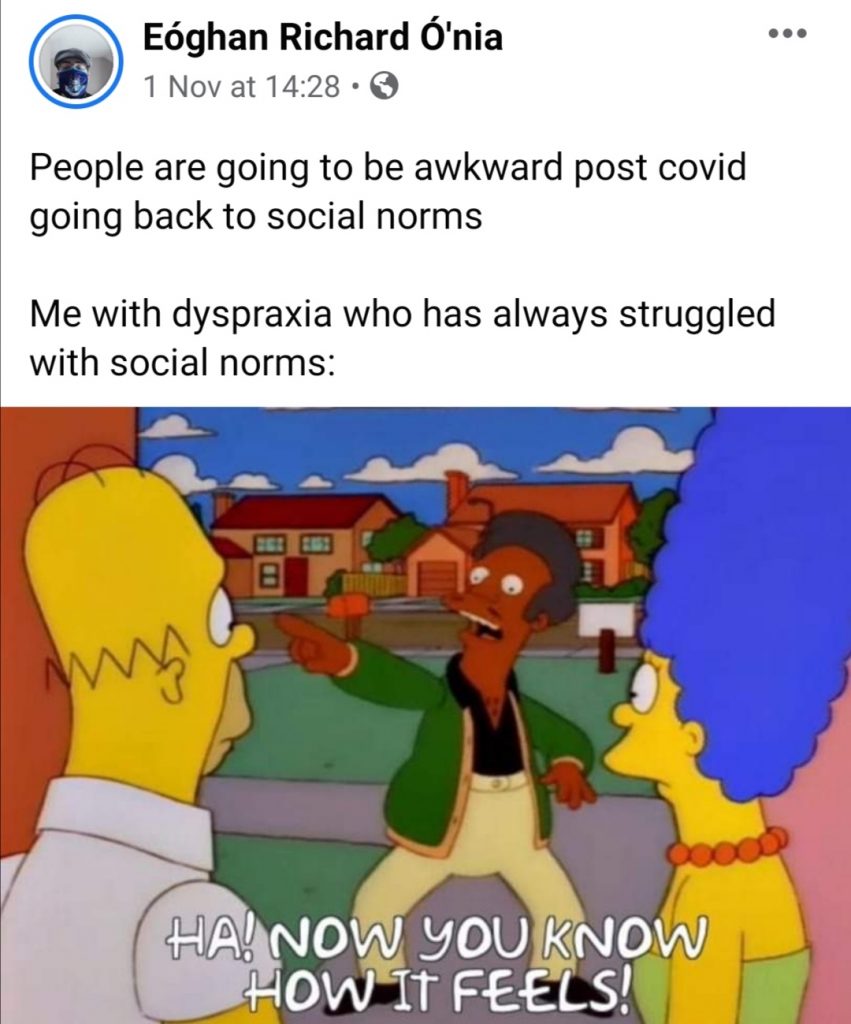
E Ó N: I think so. Like when an article in the Irish Times covered how people are going to have difficulties with social norms post COBID: like shaking hands. And I put up a meme in Simpsons fans and I just said, ‘Me as someone with dyspraxia who struggles with social norms.’ And it just said, ‘Ha, now you know how it feels.’

Simpsons meme for book about dyspraxia feature
Social norms have always been a struggle for people with dyspraxia

An awkward moment for Aodhán Ó RÍordáin during an RTÉ interview:

Tweet of Awkward moment for Aodhán Ó Ríordáin
This difficult question for Aodhán Ó RÍordáin gave Eoghan Ó Nia of Independent Left the opportunity for a Simpsons’ meme
Simpsons meme by Eoghan Ó Nia
Humour was a way of dealing with bullying related to having dyspraxia for both Victoria Biggs and Eoghan Ó Nia

What does Victoria Biggs’ book about dyspraxia say about school supports?

CK: Did you and Victoria get any support in school?

E Ó N: Victoria Biggs had a good deal of support from her parents and from her family. One of her teachers supported her indirectly without her knowing. Which she said in looking back on it all now, annoyed her. She would have preferred if that teacher had just been honest with her. For example, they’d have to clean up their dormitories. The teacher would make sure that Victoria Biggs was alone when she was doing that because otherwise the other kids would judge her for taking longer to do the cleaning. But she makes the point that she would have preferred if the teacher had have actually been open and honest about it instead of just being helping in a sneaky kind of way.

As for me, I got the usual learning support. That was very good. In fact, actually it was the learning support teacher in my third year of secondary school (I already had dyslexia at that point) who spotted my dyspraxia. I was doing a test in relation to dyslexia and I was struggling with using blocks to make words. I was finding it hard to actually pick up the blocks. And the support teacher rang up my mom and said, ‘I think he has dyspraxia’. I was referred for an assessment and sure enough was diagnosed with it. If it wasn’t for the learning support teacher, I wouldn’t have even been diagnosed with dyspraxia.

CK: Does Victoria Biggs end up advocating for change or policies? What would she like to be different about the world to make it more inclusive for people with dyspraxia?

E Ó N: The main conclusion that she draws with the book is the need to raise awareness for dyspraxia itself and getting people to understand what it is and all the different aspects to it. Obviously, the book was written originally in 2005, so the supports and services in place then were very poor. Dyspraxia was only really a relatively kind of new thing. A lot has changed since then.

I think another point is that when you do the assessment of needs and all the different supports that are there outside of school, they are all designed for children, which isn’t great for teenagers or adults with dyspraxia. Increased support after childhood is also something Victoria Biggs is calling for. We don’t have any supports for anything designed specifically for teenagers or adults.

Advice for inclusive political parties and campaigns

CK: Any tips – this is probably more for you than from reading the book – but any tips for people who are running campaigns to make sure that they’re inclusive and that people with dyspraxia can be fully involved?

E Ó N: First of all, I’d say each intellectual disability presents its own challenges and for someone with just dyslexia and someone with just dyspraxia, there’s going to be two different approaches. But at the end of the day, the experts on this are the people with those particular disabilities. They’ll know what they need and they’ll know where they’re struggling. It’s probably not very enlightening what I have to say, but sometimes – and with the dyspraxia especially – I focus my brain on doing the basics right first, rather than trying to do anything over-complex. And sometimes I feel like people in politics miss that, that they don’t do the basics right. Talk to people with dyslexia, talk to people with dyspraxia and ask them to look at your campaigns and your parties. And ask them: is this something that, regardless of whether you agree with it or not, that you could engage with? That you could involve yourself with? That you can understand what we’re for?

Also, if you have someone in your party or organization that has an intellectual disability, again, talk to them. Let them speak for themselves. I remember after the general election Sinn Fein had a couple of Facebook ‘live’ on intellectual disabilities. Which were good. I liked them. But again, it was mostly just the representatives and the ‘experts’, not really anyone with a disability. Parties have to involve the people with the disabilities in the actual discussions.

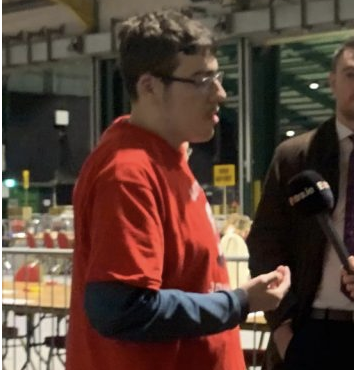
Eoghan Ó’Nia addressing the media for Independent Left
Eoghan Ó Nia speaking to the media on behalf of Independent Left after the general election of 2020

CK: It’s a simple tip, but it’s really important. And it’s surprising how often that doesn’t actually happen. Is there anything about the book you particularly wanted to highlight?

E Ó N: I don’t agree with how there’s always a focus on the famous people that have a particular disability. But Victoria Biggs was saying that although not confirmed, they believe that Churchill presented with symptoms of dyspraxia, or development cognition disorder as it’s known now. And so did Eisenhower and Montgomery. So although I’m not a fan of Churchill, I did like the quote in the book that three disabled people kicked Hitler’s arse. That was brilliant, to be fair.

Most of the chapters are obviously about people with dyspraxia themselves, so it’s going through things like how you struggle at home, how you struggle with exams. Growing up and trying to be an independent person. But the thing I would say about the book itself is it’s a good read for non-dyspraxics, because it gives everyone a good idea of what people with disabilities struggle with. And when you read through the book, you appreciate things that you wouldn’t come across otherwise, like tying a shoelace: for someone with dyspraxia, that can be a daunting task.

Like myself, she has that kind of self-inflicted sense of humour. You do get a lot of jokes where she’s poking fun at herself. It’s a very good read. Obviously it’s written by someone with dyspraxia, so it’s not difficult to read through. It’s a very approachable book. As someone who struggles with reading myself, I read one chapter a day, but obviously someone who’s more advanced in reading skills could get through it in a day. It’s especially good for parents of children with intellectual disabilities in general, not just dyspraxia. I know that this book is about people with dyspraxia, but I think it gives you a broader understanding of any kind of intellectual disability. It gives tips for everyone who’s around that person as well. Like, ‘Here’s good tips for parents when it comes to exams’ or ‘Here’s four tips for teachers when it comes to exams’.

She makes an interesting point about growing up in Saudi Arabia. Surprisingly, it wasn’t as bad for her there as when she got to England. The Saudi’s accepted her for who she was, the culture was dyspraxic-friendly; it’s quite a difference in culture that a conservative country like Saudi Arabia, without even trying, was dyspraxic-friendly.

Another important point she makes as well is that you can really do anything. As much as it can be disheartening talking only about all the different struggles that we go through, she says you can achieve a lot. Certain jobs like working in a supermarket might not be feasible but with education, there’s no reason to limit yourself. A lot of people with intellectual disabilities do actually go on to become teachers. Victoria Biggs gives ideas for different careers that you can put yourself into. Now, she doesn’t mention politics, but I’d recommend politics myself. She encourages you to push yourself. Herself, she’s just completed her doctorate in the University of Manchester (on storytelling and memory among Israeli Jewish and Palestinian youth), which is very impressive. Obviously, the main points she makes is you have to think in a different way than most and do things differently, but really, as long as you’re willing to push yourself in what you believe in, you can do almost anything really.

It’s also very good that she gets a quotes from other people with dyspraxia and they address their struggles in relation to the different chapters. I find that’s very good. There is one of these quotes that struck me: ‘If I could attach a printer to my brain, I could prove to people I’m not stupid.’ We have such an issue getting our thoughts and beliefs across, but our brain, it’s all up there, it’s just getting it out. That was my favourite quote from the book.

Dyspraxia resources and further reading for a good book about dyspraxia

Victoria Biggs has a blog here.

Dyspraxia Ireland has a wealth of resources here and a reading list of books about dyspraxia here.

Filed Under: Reviews

Copyright © 2024 · Aspire Pro on Genesis Framework · WordPress · Log in