• Skip to primary navigation
  • Skip to main content
independent left logo

Independent Left

Environmentalism, socialism, freedom and equality. #liveablecity

  • About
  • Featured Articles
    • How Farming Must Change to Save the Planet
    • The Housing Crisis: Causes and Solutions
    • Socialism in Ireland
  • Contact Us
  • Podcast
  • Animal Rights
  • Archive
    • Irish Socialist History
    • Dublin City Council Housing
    • Ukraine
    • Protests Ireland
    • Reviews
    • Irish Political Parties
    • All Posts
    • Independent Left Policies
  • Why join?

Ciarán O’Rourke's features and reviews for Independent Left

Ciarán O'Rourke poet socialist poet Independent Left

About Ciarán O'Rourke

Ciarán O’Rourke is a socialist and award-winning poet. His first collection of poems was published as The Buried Breath. Many of his poems and essays can be read at: https://www.ragpickerpoetry.net/poetry/

William Carlos Williams’s poetry was of and for the proletariat

15/02/2021 by Ciarán O'Rourke 3 Comments

William Carlos William's poems were for and about the working class
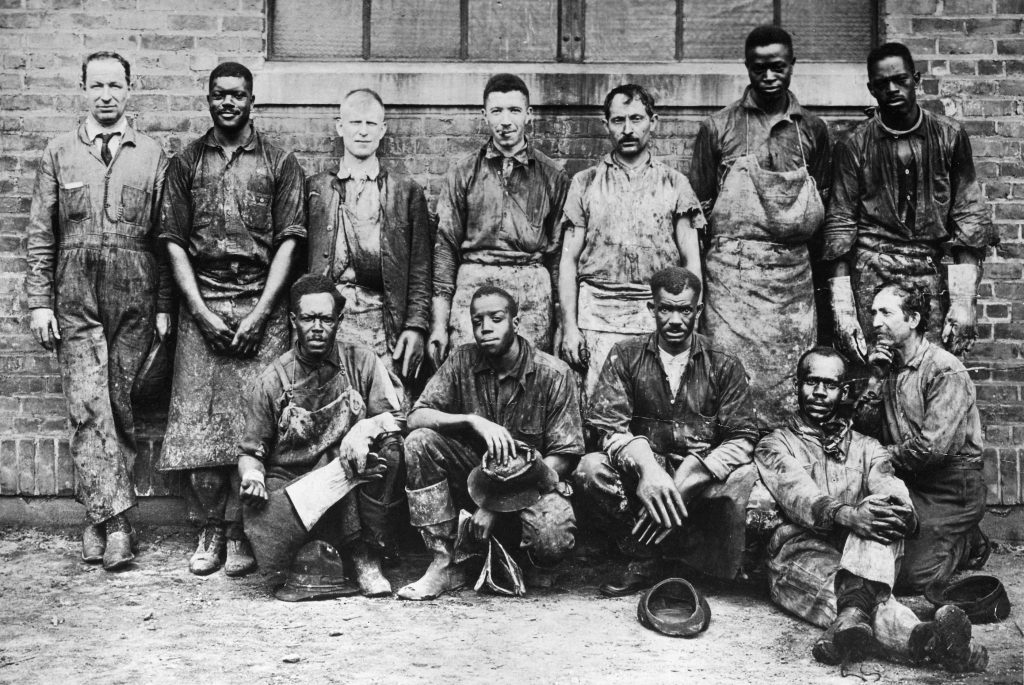
William Carlos Williams: poems for and about workers. These New Jersey chemical workers of the 1920s were a multi-racial community and typical of the proletariat in the city of the poet’s birth and residence.

‘It’s as if no other poet except Williams had really seen America or heard its language’, wrote Robert Lowell in 1962, near the end of the elder bard’s life: ‘His flowers rustle by the superhighways and pick up all our voices.’ Some decades earlier, Mike Gold, the editor of New Masses magazine, predicted that ‘[w]hen somebody writes the future history [of] proletarian literature in America, William Carlos Williams will be somewhere large in the table of contents.’ For him, William Carlos Williams’s poetry was for and of the working class.

Today, contra both Lowell and Gold, Williams is mainly known, if at all, as the author of a much-loved – and often parodied – post-it poem about someone else’s fruit: ‘I have eaten / the plums / that were in / the ice-box // and which / you were probably / saving / for breakfast…’. His ‘proletarian literature’ and manifold investigations of the American scene remain, for the most part, out of view. This is a shame, because Williams was one of the most socially engaged and formally innovative poets of his generation. A radical democrat in his political leanings, he served as a practicing paediatrician for over four decades: a doctor-on-call whose natural sympathies lay with the working poor of the industrial towns of his native New Jersey. Throughout his life, he saw poetry as a means of recording both the streets-up vitality and the crushing poverty he encountered in these urban centres – places like Rutherford and Paterson – combining an oppositional political outlook with an acute sensitivity to the human drama at the heart of day-to-day experiences.

William Carlos William's poems: This is Just to Say
William Carlos William’s poem: This is Just to Say

This last quality is partly evident even in his famous plum poem above, but its political effect is arguably fuller in a piece like Proletarian Portrait, in which a ‘bare-headed woman’ stands on the sidewalk with her shoe in hand, the whole world seeming to pause and tremble in the balance as she ‘pulls out the paper insole / to find the nail // That has been hurting her’. As here, Williams’s most meticulous evocations of ordinary (‘proletarian’) people and scenarios frequently read like exercises in political allegory: parabolic imaginings of things as they really are, or as they might be in the future. This is certainly true of his poem, The Yachts. Ostensibly depicting an afternoon of summer sport and leisure, it finishes as a critique of class society, as the bodies of the masses form ‘a sea of faces’ left ‘[b]roken, // beaten, desolate’, drowned out by the ‘skillful yachts’ as they ‘pass over’.

William Carlos Williams’s poetry was grounded in the vernacular

For Williams, American modernity was marked and maintained through the violence of elite privilege and social exclusion. ‘The wealthy / I defied’, he recalled in one late piece: the wealthy and those ‘who take their cues from them’. Like the social photographers of the 1930s, many of whom he knew and admired, his concern was to restore the experience of supposedly invisible communities – of labourers, immigrants, drifters – to the cultural record. The result was a body of poetic work at once crystalline in its political perceptions and dynamic in its formal movement, both elegant and plainspoken: a poetry grounded in the vernacular rhythms of American life, for ‘what good is it to me’, he asked, ‘if you can’t understand it?’

William Carlos William's poems were revolutionary
William Carlos William’s poems aimed to restore the experience of supposedly invisible communities

The same could not be said about the poets among whom Williams is most regularly classed today: high modernists whose literary politics ranged from the lavish insulation of Wallace Stevens, an insurance executive, to the vituperative antisemitism of Ezra Pound, whom William first met as an undergraduate student at the University of Pennsylvania.

While Pound increasingly sought to hitch his wagon of economic reform to the scorching lodestar of Mussolini’s racist authoritarianism in the 1930s Williams dedicated time and energy to anti-fascist causes. ‘I myself was chairman [of] a committee for medical aid to Spanish democracy’, he wrote in 1941, with a combination of sorrow and fury, as ‘the Storch Squadron went out with their planes on Easter while the women and children were in the streets [and] blasted them to butchers’ meat in the holy Basque city of Guernica “to see how effective the planes and bombs would be.”’

As Williams’s wife, Florence, recalled in 1964, he and Pound, although lifelong friends, ‘were on such opposite sides. Ezra was definitely pro-Fascist, much as he may deny it, and Bill was just the opposite.’ Likewise, stylistically, Williams  stood apart from his peers, favouring idiomatic literary incisions, with a ‘feeling of reality’, to the allusive, often Euro-centric innovations of Pound and Eliot. The ‘revolution’ will be accomplished, he wrote, when ‘noble has been / changed to no bull’.
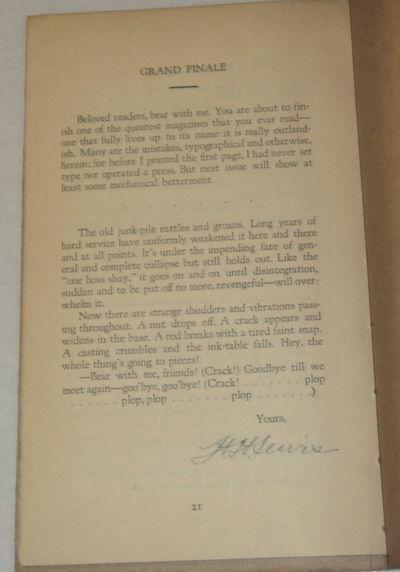
HHLewis Outlander Final Page
Final page of communist poet and sharecropper H.H. Lewis’s magazine Outlander, volume 1.

Although he published regularly in Marxist journals – a pattern of literary affiliation that earned him the reproval of a McCarthyite literary establishment in the late 1940s – Williams was generally distrustful of what he perceived as the didactic and jargonistic tendencies of America’s formal Left, and never joined, for example, the Communist Party when invited to do so. This didn’t prevent him from reaching his own conclusions, however. In 1936, he could be found arguing, with unapologetic assurance, that a ‘labor revolution by a society seeking to be in fact classless is both great and traditionally American in its appeal’:

            To violently effect, by a brave stroke, the ejection of an inhuman and anti-social domination by those who have an effective control over the means of our common livelihood for their private gain – [this] would appeal to the American character if once put into motion.

If Williams maintained a somewhat chirpy belief in the democratic possibilities of the USA as a political experiment, this credo gained grit and clarity with his accompanying insistence on re-casting ‘America’ as a kind of living monument to rebellion. It’s in this context that he could write so admiringly, in 1937, of H.H. Lewis, the sharecropper-poet and avowed Communist ‘fighting to free himself from a class enslavement which torments his body’. ‘He speaks with fervor,’ Williams observed, ‘a revolutionary singleness and intensity of purpose, a clearly expressed content… he resembles the American [rebel] of our revolutionary tradition.’

A mirror for our own times: the poetry of William Carlos Williams

For Williams, there was nothing more dutifully patriotic than to question, ceaselessly, the presumptions and practices of the status quo: political, literary, and medical. ‘I am boiling mad’, he declared to one correspondent in the late 1940s, at ‘this morning’s mail from the American Medical Association’, which ‘in the name of “democracy” orders me to pay $25 into their treasury to fight “socialized medicine”’. This ‘represents what we are up against in our times,’ he concluded, with a righteous fire drawn from a deep understanding of the human value of public healthcare, as well as the nefarious motives of a professional lobby intent on derailing such an infrastructure. In this respect, Williams’s era (and predicament) holds a foreshadowing mirror to our own.

Blaze Magazine Covers 1933: Blaze Magazine published William Carlos William's poems
Blaze Magazine Covers 1933: Blaze Magazine published several of William Carlos William’s poems

In a similarly combative mode, in a 1933 editorial to the short-lived magazine, BLAST, which he co-founded ‘in the service of the proletariat’, Williams was keen to correct what he saw as a blind spot in the thinking of some of his contemporaries, taking subtle aim at the racism that remained operative in both radical and literary circles. ‘No Communist should care for the color of the skins of his comrades’, he asserted, perhaps in reference to that phenomenon later described by David Roediger, whereby ‘the great liberal mobilizations of the New Deal and industrial unionism in the 1930s […] became a key site for the making of race’, as the ‘the color line’ was consolidated in workplaces, public housing schemes, and even within the union movement. For Williams, by contrast, the political agitator and the literary ‘artist’ alike should, as he put it, have ‘skin the color of the rainbow – with black added’.

In truth, this gutsy egalitarianism on Williams’s part was more intuitive than programmatic, and not always adequate in practice to his original intentions. He had a tendency to speak from the nerves, writing reactively to what he experienced and perceived in the society around him. The result is a passionate, if sometimes contradictory, record of his times, in which ‘color’ is a charged category and, as Toni Morrison has observed, ‘embedded assumptions of racial (not racist) language’ filter a ‘literary enterprise that hopes and sometimes claims to be “humanistic”.’

Paterson Book Cover Poetry By William Carlos Williams
Cover of William Carlos William’s poem Paterson

In other respects, however, Williams still seems a remarkably thorough and prescient social critic. Paterson, his boundary-breaking long poem published from the mid-1940s onwards, offers not only a  portrait of the titular New Jersey town, but an exposé of the social and environmental degradation faced by its working residents, whose place and circumstances come to stand in for a larger American reality. As Williams’s literary protegé, Allen Ginsberg, memorably noted when growing up there in the 1940s: ‘Paterson itself [seemed to be] degenerating into a twentieth-century mafia-police-bureaucracy-race-war-nightmare-tv-squawk suburb.’ Williams, moreover, ‘had articulated’ this catastrophic situation ‘to its very rock-strata foundations’.

The poem is technically innovative and thematically far-ranging, exploring questions of historical violence, civic and subjective memory, alienation, intimacy, as well as poetic and ecological regeneration. In contrast to Jim Jarmusch’s 2016 film of the same name, the Passaic river as it appears in Paterson is not so much a font of inspiration, bringing the poet’s reverie to life, but a churning symbol of the environmental toxicity, corporate abuse, and social decay that plagues the surrounding region, its waters ‘steaming purple / from the factory vents, spewed out hot’. As Williams once argued, the much-celebrated Alexander Hamilton – who established the USA’s first cotton and textile mills in Paterson in 1792 – ‘led the country [to] financial stability but at the cost of much that had been enivisioned during the early years of the revolution’. The ‘dead bank’ of the Passaic river, ‘shining mud’, is where Williams’s protagonist stands, attempting both to mourn and to fathom this modern America, as he breathes the fumes. Today, even by the environmentally destructive standards of twenty-first-century capitalist civilisation, the Passaic remains notoriously, and perhaps irremediably, polluted. It is impossible to read Paterson, Williams’s unflinching epic of diagnosis and discovery, without feeling an uneasy shiver of recognition.

If literature, for Williams, was a means of gaining access to social realities, right down to the root, it was also an ‘instrument’ for imagining the future: a shared life free of alienation and exploitation. Williams’s ‘delicious’ hunger for ice-box plums and vivid portraits of proletarian endurance both speak to this vision, which Paterson also shares: of an art and a society based on the living needs of human communities. The ‘outstanding character of poetry’, he wrote, resoundingly, is that it ‘cannot exist other than as the revolutionary attribute of a free people’. The message was the medicine: we need it still.

FURTHER READING

William Carlos Williams:

                        A Recognisable Image: WCW on Art and Artists,

                        Collected Poems: Vols I & II,

                        Paterson,

                        Selected Essays,

                        Something to Say: WCW on Younger Poets.

Filed Under: Reviews

One of the best books about the Haitian Revolution

29/11/2020 by Ciarán O'Rourke 1 Comment

There are many excellent and inspiring books about the Haitian Revolution, one of the richest and most insightful of which is The Common Wind: Afro-American Currents in the Age of the Haitian Revolution by Julius S. Scott.

Book About Haitian Revolution: Common Wind Julius Scott
Julius Scott’s Common Wind is one of the richest books about the Haitian Revolution

The Common Wind: Afro-American Currents in the Age of the Haitian Revolution by Julius S. Scott

In early 1790, Vincent Ogé, a charismatic black revolutionary from Paris, sailed to the French Carribean territory of Saint-Domingue with one aim: to stoke a rebellion that would “overturn the Colony and obtain complete equality between the people of Color and the whites.”

In the months that followed, he and his co-conspirators rapidly became acquainted with the force of circumstance, facing capture by neighbouring authorities shortly after a tactical retreat from a military skirmish. In a show of judicial strength – orchestrated to send a message to other potential insurgents intent on making the “diabolical ideas of freedom and equality” a reality in the region – he was later broken on the wheel in public, and decapitated. Their liberatory venture had failed.

The slaves who made the Haitian Revolution

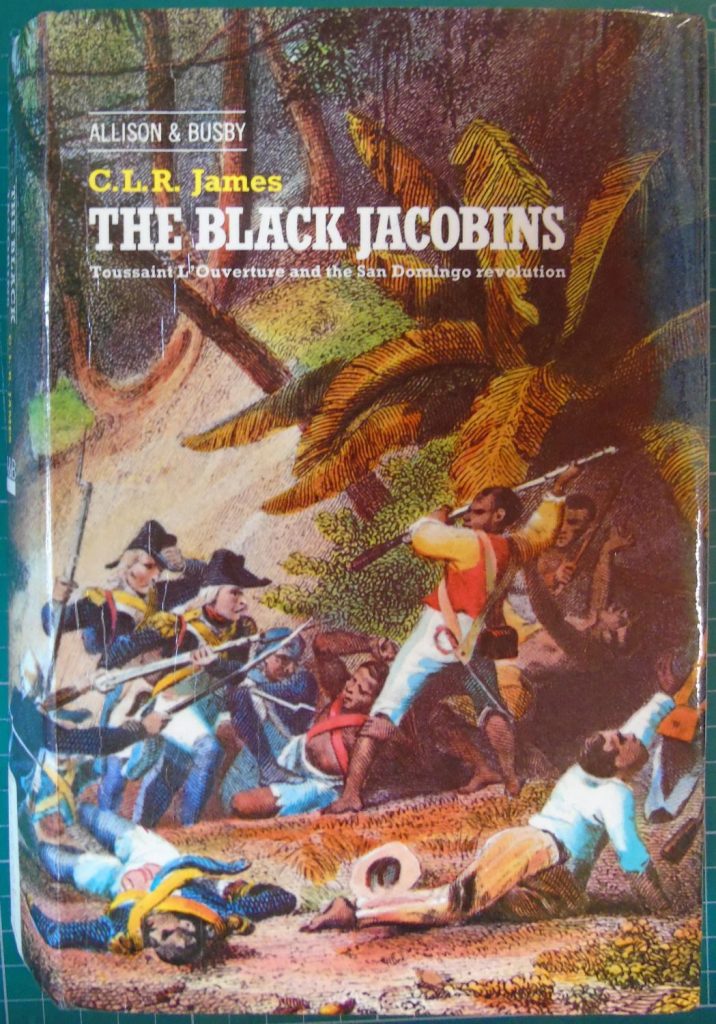
Apparently undeterred by such a gruesome spectacle, however, and inspired in part by the visions of the vodou priestess, Cécile Fatiman, within six months a self-led army of insurgent slaves did indeed change the course of history. In their tactics and relentless advance, the rebels seemed to recognise as CLR James puts it in one of the most important of books about the Haitian Revolution, The Black Jacobins, “the rich” would only “be defeated when running for their lives”: in its early months alone, their uprising levelled “180 sugar plantations and more than 900 other [white-owned] estates” on the island, then the largest producer of sugar and coffee in the world.

Cover of CLR James The Black Jacobins
Cover of CLR James’ The Black Jacobins, one of the most important of books about the Haitian Revolution.

By freeing themselves, the militants sent shock-waves through the hearts (and bank vaults) of slave traffickers, commercial magnates, imperial administrators, and white supremacists across the globe. The so-called wretched of the earth were seizing their freedom; the Haitian revolution had begun.

Although the aristoctratic Ogé was ultimately less successful than the slaves themselves, the spirit of his hoped-for coup no doubt inspired many who participated in the later revolt. Likewise, the sadistic cruelty of his execution remains instructive. Among other things, it serves as a reminder that terror was not invented by guillotine-wielding Thermidoreans in revolutionary France, prodigal though they were, nor by the self-emancipators of Saint-Domingue.

Revolution and Liberty on Both Sides of the Atlantic

Calculated butchery, for the purpose of maintaining collective submission, was deployed with coercive zeal by feudal and colonial regimes spanning Europe, the Americas, and the oceans between. The mutilations inflicted on rebels and enslaved workers in the Carribean, the unbridled ruthlessness used to disband the United Irish men and women in the same era, the punitive abuse suffered by sailors trapped (through debt or poverty) in maritime service throughout the eighteenth and nineteenth centuries, expand and clarify the vista of programmatic violence that conservative commentators have rightly identified with the 1790s, albeit within too narrow a scope.

Edmund Burke – whose statue today overlooks College Green in Dublin – inaugurated this long tradition of elitist moralism, when he condemned the “gross, stupid, ferocious—and at the same time poor and sordid—barbarians” of France’s new-formed rebel mass: for him, a “swinish multitude” lacking in both “nobility and religion”. Worst of all, Burke declaimed, was that the “Revolution” would render the “murder of a king, or a queen” as “only common homicide”, no longer the “sacrilege” of times past. The established order of things had been turned upside down.

Questions of liberty and equality, of means and ends, were the subject of urgent, heated debate in this period. According to Burke’s “servile reverence for antiquity”, wrote Mary Wollstonecraft in rebuttal, “the slave trade ought never to be abolished”, adding with incisive exasperation: “Security of property! Behold, in a few words, the definition of English liberty.”

The Slave Revolt in Haiti: A Revolt Against Commerce and Racism

He pities the plumage, but forgets the dying bird.

Thomas Paine similarly concluded, observing in the reproving theatrics of his Anglo-Irish antagonist “[n]ot one glance of compassion, not one commiserating reflection, [for] those who lingered out the most wretched of lives, a life without hope, in the most miserable of prisons.” The Bastille of Paris had been overthrown, and at the hands of a people whose misery was presumed as natural (and ritually worsened) by both monarchy and state.

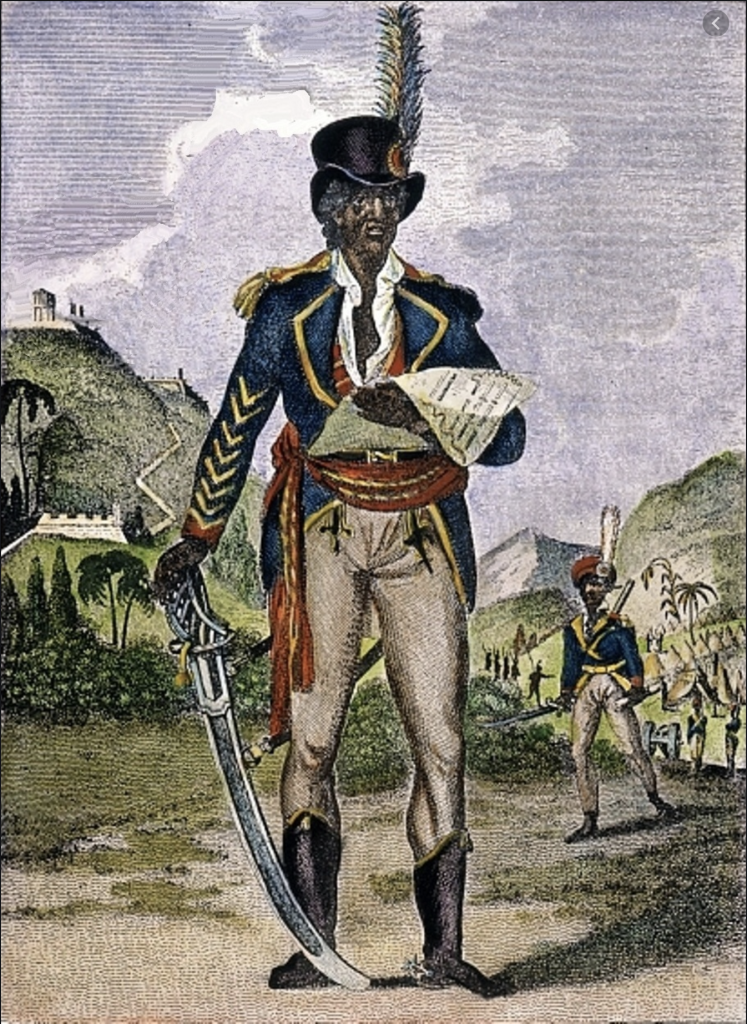
Painting of Toussaint Louverture
Painting of Toussaint L’Ouverture, the inspiring leader of the Haitian Revolution

It is a painful irony – and a parable of revolutionary apostasy – that Toussaint L’Ouverture, one of Saint-Domingue’s most famous and effective adaptors of that same radical tradition, should end his days deprived of food and water, a prisoner of the nation that bore “Liberté, Égalité, Fraternité” as its unofficial motto. In their abolition of slavery, their self-conversion from exploited instruments of capital into agents of social revolution and racial equality, the rebels of Saint-Domingue had set a precedent of successful emancipation from the hierarchies of power that ruled their changing world.

Figures like L’Ouverture were as much of a threat to the economic affairs of post-revolutionary France and America, as to the commercial and imperial ambitions of Europe’s imperial monarchies. Scott, in his book on the Haitian Revolution, highlights the views of one Pedro Bailly in this regard.

A Louisiana militiaman of colour, part of a global community of radicals inspired by the political developments in the Atlantic isle, Bailly understood the world-historical significance of the Haitian example: “We have the title of ‘Citizen’ in Saint-Domingue”, he said, “All of us being human, there should be no differences: color should not differentiate us.”

Glints of Life and Resistance

Thomas Paine himself was regularly burned to death, in effigy, by pro-slavery mobs across the Carribean in these years: reviled by a class whose commercial success depended on those divisions of property and privilege that his writings exposed with such aplomb. “It is time to dismiss all those songs and toasts which are calculated to enslave,” he proclaimed in his defence of the principle of revolutionary self-activity: “On all such subjects men have but to think, and they will neither act wrong nor be misled.”

As we have seen, in an effort to contain the spread of such incendiary opinions, governing forces on both sides of the Atlantic asserted their authority through murder, torture, dispossession, and  engineered necessity, on a scale both pressingly intimate and increasingly far-reaching.

Taken together, untold millions suffered in the name of king, imperium, race, and caste; later, millions more were sacrificed to the poverty and killing labour that accompanied the much-lauded industrial miracles of the nineteenth century. Such degradations, however, do not convey the whole story, which on closer examination is stippled with glints of life and resistance.

A Ground-Breaking Book on the Haitian Revolution

To peer through these kaleidescopic keyholes, as Scott does, is to discover a new history and a new approach. As empires expanded and evolved, as enterprises ravenous for profit and commercial opportunity chased their elusive margins around the world, previously disparate communities responded, often defensively, with re-forged conceptions as to human worth and earthly value, organising themselves into fresh formations of revolutionary consciousness and communication that threatened, at every turn, to up-end the vast ambitions of their supposed masters.

As Scott’s ground-breaking book on the Haitian Revolution shows, the circulation of (radical) ideas was dependent, in the main, on the agency and mobility of often downtrodden people, fashioning their own routes of resistance and freedom. In November, 1791, one English plantation owner, tremulously awaiting news of order lost or restored in Saint Domingue, discovered with horror that “his slaves learned of recent developments on the coast before he did”, through word-of-mouth contact with fellow labourers and fugitives.

Some months later, a similarly watchful naval commander, cautiously navigating the coast of Saint Domingue, encountered a rowboat “armed with fifty or sixty men of all colors” led by an “Irishman of prodigious size”: a “deserter” from the captain’s own vessel, who had “apparently made common cause with the black rebels on land” and now was dedicating himself to raiding “British and American shipping.”

The Struggle for Liberty Inspires History

The masters themselves were governed by fear. Supposedly invisible and disposable populations were embracing the most radical elements of contemporary history as their own. In Jamaica, the white minority noted with trepidation “the Ideas of Liberty” that “have sunk so deep in the Minds of all the Negroes”, anticipating “that wherever the greatest Precautions are not taken, they will rise.”

By the summer of 1792, likewise, “an air of insolence” was said to be circulating among the black population of Kingston, as ruling officials speculated as to their ability to control a potential outbreak of “the same Phrenzy which rages a few Leagues distant” in Saint Domingue.

Farther afield, a decade after Haiti had been declared an independent republic, in 1811 Charles Deslondes, himself a Haitian, marched with “between 200 and 500 rebel slaves” on New Orleans, “setting fire to plantations on the way”, in what was the largest self-organised slave insurrection in North America.

“There’s not a breathing of the common wind / That will forget” the Haitian revolutionaries, William Wordsworth had assured the spirit of Toussaint L’Ouverture in his poem dedicated to the captured general: the “exultations” and “agonies” of their struggle for liberty now bore a catalysing relation to human history at large. In this, as Scott argues in his book on the Haitian Revolution, time and again, he has been proven right.

We Remain Today A Part of the Haitian Revolution

Today, as a result of punishing trade (and aid) agreements, as well as an increasingly entrenched internal culture of upper-class corruption, Haiti has one of the highest rates of child mortality in the world, while a quarter of Haitians live in abject poverty. International conglomerates have consistently sought to capitalise on this economic and social vulnerability, including Digicel, the communications company owned by Irish business tycoon, Denis O’Brien, accused in 2019 of being a “co-conspirator” in a “ruse” to divert funds intended for Haitian education to its own benefit.

Were we to look beyond the fortunes of O’Brien and his ilk, we would see that Ireland, itself simmering in the long aftermath of revolutionary defeat, is in many ways a homeless nation, wracked by inequality and corporate shadow-rule: a tax haven serving the needs of the wealthiest and most exploitative interests on earth.

To counter and transcend this spectacle of crass, murderous venality, we might begin by recognising that Scott’s – and other books about the Haitian Revolution – show us the real traditions of Atlantic radicalism and aspiration that shaped our respective regions once, and may do again. The Haitian emancipators were internationalist in their consciousness, local and concerted in their collective actions; they shaped their insurrection to the demands and rights of their communities, and not to the blinkered vision of the status quo that ruled them; they knew the power of their words and mass; they were unafraid to rebel. We owe Scott our gratitude for bringing their story back to life, with its whispering grassroots voices and tremoring waves of change. From histories like this a common future can be made: from each according to their ability, to each according to their need.

Red Round Globe Hot Burning Cover
Peter Linebaugh’s Red Round Globe Hot Burning covers similar themes to Common Wind

If you enjoyed this review, for other books about the Haitian Revolution and that era you might also like to read Johnny Flynn’s review of Red Round Globe Hot Burning and his interview with Peter Linebaugh, the author.

Filed Under: Reviews

The poet John Clare: Freedom and Anguish

26/10/2020 by Ciarán O'Rourke 2 Comments

Poet John Clare by William Hilton
The poet John Clare witnessed the enclosure of the commons and sympathised with the dispossessed

The poet John Clare was born on 13 July 1793, on the same day that Jean-Paul Marat, the zealous Jacobin revolutionary who believed that ‘man has the right to deal with his oppressors by devouring their palpitating hearts’, was assassinated. John Clare died 20 May 1864, a week before the United States Congress formally recognised the Montana territory of settlement (in a region long-inhabited by Crow, Cheyenne and Blackfeet indigenous peoples) and at a time when Union and Confederate forces waged bloody warfare in Virginia and Georgia over the question of American slavery, its legitimacy and continuation.

Throughout his adult life, Clare disapproved of those he called ‘the French Levellers’ for the violence and upheaval of their programme, and he never left England, but his life and poetry nonetheless stand in an opposition to the dispossessions, divisions and labours of the nineteenth century, the age of capital.

In contrast to the majority of his literary contemporaries, John Clare, born in Northamptonshire to a family of tenant farmers, experienced the privatisation of common land that swept across Britain (and British-controlled regions around the globe) in the wake of the 1801 Inclosure (Consolidation) Act, converting communally tended and lived landscapes into real estate, while intensifying the precarity and dependency of an entire population of rural workers. ‘There once were days, the woodman knows it well’, Clare writes in The Village Minstrel, ‘When shades e’en echoed with the singing thrush’:

There once were lanes in nature’s freedom dropt,

There once were paths that every valley wound –

Inclosure came, and every path was stopt;

Each tyrant fix’d his sign where paths were found,

To hint a trespass now who cross’d the ground…

John Crome Mousehold Heath Norwich 1818-20
Mousehold Heath was common land near Norwich that was largely enclosed by 1814. Painting by John Crome

The Inclosure Acts were presented by parliamentary advocates as a form of ‘improvement’ in land law and distribution. John Clare, however, perceived first-hand the violence of the new order, resulting in an entrenched disparity of privileges and resources, forcing newly created ‘parish-slaves’ to ‘live [only] as parish-kings allow.’ ‘Enclosure came, and trampled on the grave / Of labour’s rights’, Clare resoundingly asserts in The Moors, ‘and left the poor a slave.’

John Clare’s landscape poems observe the social as well as the natural

In the work of William Wordsworth, the foremost ‘Romantic’ of the era (and later, Queen Victoria’s poet laureate), the natural world is celebrated and explored primarily as a metaphor for ‘the mind of man’  – with all the gendered connotations of that concept intact – and indeed as a screen on which the artist’s own life and fancies are projected and presumed as universal truths. Even the relatively radical (if also aristocratic) George Gordon Byron and Percy Bysshe Shelley follow Wordsworth’s lead in this respect, albeit with the more combative aim of inspiring political and individual regeneration through a renewed apprehension of natural cycles: the revolving weathers of the world coming to symbolise the human capacity for agency and change.

Poet John Clare was attentive to the lives of the commoners such as those working under the harvest moon. Painting by Samuel Palmer.

The work of poet John Clare, however, is of a different variety and intensity: an intimate, achingly powerful poetry of natural and social portraiture, grounded in both literary and vernacular traditions, as well as the earth- and sky-scapes of his native locale. His landscape poems have a luminous observational precision, as well as a rambler’s colloquial flow (from Summer Images):

[A] wind-enamoured aspen – mark the leaves

Turn up their silver lining to the sun,

And list! the brustling noise, that oft deceives,

And makes the sheep-boy run:

The sound so mimics fast-approaching showers,

He thinks the rain begun….

John Clare’s biographer, Jonathan Bate, has drawn attention to the poetry’s oral character and technical ease, while also noting Clare’s work (for the fiddle-playing poet, a kind of pleasure) of preserving local melodies as an added dimension and possible source of the famed musicality of his verse. ‘The clock-a-clay is creeping on the open bloom of May, / The merry bee is trampling the pinky threads all day’, reads Summer, ‘And the chaffinch it is brooding on its grey mossy nest / In the whitethorn bush where I will lean upon my lover’s breast’.

As a young man, Clare in fact filled two notebooks with transcriptions of ‘gypsy’ tunes and dances. His instinct, then and throughout his life, was to celebrate and learn from the richness of those folk cultures that fringed the world he grew up in, which (as Tom Paulin reminds us) was ‘no backwater’, but very much alive with its own artistic and intellectual customs.

The poet John Clare’s sympathy for the commoners

‘My life hath been one love – no blot it out’, the poet John Clare urges in Child Harold: ‘My life hath been one chain of contradictions’. And so, if he was cautiously conservative in his formal politics – rejecting what he viewed as the historical extremism of both French and Cromwellian revolutions – his respect and affection for the ‘gypsies’, as well as other groups who suffered disdain and marginalisation from English officialdom, are arguably more indicative of his fundamental social sympathies. ‘Everything that is bad is thrown upon the gypsies’, he writes despairingly of the prevailing attitudes in the Northampton press: ‘their name has grown into an ill omen and when any one of the tribe are guilty of a petty theft the odium is thrown upon the whole tribe.’ Countering this trend, in his poem, The Gipsey’s Song, Clare adopts the voice of the travellers themselves, whose vagrancy and ‘liberty’ (not to mention, their music) he admires.

And come what will brings no dismay;

Our minds are ne’er perplext;

For if today’s a swaly day

We meet with luck the next.

And thus we sing and kiss our mates,

While our chorus still shall be –

Bad luck to tyrant magistrates,

And the gipsies’ camp still free.

As here, Clare’s rhythmic, vibrant verse is also a form of subtly layered social observation. ‘Religion now is little more than cant’, he writes in The Parish, blending satire and poetic rage at the sight of ‘Men’ who:

… love mild sermons with few threats perplexed,

And deem it sinful to forget the text;

Then turn to business ere they leave the church,

And linger oft to comment in the porch

Of fresh rates wanted from the needy poor

And list of taxes nailed upon the door…

In a few lines, Clare exposes the entire edifice of hypocrisy and greed undergirding Britain’s burgeoning bourgeoisie, as represented by the ‘business’-oriented land-holders in the local parish. Tellingly, once again, the poem’s critique is made from the perspective of ‘the needy poor’: a recurring feature of Clare’s work, which repeatedly voices solidarity with those in his society for whom poverty, eviction, exploitation are palpable and perennial realities. Indeed, he writes as one of them such as in Inpromptu on Winter.

Winter could be a terrible challenge to commoners in the nineteenth century. Painting by Johann Jungblut

O winter, what a deadly foe

Art thou unto the mean and low!

What thousands now half pin’d and bear

Are forced to stand thy piercing air

All day, near numbed to death wi’ cold

Some petty gentry to uphold,

Paltry proudlings hard as thee,

Dead to all humanity. 

Ecological protest in the poetry of John Clare

The acute, eye-level understanding of both social relations and seasonal change is part of what makes Clare so unique a figure in the Romantic literary movement. E.P. Thompson designates him ‘as a poet of ecological protest’ on this basis: an artistic consciousness almost preternaturally attuned to any ‘threatened equilibrium’ in the rural world – shaped by long-standing customs of free movement and shared access to natural space and resources – into which he was born, and which ‘Enclosure’ definitively ended.

Importantly, Clare’s poetic conscience seems always primed to detect and diagnose cruelty as such, whether with regard to the victims of social ‘improvement’ or more broadly. The Badger, for instance, offers an accurate (and brutal) portrayal of baiting day, a village tradition Clare himself thought cruel and disturbing. Indeed, the poem seems propelled by a pained identification with the torment of the titular animal, up-rooted from its den and eventually routed in the street by a crowd ‘of dogs and men’. It finishes:

Though scarcely half as big, demure and small,

He fights with dogs for bones and beats them all.

[…] He tries to reach the woods, an awkward race,

But sticks and cudgels quickly stop the chase.

He turns again and drives the noisy crowd

And beats the many dogs in noises loud.

He drives away and beats them every one,

And then they loose them all and set them on.

He falls as dead and kicked by boys and men,

Then starts and grins and drives the crowd again;

Till kicked and torn and beaten out he lies

And leaves his hold and cackles, groans, and dies.

‘Poetry is the image of man and nature’, Wordsworth had declared in the preface to Lyrical Ballads (1800), ‘a homage paid to the native and naked dignity of man.’ Far from idealising humanity and nature (and the relations between them), however, Clare’s ecological sensitivities and ‘customary consciousness’ together helped him to depict life as he found it, and with a realism few other writers were socially equipped or emotionally inclined to engage.

Famously, Clare spent the last twenty-three years of his life at what was then The Northampton General Lunatic Asylum, having previously been hospitalised in a similar institution in Essex (his wife, Patty, and surviving children, remained in the family home in Northborough). As Bate notes, ‘Clare was perceived as an anomaly within his culture’ throughout his career, and after, with the result that there has ‘always [been] a tendency to attach labels to him: mad poet took over where peasant poet had left off.’

Such classifications have obscured the achievements and concerns of the work itself, while also reducing the artist to a cliché (and a potentially harmful one at that). At any rate, Joe Clare continued composing poems throughout this time: cataloguing personal spells of both depression and nostalgia, as well as producing erudite and witty works in the style of Byron (Clare claimed to have been and/or known a number of prominent world figures, including Byron and Napoleon Bonaparte). ‘I am–yet what I am none cares or knows’, he says in this period in I Am!,

I am the self-consumer of my woes,

They rise and vanish in oblivious host,

Like shadows in love’s frenzied stifled throes

And yet I am, and live–like vapours tossed

Into the nothingness of scorn and noise,

Into the living sea of waking dreams,

Where there is neither sense of life or joys,

But the vast shipwreck of my life’s esteems;

Even the dearest that I loved the best

Are strange–nay, rather, stranger than the rest.

Northampton-County-Lunatic-Asylum
Poet John Clare spent twenty-three years at Northampton County Lunatic Asylum

The anguish of the poet John Clare

John Clare is a poet of psychic anguish, as well as ecological critique and music. A similarly potent atmosphere of sadness and isolation looms in another late, autobiographical piece, one of his greatest works: The Journey out of Essex. The prose letter was written as a personal account of his spontaneous departure, in the summer of 1841, from the asylum where he had been admitted as a patient, heading for Helpston in search of his first love, Mary Joyce, who was in fact deceased by this time.

It was a four-day journey of ‘hopping with a crippled foot’ in ‘old shoes [that had] nearly lost the sole’, with little food or water, during which he slept out-of-doors more than once, including in a sodden ditch. ‘I was very often half asleep as I went on the third day’, Clare writes (with a characteristic minimum of punctuation), ‘I satisfied my hunger by eating the grass by the road side which seemed to taste something like bread I was hungry & eat heartily till I was satisfied’.  In itself, the combined vividness and loneliness of the text makes for haunting reading.

The Journey also quivers, however delicately, with the pulse of history-at-large. It is difficult not to trace in Clare’s chronic hunger and homelessness, the crippling pain of his ninety-mile trek – expressed with unparalleled literary intensity – the spectres of alienation and displacement that accompanied Britain’s industrialising drive and imperial rule throughout the nineteenth century.

In a chronicle written in the late 1830s, after two tours of the island, French magistrate Gustave de Beaumont noted how ‘every year, nearly at the same season [the] commencement of a famine is announced in Ireland’: a pattern of colonial mismanagement and market-exacerbated scarcity that would reach a new nadir of devastation in the mid-1840s, following the failure of the potato crop. In the same period, hundreds of thousands of peasant and labouring populations from Ireland, and across Britain and Europe, sailed to America in search of a more secure future, often in turn forcing indigenous tribes into conflict or internal migration.

When situated in such a world-historical vista, Clare’s desperate meal of roadside grass, his powerful yearning for home (which is, for him, both a physical place and a memory of a time, now lost, before enclosure), seems almost a parable of universal dispossession, in a decade of civilised disasters.

‘Oh, who can tell the sweets of May-Day’s morn / To waken rapture in a feeling mind’, the poet John Clare asks his readers in the poem The Village Minstrel: celebrating not only the turning seasons, or his own sensations, but the joy and “plenty” promised by the specific community-in-nature he knew in his youth, and which in later years he hoped always (at times despondently) to reclaim. Clare’s poetry is one expression of that elusive but palpable awakening. Our politics might be another, drawn from nature, from rapture, from one another, and (as historians like Peter Linebaugh have contended) from May-Day itself, both a political and a seasonal tradition. If a future commons is possible, it begins now, with Clare: as we shape our lives and relationships through labour, song, compassion and respect. These are the principles by which we make the world.

FURTHER READING

John Clare: A Life by Jonathan Bate

Crusoe’s Secret: The Aesthetics of Dissent by Tom Paulin

Minotaur by Tom Paulin

John Clare: Major Works by John Clare, edited by Eric Robinson and David Powell

Filed Under: Reviews

Did Seamus Heaney write political poems?

10/10/2020 by Ciarán O'Rourke 3 Comments

A review of On Seamus Heaney by Roy Foster

Roy Foster's On Heaney skirts the Seamus Heaney's Political Poems
Roy Foster’s On Seamus Heaney is an insightful biography but fails to address Seamus Heaney’s Political Poems

Although known for his active support of the South African anti-Apartheid movement and for his open opposition to the American invasion of Iraq in 2003, Irish poet and Nobel-prize winner Seamus Heaney was not famous for his politics. This has led some sceptics to dismiss the political content in the poems of Seamus Heaney on the grounds of his willing proximity to centres and figureheads of power: from his tenureships in Oxford and Harvard Universities to his warm relations with American Presidents, including Bill Clinton and Barack Obama (although footage can still be found of a fresh-faced Seamus Heaney expressing his sympathy for the socialistic tendencies of the early civil rights movement in Northern Ireland).

Seamus Heaney Nobel Prize Winning Poet
Seamus Heaney’s politics were relevant to several of his poems

Such critiques are valid in shining a light on the embedded nature of the arts, at least at an institutional level, in the power structures of capitalism, as well as the risks that trail in the wake of creative endeavour as a result, whereby after a period of time (as Adrienne Rich once wrote) the artist “simply decorates the dinner table of power which holds it hostage”, becoming a kind of living fig leaf to cover the “radical disparities of wealth and power” in their society. In this case, however, it would be a mistake to oversimplify or overlook the poems of Seamus Heaney in which political ideas are present and important. This is the weakness of an otherwise insightful new book by Roy Foster on the poems of Seamus Heaney.

Imperialism, Roy Foster and Seamus Heaney

In some ways, Foster is an unlikely candidate for elucidating the development and concerns of so complicated a cultural force as Heaney. Deeming Dublin’s 1916 Rising against British imperialism an act of righteous folly, an event he views as derailing the proper course of constitutional nationalism from achieving its promised reward, Foster has long been in the habit of articulating establishment positions on history (and revolution) with a consistency and quasi-literary aplomb that are in themselves impressive, if hardly winning. Such a tendency may partly be seen remarks such as: ‘the advent of apocalypse after 1968 is … an avoidable lurch into violence rather than the inevitable bursting of a boil’; and in the lapidary aside that the conflict in Northern Ireland ‘fed on ancient antipathies as well as recent injustices.’

Foster’s intention is to offer sympathetic clarification of Heaney’s evolving predicaments as a conscientious nationalist averse to armed violence, which these comments partly do, but they also bear hints of a cosmopolitan sanctimony entirely Foster’s own. We might qualify and contextualise Foster’s historicising by reference to another historian, Daniel Finn: ‘Ancestral voices do not call out to people from beyond the grave: they have to be summoned by the living to legitimize a present-day political stance.’ Foster’s reflexive urge to associate Irish anti-imperialism in general, and however subtly, with the “ancient antipathies” of religious prejudice is as much an act of de-legitimizing as any, and should itself be subject to critical scrutiny.

Modern Ireland by Roy Foster
Foster’s Modern Ireland adopts an outlook unsympathetic to the United Irishmen

In a similar vein, it’s surely notable that Foster’s criticism, in Modern Ireland: 1600-1972, of United Irishman Wolfe Tone for his supposed ‘inability to recognise the sectarian underpinning of all political activity in Ireland’ in the lead-up to the 1798 rebellion, conflating revolutionary nationalism once again with religious sectarianism, stands in stark contrast to Heaney’s simmering memorial of the same in ‘Requiem for the Croppies’, whose propulsive beginning is:

The pockets of our greatcoats full of barley

No kitchens on the run, no striking camp

We moved quick and sudden in our own country.

Although Heaney would later refrain from public readings of this piece, lest it be interpreted as an endorsement of the IRA’s armed campaign (to which he was opposed), its atmosphere of inspired anti-imperialism still retains a quivering power and assurance, while the poem’s seemingly instinctive joy in the mass agency of the rebels (‘We moved quick and sudden in our own country’) immediately calls to mind the stirrings of civil disobedience in Northern Ireland, and elsewhere, in the late 1960s when it was written.

Seamus Heaney’s politics misread

If Heaney vacillated between a disdain for British imperialism as such and a distaste for the tactics and righteous rhetoric of the Provisional IRA, the combative spirit and perception of dignity in struggle that animates ‘Requiem for the Croppies’ persisted in his work, finding a guarded echo in his collection of a decade later, Field Work. In ‘The Toome Road’, Heaney (or at any rate, the expressive conscience that permeates his poems) meets:

…armoured cars

In convoy, warbling along on powerful tyres

This patrol disturbing the natural soundscape as well as the political ecosystem of a locale that, nonetheless, remains an ‘untoppled omphalos’, as the British forces swerve into view,

approaching down my road

As if they owned them.

The poem encapsulates Heaney’s groundedness in the landscape of his origins (it is not, contra Foster’s interpretation of Irish nationalism above, an expression of sectarian pride), as well as striking a clear chord of collective, political defiance against colonial incursion. Importantly, however, in its recourse to classical tradition – in ancient Greek, omphalos means, roughly, a navel and the centre of a social order – Heaney is also making legible and understandable, for an insulated intellectual elite typified by Foster as much as for onlooking political communities in Dublin and London more broadly, the feelings of anti-colonial resentment and communal pride-of-place that define the hinterlands of his first home, in the Derry/Antrim area.

Foster, then, is sometimes inclined to miss or misread the anti-imperialistic charge animating crucial sections of Heaney’s oeuvre.

The experience of empire, Civil Rights and republicanism creates a tension in Heaney’s career and legacy, about which Foster has little to say beyond suggesting that increasing demands on the poet’s time in later years had a debilitating effect on his personal well-being, and citing (fascinatingly, if without further comment) an interview in which the bard indicates his interest in new academic trends that stress, in his own words, ‘the connivance between the promotion of art and the prevailing structures of capitalist society’. No doubt a compelling study could be made of Heaney’s evolving attitude to such issues, and the spectrum of political stances his career incorporated, but they form only a peripheral part of Foster’s focus in this volume.

A richness in Heaney’s poems that escapes narrow politics

By following the line of critique outlined above too rigidly, of course, we risk diluting the richness of Heaney’s work, as well as overlooking the strong current of self-interrogation and self-reproach that courses through it. One of Heaney’s recurring fixations is that of the implication of the poet in the violences (and silences) of history: the sharded nature of his own reflective life. ‘I am the artful voyeur’, he famously writes, in pained remorse,

who would connive

in civilized outrage

at sectarian killing and sacrifice,

yet understand the exact

and tribal, intimate revenge.

For all the rootedness and consistency of its motifs, Heaney’s work refuses any easy faith in its own rituals, or in the integrity of his own position. I…

gather up cold handfuls of the dew

To wash you, cousin

and

plait

Green scapulars to wear over your shroud

… reads ‘The Strand at Lough Beg’, an elegy for his murdered relative, Colum McCartney, whose ghost returns in another poem a decade later to ‘accuse’ the poet: ‘“…for the way you whitewashed ugliness [and] saccharined my death with morning dew.”’ Questions of ethical complicity and redress, of failure and rebuke, haunt and define this most acclaimed of literary laureates, who never presumed to take the accomplishments of his craft for granted.

Seamus Heaney turf cutting
Seamus Heaney’s poems were nuanced and rarely concerned with explicitly political themes

Where Foster’s study is exemplary is in its praise and foregrounding of the nuanced nature of the work, and its human value. Such qualities have not always given their due.

The development of Seamus Heaney as a poet

‘There is a Proustian exactness in [Seamus Heaney’s] evocation of the texture and detail of his early life’, writes Roy Foster, an ‘unerring memory’ that lends his every reminiscence a living gleam. Here, Foster’s interpretation of Heaney’s work is commendable for its clarity and concision, and noteworthy for its close-focussed appreciation of the skill and achievement of a figure widely regarded as Ireland’s national poet. The compressed format of the Princeton Writers on Writers series, it should be said, is a comfortable fit for Foster’s style, which favours suggestive aphorism over in-depth analysis (which would, in this case, perhaps be cumbersome anyway). As such, the volume serves as a fluent personal response to Heaney on Foster’s part, while also offering an accessible and stimulating reader’s guide to the work: elegant, career-spanning, and lucid, if also somewhat breezily assured of the durability of its own impressions.

Heaney emerges from Foster’s account as ‘a poet’ possessed of ‘a novelist’s perception of circumstance and psychology’, a writer ‘whose complexities stretch far beyond the charm of his early poems’, a ‘charm which itself is never simply what it seems’, an artist whose Catholic upbringing and ground-breaking explorations of his own memory and shaping landscapes Foster finds comparable, intriguingly (although sadly without elaboration), to those of Italian film director, Federico Felini.

Foster is a sensitive reader of the work, from the ‘lush and winsome wordplay’ of juvenilia to ‘the voice [that is] steadying and readying itself for a journey into another dimension’ in Human Chain (2010), Heaney’s final book. Additionally, On Heaney presents an often compelling trajectory of the poet’s development, emphasising his generosity as a public figure (a trait likewise acknowledged by cultural figures as far-flung as the writer, Dermot Healy, and the anti-apartheid campaigner, Kader Asmal), the emotional and intellectual nuance of both the books and the individual poems he produced, and the sharp, sometimes vexed awareness of cultural status and responsibility that increasingly accompanied his literary fame. Foster interweaves these strands of the Heaney story deftly, concluding he was possessed of ‘a strong sense of the shape of his life’ as well as the ‘completely defensible’, if frequently disguised ‘ambition of the major talent’.

Were Seamus Heaney’s poems influenced by Yeats?

Foster’s apparently effortless savvy and decisiveness in such matters is of course in great part due to his playing to his own strengths throughout. The case for Heaney’s ‘Yeatsian’ qualities and ‘Yeats-like’ development as a poet is made repeatedly, although not, to my mind, entirely convincingly. The Heaney canon is full of probing (and dutiful) responses to Yeats, in both prose and poetry: a landmark piece such as ‘Casualty’, for example, adopts the rhythm of the elder songsmith’s ‘The Fisherman’, albeit as much as a means of demarcating its own difference in approach and historical context as for any accompanying literary resonance.

W B Yeats portrait
Foster’s attempt to link the poems of Seamus Heaney to those of Yeats is unconvincing

In fact, the resemblance between the two writers is limited at best: only to the extent that Foster has written a biography of one national poet and now is presenting an interpretation of another (both, of course, having been awarded a Nobel Prize in Literature), does Heaney’s work appear to grow from and comes to mirror that of Yeats. In their sensibilities, their sources, their historical backgrounds and perspectives, they are hardly alike. Yeats, oracular and shape-shifting, is forever taking flight, searching for new myths to illuminate and inhabit, before passing on; Heaney, intuitive and cautious, is always hunkering down, his slow roots thirsting in the dark for something sure and known, whose existence he frequently both doubts and yearns for.

In this and in other respects, as Foster’s commentary suggests, Heaney’s work rings true, entering the world with a palpability and force all its own. The observational intensity of his poems is often unforgettable: from the ‘water’ that,

Honeyed

in the slung bucket

of a sunlit farmyard, to the ‘surface of a slate-grey lake’ that’s been,

lit

By the earthed lightning of a flock of swans.

Heaney’s poetry is as much a mode of memory as an act of imagination, giving dramatic life to the sensuousness of longing, both romantic and elegiac: a longing he often acknowledges as being somehow unreachable, ‘Its heft and hush become a bright nowhere’, impossible to bring to a state of fulfilment or permanent healing. Most people experience a version of this feeling, in love or mourning, in aspirations glimpsed or denied. For revolutionaries, it forms a prelude to the complex hope they carry: a realisation that the world to be won encompasses the irreparable losses of past sacrifice and unsuccess as well as the promised gains of mutuality and a common future: we bring them forward with us as we go. Heaney’s poem in dedication to his sons, ‘A Kite for Michael and Christopher’, captures something of this, blending a hard-edged vision with soft, sad faith:

Before the kite plunges down into the wood

and this line goes useless

take in your two hands, boys, and feel

the strumming, rooted, long-tailed pull of grief.

You were born fit for it.

Stand in here in front of me

and take the strain.

Reading Heaney can be a way of preparing ourselves, and recognising one another; his work clarifies the frequent perilousness and hoped-for (never guaranteed) continuity of our own humanity. We would do well to pay heed.

Filed Under: Reviews

David Graeber’s Politics, An Appreciation

05/09/2020 by Ciarán O'Rourke 3 Comments

David Graeber City Lights Bookshop 2012. David Graeber's politics were those of a self-proclaimed anarchist and anti-capitalist
David Graeber’s politics were those of a self-proclaimed anarchist and anti-capitalist

“Say what you like about nurses, garbage collectors, or mechanics,” declared anthropologist David Graeber in 2013,

it’s obvious that were they to vanish in a puff of smoke, the results would be immediate and catastrophic. A world without teachers or dock-workers would soon be in trouble, and even one without science fiction writers or ska musicians would clearly be a lesser place. It’s not entirely clear how humanity would suffer were all private equity CEOs, lobbyists, PR researchers, actuaries, telemarketers, bailiffs or legal consultants to similarly vanish. (Many suspect it might markedly improve.)

Graeber, who died in Venice on 2 September 2020, was writing specifically of what he called “Bullshit Jobs” and in the process demonstrated many of those characteristics for which his life and work were already famous and now are mourned. His dissections of capitalist operations, ideological and material, had a bright-honed clarity and incisiveness: qualities magnified in turn by how intuitively he seemed to offer support, in practice (and in person when possible), to struggles for self-determination, from Seattle in 2001 to the heroic “social revolution” of Rojava in 2014. Graeber’s account of the anti-globalisation campaigns that erupted and expanded at the turn of the twenty-first century are particularly vivid in this regard, blending self-deprecating literary flair with an incendiary (and infectious) perception of the potential of mass power to derail what he categorised as the ruthless imperialism of Euro-American political and financial elites. “The IMF”, Graeber wrote, “was always the arch-villain of the struggle”:

David Graeber 2011
David Graeber, anthropologist and revolutionary in 2011

It was their job to ensure that no country (no matter how poor) could ever be allowed to default on loans to Western bankers (no matter how foolish). Even if a banker were to offer a corrupt dictator a billion dollar loan, and that dictator placed it directly in his Swiss bank account and fled the country, the IMF would ensure a billion dollars (plus generous interest) would be extracted from his former victims. If a country did default, for any reason, the IMF could impose a credit boycott whose economic effects were roughly comparable to that of a nuclear bomb… [In] the world of international politics, economic laws are only held to be binding on the poor.

Graeber’s versatile irreverence for the institutions and narratives of neoliberal civilization made him one of the most radical (and humane) of anthropological and economic commentators. His writing dances, in furious delight, with the recognition of capitalism not only as a broken system, but one ready to collapse in ruins at the slightest pressure of “the poor”, whom he counted as his educators and comrades. There is “no possible way we could have an anti-capitalist revolution”, he observed decisively, “while at the same time scrupulously respecting property rights”.

Debt The First 5000 Years Book Cover. David Graeber's politics and knowledge of Anthropology allowed him to write widely on subjects across thousands of years of history, such as his 2011 book: Debt - The First 5,000 Years
David Graeber’s politics and knowledge of Anthropology allowed him to write widely on subjects across thousands of years of history, such as his 2011 book: Debt – The First 5,000 Years

In the days since his death, the internet and other outlets have hummed with personal tributes and reminiscences, a vast chorale of grief and celebration, that place Graeber without fail as a voice of warmth, insight and non-didactic solidarity among the internationalist Left. He had a gift for practicing what he preached, in short, but also for avoiding the instructional pretensions that so often accompany the analyses of Euro-American intellectuals, convinced not only of the complicated rottenness of capitalistic civilisation, but of the exclusive expertise undergirding their own pronouncements. If Graeber’s concerns were prodigiously far-ranging (from his intricately woven history of debt to his interpretation of “fun” as both an evolutionary and revolutionary phenomenon), his interventions were refreshing, always, for the humour, the air of dishevelled enthusiasm, which accompanied their presentation. His wit, his ability to demystify the reigning economic and political superstitions of our time, is often best encountered in full flow, as here:

[Rather] than allowing a massive reduction of working hours to free the world’s population to pursue their own projects, pleasures, visions, and ideas, we have seen the ballooning of not even so much of the ‘service’ sector as of the administrative sector, up to and including the creation of whole new industries like financial services or telemarketing, or the unprecedented expansion of sectors like corporate law, academic and health administration, human resources, and public relations….These are what I propose to call ‘bullshit jobs’…. It’s as if someone were out there making up pointless jobs just for the sake of keeping us all working. And here, precisely, lies the mystery. In capitalism, this is precisely what is not supposed to happen.

In a single stroke, Graeber dissipates the self-delusional fog that passes for capitalist thought, and does so with utter lightness and lucidity. As a result, and quite understandably, many of the re-prints and obituaries that have emerged since last Wednesday have emphasised the eloquence and egalitarianism that shine across his life and works. No doubt there is some justice in this perspective. Graeber’s writing flares with the freshness and powerful urgency of a true student of humanity in action, and rebellion itself: a person accustomed to thinking of themselves as a participant in a community, a part of a larger whole. “Odd though it may seem,” he wrote,

the ruling classes live in fear of us. They appear to still be haunted by the possibility that, if average [people] really get wind of what they’re up to, they might all end up hanging from trees.

“The ultimate, hidden truth of the world,” he elaborated elsewhere (once again evidencing his willingness to think in collective categories),

is that it is something that we make, and could just as easily make differently.” With such gifts – of expression and vision, faith in the crowd and humility before its might – it’s surely no accident that he is credited as an originator (among others, as he often emphasised) of the rallying cry, “We are the 99%”.

Anarchism at the core of David Graeber’s politics

To give full service to David Graeber’s politics, it is essential to recognise the self-proclaimed anarchism that informed and motivated Graeber’s approach and grapple with its implications. “At their very simplest,” he noted, “anarchist beliefs turn on to two elementary assumptions”:

The first is that human beings are, under ordinary circumstances, about as reasonable and decent as they are allowed to be, and can organize themselves and their communities without needing to be told how. The second is that power corrupts.

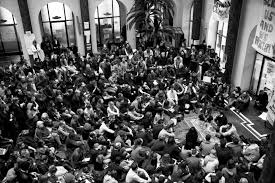
Occupy Wall Street Logo 99 percent. David Graeber's politics led him to champion protests such as the Occupy Wall Street movement of 2011.
David Graeber’s politics led him to champion protests such as the Occupy Wall Street movement of 2011

It is to Graeber’s credit that he applied such principles as readily in his critiques of leftist campaigns and organizations (in America and farther afield) as in his exposés of the violence and distortion inherent in so many of capitalism’s most prized practices and presumptions. In contrast to what he termed “Marxist sectarians”, for instance, with their “top-down popular front groups” and “old-fashioned activist organizing styles” seemingly designed to generate “steering committees and ideological squabbles”, Graeber was clear and characteristically persuasive in his fundamental commitments, declaring himself a glad member of the “horizontalist, direct-action-oriented wing of the planetary movement against neoliberalism”. For this branch (or root, perhaps) of “the planetary movement”, our chances of surviving and even defeating capitalist hegemony, a project necessarily both local and global in its coordinates, are infinitely greater if the campaigns – along with the modes of self-organisation and mutual aid – we adopt now foster and embody values of transparency, equality, democratic participation as a matter of standard practice. Vitally, for Graeber, such political tenets were neither lofty nor aspirational, but could be discerned over and over, and in concrete terms, throughout human history. “When you can actually test them, most of the usual predictions about what would happen without states or capitalism turn out to be entirely untrue”, he wrote, in a passage worth quoting in full:

For thousands of years people lived without governments. In many parts of the world people live outside of the control of governments today. They do not all kill each other. Mostly they just get on about their lives the same as anyone else would. Of course, in a complex, urban, technological society all this would be more complicated: but technology can also make all these problems a lot easier to solve. In fact, we have not even begun to think about what our lives could be like if technology were really marshalled to fit human needs. How many hours would we really need to work in order to maintain a functional society — that is, if we got rid of all the useless or destructive occupations like telemarketers, lawyers, prison guards, financial analysts, public relations experts, bureaucrats and politicians, and turn our best scientific minds away from working on space weaponry or stock market systems to mechanising away dangerous or annoying tasks like coal mining or cleaning the bathroom, and distribute the remaining work among everyone equally? Five hours a day? Four? Three? Two? Nobody knows because no one is even asking this kind of question. Anarchists think these are the very questions we should be asking.

As is arguably true of anti-capitalists in general, Graeber’s radicalism was most manifest, and most valuable, in his urge to frame new questions about the world – including our revolutions within and across it – rather than regurgitating pre-approved answers about the same. His working assumption, moreover, is compelling: that the more vigorously democratic (as opposed to hierarchical) and inclusively action-centered (rather than stage-managed and conciliatory) our radical practice is, the more cohesive, resilient, and effective our struggles will become.  Revolutionaries of all stripes would do well to take heed.

Amsterdam Protest 2015, students listening to David Graeber's politics.
David Graeber speaking at a protest in Amsterdam in 2015

Graeber’s life and work seem to touch and illuminate so many strands of radical thought and endeavour that the notion of offering a final word on either seems flawed, if not plainly ridiculous. Indeed, the unflagging zest and comradeliness, insight and interconnection, of his approach are such that he seems one of the few figures in the present day whose utopian realism can truly be seen as living on, to be borne out and extended, in the actions of mass resistance and mutual support that flourish beyond his own individual, immediate involvement. No doubt this is at best a complex consolation to the friends, comrades, and shipmates on the voyage of his one life, now closed. But if nothing else, it reminds us that the greatest tribute we can pay to Graeber, and those from whom he himself drew inspiration, is to practice and develop the politics and political culture he exemplified when living.

Filed Under: Reviews

  • Page 1
  • Page 2
  • Go to Next Page »

Copyright © 2024 · Aspire Pro on Genesis Framework · WordPress · Log in