• Skip to primary navigation
  • Skip to main content
independent left logo

Independent Left

Environmentalism, socialism, freedom and equality. #liveablecity

  • About
  • Featured Articles
    • How Farming Must Change to Save the Planet
    • The Housing Crisis: Causes and Solutions
    • Socialism in Ireland
  • Contact Us
  • Podcast
  • Animal Rights
  • Archive
    • Irish Socialist History
    • Dublin City Council Housing
    • Ukraine
    • Protests Ireland
    • Reviews
    • Irish Political Parties
    • All Posts
    • Independent Left Policies
  • Why join?

The Carpet Crawlers: the Meaning of the Lyrics

06/06/2022 by Conor Kostick 18 Comments

What is the meaning of The Carpet Crawlers? The Genesis song, whose lyrics were written by Peter Gabriel, has a dense, religious imagery leading to considerable discussion over the years as to what is the meaning of the The Carpet Crawlers lyrics. Here I’ll offer an interpretation that it is, at heart, addressing a terrible truth: that our world is hellish and those whom we believe we are following out of our own choice are keeping us trapped in illusion.

The Carpet Crawlers first appeared on the 1974 Genesis album, The Lamb Lies Down on Broadway. In writing The Carpet Crawlers, the lyrics came first. And this is important in any attempt to understand it. Often a band will start with the music and fit lyrics in to suit the music; with The Carpet Crawlers, Peter Gabriel came to his band members with the lyrics already written and they created the D, E-minor, F-sharp minor sequence against which Gabriel then spent ‘hours and hours’ developing the melody on an out-of-tune piano. The sense of movement in the song feels simplistic when you isolate the keyboard or drum parts, but combined with the vocal melody the song becomes complex, unpredictable (even after multiple listens), and builds in a sinister fashion.

After an early version of The Carpet Crawlers was written, Peter Gabriel decided to add more lines and, again, the rest of the band provided the music, although they were under the impression an instrumental part was required and were surprised to hear his new vocals.

The lyrics of The Carpet Crawlers describe a scene where the narrator is in a hellish and surreal environment wanting to get out. Everyone else is being encouraged to get out by working their way upwards towards heaven, but all is not what it seems. In fact, listening to those who pretend to know that you ‘have to get in to get out’ will only doom you to remain stuck.

A Close Examination of the Lyrics of The Carpet Crawlers

Thinking about the lyrics of The Carpet Crawlers in detail makes it more difficult to grasp the overall meaning of the song but also helps appreciate the skill, subversion, and powerful imagery of Gabriel’s lyrics.

The opening lines of The Carpet Crawlers introduce a first-person narrator, who in the The Lamb Lies Down on Broadway album is a character called Rael. Treating Carpet Crawlers as a self-contained work, the narrator could be any of us. At first, the narrator is aware of a pleasant, cocooning sensation.

There is lambswool under my naked feet

The wool is soft and warm

Gives off some kind of heat

The lamb is a traditional symbol of innocence: a newborn animal whose gentleness is the opposite of the ferocity of the tiger in William Blake’s Tyger, Tyger. All is not well, however. A disturbing sight now appears to indicate that close by to the narrator this mild heat turns into an inferno.

A salamander scurries into flame to be destroyed

Mythology portrays the salamander as a creature that can dance in flames. Nor is this just a tradition in legend. Aristotle believed that the salamander was proof that ‘animals do actually exist that fire cannot destroy’. Yet here the lizard ‘scurries’ toward its own death. This lyric indicates that far from being in a protective and gentle environment, our narrator is somewhere hellish, and this sense of uncanny dread is enhanced by the following lyric in The Carpet Crawlers.

Imaginary creatures are trapped in birth on celluloid

Whatever these imaginary creatures are, the cinematic presentation of their birth is made all the more troubling by the fact of their being caught in the agony of being born and unable to properly come into being.

The fleas cling to the golden fleece

Hoping they’ll find peace

Now we come to a crucial moment in our the experience of the song. The fleas are us. A somewhat disgusting association, perhaps, but with Gabriel taking delight in inverting tropes, these fleas are not simply pestilent bloodsuckers, but have potential. In particular here, they want only peace.

We live in the lambswool (golden coloured and described in a fashion to evoke the Golden Fleece of legend), which while seemingly offering warmth and protection cannot provide lasting happiness. Not only are there horrors beyond the safety of the wool, but even within the wool there is no hiding from our self-created miseries.

Each thought and gesture are caught in celluloid

There’s no hiding in memory

There’s no room to avoid

The Carpet Crawlers: the Meaning Within the Lyrics

The crawlers cover the floor in the red ochre corridor

For my second sight of people, they’ve more lifeblood than before

As the music of the song becomes darker and begins its long, slow build, the narrator views humanity from above, having this additional dimension from which to view the crawling fleas. The narrator can see our bloodsucking nature, as we draw sustenance from the red ochre corridor.

‘Red ochre’ is a carefully chosen colour and appears in the lyrics of The Carpet Crawlers not simply to make the line scan. Ochre is a clay and sand mix of yellow-to-orange colour; red ochre is closer to the colour of dried blood, because the clay contains iron oxide. When blood leaves the body, the iron in haemoglobin turns to iron oxide. Red ochre represents the blood, life-force.

The carpet crawlers meaning ochre
The carpet crawlers meaning red ochre
The red ochre colour of the corridor of The Carpet Crawlers was carefully chosen and is suggestive of a passage in the human body.

The environment sustaining humanity as we crawl along is womb-like, leading some people to interpret the lyrics of The Carpet Crawlers as a metaphor for birth: sperm have to get in to the egg to get out. There are definitely resonances with this idea in the song’s lyrics but since the core meaning of The Carpet Crawlers is that one can’t get out of hell by following the ‘callers’, then all the imagery to do with fertilisation and birth is best understood as reinforcing the main idea rather than being the main idea. If you follow the Mannichean argument below, then it makes sense that the dying crawlers should simultaneously be sperm, their light being trapped in  darkness by the act of fertilisation and condemned to rebirth in hell.

Moreover, while the place in which humanity is stuck is womb-like, it is also hellish. The relationship of the environment to the crawlers is not one of succour, peace, and maternal love; it is hostile and only provides blood because the fleas are biting into it.

The plight of humanity in The Carpet Crawlers is made clear in the following lines.

They’re moving in time to a heavy wooden door

Where the needle’s eye is winking, closing on the poor

The carpet crawlers heed their callers:

“We’ve got to get in to get out

We’ve got to get in to get out

We’ve got to get in to get out”

Drone-like, we have a shared rhythm as we move to a heavy wooden door that – by association with the Biblical idea that it is easier for a camel to pass through a needle than a rich man enter heaven – is heaven’s gate. The needle’s eye is winking, mockingly. And it is the poor who are excluded from this journey. Like with the salamander, this place is not what it seems. It is a mockery of the journey to heaven. Again too, there is a sexual aspect to the needle’s eye, which suggests the vulva.

According to Gnosticism, our current world is hell and we are deceived when we think the path to heaven consists in following the preaching of those telling us the god of this world is good (the truly good god exists elsewhere). These lines in The Carpet Crawlers are thoroughly Gnostic. A sense-dulling refrain that the way out of hell requires us to get past the door is causing us all to move as one in that direction. But should we be doing so when the anti-Biblical needle is winking at us?

Gnosticism and the Meaning of The Carpet Crawlers

From this point – the introduction of the idea that the callers are calling humanity to a route that promises escape from hell but which will not deliver it – the song drives forward with increasing intensity: via the drum beat, the plaintive guitar, the increasing volume of the keyboard arpeggios, and the exchange of vocals between Peter Gabriel and Phil Collins.

There’s only one direction in the faces that I see

It’s upward to the ceiling, where the chamber’s said to be

Like the forest fight for sunlight, that takes root in every tree

They are pulled up by the magnet, believing they’re free

The carpet crawlers heed their callers:

“We’ve got to get in to get out

We’ve got to get in to get out

We’ve got to get in to get out”

The narrator can see that the pull of the callers is upwards (the conventional direction for heaven) and a rumoured chamber exists there, full of promise. Note that the narrator is unsure whether the chamber is actually to be found there. Everyone believes they are freely choosing this path to the chamber, but like trees striving for sunlight or iron aligning to a magnet, we are allowing the callers to lead us without any real freedom on our part. We are trapped in an illusion but cannot see it.

The next line introduces a strangely modern cultural reference to what up to now has been a largely (with the exception of celluloid) timeless atmosphere.

Mild-mannered supermen are held in kryptonite

While one could imagine dozens of Clarke Kents fixed in place, the real meaning of this lyric is to challenge the idea from Nietzsche that with God dead, the way out of the restraints and limitations of existence is to become an Übermensch, a superhuman. But in the hellish world of our narrator those – cerebral rather than athletic – superhumans are just as trapped as everyone else.

And the wise and foolish virgins giggle with their bodies glowing bright

Through the door a harvest feast is lit by candlelight

It’s the bottom of a staircase that spirals out of sight

With these lines the lyrics of The Carpet Crawlers return to Christian imagery. The Biblical parable of the ten virgins – five wise, five foolish – is spoken by Christ when he is asked what sign will indicate the end of the world. Unlike the Biblical women, half of whom miss the crucial moment (the Day of Judgement) through being ill-prepared, in the song they are all aglow and inappropriately cheerful. Again, the route of our escape from hell is not what it seems. And this makes the ostensibly heaven-sent harvest festival and ascending staircase uninviting, despite the chant of the callers continuing to dominate the minds of the crawlers.

The carpet crawlers heed their callers:

“We’ve got to get in to get out

We’ve got to get in to get out

We’ve got to get in to get out”

The carpet crawlers meaning Wise and Foolish Virgins William Blake
The Parable of the Wise and Foolish Virgins (1822) by William Blake. Whereas Blake illustrates the apocalyptical meaning of the parable: that those who are unprepared will fall behind on the Day of Judgement, in The Carpet Crawlers they appear as ten cheerful women whose brightness is a lure towards a progress that is illusory.

The Final Images in the Lyrics of The Carpet Crawlers

The porcelain mannequin with shattered skin fears attack

And the eager pack lift up their pitchers, they carry all they lack

The liquid has congealed, which has seeped out through the crack

And the tickler takes his stickleback

Leaving aside the porcelain mannequin for the moment, our narrator witnesses the end of the journey of the carpet crawlers as they eagerly lift up their pitchers, whose contents are the lifeblood they will need having left their source of sustenance, the blood of the red ochre corridor. But the pitchers are broken, as Ecclesiastes 12:6 puts it when introducing the subject of death and the return of the dust of our bodies to earth. The lifeblood has seeped away and congealed.

At this point, the tickler takes his stickleback.

This final line before a long repetition of ‘we’ve got to get in to get out’ may seem humorous. Isn’t a tickle a pleasant experience? In fact this line is the awful climax of the song. No English child of Peter Gabriel’s generation will have grown up without attempting to catch sticklebacks, tiny fish which used to be abundant in fresh water. To tickle these fish is to wait for them to enter the trap of your hand and pluck them out of the water.

The carpet crawlers have been lured into the hands of death and a return to hell by the promise of the callers, along with a mistaken belief in the location of the escape chamber, as well as the illusions of the virgins, the candlelit harvest feast and the staircase.

What about the porcelain mannequin? It could well be the narrator, feeling vulnerable at the moment that the mass of crawlers leave the lambswool. An individual who has become a mannequin has had their unique features replaced by generic forms, making them able to represent all humans. A mannequin is designed to be moveable by others and an already shattered porcelain one is particularly vulnerable to harm. It would be frighting to be a porcelain mannequin and part company with the mass movement of the people around you because you intuit their final destination is not what it seems. That fear might bind you to their collective folly.

The proximity of the sound of ‘mannequin’ to ‘Manichaeism’ suggests an alternative reading of the line: that the porcelain mannequin is the Prince of Darkness, Satan. Manichaeism was the Gnostic-inspired religion that believed that it was necessary to release the light within us and become free from rebirth and pain. From this perspective, the porcelain mannequin who fears attack is the Prince of Darkness, the ruler of Earth, a hellish realm. He is fragile and vulnerable to the collective action of the carpet crawlers, should they ever change direction, for we carry light within us and for all our faults – every one of them on view – we carry the answer as to how to get out within ourselves.

If the porcelain mannequin is Satan, he need not worry. He can reabsorb our light (our death also being a moment of fertilisation to bind our light into the material world once more), causing us to be reborn in darkness, thanks to the assistance of the callers and their illusory religion.

And the tickler takes his stickleback

The pull of the music, which peaks after these lines during the repetition of We’ve got to get in to get out, implies the increasing pull of that argument, and reinforces how impossibly difficult it is to resist submission to that refrain and thus defeat.

Why are the lyrics of The Carpet Crawlers so powerful?

Peter Gabriel has a strong engagement with William Blake, the revolutionary poet, something that was evident in his setting Songs of Innocence and Experience to music for the millennium, with performances eight times a day in the Greenwich marquee. And while there are no direct references to Blake in The Carpet Crawlers there do seem to be some in Supper’s Ready, Gabriel’s other lyrical masterpiece for Genesis.

Peter Gabriel took a Blakeian approach to writing the lyrics of The Carpet Crawlers in this sense: he drew on Christian imagery and mythic creatures of his own invention to condemn orthodox religion and the way that people become trapped in the illusion that they are freely following the philosophies that bind them. It takes a prophet to write a song like Carpet Crawlers and I think that reading Blake helped Gabriel assume that mantle, at least in 1974.

As with all prophetic writing, the lyrics of The Carpet Crawlers affect us because they are addressing a fundamental truth. There is something real and important about the nature of human experience that is touched on here. And that’s why our bodies shiver on listening to the song, regardless of the extent to which we comprehend the exact meaning of The Carpet Crawlers.

Humanity is living in hell and is constantly recreating the conditions of our immiseration by callers who think they know how to direct us to heaven. And while atheists and materialists baulk at the thought that the Prince of Darkness orchestrates all this, just ask yourself, what if that evil god was Mammon? If you lived in a world that sacrificed everything to the pursuit of profit, while telling you everything was going to end well, what would that world look like?

The hell of the carpet crawlers.

Conor Kostick is the author of the international bestseller Epic , in which the people of a dystopian world are obliged to play a fantasy RPG for their living. Conor Kostick’s science fiction can be read on Substack.

Epic by Conor Kostick is dystopian like the atmosphere of Carpet Crawlers

Filed Under: Reviews

SOCIALISTS AND COALITION WITH SINN FÉIN

05/05/2022 by Colm Breathnach 4 Comments

As the likelihood of a Sinn Féin led government grows, the prospect that the government might include radical left parties as coalition partners looms. But should socialists take up roles in government in coalition with Sinn Féin? Are there circumstances where this might prove to be necessary? Obligatory even? Now is the time to debate this issue, rather than being rushed into hastily made post-election decisions that could have a disastrous effect for the left in Ireland.

TWEAKING OR TRANSFORMING?

Its worthwhile beginning the discussion by reviewing how different tendencies of the left, in its broadest sense, approach the question of governmental power in capitalist democracies, concentrating on four overlapping projects with the proviso that, in practice, political organisations often span two or more of these trends or change from one to the other over time:

1. Transformative project: This is where the organisation or movement is serious about the project of replacing capitalism with a system of workers’ democracy. Such a transformative change will primarily be driven by mass movements and will probably involve a series of crises in the social, political, and economic system. This approach is based on the premise that it takes much more than a change of government to bring about the end of capitalism. In essence, this is a revolutionary project that does not see politics as simply a matter of who is in government and, as such, is not fixated on the electoral cycle. It is a fundamental belief of this type of radical socialist or anarchist politics that we are engaged in a long-term project, not simply one of gaining a few bums on ministerial seats.

2. Gradualist project: Though the aim of this project is the same as the transformative one – the replacement of capitalism – the means are substantially different. Advocates of the gradualist project believe a deep transformation can be achieved mainly via the structures of the liberal democratic state, through the introduction of radical reforms by a left government. This “left-reformist” approach has enjoyed a semi-revival with the Corbyn/Sanders movements and, on the theoretical field, with the surge in popularity of Karl Kautsky’s theories amongst some socialists, often to justify gradualist positions in current politics.

3. Reformative project: This is the classic post-WW2 social democratic project. It effectively posited on the acceptance that it isn’t really possible, or even desirable, to break completely with capitalism. What is possible are serious economic and social reforms that would moderate capitalism significantly. In other words, Sweden (or nowadays Finland) is as good as it gets.

4. Adaptive project: This is an explicitly social-liberal, rather than anti-capitalist project. It proposes (but rarely delivers) reforms, but not ones that are in any way threatening to capitalism. This project usually combines a version of neo-liberal economics with some reforms in the area of civil liberties and equality, though often with an emphasis on image rather than substance. Epitomised by New Labour under Blair or the Irish Green Party in its current incarnation, such parties exist in the twilight zone between socialism and liberalism, so much so that it would be correct, in some cases, to question whether theirs is a left project at all. The term “centre-left” used by the mainstream media, usually refers to parties in this mould though it is sometime applied to gradualist and reformative parties as well.

Defining these different approaches is not an academic exercise in classification but is crucial to understanding how different political movements will behave in the future. It helps us to understand and anticipate where political movements might be headed. For example, a radical left party may call itself revolutionary, but in practice advocate entry into a centre-left coalition government which, at best, will engage in reforms without any possibility of a transformation to a post-capitalist society. It doesn’t matter what label an organisation applies to itself, what matters is the actual practical direction of their activities. The Corbyn project was a classic example of this – it was explicitly a reformative project – proposing nothing that the Norwegian Conservative party had not acceded to over years of hegemonic welfare-statism. This is not to say it was wrong for radical leftists in England to engage positively with Corbyn’s Labour Party or that those Labour members involved were insincere, but to argue against the illusion that Corbyn’s Labour was something that it clearly was not.

Though largely outside the scope of this article, it’s also worth noting that identifying the actual aims and methods of a political organisation does not constitute a full analysis of that organisation: an essential component of such an analysis also requires examining their social base: the class, gender, ethnic etc. nature of their voters, members, leadership, as well as the class-interests they represent.

SINN FÉIN AS (RADICAL) REFORMERS?

If the radical left is to judge how to engage with Sinn Féin, and a future Sinn Féin led government, we need to start by identifying what their “project” is. Few would argue that Sinn Féin are proposing a transformation that moves beyond capitalism; even those on the left of Sinn Féin would regard that idea as a hopelessly utopian position. It would be fair to characterise the party as a left-nationalist party, with a strongly working-class base; a party that has the potential to engage in a serious reformist project or to retreat to a largely cosmetic adaptive one. So, an important question is the degree to which the party is serious about implementing reforms: how far are they willing to go? Few expect them to introduce radical economic reforms, but will they have the strength or ability to introduce a radical housing policy that provides decent housing for the thousands who are now without? Or introduce a universal free public health service?

While having no illusions about the nature of the party, it’s important not to underestimate Sinn Féin. Unlike the social-liberal parties, they have grown out of a genuine a mass movement that is rooted in working class communities, both urban and rural. Their base of members and supporters are amongst the most politicised in their communities: this means that there is some pressure from below on them to deliver radical reforms. Whether they could sustain defiance of the intense opposition radical reforms would generate, will be dictated by the balance of forces, in other words by whether the pressure from below and outside the Sinn Féin government will be greater than the pressure exerted by capital.

In respect to what the possible outcomes could be, it is worth considering the balance sheet for Sinn Féin in Dublin City Council. Here we certainly see opportunism, acceptance of market values, and token protest rarely backed by serious campaigning. Yet there is also the occasional red line, when it’s clear that the expectations of their working-class base puts pressure on them to adopt more radical positions. From 2014–2019, Sinn Féin, then the largest party in the council chamber, formed the ruling group with Labour and the Greens. (they had tried, but failed, to involve both FF and FG in the alliance). Under the council’s housing policy during this period, the so-called Housing Land Initiative, public land was given to private developers to deliver housing in the O’Devaney Gardens, Oscar Traynor Rd, and St Michael’s sites. Although Sinn Féin claimed to be unhappy with this policy, they generally supported the process, winning only one concession: an increase in the percentage of social housing within the Public-Private Partnership mix.

O'Devaney Gardens shows the risks of coalition with Sinn Féin
The O’Devaney Gardens sell off is a victory for Fine Gael’s pro-market support for developers and landlords. Cartoon courtesy of Foxy Slattery.

In response to Sinn Féin’s defence of their position, that given an FG-controlled national government they were making the best of a bad lot, Cllr. John Lyons of Independent Left and others on the left, argued the council should reject PPP, link up with housing campaigns and activists and demand a change in national as well as DCC’s housing policy. When, in November 2019, it came to the key moment of voting on Section 183s – to dispose of the public lands – in O’Devaney Gardens, Sinn Féin’s actions displayed its vacillating nature: accepting the limits set by Irish business interests yet subject to pressure from below. The week before the vote, a local Sinn Féin councillor lambasted those who intended to vote against the disposal but then, after a backlash in the media and amongst the public when the pitiful number of proposed affordable homes on the site emerged, the party flip-flopped and voted against the proposal, having wasted the previous five years supporting it. Sinn Féin squandered any chance of creating a radical change in housing policy in Dublin through their ultra-cautious, non-campaigning, narrow, electoralist approach, which was only occasionally forced to the left by pressure from below and from the radical left councillors.

This experience in local government should certainly dampen our expectations of Sinn Féin in government but should not mislead us into presuming that they won’t, in the right circumstances, be forced to take a more radical approach. If they do make a serious effort to bring about some radical reforms which benefit working class people, while remaining within a capitalist framework, they will face an inevitable reaction from the right and the ruling class. Under such circumstances the radical left will need to navigate carefully to support and defend those reforms while pushing from below to force Sinn Féin to deliver on reforms that benefit working class communities. Which brings us to the question of how radical left TDs should approach the question of a Sinn Féin government. This is not a question for adaptive parties such as Labour, the Greens and Social Democrats (and possibly right-wing ones such as FF as well); we can presume they will have no problem in entering a Sinn Féin led coalition.

TO MUCH RUSSIA, NOT ENOUGH RECENT

The history of the experience of the radical left parties in government can certainly be of benefit in illuminating this debate on coalition with or support for a Sinn Féin led government. While the attitude of various left parties to coalition government in post WW1 Russia or Germany is relevant, given the profound differences of circumstances it has limited contemporary value. The crucial mistake in historic comparison is to compare the dilemma of entering government in a revolutionary situation with the challenge of entering coalition government in a regular liberal democracy in a non-crisis situation.

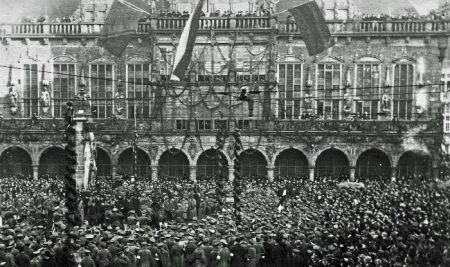
Revolutionaries could enter coalition with Sinn Féin-type parties in extreme circumstances such as arose in Germany 1919
Declaration of a Soviet in Bremen, Germany, 10 January 1919

This problem is clearly illustrated in a recent article by the PBP TD, Paul Murphy, in which he explores the question of radical left participation in government at length but mainly in relation to the experience of the KPD (German Communist Party) in the crisis-ridden 1920s and with no reference to the experience of any radical left, or even left-reformist, party in the subsequent century (Murphy, 2021). Murphy’s conclusion, that the radical left should participate in a “left government” which “pursues a revolutionary struggle against capitalism” doesn’t really leave us any clearer, since we get no inkling as to how that relates to the crucial issue of a possible Sinn Féin led government. Are we to conclude that, since SF are clearly not interested in “a revolutionary struggle against capitalism”, the prospect of joining a coalition with them is being ruled out or, since Murphy doesn’t say so explicitly, could it be that he thinks it is possible that a Sinn Féin led coalition could be such a “ruptural government”? While Murphy’s intervention is welcome in that broaches the issue, it ends up being a lesson in history rather than engaging with the current situation facing the Irish left. There are of course no models or exact replicas of what a radical party should do but rather than concentrating on Germany in the 1920s, we would be better served examining the recent experience of left-of-social-democracy parties in western European countries.

Before considering those more recent examples it is worth pointing out that others in PBP have given a much clearer indication of willingness to enter a coalition “left government”. John Molyneux (2022) dismisses the option of PBP being rushed or manoeuvred “to join this (Sinn Fein led) government lured by the prospect of office and achieving “real change” but then quickly turns to considering the conditions under which PBP would enter a Sinn Féin led left government. Firstly, there is a clear understanding that this left government would be gradualist: one that would “take on capitalism”, a deliberately ambiguous terminology.

The process of joining a coalition with Sinn Féin is outlined: PBP would negotiate on “core demands” though “The exact nature of the demands will have to be determined according to the circumstances prevailing at the time”. Whatever this is, it is not a transformative or revolutionary approach, it is a plan to work with Sinn Féin to set up a government that would implement reforms within the constraints of capitalism. The list of possible demands, including taxing the rich, a major public housing programme, establishing a National Health Service, repeal of antiunion laws; etc. would constitute major gains for workers if implemented but for a revolutionary party to enter a left reformist government to try and reform the capitalist system is counterproductive: every failure and compromise would belong to the radical party which in effect had chosen to abandon its overall goal.

There is enough ambiguity in Molyneux’s language to allow PBP to enter government on a programme of less radical reforms, since to negotiate implies, by definition, the possibility that you will have to compromise on some of your demands. Of course, a left-reformist or gradualist position is an honest, though mistaken, position but one which is based on the view that a revolutionary or transformative position is utopian and should be abandoned. If members of PBP believe that a transformative project is utopian then it is incumbent on them to argue that case openly, in which case, in practice, they have abandoned a revolutionary position.

LESSONS FROM THE CONTINENT

So, what are the lessons that the Irish left can learn from those more recent experiences in western Europe (those being the societies most directly comparable to contemporary Ireland)? First – something so obvious that it’s easy to miss – in no case has there been a serious attempt to bring about a radical transformation of society, to begin the process of establishing a society and economy directly controlled by workers. So, while it is perfectly plausible, though from a revolutionary perspective mistaken, to argue for the participation of radical parties in a centre-left coalition government, it is simply contrary to all contemporary European evidence to claim that this is a step on the road to a radical transformation of society. One could argue that the radical left entering government might lead to significant reforms or might protect workers from a roll back of the welfare state etc. but there is simply no evidence that this could feasibly lead to a serious step towards dismantling capitalism.

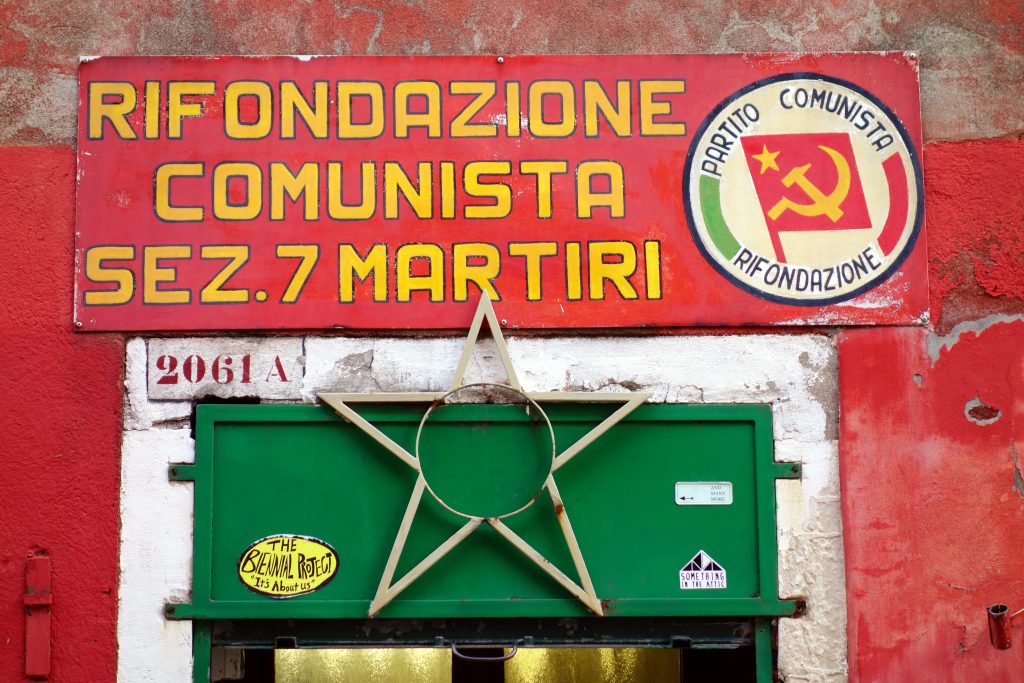
By joining in coalition with Sinn Féin-type parties Rifondazione Comunista collapsed
Rifondazione Comunista offices at Venice: the party collapsed after entry into coalition government.

In practice the outcome of entry into a centre-left government has been overwhelming negative from an anti-capitalist perspective. In two cases entry by the radical left into coalition has led to a party’s collapse into irrelevance (Rifondazione Comunista in Italy) or absorption into the main social democratic party (The Alliance in Iceland) without even the achievement of serious structural reforms within capitalism.

We see a slightly different process in Scandinavia with the so-called Nordic Green Left: these are quite large parties that emerged from the anti-Stalinist wings of communist parties in the 1950s and 60s, ones that initially offered a democratic left critique of social democracy. These formerly radical organisations, such as the Danish Socialist People’s Party, by entering coalition government with social democratic parties (and sometimes liberal parties as well), without challenging the fundamentals of capitalism in any way, have clearly shown that they are simply slightly-to-the-left versions of the social democrats. They continue to exist as a potential government partners for the main centre-left party but show no inclination when in government of pushing the boundaries much further than their partners. In effect the Scandinavian electoral market offers a variety of shades of pink, in the same way as Ireland’s Labour and Social Democrats are fundamentally the same beast politically, with differences largely based on personnel, tradition, policy nuances etc.

The experience of left parties who have adopted the more radical approach of critical support for centre-left governments, without joining them, also deserves consideration as it is probably the most likely scenario for Ireland. In other words, the government survives thanks to abstentions or favourable votes from a radical left party that is not in government. Here the experience is mixed: for some policies the radicals were able to bring enough pressure on the centre-left governments of Denmark and Portugal to prevent their slippage back into a neo-liberal approach, though the impact of this ‘external support’ on the electoral support for the radicals has been varied. The experience has been relatively positive for the Red-Green List in Denmark but this external support strategy resulted in a disappointing reduction in seats for the Left Bloc in Portugal’s general election of January 2022 (the number of seats for Left Bloc fell from 19 to 5). Once the question of coalition is ruled out, as it should be, the issue of how radical left parties relate to a centre-left government from the outside then becomes central and hopefully this is the direction the debate will take in Ireland.

What then of the much rarer instance of a majority left-reformist/gradualist government? The first major instance of a left government coming anywhere near implementing significant reforms was Mitterrand’s first government in early 1980s France. The French Communist Party entered a government with the Socialist Party that was committed to radical economic/social reforms (though still within the bounds of capitalism) but when, as expected, those reforms provoked an international and national capitalist reaction, leading to a rapid retreat into neo-liberalism by Mitterrand from 1983 onwards, the Communist Party were forced to withdraw and unable to formulate any strategy other than the desire to be a junior partner in a social-democratic government, fell into a spiral of decline (though obviously other factors also contributed to that decline).

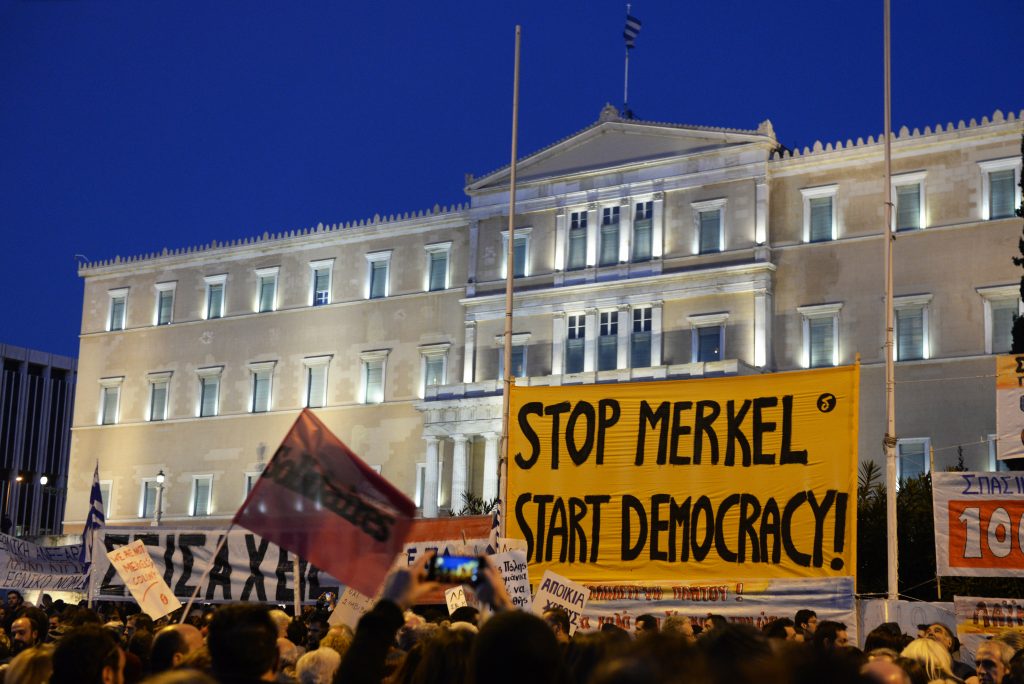
The experience of Syriza, Greece warns against coalition with Sinn Féin
Athens, Feb 15, 2015. People gather in front of the parliament during an anti-austerity demonstration to support the newly elected Syriza government

The more recent example of the Syriza government in Greece is instructive. Here you had a governing party which was led by a gradualist faction though it contained significant revolutionary factions as well (it was also reliant on a small right-nationalist party as a junior coalition partner). The story is well known: the leadership capitulated under extreme pressure from the EU and international capital, demobilised the mass movements, and quickly mutated into a standard centre-left party, implementing neo-liberal policies. The lessons are clear: while left-reformist governments can sometimes implement radical policies they cannot bring about radical transformation beyond capitalism. To reiterate, a change of government is not a change in power.

So, the modern European experience reveals that entering a left-of-centre coalition is a tacit acceptance that the best that can be achieved are reforms that protect the position of the working class within a capitalist society. This approach displays amnesia or ignorance on the part of those involved regarding how power functions in a capitalist society. To think you can implement radical reforms as one government minister – socialism in one Department as it were – sidesteps the obvious fact that the state is not neutral, that power in a capitalist society is diffused through a range of institutions and that the ruling class does not rule exclusively through the state. It is to forget that the role of all governments in a capitalist society is to administer capitalism, to ensure to continuation of accumulation, albeit sometimes with reform measures that save capitalism from itself. The fact that no minister from any centre-left party, in both the Republic and the UK, has made any attempt to undo any of the Thatcherite anti-trade union laws that have been implemented in both states since the 1980s is instructive in this regard.

“GROWN UP POLITICS” – THE PRESSURE TO GOVERN IN COALITION WITH SINN FÉIN

None of this is to trivialise the enormous pressure on radical left parties to enter coalition government when that opportunity arises. It is a serious mistake to see this simply as a matter of some inevitable process of socialist betrayal. Of course, there are opportunists who like power for its own sake in every organisation, in addition to party loyalists who will go wherever the leadership lead, but for many more there is the real force of institutional and structural pressures that push them in a right-ward direction.

Perhaps surprisingly, some of that pressure comes from below. Given the common portrayal of politics – politicians enter government whenever the opportunity arises so that they can implement the policies they have advocated for – it is not surprising that many people who vote for a radical left party would initially expect “their party” to enter coalition government so that they can deliver on their policies and promises. This understandable popular desire for short-term results can lead to intense pressure on a party and can even infect the membership and leadership. The example of Democratic Left in Ireland, which initially positioned itself to the left of the social democracy, illustrates this problem clearly. At the 1994 special conference, where Democratic Left delegates voted overwhelmingly in favour of joining a coalition with FG and Labour, the most rousing applause went to a delegate who declared that they could choose to have Proinsias De Rossa as Minister for Social Welfare, improving people’s lives immediately, or they could choose what was characterised as the useless luxury of blabbing on about some future socialist society. To use a cliché of the mainstream press: it was time to roll up the Che posters and enter the realm of “grown up politics” of compromise and delivery. A cursory knowledge of Democratic Left’s pathetic record in government, and ultimate demise, indicates where that argument led!

Reflecting both the bias of individual journalists and ruling class interests there are two narratives regarding Sinn Féin in the media: one, declining, narrative sees Sinn Féin as a terrible threat to democracy but another which is now more prominent (and more representative of ruling class interests), reassured by their record in the North and local government, holds the view that Sinn Féin is not such a danger, as long as they can be house trained, i.e. pushed to drop the more radical aspects of their agenda. This media/ruling class pressure may also extend to the radical left parties if the question of coalition arises: are they going to be responsible and graduate from their immature radicalism?

Though the establishment certainly don’t actively desire the inclusion of the radical left in a Sinn Féin led government (an SF/FF coalition would be much more to their liking), they would rather Richard Boyd Barrett et al. as government ministers, with all the compromises that would involve, than the emergence of a larger radical opposition putting pressure from the left on a Sinn Féin government. A few post-Trotskyists in government would not cause many sleepless nights in the corridors of the Irish Times or IBEC: better to have them tamed on the inside. The fact that some journalists, nurtured in the Eoghan Harris school of anti-leftist outrage, would howl with indignation at the thought of “Provos and Trots” in government should not fool us: these will be the rantings of a dying clique, not representative of the mainstream of establishment opinion. Ironically, having radical left ministers in government might also suit the right-wing parties, who will have something to gain from left involvement in a Sinn Féin led government. While regrouping in the hope of benefiting from Sinn Féin’s failure to deliver the right-wing parties will also be glad to see the sting taken out of the left’s opposition to their policies. It’s hard to go from being a Minister who kept capitalism ticking over, to being the scourge of capitalism on the opposition benches.

ALTERNATIVES TO COALITION WITH SINN FÉIN

If we accept that entry into a Sinn Féin led government would effectively process radical left participants into social democrats and remove them from any further relevance in debates about a radical transformation to a post-capitalist society, then we are faced with the crucial question of what, other than entering coalition, can or should radical socialists do? The premise here is not that a Sinn Féin led government would be same as a right-wing one or that the delivery of significant reforms by Sinn Féin would be impossible. Rather it is that because of the harmful long-term results, the role of the radical left should be to stay out of a Sinn Féin government but relate to it in a way that pushes it as far left as possible, while militantly opposing compromises with the agenda of big business.

The important factor here is that a few left TDs on their own won’t make a significant difference: only a left that is organically linked to a mass movement can really pressurise Sinn Féin away from caution and retreat from reform. Remember how cautious Sinn Féin were on the issue of Water Rates. It was only a mass movement led by the left that forced them to take the non-payment position.

At the time of writing, it seems that a Sinn Féin government will not arise as a result of a mass movement but on the basis of a passive mood of discontent: “the rest have messed things up, someone has to change things, let’s give the Shinners a go”. So, the left will have the dual role of transforming that mood into a movement to put pressure on Sinn Féin to deliver on their promises, while at the same time mobilising people to defend any advances that are made by Sinn Féin from the hostility of the right and the international ruling class.

DEBATE NOW!

This debate on coalition will become redundant, at least in the medium term, if Sinn Féin wipes out the Dáil representation of the radical left. As this is a real prospect at this stage, discussion on this issue must start now, rather than when the next general election is called. It must begin with the widest possible debate on the radical left: a prospect that, at the moment, is inhibited by the top-down nature of debates and decision-making in the larger organisations of the Irish left where, traditionally, leadership groups arrived at a position and then a debate was initiated with a preordained outcome. Instead, what is necessary is an open debate amongst grassroots members across the left, where all possible positions are freely debated. This is not just the responsibility of organisations like Independent Left, which are wholly committed to those participatory and democratic principles, but also those within the main organisations of the radical left, PBP and the Socialist Party.

Such an open debate within and between organisations and throughout the radical left milieu as a whole, would allow those, such as Independent Left, who take a transformational approach, to advocate for a united left position that rejects entry into a coalition with Sinn Féin, while defending any radical reforms that a Sinn Féin-led government would introduce and opposing right-wing attacks on such a government. Pushing from the left but defending against the right. But that united left approach can only really happen if we have clarity on the issue long before Mary Lou gets called to the Áras.

Filed Under: Independent Left Policies, Irish Political Parties

Evasions on the Left over Ukraine

26/04/2022 by Conor Kostick 22 Comments

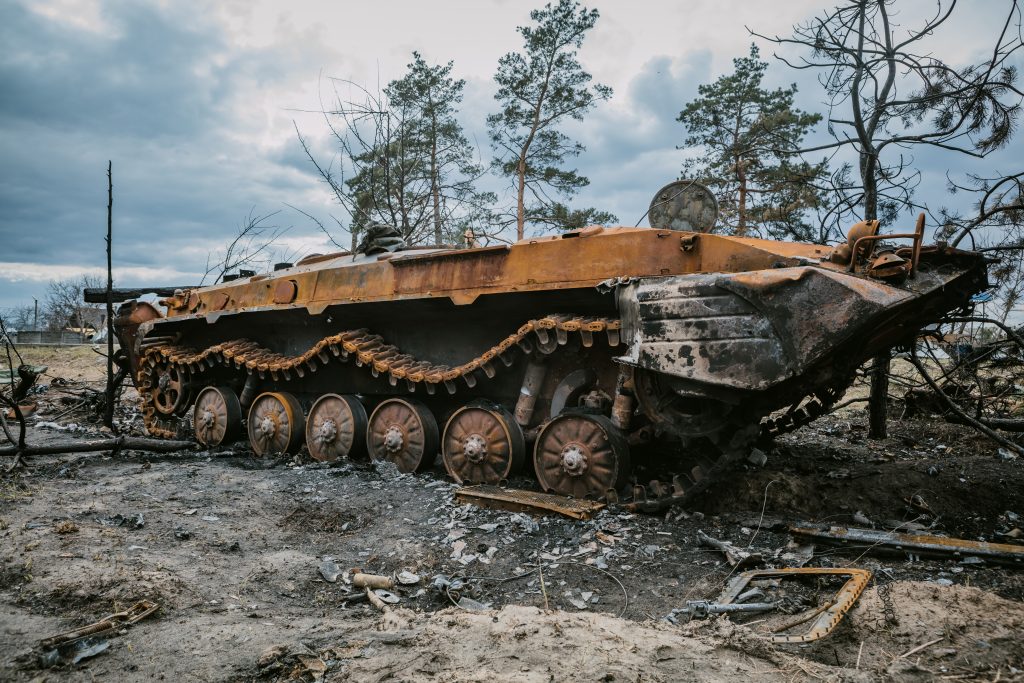
KYIV REGION, UKRAINE 05.04.2022 Russian BMP-2 burned by Ukrainian army
Burned out Russian BMP-2, 5 April 2022: Ukraine needs modern weapons to defeat the Russian invasion

Wars are not light topics that can be dispensed of with simple formulas. I, for one, cannot imagine how the success of Russia would further the cause of democracy and socialism around the world. If you do, then say so, openly, so it can be debated in public. But don’t falsify tradition and history and hide behind pathetic slogans. To paraphrase Marx, we Marxists disdain to conceal our views and aims.

John Ganz, Ben Burgis’s Bad History: Jacobin’s anti-Jacobins

There is a type of left argument around the war in Ukraine which has arisen in the West. It is one that condemns Putin’s invasion, but refuses to offer practical support to the people of Ukraine in resisting that invasion. It is the position one can read in Jacobin, or in statements by Chomsky, Corbyn, and the Stop the War Coalition in the UK. In Ireland we have the same type of response to the Russian invasion of Ukraine from People Before Profit and the Socialist Party of Ireland.

I will use the label Evasionist Left for this approach. It’s not clear how representative this trend is internationally, as many on the left do pro-actively support the resistance in Ukraine, e.g. parties such Razem in Poland; those associated with the Fourth International like Left Bloc and the Danish Red Green Alliance; and the main left party in Japan, the Japanese Communist Party.

Of course, there are pro-Russian figures around too, who claim to be on the left: although why anyone would want to be associated with Putin makes no sense. Russia is not in any way a socialist society. In fact, as Russian socialist Ilya Budraitskis puts it, Putin can be understood to be developing a new form of fascism. Explicitly pro-Putin figures are relatively rare on the left, and while they are busy sharing Russian propaganda, are not hugely influential. The left arguments I want to address here are those of the groups and their supporters who express opposition to Putin, but who refuse to take any steps towards bringing about a military defeat for the Russian invasion and in particular, are strongly opposed to the people of Ukraine obtaining arms from the West.

The groups supporting the Evasionist Left position seem to be basing their approach on two ideas: 1) Support for the resistance in Ukraine is support for NATO and 2) The war in Ukraine is an ‘inter-imperialist war’. My goal is to argue that these ideas are wrong and that if you take them seriously, you will find yourself on Putin’s side in the war. Often, when I try to discuss these points with their supporters, I hear only silence when I ask them to really think through the consequences of their formulations. But the war itself allows for no evasion.

Typical of the Evasionist Left position are features that speak out against the war in Ukraine and all wars, such as the Irish People Before Profit statement: No To War. Oppose Putin’s Invasion. Stop NATO Expansion. As with many articles by Jacobin and Stop the War (UK), the line taken by this statement is that Putin’s invasion should be condemned but the US are to be condemned equally.

The article concludes: “The real hope lies in an anti-war movement that crosses the border of East and West and opposes both Putin and NATO. We salute the actions of the Irish Anti-War Movement in calling people out to protest. We urge the international movement that came together to oppose the Gulf War in the past to rise again against the twin aggressors of Putin and NATO.”

World peace arising from a mass movement from below East and West would be lovely, but what is evaded here is the question of whether the left should support Ukrainian military resistance to the invasion. “Opposing the war” is a comfortable position to adopt if you are on the other side of Europe to the columns of Russian soldiers. But what does this conclusion mean for the people of Ukraine? Perhaps it means they should not fight back? Or perhaps there is room for supporting armed resistance to the Russian invasion, if it is decoupled from NATO? The point here is that in many cases, no one knows what it means. This is not a position that informs the people of Ukraine or those who want to express solidarity with them of what to do.

While we strive for international uprisings against war, should we want the people of Ukraine to defeat the Russian invaders in the meantime? Should we support or sabotage NATO armaments moving to Ukraine? Should we send money and perform solidarity actions that will allow Ukrainian anarchists and socialists to further their military resistance to the invasion? Or should we discourage them from fighting back, because they are unwitting tools of NATO?

These practical questions are a good way to judge the two key formulations that the Evasionist Left are using. And yet Marx’s claim that socialists don’t hide their views doesn’t seem to apply on the topic of Ukraine, where it’s difficult indeed to ascertain how these questions would be answered. Just to be clear, my own answers and those of Independent Left (and many other socialists and anarchists in Ireland) are yes, a victory for Ukraine against Russia would be the best outcome for the left and the world generally and yes, we should support the people of Ukraine getting arms from wherever they can, including from NATO. As Taras Bilous, editor of the left-wing Ukrainian magazine Commons, puts it, “the Western left, which criticizes military aid to Ukraine are outrageous. Do they want us to fight with bows and arrows when we have shot all our bullets? Do they want the Russians to kill as many Ukrainians as possible? That there were more Bucha’s?”

Based on the limited number of publications and occasional social media post, including exchanges with me, many Evasionist Left supporters do not in fact welcome the Ukrainian resistance, do not support people like Taras Bilous in their efforts to defend their cities. And to justify this they have advanced the two arguments above. These slogans are crucial to the orientation of the Evasionist position, and I believe they are quite wrong.

1. Support for the resistance in Ukraine is support for NATO.

A rather bad-faith version of this argument was visible after a UCU-supported demonstration on 9 April 2022 in the UK, in which a call for victory to the Ukrainian people was described as being “for NATO intervention in Ukraine”.

Such comments echoed the misleading headline by the UK’s Socialist Worker reporting on the demonstration, where they interpreted the call for arming the Ukrainian people to be a call for NATO escalation. To say that the people of Ukraine need arms is not at all the same as saying NATO should send troops to fight in the war.

A Russian convoy is approaching your town. The people around you join the Ukraine territorial defence to fight, several of them form their own socialist and anarchist units which you have the option of joining. But those internationally making the same arguments as above say, “No. Don’t escalate. It will lead to more war horror. And potentially nuclear war. Instead, let’s appeal to the Russian anti-war movement to save us.”

The position of these ‘left’ activists brings peace, but it’s the peace of a Putin victory, which not only means your town witnesses hellish scenes of rape and murder, that you could perhaps have prevented, but it also undermines peace for the future. Because understandably, when scenes of slaughtered civilians reach neighbouring countries there is a massive clamour for NATO assistance. Moreover, Putin will have concluded that after Syria and Ukraine, he can push on again, because fear of the horror of war, especially nuclear war, means the western left would prefer his victory to the victory of the resistance. And the Russian anti-war movement, that might have flourished as the Russian army was stalled and thrown back, is crushed by the wave of nationalism around the victorious Putin.

Fortunately, we are not yet in this scenario, above all because of the determination of the people of Ukraine not to surrender to the Russian invaders. Within the resistance to the invasion, the left are able to play an independent role. Here’s how Vitaliy Dudin, head of the Ukrainian democratic socialist organisation, Sotsyalnyi Rukh (Social Movement), described the situation from Cherkasy, Ukraine, on 6 April 6 2022:

“Some Social Movement activists, as well as many trade union members, have joined the TD as volunteers. It is worth mentioning that dozens of anarchists and socialists have formed their own unit within the TD, called the Resistance Committee.

“Secondly, a lot of leftists are helping as volunteers to supply the army or satisfy people’s humanitarian needs. One of the most effective initiatives in this regard is Operation Solidarity, which has managed to provide supplies to the militant left. We are also working to meet the needs of trade union members serving in the army.

“We have also worked with the nurses’ NGO Be Like Nina and helped them obtain medicines for hospitals that are taking care of wounded soldiers.

“Third, we see that a lot of people are protesting the invaders in occupied cities. We aren’t involved in such activity, but we support it. Of course, it is very dangerous because peaceful protests can be shot down by armed Russian soldiers. Such resistance proves that people are against the ‘liberation’ that seeks to turn their cities into grey-zones.

“Fourth, we as Social Movement continue to act as a political organisation. We seek to counter Russian propaganda and call on our people to fight for a free and fair Ukraine.”

By contrast, if the politics of the war in the Ukraine are resolved by the Evasionist Left approach, then we will see a Putin victory. You can’t negotiate any settlement with Putin, even a bad one for Ukraine that nevertheless de-escalates the threat of nuclear war, unless you stop his army and force him to realise he can’t implement his plan to eradicate Ukraine as an independent nation.

There is a better-faith version of the argument against NATO weapons going to Ukraine, which is to say, “I do want Ukrainians to defend themselves, but I don’t trust the US. Whenever they arm a side in a war, they have their own imperialist goals.” This observation about the US is, of course, correct, but do you really think people in Ukraine, especially the left, are under any illusions about the US interests at play? There’s a patronising assumption here that those demanding arms to prevent Russian soldiers from murdering their friends and families are dupes of US intelligence.

Similarly, I’ve heard socialists in Ireland say, “we have to weigh up different dynamics here, on the one hand, Russian imperialism, for sure; but on the other, US interests.”

If Ukraine is to defeat Russia the people there obviously need modern weapons. Anarchists have described how they are currently having to use machine guns from 1944.

A 1944 Maxim gun. Ukrainian anarchists and socialists fighting independently within Ukraine’s territorial defence are desperate for better weapons.

If you are someone who wants Russia to be defeated, but doesn’t want NATO armaments to arrive in Ukraine, you really need to think this through. Are you asking communities to defeat the Russian soldiers using only home-made Molotov cocktails and Second World War weapons? This seems to be the position of the Socialist Party of Ireland, who at least do support workers in Ukraine arming themselves. At the same time, however, their supporters are told: “In the Western capitalist countries opposition to NATO militarism and expansionism must always be a central feature of our propaganda, even where this is not currently the mood among the mass of workers. We stand against all military intervention on the part of U.S. and Western imperialism — this includes opposition to the provision of weaponry by NATO powers to the Ukrainian military. This in and of itself increases the threat of the conflict escalating more widely.”

Similarly, in a feature on 25 April 2022, Ukraine: The United States are now fighting a proxy war with Russia Kieran Allen (Socialist Workers Network, Ireland) argues that the Ukrainian people, “have every right to resist”, yet is opposed to them using NATO weapons.

It’s not at all unreasonable to keep an eye on what the US is up to. No doubt there are US hawks who are thinking now would be a perfect time to take Russia on and smash Putin’s army while he’s weak. We should oppose US intervention of troops, ships, and aircraft, mainly because of the risk of nuclear war but also because of their own imperialist record. But that’s not happening right now: yes, NATO countries are supplying weapons to Ukraine but at the time of writing they have not entered the war with Russia with their own armed forces. Sitting on the fence now in fear of what the US might do in future, again means not supporting those currently fighting the Russian soldiers. The same question faces the good faith left person as the bad: when the Russian convoy is approaching your town, do you fight back militarily? You can’t say, “well, there’s a balance of imperial interests to consider and I’m going to be neutral until I get non-NATO weapons.” That neutrality will be finished by a Russian bullet to the head to you and anyone else you have persuaded of your position.

Moreover, those trying to dress up this recognition of the interplay of rival imperialisms as if it’s something new are missing the obvious point that throughout the twentieth and twenty-first centuries, US and Russian imperialism always backed any movement that was fighting their rival. So when Solidarnosc rose up against the Communist Polish government in 1980-1, the CIA rushed to fund and influence the union. That didn’t stop it being a genuine mass movement which socialists of the type now adopting the Evasionist position recognised and supported.

Finally, on the legitimacy of the people of Ukraine taking advantage of inter-imperialist rivalry to obtain arms from NATO, there are very clear left precedents. For those of the Evasionist Left viewpoint who are champions of Lenin, it is worth noting Lenin’s response when France and Britain offered to give military aid to Russia to fight Germany, when he wrote: “Please add my vote in favour of taking potatoes and weapons from the Anglo-French imperialist robbers.”

He later explained:

The North Americans in their war of liberation against England at the end of the eighteenth century got help from Spain and France, who were her competitors and just as much colonial robbers as England. It is said that there were ‘Left Bolsheviks’ to be found who contemplated writing a ‘learned work’ on the ‘dirty deal’ of these Americans.

2. The war in Ukraine is an ‘inter-imperialist war’.

A second justification for not supporting the people of Ukraine fighting back against Russia is based on the idea of ‘revolutionary defeatism’. The tone here for Rebel in Ireland was set by an article by Kieran Allen, entitled, James Connolly and War.

The parallels with World War One in 1914 are striking. Then and now it was the weaker imperial power than began a new era of global conflict. In 1914, it was Austria who made the first moves. Today it is Russia, a country with a  commodity driven economy and a GDP that is one tenth that of the USA.

Just as James Connolly concentrated on challenging the propaganda of the Irish National Party and Britain, argues Allen, so socialists today should be revolutionary defeatists and recognise the main enemy is at home. Which means Irish socialists should concentrate on furthering the class war in Ireland.

Allen doesn’t spell out what revolutionary defeatism actually means in the context of the war in Ukraine: and the reason is surely that to publicly embrace the implications of his approach would be to declare that a Putin victory is the better outcome for those in the West. Again, let’s go back to the situation where a Russian column is approaching your town. A revolutionary defeatist position means that you should never give support to ‘our side’ in the war, even if that results in the other side obtaining military victories. That was the position of Karl Leibknecht in Germany and the Bolsheviks in Russia. They really did mean that they preferred to see their own countries defeated than support their own national elites in their war aims. And they were right. But transpose this policy to the soil of Ukraine and revolutionary defeatism can only mean a refusal to join the resistance and a refusal to support Zelensky, even if that means Russian victories.

The Evasionist Left position of condemning the Russian invasion, declaring support for the right of the people of Ukraine to fight back, yet taking a ‘defeatist’ approach toward Ukraine means giving no practical support for the resistance to the invasion. It is quite consistent with not wanting arms to get to Ukraine. Our main enemy (they say) is at home. It is our job to stop NATO. That might feel very principled from afar but it abandons the left in Ukraine and the population more generally to military defeat, with all that means for the massacres of civilians and the strengthening of Putin.

This is the contradictory but inevitable outcome of a flawed analysis. And the analysis is flawed for the simple reason that the Russian invasion of Ukraine is nothing like the outbreak of the First World War. Within a week of Austria’s declaration of war against Serbia in 1914, all the European imperial powers were in a full-blooded war against one another. From the Russian invasion until now, we have not witnessed the equivalent to French and British armies crashing up against the German army.

The more obvious parallel to make with James Connolly’s world is that of British rule in Ireland. For centuries Britain tried to rule Ireland directly, eradicating the Irish language and crushing Irish culture. This is a clear parallel with Russia’s history in regard to Ukraine. Just as Connolly was right to take German weapons to support an armed rising against the British empire, so the Ukrainian people are right to take weapons from wherever they can to rise against the Russian empire.

In a related feature based on the same defeatist idea, John Molyneux argues the left should not support sanctions against Russia. Sanctions, he says, are a feature of NATO’s war against Russian. They are, “an integral part of a political offensive waged by one of the imperialist blocs in this conflict – the bloc which, as internationalist socialists and opponents of all imperialism East and West, we have a particular duty to oppose because they are the bloc to which our ruling class is affiliated.”

Again, the analysis is that this war is not one of Russian imperialism attempting to crush a smaller neighbouring nation but an inter-imperialist war in which the main enemy is at home. In which case, one should not call for sanctions against Russia, because Russia is not the main enemy for the Western left: NATO is. Yet let’s go back to our approaching Russian convoy once more. Are there sanctions which will help stop that convoy reaching its target town in Ukraine? Yes, plenty of them. A good example is the closure of the tank factory at Uralvogonzavod:

Western sanctions can halt the Russian army

And another, potentially even more decisive closure arose on the basis of a fire at the Dmitrievsky Chemical Plant, Russia’s only internal source for vital chemicals.

The fire at the Dmitrievsky Chemical Plant threatens to leave Russia without additives needed for advanced rocket and jet fuels; treatments and solvents for servicing metal parts; core input chemicals for explosive and solvents, traces and washes needed to manufacture electronics and circuits. So long as sanctions prevent these from being delivered at scale, Russian military efforts will be seriously hampered.

Not all sanctions are appropriate, some are less concerned with assisting Ukraine than developing Western business advantages. But when the people of Ukraine call for Western sanctions focused on stopping the Russian war machine, they are right to do so, and the left should listen to them and support them. Ironically, the Evasionist Left position in fact supports sanctions against Ukraine, applauding actions such as those of workers at Pisa Airport, Italy, who refused to load weapons and explosives destined for Ukrainian forces. By hindering the military resistance in Ukraine and refusing all sanctions against Russia, the practical effect of the Evasionist Left is to align their political energies with a victory for Putin.

Both Anti-Imperialist and Inter-Imperialist?

In an article of 19 September 2022, Paul Murphy, an Irish TD and member of RISE, offered an analysis that attempted to bridge the position between those supporting Ukraine’s right to resist the invasion and those in the west who see NATO, not Putin, as the main enemy here. His conclusion was:

It means socialists must attempt to disentangle, to the degree possible, the legitimate resistance to Russian imperialist invasion, and the inter-imperialist conflict which we oppose.

It means supporting the right of Ukrainian people to resist. We don’t blame people in Ukraine for getting weaponry from wherever they can source it, but we do encourage them to operate on the basis of complete independence from NATO. If such genuinely independent forces existed, socialists could even fundraise to send them weapons. However, those of us living in the western camp, the dominant imperialist bloc in the world, cannot support NATO forces pouring weapons into Ukraine in the pursuit of an inter-imperialist conflict, risking an escalatory spiral that could lead to armageddon. We should support the Russian anti-war movement and demand the immediate withdrawal of Russian forces from Ukraine.

If a pure, revolutionary workers movement existed in Ukraine that was genuinely independent of NATO then RISE would not only support them, but would even fundraise for their weapons. It’s good to have such revolutionary credentials. Unfortunately for the actually existing socialists in Ukraine, such as Taras Bilous and those linked below, they aren’t sufficiently anti-NATO or in some other unstated way fail to pass the RISE test. Still, at least they aren’t to blame for their decision to fire guns and other weaponry supplied by the West and that will no doubt be comfort to their troubled consciences.

This ‘test-the-left’ position is evasionist in regard to the question of whether a victory for Ukraine under the neo-liberal Zelensky is preferable to a victory for Russia (or a peace with Russia having made territorial gains). The answer that Murphy skirts around seems to be ‘no’, because of the inter-imperialist aspect of the conflict. To achieve a Ukrainian victory risks armageddon.

The mistake here is to see the activity of the US and its goals in regard to Ukraine as being on a par to the those of Putin. There is a vast difference between the two. This is not a symmetrical inter-imperialist war where victory for either side would make no difference to the lives of Ukrainians and the fate of the world more generally. This is an imperialist invasion by Russia, where the defeat of Russia is by far the best outcome for everyone who dreams of a “just and humane world” as Boris Kagarlitsky puts it.

Victory for Russia or a settlement that gives it control of Ukrainian territory leads to ruthless military rule over the conquered people; it plays into the hands of the far right world wide; it increases the possibility of other land grabs by militarily strong powers; and, in particular, it keeps Putin in power. Defeat for Russia retains the space in Ukraine for trade unionists, social rights activists, and civil society generally to organise. It also has the potential to unleash revolution in Russia. Kagarlitsky believes, plausibly, that the defeat of Russia will bring about the end of Putin and deep changes in Russia.

Yes, defeat for Russia means temporary gains for the US but a free Ukraine would not be a satellite of the US, its people would not be under military rule and it might not even become a member of NATO. Moreover, as Kagarlitsky warns, there are those in the West who are deeply uneasy about the prospect of revolution in Russia. They would prefer Putinism without this particular Putin to a popular revolt.

The RISE position of seeing the war as both inter-imperialist and anti-imperialist separates that organisation from the Ukrainian left and any anti-imperialist revolts that develop as a result of Ukrainian military victory.

Can we draw any lessons for the international left?

The contradiction in the Evasionist Left position – ‘we condemn Russia but we don’t support arming the resistance in Ukraine’ – is an unstable one. Some members put more weight on the condemnation of Russia than others. Some even state online that they would welcome a victory for Ukraine. On the whole, though, the leadership of these parties place their emphasis on why we should not support Ukraine. Hopefully, the members who want to see Ukraine survive and throw out the Russian invaders will push back their leadership on the two formulations above (that support for Ukraine is support for NATO, and that it is an inter-imperialist war), that directly oppose support for the resistance.

There’s a lesson here for the left in how the wrong positions have been arrived at, which is that we are witnessing the consequence of a top-down approach to socialist politics rather than a bottom up. The reason I have repeatedly asked the reader to imagine the approach of a Russian column of tanks and to think through your response is that this is exactly how billions of people have thought about these issues. The majority of the world’s working class empathise with the people of Ukraine, who before Putin’s invasion were bringing their kids to school, going to work, planning their weekly shop, collecting the kids, going to the playground, chatting with friends. They were exactly like us and then the hell of war descended on them from Russia.

The left can influence this public feeling of solidarity for Ukraine by making points about Western hypocrisy on refusing to cancel Ukraine’s debt; on refugees, on Palestine, and yes, on the imperialist role of NATO. But the best way to do that is to amplify the voices of Ukrainian socialists and anarchists who are putting their lives in the front lines against Putin’s army. This ‘bottom up’ approach listens to the people of Ukraine and if you are on the left, to the voices of anarchists and socialists, such as: diary of an anarchist in Ukraine; also https://commons.com.ua/en/left-west-must-rethink/; or https://freedomnews.org.uk/…/interview-operation…/; or http://www.europe-solidaire.org/spip.php?article62209 or http://www.europe-solidaire.org/spip.php?article61988. 

The Evasionist Left model is a top down one, where the leadership derive their positions based on past experience and their reading of canonical Marxists texts, then the party apparatus delivers the position to the members. This means blunders are inevitable.

The Evasionist Left are in the process of making a serious mistake now and one where the equivocation of condemning Putin while not supporting the military resistance of the Ukrainian people cannot be sustained. There can be no hiding from the question of what to do when the Russian soldiers are coming. And if you are a member of one of these parties or organisations who thinks the Ukrainian people are right to fight back, then you have your own battle to avoid your party coming out of this war with a lasting reputation for having adopted a position whose practical consequence was to disarm those facing the Russian invasion.

Filed Under: All Posts, Ukraine

The Western Left and Russian Imperialism

16/03/2022 by Conor Kostick 4 Comments

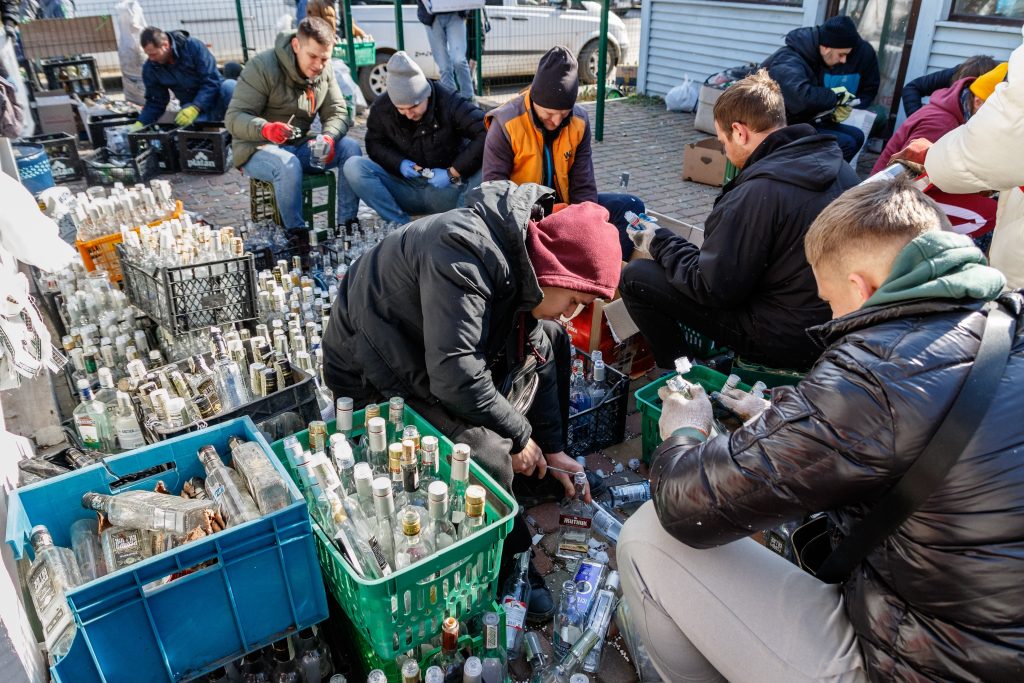
The left and Russian Imperialism: the people of Ukraine preparing Molotov cocktails.
The Left and Russian Imperialism: residents of Uzhhorod, Ukraine, 28 February 2022, making Molotov cocktails. The international left should be doing all it can to assist the people of Ukraine defend themselves.

Day and night, gunfire could be heard. There was no public transport. Knocked-out Russian tanks stood raggedly about the streets, while others rumbled continually up and down. Shattered buildings with gaping holes cast grotesque shadows across hundreds of bodies lying in the streets amid the broken glass, empty cartridges and other debris. Occasionally, a van with a Red Cross flag or a lorry-load of ‘freedom fighters’ would go crunching by. Some food shops were open. The cinemas, theatres, and restaurants were closed. In the ferment of activity, there was no time or thought for entertainment.

Andy Anderson, Hungary ’56

In 1956, Russian tanks and troops carried out a massive assault on Hungary. After a first wave had stalled, a second wave involving around 6,000 tanks succeeded in occupying the main cities of the country, abducting the Premier, Imre Nagy, and crushing the popular ‘soviets’ that had sprung up to co-ordinate resistance to the invasion.

This was a watershed moment for the left internationally. Until 1956, mass communist parties retained thousands of supporters in most countries. It was still possible to believe—if you didn’t examine the evidence too closely—that Russia was not an imperialist power but rather a state that for all its faults had held back fascism and Western aggression.

Today it should not really be necessary to make the case among the left that Russia is an imperial power. The evidence has been available for decades. Yet the left, at least the Western left I am familiar with, has so declined in the clarity of its thinking and in moral principles that the generation of revolutionaries who rose in ’68 and won young radicals away from Communism towards international socialism – figures such as Tariq Ali – are not even calling for Putin’s army to be thrown out of Ukraine.

The Left and Imperialism

Around the time of the Great War, the left understood the nature of imperialism. For Luxemburg, imperialism was a by-product of a relentless thirst by capital for surplus value. For Lenin, imperialism was the highest stage of capitalism. For Bukharin, it was the result of competition being eliminated between companies within a state only to reappear as competition between states. And for James Connolly, imperialism was a desperate drive to obtain new markets by aging capitalism.

By any of these definitions (and none are up-to-date, we need new ones that reflect modern conditions) Russia is a major imperialist power. After the Second World War, Russia subordinated the countries behind the Iron Curtain to its own drive to compete in four ways: direct theft of factories, which were dismantled and moved to Russian territory; the purchase of raw materials and goods at strong-armed prices; ‘joint’ companies which sent the lion’s share of profits to Russia but expected the satellite country to underwrite any losses; and ‘collectivisation’—the formation of Russian-led state farms.

No wonder the people in these countries – who were deprived of the right to strike, to form trade unions, or express critical ideas – wanted to escape Russian control. No wonder that they repeatedly rose up in their millions, such as in Hungary 1956, Czechoslovakia in 1968, and Poland in 1980. When the opportunity came in 1989 to get rid of both Russian control and their own local Communist rulers, of course the people did so. The mass movements of that year were entirely understandable and justified. The fact that the ‘free’ market of Western-style capitalism failed to bring about prosperity proves nothing positive about Russian control over Eastern Europe, but only that capitalism is a failed system worldwide, whatever particular garb it wears (including the twist that people wielding red flags and carrying pictures of Marx should become the ruling elite).

Justified Resistance to Russian Imperialism

Ukraine 2022 should be seen in this context of justified resistance to Russian imperialism.

Worldwide, there should be left solidarity movements for Ukraine as there were for Hungary and Czechoslovakia. Internationally the socialist left should be blossoming. By supporting the resistance of the Ukrainian people and demanding the withdrawal of Russian troops as well as pointing out that the capitalist system of ruthless competition will lead to more wars unless humanity gets out of the social vice we are trapped in, the left could revive across the planet. Millions of people are coming to realise the real danger the system we live in poses and are looking for alternatives.

Yet, in the west at least, the left is in the process of making a mess of what should be a simple task. Where are the big anti-imperialist marches like we saw in the build up to the US invasion of Iraq in 2003? Why are the left’s media filled with more posts about the US than Russia? Or maps of NATO expansion? Where is the amplification of the voices of our comrades on the front lines in Ukraine? Our anarchist and socialist comrades are fighting Russian imperialism and for a transformation of Ukraine, and they are reaching out to us for solidarity.

Why is the Western left ambiguous about wanting a defeat for Russia?

I believe that the reason for the current fumble by the Western left is that they have a mindset that prevents them from making sense of the obvious. There shouldn’t be any doubt about the fact we are witnessing a popular uprising against an empire. Instead, the left see fascists and dupes of NATO everywhere in Ukraine, even when the left in Ukraine is shouting to us that this isn’t the case.

Naturally, the Stalinist and Maoist left are for a Russian victory. I’m not addressing them. They are walking cadavers who ache to be dominated, mouthing statements fed to them by their masters. They have nothing to offer in regard to an international left revival. I’m writing this feature for a different audience: those currently wondering why Western anti-war organisations led by the left are not doing more to assist those fighting in Ukraine.

Part of the answer, I think, is that this left is moribund and has been for some years.

As Stalinism began to break up after ’56, the New Left adopted the attitude that both US imperialism and Russian imperialism were equally dangerous. But the counter culture that scorned capitalist values and the inspiring prospect of the possibility of international socialism both faded towards the middle of the 1970s. The genuinely revolutionary left was stranded high on a beach while the tide of working class revolt withdrew. To survive for all these decades, most of the left found their own rock pool to hide in and they became sects. Without the reality check provided by being rooted in working class communities, and without a connection to a mass movement of radical workers, they lost something essential: the spirit of questioning everything and debating freely (there was a darker side to this too, in the appearance of abusive hierarchies forming within several far left groups).

The left and Russian imperialism
Uzhhorod, Ukraine, 2 March 2022, the people are issued arms and given basic training. The war against the Russian invasion becomes a people’s war.
The left and Russian Imperialism: anarchists joining the resistance
The left are able to join the popular resistance with their own organisations. They are not dupes of NATO but have resolved to play their part in the national struggle against Russian imperialism. They deserve our support.

When you read the writings of Ukrainian socialists and anarchists  today, it is striking how consequential they are. They write about the results of decisions and their real, practical outcomes (which are not always for the best). Theory for the Western left, on the other hand, has degenerated into performance at conferences and second rate expositions of the canonical texts of Marxism. No one is ever called to account for their views, and where leading members of the Western left have articulated positions that don’t stand the test of time, such embarrassments are simply removed from party history.

Yet a spirit of free thinking and lively debate is needed on the left, now more than ever. No social theory is so perfect that it is accurate and actionable for decades. Specifically, in regard to the issue of Russian imperialism, there was a contradiction in the theoretical tools of the Trotskyist left that means allowing elder gurus to formulate current policy unchallenged leads to the current problem.

After the rise of Hitler and the defeat of the Spanish revolution of 1936–9 (both decisively influenced by the positions taken by the German and Spanish Communist Party) Trotsky was convinced that Stalinism was absolutely counter-revolutionary. Yet at the same time he believed there were positive features of Russian society, such as the nationalised economy, that the new rulers of Russia had yet to overturn. Trotsky was murdered by a Stalinist in 1940, so he didn’t live to see a post-war state of affairs that would have forced him to face the following contradiction in his thoughts about Russia: given that in Hungary, Poland, Czechoslovakia, etc., industry was nationalised as a result of the arrival of the Red Army, then either such nationalisations are not necessarily a step towards socialism, or Stalinism is not always counter-revolutionary.

Some of the Trotskyist left opted for believing that Stalinism can be positive, sometimes, despite itself (just watch the knots they will get into if Putin nationalises the airlines and banks). Others went the other way, such as the SWP in the UK, which saw state capitalism as in no way superior to free market capitalism. Yet even in the case of the SWP a softness towards Stalinism was revealed – particularly by those who later broke away to found Counterfire – when they thought it clever to join with George Galloway and form Respect Party. An abandonment by the radical left of the spirit of independence from all imperial agendas, in favour of a geo-political approach of picking the lesser evil is at the heart of their weakness at this defining moment. We are at the beginning of a new era of imperialist wars and we have to do better than ‘lesser evil’ politics, because they betray those fighting against empire and for social change.

Today, the Stop the War Coalition in the UK embodies the weakness of a Western left that had the potential to rally people to the side of the Ukraine socialists and anarchists who are fighting against Russia. Stop the War is dominated by former Stalinists, Trotskyists and SWP members who have found themselves in agreement that the main enemy to organise against is the US and NATO even in a situation where it is Russia invading another country . The Trotskyists can only maintain their alliance with the Stalinists by muting any criticism of Russia, or support for the Ukrainian resistance.

For some years before this war in Ukraine, the signs were clear that left-wingers of this type were moving away from a policy of listening to people engaged in real conflict with imperialism and towards an armchair geo-political analysis focused on finding out what the US agenda was in any situation and choosing the other side. When it came to the destruction of Syria, Stop the War did nothing to oppose Russia’s crushing of a popular uprising and, indeed, drove away those attending rallies on the topic of Syria who were looking for support against Russian backing of Assad. Over the course of six years in Syria, Russia killed 23,000 Syrian civilians, tested 320 weapons systems and gave combat experience to 85% of its officers.

I see this generation – the Tariq Alis, the Jeremy Corbyns – as they themselves must once have seen the leaders of Western Communist parties. As a result of their ‘campism’ (i.e. picking a camp that isn’t the US, no matter how anti-working class), they are incapable of giving the anti-war movement the energy and focus on Ukrainian left activists it needs. Corbyn often has a platform with Jacobin, the US left magazine, and that magazine too fails to amplify the voice of the Ukrainian left. Almost certainly, this is because Jacobin does not discuss the question of Russian imperialism but argues instead that this war is the product of decades of NATO expansionism. In its coverage of Ukraine so far, the magazine has limited itself to pointing to the hypocrisy of Western elites. The Democratic Socialists of America, the largest socialist organisation in the USA, has a similar view.

Similarly incapable of being able to rise to the occasion are those who cannot commit themselves to offering solidarity with the Ukrainian left in their time of need, because they see resistance to Russia as strengthening NATO.

For groups like People Before Profit in Ireland, this is not a war of liberation by a small nation against an imperial power, because if so, the Irish tradition of James Connolly’s working-class based opposition to the British Empire would be entirely relevant (as it is, including the validity of obtaining arms from Germany). No, for them, this is an inter-imperialist conflict:

Putin’s actions are being used by military hawks in the US to whip up an atmosphere for war. The US military was humiliated by their defeat in Afghanistan and are determined to re-assert their ‘leadership’ over the Western world by posing as its defenders. This is why they have done everything possible to whip up tensions. They have sent an extra 5,000 soldiers to Poland and have been systematically supplying the Ukrainian army with missiles.

Again, for them, this war is all about the agenda of the US rather than a national liberation struggle against imperialism..

When prominent PBP members frame the war in a way that presents it merely a matter of Putin versus NATO, they write out of the picture the Ukrainian left and, indeed, the entire Ukrainian people, who have as much right to an independent country free from Russia as Ireland does in respect to Britain.

James O'Toole's tweet shows how some of the western left don't advocate the defeat of Russian imperialism
When it comes to the Western left and Russian imperialism, there are many who see the war in Ukraine not as a battle for the liberation of the country from empire but as an inter-imperialist war, such as James O’Toole of People Before Profit, Ireland.

Clearly, a stronger opposition to Russian imperialism needs to be voiced by the Western left at this time. There are signs that this is taking place. In the UK the executive of the trade union Unite have taken a better position on the conflict, perhaps because its members have taken solidarity action in not unloading Russian oil. For the statement of Independent Left on the conflict see the link. And for English language socialists wanting to connect with the left in Ukraine and give them support, we recommend the work of the Ukraine Solidarity Campaign.

The Western left and Russian imperialism FAQ

Is Ukraine fascist?

No, that’s Putin’s pretext for the invasion. There are a small number of Nazis in Ukraine (they won 2% of the vote in the 2019 election) and they have less of a presence in the military than they did in the events of 2014. Russia, too, has fascist organisations and countries like the USA have larger numbers of fascists. When asked was Putin’s De-Nazification of the Ukraine welcome, Kyiv’s Chief Rabbi said, “I don’t know what he’s talking about. In terms of antisemitism, we’re very secure here.”

Should the Western left want to see a defeat for Russia in the war in Ukraine?

Yes. This should be obvious and as instinctive as supporting oppressed people anywhere in the world. This a crucial test of whether the left is at all relevant more generally. And unfortunately, much of the Western left is in the processing of failing it and failing the Ukraine resistance.

Will NATO benefit if Russia is defeated?

Possibly. But then, if Russia wins, that will create a massive upsurge of a desire for a greater NATO presence and more US armaments among the countries adjacent to Russia. This question has become the primary one for the much of the Western left but it should be secondary to the more fundamental question: are you on the side of the people facing the Russian invasion?

But what about Palestine?

Many of those raising the issue of Palestine in the context of the war in Ukraine are doing so in bad faith. They don’t want to admit to preferring a Russian victory to a Ukrainian one; rather than acknowledge this politically unpalatable position, they draw attention to the double standards of Western governments and some media outlets, which do not champion Palestine with a fraction of the energy they are devoting to Ukraine. Yes, of course the left should recognise the cause of the Palestinians as a just one. But where do you stand on the question of Ukraine?

What does Noam Chomsky say about the war in Ukraine?

You can read this for yourself in his interview here. He’s another of those on the left who see the war as a geopolitical conflict between NATO and Russia, leaving out Ukrainian people themselves. Dismissing the possibility and even the desirability of a victory for Ukraine, Chomsky argues that concessions to Putin’s goals are necessary.

What Can Socialists in the West do to help the left in Ukraine?

Above all, the Western left needs to get off the fence and start listening to their comrades who are battling Russian tanks and troops – without supporting NATO – and champion their cause against the Russian invasion. Independent Left are channeling our support through the Ukraine Solidarity Campaign, who have strong contacts among trade unionists, socialists and anarchists in Ukraine.

They have a crowdfunder campaign here.

Filed Under: Independent Left Policies, Ukraine

Independent Left Statement on Ukraine

03/03/2022 by admin 3 Comments

Independent Left Statement on Ukraine
Popular resistance in Ukraine can defeat Putin’s imperialist assault

Independent Left condemns the Russian invasion of Ukraine; Putin’s war is an imperialist adventure. We support the demand for complete withdrawal of Russian forces from all of Ukraine. 

We support the right of the Ukrainian people to resist the Russian invasion by all means necessary – armed and civil resistance. We defend the right of the Ukrainian working class to arm themselves so as to resist conquest by the Russian army. If they are able to do so, despite extraordinary disparity of military equipment, the defeat of the Russian army will inspire resistance to imperialism of all forms, whether US-led, Chinese-led, or by any other major power tempted to use force to further their interests.

This is not a defensive war, but an offensive war, by one of the world’s imperialist powers; a power which has engaged in numerous military interventions to secure wealth and strategic influence, including the defeat of the Syrian people’s revolution and the recent suppression of the working class revolt in Kazakhstan.

We support the brave anti-war movement in Russia, a movement which will grow in proportion to the resistance of the Ukranian people to the invasion. The defeat of the Russian army in Ukraine will be a victory for the Russian working class because it will advance the prospect of the fall of the right-wing regime, authoritarian Putin regime, and of the oligarchic capitalism on which it is based.  We reject any attempt to blame the Russian people as a whole for this ruling class adventure, and while we support any measure that weakens the Russian ruling elite, we oppose any international sanctions solely designed to punish the Russian working class. We oppose the militarisation of Europe by NATO which is an instrument of American imperialism. It should be noted that Ukraine is not a member of NATO and that there was little prospect of it joining, and that NATO has made it clear it will not intervene directly. At this point NATO is not at war in Ukraine, so we reject abstract sloganeering by those whose focus on NATO leads them to be equivocal, or even opposed to the victory of the Ukrainian resistance.

Like all anti-imperial wars throughout history, there is a left and a right within the Ukrainian resistance. Without in any way putting conditions on our support for the goal of defeating the Russian invasion, we call on all socialists and trade unionists to organise active support for Ukrainian working class communities and organisations in their efforts to resist imperialism by donating or fundraising for their victory through the Ukraine Solidarity Campaign.

For our feature on the failure of the ‘evasionist’ left to support Ukraine’s struggle for self-determination, see here.

A link to the leaflet we gave out with United Left With Ukraine.

Independent Left Support the Fight Against Russian Imperialism

A Public Meeting with a speaker from Ukraine Solidarity Campaign was held on Wednesday 9 March 8pm.

The Ukraine Solidarity Campaign have a crowdfunder campaign.

Filed Under: Independent Left Policies, Ukraine

  • « Go to Previous Page
  • Page 1
  • Interim pages omitted …
  • Page 5
  • Page 6
  • Page 7
  • Page 8
  • Page 9
  • Interim pages omitted …
  • Page 23
  • Go to Next Page »

Copyright © 2026 · Aspire Pro on Genesis Framework · WordPress · Log in