• Skip to primary navigation
  • Skip to main content
independent left logo

Independent Left

Environmentalism, socialism, freedom and equality. #liveablecity

  • About
  • Featured Articles
    • How Farming Must Change to Save the Planet
    • The Housing Crisis: Causes and Solutions
    • Socialism in Ireland
  • Contact Us
  • Podcast
  • Animal Rights
  • Archive
    • Irish Socialist History
    • Dublin City Council Housing
    • Ukraine
    • Protests Ireland
    • Reviews
    • Irish Political Parties
    • All Posts
    • Independent Left Policies
  • Why join?

Irish Socialists and Anarchists Show Solidarity with Ukraine

24/08/2022 by admin 3 Comments

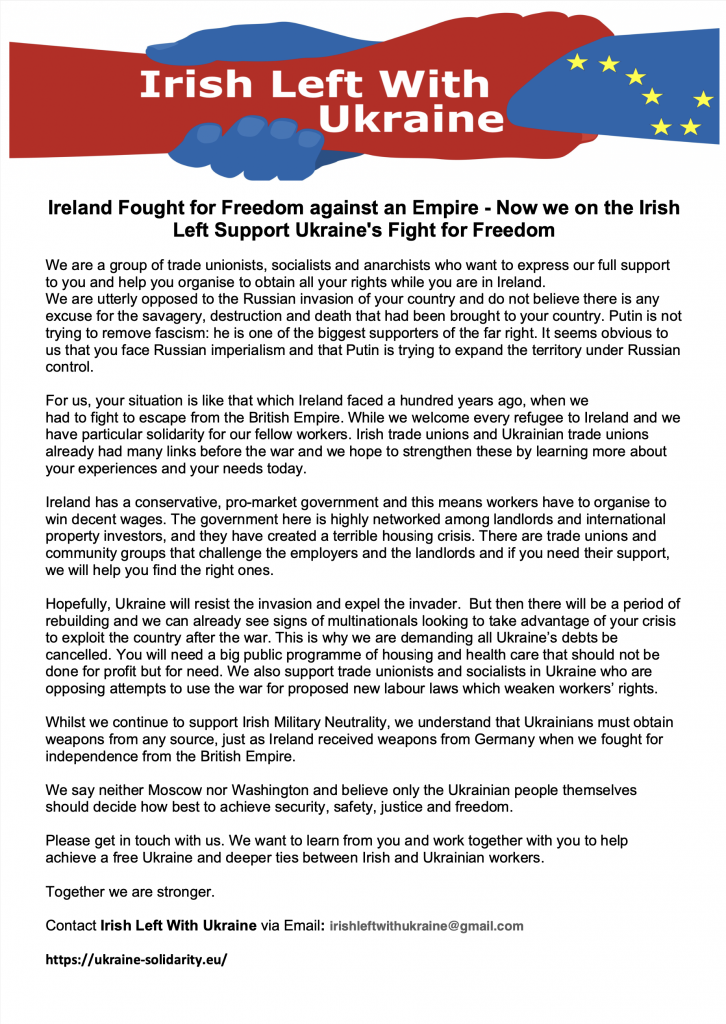
Solidarity with Ukraine: Irish socialists and anarchists show solidarity on 24 August 2022
Leaflet given out by Irish Left With Ukraine on 24 August 2022 to show solidarity at a march to mark six months of the Russian invasion of Ukraine.
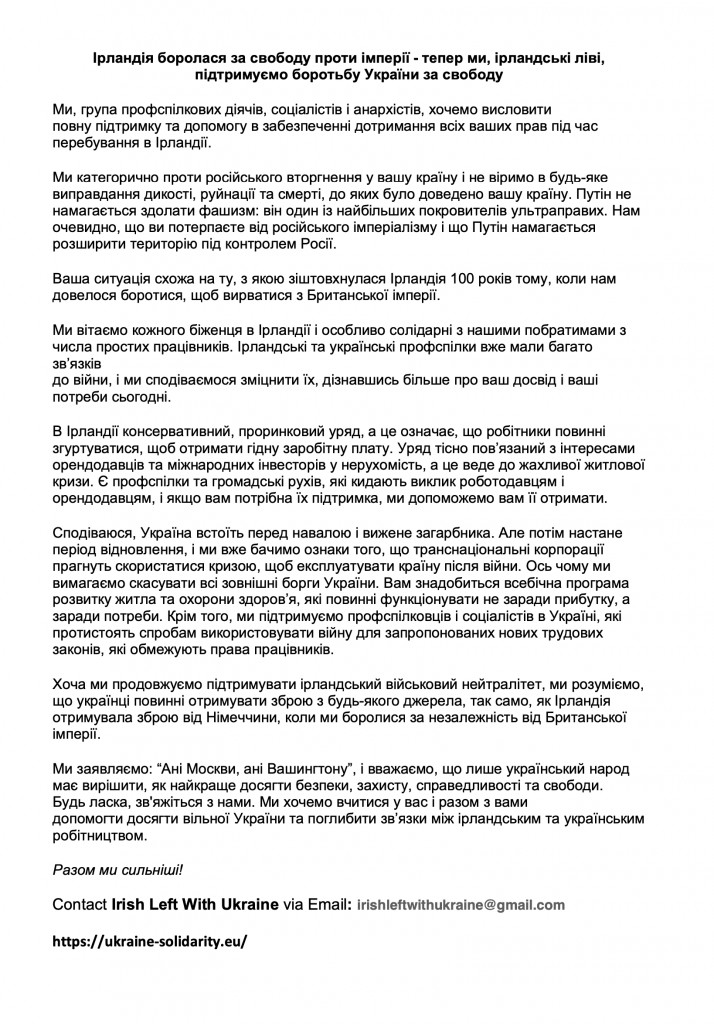
Ukrainian translation Solidarity with Ukraine: Irish socialists and anarchists show solidarity on 24 August 2022
Ukrainian translation of Irish Left With Ukraine solidarity leaflet

Irish socialists, anarchists and trade unionists have come together to form Irish Left With Ukraine and show solidarity with the resistance.

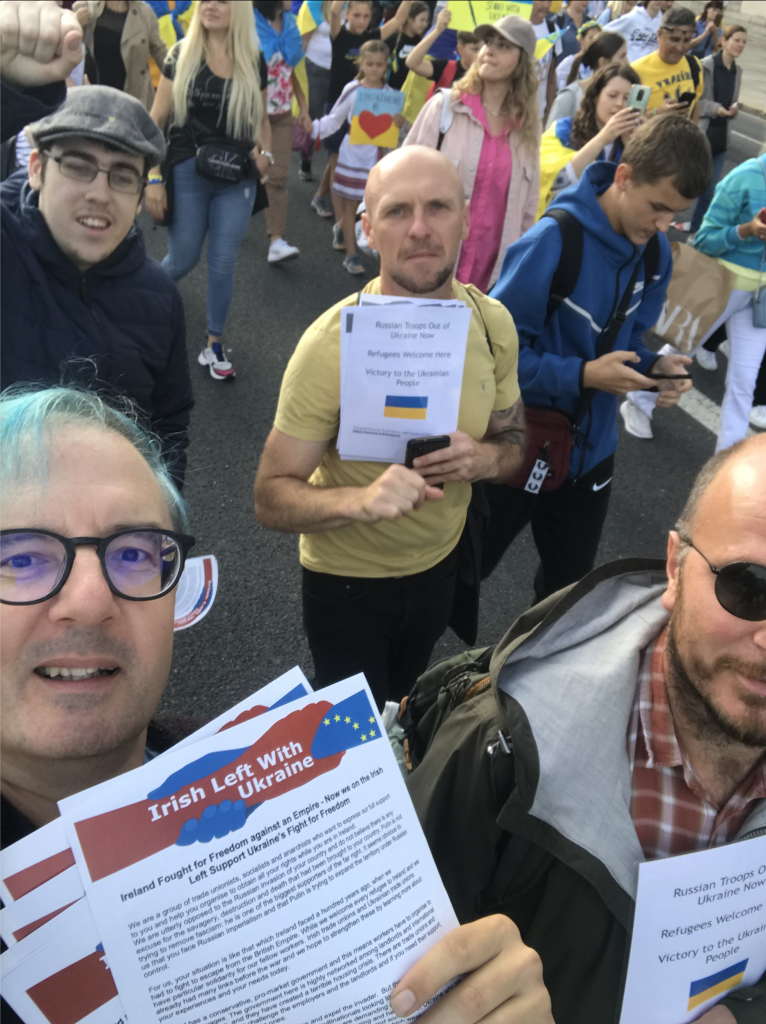
On 24 August 2022 members of the displaced Ukrainian community in Ireland held a march to mark six months since Russia invaded Ukraine. Independent Left members joined with other socialists, anarchists and trade unionists to give out a leaflet in the name of a new group: Irish Left With Ukraine. We were there to show solidarity with the Ukrainian resistance and, in particular, with Ukrainian workers.

One of the major weaknesses of the ‘evasionist’ left and ‘campist’ left is that they treat all Ukrainians as supporters of Zelensky, or, worse, fascists. But Ukraine has a vibrant and strong trade union left, a socialist movement, a feminist movement, LGBTQ+ activists, disability activists, etc. These are our comrades. They are fighting for survival AND for a socialist Ukraine.

Independent Left are proud to stand in solidarity with our Ukrainian comrades, both in Ireland and elsewhere. It is extremely encouraging that those on the left in Ireland who support the Ukrainian resistance have come together to develop this solidarity between the Irish Left and the Ukrainian left and materially assist their struggle.

The Irish Left With Ukraine group are working with Ukrainian socialists and have enormous respect for the difficulty of their activity.

The basic principles of the group are:

◦ Russian Troops Out of Ukraine Now

◦ Refugees Welcome Here

◦ Self-Determination for the Ukrainian People

Neither Moscow nor Washington is a strapline for the group.

ULWU supports the European Network for Solidarity With Ukraine: https://ukraine-solidarity.eu/

Independent Left members as part of Irish Left With Ukraine gave out leaflets at the march for Ukraine on 24 August 2022
Independent Left members along with several other Irish Left With Ukraine members leafleting the Dublin march on 24 August 2022.

Dublin Councilor John Lyons gave a speech at the march, emphasising our support for the resistance in Ukraine and the existence of a new, united left campaign.

See also here for the Tomás Ó Flatharta blog’s report on the ILWU activity on the day.

Filed Under: Independent Left Policies

Capitalism and Disability

17/08/2022 by Eoghan Neville Leave a Comment

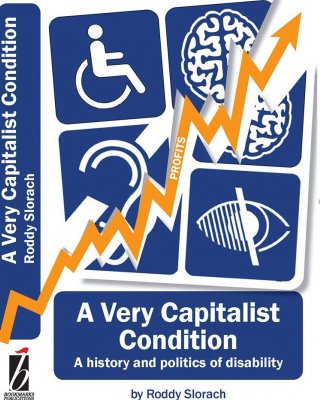
The Neuro Pride Ireland festival 2022 took place in August and Eoghan Neville of Independent Left prepared a webinar on capitalism and disability for Neuro Pride Ireland, based on his reading of Roddy Slorach’s A Very Capitalist Condition: A History and Politics of Disability. He spoke to Conor Kostick about the book and disability rights.

Conor: What do you think is the main value of the book?

Eoghan: This book acts as an introduction to socialism, to anti-capitalist thought, to all kinds of left-wing discussion. When you’re introducing someone to socialism, more experienced left-wingers will have a list of books that they say, “Oh. These should be your introduction.” This book should absolutely be there among them because I think if you can understand disability under capitalism, you can understand why the system doesn’t work for anyone.

If you take a particular issue – in this case disability – you can really begin to understand how capitalism fails us. This book really goes into a lot of details about disability under capitalism, and how this contrasts with disability before capitalism and why it has to be addressed with the social model. The book helps you connect the dots and say, “Well, if capitalism doesn’t work for this group, it doesn’t work for this other group, and it actually doesn’t even work for non-disabled white people.” You know? The stereotypical privileged people. Capitalism only works for the very people at the top, the very top.

Conor: Capitalism constantly seeks to divide the working class; it is a system that promotes racism, and sexism, and so on. Would you think there is a difference, though, to how capitalism treats people with disability? Despite discrimination, big business still wants women in the workforce and still wants black people in the workforce. But with disability, maybe the governments and companies don’t want the cost of providing equality of access to the workforce?

Eoghan: On the one hand, I think capitalism doesn’t want disabled people. No one would say it, of course, but they want to cure us. They want to make us normal. That’s what capitalism wants to do ideally, which is what it was doing in the late 1800s and the early 1900s with the eugenics movements. That’s what eugenics was: either curing or exterminating. There is a very important chapter in the book – Chapter Seven ­– about eugenics and Nazi Germany, that is well worth reading to understand the point about eugenics and Nazism when it comes to disabled people. But note that it is very distressing, a very hard read. I actually had to put the book down myself halfway through the chapter because of how just shocking it was, the details.

A trigger warning about that is key, but the main point of the history is that eugenics was just so normalized. A lot of people took Darwin’s theory of evolution and twisted it into eugenics. They said, “This is where evolution is. This is what nature is, and this is where we should arrive at,” and from that view, disability is kind of like a glitch, like when your computer stops working. It’s not meant to be, so we have to either fix this or delete it like you would delete broken files on a computer or something.

There were famous people at the time who had those views, such as George Bernard Shaw and Winston Churchill. There was an American scientist in the early 1900s who was doing openly eugenics experiments. Charles B. Davenport was getting praised in all the newspapers being described as, “This great humanitarian.” And they openly talked about him doing eugenics.

The only reason that eugenics fell out of favor is because of Nazi Germany, but now it’s kind of coming back. There’s more than a tinge of it around. It’s like with how capitalism kind of reinvented itself into neo-liberalism. There’s almost a kind of reinvention of the crude eugenics of the past into what I’d call neo-liberal eugenics. It’s like they’re trying to put a bow and tie on it or something and trying to make it look nice.

Capitalism and Disability A Very Capitalist Condition
Roddy Slorach, A Very Capitalist Condition: A History and Politics of Disability

Conor: Is this just the far-right – the sort of Trumps, and Le Pens – or is there a kind of mainstream return to isolating and pushing aside people with disability?

Eoghan: It definitely is the far-right because obviously they are the successors to the Nazis, but you have elections in various countries where a center-right government will need the support of the far-right to make up the numbers electorally, so then they have the usual thing of, “Oh. We have to make concessions,” and that’s where it can appear.

Often, disability is one of the first areas that’s targeted by any kind of government because if you go after disabled people, there’s not so much of an uproar. They kind of think, “Well, this is something we can concede to the far-right and not get much backlash on.” Social welfare benefits for disabled people are often the first to be cut by an incoming government. That’s the playbook of going after disability. Again, it’s in a new way. It’s in a neo-liberal way.

Conor: What I see is less of an overt eugenics position but discrimination around the question of resources. A lot of organizations like universities, hospitals, and so on have on paper really good policies. We want to be inclusive. We want to be diverse. We want everybody to have an access to education, health, and so on. They would like that, they say, but then when it comes to what does that actually mean, that’s when I see all the obstacles pile up really fast.

Just 24% of visually impaired people in Ireland have employment and when you go to find out why, it’s not that anyone says aloud, “Well, it’s just not worth investing in you. It’s a waste of money,” although I think ultimately that’s the logic, but no one that I meet expresses it that way.

What they say is, “Well, we can’t give you that magnifier. No. I’m sorry. We don’t have the resources or the staff to install it.”

Eoghan: I’m talking about the more political sphere when I’m talking about eugenics, but in terms of wider society like, say, access to education or something, Ireland very much has the charity model. Again, this is capitalism trying to reinvent itself moving away from the medical model, shutting down the ‘insane asylums’, and moving towards a charity model, so now you have the care homes. I mean, they have the approach in the name. They call them care homes.

Another example would be with respect to refugees. You’re not putting them in ‘refugee centres’. No. No, no. These are ‘community hubs’ or whatever term is acceptable by the charity model. The message is that these are resources we generously provide for you. You should consider it a privilege to be given this. You should be thankful you’re getting this. Rather than it being a right. It’s like as if accommodations that allow for equal access or independent living are a luxury. This is a luxury good. We can’t really give you this. That’s what I think it comes down to.

Conor: The book covers the rise of disability rights of people with disabilities organization despite the difficulties and challenging the system, so do you want to say a bit about that?

Eoghan: The main change it covers is the rise of the social model of disability, that was movement in England in the 80s with Mike Oliver and Vic Finkelstein. On a side note, Finkelstein is an interesting character because he was actually arrested for being involved in the anti-Apartheid movements in South Africa and then went to England. Basically, he was kicked out of South Africa. The book covers a great example in the US of a battle over a university who were trying to select members for a board and when it came to having someone with knowledge of disability they picked someone who had studied the subject rather than someone equally qualified who had a disability. Just because you’ve studied disability doesn’t prevent you having a negative view of disability or disabled people.

Anyway, a campaign sprang up that occupied the university until someone with a disability got the position. The book covers a lot of direct action like this, and that feeds into the social model of disability in a sense because the social model is created by disabled people. It’s a radical model made by socialists, by the people on the far-left.

Conor: Could you just give us a very quick recap on what the main points of the social model of disability are?

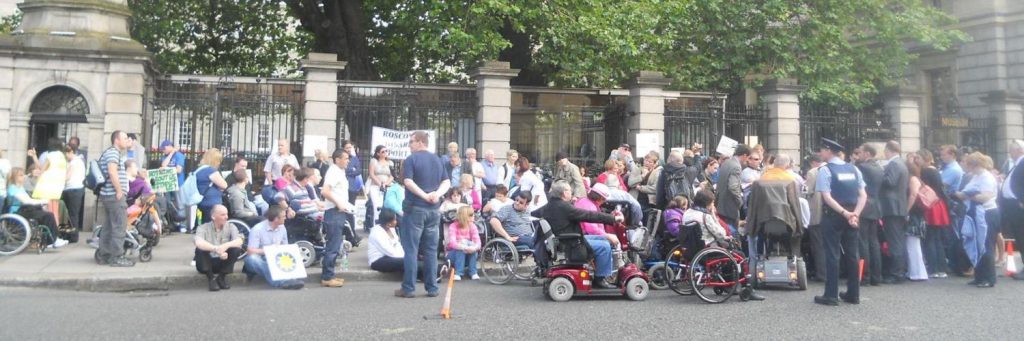
Eoghan: The main point is that disabled people should be able to live independently: so no care facilities; no medical model; none of that; not being ‘cared for’. Obviously, you have to have supports, like having a personal assistant. That’s what groups like the Independent Living Movement in Ireland are pushing for, so you’re able to live, work, and contribute to your community in whatever area you want. You can get an education, get a job, volunteer, do as you want. It’s very much focused on a disabled person-led approach.

We are the ones who are choosing. Living independently is us employing the personal assistant. So it’s not a case of that person coming in and saying, “I’m going to do this or that for you”. We are saying, “I need help with this. Can you assist? Grand.”

Also, that point about direct action such as occupying buildings to actually get rights for disabled people is part of the idea. It contrasts with a centrist government-funded disabled persons’ organization that has people in it who are not disabled. These just making a few gestures and shake their fist but without forcing change on the government. You need actual, radical change and the radical approach to it as.

Conor: Presumably there are allies for disability campaigners, perhaps in trade unions? Are there any case studies of where good alliances ran successful campaigns?

Eoghan: In relation to Ireland, I think a good link that you could get is between disabled people and travellers because these are the most oppressed communities in Ireland, and there have been recently people, disabled travellers, who have spoken about linking the two in together.

In terms of specifically here and now, those are two communities that could link in together, but I think in terms of history the movements that have been led by disabled people are a recent enough thing, like from the 80s, and 90s. It comes back to a kind of intersectionality because there will be people in other campaigning communities who have disabilities.

In America, you’d have people in the Native tribes that are also disabled, so they will have the dual understanding of why both communities are oppressed, and they can act as the link between the communities.

Other than this intersectionality though, I can’t really think of any kind of proper, big mass movement where you’ve had a proper coming together. The book does look at the Soviet Union and their disability movement before Stalin came to power. It is really interesting because it really goes into depth about how there were proper discussions, actual empowerment of disabled people and disabled academics and serious studies and research to understand various impairments and disabilities. But that really comes to an end when Stalin comes to power.

Conor: That is interesting because it’s not well known, that history. When you look at modern post-Communist countries, they seem to be particularly bad, in fact, for people with a disability. They seem to have a model that institutionalizes people with disabilities rather than hold out the prospect of them being able to play an equal part in society.

Eoghan: It’s kind of ironic. When Khrushchev comes to power and he’s trying to distance himself from all the failings of Stalin, he’s like: “We can’t do this anymore. We can’t do that anymore,” but he didn’t think about disability. He probably just went, “Oh, no. That’s grand. That’s fine. Disability doesn’t matter. We don’t need to distance ourselves from Stalin on that. That wasn’t too bad.”

Conor: Returning to today, you mentioned them earlier but the Independent Living Movement Ireland (ILMI) campaign seems to have a lot of energy and a lot of potential to be able to win progress for people with disabilities. Do you know something about that campaign and where it’s at?

Capitalism and Disability ILMI
Independent Living Movement Ireland. https://twitter.com/ILMIreland #nothingaboutuswithoutus

Eoghan: This has been going on since 2018. They’re trying to get a motion passed in the Dáil that basically calls for the independent living structure to be the model of disability: so to have a personal assistant service, to have that fully funded; to allow for the social model of disability basically.

I think it’s gone back and forth through the Dáil. It gets passed, but it then just gets hung up. Recently they did have a good win at least with the all the councils of Ireland, with the exception of Dublin City Council, passing the Independent Living motion unanimously.

Of course passing the motion is purely symbolic act, but it is one that says, “We’re calling on the government to bring in a model of independent living for disabled people.”

Conor: Well, it’s valuable that the groundwork is being laid. You can’t win equality without winning the argument and being clear on what you need, so that’s really important work, but in terms of then going the next step of actually trying to get some funding for the implementation of this, how do things stand? What’s the plan for the next step of the campaign?

Eoghan: Well, the funny thing is that we already have the personal assistant service. We’ve had it since the early 1990s, but it’s still in a trial phase. It is very hard to access, unless you have a good amount of money on yourself and can go through all the bureaucracy because there are a lot of hoops.

The structure is there in a sense, but obviously the funding isn’t and that’s the sticking point. The government saves 15 to 20 billion euro a year from carers. So they don’t have any incentive to replace family carers with paid assistants.

Conor: How does the book conclude?

Eoghan: They wrap it up with a rallying cry that if you are going to bring about change, disabled people are going to have a campaign for this themselves. It’s a simple point, but it’s often missed. The movement needs to be disabled-led. As simple as that. The book lays it out very clearly.

Conor: Whilst we want to win as much as we can at the moment and make as much progress as we can, is there ever going to be equality for people with disabilities under capitalism?

Eoghan: No. Simple answer. It is an obvious answer, but there’ll never be equality for disabled people under capitalism because there’ll be never equality for anyone under capitalism. It’s as simple as that, and what it all comes back to is linking the struggle of disabled people with the struggle of any other group, any other group throughout history, like women, like people of colour, the LGBTQ+ community. They cannot get equality under capitalism, and we cannot.

Conor: Is there anything else that my questions haven’t given you a chance to talk about that you wanted to talk address?

Eoghan: A very interesting point is made in the book about disability and war veterans. People who go off, fight war, and get a particular injury and end up in a wheelchair or losing a leg, lose an arm, they’re venerated. They’re lifted up on a pedestal and seen as good. This is what the Nazis did, actually. It’s quite ironic. For the Nazis, who were all about eugenics, put disabled people on a pedestal, and they were there with Hitler.

Disabled people have been divided in that regard, and especially with the mainstream media now. It’s a weird thing because disabled war veterans generally speaking are quite well looked after and generally there is an expectation that they be given and afforded anything they need, and as soon as there’s discrimination against a war veteran like, say, someone with a guide dog or a support animal is kicked out of a building there’s uproar in the media. National media is covering it. Everyone is going on social media and saying, “This is disgraceful. How dare they do this? This is shocking,” but if a non-war veteran disabled person was to be discriminated against, nothing.

The war veterans themselves may not want to be used in this way. But their disability is seen as a mark of honor whereas other people’s disability is portrayed as a shame. It is a bad thing. It is a scar. You should hide that.

Conor: On the question of shame, is Neuro Pride a new development? Can you say something about that?

Capitalism and Disability
Neuro Pride Ireland have an annual festival to celebrate neurodivergent people, community, and culture

Eoghan: Neuro Pride Ireland were founded last year. They held a festival last year, and they’ve done one this year, and now they’re doing kind of meetups as in public meetups in person which is for neurodivergent people, various impairments. Autism especially I think. Well, obviously all neurodivergencies, but I think a particular focus on autism because I think that’s the one that’s really stigmatized in the media.

At the moment, they’re trying to organize to end Applied Behaviour Analysis, ABA, which is a negative kind treatment plan often used by non-autistic ‘experts’ who are trying to cure autism or make the impairment lesser. If you look at kind of the people who founded the modern kind of medical model of autism, how to approach it, they have a eugenics mindset.

Neuro Pride has a community-led, bottom-up approach. They’re very much going down the route of being an NGO, which is grand. There’s nothing wrong with that. I mean, you can still work with that because they genuinely want to change things, and also they’re community-led which is a radical thing in and of itself, but there’s loads of people in that movement who are radical, who are anti-capitalist.

When I joined that group, I started talking about the book and everyone was genuinely interested. It’s actually really great to be in that community.

Read Eoghan’s review of an inspiring book about dyspraxia here. Learn more about Neuro Pride Ireland here and about ILMI here.

Filed Under: Reviews

How Farming Must Change to Save the Planet

12/08/2022 by Conor Kostick 15 Comments

How Farming Must Change to Save the Planet Animal rights Eco Socialism

Agriculture has to change if we are to save the planet. The depth and scale of that change is enormous, far beyond that being proposed in any current agriculture transition plan. Sustainable farming that does not contribute to global warming, nor the mass extinction of species, let alone that treats other animals with the respect their sentience deserves, means adopting an approach that is completely opposed to market-driven agriculture. Not only that, at an even more fundamental level the change in farming practices needed to save the planet must overturn beliefs shaped by seven thousand years of agriculture.

Back in 1972, the anthropologist-turned-systems-theorist Gregory Bateson wrote that humanity was heading for catastrophe because our methods of production were constantly accelerating without any means of self-regulation. Unlike steam engines, which are designed with governors to release pressure before a runaway explosion takes place, modern agriculture has no failsafe.

Among his many prophetic statements, Bateson argued that if humans see themselves as outsiders, acting on the environment rather than sharing it with other minds (e.g. animals), we would be heading for certain extinction:

As you arrogate all mind to yourself, you will see the world around you as mindless and therefore not entitled to moral or ethical consideration. The environment will seem to be yours to exploit. Your survival unit will be you and your folks or conspecifics against the environment of other social units, other races and the brutes and vegetables.

If this is your estimate of your relation to nature and you have an advanced technology, your likelihood of survival will be that of a snowball in hell. You will die either of the toxic by-products of your own hate, or, simply, of over-population and overgrazing. The raw materials of the world are finite.

If I am right, the whole of our thinking about what we are and what other people are has got to be restructured. This is not funny, and I do not know how long we have to do it in. If we continue to operate on the premises that were fashionable in the pre-cybernetic era, and which were especially underlined and strengthened during the Industrial Revolution, which seemed to validate the Darwinian unit of survival, we may have twenty or thirty years before the logical reductio ad absurdum of our old positions destroys us. Nobody knows how long we have, under the present system, before some disaster strikes us, more serious than the destruction of any group of nations.

Gregory Bateson, Steps to An Ecology of Mind.

The Evidence that Farming has to Change

Modern agricultural business practices are calamitous and their consequences might have already brought us beyond the point of no return. They are a major contributor to facts like: the sea contains six times more plastic by mass than plankton; the global market for food has been concentrated to the point that 40% of the world’s people are dependent on food from other nations; crops have lost 75% of their genetic diversity since 1909, leading to devastating global outbreaks of plant diseases; just four companies control 90% of the world’s grain trade; in 2021, 41 million hectares of land were given over to producing food to be burned as biofuel; four billion people suffer water shortages for at least a month a year; desertification affects a third of the world’s population; and rainwater across the whole planet is now unsafe to drink.[1]

While Bateson’s prediction was based on a simple but powerful generalisation about systems without inbuilt mechanisms of self-correction, he did not provide specifics other than a case study of the insecticide DDT. DDT was discovered in 1939, leading to a massive commitment by industry to its production and thus its continued use long after the harmful consequences of using it were identified. It is easier to understand the particular farming practices that have driven us into an age of mass extinction from the standpoint of 2022 than it was in 1972 and these are identified and explained with great lucidity by George Monbiot in his 2022 book Regenesis.

Overall, the main problem with intense capitalist agriculture is that it has created a global monoculture in terms of diet and farming practice. Crop production has concentrated in certain regions: four countries harvest 76% of the maize exported to other countries. Five countries sell 77% of the world’s rice; five countries supply 65% of the wheat; three 86% of the world’s soyabeans.[2] Instead of a world where a great deal of self-sufficiency exists, we live in one highly dependent on international trade. And this means that vulnerability to shocks has increased.

Furthermore, as food culture converges on certain diets, so farming practices converge on the same methods, with the same seeds, equipment and chemicals. The suppliers of these universal means of farming have evolved to be immensely powerful multinationals with commensurate political power. Four companies control 90% of the world grain trade, a different four control 66% of agricultural chemicals, and three of these plus LimaGrain own 53% of the seed market. Three companies sell nearly half the world’s farm machinery. Four companies control 99% of the chicken-breeding market. Four firms run 75% of the world’s abattoirs. And so on for all livestock processing.[3]

It’s well known that wealth is concentrated into a few hands. The three wealthiest men in 2022 had $26.3bn, more than that of the poorest 222.4 million people combined.[4] What is less well appreciated is how handfuls of humans, members of the boards of these agricultural mega-businesses, control food production. Most have never even set foot on a farm.

And the farming landscape has been utterly transformed. If you ever pick up a child’s book with farm animals – the friendly pig, the happy cow, the rabbits and birds – the pictures are of fantasy realms that don’t exist. The last place you would want to take that child is to a modern farm: whether to acres of bleak fields with a lone tractor in the distance or to sheds with animals in stalls packed close together, feeding on soya products and waiting to be killed.

The issue of animal feed is crucial. While the planet is producing more calories of food than ever before (for now), humans are receiving less of it. The world’s livestock population is rising at about twice the increase in the human population. In the last 50 years the number of cattle has increased 15%, pigs 100% and chickens 500%.[5] These animals are consuming crops, mainly soya, and this rate of growth is unsustainable even if plant production continues to increase at current rates.

Moreover, we are likely to hit a ceiling in crop production, due to diminishing effectiveness of pesticides and fertilizer as well as global warming. Monbiot points out that when temperatures relative to moisture (called the wet-bulb temperature) reach a certain point, humans can’t function. We die of heat stress at a wet-bulb temperature of 35 degrees. This kind of temperature is being registered more and more, meaning that in regions like the Persian Gulf, India, Pakistan and the Gulf of Mexico, outdoor daytime work has to come to a halt.

As the planet heats up, dramatic weather events occur with greater frequency, with cyclones, hurricanes, droughts and floods disrupting the globalised food chain and market speculation then amplifying the difficulties.

Another ceiling which we have bumped up against is that many countries rely on meltwater from glaciers to feed the rivers that irrigate their lands. These glaciers are rapidly disappearing or, as with the Gourgs Blancs in the Pyrenees, have already melted, never to return.

Glacier melt  Gourgs Blancs glacier 1910 above a picture taken 6 August 2022 Farming Must Change to Save the Planet
 Melt water from glaciers is drying up: Gourgs Blancs glacier 1910 above a picture taken 6 August 2022.

Agriculture Must Change to Save the World

Other dynamics at play which illustrate that Bateson’s predictions have come true include the rapid decrease in the effectiveness of antibiotics due to their overuse on farms (75% of antibiotics sold in the US and Europe go to farm animals); the extinction of life in fresh-water rivers due to slurry being washed into them from fields; Insectaggon (the collapse of insect life); and vast dead zones on the sea where oxygen has fallen below levels necessary for sea life. Probably this is due to oxygen being drawn out of the water by algae that has spread uncontrollably with all the fertilizer that is washed into the sea. Such algae stretches around a quarter of the planet.[6]

George Monbiot has a proposal for how farming must change to save the planet: we need to transition to the mass production of flour via microbial fermentation: protein from bacteria. This new technology, he says, represents ‘the beginning of the end of most agriculture.’ The reason for such a dramatic statement is that protein produced by growing bacteria requires only a tiny fraction of the land needed to make it by growing soya. Every 1,700 hectares of soya could be replaced by 1 hectare of fermenting bacteria. In theory, our needs could be met without farms, allowing huge tracts of land on the planet to be rewilded. Widespread adoption of bacteria-farming technology has the potential to provide the new chicken. Only, instead of 66 billion animals being killed a year (after a life of suffering), the basic staple protein block could be fermented from bacteria with no animal being constrained or harmed.

This welcome news, argues Monbiot, adopted as it becomes increasingly cost effective, will flip the way we farm, much as the advent of the pill changed western culture.

The pill accelerated the liberation of women. It intensified impatience with the status quo, hastening a transition that was already beginning to happen. It helped to drive a virtuous spiral of social change, making what was scarcely imaginable quickly seem inevitable.

As meat is challenged by plant proteins, then plant proteins are challenged by microbial proteins, and as farmfree products become cheaper, better and healthier than the food with which they compete, the existence of good alternatives will sharpen our growing disquiet with the treatment of livestock, the destruction of our life-support systems, and the pandemics caused by animal farming.

George Monbiot, Regenesis

It would be wonderful if this vision could be realised. And perhaps it will be. But to me it reads like wishful thinking. Monbiot is well aware that the agricultural mega-companies are powerful political opponents. As he points out, faced with the rise of non-meat products, legislators have been lobbied to ban terms like burger and sausage for foods that aren’t made from animals. Even the packaging styles of traditional foods have been protected. Just like with technologies that have threatened the car industry, the established interests – that is, the boards of the major food companies – will act strategically to continue to expand their organisations as effectively as they can, whether by using political influence or by taking over rival technologies in order to snuff them out.

Also, impressive as the potential savings in land use are by this technology, we don’t need it to avert the extinction catastrophe we are currently faced with. Simply addressing the shocking waste of land that arises from including meat in the human diet would be enough.

It is sometimes claimed that vegans are to blame for the destruction of the Amazon and biodiversity, because of all the soy grown in the deforested Amazon. But the reality is that a mere 4% of the soy grown globally is fed to humans. The vast majority of the soy grown globally is fed to factory farmed animals. The conversion rates from the feed grown specifically for nonhumans to produce meat and dairy to feed humans is pathetically low.

Chickens have the highest conversion ratios with 4.5 kilos of feed to produce edible kilo. For pigs it’s 9.4 kilos of feed edible kilo and for beef it is a lousy 25 kilos of feed per kilo of meat. But perhaps an even better measure is the energy captured by the plants and the protein they make that ends up on our plates that we could have otherwise captured with human edible plants. By that measure chickens still have the highest conversion with 11% of the calories and 20% of the protein in the feed ending up in the meat. Pigs aren’t far behind at 10% for calories and 15% of protein. But cattle are just awful at 1% of the calories and 4% of the protein in the animals feed ending up in the edible portion of the animal.

https://awfw.org/feed-ratios/

All told two-thirds of all of the energy in the plants humans harvest are used to feed animals, yet those animals only contribute 13% of the total food calories that people eat.

So Monbiot is right that ending the reliance on animal agriculture will allow for huge percentages of the ice-free land on the Earth to be rewilded, and allow biodiversity to thrive and avert the extinction catastrophe we’re currently faced with. But there’s no need to go developing any new technologies to do this. A wholefood plant-based diet takes up a fraction of the land, uses a fraction of the water, and is healthier for the environment, and better for human health.

Perhaps Monbiot’s enthusiasm for the bacteria fermentation technology is not so much based on the additional land it could free for rewilding as the hope that it might become prevalent without any other revolution being required, other than that which sometimes takes place within culture thanks to the dynamics of the global market. But I don’t believe that any new technology will come to save humanity and the millions of species we are exterminating unless we ourselves take control of production and quite deliberately and defiantly take that control away from the elites dominating agriculture.

This should not be read as an attack on farmers: they are caught up in a system that is making it increasingly difficult for small farmers especially to make a living. Farmers can be rescued from ruin and incentivised to help restore the land with the right societal changes and a just transition.

Which brings me to Marxism.

Does Marxism Show How Farming Must Change to Save the Planet?

If we are talking of class conflict, of us, the great majority, taking control of farming from them, the boards of the mega-corporations, then surely Marxism shows how to do this? For of all the alternative philosophies to market capitalism, Marxism appears to be the most radical. Yet even if we rescue the spirit of Marx’s writings from the actual experience of Communism by claiming that Stalin, Mao, et. al. crushed genuine revolutionaries to implement policies that were state capitalist, a problem remains.

Marx, like all of us, was a product of his time and place. In the way that he frames the argument against capitalism are assumptions that are very much derived from a post-Enlightenment tradition of Western philosophy. Marx saw the rise of international capitalism as calling forth extraordinary powers from the ground, but because of the fundamental flaws of the economic system, it would take revolution and working class power, followed by the abolition of all classes, to harness those powers so that humanity can realise its true potential.

Sounds good? Well, yes, except that the whole notion of the human mind as outside of nature and acting upon it is – as Bateson understood – liable to lead to humans seeing everything else around us as mindless and not deserving of ethical consideration.

In Capital I.8 while explaining how only labour adds value to a commodity, Marx wrote: ‘The coal burnt under the boiler vanishes without leaving a trace, so, too, the tallow with which the axles of wheels are greased.’ We live in times where the traces of burned coal are all too evident. As Timothy Morton observes about Marx, he was anthropocentric: the way to obtain knowledge of the world is from the standpoint of human activity, specifically economic activity. This anthropocentrism, argues Morton, is a bug in Marx which should be acknowledged and addressed rather than defended as if Capital were a sacred text.[8]

The brand of Eco-Socialism I’m familiar with in Ireland is explicitly Marxist (of the kind that says Marx was already on the case and anticipated both the environmental crisis and how to solve it). While supporting a transition from beef and dairy farming, these Eco-Socialists do not see animals as beings towards whom we should feel solidarity and with whom we should share the planet. In this they are accurately following the nineteenth century advocate of revolution, albeit at the cost of having genuinely revolutionary solutions for how to change agriculture to save the planet.

Marx wrote a famous passage in which his belief in the mindlessness of spiders and bees was clear:

A spider conducts operations that resemble those of a weaver, and a bee puts to shame many an architect in the construction of her cells. But what distinguishes the worst architect from the best of bees is this, that the architect raises his structure in imagination before he erects it in reality.

Karl Marx, Capital I.7.

This statement is an almost exact rephrasing of the idea of Descartes, that the difference between men [sic] and beasts is that the latter are like machines, acting without thought purely from the disposition of their organs. And it is an idea that is quite wrong, not only scientifically and morally, but also from the standpoint of bringing about revolution.

It’s increasingly evident that insects like spiders and bees are sentient. A recent paper found REM-like activity in the sleep patterns of spiders, while bees are, ‘clever, sentient, and unique beings.’ It’s even possible that the massive networks of certain types of fungi that spread out over acres of forestland and manage the chemistry of the trees above them have sentience.[9]

Once you accept that animals have sentience (even if you don’t accept the evidence for sentience in insects), then how can their mistreatment be justified? Necessarily, by having some kind of hierarchy of sentience with humans at the top. Rather like the origins of modern racism, which evolved to justify slavery by arguing black people were not fully human and therefore had no claim to equality with whites, those who stand over the farming of animals have to make an argument along the lines that, ‘well, yes, cattle, pigs and sheep are sentient, but they are at a lower level than humans. And you never see them on picket lines, so let’s change the human world first and then society will be more humane to animals.’

I’ll address the second part of that argument in the conclusion of this feature, but with regard to some kind of pyramid of sentience, it’s pure story telling. No one knows what it is like to be a fly. Perhaps Blake was right:

Seest thou the little winged fly, smaller than a grain of sand?

It has a heart like thee; a brain open to heaven & hell,

Withinside wondrous & expansive; its gates are not clos’d,

I hope thine are not: hence it clothes itself in rich array;

Hence thou art cloth’d with human beauty O thou mortal man.

William Blake, Milton I 20/22:27–30.

If you try to get humans to come out on top by organising the pyramid of sentience based on the extent to which an animal has neurons and connections in the brain, you have a problem, because humans are not at the top: the African elephant has three times the brain weight and number of neurons as a human.[10] You also have a problem arising from the following thought experiment. If aliens arrive on Earth with demonstrably greater brain matter than humans, does that give them the right to enslave and farm us for food? No? Then at what level of sentience do you lose that right? That’s a very difficult line to draw, especially when (as research into the social impact of Artificial Intelligence shows) we don’t have a successful model of what a mind is, even a human one. What we do know is that the part of the brain that is concerned with consciousness is about half a billion years old and shared with most vertebrates.[11]

How would we know, for instance, that cattle are the wrong side of a threshold for the exploitation of other sentient beings? The film Cow is extremely moving in this regard, because it is touching how the cattle in the film rejoice at being let out into fields. They skip and leap and dash away from the sheds in which they are usually constrained and later are clearly at peace, facing a deep red sunset.

There are no ethical grounds for our farming of animals and a truly revolutionary demand has to be to stop it altogether and treat all sentient life as non-human people. If humans have inherent rights – not rights given on the basis of passing some kind of test but rights that are intrinsic to being a human – then so do animals. As long-time animal rights advocate Tom Regan puts it:

Other animals have a life of their own that is of importance to them apart from their utility to us. They are not only in the world, they are aware of it, and also of what happens to them. And what happens to them matters to them. Each has a life that fares experientially better or worse for the one whose life it is. Like us they bring a unified psychological presence to the world. Like us they are somebodies, not some things. In these fundamental ways the non-human animals in labs and on farms for example are the same as human beings and so it is that the ethics of our dealings with them and with one another must rest on some of the same fundamental moral principals.

Adopting this approach also has revolutionary consequences that are more profound than those of the Marxist Eco-Socialists who would save the Earth… for humans. Once we lose a sense of companionship with animals and instead see ourselves as farmers with a mission to maximise the use of the land for the greatest possible outputs we can achieve, we are on the start of a journey of extinction for the reason that Bateson gives. Our goal should not be a revolution that leads to more efficient exploitation of the land than capitalism can achieve, but a radical rearrangement of our relationship to the land and to the other non-human beings of the planet.

It is perhaps because of the harmful consequences of an anthropocentric approach to the environment that for thousands of years early human societies moved back and forth and sideways in their farming practices. As Wengrow and Graeber have shown, the ‘severing’ (to use a term from Morton which is entirely compatible with their approach) was not a short, sharp moment in pre-history. It was not V. Gordon Childe’s agricultural revolution but a much more drawn out affair where we only settled into our disastrous exploitative relationship to animals and crops after considerable experimentation and social upheavals in which proto-rulers were often held in check or overthrown.[12]

The eventual predominance of settled farming also brought with it the development of rigid hierarchies and large-scale warfare. And these wars were possible, not only because the materials existed to make weapons as well as the social structures to coerce bodies of warriors to march against each other. But also because treating other beings as food to be farmed (as opposed to being killed out of necessity, with reverence and sacrifice to the gods for the crime) crosses a fundamental moral chasm that allows for the enslavement and murder of humans.

It has long been established that those who would harm animals would also find harming humans acceptable. In 1997, for example, a study sponsored by Northeastern University and the Massachusetts Society for the Prevention of Cruelty to Animals found that those who abused animals were five times as likely to harm other humans. Or to put it the other way around, if you wouldn’t hurt a fly, you certainly wouldn’t mutilate and execute a human being as we see happening in some appalling videos of Russian soldiers and their Ukrainian captives.

It is in this sense that an approach to changing farming practices based on treating non-humans as people is more revolutionary than demanding workers’ control over the farming industry. Of course, bring on the day when workers take over the means of production. But that day will be hastened and have the kind of transformative power that might yet save our species if the workers’ movement is inspired as much by a sense of solidarity with non-human beings as with each other.


[1] https://www.sciencedirect.com/science/article/abs/pii/S0025326X0100114X; George Monbiot, Regenesis (Dublin, 2022), pp. 34 – 5, 41, 47, 53; https://www.independent.co.uk/climate-change/news/rainwater-cause-cancer-forever-chemicals-pfas-b2137020.html.

[2] Regenesis, p. 33.

[3] Regenesis, pp. 35 – 6.

[4] https://www.oxfamireland.org/blog/inequality.

[5] Regenesis, p. 41.

[6] Regenesis, p. 71.

[7] https://awfw.org/feed-ratios/

[8] Timothy Morton, Humankind: Solidarity with Non-Human People.

[9] https://www.scientificamerican.com/article/spiders-seem-to-have-rem-like-sleep-and-may-even-dream1/; https://www.theguardian.com/environment/2022/jul/16/bees-are-really-highly-intelligent-the-insect-iq-tests-causing-a-buzz-among-scientists; Rupert Sheldrake, Entangled Life.

[10] https://www.ncbi.nlm.nih.gov/pmc/articles/PMC4053853/.

[11] Mark Solms, The Hidden Spring: A Journey to the Source of Consciousness.

[12] David Graeber & David Wengrow, The Dawn of Everything.

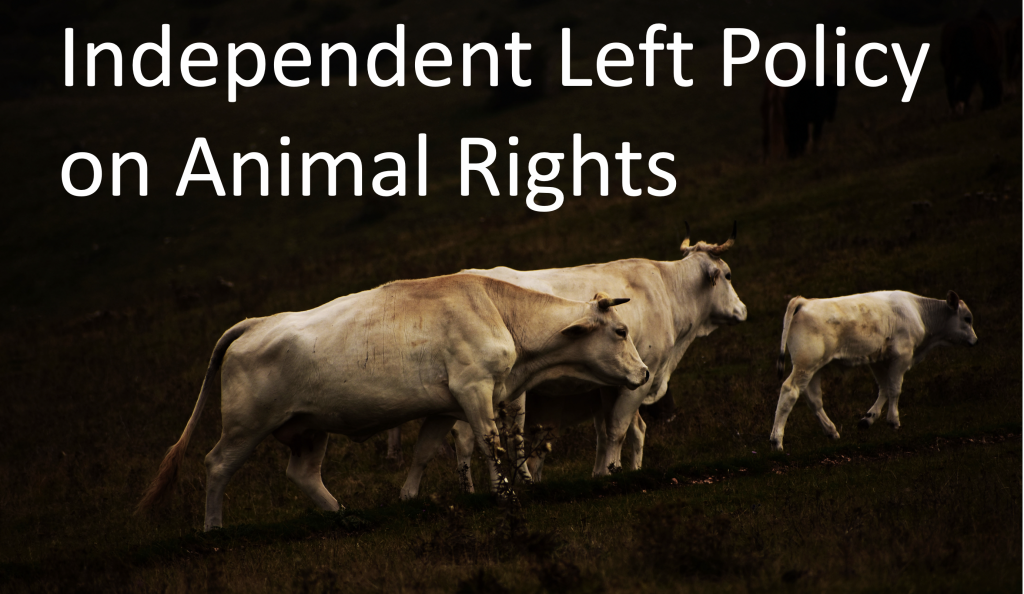
Independent Left have adopted an Animal Rights policy inspired by the goals of the National Animal Rights Assocation.

In August 2022, Independent Left hosted a Zoom meeting led by Laura Broxson, animal rights activist and founder of the National Animal Rights Association.

Filed Under: Animal Rights, Independent Left Policies

Why is Ireland so Expensive?

08/07/2022 by John Lyons 1 Comment

Ireland is officially the most expensive country in the EU

Cost of Living Crisis: Time to Bail out the People

Why is Ireland so Expensive Why is Dublin so expensive?
Why is Ireland the most expensive country in Europe to live in?

The reason why Ireland – and Dublin in particular – is so expensive is because corporations are protecting their profit margins by further hiking up their prices which they can do as competition here is weak and consumer protections are poor.

At the start of July 2022, EU Eurostat published a report on 2021 price levels for consumer goods and services which found prices in Ireland are 40% above the EU average.

Our housing costs (rents, mortgages, gas, electricity) are the most expensive in the entire EU, 89% above the EU average, with Dublin the most expensive.

Our health costs are the most expensive in the entire EU, 72% above the EU average.

Our food and non-alcoholic beverage costs are the third highest in the EU, as are our communication costs.

Corporate Profits and Shareholder Dividends are Booming as We are Struggling in the most expensive country in the EU

When it comes to trying to make ends meet week to week, month to month, it is becoming increasingly difficult. Everything is going up except our wages and social transfers.

Living in an already very expensive country which is now experiencing record inflation at a 38-year high of 7.8% is further squeezing the life out of families on middle and lower incomes whilst profits in the corporate sector boom.

The combined annual profits of the five biggest energy utilities doubled to €560 million in a year, while profits at the five largest Irish food companies increased by €174 million.

The government, whose wealthy politicians are highly networked with the boards of these companies, says they will do nothing to help struggling families and tackle corporate profiteering.

The taoiseach receives €217,000 a year              The tanaiste receives €200,000 a year
Every Minister receives €183,923 a year      Every TD receives €101,193 a year
Meanwhile 630,000 people in Ireland are living below the poverty line.
The median average wage in 2021 was €35,500.[1]

These politicians live in a different world to us. We have to force them to care.

We need:

  • a windfall tax of 10% on the excess profits of Irish energy companies
  • Scrap the carbon tax, which hits lower income families the hardest
  • Introduce a new annual tax that targets the wealth of the Ireland’s millionaires & billionaires
  • Pay increases of at least 10% as well similar increases in social welfare payments
  • Maximum unit price cap on electricity, gas and home heating oil
  • State-led building programme of social & affordable homes on state lands, nationwide retrofitting programme, rent freeze and a ban on evictions.

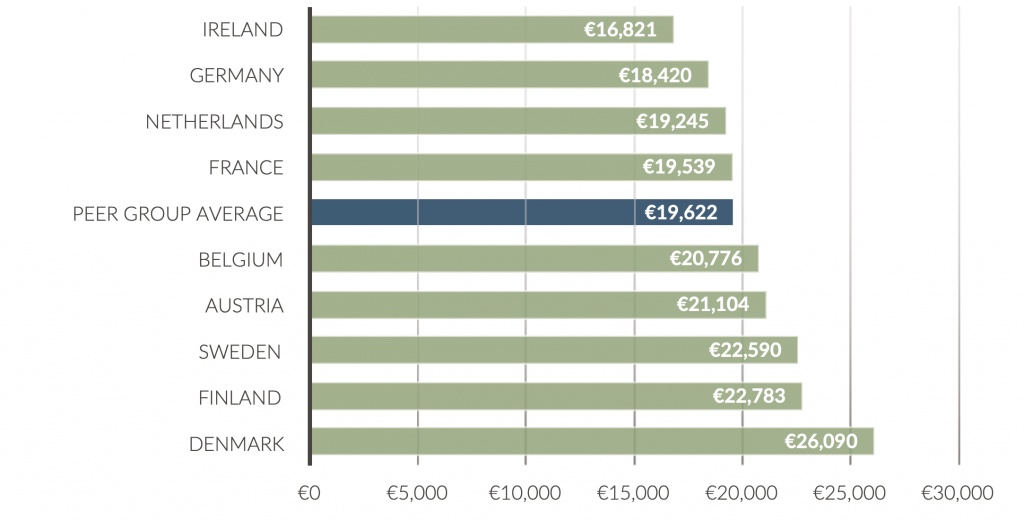
The government narrative about why Ireland is so expensive is that high prices are caused by global shortages for which they have no responsibility. There might be some truth in that for particular cases but it is absolutely not true for the disproportionate expense of housing and childcare, which arise from government policy. As the Irish Congress of Trade Unions have noted, Ireland is about €14bn a year behind peer European nations in per capita expenditure on public services.

Why is Ireland expensive? Because Public Spending in Ireland is €14bn below peer EU countries
The real reason Ireland is expensive: the private market dominates services

Imagine what a difference it would make to the expense of living in Ireland if childcare were free. Well, that would be possible with €2bn of government expenditure. Or imagine if a huge public housebuilding initiative went ahead to provide tens of thousands of genuinely affordable homes and high quality, low-rent projects. This happens in other countries and the fact it doesn’t happen here is because the voice of Irish workers means a lot less to Fianna Fail and Fine Gael than that of global businessese lobbying for low taxes and property investors.

Why is Ireland so expensive? Because of the lack of public expenditure and the lack of price regulation in the private sector.

[1] This figure is deliberately obscured by the way statistics on wages in Ireland are collected, in which incorporating small volumes of very high earners distorts the picture. Using Felim O’Rouke’s technique (assuming that mean average wages are 26% above median average wages) and taking the 2021 CSO figures for mean average weekly earnings, Independent Left calculate the median annual wage to be approximately €35,500.

Filed Under: Independent Left Policies

Solidarity With Polish Women

22/06/2022 by admin 1 Comment

Solidarity with Polish Women Razem Campaign for Abortion Rights

The Polish left-wing party Razem alongside feminist groups have drafted a bill to end the abortion ban in Poland and provide legal and unconditional access to abortion until the 12th week. Having secured over 200,000 signatures, the Polish parliament are obliged to discuss the bill, which will be voted on 23 June.

Razem released the following statement and asked that it be shared widely:

Defending the reproductive rights of Ukrainian women in Ukraine, Poland, across and beyond the European Union: a global feminist struggle

Since February 24th, Ukrainian women are facing increasing levels of gender based violence as a consequence of the Russian invasion: (1) Russian troops are massively using rape against women and children as a war weapon. (2) Domestic violence against women and children has significantly increased. (3) Women displaced inside Ukraine and abroad, looking for safe shelter face an acute risk of gender-based and sexual violence. Rape and consequent forced pregnancies are present in all these forms of gender-based violence.

Although abortion is legally provided on request up to the 12th week in Ukraine, the war context has limited access to healthcare, including reproductive health services. The problem is particularly serious in the occupied territories, because of the displacement of healthcare practitioners, lack of medicines, targeted attacks on health facilities, and so on. Access to safe reproductive health, including family planning, contraception, abortion and maternal and newborn health is highly compromised.

Many Ukrainian women and children fleeing the war seek refuge in neighbouring Poland where abortion is criminalised and access to contraception is ranked the worst in Europe. Since January 2021, Poland’s new law on abortion bans all pregnancy terminations except in cases of rape, incest, or if the mother’s life is at risk. Theoretically, it is possible for a Ukrainian rape survivor to access abortion in Poland. However, the Polish law requires that rape be proved by a criminal investigation, in order to obtain a public prosecutor’s order to terminate a pregnancy. This is often impossible, and is an extremely time-consuming process which makes it hardly possible to terminate the pregnancy within the time limits.

In practice, Ukrainian displaced women and all women under Polish jurisdiction are being forced to choose between carrying an unwanted pregnancy to term in precarious circumstances or facing significant risks associated with clandestine abortions. Health staff, activists and friends helping women to terminate their pregnancies risk prosecution and prison. By the time Ukrainian displaced women finally manage to reach a country where abortion is legal, they are very likely to have exceeded the legal time limits, which is 12 weeks in most European countries.

Moreover, in some host countries, such as Slovakia, Ukrainian displaced women’s access to abortion is being questioned. In Hungary, all women must attend at least five medical consultations before accessing abortion procedures. And in Moldova, Ukrainian women cannot easily access the underfunded public health system and are mostly too poor to access private reproductive rights clinics.

Defending our reproductive rights, in Ukraine, in Poland and everywhere is a global feminist struggle in these times of conservative and neoliberal backlash taking place across the world.he right to abortion is being continuously attacked at different levels and from different fronts in several countries, while women in some other countries are still fighting to win that right. Attacks on women’s reproductive rights are part of a larger strategy of systematic destruction and control of women’s and workers’ rights by conservative and neoliberal forces. We call on all those who defend women’s rights around the world to fight with us for

Ukrainian women’s right to safe abortion on demand in Ukraine, Poland and across and beyond the European Union. We demand:

* The immediate legalization of abortion in Poland.

* The right to safe abortion on demand everywhere.

* The development and reinforcement of public services permitting access to healthcare including reproductive health for all women in Ukraine, in all European countries and across the world.

People Before Profit have called for a protest in Dublin 4-8 Eden Quay at 1pm Thursday 23 June.

Solidarity with Polish Women Protest 23 June 2022

Filed Under: All Posts

  • « Go to Previous Page
  • Page 1
  • Interim pages omitted …
  • Page 4
  • Page 5
  • Page 6
  • Page 7
  • Page 8
  • Interim pages omitted …
  • Page 23
  • Go to Next Page »

Copyright © 2026 · Aspire Pro on Genesis Framework · WordPress · Log in