• Skip to primary navigation
  • Skip to main content
independent left logo

Independent Left

Environmentalism, socialism, freedom and equality. #liveablecity

  • About
  • Featured Articles
    • How Farming Must Change to Save the Planet
    • The Housing Crisis: Causes and Solutions
    • Socialism in Ireland
  • Contact Us
  • Podcast
  • Animal Rights
  • Archive
    • Irish Socialist History
    • Dublin City Council Housing
    • Ukraine
    • Protests Ireland
    • Reviews
    • Irish Political Parties
    • All Posts
    • Independent Left Policies
  • Why join?

Ukraine: Voices of Resistance and Solidarity

27/02/2023 by admin 3 Comments

Ukraine Book Launch Voices of Resistance and Solidarity
Irish book launch of Ukraine: Voices of Resistance and Solidarity

Ukraine: Voices of Resistance and Solidarity is a book edited by Fred Leplat and Chris Ford, published by Resistance Books and Ukraine Solidarity campaign. It contains essays by Mick Antoniw, Welsh Labour MP; John-Paul Himka, history professor; Taras Bilous, activist for Sotsialnyi Rukh / Social Movement; Yuliya Yurchenko activist for Ukraine Solidarity Campaign and Sotsialnyi Rukh / Social Movement; Oksana Dutchak, co-editor of Spilne/ Commons; Viktoriia Pihul, Ukrainian feminist; Nataliya Levytska, Deputy Chair of the Confederation of Free Trade Unions of Ukraine; Vitalii Dudin president of Sotsialnyi Rukh / Social Movement; Bogdan Ferens, founder of the Social Democratic Platform; Eric Toussaint, spokesperson of the CADTM International; Ilya Budraitskis, activist in the Russian Socialist Movement; Niko Vorobyov, Russian-British freelance journalist; Gilbert Achcar, Lebanese socialist; Simon Pirani professor of modern languages and cultures; Stephen R. Shalom, editor of New Politics; and Dan La Botz, editor of New Politics.

Ukraine: Voices of Resistance and Solidarity is an important publication that achieves two fundamental tasks: it amplifies the voices of Ukrainian socialists, feminists and trade unionists; and it refutes the arguments that many on the left internationally deploy to excuse their failure to support the Ukrainian resistance.

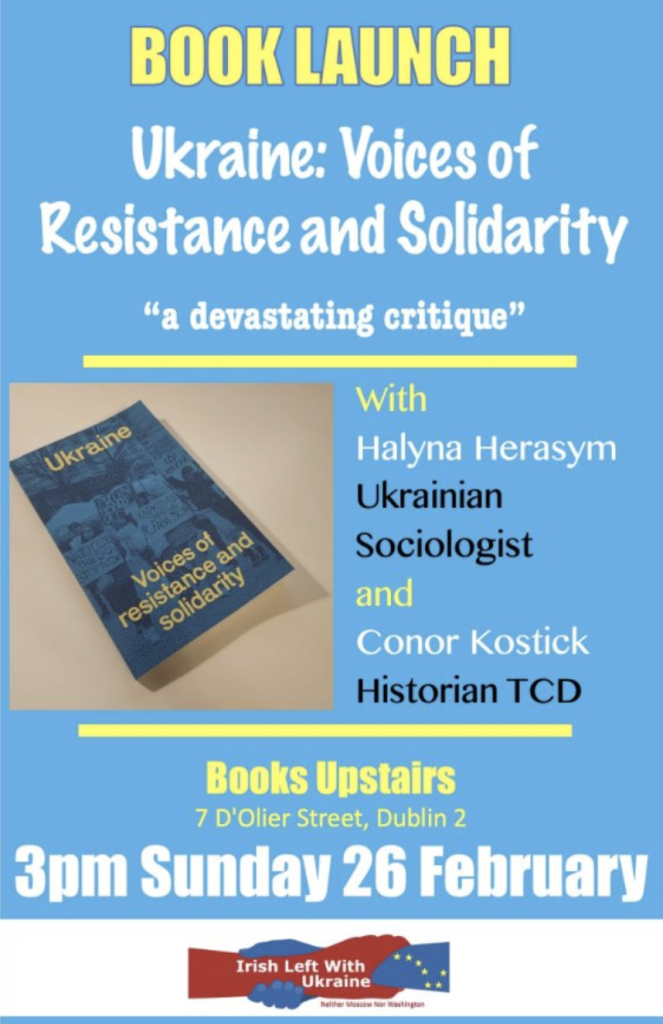
On 26 February 2023, Ukraine: Voices of Resistance and Solidarity had its Irish book launch, hosted by Irish Left With Ukraine. The two speakers were Conor Kostick, a founding member of ILWU and Halyna Herasym, a Ukrainian sociologist currently based at UCD.

A full recording of the two speeches and the introduction by chair Noirin Greene, former SIPTU national equality officer can be watched below:

Transcript of the booklaunch Ukraine: Voices of Resistance and Solidarity

Noirín Greene, former SIPTU national equality officer:

So the first person I want to introduce is Conor Kostick, who a lot of you already know. Conor is an Irish historian and writer living in Dublin. He the author of many lauded works of history and fiction and has received special recognition for his significant contribution to writing for children in Ireland. And I think that’s very admirable thing to do, Conor.

Conor was editor of the Socialist Worker in Ireland, twice chairperson of the Irish Writers Union and is a board member of the National Library of Ireland. As a historian, Conor’s awards include a gold medal from Trinity College, Dublin and fellowships from the Irish Research Council and the University of Nottingham. There’s also a great deal more, I’m seeing, Conor, but as I say, I’m only five minutes so I cut it all short. So thank you and I’ll ask Conor to give his address. Thank you.

Conor Kostick, novelist and historian:

I’m very glad to be asked to launch this book. I think it’s a really important book and it achieved two fundamentally important goals. One is it amplifies the voices coming from Ukraine, and two, it deals with the arguments that we’ve been facing since this war began. And just to go over those two points, it’s hard to underestimate the importance of hearing voices from Ukraine. The great failing of the left internationally, and we see it here in Ireland, is that it doesn’t start with the experience of people in Ukraine. Instead, they start from various different positions. They look at their political interests, their networks, and they come up with formulations about the situation in Ukraine that are back to front. And they end up, as we’ve seen recently, making all sorts of calls that have no bearing on what has actually happened in this last year.

They don’t think about, they don’t empathize with the experience of the people who are just living just like we were with the same nuances of politics, people struggling for a better world in against neoliberal agendas and so on. And suddenly bang! This massive, massive transformation of their lives, this deterioration of their lives, this horrific war. So I think to start with the experience of people in Ukraine means you don’t go as far wrong. And what this book does is it gives us the voice of the left in Ukraine. This is really important, because just like in Ireland, just like in any country, there’s a rich left tradition in Ukraine, there’s trade unionists, feminists, LGBTQ+ activists, socialists, anarchists, of course, every variation of political party that exists on the left elsewhere, exists in Ukraine. So why don’t we talk to them? Why don’t we start by saying, “What’s your experience? What do you want us to do? How can we show our solidarity with you?”

And when you start like that, you can very quickly arrive at the importance of arguing for Ukraine’s rights, self-determination, because nobody on the left Ukraine has the positions that we hear being articulated by the Irish Left. Here groups like People Before Profit, The Socialist Party, the Socialist Workers Network, let alone the more sort of communist parties, they don’t make it clear that people of Ukraine have the right to resist. No, they say that, “yes, Ukraine has the right to self-determination, and they are against Putin (I will get to Putin), but they don’t have the right to take arms from the West. That’s a big mistake. They can’t have mines cleared by Irish trained people, because that’s a threat to Irish neutrality.” So they come up with these positions that are, I’ve described as a evasionist, because it’s fine to say, “We’re in favor of peace.” Everybody wants peace, but they won’t say that the peace now is going to involve occupation of Ukrainian territory.

It’s going to mean the crushing of the left. I mean, there’s no question that whenever Russia occupies territory, it smashes the left. There’s no trade union activity in Russian occupied area. The trade unions are banned. The activists like Taras says in his essay here, Taras Bilous of Social Movement, he had to make a decision about whether to stay in Kiev at the start. And people were saying to him, “If you stay, you’ll get killed,” because it looked like the Russians were going to take Kyiv. And they are killing the civilians, yes. But they’re also targeting activists. Russia has a very conservative agenda so much that really, I’ll just come into this in a minute, the real far right position on this war is to support Russia. And that’s happening internationally, because as Putin sees it, by having gay rights and so on, the West is needs putting in its place and he’s trying to stop this.

The stakes of this war are very high, because there’s a world historic momentum that we’ve also had in Ireland towards same-sex marriage and abortion and so on. And the far right internationally, the conservatives internationally, hate this. Victory for Putin is all about this kind of taking away of democracy, taking away civil rights. So what’s happening in Ukraine is absolutely vital. And Taras made the decision to stay. A lot of the socialists in Ukraine are right now in the front lines. An anarchist group I know are raising money to get night vision goggles. So they are physically putting themselves in the frontline. And as they say in the book, they’re very clear, they’re not doing this for NATO and they’re not doing this even for Zelensky, although they support the Zelensky government under these circumstances, they’re doing it because if Russia wins, all the space for left organizing is eradicated.

At least if Ukraine wins, they can then have a discussion about what post-war Ukraine looks like, how trade unionists can fight for their rights. But that fight won’t happen if they lose. When I’ve tried to raise this with the Irish Left, what I find is they cannot bring themselves to listen to the voices of the Ukrainian left. It’s like trying to bring two magnets of the same polarity together. They just slide away rather than connect. They never ever platform and address the positions of the Ukrainian left. And I’m not saying they have to agree with them. What’s really shocking about this current moment in history in Ireland is that the left here are silencing the left in Ukraine, I think deliberately so, because people like Irish Left in the Ukraine have made it clear that we’re in contact with the Ukrainian left, we would give them speakers. They don’t want to know, because as soon as they admit that there is a Ukrainian left that you should talk to and listen to, even if you disagree with them, then their arguments collapse.

I managed to get one of them online to start a bit of a discussion which he quickly ran away from. But he said, “The people you’re amplifying with this book, (and also who we’ve been in touch with since start of the war), are a terribly small minority.” It’s what he said. Now first of all, that’s simply not true. Social Movement is a modest enough organization. But here in this book we hear from trade unions representing millions of Ukrainian workers, really big representative movements, feminists representing thousands of activists. So it’s simply not true. But even if it were true, I asked him, “How many people in Ukraine support your position that Ukraine is right to have independence, Putin is wrong, but that they’re not allowed to have Western weapons?” Not one person supports that, because it’s idiotic. If Ukraine has the right to self-discrimination, then it has the right to arm, people have the right to get arms from wherever they can.

And there’s a long history of this, of independence movements gaining arms from wherever they can. Which brings me to another point. Let me just give you a quick example of what you can read about from this book. The kind of voice that deserves to be amplified, that deserves to be heard here and is being, I think, deliberately silenced by the Irish Left. This is from a feminist organization, an interview with Viktoriia Pihul. At the moment there are people going around and saying we want peace, which is fine, but the implicit message is that we’re willing to accept that Russia occupies the positions it’s got at the moment and the equivalent ‘peace now’ argument has happened with regards to feminism.

So we have a western feminist manifesto that calls for an end to war, but doesn’t say anything about whether Ukrainian women should fight for independence. This is Vuktoriia’s response, “We’ve seen many pacifist statements by western feminists, including their manifesto. In the face of war and daily deaths of our women and children we are critical of this position.” That’s a massive understatement. She must be seething at that position, but anyway. “In this context, I am part of a working group of Ukrainian feminists who have written the Ukrainian Feminist Manifesto. We call for support for Ukrainian women including our rights for armed resistance. What I mean here is succumbing to geopolitical reasoning and geopolitical thinking and withdrawing from the conflict by condemning all sides is not a workable position. We must clearly distinguish the rapist from the victim and help the victim to assert her right to exist and be a subject.” Terrific; short; powerful in just those few lines. That really makes the point more clearly than what I’ve been saying. We have to distinguish the rapists and the victims, it’s as simple as that.

The Russians are the rapists. Ukrainians are the victims. Which side are you on? Of course, you should be on the side of the victims. It’s shocking that there are so many people who cannot see it that simply and clearly and cannot recognize the experience of Ukrainians. And this has practical consequences of course, not only in that trade unions here and elsewhere have given practical solidarity to our fellow trade unionists and activists and feminists in Ukraine. But also even just for marches like the other day. The Irish Left With Ukraine, we can go to these marches, we have comradeship with the people on the marches. We can have a conversation with anybody on the marches. The rest of the Irish left, they don’t go to them, because their positions would just be treated with scorn at the best. So they’re cutting themselves off.

The Irish left, which should be so vibrantly engaged with Ukrainian left – and we’ve met people from Ukraine through these activities who are revolutionaries and Marxists and feminists of course ­– should all be comrades together and that’s not happening except thanks to Irish Left With Ukraine and through Irish trade unions. Many trade unions here have much better position than the local left parties. So that’s the side of the book that amplifies the voices from Ukraine. So you cannot underestimate how valuable that is. And then the other thing that the book does is go through many of the arguments we’ve been facing and deals with them at a sort of theoretical level, but also drawing on their experience. And I won’t go through all the arguments, but I just take on the one argument that the book helps us answer, which is the question of whether the conflict in Ukraine in an inter-imperialist war, a proxy war?

Because if it is, then we don’t want to get involved. We don’t want take sides. And that’s the position of People Before Profit, the Socialist Party and the others: “all countries have got the right to self-determination. But supporting Ukraine to defeat Russia would mean supporting America’s goals and therefore we’re not going actually give any practical support to the Ukrainian resistance.” So that’s the key argument and the book gives us really good answers. People have really looked at this. There’s a very good essay that points out really since 1900 there has not been a war anywhere in the world that has not had inter imperialist dynamics to it. Of course, if a small nation is rising up against American domination, Russia is interested in that. It weakens America, great. If a small nation is rising up against Russian domination, America’s interested in that. That’s happened throughout the whole of the twentieth century.

And in fact they don’t have this in the book, but we know from Ireland, we know from our history how it happened. In 1916 Germany shipped 20,000 rifles, a million rounds of ammunition on the Aud to help the rebels here. Roger Casement came in a U-boat. He was given a submarine from Germany. Should he not have had that submarine? Should we have not had those guns? Of course, Germany had an interest to weaken Britain. James Connolly knew that as soon as we take German weapons, there’s going to be the equivalent to People Before Profit saying, “It’s an imperialist war. You’re supporting Germany.” So he had a big banner made: we serve neither King nor Kaiser, but Ireland. Yeah, we’ll take the guns, but we’re not serving the Kaiser. There’s no quid pro quo. And that’s the position of the left in Ukraine.

“Yeah, we’ll have your Apache helicopters and we’ll have your HIMARS, we’ll have all that. We need that. We absolutely need that. Otherwise, we could lose.” And, by the way, unfortunately it’s a very difficult military situation right now. They absolutely need this kind of equipment. It doesn’t mean we’re necessarily for NATO. And even if it did, the slogan, the right to self-determination of Ukraine, means nothing if they cannot choose to join NATO. I don’t want them join NATO. Taras Bilous doesn’t want to join NATO, the trade unionists, the feminists in here don’t want to join NATO. But if they choose to join NATO, that’s their choice.

If they don’t have a choice about joining NATO, they don’t have self-determination. So you cannot make your support conditional, you can’t say, “well I’m hesitant, because they might join NATO.” Tough luck. If you believe a country has a right to self-determination, then it has the right to make choices you don’t agree with. In Ireland we’ve had loads of referendum we’ve lost, the left has lost, but at least we’re making our own decisions about whether to be in Europe or not.

The left, if it loses the argument about NATO in Ukraine, it will nevertheless carry on arguing into the future. But it cannot make those arguments unless it’s free of Russian troops. So that’s the crucial point about these proxy wars. And we’ve seen from Vietnam where Russia and China armed the Vietnamese, but the left had no problem recognizing that the Vietnamese had the right to throw out the American supported government. And on the other side of the equation, some of you remember Solidarnosc, the independent trade union that flourished in Poland in 1980. Well the CIA got straight behind that, because they wanted to weaken Russia. Thatcher and Reagan feted the Solidarnosc leaders. It didn’t stop it being a genuine mass movement that socialists would support. So just because the inter imperialist powers are jockeying for position around a movement, that can’t let you determine what your position is. Your position has to start from the core principle. There is a rapist, there is a victim. Where am I standing? You start there and you can’t go wrong.

And yes of course, you’re going to see the other side jockeying for position, but the revolutionary victory, the resistance, the people’s struggle does more for making the world a better place than to let Russia win on the grounds that otherwise the US stands to gain.

And just finally just say something on the far right: the argument has been coming from Russia that Ukraine is fascist. And as this book makes absolutely clear, fascism is a problem in Ukraine, but it’s a diminishing one from its height in 2014. They got less than two and a half percent in the election in 2019. They got no parliamentary representatives elected and the left in Ukraine don’t swallow that excuse about the far right. They need independence and they will deal with the far right. That’s their problem to deal with.

And of course, the other side is easily more identifiable with its links to the far right. I mean, there are Russian activists who describe Putin as fascist and they might not be wrong as sort of neo-fascist. When you look at the big rallies the uncanny language that so echoes Hitler. But while there are nuances about what is a fascist movement and what is just a brutal dictatorship with state forces, the excuse about fascism should be laid to rest. There’s no justification for the evasion of Ukraine on those grounds.

So those are my takeaways from the book, really powerful important book. And the more it can get read, the better.

Noirín Greene:

Well done, Conor, for giving us an overview, your insight of what’s in this magnificent book. And I hope because of your address, it doesn’t put people off buying it. Don’t think you’ve read it all, because you are certainly haven’t. It’s a fabulous, fabulous inspirational book. I know my only job was to introduce the speakers, but digressing slightly, I loved your reference to the banner which was shown over Liberty Hall. We serve neither King nor Kaiser, and that wonderful photograph of the mobilization of the citizens army. We took their weapons, who took any support from wherever they can get it. Just before I go, I know Danigan will be summing up I think at the end. If I could just ask you, giving you notice, maybe you could say a little bit about the Irish Left with Ukraine and how people can join up and what you can do next.

I do want to say that I think the time, and I think Conor mentioned that all the references that are in this wonderful book, the time for the what aboutery. I’m allowed to say pissed off, aren’t I? [inaudible 00:20:07]. Really pissed off when you’re trying to have this discussion with people on, they call it the broad left about what is happening in Ukraine and how we should support the people there in Ukraine. And this is what aboutery goes on and on and the but word. And to be quite honest with you, I think a year later it’s over. I think people need to join up, sign up and do the right thing. I know most of the people and all of you, we are on the right side and that’s all that needs to be known. So anyways, that’s my little digression.

I’m not sure I’m supposed to do that. It gives me great pleasure to afford a very warm welcome to Halyna Herasym. I hope I pronounced all of that right and just a little tiny little bit of background on, because I am limited in time. Halyna move to Ireland in 2020 from her home, and I hope I’m right on this, in the western part of Ukraine to study for her PhD in UCD School of Sociology. And little did she know that when she left her family and friends behind to complete her studies in Ireland, that her beloved Ukraine would be ravished by the terror of the Russian invasion.

Halyna will tell us about her experiences as a Ukrainian living in Ireland. And I think Conor’s stressed that earlier, that’s the people that we really need to be listening to and her reaction to the news of the invasion by Russia, by living in Ireland and her shock and concerns for her family and friends left behind in Ukraine. Also, some of the harrowing stories, because I did listen to your interview with the Irish Times and I would recommend that you certainly try and do that. I think it’s on YouTube and she’s heard of just some of the atrocities that are unfolding every day. Wasn’t just at the start, it wasn’t just in the middle, it’s still going on that have been committed by Russian forces in the occupied territories in this illegal war. And I’m sure that you will have a lot more to tell us. So very hearty welcome to her. Thank you.

Halyna Herasym, Ukrainian socialist:

Thank you, Conor. I have some large shoes to fill now after your wonderful presentation. So I want to start with a little story of one of the authors of this book, Taras Bilous was mentioned by Conor. So he’s about my age. He is a Ukrainian left activist who was fighting for workers right, for the rights of women, for the rights of LGBTQ community for quite some time now. He’s an editor of Commons Journal, the left-wing Ukrainian Journal, and he has a very peculiar biography that I think highlights the struggle of Ukrainians very well. So Taras was born in [inaudible 00:23:10] region, which is the far, far eastern part of Ukraine. And once we were together at an event where we had to speak Russian. I myself was born in western part of Ukraine as Maria already told us and my Russian is not very good. For me it’s absolutely second, third language. I knew Polish at the time better than I knew Russian.

And I was like, “Whoops, I’m in trouble.” So I had to make my presentation in Russian. I was like, “Jesus, I probably have done not very good.” And then it was Taras’ turn and I never spoke to Taras in Russian obviously. We always communicated in Ukrainian and then it was his turn and I realized that my Russian is not the worst in that room. Taras’ accent was bad and it showed that he wasn’t very fluent in Russian. I think his biography and the way he stands for his conviction highlights that many divisions within Ukrainian society are not as they see it from the outside. Taras is a very sweet, very peaceful person, very patient for… I couldn’t be that patient to save my life, to be honest. He’s always very willing to go out of his way to have a genuine discussion, even with the people he knows that they would disagree with him and sometimes even with danger to himself.

So of all the people who would be patiently trying to persuade some activists on the right side, for instance, Taras would be the one who would be patient with talking to them. And he would be the last person that you would imagine taking up arms and going to fight in the battle. But when the Russian invasion began last year, Taras decided to stay and fight. So yeah, I think his biography and his character depicts very well the experiences of so many Ukrainian people. It depicts that the story of Ukrainian society is way more complicated than simplistic divisions like West and East Russian speakers, Ukrainian speakers and so on and so on and so on. When I read this book, I could really feel the frustration of another author Oksana [inaudible 00:25:46], also sociologist from Ukraine whose husband currently is fighting in war. They have two children and she had to flee, because they lived in Kiev.

Her husband is, he’s also from the western part of Ukraine and he is a wonderful, absolutely wonderful writer. I encourage you to look him up. I think some of his writing pieces were featured in New Yorker. His name’s [inaudible 00:26:13]. He’s an absolutely wonderful writer who spent quite some time sometime traveling, trying to learn about his home country, about Ukraine and writing reports about what he had seen. His book, [inaudible 00:26:29] Ukraine, is really inspiring and it tells those stories like the one of Taras about just some people living, going about their lives, being open and having discussions with him on his way, absolutely wonderfully. He also did participate, had been participating in left-wing politics for a long time, I think more than 10 years now in Ukraine and publishing his books. And Oksana in this book had written this article on 10 terrible leftist arguments about Ukraine.

And you can sense her frustration, you can sense her anger. And she even mentioned that hearing some of these arguments, she feels emotions that she’s ashamed of because these arguments make her so angry. And I can honestly relate to that, because unfortunately with many left-wing activists, and not only in Ireland, all around the world, you can feel like you’re invisible. So you are talking and you’re not being heard as a Ukrainian, it’s like this invisible veil comes between you and the person you are trying to talk to. And this lack of acknowledgement of your agency is honestly very frustrating sometimes because again, it is a very diminishing experience to be honest, when the people do not act as if you are there equal. They are trying to persuade you that, oh, this is all like a NATO rules or whatever. You are just are just being brainwashed.

I’m sorry people. I have a very good education. I am smart, adult human being. I’m capable of coming to my own conclusions about the situation and I do know quite a bit about the situation on the ground. So I can hear, I can feel Oksana’s frustration and I’m really delighted that right now I have an opportunity to present these Ukrainian voices and Oksana’s voice in particular here. In my research, I have two streams of research, one of them is I’m researching funeral culture in Ireland here. So I learned quite a bit about the Irish society, but the other stream of my research is dedicated to social movements in Ukraine. And I’m focusing on what I’m calling social dreaming. So social dreaming is these desires and dreams and visions of Ukrainian society, which are lived, which Ukrainian society is trying to make true through social participation, through political participation, through their everyday experience.

This is something that we have seen during your Madam protest in 2013, ’14. This is something we are seeing now society, regardless of their political views, left and right and centrist people and people who are not that interested in politics, to be honest. They’re coming together in order to realize the dream of just society with a rule of law where they have the right to decide for themselves what they’re doing. And I’ve been interviewing a lot of Ukrainian activists in the course of my research and that’s something I been amazed again, being Ukrainian, being a part of this social movement. But I still, I am amazed time and again with this determination, with this desire to make the world of your dreams where you can realize the justice, when you can see how your rights are coming to reality. I’m amazed by that determination, that feeling less willingness to work towards that, time and again.

And here in Ireland, I feel like this research on social dreaming is becoming for me more important than ever, because in Ukraine right now, and even before, we had so many predecessors who wanted to see that [inaudible 00:31:15] world, that world they’re envisioning for themselves. As Conor wonderfully mentioned, we have seen the solidarity movement in Poland. We have seen so many anti-colonial moments all around the globe. So in the course of my life and the life of my generations, we had so many people to look up to. So many people who were fighting to build that [inaudible 00:31:41] and more righteous world if you will. I had this discussion today that people of Ireland a 100 years were also so wonderfully mentioned by Conor. They didn’t have somebody to look up to. They had to envision their own future. They had to envision that world where they would have that right for self-determination to decide their own fate for themselves.

I think that what this book can provide for the world and for the left all over the world is this social dream, this opportunity to think out of this world, I don’t know, Cold War mindset. This opportunity to get out of that pattern of thinking America is bad, America is a superpower. We should be standing against everybody and everything America stands for and major stands for and so on and so forth. I think that this book and the voices of Ukrainian people in general can provide this opportunity for all the left all around the globe to see something new, to step outside of the box and to build more robust solidarities, which are not limited by political naming, by things that are using clever rhetorical figures to present themselves as if they’re just, or if they are promoting somebody’s rights. I think this is a very powerful opportunity to have this kind of thinking to go into this stream of social dreaming and political imagination and build this [inaudible 00:33:40] and more robust world where solidarity grows together. Thank you.

Noirín Greene:

Thank you, Halyna, that was very wonderful. Very colorful use of words in your vision as well. I particularly liked that we need to think outside the box, especially older people as well. And those that are in bureaucratic organizations or considered themselves the old left political people. I particularly liked where you said the social, socialist dream for not just the future of Ukraine, but for around the world. And I think of anybody is in any doubt as to how to get inspiration, again, I’m plugging it again, this book is just fabulous, because you have the feminist thinking in it. You have trade unionist thinking in it, and you have political with big peace and small peace and middle peace items and articles in this book. So I would again encourage you to do that.

Irish Left With Ukraine

This book launch was one of several events organised by Irish Left With Ukraine at the time of the anniversary of the Russian invasion of Ukraine.
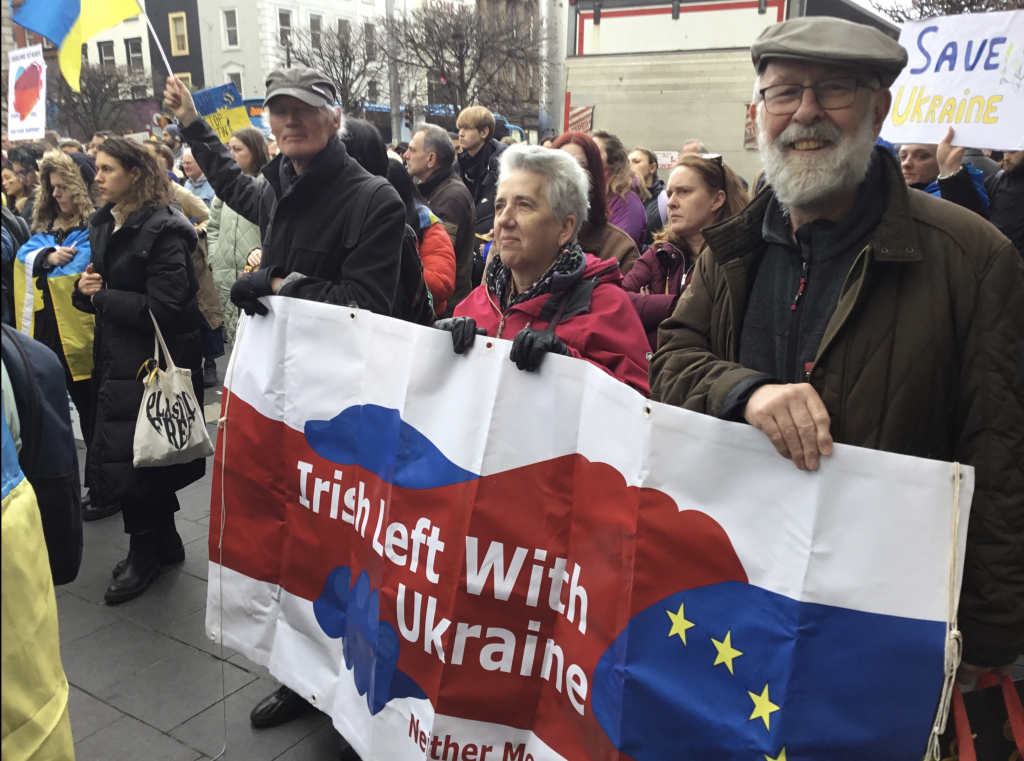
voices of resistance ILWU banner marching in solidarity with Ukraine

If you would like to get in touch with Irish Left With Ukraine, please email irishleftwithukraine@gmail.com.

Filed Under: All Posts, Ukraine

Northside Community Forum Against Racism

16/02/2023 by John Lyons Leave a Comment

#irelandforall
#irelandforall solidarity march against racism and the far-right 18 February 2023 Dublin

Statement by Councillor John Lyons in support of the Northside Community Forum

Over recent weeks there have been protests in the area targeting people seeking refuge in Ireland. It has been sad to see and the consequences can be traumatic for those directly targeted and can further disadvantage all our efforts to fight for a better Ireland for all as we can only secure housing for all, a better health service, more community, sports & social funding if we are united, not divided.

This country is extremely wealthy but we have a problem: the political class led by Fine Gael & Fianna Fail care only for the better off & wealthy.

They don’t care about our families, our communities.

All our energies, time and commitment should be focused on fighting for a better Ireland, not hurling abuse at people who have chosen Dublin as their new home.

Below is a Joint Statement from members of the Northside Community Forum which I fully support:

The Northside Community Forum is a network of Local Community Groups that work in Dublin North-East. We collectively develop actions, campaigns and work on issues affecting the community and community-based organisations.

Following the protests that we have seen over the last weeks in Artane and Coolock, members of this forum listed below, want to express our solidarity with the communities in Dublin North – East as we condemn the hatred expressed towards people seeking refuge and seeking asylum. Men, women and children, be they residents or newcomers should not fear for their safety on our streets, or in the places where they stay, their home from home.

We understand that only a small minority of people from our area are taking part, and the abuse is also being stirred up by agitators from outside.

We also understand that many of the issues that people are concerned about rightly relate to the many problems that impact people in our community such as poverty, inequality, homelessness and poor housing, the cost-of-living increases, the impact of drugs and the enduring grief brought about by the Stardust tragedy.

There are many things that need to be fixed in our society and it can seem like change is not possible at times. However, we do not believe that these problems should be used by some groups to stir up fear and hate.

At the turn of the last century, over half of the people who had been born in Ireland were living abroad. We as a country are very aware of the pain, loss, and opportunity that emigration can bring and as a community we can build on this wisdom as we welcome people from the Ukraine, people seeking asylum and seeking refuge.

The Northside Community Forum members as listed below are determined to listen to the community and to respond to these protests to ensure the people feel welcome and safe.

Archways

Artane Family Resource Centre

Association of Ukrainians in Ireland

Aster

Bonnybrook Early Education Centre

Bunratty Community Childcare

Clongriffin Community Association

Cluid Housing

Coolock Development Council

Coolock Law and Mediation Service

Crosscare

Darndale Belcamp Village Centre

Darndale Integrated Childcare Services

Discovery CTC

Doras Bui

Dublin Northeast Drug and Alcohol Taskforce

Grange Woodbine

Kilbarrack Coast Community Programme

Kilbarrack Community Development Programme

Kilbarrack Foxfield Preschool and Afterschool

Killester WW1 Memorial Campaign

Kilmore West Youth Project

KLEAR

Learn and Play Preschool and Afterschool CLG

LeChéile Donnycarney Community & Youth Centre

Migraine Association

Moatview Early Education Service

Near FM

North Dublin MABS

Northside Counselling

Northside Homecare Services

Northside Partnership

Out N About – Detached Youth Service

Priorswood Pastoral Parish Centre

Sphere 17

St Francis Parish committee

St John Vianney FC

Target

The Dales

The Sustainable Life School

Young Social Innovators

Northside For All
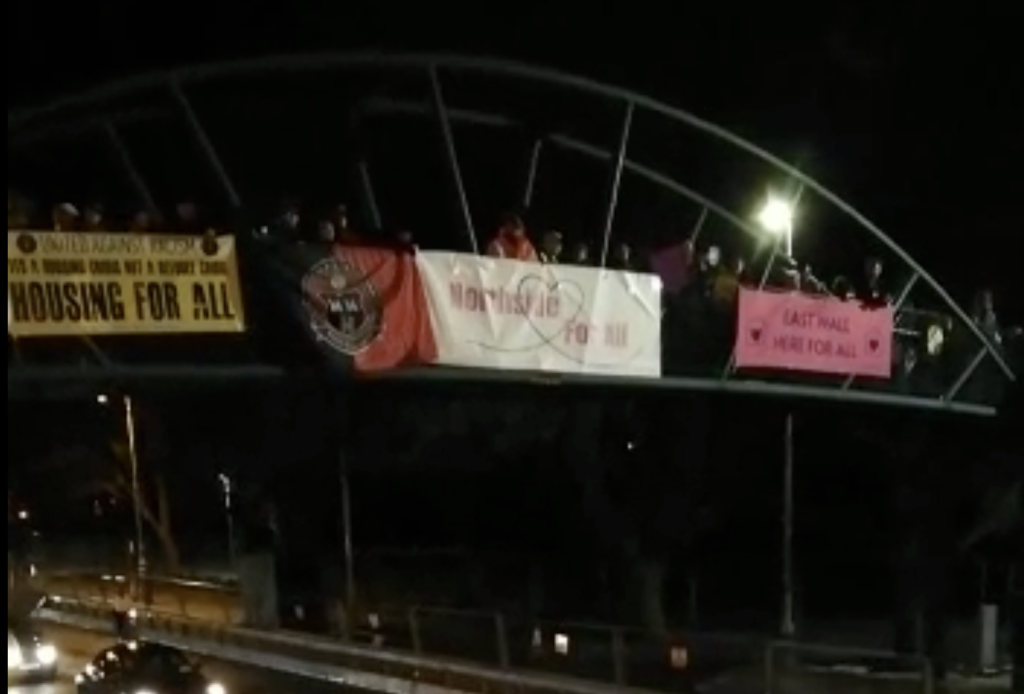
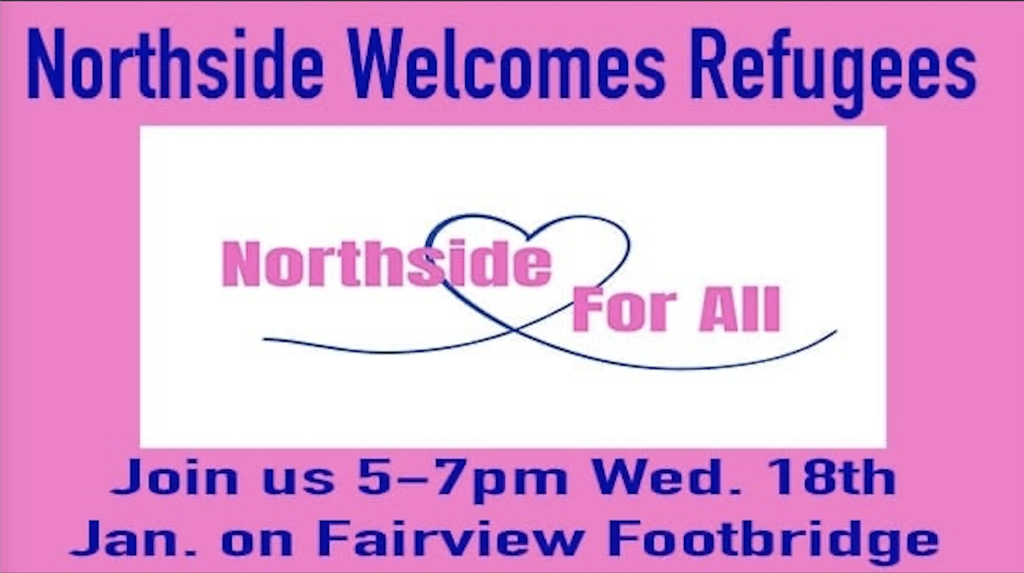
On 18 January in response to far right attacks on centres holding refugees community groups of the northside showed their solidarity with those seeking refuge in Ireland.
Northside Community Groups
Housing for All, Northside for All. 18 January 2023.

Filed Under: All Posts

THE STRANGE REBIRTH OF STALINISM

19/01/2023 by Colm Breathnach 9 Comments

If you were suddenly transported from the aftermath of the fall of ‘communism’ in the early 1990s to 2023, you would be in for a rude shock. Going from a situation where even old-style communist parties accepted that the undemocratic nature of the USSR and its satellites was problematic, you would find hordes of net-warriors quoting Stalin’s works approvingly, defending the worst excesses of the Chinese klepto-capitalist regime and lauding Putin’s lumbering war machine as it slouches across Ukraine, raping, murdering and pillaging as it goes. How has it come to pass that there is nothing too reactionary, too anti-working class, too anti-human, for such so-called ‘leftists’ to justify?  The answer is largely to be found in the bizarre re-emergence of a version of Stalinism amongst western leftists.

The Rebirth of Stalinsim: the man himself, Josef Stalin
The rebirth of Stalinism: one of the world’s worst dictators is experiencing a revival of support

WHAT IS STALINISM?

Traditional Stalinism can be conceived of as a theoretical position, a state ideology and an imaginary. In terms of theory, it posits that socialism is achieved through the agency of a vanguard party, which, on achieving state power through revolution, uses the instrument of a one-party state to build a socialist, and eventually communist society. This is sometimes varied by a belief in ‘stages theory’ whereby, based on the social/political structure existent in a particular territory, it may be necessary to pass through certain stages, usually involving alliances with bourgeois democratic or nationalist forces before there can be a transition to socialism. 

Secondly Stalinism is the ideology of the ruling class in a certain type of authoritarian socio-economic system, be it state capitalism, bureaucratic collectivism, klepto-capitalism, or a mixture of these. In this type of system, the ruling class, be they state bureaucrats, a patrimonial clique or state-adjacent capitalists, cannot maintain their rule purely by monopolisation of violence, so they need to achieve ideological hegemony. In the past the ruling class in ‘socialist’ states wielded some form of Stalinism (termed Marxism-Leninism) to justify and perpetuate their rule. This was often mixed with a strong dose of nationalism, sometimes drifting towards racism, often aimed at national minorities (see the treatment of the Turkish speaking minority in ‘socialist’ Bulgaria etc.). Ideological rhetoric was used to justify their exploitation of the workers and peasants, while also providing a link with left-wing movements world-wide. With the collapse of the ‘socialist states’ in Eastern Europe the role of Stalinism-nationalism as a state ideology is now largely confined to East Asia–China, Vietnam, North Korea and Laos.

But Stalinism is also a contemporary imaginary: a belief in the past existence of ‘socialism’ in the USSR that provides positive lessons for today. For some, China is the more successful version of a supposedly socialist state, a version that has managed to avoid collapse by incorporating and subordinating capitalism, a state-system that is superior to bourgeois democracy. Whether by reference to the Soviet past or to twenty-first century China, some leftists still console themselves by believing in the existence of a socialist reality.

WHAT’S THE PROBLEM WITH THE REBIRTH OF STALINISM?

Some on the left acknowledge the revival of Stalinism but minimise the seriousness of it. Why, they ask, get worked up about what is largely the domain of fringe groups?  Surely, we have much more serious issues to contend with. This response is fundamentally flawed.

The fundamental meaning of socialism, not ideological nit-picking, is at stake. Either socialism means a free society based on workers control of all aspects of their lives or it means authoritarian one-party state ruled by bureaucrats, where anything, including mass-murder and genocide is permissible. Modern Stalinism is a fundamentally anti-working-class ideology: actively supporting and promoting the crushing of working-class struggle across much of the world; cheering on the exploitation and oppression of people because of their ethnicity, sexuality and gender. This perverted form of anti-worker leftism is a real threat, gaining ground amongst the young, and influencing left discourse across organisational and generational boundaries.

THE CHARACTERISTICS OF NEO-STALINISM While the Stalinist revival has some ‘on the ground’ manifestations, in the form of the renewal or emergence of new Stalinist youth organisations and some influence on left-reformist organisations, its most visible form is virtual – in a galaxy of websites and online discussion forums, many of which are not tied to any particular organisation – The Grayzone, that dictator fan-boy’s favourite, being a prime example. This is what makes it attractive for naïve young people whose first experience of the ‘left’ is interaction with these online spaces. Increasingly for many young (and some not so young) leftists, the internet and social media are the main terrain of struggle, rendering them isolated from the day-to-day struggles of working-class people and more vulnerable to the macho cod-leftism of the Red Guards of virtual reality. It’s almost like a game, though not entirely virtual. This kind of politics is more akin to cosplay: even the actual physical activities are performative and often without consequence: massing together; wearing red scarves and waving mini-red flags on demos; etc.

Cosplay as Performance The Rebirth of Stalinism
The Rebrith of Stalinism: Cosplay as Performance

This primarily virtual world has its influencers, ‘maverick’ politicians and personalities such as George Galloway in the UK, MEPs Clare Daly and Mick Wallace in Ireland, or YouTube personalities such as the American Jimmy Dore. Their ‘celebrity’ status and penchant for the stunts and provocative outbursts, are well-suited to the social media spaces that many on the left inhabit. They also act as a gateway for conspiracist thinking which is also infecting parts of the left and channelling young leftists towards far-right views on immigration, vaccines etc.

The term neo-Stalinism might be more appropriate to use as, after the demise of the USSR, many orthodox communist parties toned down their explicit Stalinism, accepting that there had been problems with the ‘communist’ states, though still clinging to the view that these represented ‘actual existing socialism’. Many of these parties shrank to a cohort of old-timers; their politics largely confined to trade union activity and the anti-war movement, almost indistinguishable from mainstream left-reformism and sometimes even further to the right (as in the unprincipled alliance of Communist Party of Britain activists with Blairites in the university lecturers’ union, UCU). Some of these parties have experienced a renewal, with an influx of members into their youth sections but this has sometimes led to resentment or even splits, as the old-timers find the provocative uber-revolutionary posturing of the youngsters jarring to their staid left-reformist practice (not to mention a threat to the property assets that the old guard have garnered over the decades and which they are resolved will never be yielded to anyone else, regardless of party democracy). In the Communist Party of Ireland this has led to a full-scale split with its youth section, the Connolly Youth Movement.

State funding from countries like China and Russia is also a factor in the life-support system of some western Communist Parties. There are plenty of international conferences, journals and opportunities for paid appearances on channels like Russia TV for the right people.

In addition to this, neo-Stalinism is attractive to a cohort of trade union full-timers, who on the one hand are under pressure to oppose austerity, anti-trade union laws, right-wing government policies etc. but on the other hand are hostile to genuinely radical upsurge from below which would threaten their hold on the unions.  This leads to the bizarre situation of ‘left’ trade union officials supporting anti-worker regimes that ban independent trade unions and strikes and imprison labour activists.  Some even go further in supporting the most reactionary forces imaginable.

Neo-Stalinism is a broad church with many variations but there are some fundamentals that unite them:

Democracy: They see bourgeois democracy as inferior to past and current authoritarian regimes. Free and fair elections; basic social and political rights; the ability for the working class to organise; etc. are of no importance. ‘Liberalism’ by which they mean bourgeois democracy, is the main enemy. But it’s not that they posit radical or participatory democracy of a future socialism as being superior to bourgeois democracy, it’s that they see the non-democracy of ‘communism’ and authoritarianism as being the ideal.

My enemy’s enemy: For the neo-Stalinist, any regime or movement which is ‘anti-western’ is deserving of support or at least worthy of defending against ‘liberal’ accusations. For them the world is viewed in a geo-political manner–there are two camps, the West, and the Rest; and we always support the Rest. There is no other possibility–either you are anti-imperialist, or you are pro-imperialist.  This has taken a more specific form recently with the rise to power of Xi Jinping in China, with his veneer of occasional leftist sounding rhetoric–now China has become for many, the USSR of the 21st century–they have a new Rome to look to. This outlook entirely ignores the agency of exploited classes and oppressed peoples–it sees the world only in terms of super-power conflict–therefore demonstrating Iranian women; Ukrainian resistance fighters; striking workers in China, can only be conceived of as pawns of American imperialism.

Anti-woke:  Much of the neo-Stalinist left displays hostility to struggles against oppression–sometimes characterised by homophobia, misogyny, and especially, transphobia. This is partly based on old-fashioned economism, where struggles which are not seen as class-based are characterised as ‘identity politics’, but it also arises from raw prejudices, fear of difference, the desire to appear macho etc. In parallel with the aIt-right, it seems to be primarily younger males who are attracted to neo-Stalinism and this ‘anti-wokeness’ plays an important role in that attraction. Left ‘anti-wokeness’ promotes and feeds off a reactionary agenda, infecting parts of the left. This leads to the sort of bizarre situation where members of the Communist Party of Britain demonstrate alongside Tories outside the Scottish Parliament against the passing of the Gender Recognition law; or the ‘leftist’ academic, Angela Nagle, laughs along with the far-right Tucker Carlson on his shit-stirring Fox News show.

WHY IS NEO-STALINISM ATTRACTIVE TO YOUNG PEOPLE?

 So, what is it about neo-Stalinism that makes it attractive to young leftists?

  1. Like its ‘alt-right’ cousin, neo-Stalinism is a way of rebelling, of shocking the oldies.  It has the advantage of getting up the noses of just about everyone, from other radical leftists to liberals and conservatives.  It’s the sort of punk-rock of the left, with a new vocabulary of memes, symbols and in-group jokes etc. generating an outraged reaction, as desired. The extreme way in which neo-Stalinists express their views fits with a sort of Millwallesque sense of belonging. A classic example of this was the ‘protest’ involving two members of Workers Party Youth (Ireland) outside the Ukrainian embassy in Dublin against the arrest of two members of a Stalinist organisation in Ukraine. Such activities don’t even have a propaganda purpose in terms of winning others to their cause, it is purely for internal consumption–look at us, everyone else supports the Ukrainians but we are not afraid to take a really unpopular position–well-hard!
  2. This, of course, could only emerge in a social media world which is ideally suited for and shapes this type of activity and mentality–online culture reinforces the small-group subcultures of neo-Stalinism. The traditional viscousness of Stalinist politics, with its witch-hunting, name-calling, denunciations, is ideally suited for modern social media forums where a quick take-down, not depth of analysis, is the required skill.
  3. It might be an exaggeration to claim that reading has gone out of fashion, but for some young leftists their ideas are more likely to be influenced by what they watch on YouTube rather than what they read. This can often mean that, while very well versed in ‘facts’, they are woefully lacking in knowledge of theoretical and historical depth.
  4. Many, though not all, young leftists who are attracted to neo-Stalinism are students or come from a middle-class background. This in itself, of course, is not a fault or flaw but for some of them, there’s a certain frisson that goes with engagement with a “dangerous” ideology and practice. In addition, it feeds a desire to appear tough, a trait which is linked to a stereotypical image of being working class. This reaches ever more absurd manifestations, epitomised by a specialist niche of warmed-over Maoism. There are, no doubt, lurking somewhere out there, newly minted fans of the Khmer Rouge!
Pol Pot and the Rebirth of Stalinism
Pol Pot: Coming soon to a Discord channel near you

WHY DO THE TROTKYSIST LEFT TURN A BLIND EYE TO THE REBIRTH OF STALINISM?

So why have so many on the left not only failed to recognise the dangers of resurgent Stalinism, but sometimes actively avoid criticism of the trend?

Ironically, given the historical resonance, one of the reasons for this reluctance to confront neo-Stalinism, is the change that has occurred in a large part of the Trotskyist left. Traditionally these groups strongly opposed Stalinism in the trade unions, in solidarity campaigns etc.  However, with the end of the Cold War, and the demise of many of the orthodox communist parties, and the evolution of many Trotskyist organisations to a post-Trotskyist position, they have turned their attention away from critiques of Stalinism and in some cases, such as the UK based Counterfire, they have adopted some positions very close to neo-Stalinism (campism, anti-woke etc.), as well as being happy to cooperate with those neo-Stalinists in campaigns such as the UK Stop The War campaign. Some more traditionalist Trotskyist groupings have also adopted some positions that are very close to those of the neo-Stalinists, especially in relation to the Russian imperialist invasion of Ukraine.

However, this ‘soft on Stalinism’ problem is not just confined to those individuals and organisations which come from the Trotskyist tradition, it has infected a much broader range of leftists. This is epitomised by the view that the ‘communist’ states were in some way socialist, though usually with acknowledgement that they were flawed: ‘the Stasi were awful, but the childcare was great etc.’ or a romantic view of the activities of the popular front era Communist Parties. This trend is marked in the Democratic Socialists of America, where a strange mixture of popular front nostalgia and neo-Kautskyism has led a whole section of left-reformists to develop a distinct softness on Stalinism, a softness that has had unfortunate practical effects such as the ‘campist’ position of the DSA international committee.

Unfortunately, even for those leftists who do not share that benign view of Stalinism, actively opposing neo-Stalinist positions or organisations is often viewed as sectarian and divisive.  The old cliché, ‘we should concentrate on the 90% of things we agree on, not the 10% of things we disagree on‘ is frequently wheeled out to justify this position. This reduces the struggle against Stalinism to a disagreement with comrades over details. It is premised on the view that Stalinism is just another tendency in the socialist family rather than an ideology and movement which is fundamentally opposed to the basic principles of socialism. If the 10% includes justification for mass murder, one party states, transphobia etc., then it is in clear opposition to the most fundamental principles of socialism.

The other issue is a sort of reductionism which has always been a problem on the left. Anti-Stalinists will be told that most ‘ordinary people’ don’t care about these nuances, this is peripheral to their everyday concerns. This is the same argument that was used in the past to deny the importance of women’s liberation, or the LGBT struggle, as fundamental to the socialist project; or the type of argument that could equally be deployed to oppose involvement with international solidarity campaigns. The fact is that ideological and practical struggles are not a zero-sum game, that all struggles against oppression and exploitation are important. Of course, at different times and in different places, one issue or another may take precedence, but these are questions of practical organisation. For example, raising opposition to Stalinism because an older member of your community organisation is a CP member is not really sensible; but opposing campism in the anti-war movement is a vital matter of principle.

HOW TO RESPOND TO THE REBIRTH OF STALINISM?

Stalinism is a virus that is spreading, infecting younger leftists, and turning many onto a reactionary road despite the positive ideals that they started with. Radical socialists must confront head-on this rotten ideology and practice. Though by no means exhaustive, here are some possible actions:


1. Explicit anti-Stalinist education should be encouraged in all non-Stalinist left organisations, including a clear Marxist analysis of Stalinism as a theory, a crash-course in the monstrous crimes of Stalinism in practice, and a detailed study of the exploitative and oppressive nature of ‘actually existing Stalinism’ in China.  This could be easily facilitated by the numerous Marxist studies of all these phenomena.

2. Rather than side-stepping key issues in the interests of ‘left-unity’, socialists should openly confront anti-trans, pro-dictatorship, pro-mass-murder views on the left, driving a wedge between neo-Stalinists and those who are superficially attracted to some of their rhetoric, and forcing non-Stalinists who tolerate and work with Stalinists off the fence.

3. While hardened Stalinists should be unceasingly fought and confronted, there are many, especially younger comrades, who may be superficially attracted, for reasons already enumerated. Their drift can sometimes be halted by careful persuasion based on accurate information that is contrary to the propaganda they have previously engaged with. Such persuasion is far more likely to succeed if those doing the persuading have a record of activism in struggles against exploitation and oppression, be it through political organisations, trade unions or campaigning groups.

Above all there is a need to carve out spaces where this struggle against Stalinism can be sustained: in democratically structured, revolutionary socialist organisations and non-dogmatic spaces of discussion. An alternative, truly revolutionary and democratic politics is the best way to win people over from the strange cul-de-sac of the Stalinist revival.

Filed Under: Independent Left Policies

End Sex Trafficking

01/11/2022 by admin 1 Comment

One of the grimmest, darkest aspects of the capitalist society we live in is the kidnapping and enslavement of people, especially women, who are exploited sexually. To end sex trafficking is an urgent task.

The scale of the problem is massive and worldwide. The statistics on sex trafficking are hard to gather, given the challenge of identifying criminal activity. A key study into modern slavery is that of the International Labor Organisation of 2017. They found that an estimated 4.8 million people were subject to forced sexual exploitation, a million of whom were children. Almost all of them (99%) were female.

There is a clear divide between rich and poor nations, with most victims coming from poorer countries. If we want to end sex trafficking, we have to end a system where large profits can be made from businesses that facilitate wealthy clients and where money means power over other people.

Although there is a clear connection between the pattern of sex trafficking and the imperialist legacy of the world’s history and present patterns of warfare (Ukrainian women and children fleeing the war are being preyed upon by sex traffickers) it is important to say that sex trafficking happens in every major city in the world. Ireland is no exception and in September 2022 the Irish government was criticised by the EU’s Group of Experts on Action against Trafficking in Human Beings.

EU’s Group of Experts on Action end Sex Trafficking in Human Beings
Evaluation Report by the EU’s Group of Experts on Action to end sex trafficking.

Victims of trafficking in human beings arrive in Ireland, with official figures – an underestimate – showing that while there was a drop during COVID, they are on the rise again. There were 103 people who came to the attention of the Garda in 2017, 64 in 2018, 42 in 2019, 38 in 2020, and 44 in 2021. Predominantly, these were victims of sexual exploitation. The GRETA report points out that there are a lack of interpreters with training in this area; that the Legal Aid Board services do not provide representation for victims in court; that no victim has received compensation in Ireland (whether from the perpetrators or the state); victims are treated as witnesses not as injured parties; and the number of investigations and prosecutions has been decreasing despite an increasing number of suspect cases.

End Sex Trafficking #WhereisCamila?

The example of Camila Cinalli is representative of tens of thousands of similar cases every year. Aged 15 and living in San Miguel del Monte, Buenos Aires, Argentina, on 30 August 2015, Camila Cinalli had gone to meet a friend at the lakeside. When her friend couldn’t join her, she set off for home on the main road, National Route 3, where there is security camera footage of her. Soon after sending some texts, Camila’s phone was turned off and she has not been seen since.

The local authorities – the federal courts of La Plata – were slow to act and their investigation into Camila’s disappearance has failed to make any progress. It is the family who have striven the hardest to find Camila and the believe she was kidnapped and trafficked for sexual exploitation. Over the years the family have organised, campaigned and followed a trail of clues across different cities. Camila’s mother, María José Herrera, is a member of the revolutionary socialist group La Marx, who have an international campaign to find out what happened to Camila as well as a broader women-led campaign for to end sex trafficking.

End Sex Trafficking #WhereisCamila?

María José Herrera, mother of Camila and activist against sex trafficking spoke to Independent Left:

How big a problem is sex trafficking?

It is one of the most serious problems today. We are thousands of families around the world, especially in poor countries like Argentina, Latin America, Africa, Asia, etc who suffer the kidnapping of our daughters, friends, relations, affections. The traffickers are protected by authorities of the capitalist state: government, police, mayors, governors, and the church. Everyone takes part of the business of human trafficking. The traffickers need landing strips, open borders, enabled routes, and this is only possible with the close complicity between those in the business of trafficking and the government and security forces.

It’s 21st century slavery. It is a business that moves millions of dollars. Those who control that business are the same ones who control drug trafficking, gambling, arms trafficking, and all the dirty business of capitalism. The money is whitewashed on Wall Street and among the Corporations and tax havens of the world. That is to say, the trafficking business is closely linked to capitalism and the social class of the richest 1% that dominates the world.

Do you think it is possible to end sex trafficking?

It is possible by uniting families and victims with activists from around the world willing to confront sexism, trafficking, and defend the rights of women, and also  the male victims of this criminal activity. At the same time, those of us who organize ourselves must make progress in understanding the magnitude of the problem we face. This is only possible with revolutionary organizations, willing to confront the capitalists of human trafficking, and sexual exploitation, but also all the accomplices, which is the capitalist state. There are many platforms that claim to fight against trafficking, but they are controlled by the UN, or governments, and capitalist parties. These organizations lead the fight into a dead end, because ultimately they defend capitalism. That is why we organized the International Platform against Femicides and Disappearances, an organization completely independent of all the governments and capitalist parties of the world, that independence is essential for our fight to go to the end and achieve results.

When your daughter or friend disappears, you don’t know what to do. You are disoriented, nobody is prepared to face a situation like this. You go out looking everywhere; your life as you knew it disappears in an instant. You approach the police, the authorities, the media; everyone pretends to help you, maybe some really do, but you quickly run into a network of impunity, the witnesses remain silent or disappear, nobody knows anything, the security cameras they disappear, it is as if the earth had swallowed them and that person had never existed. The thousands of families that suffer from this problem face this hard reality that changes our lives forever.

The platform also gives emotional and legal support, provides advice for those people who receive this blow in their lives, and do not know how to react. It is not a self-help group, it is an organization for the fight, but the brotherhood, and mutual solidarity helps enormously to face the pain of the loss of our loved ones, whether dead or missing.

What is the next step for the #WhereisCamila campaign?

We are promoting new acts, and new actions that keep Camila’s presence alive, and spread knowledge of the case in ever larger countries. Camila may be in Europe today, or in the United States, kidnapped by traffickers, but anyone from those regions can provide us with useful information to help us find her.

Several organizations now provide us with technological resources, photos of Camila updated with the age she is today, as soon as we have this material it will be published on social networks, and we will be able to move forward with the Campaign. If European organizations like Independent Left or others, councillors like comrade John Lyons help us reach a person from Europe, the more people know about Camila, and our campaign, the greater the chances of finding her and rescuing her from her kidnappers.

How can our readers help your campaign?

First, promote the campaign. Put the hashtag #WhereisCamila? on social networks, place their photo, make it visible by all possible means, let’s talk about them at acts, media, social networks, events, etc. Second, join the campaign. Send us your video, your photo, your message, in all languages to the Platform, or to those who help us like Independent Left. Become an activist, organize with us no matter your language, sex, age, nationality, race, we are only interested in finding it. Fighting for Camila we fight for all the disappeared, and victims of Human Trafficking, we face this dirty and dangerous business that devastates the entire world. Third, help us strengthen the International Platform against Femicides and Disappearances, help poor women around the world who are uniting to confront this scourge, and who need your help to achieve their goals.

End Sex Trafficking #WhereisCamila?
#WhereisCamila international campaign against sex trafficking
WhereisCamila international campaign against sex trafficking with Kurdish, German and Mexican activists

You can use the Independent Left contact details to get in touch about the campaign.

Filed Under: All Posts

Resolution on the War of Sotsialnyi Rukh (Social Movement Ukraine)

10/10/2022 by admin 2 Comments

Independent Left are glad to reproduce the English-language version of a resolution on the war with Russia adopted by of Sotsialnyi Rukh (Social Movement Ukraine) at their convention in September 2022. This is an extremely important resolution for the whole of the left internationally, because it demonstrates that there is a left in Ukraine who are both against the Russian invasion and the neo-liberal policies of their own goverment.

The resolution also draws attention to the fact that far from Ukraine being fascist, the struggle for independence has a strong working class, democratic character, much like the national liberation struggles of the past, including in Ireland.

The ‘evasionist’ left internationally have a blind spot when it comes to the Ukranian left, because it does not suit their position of refusing to support a victory for Ukraine over Russia to acknowledge that the position of socialists and anarchists in Ukraine is to defeat Russia as part of the movement towards a more humane, socialist world.

Resolution: The War and the Future of Ukraine and the Left Movement


The people of Ukraine have been facing hard challenges, yet they have proven their ability to fight for the right to decide on their own fate, and their determination to defend the country and to end the war as soon as possible. The authorities and representatives of market-fundamentalist ideology, together with big business, keep pushing through an economic model focused on benefiting a minority at the expense of the welfare of the absolute majority. In this model, workers are completely subservient to the will of their employers, while social and regulatory functions of the state are abolished for the sake of “business needs”, “competition” and “free market”.

Our country deserves a post-war arrangement, in which decent work, a reliable system of social protection, affordable education, housing, and medicine become a priority. Ukrainians have already seen how essential for surviving can be public enterprises such as the state-owned Ukrzaliznytsia, and have also felt how painful deregulation of food, housing and fuel prices can be.

A party is needed to implement an alternative vision of Ukraine — democratic, social, and socialist.

This party would protect and unite the working class and the unprivileged, those who now lack political representation and suffer from constant abuse. Such a party must protect the absolute majority of the working population from the employers’ dictate.

The ultimate goal of such a political force must be the emancipation of humankind and the radical democratization of economic, political, national, and social life. The party would advocate the transfer of power over the economy from private owners and corporate management to labor collectives and communities. Decision-making and the distribution of economic goods must be in the interest of the entire community, not the capital owners. To do this, the economy must be built on the basis of public
rather than private ownership.

With the outbreak of the war, the oligarchs and other major capitalists have fled the state. It was the common people, including organized workers, representing the largest part of the civil society, who stood up to defend the country. Unfortunately, despite the fact that the working class constitutes the core of the Ukrainian resistance to Russian imperialism, our authorities continue to push through legislation aimed at limiting its involvement in decision-making, thus provoking further social conflicts, undermining defense capacities, and attacking the democratic rights of the majority for the protection of the dominant minority. Anti-social decisions are justified by military necessity, although in practice most of the successful war economy cases in the world were based on the principles of the social state and social dialogue.

The war has created new forms of self-organization and grassroots politics. The mobilization of the nation for the liberation war strengthened people’s sense of a common cause and made them realize that it is thanks to ordinary people, not oligarchs or business, that this country exists. The war radically changed social and political life in Ukraine, and we must not allow these new forms of social organization to be destroyed, but, on the contrary, expand them.

A positive sign was the widespread support for the demand to write off Ukraine’s foreign debt, which led to its eventual freezing, and the support of the largest global trade unions and democratic left parties for demands to supply Ukraine with weapons and fight against anti-labor laws.

The time has come for a change in Ukrainian politics. We call for a new, mass party that will represent organized labor, grassroot and democratic movements united around a radical project of transforming society on the basis of comprehensive liberation, public property and democracy.

Until recently, many in the world underestimated Ukraine and overlooked the subjectivity of its people. Now that the country in all its linguistic, ethnic and cultural diversity has united for an armed fight for the right to decide on its own destiny through its own forms of self-organization, it is time to explain to our business and political elites that it is not them but the people of labor who constitute the Ukrainian nation that must decide how we build our country.

“Sotsialnyi Rukh” believes that the priorities in the struggle for this have to be:

1 Complete victory and security for Ukraine

The Russian army must be defeated now, this is a prerequisite for the democratic and social development of both our country and the world.
Preserving independence and democracy will require, first and foremost, the development of its own defense capabilities. On this basis, a new international security system must be built to effectively counter any manifestations of imperialist aggression in the world. Ukraine needs a program to restore industrial production and science-intensive defense and related industries.

2. Socially oriented reconstruction of Ukraine


Neoliberal forces are trying to impose their vision of post-war Ukraine, a country belonging to big business, not to its people, and having neither social protection nor guarantees. Unlike that, we believe it is necessary to advocate for the reconstruction that emphasizes progressive development of the living standards of the majority of the population, and of our social infrastructure, provision of economic guarantees.

Reconstruction must be ecological, social, decentralized and democratic, inclusive and feminist.


In particular, the nationalization of key enterprises under workers and public control is necessary.


Besides, we deem crucial and advocate for the implementation of open accounting in all enterprises, regardless of ownership, involvement of workers in their management, creation of separate elected bodies and committees to exercise this right. Corrupt schemes of transferring offshore profits from exports of iron ore, metal, and agricultural products must be taxed. In general, taxation has to be progressive to finance the social sphere and development of the economy. Another step should be introduction of indicative and direct planning for a structured, stable and more complete development of the economy. 

Commercial secrets must be abolished. In Ukraine, there can be only one type of secrets, military ones, access to which is regulated by the state, while all other information about the work of enterprises, organisations, and state agencies should be open to all citizens.


No less important is overcoming mobbing and bullying at work, ensuring availability of shelters to victims of domestic violence, combating gendered violence, fighting for safe and stable living conditions for women, trans persons and non-binary persons, ensuring equality in the military and the workplace, stricter accountability for hate crimes, and increasing representation of all social groups in government.

3. Social democratization


Democratization of all levels of life, eliminating the influence of money and big business on politics, increasing the representation and importance of trade unions, national minorities and communities in power and their full involvement in decision-making. Owners of capital and persons funded by them cannot be people’s deputies or hold positions in public and municipal services.

War makes it necessary to limit certain rights and freedoms in order to protect independence and democracy. However, we must demand that such restrictions are clearly justified, so that they will not be used for the abuse of power where there is no military necessity.

Representatives of local communities, in particular of territorial defense units, must be directly involved in providing security and law and order, while their activity must be democratically and transparently regulated in the public interest.

Social democratization also means protection of labor rights according to the best standards existing in European countries, limitation of a working day length, and adoption of the law on labor inspection. 

We need to transform the migration policies to easen access to residence and prevent undignified treatment of foreigners.

Affordable energy-efficient and social housing, protection of tenants’ rights, rent control, developing urban infrastructure, and greening cities are a must. Expanding self-governance in cities, introducing elements of direct democracy, development of public transport and limiting usage of the private one are other essential steps to take.

Moreover, the development of student self-government is crucial. Students should be involved in the decision-making process at universities and other places of study, and develop a network of independent student unions.

Equally important is the preservation and development of the Ukrainian healthcare system. Reforms based on competition and market principles rather than on accessibility and quality of services have to end. Funding has to be increased along with modernization and guaranteeing stable and decent wages for employees of the sphere. Access to medicines should be free, commercialization of medicine has to stop.

4. Identity and inclusiveness


The new Ukrainian identity, which is being born before our eyes, is multi-ethnic and multicultural, because most Ukrainians, who now defend our country, are at least bilingual. The multilingualism and diversity of Ukrainian national culture must be preserved and developed, focusing on the Ukrainian language becoming a universal means of exchange and production of knowledge in all areas of public life, culture, science, and technology. The entire cultural heritage of humankind should not only
become available in Ukrainian, but Ukrainian should also be used to produce advanced works of literature and art, scientific and technical knowledge of a global level.

It is necessary to ensure the development of Ukrainian culture and language in all their diversity, socially oriented Ukrainianization, based on decent and competent public funding of education, publishing, popularization of science, festivals, cultural projects, cinema, etc.

The influence of the Ukrainian language should be nurtured in all fields of knowledge, to prevent it from being supplanted by the world’s more widely used international languages. Fortunately, Ukrainian is not only the language of our history, but also the language of modern science, technology, production and defense. The national revival of Ukraine is impossible without the comprehensive development of all spheres of social life, including those of high-tech production, engineering, and fundamental research.

Certainly, involvement of national minorities in politics and guaranteeing their cultural rights, development and protection of cultures with fewer speakers have to be a part of the national revival.

Struggle for liberation and the policy of rootedness is for all ethnicities of Ukraine, which includes involving their communities in the representative bodies with real political influence, proportional funding of cultural institutions and language development with a considerable compensation for the lack of a nation-state.

5. International solidarity against imperialism and climate catastrophe

Although Ukraine is the largest country on the European continent, it is thrown to the periphery of regional politics. Having no influence on decision-making, it is reduced to a marketplace for European states.

The growing contradictions between the centers of capital accumulation in the world capitalist system will not stop even after the complete destruction of Russian imperialist power. The left in Europe and around the world turned out to be helpless and disoriented when the Russian aggression in Ukraine occured. Unless the international socialist movement realizes mistakes it has made and builds a new, truly internationalist cooperation and coordination, we simply have no chance of preventing the growth of inter-imperialist struggle in the future.

The climate catastrophe unfolding before our eyes demands urgent action. Humanity must mobilize resources for the immediate and complete rejection of hydrocarbon fuel. The complete rejection of Russian oil and natural gas must be accompanied by the development of renewable energy sources, but also of nuclear energy, without which mankind cannot make it for now. All transport must be converted to electric traction as fast as possible with emphasis placed on the development of public and cable transport, rather than of private and battery-powered one. It is necessary to widely
implement electric heating systems, such as heat pumps. The use of wood should be reduced and measures to protect forests taken.

In general, necessary steps include radical revision of the relationship between human and nature, environmental regulation of enterprises, a resolute departure from the principles of unlimited development to environmentally-oriented sustainable one, significant funding for measures to improve the condition of the environment and combat climate catastrophe.

6. A world free for creativity and knowledge

Access to knowledge must be free and available to everyone. Everyone must have the best possible conditions for learning and pursuing their own creative and research interests. The system of privatizing intellectual property rights should be completely abolished and replaced by a system of public authorship, public recognition and remuneration of creators rather than businessmen appropriating other people’s works. Quality mass education with both traditional and online methods and smaller class sizes should be developed. Higher education should be free for all. Private
schooling should be banned and instead investment in public education has to be motivated.

Increased funding, expansion of research and development, especially in technical and defense industries go without saying.

Let’s protect the victory of the people of Ukraine from its privatization by oligarchs!

  • rev.org.ua 
  • facebook.com/social.ruh
  • (063)195-41-94

Filed Under: Ukraine

  • « Go to Previous Page
  • Page 1
  • Interim pages omitted …
  • Page 3
  • Page 4
  • Page 5
  • Page 6
  • Page 7
  • Interim pages omitted …
  • Page 23
  • Go to Next Page »

Copyright © 2026 · Aspire Pro on Genesis Framework · WordPress · Log in