• Skip to primary navigation
  • Skip to main content
independent left logo

Independent Left

Environmentalism, socialism, freedom and equality. #liveablecity

  • About
  • Featured Articles
    • How Farming Must Change to Save the Planet
    • The Housing Crisis: Causes and Solutions
    • Socialism in Ireland
  • Contact Us
  • Podcast
  • Animal Rights
  • Archive
    • Irish Socialist History
    • Dublin City Council Housing
    • Ukraine
    • Protests Ireland
    • Reviews
    • Irish Political Parties
    • All Posts
    • Independent Left Policies
  • Why join?

Quantum Holography and the Origin of Time

02/06/2023 by Conor Kostick Leave a Comment

Quantum Holography and the Origin of Time

‘Only by treasuring that we are stewards of planet Earth, and the finitude that comes with it, will be able to avoid humanity pitting its many powers against itself.’

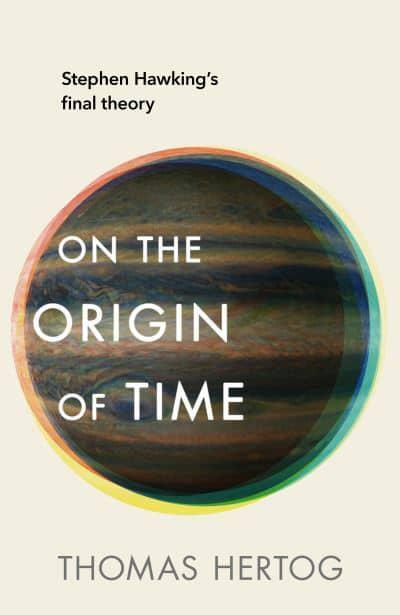
On the Origin of Time is an important book in two respects: it develops our thinking about the nature of the universe and it calls for a fundamental change in the way that humans are living on this planet.

Firstly, the nature of the universe. Hopefully, you are familiar with the wave-particle duality of light. If not, very short version: a photon has the properties of both a wave and a particle. You can make light behave like a wave and see, for example, the interference patterns it makes when it ripples through two holes. Just as with ordinary waves, when streams of light meet they reinforce each other or cancel each other out. The other aspect of light is that it is a particle and you can measure it as a stream of individual pulses as it passes by a detector. Light has both those qualities simultaneously, making it something very different to waves of water or particles of sand, something very hard to imagine and outside our usual experience. Well this book explains a new duality that has been explored in the last twenty years: that between the universe we are familiar with and a boundary filled with quantum information that projects the universe as a hologram: quantum holography.

The kinds of holograms we normally come across are three dimensional images created by projections from information recorded in two dimensions. Recent developments in physics argue that you can create a three-dimensional boundary hologram that projects the four-dimensional universe as we know it. This holographic revolution, says Hertog, ‘ranks among the most important and far-reaching discoveries in physics of the late twentieth century.’

Thomas Hertog: On the Origin of Time

There are a lot of implications to work out from this idea, but one of the most interesting concerns time. The boundary hologram does not feature time: time only emerges as you make the transition from the boundary to the universe we are used to.

I should pause here. That last paragraph needs a lot of unpacking. For a start, I need to make clear that when I write that the universe is a hologram, I don’t mean that it’s a rather flimsy, ghostly affair like a laser hologram. No, it’s the same universe we are familiar with. You can shape it, taste it, hear it, rub up against it and feel it rub back. The new idea is not that our experience of the universe is different, but that we can now understand that we are only accessing it from one side of a duality. It’s a bit like only ever having encountered light as a wave but finding out that it is just as valid to experience it as a sequence of particles.

Returning to the question of time: what are the implications of the fact that the boundary with holographic information is without a dimension of time? Well, I found that reading about this forced me to try to do something very difficult, which is to access the universe as being a time-not-time duality. Viewed from within the projection, it feels like there is time: there is causality and a progression from the Big Bang to where we are today. But that’s only a partial grasp on the situation. Viewed as a hologram, the universe is timeless and if you could translate the information from the boundary where the hologram is described, you could see the entire history of the universe. We are immersed in time and simultaneously in a timeless state.

If you are like me, you will have been brought up in an empirical philosophical tradition that is repelled by the thought of something being itself and something quite different at the same time. Pudding is pudding and don’t be telling me anything else. Either there is time, or there isn’t. How can you have a universe that’s a time-timeless one? Like a battery-driven toy bashing repeatedly into a wall, however, such an insistence on travelling only in straight-line paths misses the fact that the toy is in a maze and it won’t get out via straight lines.

Again and again in the history of thought, apparently insuperable clashes of rival theories have been resolved by adopting a wider perspective that reveals that they were only portraying part of a deeper picture. Rest turns out to be best understood as a special form of motion; Newton’s laws are best understood as a particular case within relativity.

Quantum Particles and Quantum Holography

In principle, therefore I’m willing to believe that there is a perspective for understanding the universe from which one can appreciate that the full picture involves both time and timelessness. In fact, this thought is rather appealing to me, exciting even (what effect would it have on your behaviour if you thought that everything you did was preserved somewhere?). The book doesn’t offer any of the maths behind quantum holography. We’re told that ‘it requires a sophisticated mathematical operation’ to decipher even a constrained physical universe from a holographic surface description, which means the reader only gets the gist of the argument. Given that this is a bit ropey and there is currently no explanation of where such a surface might exist, the book’s claims about the holographic nature of the universe might be a bit premature.

As an aside, a certain amount of the book is taken up with explaining how impressive was the mind of Stephen Hawking and how Hawking and the author anticipated many of the recent developments in physics. I think that in places the pages of the book are stained by the discolouring marks of our current celebrity culture and proprietorial approach to ideas, which is unfortunate because the core ideas in this book are valid and important.

The book is at its most persuasive with regard to black holes. One crucial paradox that this new approach resolves is that arising from black hole radiation. In 1974, Hawking demonstrated that black holes radiate energy. By classical general relativity, black holes destroy all information falling through the event horizon, infinitely. In contrast, by Hawking’s formula, black holes have a complex inner life and a finite capacity to absorb information. This capacity is massive – the black hole at the centre of the Milky Way can store 1080 gigabytes (the entire corpus of data currently stored in Google’s servers could fit in a black hole the size of a proton) – but it is finite and a black hole will gradually evaporate.

Quantum Holography and the Black Hole Information Paradox

The fact that black holes can radiate themselves out of existence creates a major paradox. What happens to all the information that fell into the black hole? If it is gone forever, this violates a fundamental and well understood feature of quantum physics, which is that the wave function of any system has to preserve information. This is connected to the probabilistic nature of a quantum event. The sum of the probabilities has to be one. Suppose we’re trying to pin down a subatomic particle’s position. Quantum physics gives us a formula for doing this that is probabilistic. There is a chance of finding the particle at position x. And if we add up the probabilities for all the possible x’s, this has to come to 1 since the particle is definitely somewhere.

The headache that Hawking Radiation posed for quantum physics is that if a black hole has evaporated but in the course of its life it has destroyed all the information that crossed into it, then the universe has a net loss of information. All the probabilities for the position of a particle no longer add up to 1. And this makes a nonsense of the laws of physics and quantum physics in particular.

Hawking Radition and Quantum Holography
Hawking Radition from Black Holes Created a Major Paradox

What about if the black hole radiation contained the missing information? That would work very well for keeping quantum mechanics consistent across the universe. The problem was that for a long time – two decades – the maths of Hawking Radiation said that the emitted radiation was featureless: once a black hole fully evaporated, all that was left was a cloud of thermal radiation with no history.

The breakthrough of quantum holography allowed a solution to this paradox. You can describe a black hole using a boundary hologram and by doing so, the life cycle of the black hole that is so complex and paradoxical in the universe as we experience it turns out to be very simple. As the projection of a boundary hologram a black hole is not much more complex than the heating and cooling of a plasma of subatomic particles. These fairly ordinary clusters of particles can be described with wave functions that preserve information. So by appreciating the duality of black holes – that they are simultaneously relativistic objects that are destructive of everything and yet obey information-preserving quantum laws when understood as holograms – you can, in principle, conclude that the black hole information paradox is only superficial.

In the last few years, a model has emerged of how, more precisely, the information inside a black hole can be preserved. Subatomic particles that arise as particle-antiparticle pairs are entangled and if you can measure one you simultaneously learn about the other. If one of the pair falls into a black hole, in theory we can still know a great deal about it by measuring the partner particle. Entanglement between the inside and outside of a black hole can be described mathematically by a wormhole.

Relativity and Quantum Physics

Another huge discrepancy in science addressed by the idea of the boundary hologram projecting the universe is the paradox that relativity and quantum mechanics are incompatible. Relativity is the science that traditionally informs our picture of the universe, especially with regard to large objects and gravity. The domain of quantum mechanics is typically the tiny realm of subatomic particles. The two theories are both enormously successful and yet they aren’t consistent with each other and this shows up when you consider black holes or the Big Bang, where quantum effects are massively magnified to become of fundamental importance at the macro level, which is supposed to be relativistic.

Quantum Holography and the Big Bang
The Big Bang is an event where quantum effects matter on a scale that is usually reletavistic

Quantum holography offers a standpoint to resolve the crisis, again by allowing us to appreciate that there is a duality at play, where it is not either / or but both. The quantum description of the boundary hologram gives rise to the relativistic content of the universe with planets and stars. Again, like the treatment of light as both wave and particle, we need to understand the universe in a totality where it is simultaneously both. As Hertog puts it, ‘Gravity and quantum theory need not be water and fire but can be like yin and yang, two very different yet complementary descriptions of one and the same physical reality.’

You can see this is an ambitious book. It tackles the deep challenges at the boundaries of our knowledge and any theory that offers a breakthrough on the decades-long problem of making relativity and quantum theory compatible would be worth reading for that topic alone.

Quantum Holography and the Origins of Time

What does quantum holography reveal with regard to the origin of the universe? It shows a vast emptiness, where you have scrolled so far out and blurred the resolution of the information to the point that there is just one entangled particle-antiparticle pair. This translates as the pre-origin of physics.

‘One ventures into the past in holographic cosmology by taking something like a blurred viewpoint on the hologram… It is like zooming out… A hologram of an expanding universe inscribes the far past in qubits spanning huge distances in the surface world… in effect, eventually, one runs out of entangled bits. This, then, would be the origin of time.’

Note how different this is to the classical query about what existed before the Big Bang. From within the universe and especially within the flow of time, it seems to be a reasonable question to wonder what happened before the Big Bang. By treating the universe as a quantum hologram, however, we appreciate that all the laws of physics themselves, including those concerning time, are emergent. It is not like there is a giant clock standing outside of the universe; nor fundamental laws that when we apply them to the initial conditions will allow us to model the development of the universe. What lies beyond or before the universe? We can’t say because there is nothing to speak with: there is no information on the hologram about this.

Note too how in the cosmological holograph there is no sign of multiple island universes. No multiverse. The idea that the Big Bang occurs momentarily after our universe has dropped away from a seething stream of chaotic energy has many advocates. The main appeal of this version of the multiverse argument (universes are constantly bubbling from primordial froth) is that it allows for a selection process to arrive at a universe where life is possible, despite that being extremely unlikely. But as Hertog points out, such a multiverse model requires us to believe in a place of infinite information whereas a boundary hologram is finite and for me there’s something more persuasive about that.

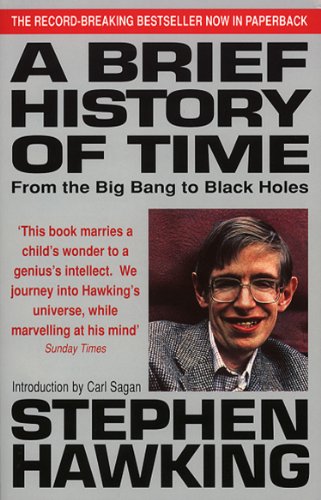
Moreover, On the Origin of Time has its own answer to the challenges of the Anthropic Principle (the laws of this universe are perfect for the evolution of life. A tiny change to any of the physical constants, however, would have resulted in very different universes. So how has this perfect universe come about?). In order to understand the hologram solution to the Anthropic Principle, we also have to understand the difference between this new book and the ideas Hawking put forward in A Brief History of Time.

A Brief History of Time

Stephen Hawking: A Brief History of Time

‘I now object to the idea that the universe has a global classical state. We live in a quantum universe so it should be described by superposition of histories à la Feynman, each with its own probability… I think that a proper quantum outlook will lead to a different philosophy of cosmology in which we work from the top down, backward in time, starting from the surface of our observations.’

One of the strangest features of the quantum world is that observation is integral to understanding it. If you had a conventional Western education like mine, then science is taught as the discovery of laws of nature that are always exact, regardless of whether anyone or anything is watching. In the quantum world, a particle is in a superposition of possible positions and velocities, described by a wave function, until one of these is fixed by an observation (the other one then, necessarily, becoming unknowable). The observer doesn’t have to be human or sentient. Any record of quantum events is a form of observation, so when a quartz crystal preserves the path of a subatomic particle that passed through it, the crystal acts as an observer.

The quantum universe does not branch without observation and this is true for fixing time as well as for space. Suppose a beam of light from a very distant quasar takes billions of years to reach us and that on the way it encounters a galaxy, which bends the light along one of many possible pathways to our telescopes. This really does happen and is called gravitational lensing. Only when we observe the light do we find out which route it actually took, which fragment of the quantum universe we are in. Until then, it is in a wave function travelling through all possible routes.

This is what Hawking and Hertog mean by ‘top-down’ cosmology. They believe the universe is a quantum universe and that even the distant past, when no observers existed, can be selected by observation today. Note that this is not at all the same as time travel. Nothing is being sent into the past. It’s more like an archaeologist finding a new type of bone and therefore being able to explain the path that evolution took. Except that for the archaeologist, the past has already been observed (by environmental events a fraction of a second after the gene mutation that gave rise to the new creature) and the branch of the universe we live in fixed long before their discovery of the bone. In the example of light crossing space for billions of years, the difference with archaeology is that the quasar light is still in a state of superposition until we switch on the telescope. The history of quantum activity isn’t fixed until an observation has taken place; current and future events select the past.

Since 2015, experiments have confirmed that the history of the motion of subatomic particles is fixed by observation and that before the observation they are in a quantum state. As Andrew Truscott put it after conducting an experiment with atoms of helium, ‘It was only when they were measured at the end of the journey that their wave-like or particle-like behaviour was brought into existence.’

This is an elusive but crucial point. It is perhaps best understood with a simple game designed by John Wheeler, a physicist whom Hawking and Hertog came to value very highly for his pathbreaking ideas in the 70s and 80s. The game is like Twenty Questions and you have to guess the item the other players are thinking of, with them giving Yes/No answers. The other players, however, haven’t agreed on what that item is. The only rule they have to obey is that their answer (Yes or No) must be compatible with the previous answers. After several questions, the possibilities are more and more constrained until the game converges on an answer that might be extraordinarily unlikely at the start (what are the odds, for example, that the result would be a black pawn from a chess set made in 1928?) but which is consistent. Notice how the questions being asked by you make all the difference to where the game ends up. If you ask, ‘is it something to do with chess?’ and the person whose turn it is to answer says ‘yes’, that creative intervention by you narrows down the possible results considerably.

In the same way, when we make observations about the universe, we are assisting in creating the answer. Hawking once told Hertog, ‘The history of the universe depends on the question you ask.’ We live in a participatory universe.

Wheeler Diagram of the Participatory Universe

Wheeler drew an image to help make this insight clearer. The universe develops to the point where there are observers and these observers fix the past, including the distant past long before any observers exist.

If we imagine the line in the Wheeler diagram as the outcome after a quantum field has been fixed by an observation, then we get to the top-down cosmology of Hertog and Hawking.

Resolving the Anthropic Principle with Quantum Holography

Taking a top-down, observer inclusive, approach to the conundrum of the Anthropic Principle makes it a non-paradox. From a classical perspective it seems extraordinary that the laws of physics should have, at every choice, taken the path that resulted in a life-compatible universe. But if we are only now switching on the telescope and observing the fragment of the wave function that we live in, then it necessarily has to be one that supports life. We might be fixing a fragment that was very unlikely, statistically, to have arisen from repeated rolls of the dice. But then all the options are more or less unlikely.

Again, it is helpful to compare the situation with Darwinian evolution. If you repeatedly run a simulation of evolution on Earth, the chance of arriving at human beings is almost inconceivably remote. But if all the evolutionary paths are in flux until an act of observation fixes the exact route taken then there is no mystery. Or rather, there’s a different kind of mystery. The way in which we got here is settled: what might have happened has been fixed by observation of the very early universe. There are other mysteries, though, such as why is there life in the universe at all?

This brings me to the other sense in which the book is revolutionary. It is an appeal for us to salvage something very precious, human life, while we still can.

Saving Human Life on Earth

The final chapter of On the Origin of Time points out that our way of life is dangerously precarious and it’s our own fault. Human-made existential risks (global heating, nuclear war, AI, etc.) threaten disaster. It’s curious, given how amenable the universe is to life, that there is no evidence for extraterrestrial civilisations. Perhaps, Hertog speculates, following the thought of Italian physicist Enrico Fermi in 1950, there is a roadblock that prevents most species from being able to spread into the cosmos. We might be approaching that roadblock. Or perhaps it is that humans are dangerous and best avoided. As Hawking once put it, ‘we only have to look at ourselves to see how intelligent life might develop into something we wouldn’t want to meet.’

It’s interesting to read how a scientist contemplates the social issues involved in saving the Earth, as opposed to a socialist or anarchist thinker. Hertog believes we can still avoid the precipice and that to do so scientists and scholars will need to act together for the common good. In particular, the current path humanity is on has to change. To analyse that mistaken path, Hertog discusses a 1963 essay by Hannah Arendt, The Conquest of Space and the Stature of Man. Arendt argued that the more humanity obtains the knowledge to control the physical environment, the more we threaten our own freedom.

This is an unusual point of view in the West at least. Here we tend to believe that the scientific revolution is very positive and that the rational goals of science are bringing us towards higher truths. This is the ethos of the Enlightenment, which in turn can be seen as a significant acceleration of a way of life begun with systematic agriculture and the early class societies of about seven thousand years ago. As an aside, Marxism tends not to counterpose itself to this positive view of the scientific revolution, but usually sees itself as completing the full emancipation of humans from nature, overcoming the fetters imposed by capitalism.

It is strange to live in times when a leading practitioner of science should argue that, ‘the flight from our earthly roots that is the hallmark of modern science has also led to a chasm between our human goals and the supposedly objective workings of nature,’ but Hertog strongly agrees with Arendt. Earth alienation, the detached view, is intrinsic to much of science and is leading to world alienation. Modern science of this sort, says Hertog, ‘will ultimately prove to be a self-defeating paradigm.’

The pursuit of science and technology, stripped from all humanity is fundamentally flawed. Be it the conquest of space in the hopes of geo-engineering another planet; the search for powerful biotechnology; or the quest for a final physical theory; Hertog agrees with Arendt that these are ‘acts of rebellion against our human condition as dwellers on this planet’.

Planet Earth becomes an object like any other, something to use, and not our home. We transform ourselves from subjects of Earth to objects. We are on course to cease to be human by, ‘lowering the stature of mankind to that of a large-scale ant colony, collectivised and monitored, deprived of all freedom.’

There is a connection between Hertog’s belief in quantum holography and his opposition to the alienation of humanity from the Earth. ‘A genuine quantum outlook on the universe counters the relentless alienating forces of modern science and lets one build cosmology anew from an interior viewpoint.’

Observers have a creative role in cosmic affairs, introducing a backward-in-time element. We read the fundamentals of the history of the universe from the top down. It turns the apparent design of the universe upside down: ‘at a quantum level the universe engineers its own biofriendliness. Life and the universes are in some way a mutual fit, according to the theory, because, in a deeper sense, they come into existence together.’

Freedom. Creativity. Imagination. Participation. These are ideas usually expressed by socialists and anarchists rather than scientists addressing humanity’s relationship to the early universe. So it is encouraging and a source of hope that millions of people are reading a bestselling book about the origin of time, with its call for an about turn in practice of science. There’s a zeitgeist at play here, perhaps the owl of Minerva taking flight, because Wengrow and Graeber’s radical deconstruction of primitive communism and re-telling the story of early human societies is also a bestseller.

The skies are darkening but it is not just revolutionaries who can see this and want to find a way out while we still can.

Filed Under: Reviews

Hoods Hoods Klan Interview

30/05/2023 by Conor Kostick 3 Comments

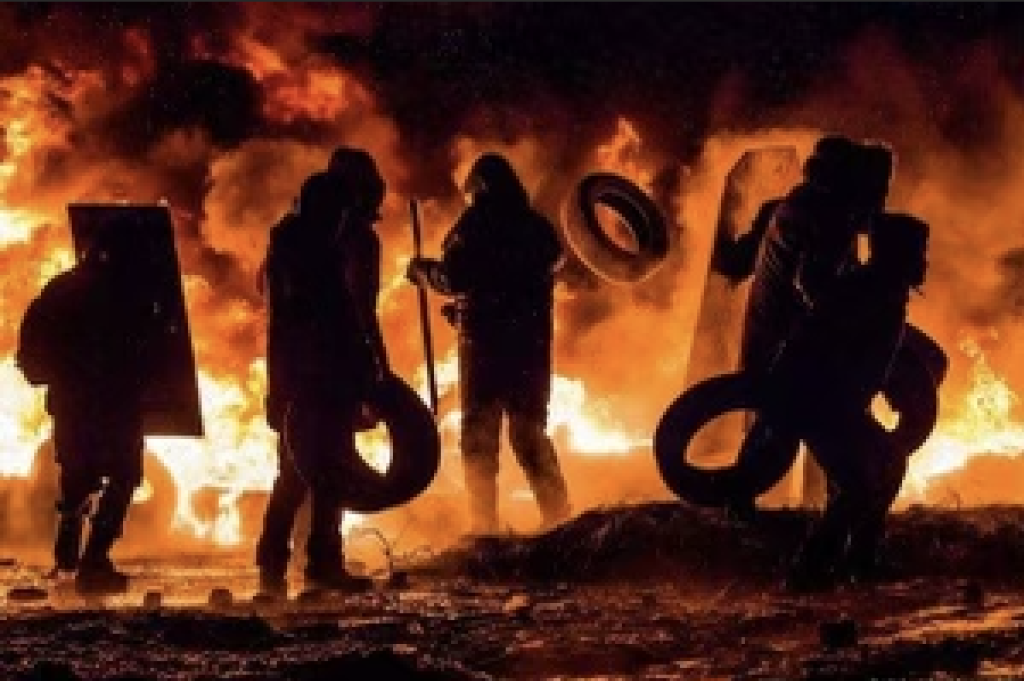
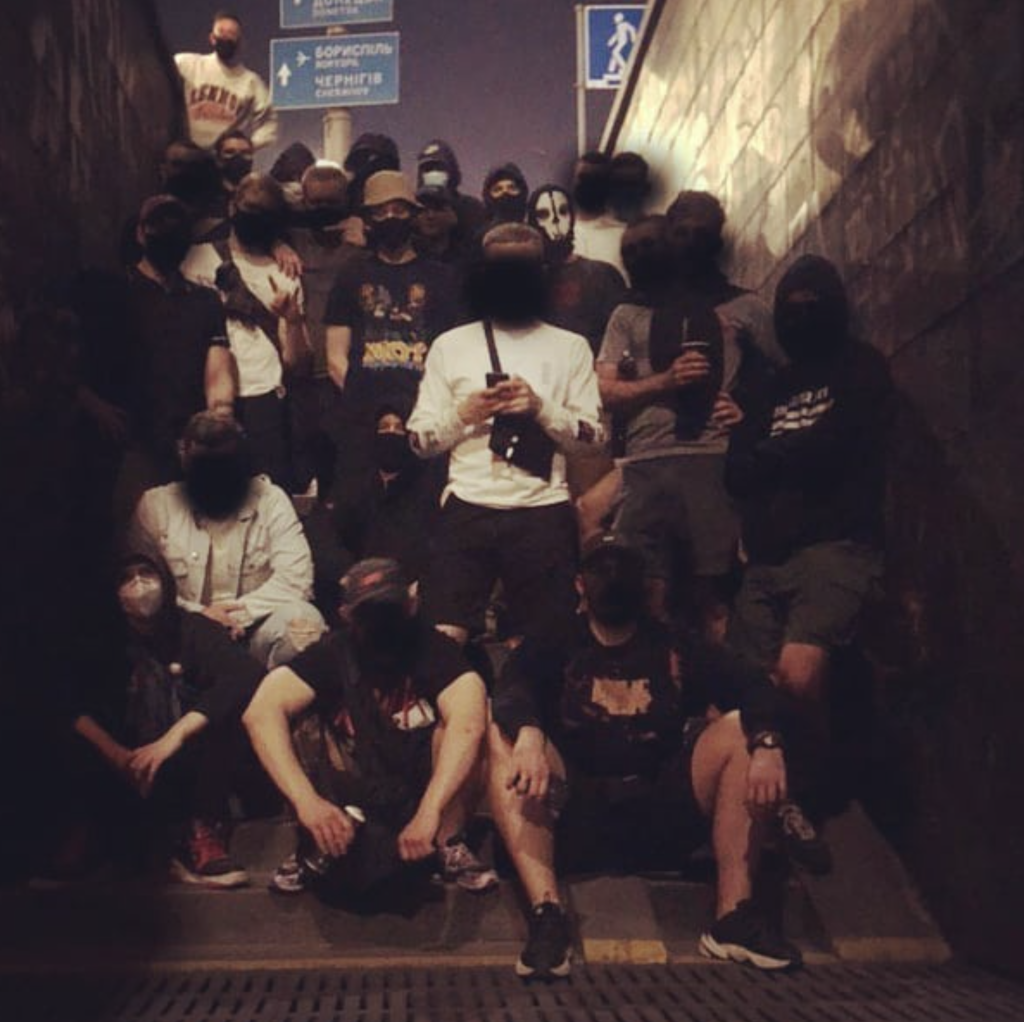
Hoods Hoods Klan: Interview: Eugene at the epicentre of clashes between protesters and police in Hrushevskoho street, Maidan Revolution, 2014
Hoods Hoods Klan: Interview: Eugene at the epicentre of clashes between protesters and police in Hrushevskoho street, Maidan Revolution, 2014.

I met Eugene at the Dublin Anarchist Bookfair, 2023. He came by the event and gave an impromptu talk at a panel on challenging imperialism. Afterwards, he agreed to meet me to be interviewed for the Independent Left website about his experiences with the Arsenal Kyiv, Hoods Hoods Klan, who have been the subject of a powerful documentary by Jake Hanrahan: Frontline Hooligan. I found what Eugene had to say inspiring and important for the future of the left internationally.

Eugene: My name is Eugene and I’m a member of the group of Arsenal Kyiv hooligans, who are called Hoods Hoods Klan. This organisation was founded in 2007 and I have had a connection with all of these lads since that time.

Conor: How did you meet them? How did you get started?

Eugene: Actually, we were a group of punk hardcore kids. At that time, football hooligans in Ukraine were right-wing: racists, Nazis, or something like that. And they always wanted to fight, especially against certain people like anti-fascists.

They went looking for anti-fascists for street violence because they need street violence. So they started to attack the punk gigs. And we wanted to protect the punk gigs, which were happening every single week. I was sixteen or seventeen at that time­; we were a young generation and we were Straight Edge. Straight Edge meant that we didn’t drink, didn’t smoke, didn’t fuck. And most of us did some sport. The older generation of Nazi skinheads were much more into alcohol; so we were much younger, but also fitter. We became a group of people who understood each other without any words. In any gig where someone said, “Boneheads,” we would group together and go outside on the street and look for right-wing hooligans. And then in 2004, some older anti-fascists, older than me, they understood that Arsenal Kyiv was the only team for us.

Hoods Hoods Klan Interview: logo
Hoods Hoods Klan Badge: No Fear No Weakness

Arsenal Kyiv had a huge working-class background, because the arsenal was one of the biggest manufacturing centres in Ukraine. It started in the eighteenth century or the seventeenth. And it was huge. The Arsenal Kyiv football team was founded in 1925, but they only played in the second, or maybe third, Soviet Union division. And in 1964 they ran out of money and stopped. But it was a really working-class football team. And then in 2001 the club was founded again and in 2004 a group of maybe just five or six anti-fascists from Kyiv started to support this team. And then our group, the Hoods Hoods Klan was founded in 2007. In 2007, it was maybe nine or ten people, something like that.

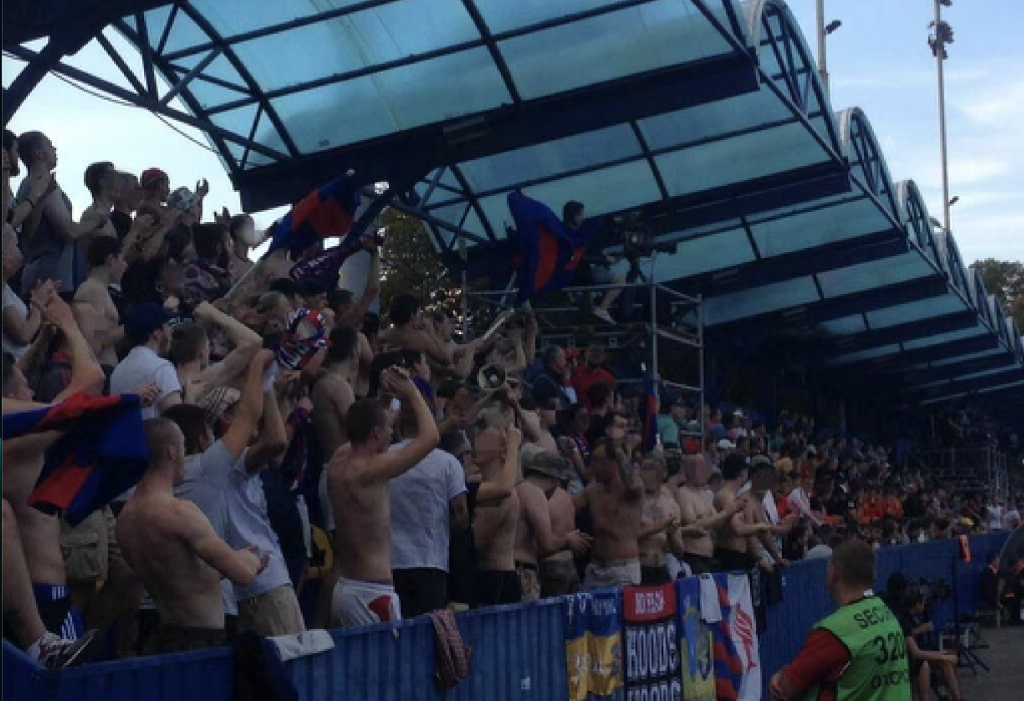
Hoods Hoods Klan Interview: Arsenal Kyiv firm
Hoods Hoods Klan Interview: Arsenal Kyiv

Year after year we gained more people because of Nazi attacks. Some people always want to offer protection and you’re very happy when you find someone who has the same ideas: anti-fascist, anti-racist and all the other positive values. There were a lot of people from the hardcore punk scene in the movement. It was one of real unity. So for example, I was living in Chernihiv, it’s the north part of Ukraine, but we had a strong connection with the guys from Kyiv. Five lads in my town started to do some hooligan things with the Hoods Hoods Klan because the bands from Kyiv played in my hometown, and the bands from Chernihiv played in Kyiv. We were young kids with the same ideas of anti-homophobia, anti-racism, anti-fascism, anti-terrorism, anti-imperialism.

I’m also vegan and there’s a lot of vegans in my group. Because my childhood was very political. So most of us, we’re like human rights and animal rights activists from the very beginning. When I was a kid, we had a Food Not Bombs in my hometown. I was the member of the Food Not Bombs group. We had everything in my childhood: Critical Mass; Food Not Bombs; all of the charity foundations; the eco campaigns; the animal liberation campaigns.

Hoods Hoods Klan Interview: Kyiv
Hoods Hoods Klan Interview: On the streets of Kyiv

Conor: It’s unusual for football hooligans to be revolutionaries.

Eugene: It’s a very unique thing for Eastern Europe, because most of the Eastern European hooligans are really right wing. And in Ukraine in 2008 most of the right wing hooligans united against us. We were against everyone and everyone was against us. We were the only group that fought against everyone many times. And many times we won the fights.

Conor: Did you earn respect from your enemies?

Eugene: Yes, I think a lot. We went out to fight even in smaller numbers, despite the fact that we knew that we could be defeated. And if we managed to fight with an equal number, most often we won. We call it the psychology of a winner. 

Even our women are brave. Today women from Arsenal Kyiv supporters are in the front line, like medics. If feminists in Ireland want to support women in the front line, I can say that we have this.

Conor: Was it dangerous?

Eugene: Street violence is always dangerous. At the same time, Hoods has always had a code of honour: we did not use knives, traumatic weapons or firearms in fights. Although, I confess that in 2012, in one of the street fights with right-wing hooligans, I was shot three times with a traumatic pistol. But I didn’t get hit. I think that with the help of force, we managed to convince the Nazis that they do not need to use knives or guns in fights. Because we were not afraid to use them in their direction. But we preferred fists.

Speaking of weapons, I will say that the Ukrainian neo-Nazis have always imitated their comrades-in-arms from Russia. Unfortunately in 2008 in Russia, the boneheads – Nazi skinheads – had a strong relationship with the FSB, which is the new KGB. And after the new presidential election in Russia, the Medvedev election of 2008, they wanted to show the Russian people that a strong power was needed. So the FSB did a deal with the boneheads and they started to kill the anti-fascists in Russia.

They killed Ivan Khutorskoy, Fyodor Filatov, and Ilya Dgaparidze. These were supporters of Arsenal Kyiv. And they killed Anastasia Baburova, she was journalist investigating Nazis and she was murdered on 19 January 2009 along with anti-Nazi lawyer Stanislav Markelov.

Conor: Did you have to fight for your life?

Eugene: Since 2005, I think, a lot of times I was fighting. I remember the time when I walked into a punk hardcore gig with my girlfriend and a group of Nazis, maybe seven, I don’t know, hit me first on the back of my head. One of them broke my eyebrow. I think they wanted to knock me down. But they couldn’t bring me down. I turned around and told them: go fuck yourself and they ran away. So, it was a quick fight and I think for me, everything started at that moment. You protect yourself. One memorable fight for me with Nazis in Ukraine was in 2018 at a hardcore punk gig. A group of Nazis tried to come in and I just came to them and asked, “What are you doing here?” And they were laughing, “We just want to watch the real gay, trans people: this scum.” And soon we’re just fighting, one by one, and it’s finished. They go away. If a Nazi or racist or homophobic person got inside the concert, we were there to protect our ideas.

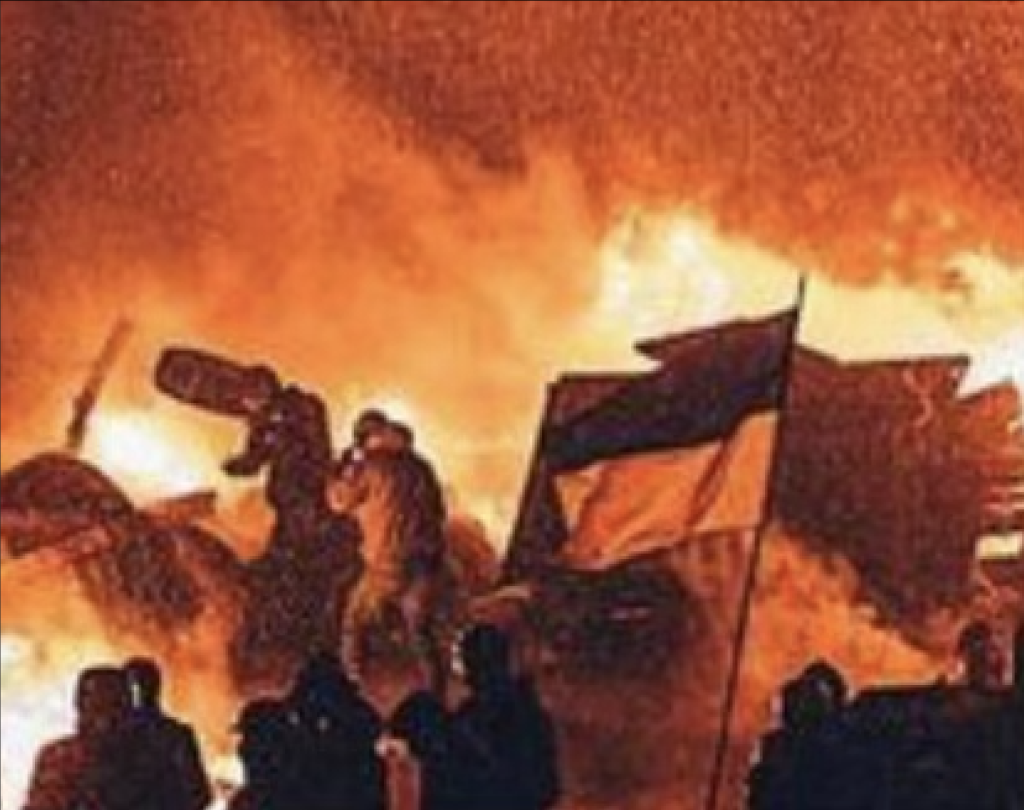
Hoods Hoods Klan: Interview: Eugene at Maidan Revolution, 2014
Hoods Hoods Klan Interview: Eugene at Maidan Revolution, 2014.

Conor: You were involved in the Maidan uprising, right? Even though there was some far right involved in that as well?

Eugene: Far right? It’s a good question. I was in Maidan from the very, very first day. Maidan started as a student action. Students were in the city centre and the cops beat them. One of the students was my classmate, he’s not Nazi, I know him well. And the next day there were a million people in the city centre. There were no right-wing flags, just flags of Ukraine: no political parties. I’m someone who joined the Maidan movement and I can truly say that it was not a right-wing revolution.

We had online broadcasts from Maidan. So even if you’re working, you’re watching the revolution. I saw the cops were gathering to beat people and immediately we were there, like within twenty minutes I think. They were armed with guns and shooting. And they had the Crimean special forces. This was the first time that I saw cops firing guns.

Then we started to build barricades in Maidan. I was one of the very first people who were there at that time who started to build the barricades from all of the stuff that was there. I had just walked in there. Everyone from Kyiv was there. If you’re a Nazi, maybe you were there too, but there were no Celtic Cross or swastikas there. Actually, even if you had a t-shirt with Nazi symbols, we also had people who wore anarchist t-shirts or something like that. So if you can say that it was a Nazi revolution, I can say that it was an anarchist revolution. But you can’t say this about ninety-nine per cent of people, those who were just working-class people without right wing ideas.

One night there was a clash and fires in the street from Molotov cocktails and it was really cold – minus thirteen – everything was burning. And the cops tried to stop the fire with hoses and water and it was like you were covered in ice. Someone said that the Right Sector is coming.

Until midnight there were a lot of people there. But after the last metro train, it was down to just hundreds of people. And we are very lucky that a huge wind carried the smoke over the cops, and they didn’t know how many people were there because if they had seen how few we were, they would have killed us.

Someone nearby said, “Okay, right now the Right Sector would be help.” And for the next minute, me and my friend who is also antifascist, we were just laughing because the famous Right Sector turned out to be just fifteen-years-old kids with wooden shields. Maybe one per cent of the people that night were right wing, but there were even people of color there. It was a revolution of the Ukrainian people. All of the Ukraine people were there.

Hoods Hoods Klan Interview: the War with Russia

Conor: Russia responded to Maidan by attacking Ukraine. How did Hoods Hoods Klan react?

Eugene: In 2014, immediately after Maidan, Russia grabbed the Crimea. And then in May were battles in the Donetsk region and a couple of our lads were involved. It was a tragedy. There were huge losses for the Ukrainian army and two anarchist guys from Arsenal Kyiv were captured and they were put in prison. Russia occupied our land and my friend – his nickname is Doc – had an injury to his back from a rocket. He had called for medical help but the Russians put him in prison for three months. We collected money for him: I made t-shirts with his image and the line from our national anthem, We will allow no masters to rule us in our motherland. It’s a very anarchist line! After that, more of Hoods Hood Klan joined the army.

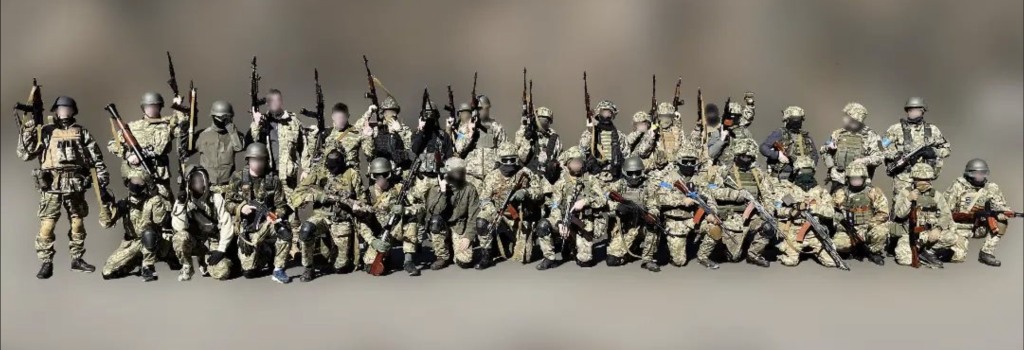
Hoods Hoods Klan Interview: geared up for war.
Hoods Hoods Klan geared up for war against the Russian invasion.

Conor: When you joined the Army, were you able to stay as the Hoods Hoods Klan? Were you able to stay anti-fascist or did you just have to go wherever you were told?

Eugene: You could stay as a group. Even right now. We are still anti racist, anti-homophobic, anti-imperialist, anti-authoritarian. And we are fighting against a government, Russia, which is a hundred per cent homophobic; a hundred percent imperialistic. I’d like to say they are racist but it’s not quite the right term. More accurate is that they are a hundred percent xenophobic. They are very chauvinistic and their idea is that there is no Ukrainian nation. Like Hitler wanted to say that there is no Jewish people. So Putin, maybe you saw the video two days ago?

Conor: The map?

Eugene: …he showed a seventeenth century map and said, “…there is no Ukrainian people at all.” It was funny, because in fact the map shows the opposite. But it shows Putin’s intention: to make Ukraine disappear. We are fighting against a chauvinistic, right-wing, terrorist country. So yes, we are still fighting with the same ideas we had fifteen years again.

Conor: Right now there are insurgents, Russian insurgents, trying to overthrow Putin. Some of them say that they’re football hooligans. And they are carrying out raids. One of these movements seems to be fascist, and another one seems to be a left movement. So how do you feel about that? Is it okay to be working with far-right units? Is there a kind of a truce between you and the fascists until you beat Russia? How does that work?

Eugene: Firstly, it’s important to say that these are Russian people fighting on their territory. I mean the fight against the Putin regime. Ukrainians just protect their own territory. At the moment, Ukrainian cities are being shelled by people of the same skin colour. As we understand, the Ukrainian army is at war with representatives of the same race. Therefore, it is ridiculous to talk about some kind of Racial Holy War. As we understand it, Ukrainian women and children were not raped by defenders of LGBT rights or feminism.  

In my opinion, the vast majority of the Russian military are homophobic and transphobic. I think that many Russians support the idea of the Russian world, being nationalists and xenophobes. One way or another, the ideas of Russian imperialism, chauvinism and even Ukrainophobia are close to many. The Russian state has long met all the signs of fascism. Therefore, it is difficult for me to understand the logic of those who fight against Russia and call themselves a Nazi or even a representative of the right ideology.

If these Russian movements say that they’re racist or fascist or right wing, I can say that I’m a hundred percent against their ideas. Because those are the values which we’re fighting against. If Russian fascists want to have a strong leader, they already have it. If they want to have the power of one religion, they already have it. There are no human rights at all in Russia. Ukraine is not perfect because it’s an eastern European country with the huge legacy of the USSR. And we still need to help with the free press. But at least we have some freedoms: in Russia, you can be in prison for fifteen years just because you call the war a war.

Conor: If Ukraine wins, do you think that Putin could be toppled? And do you think there is hope for the left in Ukraine?

Eugene: That is an interesting question. Yes. I think, yes. The majority of people, working-class people, are democratic people. For me Maidan was about fighting for freedom, fighting for human rights, fighting for liberation, fighting for equality, fighting for our ideas. I think it’s the younger generation of people who could go in the direction of socialist ideas. But still, we have the bad experience of the USSR. We need to know that actually you can be a progressive left, not an authoritarian left.

Conor: Not a communist left. Speaking of which, some of the left in Ireland and internationally, they don’t agree with Putin, obviously, but they see NATO as blame for the war and they refuse to support arming Ukraine. What do you think of that position?

Hoods Hoods Klan Interview: NATO

Eugene: This is different to Yugoslavia, where NATO really was fighting and was involved in the war. If you say we can’t have the weapons, well okay, how are you going to help us protect Ukraine without them? I remember the day when my home town was bombed from the air and my grandmother lost her memory. My life was ruined. It was the hardest day in my whole life. My parents had no electricity, no mobile connection, no internet. And of course no gas. They cooked food on the street. I remember how I felt when I couldn’t call them while knowing that the Russians were bombing my hometown, Chernihiv, from the air. In that small town seven hundred houses were destroyed; twenty-four from thirty-seven schools were bombed and thirty-four from fifty kindergartens. My uncle died during this occupation period, because he had no medicine.

We need weapons to protect ourselves, not to attack someone. Remember we asked for the skies to be closed and no one helped us. I think Putin uses this anti-NATO propaganda. Ukraine is being blamed for our connection with NATO. But it’s not like that: we just want to be able to protect civilians. This is attempted genocide against Ukrainian people, directed against the civilians. They’re fighting civilians. There are hundreds of martyrs in my home region: hundreds of rapes; hundreds murders of children and the elderly.

The left should be smarter than to blame the victims. We shouldn’t listen to Putin and his speeches about NATO. We should think more and read more.

Conor: And speak more to the Ukrainian left.

Eugene: Speak to Ukrainian people. What they are actually feeling at this moment. I had a call from my mother yesterday. She works with the people who lost houses, they’re refugees inside the country. Because Russians fight in the northern part of my region and two thousand families have left their homes, maybe forever. And she starts from work at 5:30am and it never finishes because it’s like every single day that people lose someone.

I lost my classmate in Bakhmut last month and every single day it happens. And you can ask my mom why she stopped her normal life so as to start to help these people. And where is NATO at this moment? I don’t know. Where is their invasion? Where is their threat to Russia?

Russia is the biggest danger and not just to Ukraine. It’s like Nazi Germany.

Conor: What do you think about Zelensky and his politics?

Eugene: I want to explain to you about the Ukrainian people. The Ukraine people are the real power in Ukraine. Not Zelensky. I think that most old-fashioned countries in the world, they still believe in politics like the United States, they still think politics is about presidents. Our army before 2014 was like the worst army in the world because after soviet corruption there was no technique, no interest from the people, nothing. If you are anarchist, you can understand me. People fight well not because they are told to but because you have someone you want to protect.

During Maidan, everyone began to fight for a better, freer Ukraine. There was no crime and it was very clean on Maidan, even though there were no police and no services. Can you imagine no cops in your town because all the cops were against you? This is the key, most important question. If there are no cops, why is there no crime? The answer is that we had groups in every zone in the city, in every block. And we protected our houses. We didn’t need the cops. We protected each other and shared the food.

And the same happened in 2022 during the invasion. In every single city it was the people who joined the Territorial Defence. No one told us to organise. You just did it. My mom and sister, they cooked food for the soldiers. My father made Molotov cocktails. I believe if that people can manage the tasks in a country, we don’t even need the president, to be honest. So Zelensky’s just a representative person, like the CEO of a company. That’s it. This is the answer about the Zelensky. The real power is not Zelensky: the real power is Ukrainian people.

It’s something new that the left in Europe can learn from. Even right now, the solidarity of people in Ukraine is coping with everything. It’s a very socialistic thing; a very anarchist thing.

Conor: What can we do to help?

Eugene: We have a group of anti-fascists on the front line. They still have a need for help. They think that the European left don’t care about this work. So if you can show them solidarity, that it’s actually important, it would be a huge help. Because we need cars, we need drones, we need body armour, we need a lot of medical equipment. We have a fundraiser for this. (PayPal xkemanx@gmail.com https://www.instagram.com/hoodshoodsklan/)

And if you really don’t want to support the front line, I have friends who help rebuild the houses in the Chernihiv region. (https://send.monobank.ua/jar/yrN9K9nJX https://www.instagram.com/varyalushchyk/) So that can be useful. Also, my sister, she’s a lawyer and she’s like a social worker helping the kindergartens and schools in my home family in Chernihiv (https://www.savedschools.in.ua/donate/). They also have a foundation to build the schools and kindergartens. There’s a lot of ways to help Ukraine.

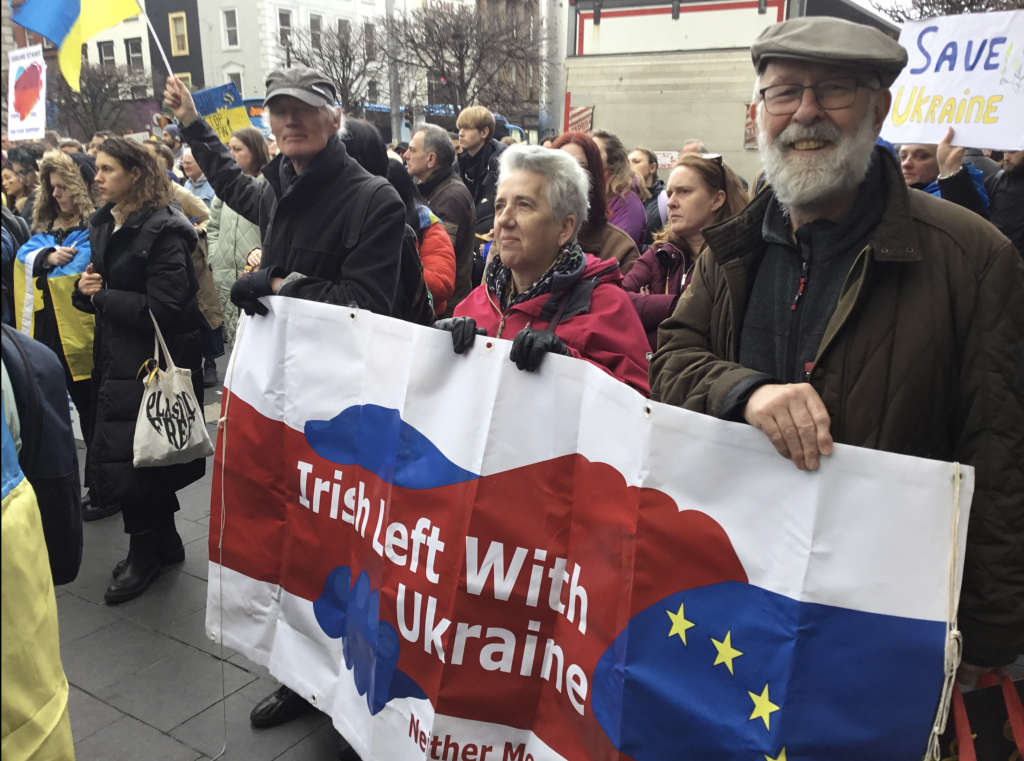
voices of resistance ILWU banner marching in solidarity with Ukraine

Conor: Irish Left with Ukraine is a grouping of trade unionists, socialists and anarchists, united behind the goal of getting solidarity for the Ukrainian left. We have a Twitter feed, a Facebook group and you can join by emailing irishleftwithukraine@gmail.com.

Filed Under: Ukraine

Oppose A Deer Cull in Ireland

08/05/2023 by admin 3 Comments

On 8 May 2023 a barrage of propaganda was put out by the government’s Deer Management Strategy Group in favour of a major cull of Ireland’s deer population. This highly contrived publicity campaign utilised the results of a survey that the group had carried out to generate their newsworthy content. Yet the survey was deeply flawed and clearly designed by those with an interest in wanting a deer cull to take place.

As the National Animal Rights Association put it, the questions were hugely biased in terms of a cull and venison trade to begin with. “It’s very clear that the government (probably due to lobbying by gun clubs primarily) want this to happen. The percentages listed in the article would indicate that gun clubs and farmers were likely the majority of those who took part in the consultation.”

Laura Broxon of NARA has asked TD Paul Murphy to shed light on the survey and, in particular, find out who was consulted. Because the public, who show enormous respect for Ireland’s deer population would never have expressed an 82% support for a deer cull: a sensational headline taken up by many media outlets out of all proportion to reality. Parliamentary Questions might also be able to expose the fact that those surveyed were not offered a chance to express support for non-lethal deer population control: if that is even needed.

There is, in fact, no data on the numbers of deer population or species. Any serious work in managing the deer population has to begin with obtaining this information. As Laura Broxon put it, “how can a cull be proposed when we have no idea how many deer there are in the first place? And hunters kill tens of thousands annually anyway, so all this makes very little sense.”

No actual research or trials in non-lethal population control have been undertaken in Ireland, even though this has been a success in America.

The Strategy Group’s press release also claimed that culling deer would be positive for biodiversity. This is completely at odds with reality, as the biggest threat to biodiversity is animal agriculture and consequent habitat destruction, water pollution, and GHG emissions.

This – as well as the ethical consideration – is why Independent Left stands for a phasing out of the animal and fish industries.

Another spurious point in the widely reported press release concerned road accidents. Road accidents can be prevented by erecting deer-proof fencing in danger zones, additional road signs and a lower speed limit.

Apart from the obvious animal rights violations, this proposed cull makes no sense, and our belief is that the Deer Management Strategy Group is probably made up of pro-bloodsports stakeholders. The agenda of the government implied by this flurry of propaganda against the deer population is to build a venison industry and also get more money in for shooting licences etc.

Two crucial facts as to why we oppose a deer cull in Ireland:

1. There has never been a survey of deer in Ireland regarding species or population, so we actually have no idea what the numbers are, and of which species.

2. In America, successful neutering and contraceptive programs were done on wild deer. We could easily do that here.

If the government decide to go ahead with a cull, they should be aware that the National Animal Rights Association will be there at every opportunity to intervene and stop this outrageous and blatant slaughter of innocent animals. #BanTheDeerCull

Filed Under: Animal Rights, Independent Left Policies

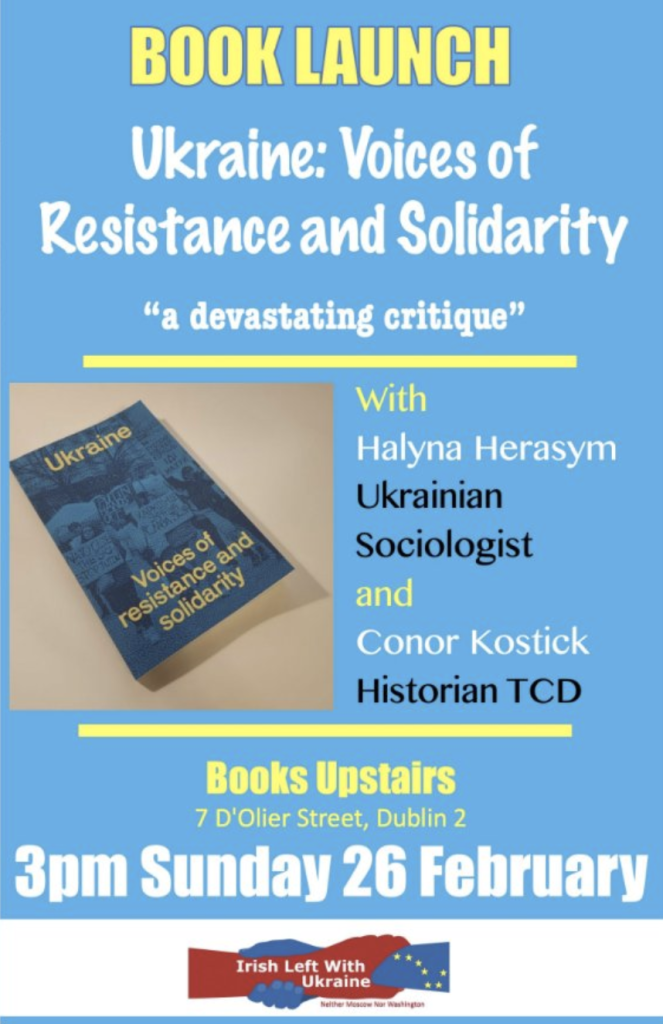
Ukraine: Voices of Resistance and Solidarity

27/02/2023 by admin 3 Comments

Ukraine Book Launch Voices of Resistance and Solidarity
Irish book launch of Ukraine: Voices of Resistance and Solidarity

Ukraine: Voices of Resistance and Solidarity is a book edited by Fred Leplat and Chris Ford, published by Resistance Books and Ukraine Solidarity campaign. It contains essays by Mick Antoniw, Welsh Labour MP; John-Paul Himka, history professor; Taras Bilous, activist for Sotsialnyi Rukh / Social Movement; Yuliya Yurchenko activist for Ukraine Solidarity Campaign and Sotsialnyi Rukh / Social Movement; Oksana Dutchak, co-editor of Spilne/ Commons; Viktoriia Pihul, Ukrainian feminist; Nataliya Levytska, Deputy Chair of the Confederation of Free Trade Unions of Ukraine; Vitalii Dudin president of Sotsialnyi Rukh / Social Movement; Bogdan Ferens, founder of the Social Democratic Platform; Eric Toussaint, spokesperson of the CADTM International; Ilya Budraitskis, activist in the Russian Socialist Movement; Niko Vorobyov, Russian-British freelance journalist; Gilbert Achcar, Lebanese socialist; Simon Pirani professor of modern languages and cultures; Stephen R. Shalom, editor of New Politics; and Dan La Botz, editor of New Politics.

Ukraine: Voices of Resistance and Solidarity is an important publication that achieves two fundamental tasks: it amplifies the voices of Ukrainian socialists, feminists and trade unionists; and it refutes the arguments that many on the left internationally deploy to excuse their failure to support the Ukrainian resistance.

On 26 February 2023, Ukraine: Voices of Resistance and Solidarity had its Irish book launch, hosted by Irish Left With Ukraine. The two speakers were Conor Kostick, a founding member of ILWU and Halyna Herasym, a Ukrainian sociologist currently based at UCD.

A full recording of the two speeches and the introduction by chair Noirin Greene, former SIPTU national equality officer can be watched below:

Transcript of the booklaunch Ukraine: Voices of Resistance and Solidarity

Noirín Greene, former SIPTU national equality officer:

So the first person I want to introduce is Conor Kostick, who a lot of you already know. Conor is an Irish historian and writer living in Dublin. He the author of many lauded works of history and fiction and has received special recognition for his significant contribution to writing for children in Ireland. And I think that’s very admirable thing to do, Conor.

Conor was editor of the Socialist Worker in Ireland, twice chairperson of the Irish Writers Union and is a board member of the National Library of Ireland. As a historian, Conor’s awards include a gold medal from Trinity College, Dublin and fellowships from the Irish Research Council and the University of Nottingham. There’s also a great deal more, I’m seeing, Conor, but as I say, I’m only five minutes so I cut it all short. So thank you and I’ll ask Conor to give his address. Thank you.

Conor Kostick, novelist and historian:

I’m very glad to be asked to launch this book. I think it’s a really important book and it achieved two fundamentally important goals. One is it amplifies the voices coming from Ukraine, and two, it deals with the arguments that we’ve been facing since this war began. And just to go over those two points, it’s hard to underestimate the importance of hearing voices from Ukraine. The great failing of the left internationally, and we see it here in Ireland, is that it doesn’t start with the experience of people in Ukraine. Instead, they start from various different positions. They look at their political interests, their networks, and they come up with formulations about the situation in Ukraine that are back to front. And they end up, as we’ve seen recently, making all sorts of calls that have no bearing on what has actually happened in this last year.

They don’t think about, they don’t empathize with the experience of the people who are just living just like we were with the same nuances of politics, people struggling for a better world in against neoliberal agendas and so on. And suddenly bang! This massive, massive transformation of their lives, this deterioration of their lives, this horrific war. So I think to start with the experience of people in Ukraine means you don’t go as far wrong. And what this book does is it gives us the voice of the left in Ukraine. This is really important, because just like in Ireland, just like in any country, there’s a rich left tradition in Ukraine, there’s trade unionists, feminists, LGBTQ+ activists, socialists, anarchists, of course, every variation of political party that exists on the left elsewhere, exists in Ukraine. So why don’t we talk to them? Why don’t we start by saying, “What’s your experience? What do you want us to do? How can we show our solidarity with you?”

And when you start like that, you can very quickly arrive at the importance of arguing for Ukraine’s rights, self-determination, because nobody on the left Ukraine has the positions that we hear being articulated by the Irish Left. Here groups like People Before Profit, The Socialist Party, the Socialist Workers Network, let alone the more sort of communist parties, they don’t make it clear that people of Ukraine have the right to resist. No, they say that, “yes, Ukraine has the right to self-determination, and they are against Putin (I will get to Putin), but they don’t have the right to take arms from the West. That’s a big mistake. They can’t have mines cleared by Irish trained people, because that’s a threat to Irish neutrality.” So they come up with these positions that are, I’ve described as a evasionist, because it’s fine to say, “We’re in favor of peace.” Everybody wants peace, but they won’t say that the peace now is going to involve occupation of Ukrainian territory.

It’s going to mean the crushing of the left. I mean, there’s no question that whenever Russia occupies territory, it smashes the left. There’s no trade union activity in Russian occupied area. The trade unions are banned. The activists like Taras says in his essay here, Taras Bilous of Social Movement, he had to make a decision about whether to stay in Kiev at the start. And people were saying to him, “If you stay, you’ll get killed,” because it looked like the Russians were going to take Kyiv. And they are killing the civilians, yes. But they’re also targeting activists. Russia has a very conservative agenda so much that really, I’ll just come into this in a minute, the real far right position on this war is to support Russia. And that’s happening internationally, because as Putin sees it, by having gay rights and so on, the West is needs putting in its place and he’s trying to stop this.

The stakes of this war are very high, because there’s a world historic momentum that we’ve also had in Ireland towards same-sex marriage and abortion and so on. And the far right internationally, the conservatives internationally, hate this. Victory for Putin is all about this kind of taking away of democracy, taking away civil rights. So what’s happening in Ukraine is absolutely vital. And Taras made the decision to stay. A lot of the socialists in Ukraine are right now in the front lines. An anarchist group I know are raising money to get night vision goggles. So they are physically putting themselves in the frontline. And as they say in the book, they’re very clear, they’re not doing this for NATO and they’re not doing this even for Zelensky, although they support the Zelensky government under these circumstances, they’re doing it because if Russia wins, all the space for left organizing is eradicated.

At least if Ukraine wins, they can then have a discussion about what post-war Ukraine looks like, how trade unionists can fight for their rights. But that fight won’t happen if they lose. When I’ve tried to raise this with the Irish Left, what I find is they cannot bring themselves to listen to the voices of the Ukrainian left. It’s like trying to bring two magnets of the same polarity together. They just slide away rather than connect. They never ever platform and address the positions of the Ukrainian left. And I’m not saying they have to agree with them. What’s really shocking about this current moment in history in Ireland is that the left here are silencing the left in Ukraine, I think deliberately so, because people like Irish Left in the Ukraine have made it clear that we’re in contact with the Ukrainian left, we would give them speakers. They don’t want to know, because as soon as they admit that there is a Ukrainian left that you should talk to and listen to, even if you disagree with them, then their arguments collapse.

I managed to get one of them online to start a bit of a discussion which he quickly ran away from. But he said, “The people you’re amplifying with this book, (and also who we’ve been in touch with since start of the war), are a terribly small minority.” It’s what he said. Now first of all, that’s simply not true. Social Movement is a modest enough organization. But here in this book we hear from trade unions representing millions of Ukrainian workers, really big representative movements, feminists representing thousands of activists. So it’s simply not true. But even if it were true, I asked him, “How many people in Ukraine support your position that Ukraine is right to have independence, Putin is wrong, but that they’re not allowed to have Western weapons?” Not one person supports that, because it’s idiotic. If Ukraine has the right to self-discrimination, then it has the right to arm, people have the right to get arms from wherever they can.

And there’s a long history of this, of independence movements gaining arms from wherever they can. Which brings me to another point. Let me just give you a quick example of what you can read about from this book. The kind of voice that deserves to be amplified, that deserves to be heard here and is being, I think, deliberately silenced by the Irish Left. This is from a feminist organization, an interview with Viktoriia Pihul. At the moment there are people going around and saying we want peace, which is fine, but the implicit message is that we’re willing to accept that Russia occupies the positions it’s got at the moment and the equivalent ‘peace now’ argument has happened with regards to feminism.

So we have a western feminist manifesto that calls for an end to war, but doesn’t say anything about whether Ukrainian women should fight for independence. This is Vuktoriia’s response, “We’ve seen many pacifist statements by western feminists, including their manifesto. In the face of war and daily deaths of our women and children we are critical of this position.” That’s a massive understatement. She must be seething at that position, but anyway. “In this context, I am part of a working group of Ukrainian feminists who have written the Ukrainian Feminist Manifesto. We call for support for Ukrainian women including our rights for armed resistance. What I mean here is succumbing to geopolitical reasoning and geopolitical thinking and withdrawing from the conflict by condemning all sides is not a workable position. We must clearly distinguish the rapist from the victim and help the victim to assert her right to exist and be a subject.” Terrific; short; powerful in just those few lines. That really makes the point more clearly than what I’ve been saying. We have to distinguish the rapists and the victims, it’s as simple as that.

The Russians are the rapists. Ukrainians are the victims. Which side are you on? Of course, you should be on the side of the victims. It’s shocking that there are so many people who cannot see it that simply and clearly and cannot recognize the experience of Ukrainians. And this has practical consequences of course, not only in that trade unions here and elsewhere have given practical solidarity to our fellow trade unionists and activists and feminists in Ukraine. But also even just for marches like the other day. The Irish Left With Ukraine, we can go to these marches, we have comradeship with the people on the marches. We can have a conversation with anybody on the marches. The rest of the Irish left, they don’t go to them, because their positions would just be treated with scorn at the best. So they’re cutting themselves off.

The Irish left, which should be so vibrantly engaged with Ukrainian left – and we’ve met people from Ukraine through these activities who are revolutionaries and Marxists and feminists of course ­– should all be comrades together and that’s not happening except thanks to Irish Left With Ukraine and through Irish trade unions. Many trade unions here have much better position than the local left parties. So that’s the side of the book that amplifies the voices from Ukraine. So you cannot underestimate how valuable that is. And then the other thing that the book does is go through many of the arguments we’ve been facing and deals with them at a sort of theoretical level, but also drawing on their experience. And I won’t go through all the arguments, but I just take on the one argument that the book helps us answer, which is the question of whether the conflict in Ukraine in an inter-imperialist war, a proxy war?

Because if it is, then we don’t want to get involved. We don’t want take sides. And that’s the position of People Before Profit, the Socialist Party and the others: “all countries have got the right to self-determination. But supporting Ukraine to defeat Russia would mean supporting America’s goals and therefore we’re not going actually give any practical support to the Ukrainian resistance.” So that’s the key argument and the book gives us really good answers. People have really looked at this. There’s a very good essay that points out really since 1900 there has not been a war anywhere in the world that has not had inter imperialist dynamics to it. Of course, if a small nation is rising up against American domination, Russia is interested in that. It weakens America, great. If a small nation is rising up against Russian domination, America’s interested in that. That’s happened throughout the whole of the twentieth century.

And in fact they don’t have this in the book, but we know from Ireland, we know from our history how it happened. In 1916 Germany shipped 20,000 rifles, a million rounds of ammunition on the Aud to help the rebels here. Roger Casement came in a U-boat. He was given a submarine from Germany. Should he not have had that submarine? Should we have not had those guns? Of course, Germany had an interest to weaken Britain. James Connolly knew that as soon as we take German weapons, there’s going to be the equivalent to People Before Profit saying, “It’s an imperialist war. You’re supporting Germany.” So he had a big banner made: we serve neither King nor Kaiser, but Ireland. Yeah, we’ll take the guns, but we’re not serving the Kaiser. There’s no quid pro quo. And that’s the position of the left in Ukraine.

“Yeah, we’ll have your Apache helicopters and we’ll have your HIMARS, we’ll have all that. We need that. We absolutely need that. Otherwise, we could lose.” And, by the way, unfortunately it’s a very difficult military situation right now. They absolutely need this kind of equipment. It doesn’t mean we’re necessarily for NATO. And even if it did, the slogan, the right to self-determination of Ukraine, means nothing if they cannot choose to join NATO. I don’t want them join NATO. Taras Bilous doesn’t want to join NATO, the trade unionists, the feminists in here don’t want to join NATO. But if they choose to join NATO, that’s their choice.

If they don’t have a choice about joining NATO, they don’t have self-determination. So you cannot make your support conditional, you can’t say, “well I’m hesitant, because they might join NATO.” Tough luck. If you believe a country has a right to self-determination, then it has the right to make choices you don’t agree with. In Ireland we’ve had loads of referendum we’ve lost, the left has lost, but at least we’re making our own decisions about whether to be in Europe or not.

The left, if it loses the argument about NATO in Ukraine, it will nevertheless carry on arguing into the future. But it cannot make those arguments unless it’s free of Russian troops. So that’s the crucial point about these proxy wars. And we’ve seen from Vietnam where Russia and China armed the Vietnamese, but the left had no problem recognizing that the Vietnamese had the right to throw out the American supported government. And on the other side of the equation, some of you remember Solidarnosc, the independent trade union that flourished in Poland in 1980. Well the CIA got straight behind that, because they wanted to weaken Russia. Thatcher and Reagan feted the Solidarnosc leaders. It didn’t stop it being a genuine mass movement that socialists would support. So just because the inter imperialist powers are jockeying for position around a movement, that can’t let you determine what your position is. Your position has to start from the core principle. There is a rapist, there is a victim. Where am I standing? You start there and you can’t go wrong.

And yes of course, you’re going to see the other side jockeying for position, but the revolutionary victory, the resistance, the people’s struggle does more for making the world a better place than to let Russia win on the grounds that otherwise the US stands to gain.

And just finally just say something on the far right: the argument has been coming from Russia that Ukraine is fascist. And as this book makes absolutely clear, fascism is a problem in Ukraine, but it’s a diminishing one from its height in 2014. They got less than two and a half percent in the election in 2019. They got no parliamentary representatives elected and the left in Ukraine don’t swallow that excuse about the far right. They need independence and they will deal with the far right. That’s their problem to deal with.

And of course, the other side is easily more identifiable with its links to the far right. I mean, there are Russian activists who describe Putin as fascist and they might not be wrong as sort of neo-fascist. When you look at the big rallies the uncanny language that so echoes Hitler. But while there are nuances about what is a fascist movement and what is just a brutal dictatorship with state forces, the excuse about fascism should be laid to rest. There’s no justification for the evasion of Ukraine on those grounds.

So those are my takeaways from the book, really powerful important book. And the more it can get read, the better.

Noirín Greene:

Well done, Conor, for giving us an overview, your insight of what’s in this magnificent book. And I hope because of your address, it doesn’t put people off buying it. Don’t think you’ve read it all, because you are certainly haven’t. It’s a fabulous, fabulous inspirational book. I know my only job was to introduce the speakers, but digressing slightly, I loved your reference to the banner which was shown over Liberty Hall. We serve neither King nor Kaiser, and that wonderful photograph of the mobilization of the citizens army. We took their weapons, who took any support from wherever they can get it. Just before I go, I know Danigan will be summing up I think at the end. If I could just ask you, giving you notice, maybe you could say a little bit about the Irish Left with Ukraine and how people can join up and what you can do next.

I do want to say that I think the time, and I think Conor mentioned that all the references that are in this wonderful book, the time for the what aboutery. I’m allowed to say pissed off, aren’t I? [inaudible 00:20:07]. Really pissed off when you’re trying to have this discussion with people on, they call it the broad left about what is happening in Ukraine and how we should support the people there in Ukraine. And this is what aboutery goes on and on and the but word. And to be quite honest with you, I think a year later it’s over. I think people need to join up, sign up and do the right thing. I know most of the people and all of you, we are on the right side and that’s all that needs to be known. So anyways, that’s my little digression.

I’m not sure I’m supposed to do that. It gives me great pleasure to afford a very warm welcome to Halyna Herasym. I hope I pronounced all of that right and just a little tiny little bit of background on, because I am limited in time. Halyna move to Ireland in 2020 from her home, and I hope I’m right on this, in the western part of Ukraine to study for her PhD in UCD School of Sociology. And little did she know that when she left her family and friends behind to complete her studies in Ireland, that her beloved Ukraine would be ravished by the terror of the Russian invasion.

Halyna will tell us about her experiences as a Ukrainian living in Ireland. And I think Conor’s stressed that earlier, that’s the people that we really need to be listening to and her reaction to the news of the invasion by Russia, by living in Ireland and her shock and concerns for her family and friends left behind in Ukraine. Also, some of the harrowing stories, because I did listen to your interview with the Irish Times and I would recommend that you certainly try and do that. I think it’s on YouTube and she’s heard of just some of the atrocities that are unfolding every day. Wasn’t just at the start, it wasn’t just in the middle, it’s still going on that have been committed by Russian forces in the occupied territories in this illegal war. And I’m sure that you will have a lot more to tell us. So very hearty welcome to her. Thank you.

Halyna Herasym, Ukrainian socialist:

Thank you, Conor. I have some large shoes to fill now after your wonderful presentation. So I want to start with a little story of one of the authors of this book, Taras Bilous was mentioned by Conor. So he’s about my age. He is a Ukrainian left activist who was fighting for workers right, for the rights of women, for the rights of LGBTQ community for quite some time now. He’s an editor of Commons Journal, the left-wing Ukrainian Journal, and he has a very peculiar biography that I think highlights the struggle of Ukrainians very well. So Taras was born in [inaudible 00:23:10] region, which is the far, far eastern part of Ukraine. And once we were together at an event where we had to speak Russian. I myself was born in western part of Ukraine as Maria already told us and my Russian is not very good. For me it’s absolutely second, third language. I knew Polish at the time better than I knew Russian.

And I was like, “Whoops, I’m in trouble.” So I had to make my presentation in Russian. I was like, “Jesus, I probably have done not very good.” And then it was Taras’ turn and I never spoke to Taras in Russian obviously. We always communicated in Ukrainian and then it was his turn and I realized that my Russian is not the worst in that room. Taras’ accent was bad and it showed that he wasn’t very fluent in Russian. I think his biography and the way he stands for his conviction highlights that many divisions within Ukrainian society are not as they see it from the outside. Taras is a very sweet, very peaceful person, very patient for… I couldn’t be that patient to save my life, to be honest. He’s always very willing to go out of his way to have a genuine discussion, even with the people he knows that they would disagree with him and sometimes even with danger to himself.

So of all the people who would be patiently trying to persuade some activists on the right side, for instance, Taras would be the one who would be patient with talking to them. And he would be the last person that you would imagine taking up arms and going to fight in the battle. But when the Russian invasion began last year, Taras decided to stay and fight. So yeah, I think his biography and his character depicts very well the experiences of so many Ukrainian people. It depicts that the story of Ukrainian society is way more complicated than simplistic divisions like West and East Russian speakers, Ukrainian speakers and so on and so on and so on. When I read this book, I could really feel the frustration of another author Oksana [inaudible 00:25:46], also sociologist from Ukraine whose husband currently is fighting in war. They have two children and she had to flee, because they lived in Kiev.

Her husband is, he’s also from the western part of Ukraine and he is a wonderful, absolutely wonderful writer. I encourage you to look him up. I think some of his writing pieces were featured in New Yorker. His name’s [inaudible 00:26:13]. He’s an absolutely wonderful writer who spent quite some time sometime traveling, trying to learn about his home country, about Ukraine and writing reports about what he had seen. His book, [inaudible 00:26:29] Ukraine, is really inspiring and it tells those stories like the one of Taras about just some people living, going about their lives, being open and having discussions with him on his way, absolutely wonderfully. He also did participate, had been participating in left-wing politics for a long time, I think more than 10 years now in Ukraine and publishing his books. And Oksana in this book had written this article on 10 terrible leftist arguments about Ukraine.

And you can sense her frustration, you can sense her anger. And she even mentioned that hearing some of these arguments, she feels emotions that she’s ashamed of because these arguments make her so angry. And I can honestly relate to that, because unfortunately with many left-wing activists, and not only in Ireland, all around the world, you can feel like you’re invisible. So you are talking and you’re not being heard as a Ukrainian, it’s like this invisible veil comes between you and the person you are trying to talk to. And this lack of acknowledgement of your agency is honestly very frustrating sometimes because again, it is a very diminishing experience to be honest, when the people do not act as if you are there equal. They are trying to persuade you that, oh, this is all like a NATO rules or whatever. You are just are just being brainwashed.

I’m sorry people. I have a very good education. I am smart, adult human being. I’m capable of coming to my own conclusions about the situation and I do know quite a bit about the situation on the ground. So I can hear, I can feel Oksana’s frustration and I’m really delighted that right now I have an opportunity to present these Ukrainian voices and Oksana’s voice in particular here. In my research, I have two streams of research, one of them is I’m researching funeral culture in Ireland here. So I learned quite a bit about the Irish society, but the other stream of my research is dedicated to social movements in Ukraine. And I’m focusing on what I’m calling social dreaming. So social dreaming is these desires and dreams and visions of Ukrainian society, which are lived, which Ukrainian society is trying to make true through social participation, through political participation, through their everyday experience.

This is something that we have seen during your Madam protest in 2013, ’14. This is something we are seeing now society, regardless of their political views, left and right and centrist people and people who are not that interested in politics, to be honest. They’re coming together in order to realize the dream of just society with a rule of law where they have the right to decide for themselves what they’re doing. And I’ve been interviewing a lot of Ukrainian activists in the course of my research and that’s something I been amazed again, being Ukrainian, being a part of this social movement. But I still, I am amazed time and again with this determination, with this desire to make the world of your dreams where you can realize the justice, when you can see how your rights are coming to reality. I’m amazed by that determination, that feeling less willingness to work towards that, time and again.

And here in Ireland, I feel like this research on social dreaming is becoming for me more important than ever, because in Ukraine right now, and even before, we had so many predecessors who wanted to see that [inaudible 00:31:15] world, that world they’re envisioning for themselves. As Conor wonderfully mentioned, we have seen the solidarity movement in Poland. We have seen so many anti-colonial moments all around the globe. So in the course of my life and the life of my generations, we had so many people to look up to. So many people who were fighting to build that [inaudible 00:31:41] and more righteous world if you will. I had this discussion today that people of Ireland a 100 years were also so wonderfully mentioned by Conor. They didn’t have somebody to look up to. They had to envision their own future. They had to envision that world where they would have that right for self-determination to decide their own fate for themselves.

I think that what this book can provide for the world and for the left all over the world is this social dream, this opportunity to think out of this world, I don’t know, Cold War mindset. This opportunity to get out of that pattern of thinking America is bad, America is a superpower. We should be standing against everybody and everything America stands for and major stands for and so on and so forth. I think that this book and the voices of Ukrainian people in general can provide this opportunity for all the left all around the globe to see something new, to step outside of the box and to build more robust solidarities, which are not limited by political naming, by things that are using clever rhetorical figures to present themselves as if they’re just, or if they are promoting somebody’s rights. I think this is a very powerful opportunity to have this kind of thinking to go into this stream of social dreaming and political imagination and build this [inaudible 00:33:40] and more robust world where solidarity grows together. Thank you.

Noirín Greene:

Thank you, Halyna, that was very wonderful. Very colorful use of words in your vision as well. I particularly liked that we need to think outside the box, especially older people as well. And those that are in bureaucratic organizations or considered themselves the old left political people. I particularly liked where you said the social, socialist dream for not just the future of Ukraine, but for around the world. And I think of anybody is in any doubt as to how to get inspiration, again, I’m plugging it again, this book is just fabulous, because you have the feminist thinking in it. You have trade unionist thinking in it, and you have political with big peace and small peace and middle peace items and articles in this book. So I would again encourage you to do that.

Irish Left With Ukraine

This book launch was one of several events organised by Irish Left With Ukraine at the time of the anniversary of the Russian invasion of Ukraine.

voices of resistance ILWU banner marching in solidarity with Ukraine

If you would like to get in touch with Irish Left With Ukraine, please email irishleftwithukraine@gmail.com.

Filed Under: All Posts, Ukraine

Northside Community Forum Against Racism

16/02/2023 by John Lyons Leave a Comment

#irelandforall
#irelandforall solidarity march against racism and the far-right 18 February 2023 Dublin

Statement by Councillor John Lyons in support of the Northside Community Forum

Over recent weeks there have been protests in the area targeting people seeking refuge in Ireland. It has been sad to see and the consequences can be traumatic for those directly targeted and can further disadvantage all our efforts to fight for a better Ireland for all as we can only secure housing for all, a better health service, more community, sports & social funding if we are united, not divided.

This country is extremely wealthy but we have a problem: the political class led by Fine Gael & Fianna Fail care only for the better off & wealthy.

They don’t care about our families, our communities.

All our energies, time and commitment should be focused on fighting for a better Ireland, not hurling abuse at people who have chosen Dublin as their new home.

Below is a Joint Statement from members of the Northside Community Forum which I fully support:

The Northside Community Forum is a network of Local Community Groups that work in Dublin North-East. We collectively develop actions, campaigns and work on issues affecting the community and community-based organisations.

Following the protests that we have seen over the last weeks in Artane and Coolock, members of this forum listed below, want to express our solidarity with the communities in Dublin North – East as we condemn the hatred expressed towards people seeking refuge and seeking asylum. Men, women and children, be they residents or newcomers should not fear for their safety on our streets, or in the places where they stay, their home from home.

We understand that only a small minority of people from our area are taking part, and the abuse is also being stirred up by agitators from outside.

We also understand that many of the issues that people are concerned about rightly relate to the many problems that impact people in our community such as poverty, inequality, homelessness and poor housing, the cost-of-living increases, the impact of drugs and the enduring grief brought about by the Stardust tragedy.

There are many things that need to be fixed in our society and it can seem like change is not possible at times. However, we do not believe that these problems should be used by some groups to stir up fear and hate.

At the turn of the last century, over half of the people who had been born in Ireland were living abroad. We as a country are very aware of the pain, loss, and opportunity that emigration can bring and as a community we can build on this wisdom as we welcome people from the Ukraine, people seeking asylum and seeking refuge.

The Northside Community Forum members as listed below are determined to listen to the community and to respond to these protests to ensure the people feel welcome and safe.

Archways

Artane Family Resource Centre

Association of Ukrainians in Ireland

Aster

Bonnybrook Early Education Centre

Bunratty Community Childcare

Clongriffin Community Association

Cluid Housing

Coolock Development Council

Coolock Law and Mediation Service

Crosscare

Darndale Belcamp Village Centre

Darndale Integrated Childcare Services

Discovery CTC

Doras Bui

Dublin Northeast Drug and Alcohol Taskforce

Grange Woodbine

Kilbarrack Coast Community Programme

Kilbarrack Community Development Programme

Kilbarrack Foxfield Preschool and Afterschool

Killester WW1 Memorial Campaign

Kilmore West Youth Project

KLEAR

Learn and Play Preschool and Afterschool CLG

LeChéile Donnycarney Community & Youth Centre

Migraine Association

Moatview Early Education Service

Near FM

North Dublin MABS

Northside Counselling

Northside Homecare Services

Northside Partnership

Out N About – Detached Youth Service

Priorswood Pastoral Parish Centre

Sphere 17

St Francis Parish committee

St John Vianney FC

Target

The Dales

The Sustainable Life School

Young Social Innovators

Northside For All
On 18 January in response to far right attacks on centres holding refugees community groups of the northside showed their solidarity with those seeking refuge in Ireland.
Northside Community Groups
Housing for All, Northside for All. 18 January 2023.

Filed Under: All Posts

  • « Go to Previous Page
  • Page 1
  • Page 2
  • Page 3
  • Page 4
  • Page 5
  • Page 6
  • Interim pages omitted …
  • Page 23
  • Go to Next Page »

Copyright © 2026 · Aspire Pro on Genesis Framework · WordPress · Log in