• Skip to primary navigation
  • Skip to main content
independent left logo

Independent Left

Environmentalism, socialism, freedom and equality. #liveablecity

  • About
  • Featured Articles
    • How Farming Must Change to Save the Planet
    • The Housing Crisis: Causes and Solutions
    • Socialism in Ireland
  • Contact Us
  • Podcast
  • Animal Rights
  • Archive
    • Irish Socialist History
    • Dublin City Council Housing
    • Ukraine
    • Protests Ireland
    • Reviews
    • Irish Political Parties
    • All Posts
    • Independent Left Policies
  • Why join?

Ireland’s Climate Strike 20 September 2019

21/09/2019 by admin Leave a Comment

Young people in Ireland played their part in the massive world-wide strike against Climate Change on 20 September 2019. The energy and determination as well as the frustration of the participants was evident in the chants and slogans on the placards.

Fair play to the anonymous students who posted on Reddit that they had to go against the principal to participate:

Obviously have to keep this anonymous so I wont say what school but today out school refused to let us out of school for a few hours to the protests for climate change
I think this is a joke like seriously. It was only from 12-3 like its ridiculous. The school didn’t even mention it to us at all that this was happening or suggested we take part in it ourselves.
Needless to say we weren’t taking this shit so we grouped together and about 80-100 students rushed out the doors and ran to protest anyways.

Here are some of the images and videos from the day.

Participants in Belfast for Climate Strike 20 September 2019
Dublin protesters turned out in huge numbers, here marching along the west side of Merrion Square (photo credit: Conor Healy)

View of the 20 September 2019 climate strike, from above, south side of Merrion Square, Dublin.

The Irish Times concentrated on very young protesters but nevertheless captured the sense of determination as well as anxiety among protesters in their coverage of the climate strike in Dublin 20 September.

Gathering for the 20 September climate strike, Galway.
Grand Parade Cork, 20 September 2019, another large turnout as part of Ireland’s support for the climate strike.
The famous ‘Free Derry’ wall, painted over to support the climate strike of 20 September 2019 (and a march on 21 September).

Filed Under: All Posts, Protests Ireland

The Shock of Climate Change, the Awe of Geo-Engineering

17/09/2019 by Conor Kostick 2 Comments

A vast cloud of smoke issues from an active volcano; streams of lava pour from the cone.
Past volcanic eruptions serve as a warning against solar geoengineering

Even if human society immediately managed a complete stop to the emission of carbon, we will fail to achieve the target of the Paris Accord of 2016, of keeping the increase in planetary temperatures to under 2% above pre-industrial levels. And of course, carbon emissions, far from coming to an end are increasing. There is no doubt that dramatic climate change is underway and it is not slowing down.

We are in very big trouble as a species unless we invent miracle solution to global warming. And as the crisis crows, so does momentum behind a project that has striking parallels with the Manhattan Project, the 1941 assembly of scientists at Los Alamos that eventually led to nuclear strikes on Hiroshima and Nagasaki and the danger (that remains with us) of nuclear winter for the planet.

The risks of Geo-engineering

The project I’m referring to is that of Geo-engineering the planet’s atmosphere and in particular, the plan to apply the stratospheric aerosol injection (SAI) of chemical compounds. The idea is to pump sulphates (dust) into to the upper atmosphere so that solar radiation is back-scattered into space.

Behind the push for a Geo-engineered solution to global warming are backers such as the Bill Gates Foundation and the idea is gathering momentum. You can see the growing number of geo-engineering projects via map.geoengineeringmonitor.org, which shows that there were more than eight hundred projects in 2017 (compared to three hundred in 2012).

SAI is an idea that will work. We know it does because when, in the past, such as in 1815, massive volcanic eruptions blasted dust into the stratosphere, the next year or two saw global temperatures drop by as much as five per cent. SAI scientists are attempting to recreate the effect of these volcanoes artificially.

A cartoon of a volcano beside a ballon, both pushing dust above the stratosphere. Sunlight, drawn as a yellow arrow, partially bounces off the veil of dust.
Solar engineering mimics the effect of powerful volcanos
Source: https://commons.wikimedia.org/wiki/File:SPICE_SRM_overview.jpg

One of the parallels between the Geo-engineering drive and the Manhattan Project, is that several of the scientists involved in this research have claimed that the technology will never be used. They are developing the technology… ‘just in case’. But as the climate crisis unfolds, panic measures will be implemented and any new technology that we have available to address global warming will be considered in earnest, no matter now risky.

And there are massive risks with this apparent solution to global warming.

One important point to make about SAI is that it would not change the density of carbon in the atmosphere and therefore it would have no impact on effects such as the acidification of the seas. Secondly, SAI could allow companies and countries to avoid a fundamental solution to the burning of fossil fuels. In fact, petrochemical companies have expressed an interest in supplying the sulphates needed for the project, which would be paid-for by taxpayers. If implemented, SAI represents a huge win for them.

The most common objection to SAI geo-engineering is a strong one: how do we know what the consequence will be? Predictions of what will happen depend on computer models for the atmosphere and at the current time, these models are nowhere near accurate enough to be confident about the impact of SAI. Given that important global phenomena like the North Atlantic Oscillation and the El Niño-Southern Oscillation have yet to be successfully modeled, we just cannot predict what will happen on a global scale, let alone a regional scale. It is very likely that filling the stratosphere with sulphates will not only cool the planet but it will create major turbulence and extreme weather events. Particularly important here is the effect on rainfall: it is quite possible an overall cooling of the planet through SAI is accompanied by devastating floods and droughts at a regional level.

My own concern about SAI arises from my research into the societal consequences of major volcanic eruptions. Let’s suppose humanity starts on the SAI approach, we are then caught in a very dangerous situation, where every year we will have to keep up the practice filling the stratosphere with particles. And as soon as we stop, the underlying crisis of high planetary temperatures will reassert themselves. But what would happen if during this process a major volcano erupted? The dumping of tonnes of dust into the stratosphere on top of the human effort will have devastating consequences. There will be a year or two without summers, crop failure on a massive scale and enormous economic dislocation as planes are grounded for months.

I’m looking at the medieval world in particular, where life was far more precarious than our own. But we cannot be complacent about the potential for resilience today. Modern society in some ways is more vulnerable than that of our medieval predecessors. Just-in-time production and the inter-dependency of the world economy means that if international trade is grounded for several months, the consequences would be shocking.

After the 2010 Icelandic eruption of Eyjafjallajökull, air traffic was affected in some regions for up to a month. This was a volcanic eruption of about one tenth the size of those I’ve been researching in the historical record.

My point is that as the geo-engineering option becomes more appealing in the face of increasingly damaging consequences arising from global warming we will lose track of the bigger historical picture in the hope of a short-term fix. But what this wider perspective demonstrates is that sooner or later a major eruption will happen that brings its own challenges. And if we have already saturated the atmosphere artificially with sulphates when it does, we are going to bring about a year or two of unforeseen, incredibly cold years of massive economic dislocation and crop failure.

Awareness of the dangers of Geo-engineering needs to grow

There is no governing body that can stop a figure like Donald Trump from beginning this process. Geo-engineering on sufficient scale to cool the planet would cost about a billion dollars. That’s relatively cheap to implement. And this brings imperial considerations into play. There is nothing to stop a rich country, which also is relatively protected from unpredictable consequences from going ahead on their own. Nothing, that is, except the opposition of their own population. That’s why awareness of the dangers of geo-engineering needs to grow, especially among those protesting on 20 September.

This post was originally written for We Only Want the Earth, a Facebook page curated by Dave Lordan to build support for the global climate strike 20 September 2019.

You can download an academic chapter that deals with the topic in greater depth by clicking here.

And below is an interview between myself and Pat Kenny of Newstalk about the dangers of GeoEngineering:

Filed Under: All Posts, Independent Left Policies

O’Devaney Gardens: Public Lands for Public Housing

12/09/2019 by John Lyons 4 Comments

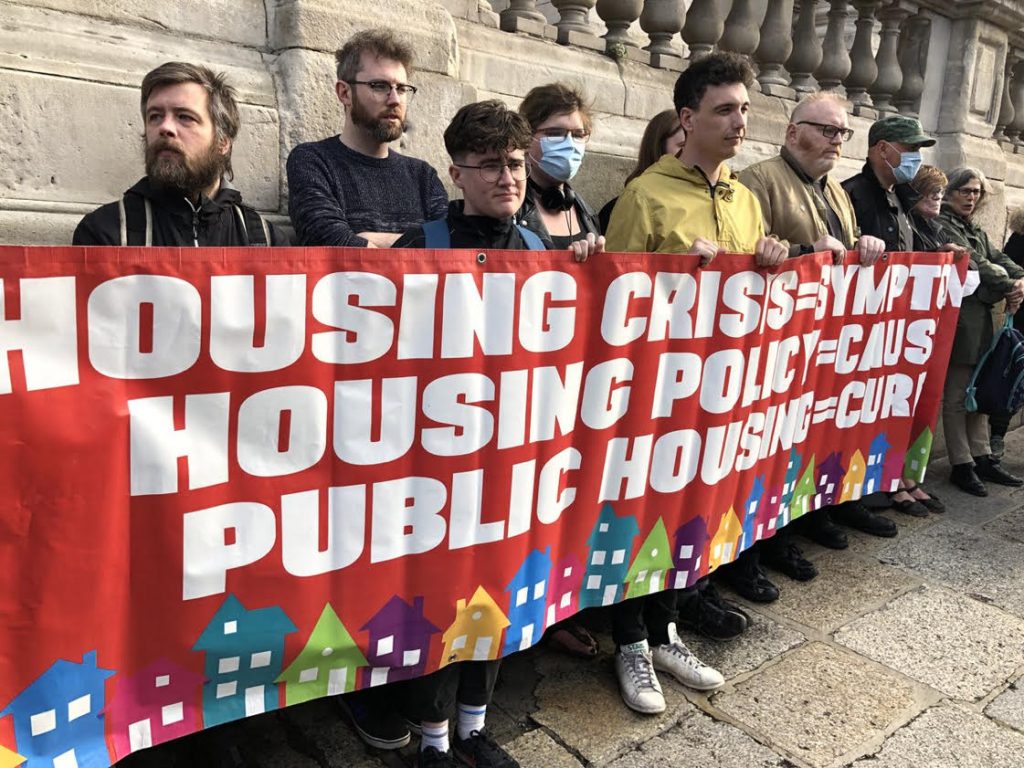
O'Devaney Gardens protest to build public housing by the Campaign for Public Housing, the Homeless Street Engagement Group, Dublin 8 Housing Action Collective, Forward Together and local residents, 11 May 2022, City Hall, Dublin
O’Devaney Gardens protest by The Campaign for Public Housing, the Homeless Street Engagement Group, Dublin 8 Housing Action Collective, Forward Together and local residents, 11 May 2022, City Hall, Dublin.

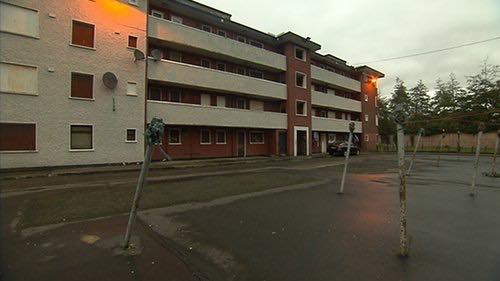
O’Devaney Gardens is a 14 hectare site right next to the Phoenix Park, and if developed sensibly, could have provided a large number of social and affordable housing units on site, yet instead it is being used to give a huge payday to developer Bartra Capital.

Public land at O’Devaney Gardens Given Away for Private Developer Profit

It is more than two years since a terrible decision to gift the public land at O’Devaney Gardens to the property developers Bartra Capital was made by Fianna Fail and Fine Gael councillors joining forces with councillors from the Social Democrats, the Greens and Labour. A full two years on and what has happened on the site?

Precisely nothing.  No sod turned nor one brick laid.

In the midst of a deepening housing crisis, Barta delayed and delayed lodging a planning application, and when indeed they did apply for planning permission, rather than adhering to the agreement made with DCC in November 2019 to deliver 796 new homes, the developer went looking for more: going higher and denser. An Bord Pleanala duly delivered a planning permission in September 2021 to build 1,047 residential units across 10 apartment blocks up to 14 storeys high.

As far as a bad deal goes, at least those who voted in favour of it could now say housing was on the way, no?

No. Bartra have spent the past six months in the High Court challenging one of the conditions attached by An Bord Pleanala to the planning permission, namely that the developer was prohibited from selling any of the “for private sale” apartments to institutional investors, ie vulture funds.

Take a moment to realise that DCC officials and councillors from the Social Democrats, the Greens, Labour along with Fine Gael and Fianna Fail still believe that this is the best use our public land and the best way to deliver housing in the city. Truly dire politics wedded to failed neoliberal ways of governance.

Fianna Fail Force Through Giveaway at O’Devaney Gardens 11 May 2022

On 11 May 2022, I spoke at a special meeting of Dublin City Council on the giveaway of O’Devaney Gardens to a private developer and called for the deal to be scrapped.

The O’Devaney Gardens PPP deal was a disaster from day one and should have been stopped before it began. This is as true today in its latest iteration as it was in 2015, 2016, 2017, 2018 and 2019 when we last voted on the deal. Barta have breached certain conditions of the Development Agreement and therefore the deal should be rescinded immediately, the plans for this site gifted to DCC and work begin on engaging construction companies to go on site and commence building genuinely good value social homes and actually affordable rental and purchase homes.

We know that the housing crisis so that so many individuals, couples and families are enduring has been caused by the extremist market ideology of Fianna Fail and Fine Gael over the last number of decades as they took turns at misgoverning this state, viewing housing as a commodity from which private interests have a divine right to profit from at our expense.It was ever thus with Fianna Fail and Fine Gael. In the first decade of this century their ideology led to the massive property bubble and crash in 2008 and the resultant decade of misery for so many a alongside the wholesale gifting of vast swathes of Irish property to international vultures via NAMA, and a retrenchment in social housing construction which led directly to our current housing crisis.

So to expect either of these parties, or indeed their junior partners in crime from time to time the Labour Party, to “solve” the housing crisis is ludicrous – their policies are the housing crisis. Which leads us to this city council and our responsibilities to the people who elected us in 2014 and in 2019: they did not elect us to rubber stamp the appalling housing policies coming from FF FG Lab Greens at national level which have had and are having such devastating consequences for so many but particularly for thousands of children whose early years have been so negatively affected by this housing crisis.

When the plan to privatise vast tracts of public land emerged in 2014/2015, a plan known as the Housing Land Initiative, it should have been rejected outright as it was by myself and other socialist councillors. We should have joined together and campaigned with all those concerned with the housing crisis to force a change in government housing policy.But instead the largest group on DCC at the time with 16 councillors, Sinn Fein, enabled this disastrous public-private partnership model of housing delivery to progress through 2015, 2016, 2017, 2018 and 2019.

So at a national level the blame lies squarely with FFFG but at the local level of the city council Sinn Fein, the Labour Party, Greens and Social Democrats must carry a significant amount of the blame for the continuation of failed neoliberal housing policies that sees prime parcels of public land like O’Devaney Gardens and Oscar Traynor Road gifted to private developers in return for expensive social homes, unaffordable cost rental homes and unaffordable private purchase homes.

There is another way to deliver social and affordable housing that doesn’t rely on private, for profit developers but sadly the support that the Housing Land Initiative has received over the last 7 years from all the above parties has at the very best delayed an alternative housing policy emerging for at least a decade and at the very worst, has buried the potential for Dublin City Council, in conjunction with construction companies, delivering the social and affordable housing so many Dubliners need and deserve.

So where are we with O’Devaney Gardens?

Barta Capital won their High Court judicial review and are now free to sell privately the 50% of the residential units to whomever they so choose, for whatever price they like. As to the remainder of the units, 30% will be purchased by the city council for social housing with some 20% for a very expensive-looking affordable purchase scheme. Every single unit will be sold by the developer with a healthy 15% profit margin or more.

Some more good news for the developer though: Dublin City Council officials have recently stated their willingness to take more units on the site, looking to purchase some 30% of the 50% of the private units for a cost rental scheme. Developer pay day again.

The sheer awfulness of the original and subsequent O’Devaney Garden deals angered and shocked the people of Dublin, who are still at a loss to understand how anyone would think giving public land to private developers for nothing and in return buying off the developer the homes built on the site at overinflated market prices is the best way for Dublin City Council to meet its housing targets.

There are still some of us on Dublin City Council who believe that DCC officials should rescind the terrible deal with Bartra Capital and develop the site itself as this would result in housing being delivered in a more timely and cost efficient fashion. Crucially, though, it is going to need a mass campaign to save this land for public housing.

Map of O'Devaney Gardens
Site of O’Devaney Gardens

Background: In 2019 DCC gave away O’Devaney Gardens without guarantees of affordable housing

On the evening of 4 November 2019, Dublin City Council officials and councillors from a range a political parties (Fianna Fáil, Sinn Fein, Labour, Soc Dems, Greens and some Independents) handed over a hugely valuable piece of public land, owned by the people of Dublin through the local authority, to a private developer.

Independent Left Councillor John Lyons made his opposition to this plan clear after the meeting of Dublin’s councillors.

The vote tonight on the O’Devaney Gardens Public-Private Partnership deal was a red line: the plan to gift the private developer Bartra Capital one of the most valuable sites in Dublin was passed by a majority of Dublin City councillors, meaning life in this city for thousands of individuals, couples and families struggling with sky-rocketing rents, unaffordable house prices, ever-lengthening housing lists, insecure tenancy arrangements and worsening homelessness will become even more of a struggle.
I voted against this proposal as it further entrenches the neoliberal model of housing delivery pushed over the last two decades by Fianna Fáil and Fine Gael: gift prime public assets to private capital, receive a paltry return and be grateful.
Is it crazy to believe in the idea that public land should be used to meet the housing needs of the public and not to enrich a wealthy property developer?
Instead, it appears that Fianna Fáil, the SocDems, Greens and Labour would rather have cosy chats with Bartra Capital than campaign for public housing on public land.
Dublin City Council can and must do better: yes, our ability to act independently is restricted by the pro-market, neoliberal, property developer-friendly Fine Gael government at a national level but this only serves to emphasize how important it is that all elected representatives who care about housing in the city oppose the sell-off of public land and link in with local, city-wide and national housing campaigns to apply the pressure and force a change in national housing policy, away from the failed pro-market policy that only favours the rich and powerful towards a more humane housing policy that treats housing as a right and not a commodity.
I will continue to campaign and call for the construction of public and affordable housing in Dublin City. This city belongs to us all not just those with the deepest pockets and the ear of the government. We need to stand up and take back the city from the vultures and speculators and their politician friends.

Councillors had a vote on the proposed section 183 disposal of the land to the developer. Unfortunately, even parties who claim to represent the interests of working class communities allowed this plan to go ahead.

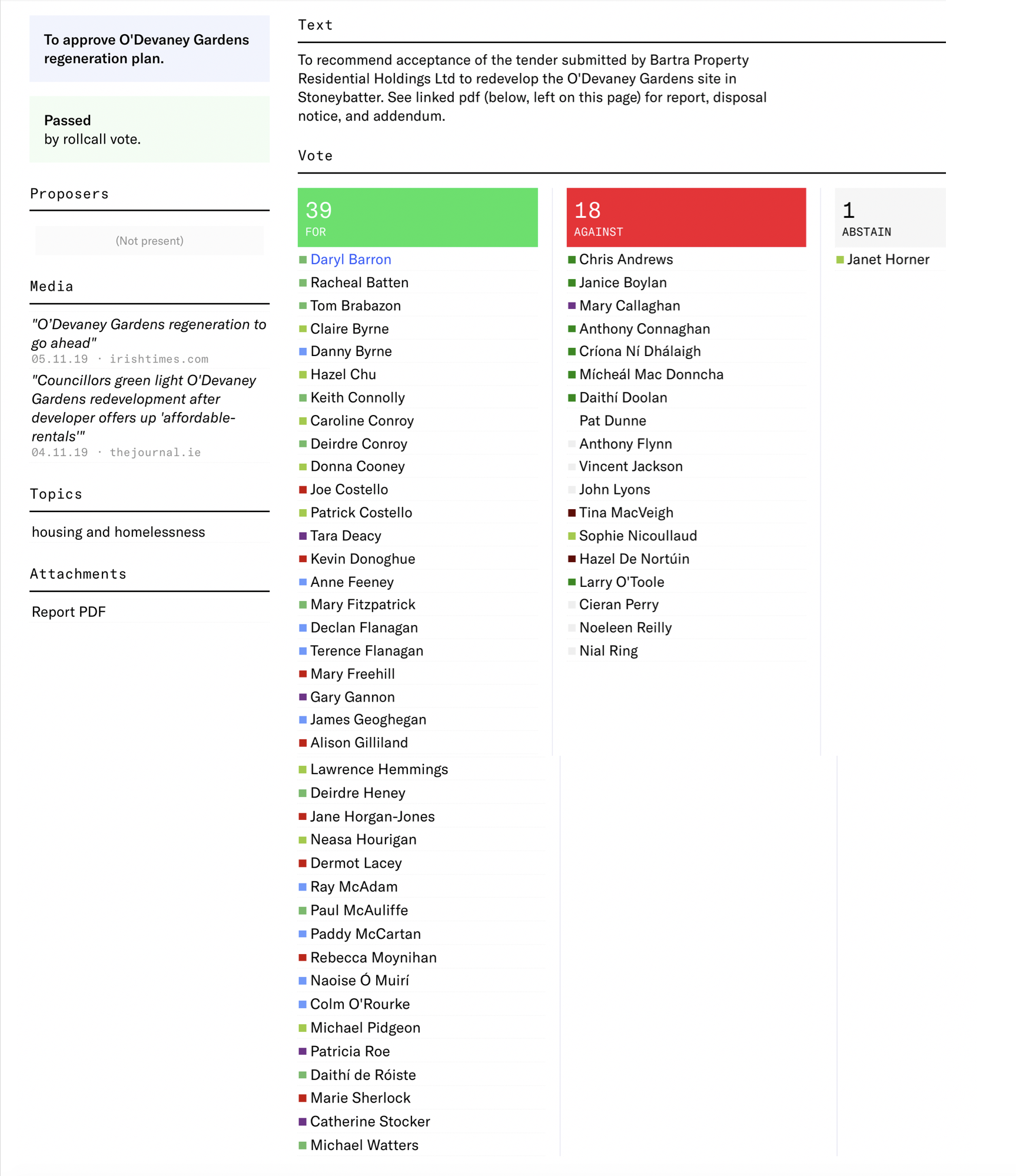
The deal went through with the support of Fianna Fail, SocDems, Greens and Labour. They called for the housing minister’s resignation yet they rubber-stamped and further entrenched Fine Gael’s pro-market model of housing delivery.

List of Dublin City Councillors organised in three columns. Under a text about the motion to approve the tender to redevelop O'Devaney Gardens is a column with a heading '39 FOR' against a green background; a column with '18 AGAINST' against a red background and '1 ABSTAIN' against a grey background. Inside the columns are the names of the councillors.
Dublin City Councillors listed according to whether they voted for or against the tender plan submitted by Bartra Property to redevelop the O’Devaney Gardens site. It shows the Social Democrats, Greens, and Labour joined with Fianna Fail and Fine Gael to approve the sell-off.

Sinn Féin opposed the plan, but had previously flipped and flopped over O’Devaney Gardens over the past three years. Their manoeuvring on 4 November rang hollow. The previous council meeting had an opportunity to develop a truly public cost rental model on the site but SF, along with Labour and Greens, defeated it.

A cartoon with the headline Fine Gael: Public Private Plunder. Underneath, a Leprechaun looking like Eoghan Murphy, Housing Minister, is handing a pot of gold labelled 'O'Devaney Gardens' over to a man in a suit with top hat and bow tie. Behind them, famine figures look on.
O’Devaney Gardens sell off is a victory for Fine Gael’s pro-market support for developers and landlords. Cartoon courtesy of Foxy Slattery.

A bad deal for Dubliners out there struggling on mid-to-low wages and faced with dire homelessness, outrageous rents, unaffordable house prices and lengthening council lists.

Public land should not be used for private gain.

Developer demands €7m: Councillor John Lyons refuses to be bullied

Ahead of the important Dublin City Council vote on Monday 7 October 2019, the head of housing for Dublin City Council, Brendan Kenny briefed the press that the developers, Bartra Capital, had demanded a €7m payment from the council. Kenny threatened that there would be a five-year delay should this not be granted by councillors and released figures that glossed over the extent to which Bartra capital were able to exploit the situation, namely by having 50% of the units for sale on the open market.

John Lyons, Independent Left councillor, made his opposition to this extra give-away clear:

I will not be threatened by the executive of the city council acting on behalf of a private developer, and so will be voting against the plan to hand over the O’Devaney Gardens site to a Bartra Capital.

We have, as Dublin City Councillors, an opportunity next Monday to stand up for the people of Dublin who are despairing at the lack of public and affordable housing in the city.

I will not support a plan that will see a private developer make massive profits from the privatization of public lands, and with such a paltry return for the council terms of social housing, as well as the complete absence of any kind of housing that could be reasonably be described as affordable.

We have a fight on our hands and so we must link up with all the campaign groups and others interested in creating a city that is accessible to all.

O'Devaney Gardens should be used to provide affordable public housing.
O’Devaney Gardens should be used to provide affordable public housing

The vote to privatise the public lands at O’Devaney Gardens had previously been postponed, seemingly so that then Minister for Housing, Eoghan Murphy, could get involved on behalf of Bartra Capital. On 7 October 2019, the Minister for Housing repeated the threat earlier made by a DCC official that if councillors refused to vote to gift a prime piece of public land to a private developer then nothing will happen on that site for at least half a decade.


At the time Councillor John Lyons made the following response to the Minister’s desire to address councillors:

To offer what exactly? I would say not much but a slightly tweaked outrageously bad deal.

So let’s use the next few weeks to build up the pressure on Fine Gael, DCC officials and the councillors currently in favour of this rotten deal.

Both Richard Barrett, the founder of Bartra Capital, and Eoghan Murphy TD shared the idea that it is valid to build co-living apartment blocks. In other words, accommodation that is only a bedroom, with other facilities being shared.

Minister for Housing Eoghan Murphy sitting on the right of RIchard Barrett, founder of Bartra Capital, the main beneficiary of the DCC deal over O'Devaney Gardens
Minister for Housing Eoghan Murphy and RIchard Barrett, founder of Bartra Capital

Infamously, Murphy described such accommodation as like living in ‘a trendy boutique hotel’. Everyone else calls it for what it is: a rat race designed by developers who want to maximise profits.

We should be designing beautiful public environments, like the one in Vienna highlighted here by Councillor John Lyons.

In April 2019 the Irish Sun used a freedom of information request to discover that the founder of Bartra Capital wrote to Eoghan Murphy in 2017 after his becoming Minister for Housing. Richard Barrett intended to avail of the ‘passports for cash’ scheme (officially, the Immigrant Investor Programme) but civil servants replied on behalf of Murphy that the meeting would be premature.

A film made in 2013, ‘Inside Out Outside In, Stories from O’Devaney Gardens’, highlights what has now been lost: a vibrant working class community.

Councillor John Lyons called for resignations over the way DCC was misled over O’Devaney Gardens

Opposition to Dublin City Council’s plan for O’Devaney Gardens rocketed after 18 November 2019 when it emerged that the council voted through a plan two weeks’ earlier (see below) that was reported to the council as a new one, with increased affordable housing by way of new cost rental units, when in fact the Minister, Eoghan Murphy, had not signed off on any changes to the original, rejected plan.

A letter obtained by Sinn Féin under the Freedom of Information act detailed comments from the Minister including statements that refute the promise of social and affordable housing:

In order to repay the required financing, the rental levels would likely have to be set at, or close to, market rates. This would effectively negate the concept of providing affordable homes for rent.

… it seems highly unlikely that the purchase of private units from the developer… can deliver its intended goal of affordable rental.

Independent Left Councillor John Lyons moved a suspension of DCC’s standing orders at the annual budget meeting on 18 November 2019 in an attempt to win a plan for government funding towards a project that guarantees a large allocation of affordable housing for O’Devaney Gardens. Unfortunately, at that time parties such as Labour, Greens and Social Democrats missed the opportunity to recognise that voting for the plan of 4 November was a massive mistake and a betrayal of those on low and middle incomes who elected them.

John Lyons explained his call for resignations by those who had misled the council:

I believe that all councillors from Fianna Fail, the Social Democrats, the Green Party and the Labour Party who voted in favour of gifting the prime public land at O’Devaney Gardens to the private developer Barta Capital should resign, with Fianna Fail Lord Mayor Paul McAuliffe the first to step down.

It turns out, unsurprisingly, that their private “deal” with the developer has no legal basis and did not change the percentage of affordable housing contained within the disastrous deal struck between Dublin City Council and Barta.

During the city council meeting in which the vote took place on November 4th last I posed a question to the law agent: does the new FiannaFail/SocDem/GreenParty/Labour Party “deal” materially change the
contract between DCC and Barta?

The Lord Mayor refused to allow the question to be answered. Why?

Either these councillors knew that their new deal was nothing but a fig leaf to cover up their vote to privatise public land or they were genuine in their belief that their “developer deal” was going to increase the number of affordable homes but were too incompetent to ensure that their deal was legally sound.

Either way, they should resign over this farce.

Filed Under: All Posts, Dublin City Council Housing

Fifty Years After the Birth of the modern Irish Republican Army

02/09/2019 by Conor Kostick 2 Comments

In August 1969 British Army arrived in Northern Ireland and despite being called ‘peacekeepers’, soon began to police the nationalist community.

In Arundhati Roy’s 2011 Walking with the Comrades there is a moment where she recaps the stories of Ajitha and Laxmi, Maoist guerrillas in eastern India. They became fighters after the Salwa Judum, a state-supported militia, attacked their villages.

The Judum came to Korseel, her village, and killed three people by drowning them in a stream. Ajitha … watched them rape six women and shoot a man in this throat.

         Comrade Laxmi, who has a long, thick plait, tells me she watched the Judum burn thirty houses in her village, Jojor. “We had no weapons then,” she says, “we could do nothing but watch.”

         Arundhati Roy is not an advocate of a guerrilla strategy and therefore was torn when she heard about an execution of a leading member of a district council carried out by the Maoists:

         I feel I ought to say something at this point. About the futility of violence, about the unacceptability of summary executions. But what should I suggest they do? Go to court? Do a dharna in Jantar Mantar, New Delhi? A rally? A relay hunger strike? It sounds ridiculous. The promoters of the New Economic Policy­—who find it so easy to say “There Is No Alternative”—should be asked to suggest an alternative Resistance Policy. A specific one, to these specific people, in this specific forest. Here. Now.

Conor Kostick sat beside Arundhati Roy.
Conor Kostick and Arundhati Roy at the Kerela Literature Festival 2019.

         I was reminded of this passage when reading the August 2019 edition of An Phoblacht and its coverage of the fiftieth anniversary of the upsurge of loyalist attacks on catholics in Belfast and the subsequent appearance of the Provisional IRA. Between 14 and 18 August 1969, eight people were shot dead and around 2,000 families, mostly catholic, turned into refugees. An Phoblacht carries the experiences of some of these who suffered the loss of loved ones, not only from the loyalist mobs but also the involvement of the RUC and B Specials in the attacks. Nine-year-old Patrick Rooney, for example, was shot in his bed when armoured cars fired indiscriminately into Divis flats.

         Ann McLarnon talks about hearing an RUC officer call out to loyalist arsonists to, ‘leave the fenian bastards to us,’ shortly before her husband Sammy was shot dead looking out from his window, having just returned from trying to put out a fire in a neighbour’s house.

         Richard McAuley, a former political prisoner, recalled:

Those organising aid for the increasing numbers of refugees in St Teresa’s needed cars and volunteers to go down to the Clonard and lower Falls to help evacuate streets. It was believed more attacks would occur. I couldn’t drive but I had willing hands. I joined up with Joe Savage who had a mini and we went to Waterville Street at the back of Clonard Monastery to take away belongings and children and elderly folks. An hour or so later, a few yards just around the corner in Bombay Street, Fifteen-year-old Gerard McAuley was shot and killed by loyalists. Bombay Street was totally destroyed in a firestorm of petrol bombs.

The defining moment in the birth of the modern IRA was ‘the Battle of St Matthews’ which took place after dark on 27 June 1970 and lasted until about 3am. Although loyalist paramilitaries, without any restraint from the British Army, began an assault on the Short Strand from several directions, they were held up by republican fighters who earned the admiration of many of the residents. And reading about these events of fifty years ago, I was brought back to the similarity of the account in Walking with the Comrades.

Imagine the warm summer night, made hotter by the flames of burning houses. Imagine the sectarian mob at the end of your street, determined to get you out because of the community you belong to, and imagine too the real danger that someone you love is about to be killed. What course of action should you take? Go to court? Sit in protest at the doors of Westminster, London? A rally? A relay hunger strike? It sounds just as ridiculous as when Arundhati Roy posed these alternatives to herself. A different policy is needed in the here and now.

Hopefully, I won’t ever face such a situation, but they have happened often enough in modern history to make it likely they will recur again. An answer has to be given to the question of what should be done. And my answer is that yes, under such circumstances the besieged community should throw up barricades and defend themselves in arms if necessary. Unlike the majority of political parties competing for power in Ireland and in India today, who howl with outrage at any expression of support for the CPI (Maoist) and the IRA, I therefore have sympathy for and a sense of solidarity with, those who took up guns against mobs that had been organised (in both cases) to intimidate and crush those wanting equality and civil rights.

Does that mean I support violence as a political strategy? In short, no. There is an enormous difference between recognising that in a particular moment, for a few hours, a community might find it necessary to battle for survival and advocating that armed struggle is a way forward for that community in the longer term. It clearly isn’t. In the case of Ireland (which I’m more familiar with, but I think the same arguments apply to India and, indeed, elsewhere), although the Battle of St Matthews led to a rapid increase in recruits for the IRA, those who joined that organisation on the basis that it was the right way to bring about change in northern Ireland were making a mistake. Several mistakes in fact.

Firstly, it wasn’t ever going to win. Or even bring about modest reform. The famous German revolutionary socialist, Rosa Luxembourg, once made the point to her more conservative labour colleagues that by choosing the path of reform rather than revolution, they were in fact, turning away even from winning reforms. Why? Because concentrating on parliamentary activity comes at the cost of belittling the types of activity that does get results, namely mass popular protest: strikes, occupations, boycotts, etc. With the advantage of hindsight it is clear that the same argument applies to politics in Northern Ireland. Tremendous energy and sacrifice by nationalists was poured into waging a campaign of armed struggle, yet the local state could not be toppled that way and insofar as concessions to the demands of the civil rights movement were made, they came in response to the broader expressions of popular discontent. There are parallels with the Irish War of Independence (1919 – 1921), where even in that much more favourable situation for an armed campaign against the British Empire, it was popular militancy that undermined Britain’s ability to rule Ireland.

Secondly, and this is related, there is an elitism in the practice of organising armed resistance to a major state that eventually introduces authoritarianism and heirarchy into the relationship between the movement and its base. The pattern of admired fighters for freedom and liberation becoming a new set of rulers is not limited to examples from Ireland. It’s a world-wide pattern and it stems from the necessity of having a tight chain of command in a military organisation as well as from having a political goal that is not explicitly socialist and egalitarian. If someone is going to run the new state after it falls to a successful armed rebellion, then who will the new politicians and officials be? Those who see themselves as having carried the struggle forward on behalf of (rather than in step with) the people hardly ever then give up the power they have obtained.

Thirdly, it was — and still is — a mistake not to have a strategy for change that involves protestant workers. Throughout the existence of the Northern Irish state there have always been protestant workers opposed to loyalism. Often trade unionists, the ability of these workers to stand up to the sectarian thugs in the community around them has ebbed and flowed over time. Often the pattern is shaped by events in the south. The more catholic and conservative the southern state, the more it provides a warning to protestants not to demand any changes that might lead to Northern Ireland leaving the UK.

Right now, there are some favourable circumstances that make it a little easier for non-sectarian protestant workers to push back against loyalism (e.g. the fact that abortion is available in Ireland as is same-sex marriage. Brexit, too, is an opportunity to hammer home the anti-working class agenda of the DUP, making it a shame that People Before Profit can’t make the most of this, because they put themselves in the pro-Brexit camp). But even throughout the worst of the troubles, that anti-sectarian protestant constituency was present. And it was a constituency that was completely neglected by the IRA. Worse, the more that the military campaign veered off from defending communities under threat to bombing campaigns, the more working class opposition from within unionism was silenced.

With a generation having grown up after the cease fire in the north, it’s a lot easier today to appreciate these points than it would have been in 1970. Even so, when I read about the events of fifty years ago and ask myself the same questions that Arundahti Roy asks about the Indian Maoists, I think the answer is clear. Yes, there can be urgent situations where working class communities have to battle with arms in hand to save themselves but no, that can not be then generalised to being a strategy for socialism or even for more limited changes.

Filed Under: All Posts, Irish Political Parties

Housing Development Plan for Chivers’ Factory Site, Coolock: Fine Gael backs Greed.

19/08/2019 by John Lyons 2 Comments

By Councillor John Lyons, Independent Left

Update on the plan for the Chivers Site

Owners of the old Chivers jam factory site are at it again: breaking commitments previously given, revealing themselves to be nothing but lying property speculators.

Three years have passed since Dublin City councillors rezoned the industrial site in Coolock from industrial to residential; two years since Platinum Land Ltd secured planning permission from An Bord Pleanala to build 471 apartments, a gym, crèche and gardens. And yet the site remains derelict. In the midst of a housing crisis it looks like the owners were sitting on the site, biding their time, waiting for the right moment to move and flip the site.

Nothing of note had happened in relation to this site over the last two years until news emerged last week via the Dublin Inquirer that the site was now being offered for sale by Platinum Land Ltd, which is looking to make a fortune in profit with an asking price of €25 million.

So no affordable housing and community facilities will be delivered on this site, just massive profits for the owners. And still the site will remain idle. In the midst of a housing crisis. Commitments given to the people in Coolock and their local public representatives by the owners of the site that they were here to help alleviate the housing crisis, to play their part in increasing the supply of affordable rental homes, turn out to be nothing but lies spun in order to secure a rezoning of their site.

At the time of the rezoning, myself and other councillors were informed by City Council planners that we could not attach any conditions to our decision. We knew our decision to rezone the land would increase its value many times over and we wanted to ensure that housing would actually be built  but were told that we were legally prohibited from doing so.

In the midst of a housing and homelessness crisis, we had a decision to make: leave the land zoned industrial and lock in another decade or more of dereliction or zone it residential and see the commitments given by the landowners realised in the delivery of new housing in the Coolock area.

We decided to rezone the land from industrial to residential, a decision taken by public representatives in the best interests of the public. Yet we have been betrayed and misled. The intention to sell this undeveloped site with a live planning permission attached shows Platinum Land Ltd in their true light: greedy property speculators who will say and do anything if it makes them a buck.

We have to respond. At the North Central Area Committee of Dublin City Council on Monday 20th September I proposed by way of emergency motion that they city council should initiate a compulsory purchase order (CPO) of the site, the council legally moving to take ownership of the site, for a price estimated as the value of the land prior to the rezoning decision in 2018, namely €2.55 million.

My motion was passed and will go to the full Dublin City Council meeting in October. We need to mobilise in order to build the pressure on the owners of the site and on city council officials to let them know that will not allow massive profiteering from the housing crisis, that we will never believe it acceptable for developers to lie to public representatives, manipulate a housing crisis and fraudulently benefit from decisions taken by public representatives in the best interests of the public with regard to the rezoning of land.

RTE Morning Ireland: The Strategic Housing Development Scheme in Coolock

On 21 September 2021, RTE’s Morning Ireland had a feature on the Chivers development, which reminds listeners of the promises made by the developers – in their own words – and gets my response and that of local residents.

It is available here on the RTE website.

Fine Gael’s Pro-Developer Planning Undermines Housing Rights

Interview between Pat Kenny and myself, for Newstalk, 22 October 2019.

The Fine Gael pro-developer planning system in action: we on Dublin City Council rezoned the old Chivers’ factory site in Coolock from industrial to residential in October 2017 on the advice of the following assessment from DCC’s planners:

‘It is acknowledged that this unit has been vacant for a significant period of time and that the site may not have future potential as an industrial factory type unit. Give the location of the site, particular adjacent to the Santry River and conservation area, and current access off a residential street, a residential redevelopment of the site is considered appropriate in principle.’

Myself and all other North Central area councillors rezoned the land to allow for residential development but we were promised affordable housing and sensible density: 350 affordable units at reasonable heights.

The developer briefed local councillors and held meetings in the local community to inform people of their plans: 350 units at appropriate heights of no more than five storeys.

Fine Gael, however, made two significant changes to the planning system during this time, namely the fast-tracking Strategic Housing Development process which facilitates developers building more than 100 units by-passing the local authority as the planning authority and going straight to An Bord Plenala, which leaves no room for appeal once a planning decision has been reached.

Fine Gael have allowed the former Chiver’s Factory, Coolock, to become the location of ten-floor high rises

The second change to the planning system was the issuing of new departmental guidelines on building heights, released in December 2018 which totally ripped up our City Development Plan regulations on heights and opened the door to developers to lodge planning applications involving outrageous new heights, like the one at the Chivers’ site.

When we were presented with the proposal, the idea was that the developer would build four apartment blocks, none of which would be more than five stories high. Now, the developers, Platinum, have announced that the maximum height of the apartment blocks will be ten stories high. This has come about as a result of the then Minister for Housing, Eoghan Murphy, removing height restrictions on plans, rendering our efforts to ensure a sustainable and reasonable development meaningless.

The efforts of Independent Left Councillor John Lyons along with others on DCC have been rendered meaningless by the Fine Gael Minister for Housing.

It was a very poor planning decision, allowing blocks of apartments eight and nine storeys high in a low-rise residential area.

Yet the only recourse available to anyone not happy with the decision is a judicial review in the courts, which can only challenge how the decision was reached and can costs tens of thousands of euros.

Fine Gael quite clearly allowed Dublin to be shaped by the interests of private capital, and to hell with the communities. And now in partnership with Fianna Fail, they continue to do so.

Councillor John Lyons of Independent Left calls for original plan for Chivers site to be honoured

A satellite image of the area, marked in red, of the former Chivers factory, now earmarked for a high-rise development by Platinum Land Ltd. Nearby labels show the position of Greencastle Road, Coolock Drive, Northside Retail Park, Cadbury's and Oscar Traynor Road.
Unrestrained greed will create a disproportionate development on the old Chivers’ factory site, with harmful consequences for traffic, public transport and local amenities

On 21 October 2019, I called on Platinum Land Ltd to scrap their development plans at that afternoon’s meeting of Dublin City Council North Central Area Committee in Coolock

I sought a full explanation from Andrew Gillick of Platinum Ltd as to why they shifted from their original intention of building 350 apartments in four blocks of varying heights of no more than five storeys to what was disgracefully granted planning permission by An Bord Pleanala, namely 471 apartments in blocks eight and nine storeys high.

The planning application lodged by Platinum Land was an outrageous insult to the local community in Coolock who have been disgracefully deceived by the developers. Over the previous year, Platinum met with the local community and elected representatives, promising that their plan for the former factory site would be a sensible one that integrated the new development into the existing wider low-rise residential community in a sustainable way.

What the people in Coolock now face is a proposed development, given the green light by a highly politicised An Bord Pleanala, that will destroy the visual character of Coolock by allowing blocks of flats eight and nine storeys high in an area predominantly of two-storey houses. This will create an eye-sore that will blight the community for decades to come.

Questions will also be asked about the wisdom of squeezing 471 apartments on a site originally earmarked to have just 350 apartments.

It would appear that the greed of the developer has trumped their promises to the local community and they seem to have little regard for the damage their proposed development will inflict on the area.

This is why I formally requested that Platinum Land Ltd revert to their original plan of providing 350 apartments on the site.

I also demanded that they consult with the local community at the earliest possible date.

Filed Under: All Posts, Dublin City Council Housing

  • « Go to Previous Page
  • Page 1
  • Interim pages omitted …
  • Page 17
  • Page 18
  • Page 19
  • Page 20
  • Page 21
  • Interim pages omitted …
  • Page 23
  • Go to Next Page »

Copyright © 2026 · Aspire Pro on Genesis Framework · WordPress · Log in