• Skip to primary navigation
  • Skip to main content
independent left logo

Independent Left

Environmentalism, socialism, freedom and equality. #liveablecity

  • About
  • Featured Articles
    • How Farming Must Change to Save the Planet
    • The Housing Crisis: Causes and Solutions
    • Socialism in Ireland
  • Contact Us
  • Podcast
  • Animal Rights
  • Archive
    • Irish Socialist History
    • Dublin City Council Housing
    • Ukraine
    • Protests Ireland
    • Reviews
    • Irish Political Parties
    • All Posts
    • Independent Left Policies
  • Why join?

Derek Mahon, A Poet of The Left

14/12/2019 by Ciarán O'Rourke 1 Comment

A portrait of Derek Mahon, poet, who describes himself as having a penchant for left-wing imagery. He is wearing a blue and purple vertical stripped shirt and is looking directly at the camera with a slight smile.
Derek Mahon: a poet of and for the political left

By Ciarán O’Rourke

‘I know the simple life / Would be right for me’, wrote Derek Mahon in Ovid in Tomis, ‘If I were a simple man.’ A glad complexity, it seems, is the order of the day; a dynamic interweaving of expression and insight evident throughout Mahon’s work, lending the poems both a clarity and a frequent mystery. ‘It is not sleep itself but dreams we miss’, Mahon posits (with aphoristic aplomb), ‘We yearn for that reality in this.’ Known for his intellectual force and technical fluency, and admired as a translator from multiple verse traditions, the Belfast-born poet was universally recognised in establishment literary circles as a leading figure of his generation and moment. Less mentioned, however, is that – in its breadth, emphasis, and overarching perspective – his work invites celebration and cultural co-optation by socialists, anarchists, and every species of utopian realist in between. For although formally traditional, his poems are critically incisive and, in brief, radically human to the core.

It’s a point that’s seldom heard, and so, perhaps in a small way, worth reiterating. Insofar as the ethical compass and content of Mahon’s poetry are discussed at all, the conversation tends to be couched in a discourse of reflexive academic qualification: so that the specific details of Mahon’s political commentary and commitment, at any one point in his poetic career, are presumed to be offset or made redundant by his aesthetic, philosophical, or even formal concerns at another. We are left with a ‘poet of divided affiliations’, who maintains ‘a cautious distance from schools and groups (whether literary or political)’, his stylistically graceful poems ‘characterised by indirection and obliquity’, even as they depict (occasionally) a ‘humanity… powerless against the inevitable forces [that] shape human life.’ We end up, in other words, with a political poet, but one whose work is said to exceed its own politics: thus transforming the latter into an empty category, rimmed by abstractions such as The Force of History or The Demands of his Time.

Such a trend, of course, arguably relates to culture in general, and not to the work of Mahon alone. It would certainly be a tempting thesis to explore: that in a neoliberal society, art and literature are circulated in order to be owned, to placate, or to make life as it is (exploitative and miserable as it may be for many) more liveable and not to subvert the tenets by which that society is organised. In which scenario, what we think of as literary criticism would in fact amount to nothing else than a series of discursive adjustments and revisions, a sort of academic vanishing trick whereby whatever creative radicalism was identified in an art-work, oeuvre, or historical moment would disappear as soon as it was declared. Sound familiar?

At any rate, for gentle-hearted heretics of all stripes – anti-establishmentarian in their politics, but nevertheless in need of the emotional and critical sustenance that literature provides – there is surely some merit in re-examining the work of poets, great and mighty, and the inherited assumptions that frame our encounters with them. In Mahon’s case, moreover – a writer who calls himself an ‘aesthete’ with a penchant ‘for left-wingery […] to which, perhaps naively, I adhere’ – doing so helps us to reach a fuller and clearer understanding not only of his literary back-catalogue, but of the power systems that rule and rack our present world. This may seem like high praise for one of Ireland’s more canonical of recent poets; but it’s also true.

Derek Mahon’s An Autumn Wind

Take Mahon’s book, An Autumn Wind, in which we find the artist’s inward vision turning to survey, with searing perception, a global vista defined in the main by corporate theft and murderous imperialism (headed by the USA). ‘The great Naomi Klein’, he wrote,

[…] condemns, in The Shock Doctrine,

the Chicago Boys, the World Bank and the IMF,

the dirty tricks and genocidal mischief

inflicted upon the weak

who now fight back.

Mahon’s praise (indeed, rather pointed name-dropping) of Naomi Klein surely gives credence to his self-proclaimed status as a political Leftist. But it also draws a question mark over the standard critical narrative outlined above. Far from deploring modernity in the abstract, shaped by some equally vague ‘inevitable forces’, Mahon’s verse here associates directly the neoliberal economic doctrines of ‘the Chicago Boys, the World Bank and the IMF’ with crimes against humanity, while also acknowledging both the theory and the praxis of resistance that such doctrines inadvertently generate (typified by Klein and by ‘the weak who now fight back’, respectively). It is difficult to imagine Seamus Heaney or Michael Longley, the two most-fêted of Mahon’s Irish contemporaries, even coming close to advancing such a perspective.

Derek Mahon the poet and the opponent of neoliberalism

It is notable, also, that the much-touted ‘concern for the ecological’ in Mahon’s later work exists, in the poem above, within an explicitly anti-capitalist paradigm. Close-focusing on a ‘hare in the corn / scared by the war machine / and cornered trembling in its exposed acre’, the piece in its closing stanza switches to a wide-angle lens, so to speak, and urges that in the next ‘spring, when a new crop begins to grow, / let it not be genetically modified / but such as the ancients sowed / in the old days : a possible retort to the criminal agri-policies of Monsanto. What’s certain, however, is that this is a poetry that arrays itself against (and takes aim at) neoliberalism per se – or what Mahon termed, in his resonantly titled poem, ‘Trump Time’, ‘the bedlam of acquisitive force / That rules us, and would rule the universe.’

Without wanting to over-extend the argument, there’s also a refreshing contemporaneity and excursive quality to Mahon’s range of reference here. Although he was indeed a literary practitioner combining ‘classical structure with contemporary concerns’ in his work (read great, white and male) – his ‘precursors’ including ‘Samuel Beckett, Louis MacNeice, the poets of Rome and Greece’ – in this instance Mahon openly, and quite self-consciously, took his cues from a feminist critic of modern capitalism, herself writing of a number of (highly gendered) grassroots movements, primarily in the Global South. Feminist icon he was not, but Mahon’s work at the very least pointed towards an intersectional understanding of economic exploitation and political struggle: as companion poems in the same volume (such as ‘Water’) arguably also testify.

Radical poet Derek Mahon reading from a book of his own poems held open in his left hand. His right is raised. He is smiling. A microphone is in front of him and behind him are curtains and the end of a bookcase  or cabinet with finely bound books.
Derek Mahon: a politically committed poet of the left

None of which is meant to create a further barrier between the so-called aesthetic merits and political commitments of Mahon’s work. If anything, it’s to argue that these qualities exist in continuity with one another, and to suggest some ways in which the overtly political interventions of Mahon’s verse may be seen to sharpen what one authority has described as the ‘crystalline clarity’ of its intellectual make-up, giving heft and consequence to the ‘sophisticated sound-patterning’ for which his poetry is so often admired. After all, Mahon’s bright-soaring, early imagination of an art drawn ‘From the pneumonia of the ditch, from the ague / Of the blind poet and the bombed-out town’ – one envisaged as bringing ‘The all-clear to the empty holes of spring, / Rinsing the choked mud, keeping the colours new’ – was always grounded not just in the sensations of a literate intellect, but in a sensibility disposed to compassionate identification with the realities of other people’s lives: in a word, to solidarity. For Mahon, equipped as a writer with the same ‘light meter and relaxed itinerary’ so beloved of countless literary fence-sitters, the urge that recurs most persistently is in fact ‘To do something’ – or ‘at least not to close the door again’ on those condemned to live ‘in darkness and in pain.’

On a final note: this short sketch has tried to claim Mahon was a poet of and for the political Left: a loose but very real community, whose existence is rarely questioned except by a few faction-feasting personages who are already in it. In doing so, however, we would do well to remember that the democratisation of power so often promised and struggled for by activists holds exciting possibilities for poetry, too: its creation, its reception, and (again) its circulation. As Mahon’s homage to Shane MacGowan implies, the list of great poets can and should be appreciated ‘together with the names Seeger and MacColl’: dissident troubadours both, generally lacking from Mahon’s academically prescribed influences. Art is what we make of it, in short, and the broader the field of shared endeavour, the better. So let the task be to reap and sow the commons of poetry and song, if for no other reason than to pay tribute to Mahon’s work and in the same spirit that the work itself proclaimed.

Filed Under: All Posts, Reviews

Bolivia’s Coup of November 2019: where did it go wrong for Evo Morales?

14/11/2019 by admin Leave a Comment

Evo Morales waving the colourful flag of the Movement Towards Socialism against a black, night-time background. He is smiling and so are the people around him, some of whom also wave flags and others have musical instruments.
Evo Morales: an indigenous, radical union leader whose compromises
with big business lost the support he needed to resist the coup of 10 November.

On Tuesday 12 November 2019, Jeanine Anez, a fierce, right-wing opponent of socialist Evo Morales, took power in Bolivia with the backing of the police and the military. This represents a setback for the working class and indigenous people of Bolivia (and beyond). It was a setback that could have been avoided and the main lesson is a simple one: socialists cannot succeed in bringing about lasting change from the top downwards.

In 2005, Evo Morales became Bolivia’s first ever elected indigenous President, he maintained this position for nearly fourteen years. How did an indigenous, radical union militant and leader of coca growers become the president of Bolivia?

This article seeks to explain the rise of Morales and the MAS party (movement towards socialism) government and the process of change it brought to the people of Bolivia and its economy. This explanation has to be found in a wider understanding of the history and politics of Latin America.

Latin America is one of the most unequal regions on the planet: according to Meirke Blofield’s 2011, The Great Gap: Inequality and the Politics of Redistribution in Latin America inequality in Latin America has been an entrenched characteristic since colonization, he states that in 2009, 189 million people in the region lived in poverty.

Latin America has a long history of reliance on world markets and transnational powers for its survival. Following a history of colonialism, in post-independence, Latin America prioritised exporting its vast abundance of natural resources over developing its economy domestically, leaving the region weak, underdeveloped and vulnerable to the boom and bust cycles of capitalism. The Great Depression of the 1930s hit the region very hard as demand for exports dramatically reduced.

World War II and the subsequent rebuilding years following the war created a stimulus to world trade internationally and Latin America’s exports began to rise. By 1955 manufacturing was ahead of agriculture in real GDP terms. Latin America adopted a form of Keynesian economics with welfare supports and social democracy. It wanted to turn from free market economics to focus on domestic development using Import Substitution Industrialisation (ISI) as a protection from the turbulent and at times devastating consequences of Laissez Faire economics.

ISI focused mainly on high export Tarriffs, domestic industrial growth as opposed to agriculture and saw a rapid growth in urban populations across the region, it shielded many from the full force of market demands through subsidies, it gave labour rights, gave land rights to indigenous groups and initiated public health, education and housing programs.

A square made out of coloured squares which run in diagonals: 1 yellow, bottom left; 2 orange; 3 red; 4 purple; 5 blue; 6 green; 7 white; 6 yellow; 5 orange; 4 red; 3 purple, 2 blue and 1 green, top right.
The Whipla: the flag of some native people of the Andes

While this protectionism gave some improvements to the quality of life it did not tackle the deeply entrenched inequality that remained a consistent across the region: those who mainly benefited were the formal work force, the middle class and the elite.

Latin America was still dependent on core countries for export and import, technical and intellectual know-how and loans to help cover the high costs of its welfare programme demands. In the 1970s, the global economy experienced another shock, in the form of an oil crisis and war in the Middle East.

The downturn affected the Latin American region in many ways, the revenue from and rate of exports reduced; the cost of imports increased; inflation across the region exploded, leading to an ever-increasing debt for every Latin American country. For example, in Bolivia the inflation rate in 1984 was at 1,300% by 1985 it was 11,805%. By 1983, total debt in Latin America was nearly 300 times the rate of its exports. The region had to turn to the International Monetary Fund for assistance in paying its soaring debt from international capital.

Loans from the IMF are significant for countries as they signal to international markets and lenders that the country is credit worthy. The IMF insist on neo-liberal structural reforms from a borrowing country: the IMF is the last resort for countries, they are rarely able to refuse.  Structural reforms consist of reducing state spending, privatisation of state assets and resources, also the privatisation of health, housing and education resources, a more precarious labour market with few labour laws, minimal welfare supports. This austerity often led to authoritarian regimes and military control in order to implement such goals.  As Jean Grugel wrote (in Grugel & Riggirozzi’s 2011 Governance after Neo-liberalism in Latin America):

By the early 1980s the social fabric of the region was in tatters, the horrors of civil war, military aggression and state sponsored repression created a willingness among ordinary people and their leaders not to push too far in the way of redistribution.

 A change in international relations and a horror at how the military regimes treated its citizens brought a third wave of democracy in Latin America in reaction to authoritarian control.

The third wave worked in two ways: through free market economics and liberal politics. This created a very minimalist form of democracy and its only requirement was free and fair elections. Neoliberalism believes in reduced state intervention and control that the free market can regulate itself and will eventually reduce inequality using trickle-down economics. It is in the context of this third wave that, despite its limitations, radical movements could begin to find political expression, including in Bolovia.

Bolivia has a wealth of natural resources including forestry, minerals, lithium and more recently, oil and natural gas reserves. Additionally, there are large swathes of agricultural land with a strong livestock industry and significant soya bean production. The wealth and development from these resources have never been equally distributed among all sectors of the Bolivian population.

According to Linda Farthing’s 2019 article, ‘An Opportunity Squandered? Elites, Social Movements and the Government of Evo Morales’, the elite within Bolivia have run the country in their own self-interest for over 200 years drawing from their own class to ensure the positions of the presidency, the senate and the judiciary were tightly within their power. 

The neo-liberal era in Bolivia did not reduce inequality; the New Economic Policy negotiated by the IMF was implemented by three consecutive right-wing state managers from 1985-2002. This shock treatment caused profound economic and political exclusion of popular sectors, threatening their very livelihood leaving them without defences.

Nevertheless, this inequality was challenged in a number of dramatic outbreaks of social struggle by workers and their allies. In 1952, for example, Bolivia experienced a social revolution.

Bolivia 1952, massive crowds of workers march behind white banners, the most prominent of which reads VIVA EL M.H.R.
A massive, workers-led revolution swept through Bolivia in 1952

The implementation of the New Economic Policy in the 1990s saw reforms in labour laws, reductions in mining, and an increase in gas production. The traditional unionised sectors from rural areas were destroyed.  People sought employment and began organising in more urban environs. The USA under the new economic regime were facilitated to destroy coca growing and coca farmers. This brought traditional union organisations, national liberation movements and indigenous groups together: earlier in the twentieth century, these groups did not have perceive common ground with each other. These challenges and new formations of popular sectors and their subsequent struggles against the New Economic Policy lay the foundations for the MAS party and the presidency of Evo Morales.

The period 2000 – 2002 saw powerful social movements such as the 2000 water war in Cochabamba, Aymara and a protest movement in Chapare of coca growers.

The original strategy of MAS was in extra-parliamentary activism, grounded in anti-neoliberal, anti-imperialist and rank and file democracy. Its power lay in the great number of different organisations involved in the party, including neighbourhood groups, unions, precariat workers, women’s groups and indigenous organisations. These groups were able to mobilise against neo-liberal reforms and eventually topple two successive right-wing presidents.

Jeffrey Webber’s 2017 The last day of Oppression and the First Day of the Same:  The politics and Economics of New Latin American Left, points out that Bolivia had a huge opportunity for fundamental, transformative and structural change from 2000-2005 as it was in a:

… revolutionary epoch this saw a combined rural and urban rebellion of a liberation struggle to end the interrelated process of class exploitation and racial oppression.

Post 2005, however, the class composition leadership layers of the party, its ideology and political strategy began to shift from a revolutionary organisation to a reformist outlook. When it began to contest elections and needed the middle-class urban voters, its leadership began to reflect an outlook formed more by the intelligentsia and middle class than that of workers.

The election of Evo Morales and the MAS party brought significant improvements to the lives of those who have suffered consistent inequality, poverty, racism, sexism and exclusion in Bolivia. According to Linda Farthing the victory of MAS expanded formal rights for women and indigenous people, leading to a significant increase of both within the MAS party and in positions of power in government.

Bolivia has seen one of the greatest drops in poverty: it has tripled the minimum wage, provided massive public investments in rural areas with new schools, hospitals and roads, and initiated the biggest land reform since the 1952 revolution. Despite opposition from the USA, MAS ensured that coca production became an indigenous right. The Morales leadership introduced a more radical constitution, voted on by referendum, his leadership brought a reduction in violence and a more stable situation for the majority of Bolivian people.

Yet Evo Morales’s administration failed to deliver on its more radical promises.

The domestic elite and transnational capital still had control of important sectors of the economy: banking, insurance and construction (mainly in LA Paz the capital and Santa Cruz the headquarters for the hydrocarbon and agribusiness sectors). After Morales’ first electoral victory to the presidency, the ruling elite still maintained power in the senate parliament.

The elites in La Paz initially resisted the new Morales regime, but the flow of capital from large government contracts and a limited expansion of state banking soon saw the economy thrive and profits grow and with that the La Paz elites were happy to cooperate.

The Santa Cruz elites, on the other hand, have always been part of the regional autonomy movement and have rebelled against central government whenever they have come under pressure to deliver to the state an increased share of the economy.  To thwart Morales, the Santa Cruz movement formed a coalition with three other regions with a neo-liberal ideology and a discourse of light skinned superiority. At its height, this coalition mobilised a million people, almost bringing the Morales government to crisis, but the rebellion didn’t last as Morales had the support of social movements across the country. The right did manage to gain concessions from Morales regarding land reform, which saw many of the elites keep illegally acquired lands.  Nor did Morales fully nationalise gas production, which had been an election promise, but managed to secure a much-improved deal which brought a huge amount of capital to government funds.

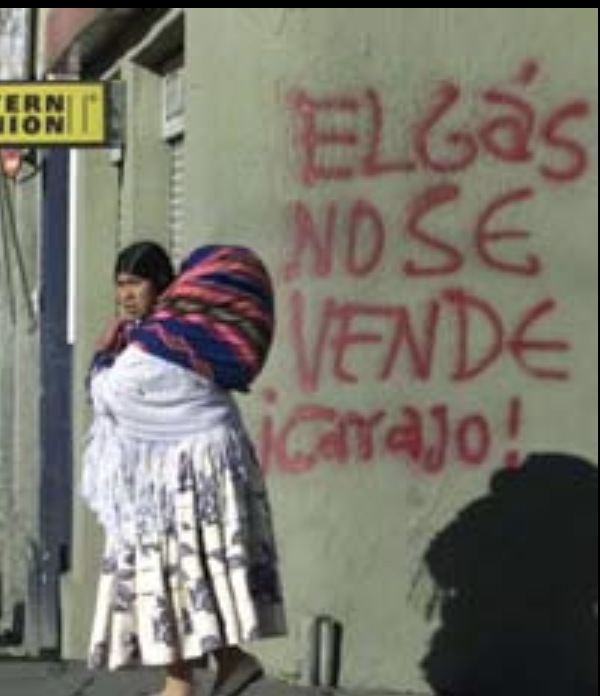
A woman, dressed in white with a large sack of made of purple cloth is walking past graffiti which translates as: Gas is not for sale, damnit!
An indigenous woman stands in front of graffiti that says: Gas is not for sale, damnit!

The process of change in Bolivia under the Morales government saw much improvement for many, but there came a point where its momentum towards change began to falter. Workers remained in precarious employment. The rate of unionisation dropped despite the country having a strong militant history of union organisation. Bolivia under Morales, despite the name of his party, was not a socialist state, the elite still owned vast swathes of land, foreign investment grew under Morales and this gaves the elite power and leverage. In short, the left administration scored some success but failed to deliver on its radical promises.

Morales continued to negotiate and work with domestic and foreign capital even after increasing his political power after the 2009 election. The process of change in Bolivia has not seen a socialist society emerge, nor could it when the strategy was to work with the local elites and global powers, to obtain the resources for reform.

Morales and twenty members of his administration had to flee for their lives to Mexico following threats from the army and police on 10 November 2019. Their ability to rouse the population and especially the working class against this coup had been deeply undermined by years of disenchantment as well as a perception of interference with the election of 20 October 2019 by Morales’ supporters.

Of course, Independent Left are against the coup and for a restoration of Morales. But we also have a wider vision.

Time again in Latin America and beyond the demands of capital have clashed with aims of governments that have declared themselves socialist. And every time, whether the Castro regime post-Cuban revolution, or that of the Sandinistas, governments that tried to manage their local part of a world capitalist system ultimately failed to transform society.

You cannot bring about socialism on behalf of the working class while in partnership with big business. Instead, we have to take over the workplaces and run them on entirely different lines, with entirely different goals and with very different politics to those of Morales.

Filed Under: All Posts

Review: Ken Loach’s ‘Sorry We Missed You’

13/11/2019 by John Flynn Leave a Comment

By John Flynn

The redoubtable Ken Loach has followed up his Palm D’Or winning I, Daniel Blake with a devastating drama about a family struggling to make ends meet in a precarious working environment. Along with his longtime screenwriter Paul Laverty, Loach has crafted a very necessary film about working life for so many people today.

Ricky has gone from ‘shit job to shit job’ since the crash of 2008 derailed the family’s prospects. A constant plaintive refrain heard throughout the film by different family members is: ‘I just want to go back to the way things were’. Ricky takes a job as a self-employed delivery man believing (probably out of desperation) that it will finally give him the means to succeed. But, in order to put down the deposit on the van of £1000, he convinces his wife Abbie, a home carer on a zero-hours contract, to sell her car. From these desperate beginnings things soon begin to get worse. This brilliantly acted film will leave you emotionally spent as you watch this increasingly frazzled couple attempt to battle the exhaustion of long hours in high stress conditions and the fall-out of neglect at home.

There is a scene in the film that nicely weaves the personal with the political and provides a wider background to the film. Abbie is visiting Mollie, a favoured care recipient. Against the rules of the agency that she works for, (you’re not supposed to be friendly with your clients!) they are enjoying a fugitive moment of companionship sharing photographs with one another. Mollie shows her photos from the 1984 miners’ strike where she helped run the canteen. They are treasured memories of friendship and solidarity but from a tragic defeat for the labour movement. Abbie’s funny photographs are from her courtship with Ricky (at a rave), from a happy time when it seemed that they were going to buy their own home. But, the collapse of Northern Rock put an end to their hopes. It’s only in the photographs that Ricky and Abbie look happy. Now, they are exhausted and struggling to cope. A moment of marital intimacy is aborted because Abbie says she feels so sad she could cry for a week.

You always get a character in a Loach film who articulates very convincingly the point of view of the class enemy. Here, we have Moloney, ‘patron saint of nasty bastards’. He thinks that a company’s shareholders should erect a statue to him because he runs such a brutal operation for them. In the interview at the opening scene he gives Ricky some insidious language about this new economy, ‘you don’t work for us; you work with us’, but, before long, we see the brutal reality behind this rhetoric. Drivers are constantly monitored by their scanners, on severe time constraints, liable to sanctions, if they fail to meet targets. Ricky is horrified when his friend gives him a plastic bottle for emergency piss stops. But this is reality for the armies of delivery drivers frantically meeting the orders from companies like global giant Amazon. In an interview, scriptwriter Paul Laverty sardonically quipped, ‘I can’t imagine Jeff Bezos pissing in a plastic bottle because a meeting went on too long!’ When Ricky does need to use the bottle one time to relieve himself, he is savagely beaten and robbed. As he sits in the hospital waiting room with Abbie waiting to her from the X-ray results, Maloney rings him to inform him that he is liable for over £1500 because of the robbery. This, after he had incurred numerous sanctions after missing work because of domestic issues with his son, Seb. The reality of the new economy: all the costs to the worker.

Ricky and Abbie have two kids, Sebastian, the eldest and Liza Jane. Though Liza, Jane looks distraught at what is happening to her family (one terrible moment, when she bursts out crying after confessing to something is utterly heartrending), she is performing well in school. Sebastian, or Seb, is in trouble at school. He seems completely disabused of the entire system, and shoplifts spray paint for his graffiti art. The scenes with Sebastian and his friends are probably the only ones that point to self-activity or self-expression: Seb even sold his winter coat to purchase spray paint! When Sebastian gets arrested for shoplifting during a particularly fraught time for the family, Ricky collects him at the police station. Luckily, he meets a kindly copper who gives him a well-meaning talk about how fortunate he is to have a loving family and that he can get his life back together and be what he wants etc. The message of the film for me would imply that all this is well meaning nonsense. Sebastian’s graffiti collective is closer to some truth about class war politics than pieties about bootstraps and knuckling down.

Ken Loach’s Sorry We Missed You is a devastating critique of precarious work

It has always been a great strength of Loach that he manages to get such brilliant performances from inexperienced actors. The performances of the four main actors in Sorry We Missed You are superb, particularly in some emotionally fraught scenes. The cumulative effect of watching Ricky and Abbie struggle through the long working days (“What happened to the 8-hour day?” Mollie says at one point) and try to deal with the issues at home is really devastating. This is one of the most unflinching portrayals of working life ever seen on screen but also, one with an obviously deep sympathy for the characters. Ken Loach is one of the great socialist filmmakers.

So, it is probably surprising that the film ends on a note of such despair. I watched the film in the IFI with two friends and we were distraught at the end, in shock, could hardly look at one another. When you remember earlier Loach films also during times of defeat, like Riff Raff, there was some satisfaction when Robert Carlyle burned down the building site at the end in revenge against a brutal employer. Here, we don’t have that. I am thinking that Loach sees the total hopelessness of the current system and that it must go. But, destruction of this atomising system of colossal enrichment of the few is a collective project.

Filed Under: All Posts, Reviews

Google and Facebook workers’ protests grow

25/10/2019 by Conor Kostick Leave a Comment

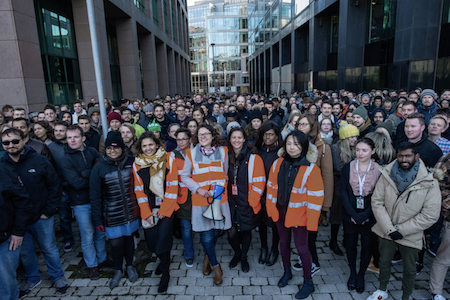
On 1 November 2018, workers at Google’s HQ in Dublin struck

Back in the late 1980s, after the defeat of the air traffic controllers in the USA and the miners in the UK, a great many activists gave up on their hopes that working class people could lead a revolt against capitalism. Andre Gorz, for example, had written a book, Adieux au proletariat (Farewell to the Working Class) which became popular on the left. His argument was that the traditional working class had changed in such a fundamental way that we would never again have the power to lead a transformation of society.

What the book (and those influenced by it) failed to appreciate is that the working class is always changing. Industries rise and fall, with consequences for patterns of employment. But the fact that all companies exploit their workers to maximise profits is a constant. And it is a constant that means after a new company has been running for a while, its employees will try to organise themselves.

Take Google and Facebook, two very important examples of new workforces, especially for Ireland. Right now there is major unrest by staff worldwide in these companies along with a drive to unionise.

The struggle for trade union rights at Google

At the end of October 2019, a row broke out at Google over a new tool for Chrome that automatically launches a pop-up when staff book a room capable of holding 100 people or more. Google says that it’s just a roadbump to stop unnecessary invitations but employees anonymously leaked news of this tool with the allegation that it was designed to warn management of attempts to hold organising meetings.

Workers have mocked the tool, circulating memes such as one showing Professor Dolores Umbridge teaching a defence against the Dark Arts class. Beneath her, it says: ‘Google decree number 24: no employee organization or meeting with over 100 participants may exist without the knowledge and approval of the high inquisitor.’ Another shows a bunch of male managers in suits laughing as one of them says: ‘and then we told them “we will not make it appear to you that we are watching out for your protected concerted activities” as we pushed a Chrome extension to report when someone makes a meeting with 100+ people.’

This came shortly after a meeting, 21 October 2019, in Switzerland, where for several months, over 2,000 Google staff had been attempting to organise a meeting addressed by the trade union Syndicom. Management attempted to thwart the meeting and at one point sent a message around to employees saying, “we’ll be cancelling this talk.”

In the end, some 40 workers insisted on their right to hear the union representative and this issue is likely to culminate in a fierce battle for recognition.

To some extent the drive to unionise was trigged by the massive walkout on 1 November 2018, a strike that was very well supported by Dublin Google workers at the Barrow Street headquarters. Google employs around 7,000 workers in Ireland. Over 20,000 workers in 47 countries held a wildcat strike to protest at massive severance payments made to male executives accused of sexual harassment.

Google workers have recently leaked information on issues they feel are morally wrong in the direction of the company, such as censored search engines for China; co-operation with armies, or with the fossil fuel industry.

On 25 November 2019, the New York Times reported that it had seen a memo where four Google workers associated with organising their colleagues were fired.

Facebook has over 4,000 employees in Ireland and here too there have been leaks, not least in regard to making contracts public. This has been an important contribution to a legal case against Google contracts where the plaintiffs want end to compulsory arbitration of workplace discrimination cases.

One Facebook worker described to Independent Left how the company started in Ireland in a non-traditional way, making an effort to create a team spirit through twenty-four hour, free access to a variety of food and drink, including a bar. But now, most of that has gone and the company manages its workers much like any other.

Life in Google and Facebook for workers is unrecognisable in the Hollywood versions of these companies (e.g. in The Social Network or The Internship).

What this discontent among workers in the giant tech companies shows is that although the decline of old industries can indeed shatter working class organisation and confidence for a few years, the rise of new ones (and, indeed, the return of confidence to traditional ones) brings back the fight to organise against exploitation and unfair practices.

And what this means for the big picture is that the potential for workers to lead a massive, fundamental change to how the world currently works is as great as ever.

Facebook Staff Protests Against Trump: Update 2 June 2020

It is not only the issues of working conditions that is driving Facebook workers to organise themselves. The wider social role played by Facebook is leading to its own workers attempting to instil ethical values on their practices. In particular, there is a growing desire by workers to curtail the use of Facebook by Donald Trump to promote his side of the growing social split in the US. Many staff held a virtual walkout on 1 June 2020 to challenge the way that the US President was using Facebook to spread misinformation and incite violence.

A tweet by Jason Toff (@jasontoff) which has 187k likes. It reads:
I work at Facebook and I am not proud of how we're showing up. The majority of coworkers I've spoken to feel the same way. We are making our voice heard.
It is dated 5.55am June 1, 2020.
Posts by Facebook workers concerned to implement an ethical policy about the use of the platform are gaining hundreds of thousands of likes.

A design manager tweeted:

I’m a FB employee that completely disagrees with Mark’s decision to do nothing about Trump’s recent posts, which clearly incite violence. I’m not alone inside of FB. There isn’t a neutral position on racism.

Placing a logo of a fist with a hart on their posts, another Facebook team joined the walkout en mass. It is widely reported that Trump spoke to Zuckenburg on Friday 29 May after Zuckenburg asked him to amend a post.

While the head of Facebook holds back from acting against Trump, his staff are sharing a quote from Anti-Apartheid leader Archbishop Desmond Tutu:

If you are neutral in situations of injustice, you have chosen the side of the oppressor.

Filed Under: All Posts, Protests Ireland

Amy Dunne: her bravery helped change Ireland’s abortion law

20/10/2019 by admin 1 Comment

By Niamh McDonald, Chairperson, Dublin Bay North ‘Together For Yes’ 

‘Repeal Changed My Life’

Portrait photograph of Amy Dunne. No background other than a blue sky. A confident, proud expression on her face.
Amy Dunne in 2019. Amy was ‘Miss D’ in the landmark ‘right to travel’ High Court abortion case of 2007. Pic: Arthur Carron

It is not easy to talk in public about personal experiences of abortion and enormous credit has to be given to those like Amy Dunne, who told their stories and helped change abortion law in Ireland.

Ireland’s long journey from being a country with strict anti-abortion laws to the success of the Repeal movement was not a gradual one.  Rather, after years when there was no movement on the issue, the country gained a much deeper national understanding of why women should have right to choose from particular cases.

The awful situation that a fourteen-year-old girl – Miss X – found herself in, having been raped and made pregnant in 1992 shook the country. Not only was she refused an abortion in Ireland, but the Irish courts initially refused to let her travel to England for an abortion. Only after a massive outcry and a march of over 10,000 people did the Supreme Court rule that abortion was legal if the woman’s life was at risk.

Students from 1992 sitting in the road in the Dail, behind a banner saying 'Abortion Information Now'. A highlighted square and arrow draws attention to where the image has been altered to cover up a phone number.
In 1992, newspapers didn’t even dare reproduce phone numbers of abortion information services. This, taken by Eric Luke, was doctored to remove the number before being published in the Irish Times.

Amy Dunne was threatened with a murder trial

Another such case was that of Miss D, who we now know as Amy Dunne. In October 2019, Amy told her story to RTÉ’s Sean O’Rourke. Unlike the X case, Amy wanted a baby but discovered in 2007, on her seventeenth birthday, that the baby had anencephaly. Her choice was to have an abortion, but because Amy was in temporary foster care, social workers were involved and the told her that she – along with anyone who travelled with her ­­– would ‘be done for murder’.

Amy refused to back down and took her case as far as the High Court in order obtain the right to travel to the UK (and her passport, which was being withheld from her).

In Liverpool, after induced labour, her baby, Jasmine, died. The experience has left her haunted. As Amy put it, ‘I would have lived with the regret of having an abortion but now that’s not what I have, I have a baby I carried, I have a connection, I have a grave, I’ve had a funeral. I have pictures, I have a child, I have memories. I have newspaper clippings.

‘I am forever haunted instead of just being able to go and do what I needed to do.’

The retelling of such a traumatic experience in public while trying to live with its consequences every day is a huge act of bravery and this bravery highlights the sheer cruelty of the actions of anti-choice bigots who still continue to bully pregnant people when they are at their most vulnerable.

Repealing the 8th was a huge achievement, one that was delivered thanks to the grassroots organisation of thousands of  women across the state. But the legislation is too narrow and restricted. People are still travelling for abortion healthcare, the lack of flexibility in the law means some migrants and people in Direct Provision are left without care.

Amy Dunne is in favour of exclusion zones around hospitals

We urgently need legislation for exclusion zones, a demand that Amy Dunne spoke in favour of. She said that seeing protests at hospitals made a difficult situation worse for a woman who has a hard choice to make, ‘I don’t think anyone should be allowed protest outside a hospital. Pro-life people should be ashamed of themselves. I think it’s sick – I think they have a mental illness. We all make decisions and they’re not made lightly.’

Fine Gael were happy to ride the Liberal repeal wave that was created by the hard work of grassroots activism but now when women and pregnant people need support these are sadly lacking

Filed Under: All Posts

  • « Go to Previous Page
  • Page 1
  • Interim pages omitted …
  • Page 15
  • Page 16
  • Page 17
  • Page 18
  • Page 19
  • Interim pages omitted …
  • Page 23
  • Go to Next Page »

Copyright © 2026 · Aspire Pro on Genesis Framework · WordPress · Log in