• Skip to primary navigation
  • Skip to main content
independent left logo

Independent Left

Environmentalism, socialism, freedom and equality. #liveablecity

  • About
  • Featured Articles
    • How Farming Must Change to Save the Planet
    • The Housing Crisis: Causes and Solutions
    • Socialism in Ireland
  • Contact Us
  • Podcast
  • Animal Rights
  • Archive
    • Irish Socialist History
    • Dublin City Council Housing
    • Ukraine
    • Protests Ireland
    • Reviews
    • Irish Political Parties
    • All Posts
    • Independent Left Policies
  • Why join?

Brexit: What Should Irish Socialists Say?

19/10/2019 by Conor Kostick 1 Comment

Short version: Independent Left advocate Remain.

At the time of writing, there is still a lot of uncertainty around whether and under what conditions the UK will leave EU. On Saturday 19 October, it seemed possible that Boris Johnson would just about get a Brexit deal through the UK parliament, only for him to be caught by surprise by an amendment (the Letwin amendment) that postponed a vote on Johnson’s Brexit package until a Withdrawal Agreement bill (WAB) was first agreed. The point being that MPs did not trust Johnson: so long as WAB was not passed, there was a danger of a No Deal crash out on 31 October.

Currently, even if Johnson does have the slender majority he needs to deliver Brexit in line with his agreement, there is still opportunity for UK MPs to amend the WAB, including by adding the idea that a second referendum has to be organised to endorse the deal. A new referendum was the demand of the huge (possibly as many as one million people) march in London on the same date.

What is certain is that if Brexit takes place – and especially if it’s the Johnson version – the UK leaving will be harmful for working class communities. In the UK itself, including Northern Ireland, Brexit would mean a rise in unemployment, a food and medicine crisis and an economic decline that some analysts anticipate will be worse than that of the 1930s. In Ireland, there are likely to be similar, if much less severe consequences. Here too, however, we are also going to face a government that will use Brexit, like it has used every crisis before now, as an excuse to strike down on working class people.

Remember how the Universal Social Charge was introduced by Fianna Fail’s Finance minister Brian Lenihan in 2010 as ‘a temporary measure’ to help Ireland cope with the financial crisis? Well, Brexit will be used in exactly the same way: even now Fine Gael are raising Brexit to justify their failure to properly fund essential services. The most recent budget is just the latest example of this approach.

For this reason alone, Irish socialists should advocate Remain. Moreover, there’s another way that the position of workers has already worsened as a result of the Brexit vote and that is because it has been accompanied by a rise in racism. Racists of all hues in the UK, including out-and-out fascists, greeted the result of the Brexit referendum with delight and there was an immediate upsurge of attacks on immigrants (a rise of 41% in what the UK police term ‘hate crimes’). In Ireland, we only experienced a ripple of this, but any growth in hostility to immigrants harms our ability to stand together and make progress on all the pressing issues that face us.

Does supporting Remain mean supporting the EU?

On the whole, with the important exception of Bernadette McAliskey, who quite rightly said, ‘politically the Right wing of British and European politics along with anti-immigration and naked racism has been strengthened by the Brexit victory,’ the Irish left were pro-Brexit at the time of the first referendum. It is understandable why. We shocked the establishment in 2001, when we were a successful part of the campaign against the Nice Treaty (opposing it largely because the treaty undermined Irish neutrality). The Irish conservative parties had to spend a lot of time and energy in pushing through the re-run in 2002. Again, the Lisbon Treaty of 2008 was rejected, with the left in tune with working class communities who mistrusted the proposed changes as likely to favour business over workers’ rights.

Given the EU had bullied Ireland into taking on the debts of their banks after the crash of 2009 and then tried to insist on us having water charges to pay for these massive debts, it’s no wonder that the Socialist Party, People Before Profit and many others on the left assumed that being in favour of Brexit was the natural continuation of an approach that – rightly – characterises the EU as being dominated by big business.

They were mistaken and deeply so.

Every referendum has to be judged on its merits and understood to be taking place at a particular moment in time. The UK one on Brexit had a very different dynamic to Nice and Lisbon. It was rapidly taken up by the anti-immigration UKIP and small parties even further to the right and then became all about immigration, particularly after the murder of Labour’s Jo Cox. Jo Cox was a prominent activist against Islamaphobia who was campaigning for Remain. She was killed by a man with fascist connections, who shouted “Britain first”.

Socialists who had a vote should have voted Remain, primarily in order to stand with the anti-racists.

There is no contradiction at all in advocating Remain for these reasons and still holding to a view that the EU is driven by big business. Because Brexit too is all about a big business agenda: the Conservative Brexiteers can hardly wait to tear up EU regulations protecting workers’ rights. They think realignment with the US and the far-east will prove more profitable than staying in the EU.

The old Socialist Workers Party that was, had a slogan, ‘neither Washington nor Moscow’ to indicate that in the Cold War it did not see it necessary to pick a side, when both sides were racing to oppress and exploit their populations. That’s the approach that socialists should take when the rows among a divided elite spill over into a referendum. The Irish version runs: feck ye both.

We don’t have a side between the EU and British businesses who think they are better off facing towards the US. But we do take sides against racism and we are rooted in communities that are going to suffer when Fine Gael wield the hammer, shouting ‘sorry, but Brexit’.

So Remain it is.

What should socialists do now about Brexit?

The Brexit vote is not a defiant working class refusing to be pushed into a Lisbon-type treaty. It’s the opposite: an anti-immigrant, right-wing vote. On the other hand, the Remain vote had as its largest component exactly the kind of people who make up the natural constituency for socialist parties: trade unionists, community activists and especially anti-racists.

The Ashcroft exit poll to the Brexit referendum was the most comprehensive poll at the time (12,000 people sampled). It shows that two out of three Labour voters voted Remain. A majority of people in work voted Remain. 67% of Asians voted Remain and 70% of Muslims. True, there were traditional Labour regions that voted leave, but no one argues that they did so for any other reason than being anti-immigrant. Their champion within the Labour Party, Stephen Kinnock, thinks Labour has to emphasise, ‘the value of place’ and the legitimacy of raising concerns about immigration.

Trying to appease racism never works. The more divided a working class community, the less able we are to win campaigns on all the issues affecting us.

Probably, the penny has begun to drop among Irish socialists that they have the wrong approach to Brexit and they are alienating themselves from core supporters.

Hopefully these parties change their approach. Although they have no culture of doing so, it would not harm these parties to acknowledge that supporting Brexit was a mistake but now, in the light of developments, they are for Remain. No harm at all. In fact, you win respect by honesty instead of evasive, never-wrong, politician-speak. We need to have the humility to acknowledge when we make mistakes, learn from them and move forward. No one is all-knowing, so we shouldn’t pretend to be so.

For our part, we are unambiguous. Independent Left are for Remain.

Filed Under: All Posts, Independent Left Policies

The Quiet Collapse of the Parnell Square Cultural Quarter

04/10/2019 by John Lyons 3 Comments

By Councillor John Lyons, Independent Left

Painted illustration of the north side of Parnell Square, Hugh Lane at the centre with imagined colourful stalls along a pedestrianised street.
The plan for beautiful new cultural quarter for Parnell Square is faltering due to the failure of the private-wealth approach

A beautiful new library, part of an ambitious new cultural quarter encompassing places for learning, literature, music, innovation and enterprise, inter-culturalism and design, to be located at Parnell Square Dublin 1, was in store for Dublin and Dubliners. The Central Library in the Ilac Shopping Centre has its charm but this new library was to be something else, a civic space fitting for a twenty-first century capital city, especially one designated UNESCO City of Literature.

The Parnell Square Cultural Quarter, a 11,000 m2 development comprising a new city library and a range of social and cultural facilities –  a music centre, a design space, an innovation hub, a business library, a 200 seat conference space, an education centre, a café and an exhibition area – was to be Dublin City Council’s major flagship development, regenerating the north inner city as well as providing a new focus and destination at the northern end of O’Connell Street.

The  proposed  development was to include  work  to  the  existing  Georgian  houses  at  23  to  28 Parnell  Square  North  as  well  as  a  dramatic  new  building  to  the  rear  of  these  houses.  It included  20 and 21 Parnell Square  North and would have seen the creation of a new public plaza along Parnell Square North. It was intended that Dublin City Gallery The Hugh Lane would form part of the overall  Parnell Square Cultural Quarter offering and its role and impact would be expanded by the development of the new facilities. Magnificent!

I have supported this wonderful civic vision for Parnell Square over the last five years but with one recurring reservation: the funding model deployed to transform the vision into a reality was predicated upon 55% of the entire cost of the project coming through philanthropic channels. Yes, the rich Irish elite were going to be approached to cough up some of the money they save through our rather elite-friendly taxation system.

Alas, it was not to be. Unlike the Scottish-American millionaire philanthropist Andrew Carnegie who provided £170,000 between 1897 and 1913 to fund an entire network of libraries in Ireland (some 80 in total, 63 of which are still standing today), the millionaires and billionaires in twenty-first century Ireland appear disinterested in the kind of philanthropic activity Carnegie was involved in over one hundred years ago.

Parnell Square Cultural Quarter too Dependent on Private Capital

“Destined to fail,” some said; “bizarre”, said others; “doomed”, declared many. “Why the hell can’t we just fund it ourselves?” asked many more.

The cost of the project was estimated (in August 2019) to be in the region of €131 million. According to Dublin City Council’s executive Owen Keegan, a “unique feature of this project  is that Kennedy Wilson Europe Limited agreed,  on a pro bono basis, to assist the delivery of the project by providing seed capital to get the project through design, costing and final planning, leading the effort  to  raise the required  level  of private donations to  fully  fund  the  project and providing expertise to assist in the management of the project.”

This strange funding structure would have seen 55% of that funding raised via philanthropic donation(s) secured through the efforts of one of the largest private property landlords in the city. The rich folk of the city, and perhaps the country, were going to don the blue jersey and stump up the millions, with Dublin City Council agreeing to finance the other 45%.

Agreeing to allow US property speculator Kennedy Wilson take responsibility for fundraising over 50% of the cost of the new Dublin City Library at Parnell Square appeared like a particularly unusual way for Dublin City Council to go about raising the capital funds required for one of the capital city’s cultural flagship developments.

During my five years to date as an elected representative on Dublin City Council, however, I have become used to proposals which involve a heavy dose of the private sector: from housing construction, waste collection, water and sanitation to grass-cutting, housing maintenance, the involvement of private contractors is ubiquitous. The city council’s capacity to deliver these services has shrivelled through years of austerity and privatisation.

When asked by myself and other elected representatives why we couldn’t fund the project fully ourselves, whilst pointing to the obvious dangers of relying on private donations to raise over half the cost of the development, we were assured by city council officials that this was the best way to go about it.

So the Parnell Square Foundation, comprised of City Council officials and Kennedy Wilson representatives was established in 2013 to oversee the project. And according to city council report from July 2019, “considerable  progress has been made  over the past seven years… In particular,  all  the required buildings  have  been  brought  into  City  Council  ownership,  substantial  support  for  the  City Council’s vision  for Parnell Square  North  has been generated,  a world class design  has  been procured and full planning permission for the proposed development has been obtained from An Bord Pleanála.”

But here comes the “however”: Dublin City Council manager Keegan goes on to state in the same report that, “I have now been  advised, following work undertaken by a consultant engaged  by  Kennedy Wilson on behalf of the Foundation, that the required private fundraising could take over 3 years and that there is no guarantee it will be successful.” (My italics). The consultant’s interim report identified a number of potential obstacles to a successful fundraising campaign for the project including the following:

– the scale of funding required for the project relative to the sums raised previously for cultural projects in Ireland from national and international donors,

–  the fact that the Foundation has no previous donor base to act as project champions,

–  the intense competition for  philanthropic funding from high profile national cultural projects based in Dublin, which have already secured significant State funding and

– the fact that libraries have a lower affinity score with private donors than the arts generally. 

The rich ain’t interested, national government is nowhere to be seen or heard, and so the city council is left to pick up the pieces. Predictable but nonetheless devastating for the city of Dublin.

What Happens Now for the Parnell Square Cultural Quarter?

So where to now? Keegan proposes to proceed with the new library but to delay the redevelopment of the five Georgian buildings which were to house the new Cultural Quarter Education Centre, the Music Centre, the Design Space, the InterCultural Hub and the public realm works, thus effectively abandoning the wonderful civic vision for Parnell Square in favour of a piecemeal development.

Just. Not. Good. Enough.

So I have tabled the following motion to Dublin City Council in the hope that the entire Parnell Square Cultural Quarter vision can be saved and developed as one project, as initially conceived:

The elected members of this city council call on national government to include in this year’s Dublin City Council Capital Programme the necessary central exchequer funding to ensure that the Parnell Square Cultural Quarter, Dublin City Council’s major flagship civic development, proceeds in its entirety as envisioned in the planning permission granted by An Bord Pleanala in May of this year, namely the entire 11,000m2 development comprising a new city library, a range of cultural, education, musical and exhibition spaces and the enhancement of the public realm.

For More Information on the Parnell Square Cultural Quarter, see here.

Filed Under: All Posts

Property Developer Bypasses Clongriffin Residents

03/10/2019 by John Lyons Leave a Comment

Gannon Homes use multiple proposals to ‘develop’ Clongriffin Town centre to circumvent community input and calls for health and sports amenities

By Independent Left Councillor John Lyons

So this is the Irish planning system in action: Gannon Homes wants to construct 1,970 residential units in Clongriffin, along with some office and commercial space yet they have lodged three separate planning applications to two different bodies: An Bord Pleanala and Dublin City Council, thus making it a near-impossible task to engage in a proper planning dialogue with regard to the planning vision for the entirety of this area, Clongriffin Town Centre.

The First Strategic Housing Development application is to An Bord Pleanala: 1,030 apartments (352 residential, 678 Build to Rent units), 2 creches, 10 retail units and all associated site works.

The Second Strategic Housing Development application is also to An Bord Pleanala: 500 apartments (235 residential, 265 build to rent), creche and all associated site works.

The third application is to Dublin City Council: The development will consist of the construction of a mixed-use development comprising of 420 apartment units.

This multiple submission tactic completely disadvantages residents, community associations and elected representatives from having their voices heard in the planning system.

It also leads to a sense of fragmentation: our city council Local Area Plan for Clongriffin and the wider Dublin City Development Plan appear lost in this new process.

Who is in charge of taking a wider and longer view of planning in this area? Who ensures that the long-term objectives of creating a sustainable and vibrant mixed-use town in actually achieved here in Clongriffin?

The Strategic Housing Development (SHD) fast-track process is the most anti-democratic move made by Fine Gael, at the behest of property developers, in recent years: any proposals to build 100+ houses or 200+ student accommodation bedspaces bypasses Dublin City Council as the Planning Authority and goes straight to An Bord Pleanála (ABP).

We’ve seen what that means in the radical revision of Dublin City Council’s plans for the Chiver’s Factory site.

Property developers have the government in their pockets: the planning system and thus the city of Dublin is being reshaped in its profit-making image, with a housing and homelessness crisis; a bubble in office construction; a dearth of community and artistic spaces and in the case of Clongriffin, the construction of a soul-less apartment complex-dominated dormitory town rather than the creation of vibrant mixed-use town, as was originally envisaged for this area.

And lastly, in order for your voice to heard in all three of these applications, you will have to cough up 60 euro (20 quid per application). Sure why not?

Not only is our voice drowned out by profit-seeking property developers and their government and civil service cronies but we get fleeced at the same time.

Filed Under: All Posts, Dublin City Council Housing

New Playground For Kilbarrack

01/10/2019 by admin Leave a Comment

After a long struggle, Kilbarrack finally has a new area for children to play in

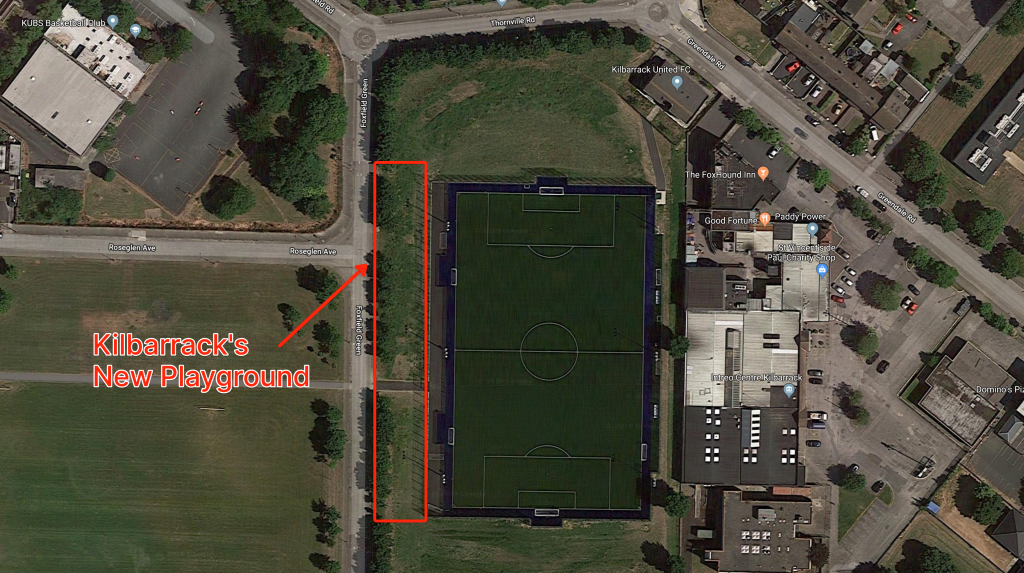
After a protracted effort that began more than twenty years ago, there is finally a new children’s playground in Kilbarrack in front of the Kilbarrack All Weather pitch facing on to Greendale Road at the top of Thornville Road.

Satellite map showing the location of Kilbarrack's new playground as a red rectangle
Map showing the location of Kilbarrack’s new playground

A significant role in advocating for the playground was played by the Kilbarrack Coast Community Programme (KCCP), who are rightly proud and delighted with the result. After organising several meetings in the community around the issue of the playground, KCCP elected two representatives (Lenann Clarke and Stephen Hutton) who made a presentation to Dublin City councillors and officials, members of the Northern Area Committee.

On foot of this campaign, funding was allocated to the new playground and the process of planning went ahead.

It was still a massive task, however, to actually get the playground built.

And to make matters worse in 2016, KCCP lost a safe space for children’s play when a new fence was put up right outside their exit, creating a prison-like atmosphere.  In response, a fantastic video, produced and directed by Tiernan Williams called Kilbarrack’s Ode to Bansky was released in August 2016.

Later in 2016, Amy Fogarty launched an online petition that gathered 688 signatories and in October that year she was told:

In response to your query I can inform you that I am currently working on developing a playground analysis of the North Central Area for the purpose of identifying deficits in play facilities for this area. This is due to be presented at the next North Central Area Committee meeting. However, current records indicate that Kilbarrack has been identified as a deficit area according to Parks Strategy playground analysis. ‘Roseglen’ open space has been identified as a potential location for a new playground but as yet a delivery programme has to be identified following review of completed playground analysis for this area. I will get back to you with an update in the coming weeks. 

Unfortunately, this did not result in a prompt build and despite several positive announcements, the process dragged on until now.

Finally able to announce the new playground KCCP said:

Two Dublin City Councillors were particularly supportive of our campaign – Councillor John Lyons and Councillor Mícheál Mac Donncha The playground may not be perfect and may need improvements but for a community that has been waiting for so long it is a great first step.

The work is nearing completion and KCCP have invited suggestions on necessary improvements: please email info@kccp.net or ring Marian 01-8324516

Council John Lyons was equally delighted.

 There is now a new playground in Kilbarrack. Happy to see that the community’s effort and persistence over a very long time has paid off!

Let’s hope that the kids in the area love it and use it as much as their hearts desire.

Filed Under: All Posts, Dublin City Council Housing

New Stardust Fire Inquest for Victims of 1981

26/09/2019 by admin 1 Comment

It is three years since the Attorney General of the day decided that a new Stardust Fire inquest into the deaths of the 48 young people who perished in the 1981 nightclub fire should be held and yet the families still wait.

For more than forty-one years the families and friends of the victims and the survivors have been fighting for the truth of what happened to their loved ones on that Valentine’s Night in Artane and why. Campaigning for truth and justice for more than four decades, these heroic people have faced heartbreak and pain, frustration and suffering, insult and injury as successive governments and civil servants brushed them off.

No one has ever been held responsible for the worst fire disaster in the state’s history.

The latest delay and cause of frustration was the attempt by Eamon Butterly, general manager of the Stardust nightclub on the night of the fire and son of the nightclub owner and Fianna Fail associate Patrick Butterly, to prevent a finding of “unlawful killing” being available to the coroner, Dr. Myra Cullinane.

But on 2 November 2022 Mr Justice Charles Meenan in the High Court ruled “unlawful killing” should be available to the jury in the inquests.

‘The ruling is very welcome. We have been fighting for these inquests to get
underway since 2019,’ Maurice McHugh, who along with his wife Phyliss, lost their only daughter Caroline aged 17 in the fire, told The Irish Times.

‘What we want to achieve is to know how the fire started that night, what happened to our children. We hope to get started now and get answers.’

Over the last two years, fourteen pre-Inquest hearings have taken place and now that Butterly’s legal challenge to the process has concluded, the fifteenth hearing scheduled to take place at 2pm on 23 November 2022 at The Pillar Room, Rotunda Foundation, Parnell Square East, Dublin 1 could well be the first day of the official inquests.

The Long Road to Justice for the Victims of the Stardust Tragedy

All the pain we’ve been put through, all the stuff we’ve gone through for the truth. This is what we fought for, campaigned for, and what we wanted.

This is how Selina McDermott greeted the news on 25 September 2019 that there will be a new inquest in to the Stardust fire. Selina’s sister Marcella (16) and her brothers, George (19) and William (22) died on the night of 14 February 1981 at the Valentine’s Day disco at the Stardust nightclub, Artane. In all, 48 people died that night with another 11 badly disfigured, 214 physically injured and hundreds, too, traumatised ever since.

Starting in a first-floor storeroom, a fire that night developed rapidly, in part because despite a lack of planning-permission, flammable materials were present in great quantity, including nearly 250kg of cooking oil in five drums. Although the Fire Brigade were alerted in minutes a blast of heat and the melting of ceiling material, followed by the lights going out created a catastrophic situation.

Stardust Fire inquest. Eamon Butterly owns the Butterly Business Park, which is the modern site of the Stardust fire of 1981. The picture is evening and shows a two story building with a large front entrance, above which the word Butterly is spelled out in glowing pale lights.
The Butterly Business Park, owned by Eamon Butterly, the site of the Stardust Fire of 1981

Most of the dead and injured came from Artane, Kilmore and greater Coolock, where the community has never ceased to suffer. Not only because of the pain of the losses, but also because of the way in which our political and legal system has failed us.

Independent Left Councillor John Lyons’ response to the announcement of the new inquests was to welcome it as hugely important but he added that this should never have taken so long.

The families of the victims and the survivors of the worst fire disaster in the history of the Irish state have been through hell and back many times over the last thirty eight years, from the initial political cover up by way of the Keane tribunal to years of political indifference, and the more recent con job that was the McCartan Report, which can only be described as a disgraceful insult, the families kept fighting, kept demanding answers as to how forty eight young people died in that building.

They have been vindicated by the decision of the Attorney General to open up new inquests into the forty eight deaths. But the survivors and the families and friends of the victims should not have had to wait nearly four decades to get the answers they deserve. If the fire had taken place in Blackrock rather than Artane, there is no way that people would be left waiting so long for justice. The working class communities of Coolock and Artane know this to be true as the treatment they have received from the Irish state, successive Fianna Fail and Fine Gael-Labour Party has been nothing short of a scandal.

The fact that the Keane tribunal of 1981 found that the fire was probably caused by arson – a finding that was always disputed and eventually ruled out – meant that the owners, the Butterly family not only escaped compensation claims and therefore proper accountability for their actions, which included the obstruction of fire exits, but they were awarded IR£580,000 in compensation.

The Stardust had been developed without planning permission and the fire authorities had denied Paddy Butterly permission to retain the club unless he installed another fire escape.

Although a 633-page was sent by the Gardai to the DPP, the only person to face charges arising from the tragedy was John Keegan, whose two daughters died that night, for confronting Paddy Butterly.

Eamon Butterly Has a Lot of Questions to Answer at a New Stardust Fire Inquest

The Butterly family were – and probably still are – highly networked politically. In his memoirs, published just for family and friends but leaked, Paddy Butterly reveals that a former economic advisor to Labour Tanaiste Dick Spring worked for the family for two years. While he was Minister for Industry and Commerce, Fianna Fáil’s Kevin Boland had a chat over coffee with Paddy Butterly nearly every morning. “We were all Finna Failers”, reports Butterly, and adds that Fianna Fáil Taoiseach Jack Lynch asked Butterly to join Taca, their party fundraising group for wealthy businessmen.

‘‘What you had these people for,” explains Butterly, “was to help get things. I don’t mean by giving them money. But if you wanted to know something about your business or you wanted someone who could do something, you didn’t get the answers by writing into the papers. You asked these people.”

The injustice of the treatment of the Stardust families and their lack of access to political power in comparison to the situation of the Butterly’s explains why it has taken so long to obtain this inquest. And why it has been such an uphill struggle.

When, in 2006, Eamon Butterly, owner of the Stardust, opened The Silver Swan pub in the business park where the fire took place, protesters played the following Christy Moore song for ten weeks outside the bar, every night between six and eight pm.

They Never Came Home, was released in 1985 and was banned, with Christy Moore being found guilty of contempt of court for having written it. It remains a powerful statement on a terrible tragedy and a political system that has only contempt for working class communities.

They Never Came Home Lyrics

Christy Moore

St Valentine's day comes around once a year,
All our thought turn to love as the day it draws near,
When sweethearts and darlings, husbands and wives,
Pledge love and devotion for the rest of their lives.
As day turns to evening soon night-time does fall,
Young people preparing for the Valentine's Ball,
As the night rings with laughter some people still mourn
The 48 children who never came home.
Have we forgotten the suffering and pain
The survivors and victims of the fire in Artane,
The mothers and fathers forever to mourn
The 48 children who never came home.
Down to the Stardust they all made their way
The bouncers stood back as they lined up to pay
The records are spinning there's dancing as well
Just how the fire started sure no one can tell.
In a matter of seconds confusion did reign
The room was in darkness fire exits were chained
The firefighters wept for they could not hide,
Their anger and sorrow for those left inside.
Have we forgotten the suffering and pain
The survivors and victims of the fire in Artane,
The mothers and fathers forever to mourn
The 48 children who never came home.
All around the city the bad news it spread
There's a fire in the Stardust there's 48 dead
Hundreds of children are injured and maimed
And all just because the fire exits were chained.
Our leaders were shocked, grim statements were made
They she'd tears in the graveyard as the bodies were laid
The victims have waited in vain for 4 years
It seems like our leaders she'd crocodile tears.
Have we forgotten the suffering and pain
The survivors and victims of the fire in Artane,
The mothers and fathers forever to mourn
The 48 children who never came home.
Half a million was spent on solicitor's fees,
A fortune to the owner and his family
It's hard to believe not one penny came
To the working class people who suffered the pain.
Days turn to weeks and weeks turn to years
Our laws favour the rich or so it appears
A woman still waits for her lads to come home
Injustice breeds anger and that's what's been done.
Have we forgotten the suffering and pain
The survivors and victims of the fire in Artane,
The mothers and fathers forever to mourn
The 48 children who never came home.

Antoinette Keegan, who lost two sisters in the Stardust disaster, asked people to give John Lyons (Independent Left) their number one vote in Dublin Bay North in the general election of 2020.

John has been very, very helpful to us, been a huge support, given us a lot of time and effort. He’s been on the campaign for a long, long time. He has been fantastic for justice for Stardust and also other issues in the community. Please give him your number one vote.

Antoinette Keegan, member of the Justice for the Stardust 48 group.

’48 by Gemma Kane was a powerful play about the Stardust tragedy

Actor and playright Gemma Kane has a personal connection to the disaster at the Stardust, her parents were there that night (and escaped). ’48 is told through the perspectives of four people who – with a lot of humour – share their lives and dreams in the run up to their fateful night out.

The cast were Gemma Kane, Emily Fox, Laurence Falconer and Niall O’Brien, the play was directed by Clare Maguire and produced by Ali Fox. It was shown on 12 February and 13 February 2020 in the Axis Theatre, Ballymun.

Gemma Kane, Emily Fox, Laurence Falconer  and Niall O’Brien are sitting on a stone wall under some trees. They are dressed in 80s clothes, as the characters from '48, a play about the Stardust tragedy.
Gemma Kane, Emily Fox, Laurence Falconer and Niall O’Brien: the cast of ’48, a play about the Stardust fire.

39th Anniversary Vigil of the Stardust Tragedy

On 13 February 2020, a vigil was held to commemorate the Stardust tragedy. Singer Christy Moore, longstanding supporter of the Stardust families, attended, along with North Dublin Gospel-Choir, Eamon Dunphy and Charlie Bird. Dublin City Council supported the event and provided a marquee outside the former Stardust venue at Butterly Business Park on the Kilmore Road in Artane.

Justice for the Stardust48

Stardust Fire Inquest. A plaque to remember the 48 victims who lost their lives in the Stardust - Michael Barrett, Richard Bennett, Carol Bissett, Jimmy Buckley, Paula Byrne, Caroline Carey, John Colgan, Jacqueline Croker, Liam Dunne, Michael Farrell, David Flood, Thelma Frazer, Michael French, Josephine Glen, Michael Griffiths, Robert Hillick, Brian Hobbs, Eugene Hogan, Murtagh Kavanagh, Martina Keegan, Mary Keegan, Robert Kelly, Mary Kennedy, Mary Kenny, Margaret Kiernan, Sandra Lawless, Francis Lawlor, Maureen Lawlor, Paula Lewis, Eamon Loughman, George McDermott, Marcella McDermott, William McDermott, Julie McDonnell, Teresa McDonnell, Gerard McGrath, Caroline McHugh, Donna Mahon, Helena Mangan, James Millar, Susan Morgan, David Morton, Kathleen Muldoon, George O'Connor, Brendan O'Meara, John Stout, Margaret Thornton, Paul Wade.
Memorial Plaque to the Stardust 48
Stardust Fire Inquest. The stage at the marquee for the 13 February 2020 memorial event for the Stardust 48. It shows a microphone, a red curtain and in front of it in large yellow figures: 48. A pop-up banner on the right of the pictures says: forever in our hearts.
The stage at the marquee for the 13 February 2020 memorial event for the Stardust 48.
Stardust Fire Inquest. A full marquee at the moving Stardust 48 memorial, 13. February 2020. The picture shows a marquee with temporary lighting and chairs, It is full with people standing at the back.
A full marquee at the moving Stardust fire memorial, 13 February 2020.

Filed Under: All Posts

  • « Go to Previous Page
  • Page 1
  • Interim pages omitted …
  • Page 16
  • Page 17
  • Page 18
  • Page 19
  • Page 20
  • Interim pages omitted …
  • Page 23
  • Go to Next Page »

Copyright © 2026 · Aspire Pro on Genesis Framework · WordPress · Log in