• Skip to primary navigation
  • Skip to main content
independent left logo

Independent Left

Environmentalism, socialism, freedom and equality. #liveablecity

  • About
  • Featured Articles
    • How Farming Must Change to Save the Planet
    • The Housing Crisis: Causes and Solutions
    • Socialism in Ireland
  • Contact Us
  • Podcast
  • Animal Rights
  • Archive
    • Irish Socialist History
    • Dublin City Council Housing
    • Ukraine
    • Protests Ireland
    • Reviews
    • Irish Political Parties
    • All Posts
    • Independent Left Policies
  • Why join?

Tracker Scandal: Bankers Evade Jail Despite Being Thieves

17/07/2019 by John Lyons Leave a Comment

By John Lyons

When you hear, ‘regulated by the Central Bank of Ireland’, think, ‘given license to do as they please.’

The final report from the Central Bank’s Tracker Mortgage Examination  makes grim reading. The tracker scandal reveals yet again the power of Irish bankers, as not one single individual banker will be held responsible for the decisions they made to rip-off their customers. And when finally forced to admit their wrong-doing, their criminal behaviour, they did their best to minimise the amount of compensation they would have to pay out.

And some consumer affairs organisations claim that the report does not go far enough: that there are still hundreds of families who have not be restored to the correct tracker rates.

Will there be any legal consequences for those individuals in the banks who made the decision to rip-off their customers? It appears not.

And the 99 families who lost their homes through no fault of their own? No amount of money can compensate them for the stress and strain they must have endured.

By the end of May, the banks had paid out €683m in compensation. Overwhelmingly the banks involved in robbing their customers are the big five, 98% of those affected were customers of AIB, Bank of Ireland, KBC Bank Ireland, Permanent TSB and Ulster Bank.

We are talking about at least 40,100 customer accounts affected. And while it might seem that the banks are now contrite, effectively, they have gotten the taxpayer to recompense the victims of their cynical practices, since the State remains a significant owner of AIB, Bank of Ireland and Permanent TSB. To the €64 billion bailout bill, we can add most of this one.

When you think about the stress of having a bank chase you for additional money that you never calculated on owing, when you think about the relationships that could not cope and especially when you think about the slick way in which these burdens were imposed, totally without justification, then the payouts are in fact low. This is especially the case for the 99 families whose average recompense was €194,000.

The problem for the banks, post-2008, is that they had made a mistake with tracker mortgages. For once, the deal favoured the customer. But the customer can’t be allowed to win. ‘Choice’ in the marketplace of mortgages is illusory. It is only a matter of minor variation and in all circumstances, as far as the bankers were concerned, they must be able to squeeze the mortgage holder.

So they broke their own contracts and their own rules and by bullying or by sleight of hand, forced thousands of people off their tracker mortgages.

There are so many lessons in this scandal about how Irish capitalism really works, it is hard to know where to start. But the takeaway is surely this, that when we lift the rock, we can see the insects crawling around. The report might not go far enough but it does allow us to see how the financial elite operate. it has exposed a world that we don’t normally get to see and which is one where the drive for profit is dominant, even if that means theft by people who pose as utterly respectable.

Filed Under: All Posts

Review: Helena Sheehan: Navigating the Zeitgeist: A Story of the Cold War, the New Left, Irish Republicanism, and International Communism

14/07/2019 by Conor Kostick Leave a Comment

Everyone goes through a crisis of belief at some point in their lives. We grow up with certain views of the world presented to us and when they don’t fit experience, have to revise or abandon them. This process can be incredibly painful and in the case of Helena Sheehan, it’s hard to imagine a more total collapse and rebuilding than her journey from nun to communist. Her autobiography, therefore is an important book, not just for documenting her times and the very interesting circles she moved in but in allowing the reader to explore in some depth a crucial question for us all: how do I know my current belief system is right?

That’s a big question for anyone, but it’s especially important if you are going to devote years of your life to a particular political strategy and try to persuade others of it.

Helena Sheehan’s political trajectory, charted with complete honesty in this book, was from conservative Catholic, to the US New Left of the late 1960s, to Official Sinn Féin on her arrival in Ireland in 1972 and to the Communist Party of Ireland in 1975, which she left early in 1980. Joining the Labour Party in 1981, Helena helped found the Labour Left group and was close to Michael D. Higgins.

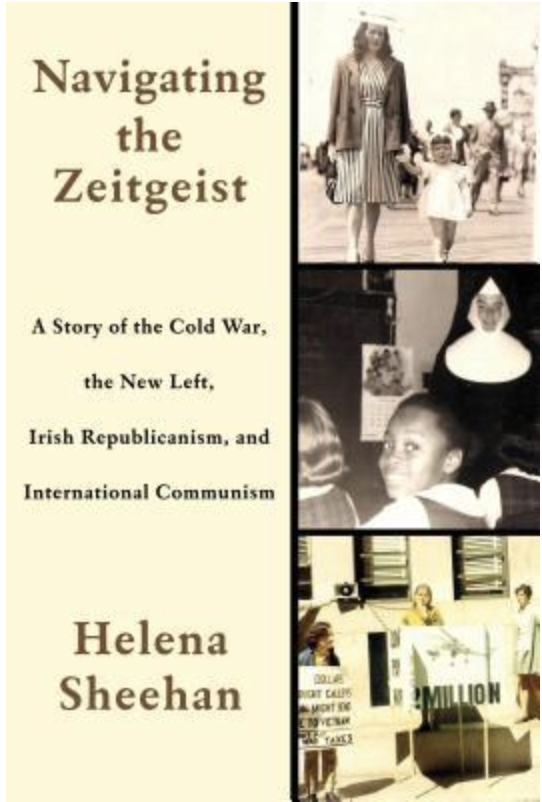
Cover of Navigating the Zeitgeist by Helena Sheehan

There’s plenty in the autobiography for those wanting to cherry pick her insights into characters like Seamus Costello, Tomás Mac Giolla, Betty Sinclair and Michael O’Riordan, but my interest is in the deeper story.

In 1965, having committed herself to the Sisters of St Joseph in Pennsylvania, Helena found herself at odds with the lifestyle of the order. In particular, watching news broadcasts on the march from Selma to Montgomery in spring 1965, she saw nuns participating and wondered why she couldn’t do the same. She taught, ‘We shall overcome’ to the kids in her class. In other words, it was waves of history (as she puts it) that tore her away and while a few years later, nuns left the order in droves, Helena was one of the first to do so.

The intellectual crisis this brought about, compounded by losing her teaching job for being too ‘controversial’ and falling out with her family, was nearly fatal:

I was alone and desperate as it was possible to be. My world was in ruins. In time, I would rebuild on new foundations. But between the collapse of one worldview and the construction of another, there was only an abyss. I often wonder where I found the strength to endure that emptiness.

Eventually, Helena found a way forward via philosophical existentialism to the radical left in Philadelphia (she was studying at Temple University) and by 1970 was deeply involved with city politics. This is a fascinating part of the book, depicting a non-stop lifestyle and a feverish intensity of revolutionary discussions and actions that has rarely been seen since. Helena was in constant discussion with Black Panthers, Students for a Democratic Society, anti-Vietnam protestors, members of the Weather Underground movement, Feminists, Gay rights activists, etc. Her background and intellectual rigour seems to have made her an extremely valuable activist, more able to connect the revolutionaries to wider audiences than many of her peers. And also to spot nonsensical posturing.

This is also the part of the book that in my view, most meets a challenge that she states in the preface, of wanting to connect the social and economic changes of her times with the experience of an individual. Her grasp of the totality of US society, allows her writing to be both wonderfully vivid at a personal level and at the same time to portray a massive systemic crisis. The same strengths are not evident in the sections on Ireland and the USSR, not because her beautiful writing style falters but because I don’t think, even now, reflecting on her life, she’s as clear about the nature of the social systems she’s writing about. These chapters lack her ability, for example, to juxtapose popular culture and sub-culture the way she does so brilliantly with the chapters on the USA.

And this brings me back to the question of belief systems. For a long time Helena was, to put it bluntly, a Stalinist, even after leaving the CPI. Since ‘Stalinist’ is an insulting term that evokes dictatorial practices and bullying, I need to state that Helena comes across as never anything but totally honest and someone who does not believe (as, alas, so many on the left seem to, even today) that there are situations where the ends justifies the means. As she quite rightly observes, ends and means are connected. Helena’s loyalty to the USSR was one of genuine intellectual conviction. Having studied Marxism of a certain type, seen its power, coherence and strength of insight, especially when compared to the anaemic philosophy she encountered while working on her PhD at TCD, Helena sincerely accepted that the USSR was socialist.

How does it happen that someone who has struggled to pick herself up from near death for having invested herself in one ideology (Catholicism) that came crashing down upon her, then adopted another that would do the same? The book stops in 1988, just before the fall of the Berlin wall, with a signal that this would be the second great intellectual crisis of her life. The cheap answer, which seems to have been thrown at her several times, is that this is just her nature, to uncritically commit to a big-picture ideology. From nun to communist is not such an extraordinary journey from this perspective.

Helena’s own rebuttal to that is that she’s acquired her second, communist, worldview after years of effort to achieve intellectual and moral clarity, whereas she stumbled into the first, unformed and driven by forces of which she was largely unconscious.

And yet.

Let’s agree that, broadly speaking, to be a socialist is a fine thing. Really, this is an inspiring book because it is about a life spent largely in causes that have improved the position of working people, of those nations resisting empires, and especially the position of women. Nevertheless, as soon as you think you have the full picture, worse, if you defer to someone else in your party you think has the full picture, you’re doomed to one day finding yourself articulating a view that no socialist should hold.

In Helena’s book, I don’t think she ever defers to someone in authority, except perhaps the dead authorities of brilliant thinkers. But I do think her model of Marxism is (at least for 1975 to 1988), ultimately, a sterile one, by which I mean the categories that Marxists use to discuss social structures (mode of production, surplus value, etc.) have been imposed on history rather than derived from it.

How do I know my current belief system is right? Because I’ve studied; I’ve fought; I’ve struggled to change the world; I’ve tested it constantly against unfolding events; I’ve had to build it up from the ruins of previous belief systems. That’s all impressive but it’s not enough. My view is that you also have to be open to the possibility that this hard-fought for model is wrong. It’s difficult, because the path to becoming a post-modernist (something that Helena despises, with good reason), begins with surrendering the primacy of your belief system.

Yet when I see a human being who clearly has great honesty and integrity fail to mention the Hungarian uprising of 1956 in her discussions of Eastern Europe; fail to support the Prague Spring or the early days of Solidarity in Poland and instead, describe her sojourns in the USSR largely in halcyon terms, I have to shake my head in dismay. Now the book only ends in 1988, so Helena’s current views might be much closer to mine on these issues (i.e. on the side of those who rose up against the rulers of Russia and the eastern block). But for me the most fascinating aspect of this candid auto-biography is that it makes you question your own understanding. Readers will ask themselves: if someone with Helena’s strengths can end up a Stalinist, then where am I heading?

It’s not easy, being ambitious and determined enough to believe the whole world can become a place of equality and freedom, yet modest enough to accept your current approach to achieving that goal could be flawed. Yet on reading this entertaining autobiography, it seems to me that’s the fast-flowing contradiction that socialists have to constantly navigate.

Filed Under: All Posts, Reviews

Superb Kilbarrack Murals Launched by Roddy Doyle

11/07/2019 by John Lyons Leave a Comment

A positive welcome to Kilbarrack and Dublin Bay North

By John Lyons

Two superb artistic creations were unveiled in Kilbarrack on 10 July 2019, with Roddy Doyle on hand to add some literary flair to the launch of the two murals.

One of the murals was created by the Reach Out Project, a programme designed for 18-25 year old young adults. These individuals are likely struggling with one of a number of issues relating from a variety of psychosocial pressures. Addiction, mental health conditions and/or people just stuck in a rut are the main people who are the focus of “Reach Out” interventions.

They have created a piece of artwork with the internationally renowned graffiti artist “Solas”. This was facilitated with the support of Laura Larkin from DCC Culture Company and Iarnrod Eireann. It’s been an honour working with an Artist as brilliant as Solas and the young people in the Reach Out project have really enjoyed it: to the point that they were inspired to create and are now finishing their own separate graffiti mural, which was also unveiled on the day. Solas’s art piece celebrates Kilbarrack’s links with Roddy Doyle’s novels and the fictitious “Barrystown” which essentially represents Kilbarrack. It is also an effort to capture the struggle and spirit of those from Kilbarrack who would never give up. In particular we focus on three strong women: Brenda O’Connell, Ann Murnane and Kathleen O’Neill who represented the heartbeat of the community.

Roddy Doyle launches the new Kilbarrack mural

The second art piece completed by the young people celebrates the significant amount of successful people who have originated in the North Bay community of which Kilbarrack is a proud member. The young people felt it was important to highlight the amount of successful people in the mural, who have come from their communities. It was especially important that the mural is placed in the local rail station for a couple of reasons. The first being that the station is often the only feature some people see when commuting through Kilbarrack on the train. The second is that the train station has in the past, been a place of some antisocial activity. The mural is a positive, hope-filled artwork, strategically placed to have a maximum impact for vulnerable people who congregate around the station. But also, to educate others unfamiliar with the area. To visually show that the Kilbarrack community has a strong heritage with a proud and wonderful people residing within the area.

The Reach Out Project is part of Kilbarrack Coast Community Programme. (KCCP). In the 1990s Kilbarrack suffered from social disadvantage with high levels of unemployment and little or no history of young people going into third level education. KCCP was set up in 1997 in response to the “second heroin epidemic”, which was devastating our community. Year on year KCCP has increased the range of services and the numbers using the services e.g. our community counselling service worked with 150 people from the community last year. In 2018 the Health Services Executive conducted an evaluation of our services and concluded that we are an “exemplar Project” and that all our services are delivered to the highest standard.

Filed Under: All Posts

Independent Left’s response to gangland killings in Coolock and Darndale

05/06/2019 by Conor Kostick 1 Comment

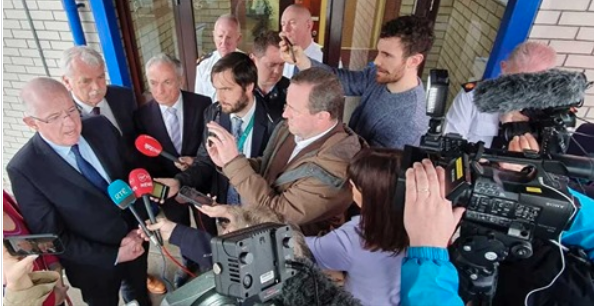
Minister Charlie Flanagan visits Coolock and does nothing for the community
Millionaire Charlie Flanagan fails the young people of Coolock and Darndale

When young people from working class communities are drawn towards crime gangs, tragedy is never far away. On 25 May, Eoin Boylan, aged 22 was shot and killed in the residential area of Clonsaugh Avenue Coolock.

In May, Hamid Sanambar (42) was shot on Kilbarron Avenue, Coolock, the home of Sean Little (22), who was shot dead on Tuesday 21 May 2019. Jordan Davis (22) was shot dead in Darndale on 22 May, while earlier in the year, in a related assassination, Zach Parker (23) was killed in Swords. The fact that these lives were wasted is tragic and clearly too there is the risk that bystanders including children and the elderly will get caught up the feud, with the murders taking place in daylight on busy streets.

Independent Left councillor John Lyons calls a fully-funded multi-agency body

In an interview with RTE’s Sean O’Rourke, Independent Left councillor highlight the neglect of support for youth initiatives in Dublin’s north east and argued for greater resources for the area and the creation of a coherent, fully-funded multi-agency body similar to the North East Inner City (NEIC), to tackle and address the many issues involved in this murder.

What have the government to offer a traumatised community and a youth culture that celebrates gangsters? In the case of the Taoiseach, nothing at all. He said that, ‘as soon as I can find a little time’, he would visit Coolock and Kilmore West. When he wants to move fast, Leo Varadkar can make room in his diary, such as to meet with Donald Trump. Clearly, this crisis of gangland feuding is not a priority for him, nor for his ministers.

Although Justice Minister Charlie Flanagan came to Coolock Garda Station in May 2019, he had nothing to announce by way of a new package of assistance for the community. A small amount of investment in sports clubs, for example, goes a long way in terms of giving young people inspiring, constructive role models. We only have to look at Katie Taylor to see that.

Instead of bringing welcome news on the community support side, Flanagan told young people to ‘drop the bling’ and that criminal gangs were ‘all losers.’ If I were a teenager being told by a landlord worth over €3m to drop the bling and stay away from criminal gangs, my fury at his privileged arrogance would have me reaching for a milkshake.

In the UK, Nigel Farage was one of many far-right politicians targeted by ‘milkshaking’ in 2019

This is why Councillor John Lyons was absolutely right to describe the visit of Flanagan (and Richard Bruton and Finian McGrath) to Coolock as a shameful public relations stunt.

John Lyons called on the government to establish a taskforce for the Coolock area to address the ongoing gangland violence, and the many economic, social and educational inequalities that give rise to such activity: ‘It is hugely disappointing that the three government ministers had nothing of note to announce. We need a task-force established that will be responsible for monitoring the work of the various government departments, state agencies and community groups that have a role to play in tackling the many problems faced by people in the area.

‘I am sure that if the recent murders in Darndale and Kilmore had occurred in Dalkey or Killiney we would have seen a much swifter and more serious response from the government; instead, it takes government ministers a full week to visit the area and when they visit, they have nothing of value to say or announce. Shameful really, and not good enough for the communities directly affected by the recent violence.

‘So I am once again inviting An Taoiseach to find “a little time” to visit the area, meet with the various stakeholders in the community with a view to establishing a task-force for the area. The communities deserve a serious response from government, a response sadly lacking to date. The government must step up.’

In the coming days Councillor John Lyons and Niamh McDonald will be working together with community groups and sports organisations to formulate a serious response to the gangland crisis, one that can make a significant impact in the life paths of young people instead of attempting to dismiss them. To paraphrase the Sex Pistols, if you treat kids as morons, you create H Bombs.

While the contempt of millionaire, landlord politicians just makes the situation worse, Independent Left seeks to create a constructive path for the energy and passion of the young people of our community.

An election image for Dublin Bay North showing John Lyons and headlined crime. He calls for greater spending on schools and amenities and a local multi-agency task force.
In general election 2020 as candidate for Dublin Bay North, John Lyons called for increased spending on amenities and a multi-agency task force to tackle the growth in crime gangs.

Filed Under: All Posts, Independent Left Policies

Election Counts and Results Artane-Whitehall and Donaghmede 27 May

27/05/2019 by Conor Kostick 2 Comments

Election candidates from Artane-Whitehall discuss a recount
John Lyons and Niamh McDonald in discussion with the electoral officer during a recount

The second day of counting in the local elections confirmed our expectations from the first. For the Artane-Whitehall constituency, which includes Artane, Beaumont, Belcamp, Clonshaugh, Coolock, Darndale. Kilmore West, Santry and Whitehall, John Lyons retained his seat on Dublin City Council (despite a redrawn constituency). With the elimination of the independents Paul Clarke and Paddy Bourke, John pulled well clear of Fianna Fáil’s Racheal Batten, just (after a recount) 11 votes shy of a quota. Given that the top three candidates polled well ahead of Fianna Fáil and Fine Gael, it is clear that this is one of the most left wing of Dublin constituencies.

Artane Whitehall Count 5
The result of the fifth count for Artane-Whitehall

After his victory, Councillor John Lyons said:

I’m incredibly honoured that so many people on the Northside voted to endorse the Independent Left platform demanding action on climate change, more public and affordable housing, reform of local government, the remunicipalisation of waste services, enhanced public transport and cycling infrastructure, better community cleaning and a more affordable system of public childcare.
There is a lot more to say about what has happened over the last two days but for now, thank you to all who got involved, supported and voted for a radically different vision of Dublin, one that places people not profit at the heart of the city’s political decision-making processes.

John Lyons elected in count 6 of the Artane-Whitehall LEA following recount. His surplus of 385 will now be redistributed #LE19 #DCC19 pic.twitter.com/dud0NGrHHr

— Dublin City Council (@DubCityCouncil) May 26, 2019

It was an impressive result given the context of an election in which the socialist left on Dublin City Council and elsewhere struggled to hold their ground as the Greens made substantial gains (and Fianna Fáil made a slight recovery) and it testifies to the steady resistance of the community to the agenda of the government as well as an appreciation that Councillor John Lyons and his team have put their energies behind a whole range of local campaigns.

In the Donaghmede constituency, covering Ayrfield, Belmayne, Clarehall, Clongriffin, Donaghmede, Edenmore and Kilbarrack, where Niamh McDonald represented Independent Left, the election demonstrated that the constituency has challenges for socialists, with two Fianna Fail and one Fine Gael councillor elected out of the five positions. Donaghmede provides an example of the trend that was evident across the country, where the strong performance of a Green Party candidate, in this case Lawrence Hemmings, was reinforced by a steady accumulation of transfers.

Between the Social Democrat Paddy Monahan, Niamh McDonald and Solidarity’s Michael O’Brien there was a left seat in play until the very end. The transfers on the elimination of Labour’s Shane Folan make for interesting reading and decided the issue. Overwhelmingly, they went to the Green Party but also Labour voters showed a notable preference for Fine Gael and Fianna Fáil over Michael O’Brien.

Donaghmede count figures 27 May
The Donaghmede final count figures show how the Green Party took a seat at the expense of the left.

Given these figures, the fact that Nimah McDonald rallied nearly 600 first preference votes for Independent Left is a real achievement and again shows there is a strong base for future campaigns and resistance to the government in the Donaghmede area. And this, of course, is the crucial point. Across the country there will be several disappointed socialist candidates tonight, whose hopes of council seats disappeared in the light of the strong Green performance. Yet the overall message of this election is a positive one.

I think it would be fair to say that the message of the election is that the country has not bought into Fine Gael’s complacent story about Ireland’s progress. While Fine Gael, Finian McGrath and the other ‘independents’ may have created hundreds of new millionaires in the last three years (especially from the landlord class), their record on housing, the environment and health especially has been disastrous and not only for working class communities. The rise of the Green vote is a slap in the face to such complacency and expresses a desire for much more radical responses to climate change especially. This feeling is likely to feed into Ireland playing it’s part in a huge international protest about the climate on 20 September (a #globalclimateaction strike that we can start building for now) and into campaigns on housing.

So there’s every chance that in the coming months there will be plenty of opportunity for socialists, whether council members or not, to participate in campaigns, local and national, and while doing so, to emphasise that for lasting change, we need to look at a transformation that is far more profound than that which is on offer from the Greens.

All the political parties, including those of the left, are now rushing (insincerely in the case of Fine Gael and Fianna Fáil) to emphasise their environmental credentials. But the crucial point to be made to those who hope that the Green Party are going to offer a different approach is simple: they won’t. Whether or not the Greens have the best policies on housing, transport, climate change, etc. (and we are happy to adopt them if they do), the problem the Green Party faces is a deep-rooted acceptance of the current pro-business way in which the world is run.

In response to his own party member Saoirse McHugh saying she would resign from the Green Party if they went into coalition with Fine Gael or Fianna Fail, Ciaran Cuffe, the millionaire Green candidate for the Dublin constituency in the European elections, couldn’t even bring himself to rule out that option when asked about it today at the count centre. And he is looking distinctly uncomfortable with the question.

For Independent Left, it would have been easy to answer that question: not only would we never participate in such a coalition, but we are striving for a global change to how our planet is organised, one that abandons the race for private profit and instead makes decisions on the basis of equality, freedom and care for the needs of the many. In a word: socialism.

Filed Under: All Posts, Irish Political Parties

  • « Go to Previous Page
  • Page 1
  • Interim pages omitted …
  • Page 19
  • Page 20
  • Page 21
  • Page 22
  • Page 23
  • Go to Next Page »

Copyright © 2026 · Aspire Pro on Genesis Framework · WordPress · Log in