• Skip to primary navigation
  • Skip to main content
independent left logo

Independent Left

Environmentalism, socialism, freedom and equality. #liveablecity

  • About
  • Featured Articles
    • How Farming Must Change to Save the Planet
    • The Housing Crisis: Causes and Solutions
    • Socialism in Ireland
  • Contact Us
  • Podcast
  • Animal Rights
  • Archive
    • Irish Socialist History
    • Dublin City Council Housing
    • Ukraine
    • Protests Ireland
    • Reviews
    • Irish Political Parties
    • All Posts
    • Independent Left Policies
  • Why join?

Why is Ireland so Expensive?

08/07/2022 by John Lyons 1 Comment

Ireland is officially the most expensive country in the EU

Cost of Living Crisis: Time to Bail out the People

Why is Ireland so Expensive Why is Dublin so expensive?
Why is Ireland the most expensive country in Europe to live in?

The reason why Ireland – and Dublin in particular – is so expensive is because corporations are protecting their profit margins by further hiking up their prices which they can do as competition here is weak and consumer protections are poor.

At the start of July 2022, EU Eurostat published a report on 2021 price levels for consumer goods and services which found prices in Ireland are 40% above the EU average.

Our housing costs (rents, mortgages, gas, electricity) are the most expensive in the entire EU, 89% above the EU average, with Dublin the most expensive.

Our health costs are the most expensive in the entire EU, 72% above the EU average.

Our food and non-alcoholic beverage costs are the third highest in the EU, as are our communication costs.

Corporate Profits and Shareholder Dividends are Booming as We are Struggling in the most expensive country in the EU

When it comes to trying to make ends meet week to week, month to month, it is becoming increasingly difficult. Everything is going up except our wages and social transfers.

Living in an already very expensive country which is now experiencing record inflation at a 38-year high of 7.8% is further squeezing the life out of families on middle and lower incomes whilst profits in the corporate sector boom.

The combined annual profits of the five biggest energy utilities doubled to €560 million in a year, while profits at the five largest Irish food companies increased by €174 million.

The government, whose wealthy politicians are highly networked with the boards of these companies, says they will do nothing to help struggling families and tackle corporate profiteering.

The taoiseach receives €217,000 a year              The tanaiste receives €200,000 a year
Every Minister receives €183,923 a year      Every TD receives €101,193 a year
Meanwhile 630,000 people in Ireland are living below the poverty line.
The median average wage in 2021 was €35,500.[1]

These politicians live in a different world to us. We have to force them to care.

We need:

  • a windfall tax of 10% on the excess profits of Irish energy companies
  • Scrap the carbon tax, which hits lower income families the hardest
  • Introduce a new annual tax that targets the wealth of the Ireland’s millionaires & billionaires
  • Pay increases of at least 10% as well similar increases in social welfare payments
  • Maximum unit price cap on electricity, gas and home heating oil
  • State-led building programme of social & affordable homes on state lands, nationwide retrofitting programme, rent freeze and a ban on evictions.

The government narrative about why Ireland is so expensive is that high prices are caused by global shortages for which they have no responsibility. There might be some truth in that for particular cases but it is absolutely not true for the disproportionate expense of housing and childcare, which arise from government policy. As the Irish Congress of Trade Unions have noted, Ireland is about €14bn a year behind peer European nations in per capita expenditure on public services.
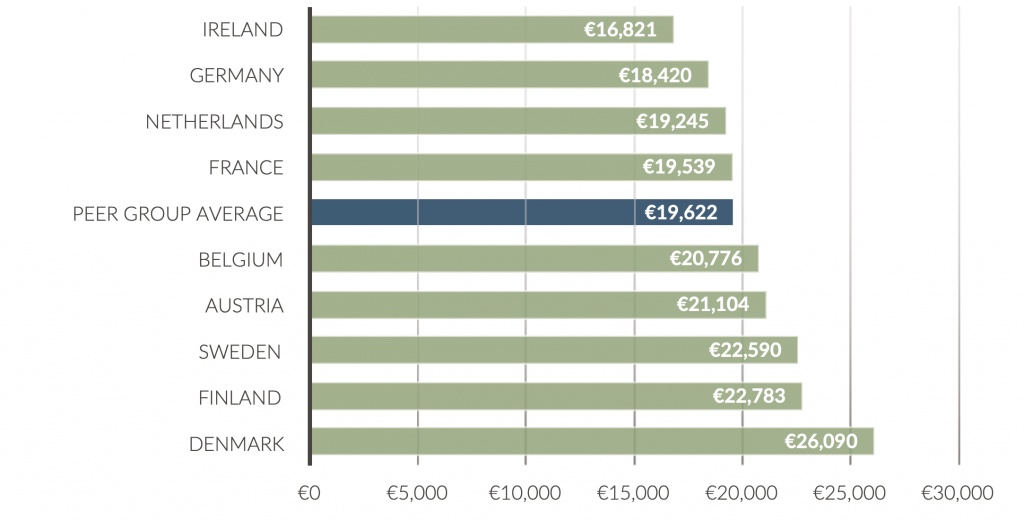
Why is Ireland expensive? Because Public Spending in Ireland is €14bn below peer EU countries
The real reason Ireland is expensive: the private market dominates services

Imagine what a difference it would make to the expense of living in Ireland if childcare were free. Well, that would be possible with €2bn of government expenditure. Or imagine if a huge public housebuilding initiative went ahead to provide tens of thousands of genuinely affordable homes and high quality, low-rent projects. This happens in other countries and the fact it doesn’t happen here is because the voice of Irish workers means a lot less to Fianna Fail and Fine Gael than that of global businessese lobbying for low taxes and property investors.

Why is Ireland so expensive? Because of the lack of public expenditure and the lack of price regulation in the private sector.

[1] This figure is deliberately obscured by the way statistics on wages in Ireland are collected, in which incorporating small volumes of very high earners distorts the picture. Using Felim O’Rouke’s technique (assuming that mean average wages are 26% above median average wages) and taking the 2021 CSO figures for mean average weekly earnings, Independent Left calculate the median annual wage to be approximately €35,500.

Filed Under: Independent Left Policies

SOCIALISTS AND COALITION WITH SINN FÉIN

05/05/2022 by Colm Breathnach 4 Comments

As the likelihood of a Sinn Féin led government grows, the prospect that the government might include radical left parties as coalition partners looms. But should socialists take up roles in government in coalition with Sinn Féin? Are there circumstances where this might prove to be necessary? Obligatory even? Now is the time to debate this issue, rather than being rushed into hastily made post-election decisions that could have a disastrous effect for the left in Ireland.

TWEAKING OR TRANSFORMING?

Its worthwhile beginning the discussion by reviewing how different tendencies of the left, in its broadest sense, approach the question of governmental power in capitalist democracies, concentrating on four overlapping projects with the proviso that, in practice, political organisations often span two or more of these trends or change from one to the other over time:

1. Transformative project: This is where the organisation or movement is serious about the project of replacing capitalism with a system of workers’ democracy. Such a transformative change will primarily be driven by mass movements and will probably involve a series of crises in the social, political, and economic system. This approach is based on the premise that it takes much more than a change of government to bring about the end of capitalism. In essence, this is a revolutionary project that does not see politics as simply a matter of who is in government and, as such, is not fixated on the electoral cycle. It is a fundamental belief of this type of radical socialist or anarchist politics that we are engaged in a long-term project, not simply one of gaining a few bums on ministerial seats.

2. Gradualist project: Though the aim of this project is the same as the transformative one – the replacement of capitalism – the means are substantially different. Advocates of the gradualist project believe a deep transformation can be achieved mainly via the structures of the liberal democratic state, through the introduction of radical reforms by a left government. This “left-reformist” approach has enjoyed a semi-revival with the Corbyn/Sanders movements and, on the theoretical field, with the surge in popularity of Karl Kautsky’s theories amongst some socialists, often to justify gradualist positions in current politics.

3. Reformative project: This is the classic post-WW2 social democratic project. It effectively posited on the acceptance that it isn’t really possible, or even desirable, to break completely with capitalism. What is possible are serious economic and social reforms that would moderate capitalism significantly. In other words, Sweden (or nowadays Finland) is as good as it gets.

4. Adaptive project: This is an explicitly social-liberal, rather than anti-capitalist project. It proposes (but rarely delivers) reforms, but not ones that are in any way threatening to capitalism. This project usually combines a version of neo-liberal economics with some reforms in the area of civil liberties and equality, though often with an emphasis on image rather than substance. Epitomised by New Labour under Blair or the Irish Green Party in its current incarnation, such parties exist in the twilight zone between socialism and liberalism, so much so that it would be correct, in some cases, to question whether theirs is a left project at all. The term “centre-left” used by the mainstream media, usually refers to parties in this mould though it is sometime applied to gradualist and reformative parties as well.

Defining these different approaches is not an academic exercise in classification but is crucial to understanding how different political movements will behave in the future. It helps us to understand and anticipate where political movements might be headed. For example, a radical left party may call itself revolutionary, but in practice advocate entry into a centre-left coalition government which, at best, will engage in reforms without any possibility of a transformation to a post-capitalist society. It doesn’t matter what label an organisation applies to itself, what matters is the actual practical direction of their activities. The Corbyn project was a classic example of this – it was explicitly a reformative project – proposing nothing that the Norwegian Conservative party had not acceded to over years of hegemonic welfare-statism. This is not to say it was wrong for radical leftists in England to engage positively with Corbyn’s Labour Party or that those Labour members involved were insincere, but to argue against the illusion that Corbyn’s Labour was something that it clearly was not.

Though largely outside the scope of this article, it’s also worth noting that identifying the actual aims and methods of a political organisation does not constitute a full analysis of that organisation: an essential component of such an analysis also requires examining their social base: the class, gender, ethnic etc. nature of their voters, members, leadership, as well as the class-interests they represent.

SINN FÉIN AS (RADICAL) REFORMERS?

If the radical left is to judge how to engage with Sinn Féin, and a future Sinn Féin led government, we need to start by identifying what their “project” is. Few would argue that Sinn Féin are proposing a transformation that moves beyond capitalism; even those on the left of Sinn Féin would regard that idea as a hopelessly utopian position. It would be fair to characterise the party as a left-nationalist party, with a strongly working-class base; a party that has the potential to engage in a serious reformist project or to retreat to a largely cosmetic adaptive one. So, an important question is the degree to which the party is serious about implementing reforms: how far are they willing to go? Few expect them to introduce radical economic reforms, but will they have the strength or ability to introduce a radical housing policy that provides decent housing for the thousands who are now without? Or introduce a universal free public health service?

While having no illusions about the nature of the party, it’s important not to underestimate Sinn Féin. Unlike the social-liberal parties, they have grown out of a genuine a mass movement that is rooted in working class communities, both urban and rural. Their base of members and supporters are amongst the most politicised in their communities: this means that there is some pressure from below on them to deliver radical reforms. Whether they could sustain defiance of the intense opposition radical reforms would generate, will be dictated by the balance of forces, in other words by whether the pressure from below and outside the Sinn Féin government will be greater than the pressure exerted by capital.

In respect to what the possible outcomes could be, it is worth considering the balance sheet for Sinn Féin in Dublin City Council. Here we certainly see opportunism, acceptance of market values, and token protest rarely backed by serious campaigning. Yet there is also the occasional red line, when it’s clear that the expectations of their working-class base puts pressure on them to adopt more radical positions. From 2014–2019, Sinn Féin, then the largest party in the council chamber, formed the ruling group with Labour and the Greens. (they had tried, but failed, to involve both FF and FG in the alliance). Under the council’s housing policy during this period, the so-called Housing Land Initiative, public land was given to private developers to deliver housing in the O’Devaney Gardens, Oscar Traynor Rd, and St Michael’s sites. Although Sinn Féin claimed to be unhappy with this policy, they generally supported the process, winning only one concession: an increase in the percentage of social housing within the Public-Private Partnership mix.

O'Devaney Gardens shows the risks of coalition with Sinn Féin
The O’Devaney Gardens sell off is a victory for Fine Gael’s pro-market support for developers and landlords. Cartoon courtesy of Foxy Slattery.

In response to Sinn Féin’s defence of their position, that given an FG-controlled national government they were making the best of a bad lot, Cllr. John Lyons of Independent Left and others on the left, argued the council should reject PPP, link up with housing campaigns and activists and demand a change in national as well as DCC’s housing policy. When, in November 2019, it came to the key moment of voting on Section 183s – to dispose of the public lands – in O’Devaney Gardens, Sinn Féin’s actions displayed its vacillating nature: accepting the limits set by Irish business interests yet subject to pressure from below. The week before the vote, a local Sinn Féin councillor lambasted those who intended to vote against the disposal but then, after a backlash in the media and amongst the public when the pitiful number of proposed affordable homes on the site emerged, the party flip-flopped and voted against the proposal, having wasted the previous five years supporting it. Sinn Féin squandered any chance of creating a radical change in housing policy in Dublin through their ultra-cautious, non-campaigning, narrow, electoralist approach, which was only occasionally forced to the left by pressure from below and from the radical left councillors.

This experience in local government should certainly dampen our expectations of Sinn Féin in government but should not mislead us into presuming that they won’t, in the right circumstances, be forced to take a more radical approach. If they do make a serious effort to bring about some radical reforms which benefit working class people, while remaining within a capitalist framework, they will face an inevitable reaction from the right and the ruling class. Under such circumstances the radical left will need to navigate carefully to support and defend those reforms while pushing from below to force Sinn Féin to deliver on reforms that benefit working class communities. Which brings us to the question of how radical left TDs should approach the question of a Sinn Féin government. This is not a question for adaptive parties such as Labour, the Greens and Social Democrats (and possibly right-wing ones such as FF as well); we can presume they will have no problem in entering a Sinn Féin led coalition.

TO MUCH RUSSIA, NOT ENOUGH RECENT

The history of the experience of the radical left parties in government can certainly be of benefit in illuminating this debate on coalition with or support for a Sinn Féin led government. While the attitude of various left parties to coalition government in post WW1 Russia or Germany is relevant, given the profound differences of circumstances it has limited contemporary value. The crucial mistake in historic comparison is to compare the dilemma of entering government in a revolutionary situation with the challenge of entering coalition government in a regular liberal democracy in a non-crisis situation.

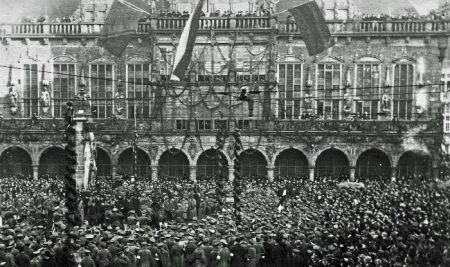
Revolutionaries could enter coalition with Sinn Féin-type parties in extreme circumstances such as arose in Germany 1919
Declaration of a Soviet in Bremen, Germany, 10 January 1919

This problem is clearly illustrated in a recent article by the PBP TD, Paul Murphy, in which he explores the question of radical left participation in government at length but mainly in relation to the experience of the KPD (German Communist Party) in the crisis-ridden 1920s and with no reference to the experience of any radical left, or even left-reformist, party in the subsequent century (Murphy, 2021). Murphy’s conclusion, that the radical left should participate in a “left government” which “pursues a revolutionary struggle against capitalism” doesn’t really leave us any clearer, since we get no inkling as to how that relates to the crucial issue of a possible Sinn Féin led government. Are we to conclude that, since SF are clearly not interested in “a revolutionary struggle against capitalism”, the prospect of joining a coalition with them is being ruled out or, since Murphy doesn’t say so explicitly, could it be that he thinks it is possible that a Sinn Féin led coalition could be such a “ruptural government”? While Murphy’s intervention is welcome in that broaches the issue, it ends up being a lesson in history rather than engaging with the current situation facing the Irish left. There are of course no models or exact replicas of what a radical party should do but rather than concentrating on Germany in the 1920s, we would be better served examining the recent experience of left-of-social-democracy parties in western European countries.

Before considering those more recent examples it is worth pointing out that others in PBP have given a much clearer indication of willingness to enter a coalition “left government”. John Molyneux (2022) dismisses the option of PBP being rushed or manoeuvred “to join this (Sinn Fein led) government lured by the prospect of office and achieving “real change” but then quickly turns to considering the conditions under which PBP would enter a Sinn Féin led left government. Firstly, there is a clear understanding that this left government would be gradualist: one that would “take on capitalism”, a deliberately ambiguous terminology.

The process of joining a coalition with Sinn Féin is outlined: PBP would negotiate on “core demands” though “The exact nature of the demands will have to be determined according to the circumstances prevailing at the time”. Whatever this is, it is not a transformative or revolutionary approach, it is a plan to work with Sinn Féin to set up a government that would implement reforms within the constraints of capitalism. The list of possible demands, including taxing the rich, a major public housing programme, establishing a National Health Service, repeal of antiunion laws; etc. would constitute major gains for workers if implemented but for a revolutionary party to enter a left reformist government to try and reform the capitalist system is counterproductive: every failure and compromise would belong to the radical party which in effect had chosen to abandon its overall goal.

There is enough ambiguity in Molyneux’s language to allow PBP to enter government on a programme of less radical reforms, since to negotiate implies, by definition, the possibility that you will have to compromise on some of your demands. Of course, a left-reformist or gradualist position is an honest, though mistaken, position but one which is based on the view that a revolutionary or transformative position is utopian and should be abandoned. If members of PBP believe that a transformative project is utopian then it is incumbent on them to argue that case openly, in which case, in practice, they have abandoned a revolutionary position.

LESSONS FROM THE CONTINENT

So, what are the lessons that the Irish left can learn from those more recent experiences in western Europe (those being the societies most directly comparable to contemporary Ireland)? First – something so obvious that it’s easy to miss – in no case has there been a serious attempt to bring about a radical transformation of society, to begin the process of establishing a society and economy directly controlled by workers. So, while it is perfectly plausible, though from a revolutionary perspective mistaken, to argue for the participation of radical parties in a centre-left coalition government, it is simply contrary to all contemporary European evidence to claim that this is a step on the road to a radical transformation of society. One could argue that the radical left entering government might lead to significant reforms or might protect workers from a roll back of the welfare state etc. but there is simply no evidence that this could feasibly lead to a serious step towards dismantling capitalism.

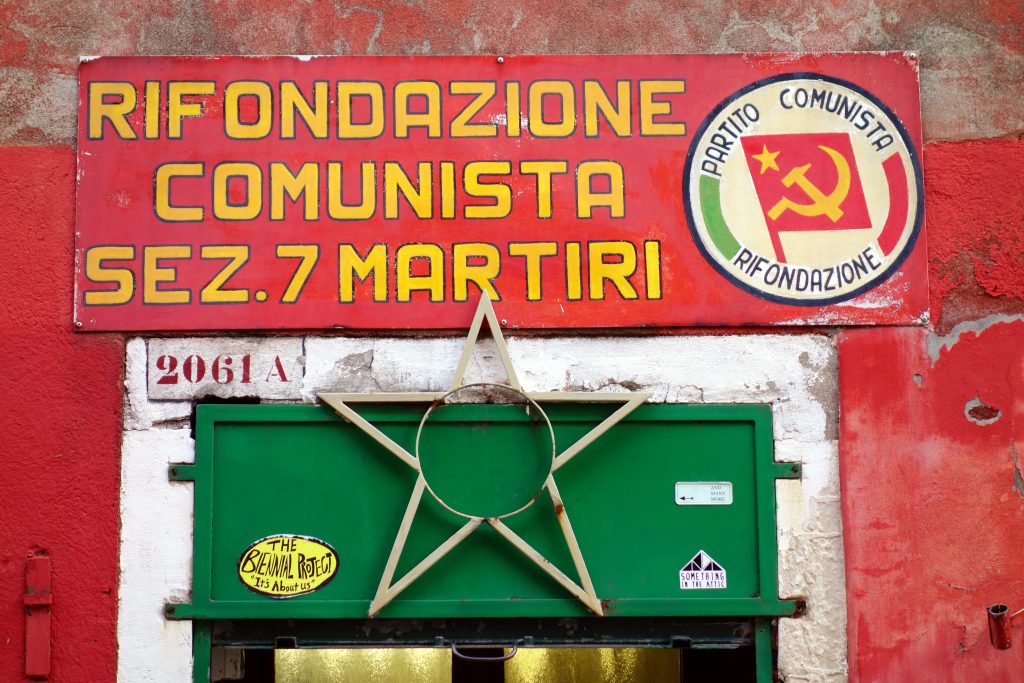
By joining in coalition with Sinn Féin-type parties Rifondazione Comunista collapsed
Rifondazione Comunista offices at Venice: the party collapsed after entry into coalition government.

In practice the outcome of entry into a centre-left government has been overwhelming negative from an anti-capitalist perspective. In two cases entry by the radical left into coalition has led to a party’s collapse into irrelevance (Rifondazione Comunista in Italy) or absorption into the main social democratic party (The Alliance in Iceland) without even the achievement of serious structural reforms within capitalism.

We see a slightly different process in Scandinavia with the so-called Nordic Green Left: these are quite large parties that emerged from the anti-Stalinist wings of communist parties in the 1950s and 60s, ones that initially offered a democratic left critique of social democracy. These formerly radical organisations, such as the Danish Socialist People’s Party, by entering coalition government with social democratic parties (and sometimes liberal parties as well), without challenging the fundamentals of capitalism in any way, have clearly shown that they are simply slightly-to-the-left versions of the social democrats. They continue to exist as a potential government partners for the main centre-left party but show no inclination when in government of pushing the boundaries much further than their partners. In effect the Scandinavian electoral market offers a variety of shades of pink, in the same way as Ireland’s Labour and Social Democrats are fundamentally the same beast politically, with differences largely based on personnel, tradition, policy nuances etc.

The experience of left parties who have adopted the more radical approach of critical support for centre-left governments, without joining them, also deserves consideration as it is probably the most likely scenario for Ireland. In other words, the government survives thanks to abstentions or favourable votes from a radical left party that is not in government. Here the experience is mixed: for some policies the radicals were able to bring enough pressure on the centre-left governments of Denmark and Portugal to prevent their slippage back into a neo-liberal approach, though the impact of this ‘external support’ on the electoral support for the radicals has been varied. The experience has been relatively positive for the Red-Green List in Denmark but this external support strategy resulted in a disappointing reduction in seats for the Left Bloc in Portugal’s general election of January 2022 (the number of seats for Left Bloc fell from 19 to 5). Once the question of coalition is ruled out, as it should be, the issue of how radical left parties relate to a centre-left government from the outside then becomes central and hopefully this is the direction the debate will take in Ireland.

What then of the much rarer instance of a majority left-reformist/gradualist government? The first major instance of a left government coming anywhere near implementing significant reforms was Mitterrand’s first government in early 1980s France. The French Communist Party entered a government with the Socialist Party that was committed to radical economic/social reforms (though still within the bounds of capitalism) but when, as expected, those reforms provoked an international and national capitalist reaction, leading to a rapid retreat into neo-liberalism by Mitterrand from 1983 onwards, the Communist Party were forced to withdraw and unable to formulate any strategy other than the desire to be a junior partner in a social-democratic government, fell into a spiral of decline (though obviously other factors also contributed to that decline).

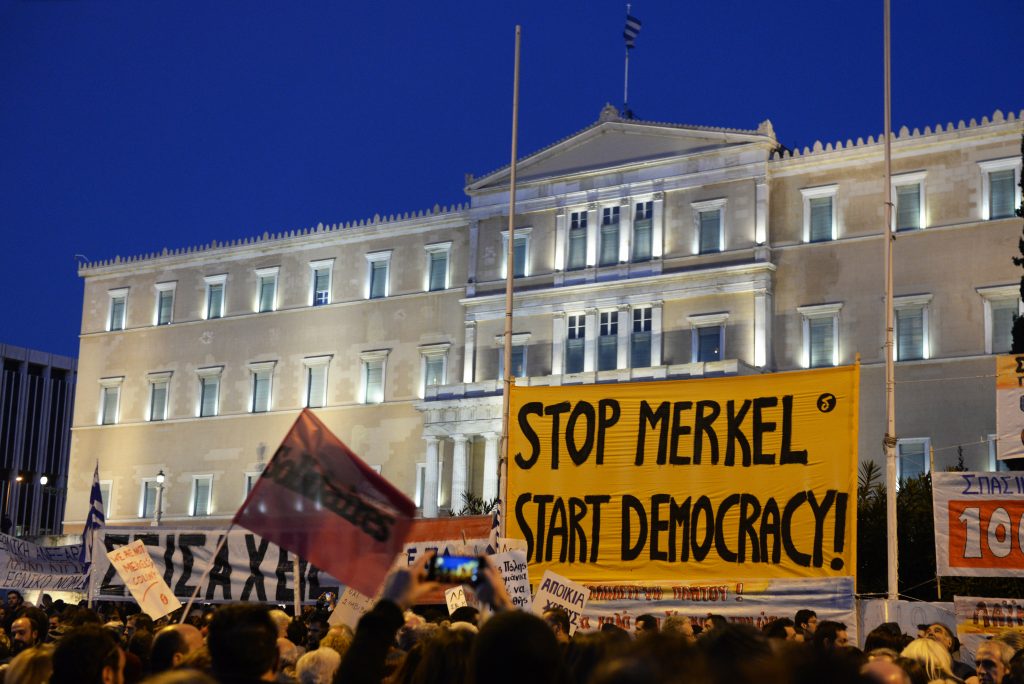
The experience of Syriza, Greece warns against coalition with Sinn Féin
Athens, Feb 15, 2015. People gather in front of the parliament during an anti-austerity demonstration to support the newly elected Syriza government

The more recent example of the Syriza government in Greece is instructive. Here you had a governing party which was led by a gradualist faction though it contained significant revolutionary factions as well (it was also reliant on a small right-nationalist party as a junior coalition partner). The story is well known: the leadership capitulated under extreme pressure from the EU and international capital, demobilised the mass movements, and quickly mutated into a standard centre-left party, implementing neo-liberal policies. The lessons are clear: while left-reformist governments can sometimes implement radical policies they cannot bring about radical transformation beyond capitalism. To reiterate, a change of government is not a change in power.

So, the modern European experience reveals that entering a left-of-centre coalition is a tacit acceptance that the best that can be achieved are reforms that protect the position of the working class within a capitalist society. This approach displays amnesia or ignorance on the part of those involved regarding how power functions in a capitalist society. To think you can implement radical reforms as one government minister – socialism in one Department as it were – sidesteps the obvious fact that the state is not neutral, that power in a capitalist society is diffused through a range of institutions and that the ruling class does not rule exclusively through the state. It is to forget that the role of all governments in a capitalist society is to administer capitalism, to ensure to continuation of accumulation, albeit sometimes with reform measures that save capitalism from itself. The fact that no minister from any centre-left party, in both the Republic and the UK, has made any attempt to undo any of the Thatcherite anti-trade union laws that have been implemented in both states since the 1980s is instructive in this regard.

“GROWN UP POLITICS” – THE PRESSURE TO GOVERN IN COALITION WITH SINN FÉIN

None of this is to trivialise the enormous pressure on radical left parties to enter coalition government when that opportunity arises. It is a serious mistake to see this simply as a matter of some inevitable process of socialist betrayal. Of course, there are opportunists who like power for its own sake in every organisation, in addition to party loyalists who will go wherever the leadership lead, but for many more there is the real force of institutional and structural pressures that push them in a right-ward direction.

Perhaps surprisingly, some of that pressure comes from below. Given the common portrayal of politics – politicians enter government whenever the opportunity arises so that they can implement the policies they have advocated for – it is not surprising that many people who vote for a radical left party would initially expect “their party” to enter coalition government so that they can deliver on their policies and promises. This understandable popular desire for short-term results can lead to intense pressure on a party and can even infect the membership and leadership. The example of Democratic Left in Ireland, which initially positioned itself to the left of the social democracy, illustrates this problem clearly. At the 1994 special conference, where Democratic Left delegates voted overwhelmingly in favour of joining a coalition with FG and Labour, the most rousing applause went to a delegate who declared that they could choose to have Proinsias De Rossa as Minister for Social Welfare, improving people’s lives immediately, or they could choose what was characterised as the useless luxury of blabbing on about some future socialist society. To use a cliché of the mainstream press: it was time to roll up the Che posters and enter the realm of “grown up politics” of compromise and delivery. A cursory knowledge of Democratic Left’s pathetic record in government, and ultimate demise, indicates where that argument led!

Reflecting both the bias of individual journalists and ruling class interests there are two narratives regarding Sinn Féin in the media: one, declining, narrative sees Sinn Féin as a terrible threat to democracy but another which is now more prominent (and more representative of ruling class interests), reassured by their record in the North and local government, holds the view that Sinn Féin is not such a danger, as long as they can be house trained, i.e. pushed to drop the more radical aspects of their agenda. This media/ruling class pressure may also extend to the radical left parties if the question of coalition arises: are they going to be responsible and graduate from their immature radicalism?

Though the establishment certainly don’t actively desire the inclusion of the radical left in a Sinn Féin led government (an SF/FF coalition would be much more to their liking), they would rather Richard Boyd Barrett et al. as government ministers, with all the compromises that would involve, than the emergence of a larger radical opposition putting pressure from the left on a Sinn Féin government. A few post-Trotskyists in government would not cause many sleepless nights in the corridors of the Irish Times or IBEC: better to have them tamed on the inside. The fact that some journalists, nurtured in the Eoghan Harris school of anti-leftist outrage, would howl with indignation at the thought of “Provos and Trots” in government should not fool us: these will be the rantings of a dying clique, not representative of the mainstream of establishment opinion. Ironically, having radical left ministers in government might also suit the right-wing parties, who will have something to gain from left involvement in a Sinn Féin led government. While regrouping in the hope of benefiting from Sinn Féin’s failure to deliver the right-wing parties will also be glad to see the sting taken out of the left’s opposition to their policies. It’s hard to go from being a Minister who kept capitalism ticking over, to being the scourge of capitalism on the opposition benches.

ALTERNATIVES TO COALITION WITH SINN FÉIN

If we accept that entry into a Sinn Féin led government would effectively process radical left participants into social democrats and remove them from any further relevance in debates about a radical transformation to a post-capitalist society, then we are faced with the crucial question of what, other than entering coalition, can or should radical socialists do? The premise here is not that a Sinn Féin led government would be same as a right-wing one or that the delivery of significant reforms by Sinn Féin would be impossible. Rather it is that because of the harmful long-term results, the role of the radical left should be to stay out of a Sinn Féin government but relate to it in a way that pushes it as far left as possible, while militantly opposing compromises with the agenda of big business.

The important factor here is that a few left TDs on their own won’t make a significant difference: only a left that is organically linked to a mass movement can really pressurise Sinn Féin away from caution and retreat from reform. Remember how cautious Sinn Féin were on the issue of Water Rates. It was only a mass movement led by the left that forced them to take the non-payment position.

At the time of writing, it seems that a Sinn Féin government will not arise as a result of a mass movement but on the basis of a passive mood of discontent: “the rest have messed things up, someone has to change things, let’s give the Shinners a go”. So, the left will have the dual role of transforming that mood into a movement to put pressure on Sinn Féin to deliver on their promises, while at the same time mobilising people to defend any advances that are made by Sinn Féin from the hostility of the right and the international ruling class.

DEBATE NOW!

This debate on coalition will become redundant, at least in the medium term, if Sinn Féin wipes out the Dáil representation of the radical left. As this is a real prospect at this stage, discussion on this issue must start now, rather than when the next general election is called. It must begin with the widest possible debate on the radical left: a prospect that, at the moment, is inhibited by the top-down nature of debates and decision-making in the larger organisations of the Irish left where, traditionally, leadership groups arrived at a position and then a debate was initiated with a preordained outcome. Instead, what is necessary is an open debate amongst grassroots members across the left, where all possible positions are freely debated. This is not just the responsibility of organisations like Independent Left, which are wholly committed to those participatory and democratic principles, but also those within the main organisations of the radical left, PBP and the Socialist Party.

Such an open debate within and between organisations and throughout the radical left milieu as a whole, would allow those, such as Independent Left, who take a transformational approach, to advocate for a united left position that rejects entry into a coalition with Sinn Féin, while defending any radical reforms that a Sinn Féin-led government would introduce and opposing right-wing attacks on such a government. Pushing from the left but defending against the right. But that united left approach can only really happen if we have clarity on the issue long before Mary Lou gets called to the Áras.

Filed Under: Independent Left Policies, Irish Political Parties

The Western Left and Russian Imperialism

16/03/2022 by Conor Kostick 4 Comments

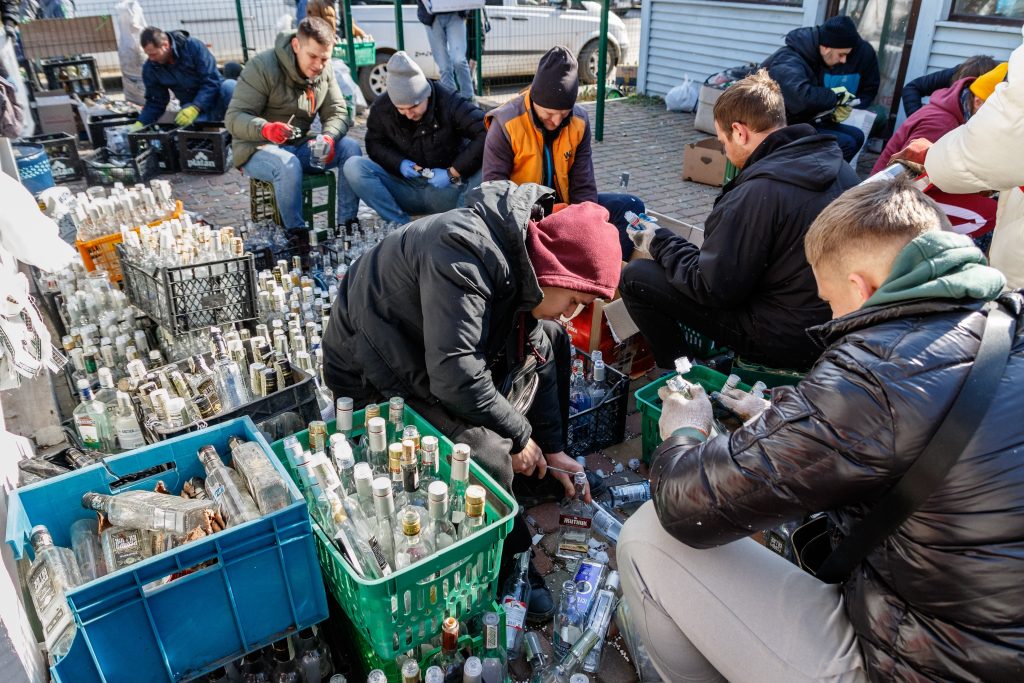
The left and Russian Imperialism: the people of Ukraine preparing Molotov cocktails.
The Left and Russian Imperialism: residents of Uzhhorod, Ukraine, 28 February 2022, making Molotov cocktails. The international left should be doing all it can to assist the people of Ukraine defend themselves.

Day and night, gunfire could be heard. There was no public transport. Knocked-out Russian tanks stood raggedly about the streets, while others rumbled continually up and down. Shattered buildings with gaping holes cast grotesque shadows across hundreds of bodies lying in the streets amid the broken glass, empty cartridges and other debris. Occasionally, a van with a Red Cross flag or a lorry-load of ‘freedom fighters’ would go crunching by. Some food shops were open. The cinemas, theatres, and restaurants were closed. In the ferment of activity, there was no time or thought for entertainment.

Andy Anderson, Hungary ’56

In 1956, Russian tanks and troops carried out a massive assault on Hungary. After a first wave had stalled, a second wave involving around 6,000 tanks succeeded in occupying the main cities of the country, abducting the Premier, Imre Nagy, and crushing the popular ‘soviets’ that had sprung up to co-ordinate resistance to the invasion.

This was a watershed moment for the left internationally. Until 1956, mass communist parties retained thousands of supporters in most countries. It was still possible to believe—if you didn’t examine the evidence too closely—that Russia was not an imperialist power but rather a state that for all its faults had held back fascism and Western aggression.

Today it should not really be necessary to make the case among the left that Russia is an imperial power. The evidence has been available for decades. Yet the left, at least the Western left I am familiar with, has so declined in the clarity of its thinking and in moral principles that the generation of revolutionaries who rose in ’68 and won young radicals away from Communism towards international socialism – figures such as Tariq Ali – are not even calling for Putin’s army to be thrown out of Ukraine.

The Left and Imperialism

Around the time of the Great War, the left understood the nature of imperialism. For Luxemburg, imperialism was a by-product of a relentless thirst by capital for surplus value. For Lenin, imperialism was the highest stage of capitalism. For Bukharin, it was the result of competition being eliminated between companies within a state only to reappear as competition between states. And for James Connolly, imperialism was a desperate drive to obtain new markets by aging capitalism.

By any of these definitions (and none are up-to-date, we need new ones that reflect modern conditions) Russia is a major imperialist power. After the Second World War, Russia subordinated the countries behind the Iron Curtain to its own drive to compete in four ways: direct theft of factories, which were dismantled and moved to Russian territory; the purchase of raw materials and goods at strong-armed prices; ‘joint’ companies which sent the lion’s share of profits to Russia but expected the satellite country to underwrite any losses; and ‘collectivisation’—the formation of Russian-led state farms.

No wonder the people in these countries – who were deprived of the right to strike, to form trade unions, or express critical ideas – wanted to escape Russian control. No wonder that they repeatedly rose up in their millions, such as in Hungary 1956, Czechoslovakia in 1968, and Poland in 1980. When the opportunity came in 1989 to get rid of both Russian control and their own local Communist rulers, of course the people did so. The mass movements of that year were entirely understandable and justified. The fact that the ‘free’ market of Western-style capitalism failed to bring about prosperity proves nothing positive about Russian control over Eastern Europe, but only that capitalism is a failed system worldwide, whatever particular garb it wears (including the twist that people wielding red flags and carrying pictures of Marx should become the ruling elite).

Justified Resistance to Russian Imperialism

Ukraine 2022 should be seen in this context of justified resistance to Russian imperialism.

Worldwide, there should be left solidarity movements for Ukraine as there were for Hungary and Czechoslovakia. Internationally the socialist left should be blossoming. By supporting the resistance of the Ukrainian people and demanding the withdrawal of Russian troops as well as pointing out that the capitalist system of ruthless competition will lead to more wars unless humanity gets out of the social vice we are trapped in, the left could revive across the planet. Millions of people are coming to realise the real danger the system we live in poses and are looking for alternatives.

Yet, in the west at least, the left is in the process of making a mess of what should be a simple task. Where are the big anti-imperialist marches like we saw in the build up to the US invasion of Iraq in 2003? Why are the left’s media filled with more posts about the US than Russia? Or maps of NATO expansion? Where is the amplification of the voices of our comrades on the front lines in Ukraine? Our anarchist and socialist comrades are fighting Russian imperialism and for a transformation of Ukraine, and they are reaching out to us for solidarity.

Why is the Western left ambiguous about wanting a defeat for Russia?

I believe that the reason for the current fumble by the Western left is that they have a mindset that prevents them from making sense of the obvious. There shouldn’t be any doubt about the fact we are witnessing a popular uprising against an empire. Instead, the left see fascists and dupes of NATO everywhere in Ukraine, even when the left in Ukraine is shouting to us that this isn’t the case.

Naturally, the Stalinist and Maoist left are for a Russian victory. I’m not addressing them. They are walking cadavers who ache to be dominated, mouthing statements fed to them by their masters. They have nothing to offer in regard to an international left revival. I’m writing this feature for a different audience: those currently wondering why Western anti-war organisations led by the left are not doing more to assist those fighting in Ukraine.

Part of the answer, I think, is that this left is moribund and has been for some years.

As Stalinism began to break up after ’56, the New Left adopted the attitude that both US imperialism and Russian imperialism were equally dangerous. But the counter culture that scorned capitalist values and the inspiring prospect of the possibility of international socialism both faded towards the middle of the 1970s. The genuinely revolutionary left was stranded high on a beach while the tide of working class revolt withdrew. To survive for all these decades, most of the left found their own rock pool to hide in and they became sects. Without the reality check provided by being rooted in working class communities, and without a connection to a mass movement of radical workers, they lost something essential: the spirit of questioning everything and debating freely (there was a darker side to this too, in the appearance of abusive hierarchies forming within several far left groups).

The left and Russian imperialism
Uzhhorod, Ukraine, 2 March 2022, the people are issued arms and given basic training. The war against the Russian invasion becomes a people’s war.
The left and Russian Imperialism: anarchists joining the resistance
The left are able to join the popular resistance with their own organisations. They are not dupes of NATO but have resolved to play their part in the national struggle against Russian imperialism. They deserve our support.

When you read the writings of Ukrainian socialists and anarchists  today, it is striking how consequential they are. They write about the results of decisions and their real, practical outcomes (which are not always for the best). Theory for the Western left, on the other hand, has degenerated into performance at conferences and second rate expositions of the canonical texts of Marxism. No one is ever called to account for their views, and where leading members of the Western left have articulated positions that don’t stand the test of time, such embarrassments are simply removed from party history.

Yet a spirit of free thinking and lively debate is needed on the left, now more than ever. No social theory is so perfect that it is accurate and actionable for decades. Specifically, in regard to the issue of Russian imperialism, there was a contradiction in the theoretical tools of the Trotskyist left that means allowing elder gurus to formulate current policy unchallenged leads to the current problem.

After the rise of Hitler and the defeat of the Spanish revolution of 1936–9 (both decisively influenced by the positions taken by the German and Spanish Communist Party) Trotsky was convinced that Stalinism was absolutely counter-revolutionary. Yet at the same time he believed there were positive features of Russian society, such as the nationalised economy, that the new rulers of Russia had yet to overturn. Trotsky was murdered by a Stalinist in 1940, so he didn’t live to see a post-war state of affairs that would have forced him to face the following contradiction in his thoughts about Russia: given that in Hungary, Poland, Czechoslovakia, etc., industry was nationalised as a result of the arrival of the Red Army, then either such nationalisations are not necessarily a step towards socialism, or Stalinism is not always counter-revolutionary.

Some of the Trotskyist left opted for believing that Stalinism can be positive, sometimes, despite itself (just watch the knots they will get into if Putin nationalises the airlines and banks). Others went the other way, such as the SWP in the UK, which saw state capitalism as in no way superior to free market capitalism. Yet even in the case of the SWP a softness towards Stalinism was revealed – particularly by those who later broke away to found Counterfire – when they thought it clever to join with George Galloway and form Respect Party. An abandonment by the radical left of the spirit of independence from all imperial agendas, in favour of a geo-political approach of picking the lesser evil is at the heart of their weakness at this defining moment. We are at the beginning of a new era of imperialist wars and we have to do better than ‘lesser evil’ politics, because they betray those fighting against empire and for social change.

Today, the Stop the War Coalition in the UK embodies the weakness of a Western left that had the potential to rally people to the side of the Ukraine socialists and anarchists who are fighting against Russia. Stop the War is dominated by former Stalinists, Trotskyists and SWP members who have found themselves in agreement that the main enemy to organise against is the US and NATO even in a situation where it is Russia invading another country . The Trotskyists can only maintain their alliance with the Stalinists by muting any criticism of Russia, or support for the Ukrainian resistance.

For some years before this war in Ukraine, the signs were clear that left-wingers of this type were moving away from a policy of listening to people engaged in real conflict with imperialism and towards an armchair geo-political analysis focused on finding out what the US agenda was in any situation and choosing the other side. When it came to the destruction of Syria, Stop the War did nothing to oppose Russia’s crushing of a popular uprising and, indeed, drove away those attending rallies on the topic of Syria who were looking for support against Russian backing of Assad. Over the course of six years in Syria, Russia killed 23,000 Syrian civilians, tested 320 weapons systems and gave combat experience to 85% of its officers.

I see this generation – the Tariq Alis, the Jeremy Corbyns – as they themselves must once have seen the leaders of Western Communist parties. As a result of their ‘campism’ (i.e. picking a camp that isn’t the US, no matter how anti-working class), they are incapable of giving the anti-war movement the energy and focus on Ukrainian left activists it needs. Corbyn often has a platform with Jacobin, the US left magazine, and that magazine too fails to amplify the voice of the Ukrainian left. Almost certainly, this is because Jacobin does not discuss the question of Russian imperialism but argues instead that this war is the product of decades of NATO expansionism. In its coverage of Ukraine so far, the magazine has limited itself to pointing to the hypocrisy of Western elites. The Democratic Socialists of America, the largest socialist organisation in the USA, has a similar view.

Similarly incapable of being able to rise to the occasion are those who cannot commit themselves to offering solidarity with the Ukrainian left in their time of need, because they see resistance to Russia as strengthening NATO.

For groups like People Before Profit in Ireland, this is not a war of liberation by a small nation against an imperial power, because if so, the Irish tradition of James Connolly’s working-class based opposition to the British Empire would be entirely relevant (as it is, including the validity of obtaining arms from Germany). No, for them, this is an inter-imperialist conflict:

Putin’s actions are being used by military hawks in the US to whip up an atmosphere for war. The US military was humiliated by their defeat in Afghanistan and are determined to re-assert their ‘leadership’ over the Western world by posing as its defenders. This is why they have done everything possible to whip up tensions. They have sent an extra 5,000 soldiers to Poland and have been systematically supplying the Ukrainian army with missiles.

Again, for them, this war is all about the agenda of the US rather than a national liberation struggle against imperialism..

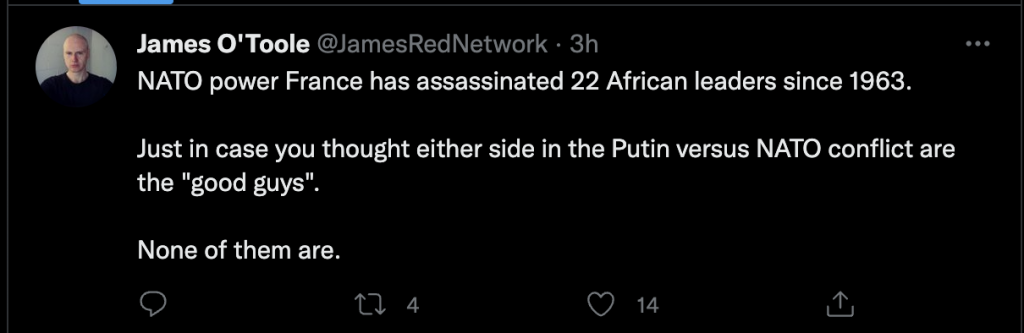
When prominent PBP members frame the war in a way that presents it merely a matter of Putin versus NATO, they write out of the picture the Ukrainian left and, indeed, the entire Ukrainian people, who have as much right to an independent country free from Russia as Ireland does in respect to Britain.

James O'Toole's tweet shows how some of the western left don't advocate the defeat of Russian imperialism
When it comes to the Western left and Russian imperialism, there are many who see the war in Ukraine not as a battle for the liberation of the country from empire but as an inter-imperialist war, such as James O’Toole of People Before Profit, Ireland.

Clearly, a stronger opposition to Russian imperialism needs to be voiced by the Western left at this time. There are signs that this is taking place. In the UK the executive of the trade union Unite have taken a better position on the conflict, perhaps because its members have taken solidarity action in not unloading Russian oil. For the statement of Independent Left on the conflict see the link. And for English language socialists wanting to connect with the left in Ukraine and give them support, we recommend the work of the Ukraine Solidarity Campaign.

The Western left and Russian imperialism FAQ

Is Ukraine fascist?

No, that’s Putin’s pretext for the invasion. There are a small number of Nazis in Ukraine (they won 2% of the vote in the 2019 election) and they have less of a presence in the military than they did in the events of 2014. Russia, too, has fascist organisations and countries like the USA have larger numbers of fascists. When asked was Putin’s De-Nazification of the Ukraine welcome, Kyiv’s Chief Rabbi said, “I don’t know what he’s talking about. In terms of antisemitism, we’re very secure here.”

Should the Western left want to see a defeat for Russia in the war in Ukraine?

Yes. This should be obvious and as instinctive as supporting oppressed people anywhere in the world. This a crucial test of whether the left is at all relevant more generally. And unfortunately, much of the Western left is in the processing of failing it and failing the Ukraine resistance.

Will NATO benefit if Russia is defeated?

Possibly. But then, if Russia wins, that will create a massive upsurge of a desire for a greater NATO presence and more US armaments among the countries adjacent to Russia. This question has become the primary one for the much of the Western left but it should be secondary to the more fundamental question: are you on the side of the people facing the Russian invasion?

But what about Palestine?

Many of those raising the issue of Palestine in the context of the war in Ukraine are doing so in bad faith. They don’t want to admit to preferring a Russian victory to a Ukrainian one; rather than acknowledge this politically unpalatable position, they draw attention to the double standards of Western governments and some media outlets, which do not champion Palestine with a fraction of the energy they are devoting to Ukraine. Yes, of course the left should recognise the cause of the Palestinians as a just one. But where do you stand on the question of Ukraine?

What does Noam Chomsky say about the war in Ukraine?

You can read this for yourself in his interview here. He’s another of those on the left who see the war as a geopolitical conflict between NATO and Russia, leaving out Ukrainian people themselves. Dismissing the possibility and even the desirability of a victory for Ukraine, Chomsky argues that concessions to Putin’s goals are necessary.

What Can Socialists in the West do to help the left in Ukraine?

Above all, the Western left needs to get off the fence and start listening to their comrades who are battling Russian tanks and troops – without supporting NATO – and champion their cause against the Russian invasion. Independent Left are channeling our support through the Ukraine Solidarity Campaign, who have strong contacts among trade unionists, socialists and anarchists in Ukraine.

They have a crowdfunder campaign here.

Filed Under: Independent Left Policies, Ukraine

Independent Left Statement on Ukraine

03/03/2022 by admin 3 Comments

Independent Left Statement on Ukraine
Popular resistance in Ukraine can defeat Putin’s imperialist assault

Independent Left condemns the Russian invasion of Ukraine; Putin’s war is an imperialist adventure. We support the demand for complete withdrawal of Russian forces from all of Ukraine. 

We support the right of the Ukrainian people to resist the Russian invasion by all means necessary – armed and civil resistance. We defend the right of the Ukrainian working class to arm themselves so as to resist conquest by the Russian army. If they are able to do so, despite extraordinary disparity of military equipment, the defeat of the Russian army will inspire resistance to imperialism of all forms, whether US-led, Chinese-led, or by any other major power tempted to use force to further their interests.

This is not a defensive war, but an offensive war, by one of the world’s imperialist powers; a power which has engaged in numerous military interventions to secure wealth and strategic influence, including the defeat of the Syrian people’s revolution and the recent suppression of the working class revolt in Kazakhstan.

We support the brave anti-war movement in Russia, a movement which will grow in proportion to the resistance of the Ukranian people to the invasion. The defeat of the Russian army in Ukraine will be a victory for the Russian working class because it will advance the prospect of the fall of the right-wing regime, authoritarian Putin regime, and of the oligarchic capitalism on which it is based.  We reject any attempt to blame the Russian people as a whole for this ruling class adventure, and while we support any measure that weakens the Russian ruling elite, we oppose any international sanctions solely designed to punish the Russian working class. We oppose the militarisation of Europe by NATO which is an instrument of American imperialism. It should be noted that Ukraine is not a member of NATO and that there was little prospect of it joining, and that NATO has made it clear it will not intervene directly. At this point NATO is not at war in Ukraine, so we reject abstract sloganeering by those whose focus on NATO leads them to be equivocal, or even opposed to the victory of the Ukrainian resistance.

Like all anti-imperial wars throughout history, there is a left and a right within the Ukrainian resistance. Without in any way putting conditions on our support for the goal of defeating the Russian invasion, we call on all socialists and trade unionists to organise active support for Ukrainian working class communities and organisations in their efforts to resist imperialism by donating or fundraising for their victory through the Ukraine Solidarity Campaign.

For our feature on the failure of the ‘evasionist’ left to support Ukraine’s struggle for self-determination, see here.

A link to the leaflet we gave out with United Left With Ukraine.

Independent Left Support the Fight Against Russian Imperialism

A Public Meeting with a speaker from Ukraine Solidarity Campaign was held on Wednesday 9 March 8pm.

The Ukraine Solidarity Campaign have a crowdfunder campaign.

Filed Under: Independent Left Policies, Ukraine

The social impact of artificial intelligence

15/04/2021 by Conor Kostick 1 Comment

The social impact of artificial intelligence
The social impact of artificial intelligence is distorted by the biases in human society

Novelists have been kind to artificial intelligence in recent times. In Kazuo Ishiguro’s 2021 book, Klara and the Sun, Klara is an AI designed to be a child’s companion and she is by far the most compassionate and self-sacrificing character in the book. In the rather darker Machines Like Me by Ian McEwan (2019), the mistreatment of an AI again arouses the reader’s indignation, because of the virtues of the artificial intelligence. As a device through which to view humanity, positing a consciousness that is more beautiful and unconditionally compassionate than we are can be a very powerful tool. But as an insight into the potential social impact of artificial intelligence, such depictions are quite outside of the current activities of AI.

Artificial intelligence as it currently stands is far removed from the conscious beings depicted in fiction. Software algorithms fed with data make computations that can be quite impressive but hardly deserve the label ‘intelligence’. There’s a squirrel who comes to my back yard, having discovered that I keep leaving seed balls in a bird feeder. This ingenious creature has learned to prise open the lid of the feeder and he or she is displaying far more intelligence than the most advanced AI software.

Where artificial intelligence is having an effective social impact is where the algorithms processing the data they are being fed are a) able to engage with absolutely vast amounts of input and b) where the algorithm is subject to constant improvement. Thanks to the fact that we live in a capitalist society, the main driving force behind the creation of AI with noticeable social impact are businesses and, more ominously, governments. This means that the early use cases for artificial intelligence include some extremely problematic, not to say dangerous, examples.

Positive social impacts of artificial intelligence

To start with a relatively benign example of the social impact of AI. Like a lot of people I mostly listen to music by streaming. And I want recommendations for new music to listen to. Nowadays, my recommendations typically come from an algorithm and not my friends. At a certain level, this works well. I click ‘like’ or ‘dislike’ to a piece of music and based on the profile this creates for me, as well as data provided by millions of other users, the suggestions I get are nearly always interesting and I definitely have found new music that I love thanks to such calculations.

The downside is that the algorithm favours music that already has thousands of likes, so this kind of process reinforces the enormous disparity that exists between bands and composers who are pushed into the stratosphere of international attention and those who might be far better artists but who cannot get off the ground. Moreover, the platforms currently offering this type of tool (e.g. Spotify, YouTube Music) pay the artists a pittance.

Other potentially positive social impacts from artificial intelligence include the rapidly advancing ability for software to parse human sentences and extract their meaning.

As a slight aside, I’ve never been enthusiastic about using the Turing Test to define consciousness because while the use of language is intimately bound up with being able to think, I’ve always felt that the definition is too narrow. Whatever a particular challenge, such as to play chess, go, or steal birdseed from a container, sooner or later the technology is going to be created that can accomplish the task.

Squirrels are more ingenious than any existing artifical intelligence

For an AI to be able to hold a conversation for a certain length of time in a fashion that makes it hard for a human to decide if they are talking to another human or the AI is tough. But we are within a decade of being able to achieve this if the time limit for the Turing conversation is limited to, say, thirty minutes. Siri can entertain my kids for about that length of time: they just say ‘hey Siri, tell me a joke’ and go from there.

Breaking down sentences and figuring out their meaning, in order to give an appropriate response, is something that chatbots are already effective at in narrow spheres.

In theory, this AI-driven technology could save our species a considerable amount of labour time. Every person whose current task involves speaking to someone in order to collect data could be spared to do something more interesting. And indeed, chatbots with artificial intelligence are everywhere answering customer queries, tracking parcels, taking payments, etc.

Harmful social impacts of artificial intelligence

One harmful societal consequence of artificial intelligence has been evident long before Marx sat down and studied how capitalism constantly replaces workers with new methods of production, which is that new technology is never introduced so that workers can enjoy more leisure time. The social impact of the introduction of artificial intelligence in the work process ought to be that workers can put their slippers on, enjoy a cocktail, and a – recommended by AI – new series on Netflix. Managers, however, typically calculate the returns on investment in chatbots by figuring how much they will save on their call centre costs and the deployment of this kind of software is often associated with layoffs instead of liberation.

Another, more subtle but potentially deeper societal hazard arising from artificial intelligence in the automation of conversation is that the very large companies, Google and IBM in particular, are dominating the conversational AI market, with algorithms trained as much of the corpus of human communication as they can get their hands on. But what if that corpus is male-centred, western-centred, biased against non-binary genders, etc? Then the algorithm will produce results that perpetuate and even deepen those biases.

Then too, with only 20% of the technical staff working on conversational AI being women, there is an additional likelihood that the algorithms they are building are gender biased. One obvious problem of racial bias in AI has already emerged in the US judicial system where officers have a software tool to score the likelihood a person guilty of an offence will reoffend. That tool was twice as likely to incorrectly identify African Americans as high risk for violent re-offense as a white person.

You only have to do an image search and you can see these biases in Google for yourself. Try searching CEO and scroll through your image results. In the west, about 27% of these images should be female. If you are seeing a lower proportion (and at the time of writing, I took a screenshot and scored 20%) then that demonstrates that the results of the search are reinforcing a bias in the dataset of images of CEOs.

A much more clearly negative social impact of artificial intelligence is its application to facial recognition. The Chinese tech company Alibaba has trained an algorithm to identify ethnic minorities via facial recognition, specifically the Uighurs of the Xinjiang region, against whom China has been carrying out an oppressive campaign.

Artificial intelligence in warfare

Worse still is the social impact of the military application of artificial intelligence. In Philip K Dick’s 1953 story Second Variety robots developed by the UN to stop a Soviet victory in the aftermath of a nuclear war overrun humanity (in a much more interesting way than this plot summary suggests). This type of scenario, where AI soldiers take military decisions, is already present in embryo, especially in the form of drone technology and also in missiles, with the US army having tendered for their Cannon-Delivered Area Effects Munition (C-DAEM).

C-DAEM missiles will be launched without human intervention, based on technology similar to face recognition but using lasers to identify targets with the profiles of tanks. The tender calls for the missile to fly up to 60km, slow down with a parachute or similar means, and while descending, identify targets autonomously. And, just as facial recognition software has its biases, these missiles will explode on vehicles based on the values of the data provided by the US military on the profiles of the tanks they anticipate destroying with C-DAEM. Pro-tip: don’t tie your Christmas tree to the roof of your car.

The most negative social impact of artifical intelligence is its application to warfare.
The most negative social impact of artifical intelligence is its application to warfare

There is a campaign called Stop Killer Robots to ban fully autonomous weapons. One reason for doing so is that even before the application of artificial intelligence to warfare it has been difficult to hold mass murders to account for war crimes. Imagine how much more difficult accountability becomes if it is the decision of a software algorithm that has resulted in attacks on civilians.

What would a society run by artificial intelligence look like?

Artificial Intelligence – in the form of software algorithms – are a new frontier for capitalism and as always when businesses charge into a new space, all sorts of harmful consequences arise, based on short-term considerations. Many NGOs, trade unions and even some governments are therefore hurrying to catch-up and urge regulation so that the more reckless companies are tamed. And that’s important. This is a sector that needs regulation, especially in regard to the creation of discriminatory algorithms.

But let’s run the timeline forward by a long way in our imaginations. Suppose, perhaps by a breakthrough in quantum computing, self-adjusting algorithms (those capable of ‘machine learning’ as the industry jargon puts it) become vastly more sophisticated and complex than anything which exists today. This might not be so far away, but should have happened by 2100 at least. Then humans would be living alongside AI companions capable of performing all the tasks that we do, including writing novels, composing music, inventing new jokes, creating vaccines for novel diseases, etc.

What will those companions be like? In 1987, Iain M. Banks wrote the first of his magnificent Culture novels, where he envisaged a far future in which AI drones look down paternalistically at the frivolous humans whom they care for. While still full of drama and, indeed, wars, this far future is essentially a utopia. No one except by choice suffers from poverty, hunger, homelessness, etc. Mostly, the humans pursue the arts (as well as take drugs, party and have lots of sex). And it’s a plausible scenario: even now the wealth exists to feed, house and provide free water and education to everyone on the planet.

Iain M Banks wrote about the positive social impact of artificial intelligence for society.
The Culture universe of Iain M Banks depicts a uptopia with the co-existence of humans and artificial intelligence

By 2100, alongside AI companions, we’ll be able to realise something like Bank’s Culture, providing we meet one condition. And unfortunately, while it’s a simple condition, it is a hard one to achieve. The benign AI scenario requires that humans themselves are free of any motivation to destroy each other automatically; free of prejudice in the structures of administration of society; free of discrimination in the cultural data (such as the entire contents of the internet) that the AI are learning from. To get a foundation for a harmonious relationship with the existence of massively powerful AI firstly requires we first of all have to revolutionise our own existence.

Filed Under: Independent Left Policies

  • « Go to Previous Page
  • Page 1
  • Page 2
  • Page 3
  • Page 4
  • Page 5
  • Page 6
  • Go to Next Page »

Copyright © 2024 · Aspire Pro on Genesis Framework · WordPress · Log in