• Skip to primary navigation
  • Skip to main content
independent left logo

Independent Left

Environmentalism, socialism, freedom and equality. #liveablecity

  • About
  • Featured Articles
    • How Farming Must Change to Save the Planet
    • The Housing Crisis: Causes and Solutions
    • Socialism in Ireland
  • Contact Us
  • Podcast
  • Animal Rights
  • Archive
    • Irish Socialist History
    • Dublin City Council Housing
    • Ukraine
    • Protests Ireland
    • Reviews
    • Irish Political Parties
    • All Posts
    • Independent Left Policies
  • Why join?

THE SYRIAN REVOLUTION 2011

13/04/2021 by Colm Breathnach 3 Comments

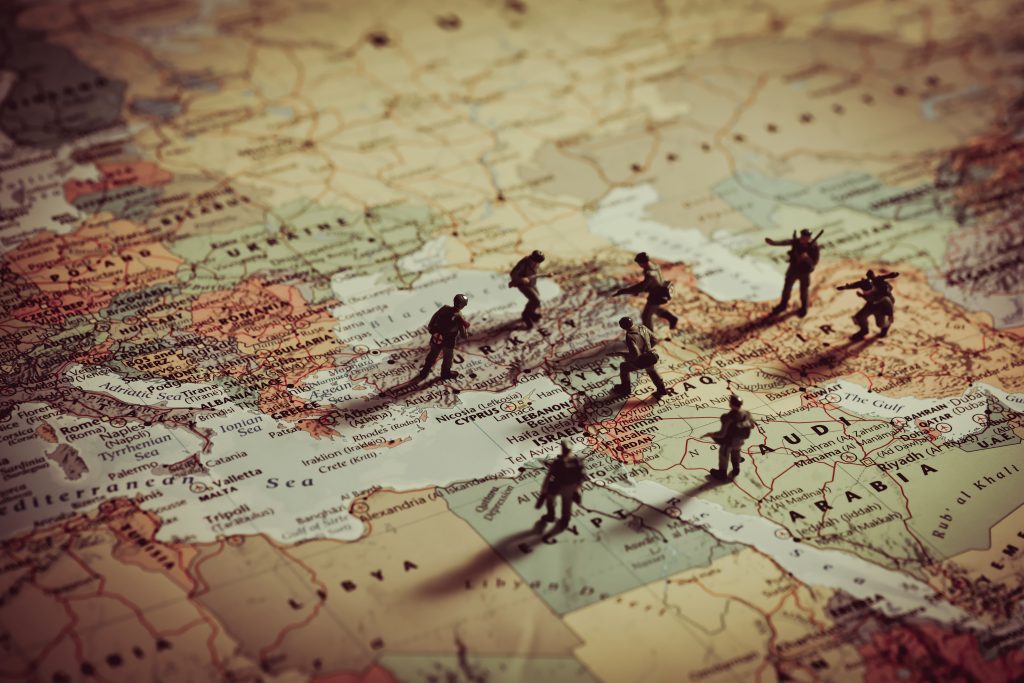
Military intervention followed the Syrian Revolution of 2011
Military Interventions followed the Syrian revolution of 2011

Socialists and the Syrian Revolution

The Syrian revolution 2011 was a genuine people’s uprising: one that was crushed by the al-Assad regime; a corrupt neo-liberal clique backed by Russian imperialism; and Iranian clerico-military oligarchy. The intervention of the US and its Saudi and Gulf allies also undermined the revolution and bolstered reactionary fundamentalist forces. Socialists support the Syrian masses in their struggle against all of these oppressive forces.

Timeline of the Syrian Revolution 2011

2000: Bashar al-Assad inherits family-run dictatorship from father, Hafez al-Assad.

2000-2011: Under Bashar, regime modifies the state-capitalist system with neo-liberal reforms – largely to benefit family and crony-capitalist class. Withdrawal of subsidies, drought etc. leads to exodus of impoverished peasants into cities.

March 2011: Inspired by Arab Spring revolutions, mass peaceful protests demanding democratic reform and end to repression sweep across Syria.

May 2011: Regime launches massive military attacks to crush peaceful protests.

July 2011: Defecting troops form Free Syrian Army to resist regime attacks. Local Coordinating Committees establish popular democratic control across Syria.

2012-2013: Conflict escalates into full scale civil war with rebels taking control of large parts of the country. Regime abandons north-east to left-wing Kurdish PYD and encourages sectarianisation of conflict. Foreign intervention begins with Iran and Hezbollah supporting regime, Saudi’s and Gulf states arming opposition jihadi groups.

2014: Creation of ISIS caliphate in northern Iraq and eastern Syria. US intervention focused on supporting Kurdish PYD to defeat ISIS.

2015: Russian military intervention turns tide of civil war in favour of regime. Secular rebels and democratic local councils squeezed between jihadis and regime.

2016-2021: Turkish military interventions creates buffer zone of pro-Turkish/jihad militias on northern border. Regime gradually restores control over much of Syria, displacement of half of Syria’s population.

Assad was nearly overthrown by the Syrian Revolution of 2011
The Arab Spring of 2011 quickly led to revolution in Syria

What is the principled socialist position on the Syrian revolution?

To understand the Syrian revolution 2011, it is necessary to understand the al-Assad regime. It is based on a narrow ruling clique made up of the al-Assad family and its cronies, a section of the Sunni bourgeoisie, with a support base in the Alawite minority (the Alawites are a heterodox religious community based in the coastal regions of Syria, Lebanon and Turkey, regarded by fundamentalist Muslims as heretics).

Under the original dictator, Hafez al-Assad the regime could be characterised as state capitalist as it combined severe repression with some degree of social protection. Hafez’s son, Bashar al-Assad, opted for full-scale neo-liberal policies and basically since then Syria has experienced a corrupt carve-up of the country’s resources and assets by the family and its cronies, often working with multi-nationals (as long as there was a big cut for the cronies).

The regime, though formally secular, has always been at its core sectarian, with its base in the Alawite community: this made it inherently unstable since the majority of the Syrian population were Sunni Muslims. Far from being anti-imperialist, despite the rhetoric, the regime cooperated with American imperialism during the first Iraq war, was developing cooperation with Saudi Arabia before the revolution, and had a tacit non-aggression understanding with Israel.

Revolution or proxy war?

The Syrian Revolution of 2011 was part of the Arab Spring
Map of Syria in 2011

Rarely does one come across a full-on defence of the al-Assad regime from leftists, rather the argument is put thus: “Yes, the regime is bad, but they are fighting against worse, the jihadis and western imperialist intervention”. This narrative only makes sense, however, if you leave out the Syrian masses and their revolution.

Like all of the mass rebellions of the Arab Spring, the original 2011 uprising in Syria resulted from the huge hardships caused by Al-Assad-imposed neo-liberalism, as well as a simple desire to be rid of a corrupt unrepresentative regime. This is the crux of the whole conflict: it began as a peaceful revolution by Syrian people of all religions. With their overthrow imminent, the ruling clique tried to supress the uprising with indiscriminate violence. As one eyewitness from Daraa put it: “Many people were slaughtered. They just ran over them with the tanks. Walking home from school to my mother’s home that day, blood ran in the streets”. This then precipitated an armed uprising as people scrambled to defend themselves, the armed element mainly coming from the defection of rank-and-file troops.

Now facing a popular uprising that was taking on an increasingly armed character, the regime saw its salvation in unleashing sectarian conflict, which it did by a number of means, including the release of a large tranche of jihadi prisoners. This gave a huge boost to jihadi forces who gradually replaced the secular rebels in many areas, with the Saudis and Gulf states happily pouncing on the opportunity to get a slice of the action by backing various jihadist factions, as did Turkey. The popular revolt continued, mainly in the form of local popular councils but now facing devastating violence and repression from both the regime and the jihadis. Finally, with the regime looking increasingly shaky, the Iranians and then the Russians intervened to save it. Ironically today the Saudis and Gulf states are moving towards reconciliation with the regime, eyeing up the profits to be made from “reconstruction”.

Some accounts of the revolution cast the Syrian masses as dupes from the beginning, pawns in an imperialist intervention to overthrow Assad but the facts, as outlined above, show the opposite. As soon as the regime’s power began to recede, people all over Syria set up organs of popular power, with little initial formal input from parties or armed groups in that process: it was a grassroots-based democratic revolution. The Syrian writer Leila al-Shami has compared these popular institutions to the Paris Commune: “as people took up arms and forced the state to retreat from their communities, Syrians engaged in remarkable experiments in autonomous self-organisation despite the brutality of the counter-revolution unleashed upon them”. The regime, and later the jihadis, always supressed these grassroots institutions when they won back control but the fact that the revolution was defeated does not make it any less of a people’s revolution, no more than the defeat of the Paris Commune negates the nature of that popular revolution.

Imperialist interventions

A popular revolution was transformed into a vicious war against its own people by the regime, leading to outside intervention. In terms of financing, arming, training etc. the primary imperialist intervention in Syria has been by Russia. Put simply, without its air power the regime would have been defeated. On the ground, Iran and its fundamentalist proxies from Iraq, as well as Hezbollah, also played a key role in rescuing a regime that was on its last legs.

US intervention, though real, was unfocussed and ineffective. This was largely because the American state didn’t really have clear aims: what they feared most of all was the vacuum that would be left if the regime collapsed and a victory for the popular revolution or for jihadi forces hostile to America. Its ideal scenario was a compromise between the regime and conservative elements of the opposition, with al-Assad himself gone. The arms and training US provided for some elements of the opposition had minimal effect because the Americans were scared of the weapons getting into the hands of jihadists who would turn them on US forces. Ironically, the only decisive intervention by the US was to back the left-wing Kurdish PYD forces in their war with ISIS: American weaponry and airpower was an important factor in the Kurdish victory over ISIS in the north east. This was because the key US goal was the defeat of ISIS, not the overthrow of the regime. One can’t blame the Kurdish forces for taking help from anywhere they could, but the US dropped them like hot potatoes once ISIS was defeated, allowing the Turks to invade the border areas.

The geopolitical context of the Syrian revolution 2011

Some leftists tend to take a “geopolitical” view of conflicts happening throughout the world. This “geopolitical” view is a version of what was called “campism” during the Cold War. This was a view that socialists had to side with the Soviet Union because, imperfect as it was, it was the only opponent of US imperialism and capitalism. So, the details of class struggle on the ground did not really matter: everything was a struggle between the USSR vs USA.  This led some leftists to support the military suppression of workers in Poland or the brutal pro-Soviet military regime in Ethiopia in its war against the national liberation movements of Tigray and Eritrea etc.

Since the fall of the Soviet Union, “campism” has evolved as there are now a number of contending imperialist and regional powers in the world – US, Russia, China, the EU etc. – but the basic view is the same you “pick sides” on the basis of who seems to be opposed to US imperialism. So, in any conflict one’s position is decided not by the interests of the worker and peasants in the conflict but simply by the interests of the great powers. If the US, even rhetorically, seems to adopt a certain position then, by default, the opposite position must be correct. Ironically, this is also the position of far-rightists, many of whom see Russia as a new nationalistic world power that acts as a counter to “decadent” liberal democracy, leading parties such as the BNP and the Front National to strongly support the Al-Assad regime.

“Geo-political” leftists see the world in terms of the relative merits of competing powers but internationalist socialists like Independent Left see the world in terms of the struggles of oppressed and exploited classes and peoples constantly striving for social, economic and political freedom. Yes, the ground on which these struggles happen are also the playing fields of the great powers which makes things complicated but the fundamental socialist principle is “always with the oppressed”. The complicated nature of the conflict should not be an excuse to declare a plague on all houses: as the Syrian leftist Yassin al-Haj Saleh has stated, “And it is indeed complicated (the Syrian conflict). But this should be a call to know better, a challenge to old simplistic approaches, rather than a cause for disidentification and apathy, as it has mostly been.”

Mass Slaughter in the Syrian Revolution

In raw human terms the Syrian conflict has been an immense tragedy and the facts about responsibility are straight-forward: the overwhelming number of civilian casualties in the conflict have been caused by the Al-Assad regime and its allies. That regime is responsible for mass murder on a huge scale: the total number of civilian deaths stands at somewhere around 200,000 and the regime and its allies are responsible for somewhere in the order of 80% to 90% of those casualties, mainly due to indiscriminate bombing and shelling of civilian districts, as well as the murder of huge numbers in the regime’s prisons. The facts on the ground are clear, this regime has engaged in unprecedented slaughter of its own people. For socialists, the only principled position possible is to oppose such mass crimes against the people.

Chemical weapons attacks during the Syrian conflict have been the focus of much discussion. According to the Independent International Commission of Inquiry on the Syrian Arab Republic, which was set up by the UN Human Rights Council to investigate breaches of human rights in the conflict, there have been around 40 chemical attacks in Syria since the start of the conflict (approximately 33 carried out by the regime and the rest of unknown). Of course, the vast majority of the tens of thousands of civilians killed by the regime have been murdered by barrel bombing, shelling, aerial bombing, torture etc. so the numbers killed by chemical attacks are relatively small. Although few would question the regime’s capability, some ask why would it carry out such attacks? It carried out these attacks for the same reason it shot down thousands of peaceful protesters at the beginning of the revolution, the same reason it shelled and bombed civilian neighbourhoods routinely: to cow the population into surrender and to drive away as many as possible thereby changing the demographic make-up of Syria.

Next Spring? Can the Syrian Revolution be renewed?

2021 Protests in Idlib Against the Government of Bashar Al-assad

We have a revolution there. Curse it or mourn it. It is there, in the rocks, in the graves, in the earth and above in the air. On the wall of a graveyard, we once wrote: “We are alive, we will keep going, and the dream will be realized”. Take whatever is left of us and keep on dreaming.

For now, the Syrian revolution has been defeated: half the population has fled the country and most of the core areas are in regime hands, shored up by Russia and Iran. But there are many factors that could fracture such an unstable regime: a crisis in one of its sponsor states, a breach between them etc. The Arab Spring should be seen as part of a long process in a similar way to the great upsurge of European democratic revolutions in 1848. The revolutions of that era were defeated by a combination of internal and external reactionary interventions, leading to decades of imperialist consolidation but the revolutions of 1848 also laid the foundations for modern socialist and democratic revolutions. Despite the terrible defeats of the great revolutionary upsurge, the forces of reaction and oppression had only bought themselves time. Time may yet run out for al-Assad and his corrupt contemporaries throughout the region, as once again the sparks of rebellion turn to firestorms of revolution in Syria.

Filed Under: Independent Left Policies

Independent Left statement on the launch of Le Chéile

04/12/2020 by admin 2 Comments

They Shall Not Pass Battle of Cable Street Independent Left and Le Chéile
Counter-prostesting is essential in the battle against fascism: such as at the 1936 Battle of Cable Street

The growth of fascism in 2020 was a disturbing development in Irish politics and one that needed a coherent response from the left. Fascists were able to capitalise on discontent at the COVID restrictions and insert themselves into anti-mask protests. At the same time, socialists, appreciating that anti-mask is anti-worker and insisting that the government did not cave in to pressures from businesses to sacrifice the vulnerable, were hampered in both protesting and mobilising against the fascists. We complied with measures to restrict the growth in COVID cases. The fascists did not.

A few skirmishes took place in which the fascists injured participants of small counter-protests and were becoming increasingly confident. A growth in fascism does not just represent a distant threat, it always leads to an immediate increase in attacks on the people they target in order to divide working class communities.

Anti-Fascist Action decided it was necessary to check the fascist rallies and successfully mobilised against the National Party on 10 October 2020. While many commentators wrung their hands and condemned the counter-protest, we stood on the side of AFA in regard to seeing the humiliation of the National Party (who would be better called the Nazi Party) and their retreat under the protection of the Gardaí as an important check on the fascists. There is plenty of evidence it damaged their morale and capacity to mobilise.

So when leading People Before Profit members initiated a conversation about creating a new anti-fascist alliance, we were keen to participate. Initially, there was a lot of positive energy about the new organisation, which would come to be called Le Chéile, not least because when asked would this organisation be genuinely owned by all the participants, we were assured by the People Before Profit TDs that it would.

It seemed to us that this movement had the potential to bring even more people onto the streets when another moment came in which it was necessary to turn out to stop a fascist event: that it could be the kind of vigorous ‘fighting’ united front of all those who would be victims of fascist growth that Trotsky envisaged was necessary to stop the rise of Hitler.

Anti Nazi League Ireland 1991
Back in the day: Richard Boyd Barrett willing to confront fascists under a clear Anti-Nazi League message

Of course there were differences expressed at the meetings, including over the question of whether there should be counter mobilisations against fascists. Independent Left members and others present recall the conclusion of this discussion being that while the new organisation would not publicly call for counter-mobilisations, it would not rule them out.

While we saw some limitations in Le Chéile, we were willing to play our part in participating in the alliance until today, 3 December 2020. Disappointingly, we found that the launch statement included the following crucial line: “it is not the aim of Le Chéile to organise counter-protests to far-right rallies.”

Indeed? Well, it certainly was our aim all along and that of some of the others present at the meetings. It came as a surprise to see this position (one which raises the question of who made that the policy of the alliance and when?). 

A launch that was anxious to communicate this non-confrontational message, whether approved of by everyone concerned or not, undermines our confidence in Le Chéile as being the right way to go about stopping the growth of fascism. We think it best to spend our energy at a grassroots level, resisting the infiltration of fascists in our communities.

Good luck to the new alliance, genuinely. There is a role to be played in having musicians and actors and politicians speak out against fascism, to have them perform anti-racists gigs, hold carnivals, readings, etc. This is important activity. But it isn’t enough.

Two wings of an anti-fascist movement checked the National Front in the UK in the 1970s: one embodied the spirit that ‘they shall not pass’, which was most evident at the Battle of Lewisham; the other was a cultural marginalisation of fascist values. The recent documentary White Riot shows the valuable work done at that time by Rock Against Racism. We hope Le Chéile will be able to deliver on that cultural side of things.

Independent Left Le Chéile: Battle of Lewisham
The Battle of Lewisham 1977: another powerful response to the growth of fascism

We appeal to members of Le Chéile: please consider the historical experience of anti-fascist movements and be less equivocal about the need to support counter-protests. Hopefully, you’ll join them in the future. If not, then please don’t sit on the fence when figures like Mick Clifford weigh in against those of us who take to the streets to scatter the fascists while we can.

And to People Before Profit members who agree with us, there is still time to change the approach of your party. We would very much welcome unity with you, not to pose together in front of the cameras, but arm-in-arm on the streets.

You can contact Independent Left in confidence by emailing conor@independentleft.ie 

Filed Under: Independent Left Policies

Socialists and Scottish Independence

17/10/2020 by Colm Breathnach 6 Comments

Socialists and Scottish Independence
What should socialists say about the movement for Scottish Independence?

Socialists support Scottish independence because it would create better conditions for short-term working-class victories and the long-term struggle for socialism. It would also herald the end of the imperialist British state. Socialists support the right of self-determination – in this case the right of the people of Scotland –  to decide their own future democratically.

The left and Scottish Independence

Over time, the left’s position on Scottish independence has evolved. Originally the Labour movement in Scotland favoured Home Rule (limited self-government within the British empire), though this morphed later into a strong commitment to an exclusively British, parliamentary reformism. The source of this Labour unionism lay in a gradual integration into and acceptance of the imperial British state, as well as suspicion of an originally rural based and conservative Scottish nationalism. 

Scottish Labour, fatally weakened by corrupt urban boss politics, Blair’s neoliberal turn, and the failure of Corbyn’s final iteration of the British road to socialism, seems to be entering its final stage of disintegration. Even its left flays about helplessly, claiming to respect the democratic right of self-determination while opposing another independence referendum, crouching on the shoreline while a huge progressive national independence movement flows by. Only a decisive turn to independence could have saved Scottish Labour but it is too late for that now.

John Maclean was a Scottish socialist in favour of independence
John Maclean (1879 – 1923) was a Scottish revolutionary socialist who was in favour of independence for Scotland

Although some early revolutionary socialists, such as the legendary John Mclean, advocated independence, this was a minority position until the turn of the twenty-first century when, mainly grouped in the broad-left Scottish Socialist Party, the radical left took a strong stance in favour of independence. Today, almost all of the Scottish radical left is pro-independence, a view shared by most of the radical left in the rest of the UK.

Why Scottish Independence matters for Socialists

There is no possibility of radical reform, not to mention revolutionary transformation, within the British state. If there was any doubt about that, the defeat of the Corbyn project has shut that door decisively. The archaic mixture of feudal left-overs, undemocratic political structures, powerful security services etc., that constitute the British state, mean that a decisive break with it would open up huge possibilities for the working class in Scotland. From the start, the terrain would be different given the class structure, political culture and dominant trends in pro-independence ideology in the new Scotland.

In an independent Scotland, a struggle for democracy would be on the table from day one: with the issues of constitution, monarchy, membership of NATO and the EU all now open for real debate. The shape of the new state’s economy, the abolition of anti-trade union laws etc, would also come to the fore. And all this in the favourable context of a weak new-born capitalist class and a dominant political party, the Scottish National Party, that has thrived on signalling left but would have to face the challenge of having to live up to those signals. It would be foolish to think that independence would immediately give birth to a Scottish Socialist Republic but the struggle for that goal would be greatly strengthened in the context of the breakup of Britain.

What we are currently witnessing is the end of the long arc of the British state from its origins in medieval expansion, Tudor conquests of Ireland, and the union of Scotland and England (and later Ireland).  The birth and rise of the UK, an imperial state, from the seventeenth century onwards, was intimately linked to the emergence of capitalism and imperialism. The decline and fall of British Empire has gradually opened the fault lines in the British state itself. Future historians will view the current crises of that state as heralding the end of the process: the final breakup of the UK. Scottish independence would be a severe blow to the British ruling class, the last pulses of British imperialism and, in Northern Ireland and Scotland, to the the sectarian reactionaries of loyalism.

The Irish and more recently Scottish struggle for self-determination has developed in a dialectic relationship with the fall of the British Empire and decline of the British state: the long view of history will reveal that the loss of southern Ireland and the loss of Scotland book-ended the British Empire from zenith to nadir. So central was imperial expansion to the creation and sustenance of the British state and British capitalism, that with the end of the Empire and consequent gradual loss of world power status the crisis of the core was inevitable. Socialists welcome the end to this former pillar of global capitalism and imperialism, whose demise will open up opportunities for potentially transformative social and political struggles.

A British Working Class?

Some on the left are animated by a fantasy of ‘the British working class’ but if the workers of these islands ever shared a broad identity, it certainly no longer does. The objective fact is that the only section of the working class in Scotland who now strongly identify with Britishness are a shrinking loyalist rump. In any case, internationalism does not require a certain configuration of states. Breaking up a state does not break up the links of class solidarity. It is in the interests of the working class of all of these islands to break up the British state. In this context, the myth of a large anti-English element in the Scottish independence movement must be challenged: it is simply empirically incorrect.  Certainly, a tiny element of anti-English fanatics do exist but they are an embarrassment to the movement as a whole and unrepresentative in the extreme. Anti-Englishness plays no role in the main movement, even its more populist pole. In fact, the number of English people living in Scotland who support independence is significant and even finds an organised expression. 

Socialists and the struggle for Scottish Independence

Socialists do not advocate independence for Scotland on the basis of subsuming their struggle under the leadership of the SNP nor on the basis of an independence first, socialism later. These arguments are made, not by socialists but by those nationalists who berate socialists for daring to raise radical demands or stand in elections or work independently during the independence struggle. Socialists are well aware of the balance needed to advance within the broad movement while maintaining distinctive socialist positions.  This is not rocket science: socialists in different contexts have always grappled with this challenge in national and democratic struggles, that of supporting all those fighting oppression while developing socialist tactics to bring the movement forward.

The united front is the classic formula that applies here: in the broader independence movement there are thousands of working class activists who see themselves as socialist (even within the SNP) who revolutionary socialists can work with to advance independence and also our own radical agenda. The facts speak for themselves: during the 2014 Scottish independence referendum this interaction between socialists and independence for Scotland was managed very successfully through the Radical Independence Campaign, which caught the SNP and official Yes campaign off-guard by focussing on radical democratic and socialist demands and which mobilised thousands of activists.

The Radical Independence Campaign moved the whole discourse of the pro-independence campaign to the left and was instrumental in the massive shift in urban working class opinion towards Yes through its targeted voter registration and canvassing in the large urban working class areas. Far from being won over by atavistic nationalism, a gradual shift of working-class opinion arose out of the arguments that the left made linking the struggle for equality and social justice to the opening that independence would provide. It is no coincidence that the only regions that voted for independence in 2014 were the great working-class heartlands of the greater Glasgow region and Dundee.

Scottish Socialist Party were in favour of Independence
The Scottish Socialist Party were in favour of Scottish Independence in the referendum of 2014

Like any movement for national independence there are number of overlapping tendencies in the Scottish independence movement, reflecting its broad social base. At its centre are the bourgeois nationalists of the SNP leadership and its allies. In ideological terms these people are social liberals and they represent the interests of the incipient independent Scottish ruling class: a potential national capitalist class composed mainly of medium and small business in addition to elements of the devolved state bureaucracy etc. Increasingly strident are the nationalist populists, a disparate grouping that includes in its ranks followers of former SNP leader Alex Salmond and disgraced former socialist leader Tommy Sheridan, as well as right-wingers associated with the Wings Over Scotland blog: heavy of Braveheart style symbolism veering towards simplistic romantic nationalism.

The populist Scottish nationalists have played a key role in mobilising the huge pro-independence demonstrations of recent years, which, while demonstrating the growing popularity of independence, have no real strategic or tactical goals. To the left is an influential, though disparate, wing of the movement ranging from Marxists to social democrats.  This left, numbering in thousands, include many new SNP members who identify as socialists, the Scottish Greens, ex-Labour activists, those involved in activist websites such as Bella Caledonia, as well as the radical left grouped around the Radical Independence Campaign and in the small revolutionary socialist organisations.

Scottish Independence as a Stage on the road to socialism?

Stages theory, with its origins in Stalinist strategies for national liberation, theorises that socialists should confine their demands and actions to winning the immediate goal of national independence, then proceed with a national democratic revolution, until moving on to the final goal of socialism. In practice, the application of this approach has often had disastrous consequences as socialists subordinate themselves to bourgeois nationalist movements and often end up as mere left-mudguards to corrupt, neo-liberal formations, as has happened to orthodox communist parties in South Africa and various Middle Eastern states.  But the alternative to this discredited theory is not to withdraw from democratic struggles but to engage in the struggle for self-determination without subordinating to bourgeois nationalism and without ceasing to engage in class struggle: all the while pushing revolutionary demands.

No radical group in Scotland has called a truce with the forces of bourgeois nationalism, none have suspended their activism on all the other issues that affect working class. In fact, the pro-independence left is to the forefront of all the major social struggles in Scotland today: whether it be the organisation of low-paid workers, land reform or renters rights. No one on the radical left is arguing that we suspend our criticisms or activities until independence is achieved, we know full well that if we did this socialists would have no credibility when we belatedly raised our red flag on the day after independence. 

The amazing case of invisible British nationalism

There are two nationalisms operating in Scotland: the reactionary but dominant one seems strangely invisible to many commentators.  Unfortunately, it is not unusual for liberals and even some on the left, to see all the flaws of small-nation nationalism but to be oblivious for the monstrous elephant in the room, imperial nationalism.  While modern Scottish nationalism cleaves to a decidedly non-ethnic civic version of what defines a country, British nationalism is racist and reactionary to its core.  It is no coincidence that the far-right are the most virulent opponents of independence, embedded in the sectarian loyalist sub-culture of west of Scotland, allied, of course, to the Conservative Party and their rear-guard of alt-right fan-boys spewing the usual trail of vitriol, much of it aimed at the SNPs government’s tame pro-LGBT/anti-racist policies.

The ‘celebration’ in Glasgow’s Georges Square, by far-right loyalist thugs the night after the referendum in 2014 graphically displayed the real nature of British nationalism in Scotland. Ironically right-wingers and their new ally, the former Labour MP George Galloway, are now demanding that all Scots, regardless of their place of residence in the UK, should have a vote in any future referendum, therefore wielding ethnic definitions of Scottishness in the cause of the preservation of the imperial state, in contrast to the demand of the pro-independence movement that all those living in Scotland regardless of origin or nationality have a vote.

Of course, central state nationalism usually reflects the interests of the ruling class of that state. Any socialists in doubt about the progressive nature of the struggle for independence only have to look at the positions taken by the British ruling class which is firmly opposed to independence. This is the class that pulled out all the stops to oppose independence during the 2014 referendum, explicitly threatening a flow of capital out of the country, in a classic move that ruling classes deploy when faced with a major threat to their interests.  The monarchy, security services, banks, big business, have all lined up clearly to oppose independence. Why such a clear and open position?  Because their interests are intimately linked to the structures of the British state and independence would destabilise that state decisively.  Of course, there is also control of Scotland’s oil and gas and the ownership of vast swathes of the Scottish countryside, but the key here is the threat to the central state. The British ruling class had no direct economic interest in Northern Ireland yet they engaged in a bloody thirty year conflict because of the kick-back that would ensue if they ‘lost’ that territory to a united Ireland. And now, they correctly perceive that the loss of Scotland would herald the end of the United Kingdom destabilising their rule even in the metropolitan core.

Eyes on the Prize of Socialism and Scottish Independence

Since the surprisingly narrow victory of the ‘No’ vote in the 2014 referendum, the demand for independence has grown rather than faded. The question of when exactly a new referendum should be held is one of tactics: optimising the chances of winning and wrong-footing any attempt of the state repression. But as support for independence soars (especially amongst the working class and youth) in the face of the most right-wing government in decades, whose disastrous response to the Covid pandemic and desire to reshape the British state radically in the mould of Viktor Orbán’s illiberal democracy, the democratic demand for the right of all the people of Scotland to decide their future now rises with renewed urgency.

Some socialists daydream of fantasy battles where they lead the massed ranks of the working class against forces of capitalism in an apocalyptic final conflict. Marxists eschew such millenarian thinking; instead they plunge into the messy battles that confront us in real life. In fact, here, Marx’s position on the democratic struggles of his time are instructive. Imagine Marx instructing socialists not to engage in the great democratic struggles of 1848, because these primarily entailed the immediate demand for democratic republics? Imagine Marx opposing the struggle foor Irish freedom on the grounds that it would disunite the working class of the UK? Marx analysed conflicts carefully, identified the most progressive outcome and advocated socialist engagement without proposing subordination to bourgeois forces. Hence, he saw the victory of the capitalist North in the American Civil War as a progressive outcome but he did not confine his demands to a simple support for the North: he, along with many other socialists and trade unionists, galvanised English industrial workers to support the North on the basis of the most daring positions: solidarity with ‘labour in a black skin’!  In the same way, socialists in Scotland today have thrown themselves into the battle for independence with their eyes wide open, refusing to lower, even temporarily, the banner of socialism, putting the demands for working class interests at the centre of that struggle.  As that struggle speeds towards a decisive vote for Scottish independence, socialists are keeping their eyes on the prize.

Independence for Scotland may be the end of the struggle for nationalists, but it is only the beginning for socialists.

Supreme Court Judgement on Scottish Independence Referendum

On 23 November 2022, the UK Supreme Court ruled that an independence referendum is illegal unless it is expressly approved by Westminster, a decision that was received with predictable gloating by the forces of unionism.  Some on the pro-independence side, especially the social liberals of the SNP leadership, seemed surprised at the decision, perhaps because of a misplaced trust in certain institutions of the British state, such as the judiciary or civil service.  But despite a qualitative difference between institutions of British bourgeois democracy – which are populated by those committed to the rule of law, separation of powers etc. – and those in the Tory Party, right-wing media etc. who believe that they can dispense with such niceties and reconstruct the British state on more Orbanesque lines, the fact is that an institution that broadly serves the interests of the ruling class made a very unsurprising decision to defend the interests of that class.  After Camron’s miscalculation that a referendum would put the issue of independence to bed permanently, the establishment has learned not to take any unnecessary risks. The simple fact is that the British ruling class can and will refuse to provide any routeway to holding a referendum.

While one can’t rule out the possibility entirely, a legal way out now seems nigh impossible.  The SNP’s leadership’s strategy of using legal manoeuvres has manifestly failed.  The latest constitutional gambit, to treat the next general election as a referendum and a SNP/Green majority as a mandate for independence will run into the same roadblock; the British state will simply refuse to accept this or any other legal/electoral manoeuvre. 

So what of the unilateralist propositions of an “illegal” referendum organised by the Scottish Government or even full-scale UDI.  These are largely the fantasies of the ultra-nationalists of the Alba Party: the product of existing in a political bubble that has no real connection with the mass of people, but also a naïve underestimation of the coercive abilities of the British state and its security apparatus.  These fantasies go down well in an online world of saltire emoji’s and hero worship of an  assortment of discredited politicians and cranks such as Salmond, Tommy Sheridan and Craig Murray, but they just don’t wash amongst the general public, even those who constitute the 45-50% of Scots who generally support independence.

Socialists and Scottish Independence Bin workers strike 2022 Glasgow,Scotland
Glasgow, Scotland, 28 August 2022: a strike against low pay by bin workers in Unite, Unison and GMB quickly takes effect.

So there is no easy way forward but the anger generated by a number of factors may serve to open a new route for socialists and Scottish independence.  Firstly, the deeply undemocratic nature of the British State and the lie of a “voluntary union” are now plain to see.  Second, that relying on the SNP and its cautious social liberal leadership to pull a rabbit out of the hat at the last minute is just not a viable strategy anymore.  Building on that reality, a combination of developments could renew a viable mass movement that takes the initiative, forcing the British state into a choice of retreat or full-scale coercion. The impact of the cost-of-living crisis is already evident in the growing wave of strikes across Scotland, but as people feel the full force of the crisis there is the potential for a full scale mass movement, which could dovetail with demands for independence. 

Glimmers of renewal on the pro-independence left might form the basis for the possible merging of these currents.  The unionist left is entirely bereft of influence, withdrawing into a doomed struggle to transform Starmer’s New-New Labour back into Corbyn’s Bennite project.  On the pro-independence side, the old Radical Independence Campaign leadership, that played such a positive role in 2014, has drifted increasingly rightward into Spiked-style “anti-wokeism”, campism etc. The stage is now open for more radical and democratic elements such as the reconstituted RIC, the Republican Socialist Platform and Socialists for Independence to step into the gap.  The existence of these open, democratic, groups could herald a renewal of the pro-independence left, a renewed left that might just drive that linkage between the popular struggle for independence and the overflowing anger against the absolute failure of the British State (and the capitalist social system in general) to meet the most basic needs of workers.

FAQ

Do Socialists support Scottish Independence?

Yes, almost all radical socialists, greens, feminists, LGBTQ, anti-racists etc. support Scottish Independence while all of the far-right and centre-right oppose it.

Why do Scottish Socialists support Independence?

Because it will end the imperial British state and advance the struggle for socialism in Scotland.

Who would gain the most from Scottish Independence?

The Scottish working class: strengthening its ability to win short term gains, while decisively tilting the position of class forces in Scotland in its favour.

Filed Under: Independent Left Policies

Irish Relationship and Sexuality Education should be secular and not controlled by Catholic bishops

05/08/2020 by Aislinn Wallace 1 Comment

Sexual Health:  young people and children in Ireland today do not receive the most up-to-date and factual RSE, especially in Catholic schools. Cartoon image with hand holding a torch, shining a light on the words 'Sexual Health' and illuminating coloured circles: yellow, pink and light blue.
Sexual Health: young people and children in Ireland today do not receive the most up-to-date and factual RSE, especially in Catholic schools

The challenge of obtaining secular Relationship and Sexuality Education in Irish schools has been ongoing since 1995, when the teaching of RSE was first introduced to Irish schools. The main thrust for the introduction of the programme was a sharp rise in teenage pregnancies and the AIDS epidemic.

The Irish constitution recognises the role of families as primary educators of children and young people, but sees the school system in a supporting role in providing this education. The 1998 Education Act recognised a child’s right to Social, Personal and Health Education (SPHE) in consultation with parents and with regard to the school ethos. The Junior Cycle SPHE Curriculum was introduced in 2000 and gave a framework of ten modules of RSE to be delivered. In 2003, the provision of 70 hours SPHE was made mandatory for junior cycle, but it was not mandatory at senior level until 2015. In 2011 Social, Personal and Health Education was introduced as a subject across all ages and RSE is part of this core subject.

In 2017, then Education Minister Richard Bruton ordered an in-depth review of the RSE curriculum, with the main concern being that the delivery of the curriculum was not homogenous and schools maintained the right to impart the curriculum with regard to the school ethos. In practice, this caveat has meant that young people and children today do not receive the most up-to-date and factual RSE, especially in Catholic schools (which are responsible for the teaching of 90% of Irish school students). The National Council for Curriculum and Assessment was tasked with the review, which was to encompass issues such as consent, development in contraception, healthy and positive sexual expression and relationships, safe internet use, social media and self-esteem and LGBTI+ issues.

Initially, the Department carried out a literature review, which I summarise below:

Prior to 1995, only a quarter of all schools had any curriculum for RSE. A survey of parents and teachers at the time found that 90% agreed with the need for a mandatory and improved curriculum.

A 2009 Department of Education and Science report from the Inspectorate found that the majority of primary schools were compliant with delivering a programme of RSE. This report also highlighted the need for a whole programme to be put together and circulated to support schools and teachers. The same report found that 75% of post primary schools had an effective implementation of an RSE programme, but there was significant variation in content and quality.

A major factor in how schools delivered the RSE programme was whether a strong and effective RSE Policy was in place. In 91% of primary schools the principals were the main contributors, while 26% of schools had significant parental input into the policy, and only 7% had input from students. 74% of teachers found teaching RSE challenging or very challenging. 48% of schools relied on outside expert groups to deliver some or part of the RSE curriculum. In the majority of post primary schools, teachers had an influence in the content of the RSE policy.

Only 26% of Irish students receiving RSE

A very interesting survey by Dáil na nÓg – Life Skills Matter – carried out in 2010 among students found that only 26% of students surveyed had received RSE in the previous year. The students that had participated in a school-based RSE programme reported an improved understanding of friendship and relationships (36%); their own and other’s sexuality (37%); a positive attitude to relationships (44%); and knowledge of reproduction (39%).

Life Skills Matter - Not Just Points: A survey of young people by Dáil na nÓg about Social, Personal and Health Education (SPHE) and Relationships and Sexuality Education (RSE) in post-primary schools. Purple and Green cover of report, with symbols for male, female and other genders suggested by ! and ? as well as hearts.
Life Skills Matter – Not Just Points: A survey of young people by Dáil na nÓg about Social, Personal and Health Education (SPHE) and Relationships and Sexuality Education (RSE) in post-primary schools.

In examining the different approaches to an RSE curriculum, the research points to three different styles:

The Abstinence Approach focuses on delaying sexual intercourse until ready or until marriage. This type of RSE does not provide information on contraception or safe sex behaviours.

The Comprehensive Sexuality Education approach is defined as, ‘a curriculum based process of teaching and learning about the cognitive, emotional, physical and social aspects of sexuality. It aims to equip children and young people with knowledge, skills, attitudes and values that will empower them to realise their health, wellbeing and dignity rights.’ This type of RSE requires a whole school approach, the acknowledgement of young people as sexual beings, and recognises and caters for diversity.

The Holistic Sexuality Education Approach aims to help learners develop the ability to make conscious, satisfactory healthy and respectful choices. It is based on the WHO Standards for Sexuality Education Principles (2010). This approach is seen as a lifelong process, which is focused on behaviour preparation and, most importantly, it’s based on a pedagogical process. The studies show that this type of Sexuality Education does not lead to increased sexual activity, loss of innocence or any damage to learners.

Following the survey of the literature, the departmental review of RSE then looked at the various modes of implementing the curriculum across many countries. It is recognised that education occurs in formal and informal settings. A study carried out by Youth Work Irealnd in 2018, found that 89% of young people got information about sex from their peers, and 74% spoke on social media about sex. This highlights the urgent need to harness this knowledge, and educate children and young people about dangerous scenarios and risky behaviour.

In primary school, when a class teacher delivers the programme, students seem to have trust and are able to ask open questions, but teachers report a lack of age and stage appropriate resources, as well as lacking confidence in the subject matter, and they are concerned with parental objections.

In post primary school, the lack of focus on SPHE as an exam subject is significant, as teachers concentrate on preparation for exams. Teachers report that student engagement increases their confidence in delivering the programme.

Sometimes an external provider is brought in to deliver part of the programme, these educators work under supervision from the class teacher who retains a central role in the delivery of the programme. In the Dáil na nÓg survey of students cited above, 61% of young people said they preferred external providers, 68% of young people found external providers useful or very useful. Factors such as availability, acceptability (to school ethos), seemed to be more relevant than the effectiveness and quality of external providers. The external providers didn’t use a particular approach to deliver the programmes.

Teachers say the biggest barriers to them implementing SPHE and RSE programmes are the status of the subject in schools: they don’t feel competent in the subject and they are aware of a lack of commitment to the subject from the school leadership.

Irish students say sexuality education programmes are failing

From the point of view of students, the programmes are flawed. They are designed by educators without student input, without any flexibility around the needs of the students, and they don’t account for the complexity of young people’s lives. Irish student want access to factual information, and to know how to develop healthy and respectful relationships, along with emotional readiness for sex. 90% of young people view the internet as a reliable source of information about sex. 20% use pornography to learn about healthy relationships. Notably, Irish students reported wanting better information around LGBT+ issues in the curriculum, to be delivered by teachers and also external facilitators.

When the review looked at the role of parents in implementing Sexual Education, it was recognised that parents are the primary educators in all matters in the lives of their children. In Ireland parents have the right to remove their children from RSE in school. 2018 research in this area points to parents broadly agreeing for the need for an RSE programme in schools, especially as parents who were surveyed indicated that they felt inhibited and were afraid to get the subject wrong, as well as experiencing a fear of going against the norms of other parents. In general, parents’ approach to Sexuality Education is oriented on the future and the consequences of the young persons sexuality. It also tends to be stereotypical and heteronormative. On the whole, the survey indicated parents are overly optimistic with regards to the implementation of sex-ed in Irish schools.

It is clear that, in fact, RSE is failing students and that these failures, while rooted in various aspects of Irish culture are actively brought about by the continuing grip of Catholic bishops over the Irish education system. One Independent Left parent, for example, has a boy in primary school who far from receiving positive messages about LGBT+ issues was encouraged to read a website whose main message about LGBT+ sexuality was that it was a device by the UN to lower population increase.

Whatever outcome of the government review, it will be up to parents who are in favour of a factual, holistic and comprehensive approach to sexuality education to organise with like-minded teachers and challenge any priests and principals on school boards who use the ‘school ethos’ exemption to impose the abstinence approach on their teaching of RSE.

Filed Under: Independent Left Policies

Ireland after COVID19: Unite the Union’s ‘Hope or Austerity’ road map

06/05/2020 by John Lyons Leave a Comment

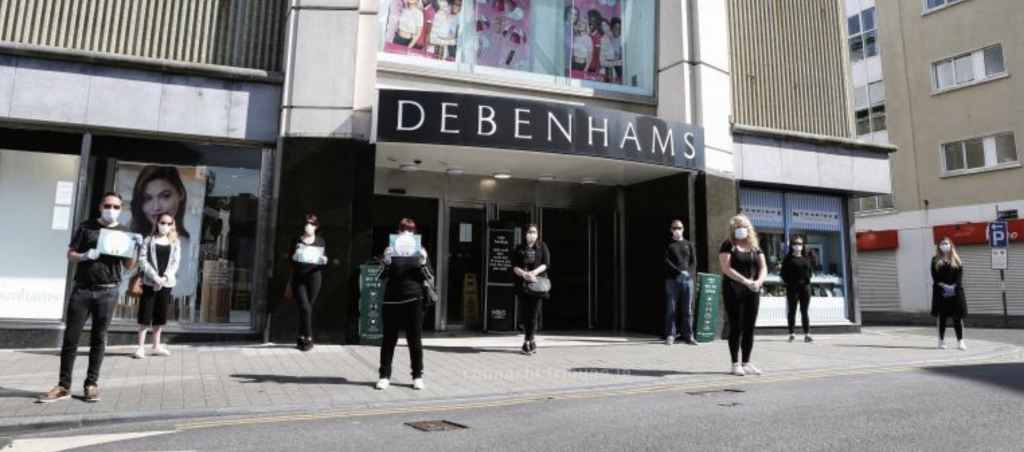
Nine workers, dressed in black, at least two metres apart, wearing masks are facing the camera outside of a Debenhams shop, beneath the store's sign, which is white writing on a black background.
Debenhams’s workers (members of Mandate) protest at shop closures and layoffs 21 April 2020

To date 3.6 million people worldwide have been infected by Covid-19, with over a quarter of a million (258,000) dying from the respiratory illness that attacks the lungs and airways. From December 2019 the virus travelled from its original source in southern China to all of Asia, Europe and the rest of the world in the space of two months, resulting in the World Health Organisation (WHO) declaring a global pandemic at the end of January. The pandemic has forced governments the world over to close their economies and lockdown their societies.

With more than four fifths of workers globally living in countries affected by full or partial lockdowns, a global public health crisis is leading to a global economic recession, with the International Labour Organisation stating that 6.7% of working hours globally have been wiped out in the second quarter of this year alone – equivalent to 195 million jobs worldwide. The global economy is in recession and may yet head into an economic depression.

Here in Ireland, north and south, there have been 22,248 confirmed Covid-19 cases and 1,375 deaths (6 May 2020). In the south we have spent the past five weeks effectively living in lockdown, instructed by state authorities to stay indoors, to go no further than a radius of 2km (now 5km as of 5 May) for our daily exercise and only engage in essential consumption – our weekly grocery shop.

The Irish economy has been deliberately shut down by the government: 598,000 people have lost their jobs, with another 427,000 people having their wages paid via a state subsidy; tax revenues are projected to shrink by 14 billion this year, and in their spring forecast the European Commission predicts that the Irish economy will shrink by 8% this year. It took more than two years during the last national crisis – the financial crisis of 2008 – for such numbers to develop, this time round it has happened in a little over two months.

The world has been rocked by the coronavirus, peoples’ lives have been turned upside down; shock, grief, fear and anxiety caused by pandemic and its economic consequences have left millions people reeling, with many feeling vulnerable and isolated. Ideal circumstances for the ruling class, the multinational corporations and their local political allies to take advantage and pursue a shock doctrine response to this global pandemic: to force the cost of the crisis onto the backs of the working class worldwide, to push more privatisation and deregulation, to further increase their wealth, power and influence.

We refuse to repeat the sacrifices of 2008

So whilst we have to remain physically distant we must remain socially close and politically critical. Some would want us to suspend not only our parliamentary democracy (with caretaker Fine Gael ministers last month bemoaning the convening of Dáil Éireann), but our critical faculties also. The old trick from the last crisis, the call to ‘don the green jersey’ in ‘the national interest’ as ‘we’re all in this together’ as a way to stifle criticism and suppress political debate has been used again during this crisis but this time it is not working.

People have lived with the consequences of the political decisions taken during the financial crisis of 2008 for more than a decade now, indeed the decade of austerity and the massive transfer of wealth from the working class to the rich resulted in the state being ill-prepared for the outbreak of such a pandemic and will likely mean that our societal and economic lockdown will last longer than many other countries.

The ease with which the cost of the financial crisis of 2008, resultant bank bailout and decade of austerity was foisted upon the people was in large part due to the lack of real opposition from the trade union movement. Insofar as there was opposition, small and sporadic though it was, it arose through the efforts of the small radical left parties. This was not effective in stopping the austerity. It was not until an alliance of trade unions, community groups and left parties formed to fight the water charges that a movement of critical size and power emerged to oppose one item on the austerity agenda.

This cannot be allowed to happen again. The trade union movement has to become the dominant force that shapes the response to the Covid-19 crisis to ensure that workers, families and communities throughout Ireland are not forced to pay for yet another crisis not our their making .

Unite the Union’s response to Ireland’s post COVID-19 economy

To that end, the Unite trade union recently commissioned the left-wing economist, writer and activist Conor McCabe to produce an analysis of what has happened to date and to sketch a socially just, economic fair and environmentally transformative pathway forward out of the economic and societal crisis we are currently living through, a document intended by the author to be ‘a tool to feed into the conversations we are having and the strategies and tactics we will pursue’ so that the Left does not ‘allow the right-wing and neoliberal voices in Ireland to dominate and shape the pathway out of the current crisis’.

You can read the Hope or Austerity document here.

Independent Left commends Unite for taking the initiative in commissioning the document Hope or Austerity as too often the Left is reactive rather than proactive. Indeed as the author notes ‘we cannot build the future we need unless we plan and fight for it’. In times of crisis we need clear thinking, critical analysis and robust debate, which this document provides.

Of course the crisis is evolving and as the author himself stated during a Unite May Day lecture it is a working document, written to feed into an on-going process of critical discussion and debate. There are parts that need expansion, like childcare and home care, and others that need to challenged, like the normalisation of the regressive and dysfunctional Local Property Tax.

Independent Left recommends a close reading of the document, welcomes the opening of discussion and aims to be a part of the comradely yet critical debates ahead as together we debate the best tactics and strategies to purse as we struggle for a better world.

Debenhams Workers in Ireland on Strike

A battle between Debenhams management and workers is a key one for all workers, at it is likely to shape the wider issues of who will pay for the impact of the COVID19 crisis on the economy.

On 9 April 2020, Debenhams Retail Ireland told 1,500 workers their jobs were gone as all 11 of its stores were closed. The company offered no redundancy.

The workforce is represented by Mandate, who have pointed out that the shops still have stock worth an estimated €25m and this should be sold to provide redundancy payments to the workers.

Mandate is demanding that more than a million items of stock currently in Debenham’s 11 closed Irish stores should be sold and the proceeds, estimated at €25m, distributed to former workers as part of a redundancy deal.

Even though it is extremely difficult to organise at a time of social distancing and closed stores, the workers voted to strike and deserve the support of all Irish workers.

Below is an interview with Councillor John Lyons and Debenhams’ strikers at the Henry Street Store, recorded 23 June 2020. The Debenhams workers are asking people to boycott the online sales of the company until the dispute is resolved.

Filed Under: All Posts, Independent Left Policies

  • « Go to Previous Page
  • Page 1
  • Page 2
  • Page 3
  • Page 4
  • Page 5
  • Page 6
  • Go to Next Page »

Copyright © 2026 · Aspire Pro on Genesis Framework · WordPress · Log in