• Skip to primary navigation
  • Skip to main content
independent left logo

Independent Left

Environmentalism, socialism, freedom and equality. #liveablecity

  • About
  • Featured Articles
    • How Farming Must Change to Save the Planet
    • The Housing Crisis: Causes and Solutions
    • Socialism in Ireland
  • Contact Us
  • Podcast
  • Animal Rights
  • Archive
    • Irish Socialist History
    • Dublin City Council Housing
    • Ukraine
    • Protests Ireland
    • Reviews
    • Irish Political Parties
    • All Posts
    • Independent Left Policies
  • Why join?

Brexit: What Should Irish Socialists Say?

19/10/2019 by Conor Kostick 1 Comment

Short version: Independent Left advocate Remain.

At the time of writing, there is still a lot of uncertainty around whether and under what conditions the UK will leave EU. On Saturday 19 October, it seemed possible that Boris Johnson would just about get a Brexit deal through the UK parliament, only for him to be caught by surprise by an amendment (the Letwin amendment) that postponed a vote on Johnson’s Brexit package until a Withdrawal Agreement bill (WAB) was first agreed. The point being that MPs did not trust Johnson: so long as WAB was not passed, there was a danger of a No Deal crash out on 31 October.

Currently, even if Johnson does have the slender majority he needs to deliver Brexit in line with his agreement, there is still opportunity for UK MPs to amend the WAB, including by adding the idea that a second referendum has to be organised to endorse the deal. A new referendum was the demand of the huge (possibly as many as one million people) march in London on the same date.

What is certain is that if Brexit takes place – and especially if it’s the Johnson version – the UK leaving will be harmful for working class communities. In the UK itself, including Northern Ireland, Brexit would mean a rise in unemployment, a food and medicine crisis and an economic decline that some analysts anticipate will be worse than that of the 1930s. In Ireland, there are likely to be similar, if much less severe consequences. Here too, however, we are also going to face a government that will use Brexit, like it has used every crisis before now, as an excuse to strike down on working class people.

Remember how the Universal Social Charge was introduced by Fianna Fail’s Finance minister Brian Lenihan in 2010 as ‘a temporary measure’ to help Ireland cope with the financial crisis? Well, Brexit will be used in exactly the same way: even now Fine Gael are raising Brexit to justify their failure to properly fund essential services. The most recent budget is just the latest example of this approach.

For this reason alone, Irish socialists should advocate Remain. Moreover, there’s another way that the position of workers has already worsened as a result of the Brexit vote and that is because it has been accompanied by a rise in racism. Racists of all hues in the UK, including out-and-out fascists, greeted the result of the Brexit referendum with delight and there was an immediate upsurge of attacks on immigrants (a rise of 41% in what the UK police term ‘hate crimes’). In Ireland, we only experienced a ripple of this, but any growth in hostility to immigrants harms our ability to stand together and make progress on all the pressing issues that face us.

Does supporting Remain mean supporting the EU?

On the whole, with the important exception of Bernadette McAliskey, who quite rightly said, ‘politically the Right wing of British and European politics along with anti-immigration and naked racism has been strengthened by the Brexit victory,’ the Irish left were pro-Brexit at the time of the first referendum. It is understandable why. We shocked the establishment in 2001, when we were a successful part of the campaign against the Nice Treaty (opposing it largely because the treaty undermined Irish neutrality). The Irish conservative parties had to spend a lot of time and energy in pushing through the re-run in 2002. Again, the Lisbon Treaty of 2008 was rejected, with the left in tune with working class communities who mistrusted the proposed changes as likely to favour business over workers’ rights.

Given the EU had bullied Ireland into taking on the debts of their banks after the crash of 2009 and then tried to insist on us having water charges to pay for these massive debts, it’s no wonder that the Socialist Party, People Before Profit and many others on the left assumed that being in favour of Brexit was the natural continuation of an approach that – rightly – characterises the EU as being dominated by big business.

They were mistaken and deeply so.

Every referendum has to be judged on its merits and understood to be taking place at a particular moment in time. The UK one on Brexit had a very different dynamic to Nice and Lisbon. It was rapidly taken up by the anti-immigration UKIP and small parties even further to the right and then became all about immigration, particularly after the murder of Labour’s Jo Cox. Jo Cox was a prominent activist against Islamaphobia who was campaigning for Remain. She was killed by a man with fascist connections, who shouted “Britain first”.

Socialists who had a vote should have voted Remain, primarily in order to stand with the anti-racists.

There is no contradiction at all in advocating Remain for these reasons and still holding to a view that the EU is driven by big business. Because Brexit too is all about a big business agenda: the Conservative Brexiteers can hardly wait to tear up EU regulations protecting workers’ rights. They think realignment with the US and the far-east will prove more profitable than staying in the EU.

The old Socialist Workers Party that was, had a slogan, ‘neither Washington nor Moscow’ to indicate that in the Cold War it did not see it necessary to pick a side, when both sides were racing to oppress and exploit their populations. That’s the approach that socialists should take when the rows among a divided elite spill over into a referendum. The Irish version runs: feck ye both.

We don’t have a side between the EU and British businesses who think they are better off facing towards the US. But we do take sides against racism and we are rooted in communities that are going to suffer when Fine Gael wield the hammer, shouting ‘sorry, but Brexit’.

So Remain it is.

What should socialists do now about Brexit?

The Brexit vote is not a defiant working class refusing to be pushed into a Lisbon-type treaty. It’s the opposite: an anti-immigrant, right-wing vote. On the other hand, the Remain vote had as its largest component exactly the kind of people who make up the natural constituency for socialist parties: trade unionists, community activists and especially anti-racists.

The Ashcroft exit poll to the Brexit referendum was the most comprehensive poll at the time (12,000 people sampled). It shows that two out of three Labour voters voted Remain. A majority of people in work voted Remain. 67% of Asians voted Remain and 70% of Muslims. True, there were traditional Labour regions that voted leave, but no one argues that they did so for any other reason than being anti-immigrant. Their champion within the Labour Party, Stephen Kinnock, thinks Labour has to emphasise, ‘the value of place’ and the legitimacy of raising concerns about immigration.

Trying to appease racism never works. The more divided a working class community, the less able we are to win campaigns on all the issues affecting us.

Probably, the penny has begun to drop among Irish socialists that they have the wrong approach to Brexit and they are alienating themselves from core supporters.

Hopefully these parties change their approach. Although they have no culture of doing so, it would not harm these parties to acknowledge that supporting Brexit was a mistake but now, in the light of developments, they are for Remain. No harm at all. In fact, you win respect by honesty instead of evasive, never-wrong, politician-speak. We need to have the humility to acknowledge when we make mistakes, learn from them and move forward. No one is all-knowing, so we shouldn’t pretend to be so.

For our part, we are unambiguous. Independent Left are for Remain.

Filed Under: All Posts, Independent Left Policies

The Shock of Climate Change, the Awe of Geo-Engineering

17/09/2019 by Conor Kostick 2 Comments

A vast cloud of smoke issues from an active volcano; streams of lava pour from the cone.
Past volcanic eruptions serve as a warning against solar geoengineering

Even if human society immediately managed a complete stop to the emission of carbon, we will fail to achieve the target of the Paris Accord of 2016, of keeping the increase in planetary temperatures to under 2% above pre-industrial levels. And of course, carbon emissions, far from coming to an end are increasing. There is no doubt that dramatic climate change is underway and it is not slowing down.

We are in very big trouble as a species unless we invent miracle solution to global warming. And as the crisis crows, so does momentum behind a project that has striking parallels with the Manhattan Project, the 1941 assembly of scientists at Los Alamos that eventually led to nuclear strikes on Hiroshima and Nagasaki and the danger (that remains with us) of nuclear winter for the planet.

The risks of Geo-engineering

The project I’m referring to is that of Geo-engineering the planet’s atmosphere and in particular, the plan to apply the stratospheric aerosol injection (SAI) of chemical compounds. The idea is to pump sulphates (dust) into to the upper atmosphere so that solar radiation is back-scattered into space.

Behind the push for a Geo-engineered solution to global warming are backers such as the Bill Gates Foundation and the idea is gathering momentum. You can see the growing number of geo-engineering projects via map.geoengineeringmonitor.org, which shows that there were more than eight hundred projects in 2017 (compared to three hundred in 2012).

SAI is an idea that will work. We know it does because when, in the past, such as in 1815, massive volcanic eruptions blasted dust into the stratosphere, the next year or two saw global temperatures drop by as much as five per cent. SAI scientists are attempting to recreate the effect of these volcanoes artificially.

A cartoon of a volcano beside a ballon, both pushing dust above the stratosphere. Sunlight, drawn as a yellow arrow, partially bounces off the veil of dust.
Solar engineering mimics the effect of powerful volcanos
Source: https://commons.wikimedia.org/wiki/File:SPICE_SRM_overview.jpg

One of the parallels between the Geo-engineering drive and the Manhattan Project, is that several of the scientists involved in this research have claimed that the technology will never be used. They are developing the technology… ‘just in case’. But as the climate crisis unfolds, panic measures will be implemented and any new technology that we have available to address global warming will be considered in earnest, no matter now risky.

And there are massive risks with this apparent solution to global warming.

One important point to make about SAI is that it would not change the density of carbon in the atmosphere and therefore it would have no impact on effects such as the acidification of the seas. Secondly, SAI could allow companies and countries to avoid a fundamental solution to the burning of fossil fuels. In fact, petrochemical companies have expressed an interest in supplying the sulphates needed for the project, which would be paid-for by taxpayers. If implemented, SAI represents a huge win for them.

The most common objection to SAI geo-engineering is a strong one: how do we know what the consequence will be? Predictions of what will happen depend on computer models for the atmosphere and at the current time, these models are nowhere near accurate enough to be confident about the impact of SAI. Given that important global phenomena like the North Atlantic Oscillation and the El Niño-Southern Oscillation have yet to be successfully modeled, we just cannot predict what will happen on a global scale, let alone a regional scale. It is very likely that filling the stratosphere with sulphates will not only cool the planet but it will create major turbulence and extreme weather events. Particularly important here is the effect on rainfall: it is quite possible an overall cooling of the planet through SAI is accompanied by devastating floods and droughts at a regional level.

My own concern about SAI arises from my research into the societal consequences of major volcanic eruptions. Let’s suppose humanity starts on the SAI approach, we are then caught in a very dangerous situation, where every year we will have to keep up the practice filling the stratosphere with particles. And as soon as we stop, the underlying crisis of high planetary temperatures will reassert themselves. But what would happen if during this process a major volcano erupted? The dumping of tonnes of dust into the stratosphere on top of the human effort will have devastating consequences. There will be a year or two without summers, crop failure on a massive scale and enormous economic dislocation as planes are grounded for months.

I’m looking at the medieval world in particular, where life was far more precarious than our own. But we cannot be complacent about the potential for resilience today. Modern society in some ways is more vulnerable than that of our medieval predecessors. Just-in-time production and the inter-dependency of the world economy means that if international trade is grounded for several months, the consequences would be shocking.

After the 2010 Icelandic eruption of Eyjafjallajökull, air traffic was affected in some regions for up to a month. This was a volcanic eruption of about one tenth the size of those I’ve been researching in the historical record.

My point is that as the geo-engineering option becomes more appealing in the face of increasingly damaging consequences arising from global warming we will lose track of the bigger historical picture in the hope of a short-term fix. But what this wider perspective demonstrates is that sooner or later a major eruption will happen that brings its own challenges. And if we have already saturated the atmosphere artificially with sulphates when it does, we are going to bring about a year or two of unforeseen, incredibly cold years of massive economic dislocation and crop failure.

Awareness of the dangers of Geo-engineering needs to grow

There is no governing body that can stop a figure like Donald Trump from beginning this process. Geo-engineering on sufficient scale to cool the planet would cost about a billion dollars. That’s relatively cheap to implement. And this brings imperial considerations into play. There is nothing to stop a rich country, which also is relatively protected from unpredictable consequences from going ahead on their own. Nothing, that is, except the opposition of their own population. That’s why awareness of the dangers of geo-engineering needs to grow, especially among those protesting on 20 September.

This post was originally written for We Only Want the Earth, a Facebook page curated by Dave Lordan to build support for the global climate strike 20 September 2019.

You can download an academic chapter that deals with the topic in greater depth by clicking here.

And below is an interview between myself and Pat Kenny of Newstalk about the dangers of GeoEngineering:

Filed Under: All Posts, Independent Left Policies

Stop Water Privatisation: Round Two

18/07/2019 by John Lyons Leave a Comment

By John Lyons

Right2WaterIreland identify ‘excessive usage charges’ as a tool for the privatisation of water

As Right2Water have recently posted, the announcement on 17 July 2019 by the Commission for Regulation of Utilities that excessive usage charges will be imposed on households that waste water is the beginning of a new battle which will see the government attempt to reintroduce the hated water charges in a new form.

Do they really want to go there again? The people have spoken, marched, boycotted, voted, marched and then marched and boycotted some more.

The Irish establishment, the supposed elite group of middle and upper class professionals and politicians, legal minds and media folk, despised the water movement because it was a great movement of the working class, middle and low income people fighting back and winning.

So they are sore, are coming back at it and are determined not to be dictated to on this issue ever again by the “ordinary people”.

They think the sting has gone out of the issue: yes, the political class paid a price in the local and European elections in 2014 and the general election in 2016, but they now feel that they have recovered and to a certain degree they have.

The Greens did well in the recent local and European elections and they favour water charges; the Labour Party did alright for themselves and they are in favour of water charges; Fianna Fail and Fine Gael had good local and European election results and are most certainly in favour of water charges.

Meanwhile the political parties of the Left and Sinn Fein, those that fought hard opposing the water charges, performed very poorly in the recent elections.

So the establishment think that the people have fallen into a slumber, are ripe for a little bit of “water wasting” propaganda, will accept the introduction of a charge for “excessive usage” and will ultimately see as inevitable the re-introduction of water charges.

They think this is their time, an opportune moment in which to begin a new battle to introduce water charges and ultimately privatise our water.

They are mistaken. Being out of touch with working class communities, they think we will be easily deceived as to the true nature of ‘excess usage charges’. Having underestimated the insight and determination of Irish workers, they will lose this battle. And Independent Left looks forward to playing our part in ensuring this.

Filed Under: All Posts, Independent Left Policies

Independent Left’s response to gangland killings in Coolock and Darndale

05/06/2019 by Conor Kostick 1 Comment

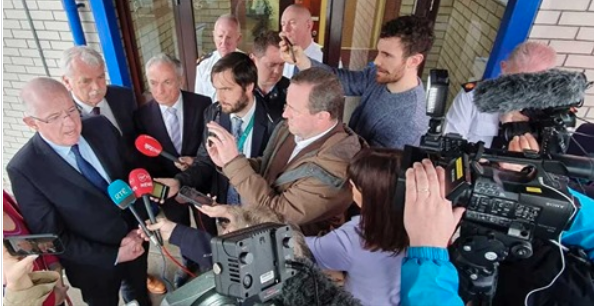
Minister Charlie Flanagan visits Coolock and does nothing for the community
Millionaire Charlie Flanagan fails the young people of Coolock and Darndale

When young people from working class communities are drawn towards crime gangs, tragedy is never far away. On 25 May, Eoin Boylan, aged 22 was shot and killed in the residential area of Clonsaugh Avenue Coolock.

In May, Hamid Sanambar (42) was shot on Kilbarron Avenue, Coolock, the home of Sean Little (22), who was shot dead on Tuesday 21 May 2019. Jordan Davis (22) was shot dead in Darndale on 22 May, while earlier in the year, in a related assassination, Zach Parker (23) was killed in Swords. The fact that these lives were wasted is tragic and clearly too there is the risk that bystanders including children and the elderly will get caught up the feud, with the murders taking place in daylight on busy streets.

Independent Left councillor John Lyons calls a fully-funded multi-agency body

In an interview with RTE’s Sean O’Rourke, Independent Left councillor highlight the neglect of support for youth initiatives in Dublin’s north east and argued for greater resources for the area and the creation of a coherent, fully-funded multi-agency body similar to the North East Inner City (NEIC), to tackle and address the many issues involved in this murder.

What have the government to offer a traumatised community and a youth culture that celebrates gangsters? In the case of the Taoiseach, nothing at all. He said that, ‘as soon as I can find a little time’, he would visit Coolock and Kilmore West. When he wants to move fast, Leo Varadkar can make room in his diary, such as to meet with Donald Trump. Clearly, this crisis of gangland feuding is not a priority for him, nor for his ministers.

Although Justice Minister Charlie Flanagan came to Coolock Garda Station in May 2019, he had nothing to announce by way of a new package of assistance for the community. A small amount of investment in sports clubs, for example, goes a long way in terms of giving young people inspiring, constructive role models. We only have to look at Katie Taylor to see that.

Instead of bringing welcome news on the community support side, Flanagan told young people to ‘drop the bling’ and that criminal gangs were ‘all losers.’ If I were a teenager being told by a landlord worth over €3m to drop the bling and stay away from criminal gangs, my fury at his privileged arrogance would have me reaching for a milkshake.

In the UK, Nigel Farage was one of many far-right politicians targeted by ‘milkshaking’ in 2019

This is why Councillor John Lyons was absolutely right to describe the visit of Flanagan (and Richard Bruton and Finian McGrath) to Coolock as a shameful public relations stunt.

John Lyons called on the government to establish a taskforce for the Coolock area to address the ongoing gangland violence, and the many economic, social and educational inequalities that give rise to such activity: ‘It is hugely disappointing that the three government ministers had nothing of note to announce. We need a task-force established that will be responsible for monitoring the work of the various government departments, state agencies and community groups that have a role to play in tackling the many problems faced by people in the area.

‘I am sure that if the recent murders in Darndale and Kilmore had occurred in Dalkey or Killiney we would have seen a much swifter and more serious response from the government; instead, it takes government ministers a full week to visit the area and when they visit, they have nothing of value to say or announce. Shameful really, and not good enough for the communities directly affected by the recent violence.

‘So I am once again inviting An Taoiseach to find “a little time” to visit the area, meet with the various stakeholders in the community with a view to establishing a task-force for the area. The communities deserve a serious response from government, a response sadly lacking to date. The government must step up.’

In the coming days Councillor John Lyons and Niamh McDonald will be working together with community groups and sports organisations to formulate a serious response to the gangland crisis, one that can make a significant impact in the life paths of young people instead of attempting to dismiss them. To paraphrase the Sex Pistols, if you treat kids as morons, you create H Bombs.

While the contempt of millionaire, landlord politicians just makes the situation worse, Independent Left seeks to create a constructive path for the energy and passion of the young people of our community.

An election image for Dublin Bay North showing John Lyons and headlined crime. He calls for greater spending on schools and amenities and a local multi-agency task force.
In general election 2020 as candidate for Dublin Bay North, John Lyons called for increased spending on amenities and a multi-agency task force to tackle the growth in crime gangs.

Filed Under: All Posts, Independent Left Policies

Make the institutional child abuse records public

21/05/2019 by Conor Kostick Leave a Comment

A dangerous and unnecessary precedent

This is how Caitriona Crowe, former head of special projects at the National Archives of Ireland greeted a new government bill, the Retention of Records Bill 2019, which will bury the records relating to the recent commission into child abuse and neglect at various religious run institutions for seventy-five years.
There are millions of records and the National Archives have advised the department that there is no need for special legislation to allow them to be archived under the 1986 National Archives Act. The department has gone ahead anyway.
And the question has to be why?
The big difference between bringing the documents into the state archives under the 1986 legislation and that of the proposed bill is in the number of years that the public must wait to view them. Without the new bill, these records can be viewed after thirty years.
We believe even thirty years is too long to wait for scrutiny of the evidence gathered by the Commission, the Redress Board and the Review Committee.
The state’s defence, as articulated by Aongus Ó hAonghusa, a senior civil servant, is that sealing the records for seventy-five years would avoid the risk of legal challenge. In response, Councillor John Lyons said:

Instead of running scared of legal action by the church, we should tell them, “bring it on”. Instead of hiding details in the shadows for seventy-five or even thirty years, we should allow the public access to these documents.
Any legal case arising from this material will only serve to highlight just how awful was the practice of these institutions.

Filed Under: All Posts, Independent Left Policies

  • « Go to Previous Page
  • Page 1
  • Interim pages omitted …
  • Page 3
  • Page 4
  • Page 5
  • Page 6
  • Go to Next Page »

Copyright © 2026 · Aspire Pro on Genesis Framework · WordPress · Log in