• Skip to primary navigation
  • Skip to main content
independent left logo

Independent Left

Environmentalism, socialism, freedom and equality. #liveablecity

  • About
  • Featured Articles
    • How Farming Must Change to Save the Planet
    • The Housing Crisis: Causes and Solutions
    • Socialism in Ireland
  • Contact Us
  • Podcast
  • Animal Rights
  • Archive
    • Irish Socialist History
    • Dublin City Council Housing
    • Ukraine
    • Protests Ireland
    • Reviews
    • Irish Political Parties
    • All Posts
    • Independent Left Policies
  • Why join?

Review: Red Round Globe Hot Burning

14/02/2020 by John Flynn 3 Comments

The book cover to Red Round Globe Hot Burning by Peter Linebaugh, which Independent Left review as a masterpiece of radical literature. It has the title in white text against an image of a human figure on a cloud, holding a black double-headed hammer, which is head down towards a deep red globe beneath the cloud. In yellow are the words: A A Tale at the Crossroads of Commons & Closure, of Love & Terror, of Race & Class, and of Kate & Ned Despard.
Peter Linebaugh‘s Red Round Globe Hot Burning is a masterpiece of radical history.

By John Flynn

Peter Linebaugh’s 2019 book Red Round Globe Hot Burning is his greatest masterpiece yet in a lifetime of triumphs. It is a mind-blowing contribution to his lifelong quest for the commons. This is a quest begun through his apprenticeship to the late Edward Thompson (whose copy of The Trial of Edward Despard Linebaugh has carried with him in his luggage all his life), and deepened with his stunning work The London Hanged. Then there is Linebaugh’s utterly miraculous collaboration with ‘fellow shipmate’ Marcus Rediker on The Many-Headed Hydra. Throw in his unforgettable Mayday Essays and his work on The Magna Carta Manifesto, not to mention his Stop Thief, a wonderful, Wobbly-inspired titled collection of essays and you have a writer of such extraordinary power that reading him can move you to tears (and will always lift your spirits). His subjects are the picaresque proletariat of the revolutionary Atlantic: some of the boldest, most irrepressible characters to ever walk the earth.

The title of this recent book is taken from William Blake’s Vision of The Daughters of Albion

They told me that I had five senses to inclose me up,

And they inclos’d my infinite brain into a narrow circle,

And sunk my heart into the Abyss, a red round globe hot burning

Till all from life I was obliterated and erased.

Linebaugh, like his mentor Thompson, is a Blake enthusiast. He writes perceptively about Blake’s work, seeing the revolutionary thinking in Blake’s complex prophecy in The Book of Urizen which he interprets as an allegory designed to describe the Atlantic transition to child labour and slavery.

It is how Linebaugh glosses the phrase ‘Red Round Globe Hot Burning’ that speaks to everything about our world today, beset as with are with fascist berserkers and a climate out of whack. In his tale ‘at the crossroads of commons and closure, of love and terror, of race and class, and of Kate and Ned Despard’ Linebaugh, ‘the people’s remembrancer’, depicts two revolutionary lovers who broke through the hardening walls of white supremacy and made a valiant attempt to overthrow the still nascent industrial capitalist system and restore the commons. In the words that they wrote together while Despard was in prison, and that he delivered from the scaffold not long after other legendary heroes from the United Irishmen suffered similar fates:

But, Citizens, I hope and trust, notwithstanding my fate, and the fate of those who no doubt will soon follow me, that the principles of freedom, of humanity, and of justice, will finally triumph over falsehood, tyranny and delusion, and every principle inimical to the interests of the human race.

Edward Despard was an Anglo-Irish officer in the British army who once saved the life of Nelson and was greatly respected for his abilities as an engineer. He  married Kate, an African American woman, and turned revolutionary in part because of his experiences among indigenous commoners in Nicaragua and Honduras. It was Despard’s open sympathy with people of colour that provoked the baymen of Honduras ‘to take arms in Defence of our lives and properties against an armed banditti of all colours’. Kate, ‘the fearless abolitionist, the tireless prison reformer, the United Irish woman, is the hero of this story’. She visited Ned in three prisons, was a terror to the authorities, for to quote Nelson, she was ‘violently in love’ with Ned. In one awesome campaign she successfully prevented Jeremy Bentham from building his panopticon on Tothill’s Fields commons.

A blue-tinged watercolour shows an eighteenth century imperial warship on a calm sea. To the right of the frame, filling the height of it, is a portrait of Peter Linebaugh by Anastasya Eliseeva: he is wearing glasses, has a slight smile and wears a scarf.
Portrait of left-wing historian Peter Linebaugh by Anastasya Eliseeva for New Frame.

The themes of Linebaugh’s latest book

The methods that Linebaugh uses to tell this tale are bold and well suited to his themes. He roams like a true commoner through space and time and across many disciplines (History, Literature, Climate Science, Thermodynamics, Engineering, Mycology, Zoology, etc) which makes his book such an incredible read. I have been through it now six times and each reading offers fresh delights. He makes great use of the poetry of John Clare and Blake, two fervent lovers of the commons, and of the poetry of the ‘hidden Ireland’ where insurrectionary thoughts were never far from the surface. He employs both statistical and anecdotal evidence to illustrate the truth behind his favourite peasant ‘koan’:

The Law locks up the man or woman who steals the goose from off the commons,

But leaves the greater villain loose that steals the commons from the goose.

Also, like a true Blake enthusiast, he has an uncanny knack for reading hostile official sources in a ‘Satanic light’ to provide brilliant evidence of the class struggle. What always stands out in Linebaugh’s work is his love of language, particularly the language of poets and proletarians. You really get the sense of Linebaugh relishing the language of each quotation he uses. There is one from an extraordinary passage: part Linebaugh, part William Covel, execrating the enclosers of Enfield commons, which nicely illustrates how much of ‘a true Leveler’ Linebaugh has become through his years of thinking and writing about a tradition inspired by Winstanley and the diggers.

[Covel’s] class consciousness was vivid. He inveighed against the possessors, their fat and scornful eyes, their taunting speech – “What lyings! What cheatings! What blood! What murders! What divisions! What tumults! What pride! What covetousness!” “Oh how the buyers and sellers are guarded, fenced with walls, and defended with Laws!” He said that the wicked of the world rule by three principles: 1) strength united is stronger, 2) “divide and spoil,” and 3) “make poor enough, and you will rule well enough”. In particular, he denounced lawyers, clergymen, corporations, and great tradesmen. Gold and silver were their signs of glory “but to others [they were] a sign of death.” In contrast, mariners, those who follow the plough, and those who practice handicrafts were useful, for on their labors all others depended.

You could with great success and much happiness for yourself practice bibliomancy with Linebaugh’s book. It would be a great spiritual defence in these frightening times to open the text at random and read his glorious prose or the many brilliant quotations he has selected. His discussion of the different kinds of love, for instance, is marvelous,

This is a story both of a couple and of the commons. Doubtless eros was part of their love – Ned and Kate had a son- and so was philia, or that egalitarian love of comrades and friends. The love of the commons was akin to that love the Greeks called agape, the creative and redemptive love of justice, with its sacred connotations.

So, what is the commons that Linebaugh writes of? I would say a permanent revolution in social reproduction inspired by the history of commoning. He advocates for the omnia sunt communia of Thomas Müntzer, the great religious communist leader of the German peasants’ revolt. The great digger, or ‘true leveller’, Gerard Winstanley’s ‘the earth was made a common treasury for all’ inspires his thinking. Linebaugh distinguishes between the radical claims on the commons made by Winstanley to those of Thomas Rainborough.

Winstanley propounds a communist theory of land. Rainborough is all about government and the nation, whereas Winstanley is all about land and subsistence. Rainborough was a Leveler, while Winstanley called himself a “True Leveller”. Rainborough is deferential (“truly, sir”), while Winstanley is declarative (“freedom is the man who will turn the world upside downe”).

We see the same differences between Tom Paine and Thomas Spence which Spence himself brilliantly outlined in his  A CONTRAST Between PAINE’s AGRARIAN JUSTICE, and SPENCE’s END OF OPPRESSION. 

Spence is one the most beautiful, awe-inspiring, irrepressible radical worker intellectuals from the British Isles. He wrote brilliant tracts like the extraordinary work on social reproduction, The Rights of Infants.

Aristocracy (sneering): And is your sex also set up for pleaders of rights?

Woman: Yes, Molochs! Our sex were defenders of rights from the beginning. And though men, like other he-brutes, sink calmly into apathy respecting their offspring, you shall find nature, as it never was, so it never shall be extinguished in us. You shall find that we not only know our rights, but have spirit to assert them, to the downfall of you and all tyrants. And since it is so that the men, like he-asses, suffer themselves to be laden with as many pair of panyers of rents, tithes, &c. as your tender consciences please to lay upon them, we, even we, the females, will vindicate the rights of the species, and throw you and all your panyers in the dirt.

When he wasn’t revisiting his plans for a commoners’ republic, Spencer was singing revolutionary songs, like A Song to Be Sung at the Commencement of the Millenium. 

Hark! how the Trumpet’s sound,

 Proclaims the Land around The Jubilee!

 Tells all the Poor oppress’d,

 No more shall they be cess’d

 Nor Landlords more molest

 Their Property.

And, if not that, he was chalking slogans on walls and roads (“You rogues! No landlords!” “Fat Barns! Full bellies!”). He minted these class war coins with slogans like “Let tyrants tremble at the crow of Liberty”. When he was arrested, as he was many times, he used his trial to restate his plan for an egalitarian society. As Linebaugh writes, ‘Spence was for all creatures – animals, as well as humans – regardless of gender, race, or age’. His thinking which evolved from the commons into ‘a precursor of communism’ was made up of many strands:

Spence combined the practicalities of the commons’ customary rights with the ideals of universal equality. He drew on several ideas and traditions, the Garden of Eden, the golden age, utopian, Christian, Jewish, American Indian, millenarian, dissenting. All of these ideas were experienced in a context of a commons of the sea (his mother was from the Orkney Islands) and of the land (the Newcastle Town Moor), not yet enclosed.

Linebaugh on the great slave revolt of San Domingue (Haiti)

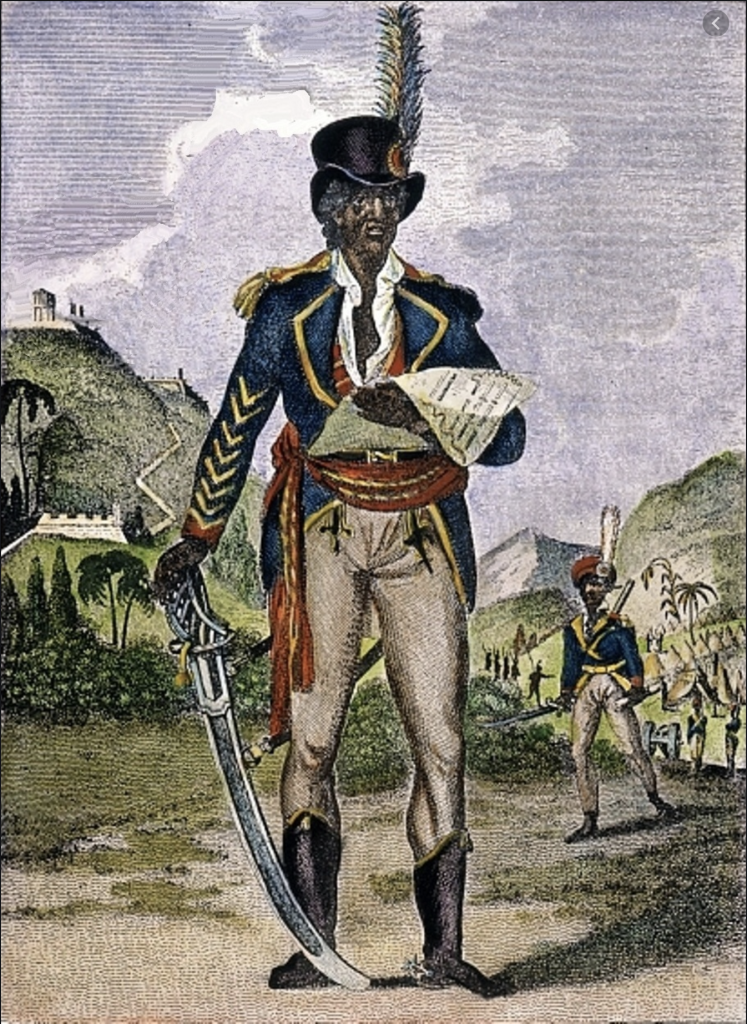
One of the ‘Atlantic Mountains’ that is a towering presence in the book is the Island of San Domingue (Haiti). The greatest slave revolt in human history which was begun on the night of August 22 1791, at the Bois De Caiman (a commons), ‘an all-out war began that culminated twelve years later – at the time of the Despard conspiracy – in the abolition of slavery and the independence of Haiti. It is a great and horrifying story of human freedom that reverberated throughout the Atlantic mountains, shaking every peak and valley’. The successful ‘black Jacobin’ revolutionaries led by Toussaint Louverture taunted their French adversaries (who were sent on a genocidal mission of extermination by Napoleon) by singing songs of the French Revolution, now in Thermidorean decline. Jean-Jacques Dessalines, who took over as leader following the capture of Louverture named his army ‘the army of the Incas’ in a fabulous salute to the failed Tupac Amaru revolt in the Andes of 1780 which had first caused the Atlantic Mountains to shake. Linebaugh refers to the work of Susan Buck-Morss, whose book Hegel, Haiti and Universal History, underlines the vital influence that the Haitian revolution had on Hegel’s development of the Master-Slave dialectic. It is incredible to think of the Haitian revolution as a root of the Marxist dialectic when you consider that Marx’s great hero of world history was another slave revolutionary, Spartacus.

A nineteenth century colourised engraving of Toussaint L'Ouverture, the revolutionary former slave who helped the successful slave revolt of 1791 achieve independence for Haiti. He stands in a uniform similar to that of a French contemporary officer, but with a straight hat with a feather in it. In his right hand, a sabre is drawn, tip resting on the ground. In his left if a proclamation.
Toussaint L’Ouveture, former slave and leader of the great revolt of 1791

Another of the great revolutionary movements of the time was that of the United Irishmen with whom Despard would eventually intersect. He became a member of the United Englishmen and of the London Corresponding Society. After Despard’s hanging, Kate disappears into the fold of the surviving cohort of United Irishmen. The United Irishmen was a glorious moment in Irish history made up of the amazing characters, a movement for ‘the men of no property’, although there were bourgeois figures like Valentine Lyons (whose mansion Kate found refuge in). The military leader was Edward Fitzgerald, ‘scion of the most privilege strata of aristocracy’. But the mass of the people was ‘helots’, a term used by William Drennan, who also coined the phrase ‘the emerald isle’ and composed the oath of the United Irishmen. These were the dispossessed, many of whom seethed with revolutionary discontent. ‘In Ireland’, Linebaugh writes,

We witness popular mobilization for the cooperative production of subsistence, in a powerful political practice known as “hasty diggings”. The Northern Star, the Belfast newspaper of the United Irish, reported that when William Orr of county Antrim was imprisoned, between five and six hundred of his neighbours assembled “and cut down his entire harvest before one o’clock on that day – and what is passing strange, and will no doubt alarm some people, would accept of no compensation”.

Revolutionary influences coursed through the Atlantic. In The Many-Headed Hydra, Linebaugh and Rediker describe the picaresque proletariat as transmitters of revolutionary messages. In an extraordinary passage that beautifully describes how Robert Wedderburn who was radicalised by the ideas of Thomas Spence became a ‘linchpin’ of the revolutionary Atlantic: they write,

Like the linchpin, a small piece of metal that connected the wheels to the axle of the carriage and made possible the movement and firepower of the ship’s cannon, Wedderburn was an essential piece of something larger, mobile and powerful.

Linebaugh has often referred to the ‘boomerang’ of the revolutionary ideas from the Diggers and the Ranters from the English revolution of the seventeenth century as they hurled about the Atlantic and returned to the British Isles in the eighteenth century. Both Despard and the United Irish were part of this movement influenced by the revolutionary currents of the time and attracted to the commoning traditions of indigenous peoples. Edward Fitzgerald was inducted into the society of the Iroquois having been saved from near death by his servant Tony Small, a freed slave. The revolutionaries of Haiti and Ireland were greatly influenced by the writings of Constance Volney, ‘one of those aristocratic Frenchmen whose enlightened outlook contributed to the breakdown of the old regime and whose thinking soared with the revolutionary waves that began to break in 1789’. In 1799, Captain Marcus Rainsford, an officer in the British army, who had served during the American revolution got to experience firsthand revolutionary Haiti: ‘the sons of revolution, American and Haitian, ate from a common dish’. The ‘dish with one spoon’ that the Iroquois leader, Joseph Brant spoke of is an inspiring example of radical egalitarianism in dialectical opposition to the refinements of fine dining. Linebaugh writes:

The meal may be the basis of human solidarity or a mirror of social hierarchy. By the seventeenth century, at least among European nobility, eating from a common dish was finished: everyone had a spoon and a fork and their own plate. Such became the bourgeois savoir vivre by the eighteenth century. These notions of civilite and politesse slowly became a means of differentiating humanite.

Captain Rainsford meets a black labourer who keeps a copy of Volney’s Travels, one of the earliest European texts to posit the African origins of human civilization, much as Martin Bernal did in the late twentieth century. It is one of the many beautiful pieces of anecdotal evidence that Linebaugh presents where humans transcend the pernicious barriers of racial supremacy. Ironically, Volney’s Ruins includes ‘the revolutionary invocation’: 

Hail solitary ruins, holy sepulchers and silent walls!….confounding the dust of the king with that of the meanest slave, [you] had announced to man the sacred dogma of equality.

This text, beloved by the United Irish, was definitively translated by Thomas Jefferson and Joel Barlow, two inveterate racists. Such are the contradictions of history.

Climate Crisis in Red Round Globe Hot Burning

‘Red round globe hot burning’ refers to the effects that our climate is now experiencing from our carbon-based economic system. The rise of Industrial capitalism was intimately tied up with the theorization of the earth as a machine. Linebaugh quotes from James Hutton’s Theory of the Earth, published in 1795:

When we trace the parts of which this terrestrial system is composed, and when we view the general connection of these several parts, the whole presents a machine of a peculiar construction by which it is adapted to a certain end.

Linebaugh writes,

‘A geological epoch commenced with a machine, the steam engine, at the same historical moment that the study of the earth, or the science of geology, conceived of the earth as a machine with heat energy at its source.’

But Linebaugh is rightly wary of an uncritical use of the term ‘Anthropocene’ which puts equal blame on the coal miner forced to labour long hours in hellish conditions with the big mining interests who were at the apex of a brutal class society, whose rise (per Karl Marx) was written in the annals of mankind in letters of blood and fire. Any reading of Marx’s Capital, especially the utterly horrifying sections on ‘The Working Day’ or even more pertinently his section on primitive accumulation would lead one to recoil from a catch-all term like the ‘Anthropocene’ which avoids any mention of class struggle, the very motor of historical materialism. Andreas Malm’s Fossil Capital provides a brilliant Marxist analysis of this intense period of class struggle and technological change. 

Linebaugh is also scathing of the ‘stages’ theory of history.

Historical determinism is the law of empire: knowledge of the future is gained by its stadial methods, and its signs are the machines of social production.

Stadialism put the imperial centre and the colonial periphery in different time frames: civilised and primitive. ‘In the new United States, the stadial theory anticipated extirpation.’ It is interesting that the one text of Karl Marx that Linebaugh includes in his bibliography is The Ethnographical Notebooks, described by the late, great Labour historian, Wobbly biographer and Surrealist Franklin Rosemont as one of those ‘works that come down to us with question-marks blazing like sawed-off shotguns, scattering here and there and everywhere sparks that illuminate our own restless search for answers.’  Rosemont’s essay ‘Karl Marx and the Iroquois’ is a fascinating and provocative look at late Marx who was seriously inspired by his reading of anthropological texts. Rosemont writes:

The neglect of the notebooks for nearly a century is even less surprising when one realizes the degree to which they challenge what has passed for Marxism all these years. In the lamentable excuse for a “socialist” press in the English-speaking world, this last great work from Marx’s pen has been largely ignored.

Rosemont bemoans the fact that few Marxists had bothered to take up the challenge laid down by these notebooks which both radically altered the traditional ideas of stages of history on evolutionary progress through class struggle and technological change and looked back to the excitement of Marx’s 1844 Manuscripts.

Fragmentary though they are, the Notebooks, together with the drafts of the letter to Vera Zasulich and a few other texts, reveal that Marx’s culminating revolutionary vision is not only coherent and unified, but a ringing challenge to all the manifold Marxisms that still try to dominate the discussion of social change today, and to all truly revolutionary thought, all thought focused on the reconciliation of humankind and the planet we live on. In this challenge lies the greatest importance of these texts. A close, critical look back to the rise and fall of ancient pre-capitalist communities, Marx’s Ethnological Notebooks and his other last writings also look ahead to today’s most promising revolutionary movements in the Third World, and the Fourth, and our own.

I would argue that Linebaugh is a worthy successor to this late Marx. This book, Red Round Globe Hot Burning, is a wonderful testament both to revolutionary and creative writing and to the forgotten heroes of the working-class movement. 

Ned and Kate were colonial subjects who lost their bid to put humankind on a different path, a road not taken. Their love for each other was part of their love for the commons. Eros, philia, and agape met their downfall in the Malthusian love of calculated breeding, or ektrophe, which serves the state and capital.

But in the words of the lovely poem by Thomas Russell, quoted by Linebaugh,

The golden Age will yet revive

Each man will be a brother

In harmony we shall all live

And share the earth together.

You may also like to read the Peter Linebaugh interview with Johnny Flynn.

Filed Under: All Posts, Reviews

What can we learn from election 2020 and the Dublin Bay North results?

11/02/2020 by Conor Kostick 5 Comments

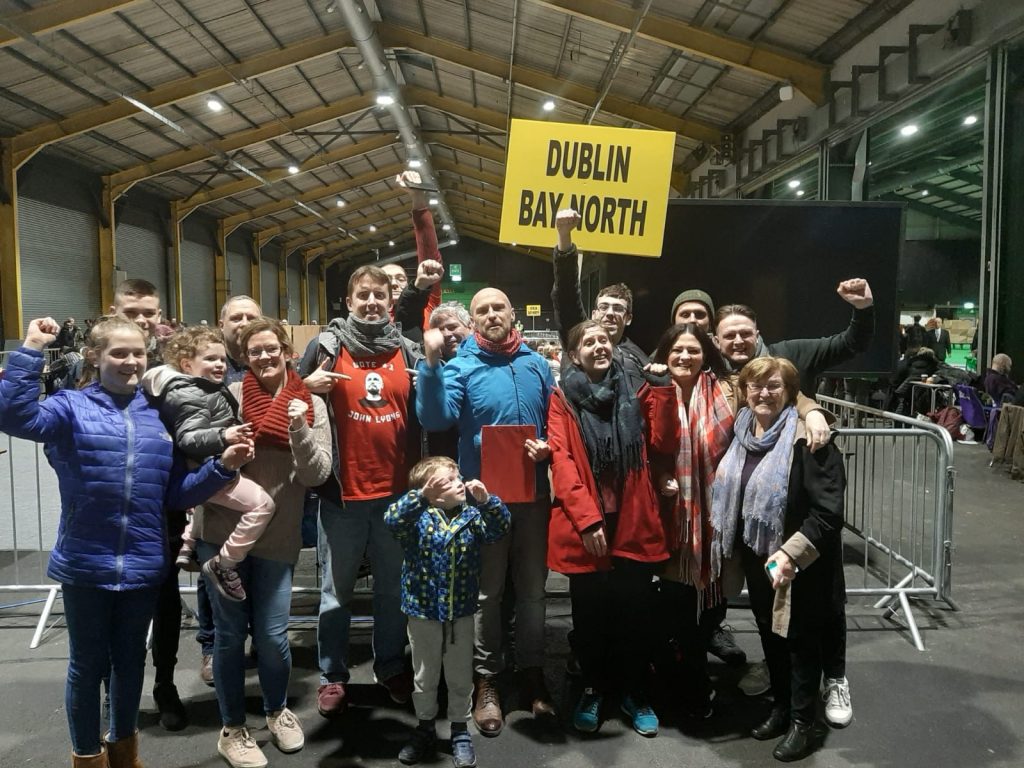
Inside the RDS stand a group of Independent Left supporters, smiling, fists raised, many of them wearing red 'Vote No.1 John Lyons' T-shirts. In the centre, in a blue coat, is John Lyons. On his left is Niamh McDonald. Behind them is a yellow placard from the RDS count centre saying: Dublin Bay North.
Independent Left had a vibrant and energetic campaign in Election 2020, Dublin Bay North

Fine Gael called this election and rubbed their hands with excitement. Full employment, Leo Varadkar looking great in dealings with Boris Johnson over Brexit, property incomes soaring. What could possibly go wrong?

Pretty much everything that can go wrong when you live in a champagne bubble and have no insight into the struggle of those on medium and low incomes. You speak with complacency and in ignorance, you are contemptuous of the electorate and you think, ‘a future to look forward to’ is a clever slogan.

Ireland has 78,000 millionaires in 2020 and they certainly have a future to look forward to. For the rest of us, unless something changes, we can only see more pain over the fact our incomes are eaten up by mortgages and rents; more difficulty accessing health services our families need, with longer waiting times; and more deprivation and anti-social activity in our neglected communities.

There was a roar of anger released in this election and it was channelled behind Sinn Féin. Sinn Féin are a working class party in the sense that their activists are generally drawn from the working class and they know the challenges working people face. So their policies and their articulation of that roar led them to becoming the lightning rod for our fury at Fine Gael and also at Fianna Fáil. We hadn’t forgotten who landed us with massive tax burdens by bailing out their banker friends and who backed Fine Gael with ‘confidence and supply’.

Understanding the rise of the Sinn Féin vote

Our class found a way to lash out at Fine Gael and Fianna Fáil and it was through Sinn Féin, whose spokespeople did a great job of expressing how we felt and offering well-informed refutations of right wing lies (remember how Leo Varadakar said during a TV debate that the rent freeze in Berlin hadn’t worked? It has been agreed but hasn’t come in yet). Even though the large newspapers and television stations did all they could to hammer down the Sinn Féin vote in the last days of the campaign, the electorate in working class areas wasn’t budging.

Some of the tallies as the boxes opened were incredible. Eighty, ninety percent Sinn Féin and just handfuls of votes for the right wing parties.

The transformation of the Irish political landscape in election 2020 is exciting for those of us on the left and humiliating for Fine Gael and Fianna Fáil.

In Dublin Bay North, as elsewhere, at first it seemed as though the socialist voice of the working class was going to also be swept away by the growth of the Sinn Féin vote. The Green vote too, might have been a challenge for socialists (although it was more of a challenge for Labour and other middle-ground and middle class parties). But as the counts went on, the transfers from Sinn Féin were strongly to the left, much more so than had been anticipated, although there were some losses to the presence of radical socialists in the Dáil and as activists with the advantages that being a TD brings to helping organise campaigns. We were sorry to see Ruth Coppinger and Séamus Healy lose their seats but delighted that after a difficult looking start, on the whole, the socialist left held their ground. In fact, we should have gained a seat in Dublin Bay North and at the expense of Seán Haughey of Fianna Fáil, who before the election had been a twenty-to-one favourite.

A list of candidates from Dublin Bay North and the details of all fourteen counts of Election 2020. The top candidates, in order of their first preference vote, were Denise Mitchell, Sinn Féin (21,344); Richard Bruton, Fine Gael (11,156); Cian O'Callaghan, Social Democrats (6,229); Aodhán Ó Riodáin, Labour (8,127); Seán Haughey, Fianna Fáil (6,651); David Healy, Green Party (5,042); John Lyons, Independent Left (1,882).
Fianna Fáil failed to get a quota in Dublin Bay North and Haughey staggered over the line only by being deemed elected on the elimination of the Green Party

It must have come as an unpleasant shock for Fianna Fáil that far from winning a second seat, Seán Haughey was down at 6,651 first preferences and ultimately, even after 13 rounds of transfers, couldn’t get a quota. Our own first preference vote was a disappointment, at only 1,882 for our candidate Councillor John Lyons. This seemed to be at odds with the very strong energy for change we’d been encountering on the doorsteps but the transfers of poll-topping Denise Mitchell for Sinn Féin clarified what had happened. There was indeed a massive vote against the establishment and for the left but it had first found a channel in Sinn Féin.

A photo taken of the large screen at the RDS on the day of the count, 10 February 2020, for Dublin Bay North and the transfer of Sinn Féin Denis Mitchell's surplus. Highlighted in red boxes are three candidates John Lyons, Independent Left, who gained 1,823 votes, Bernard Mulvany, SPBP, who gained 1,960 votes and Michael O'Brien, SPBP who gained 1,193 votes. Between them the socialist left could have won a seat on these figures had they not split the vote.

The split left vote saved Haughey’s seat

Elsewhere, the huge Sinn Féin transfers were bringing in candidates of the left and that should have been the case in Dublin Bay North too. Except that that the nearly 5,000 transfers for socialists got split three ways. Instead of one candidate reaching around 9,000 votes and pushing Haughey into sixth place by the end of the election, the Fianna Fáil candidate got lucky. Inevitably, transfers get diluted: even between members of the same party, 50 – 60% is typical. So around half of the votes expressing a desire by working class communities to vote Sinn Féin then vote left were thrown away and in the end, John Lyons, the best placed of the socialists, went out on the thirteenth count with 6,421.

In advance of the next general election, there needs to be a good-faith conversation among the potential left candidates about local government and Dáil seats, in the hope of avoiding this situation arising again.

Positive outcomes for Independent Left from GE2020

Despite the fact that John Lyons did not win Independent Left’s first ever Dáil seat, there are a lot of positives from the election for our small party. With no national presence, financial support, media presence or infrastructure we ran a fantastic campaign which in other circumstances would have brought about a shock for the right and a terrific victory. It helped that our election material was absolutely in tune with our audience. Our theme was ‘a tale of two cities’ and we both listened to and helped articulate the feeling that while the very rich and the landlords were getting richer, the rest of us were being left behind.

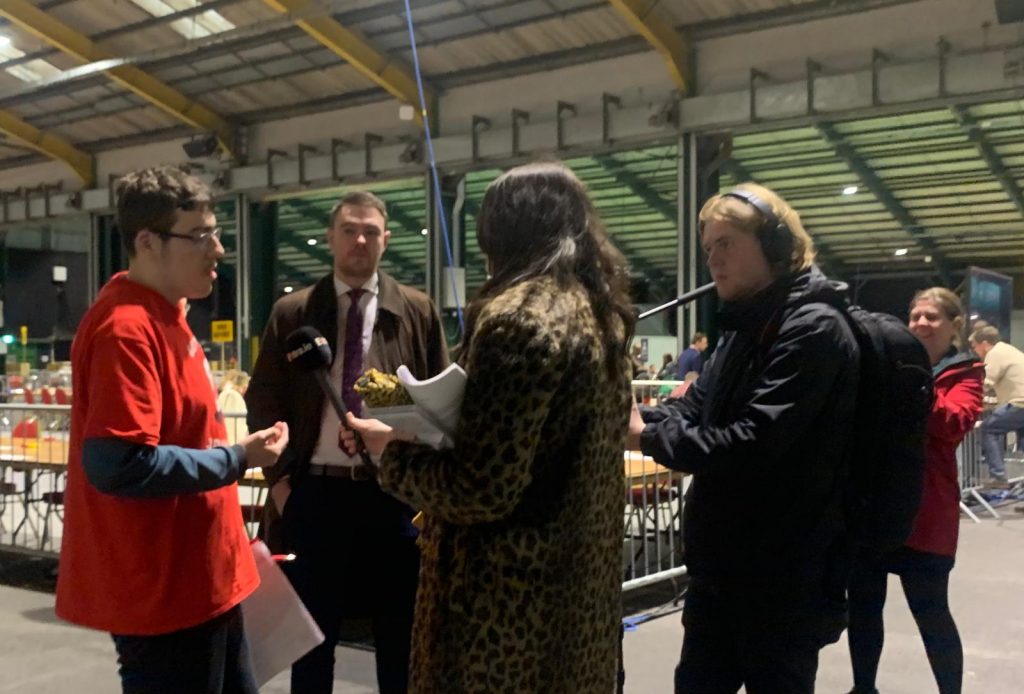
Eóghan Richard Ó'nia  in a red, 'Vote No 1 John Lyons' t-shirt is on the left, one hand raised, explaining to a journalist while another journalist watches and a third films with a camera, that the two party political system in Ireland is over.
Eóghan Richard Ó’nia of Independent Left, explaining to the media why the two-party system is gone for good

We got energy too, from the Childcare Strike and the Teachers’ Strike, which we connected to in Dublin Bay North with a lively contingent on the childcare march and support for the picket lines at the schools around the constituency.

Another big positive for us was meeting new people who have joined Independent Left and have added to our mix of socialists, environmentalists, trade unionists, parents, students, young and old. We are still a project that is evolving but it was really interesting to see how the joint effort of the election brought out a variety of skills and expertise among us and also bonded us in the common effort. Modern socialist parties can be a lot more freeform, dynamic, lively and conversational than the traditional model of a small, centralised handful of people with years of expertise directing everyone else. Facebook groups, WhatsApp groups, etc. allow for everyone to have an opinion and – in our case – a lot of laughs too. If you have been supporting Independent Left in this campaign, you’d be welcome to join us.

What will happen next in Irish politics after GE2020?


Nationally, a discussion is taking place about government formation and it seems that Sinn Féin are positioning themselves to enter government with Fianna Fáil and a smaller party or two. Probably, there is a huge debate within Sinn Féin about this and we hope that the anti-Fianna Fáil voices win. Why? Because Fianna Fáil might well offer a border poll. they might even allow Sinn Féin to introduce a rent freeze, which of course would be very welcome. But the price for these would be too high, because the wealth of the very rich and especially corporations would be untouchable, because it would be business as usual in every other regard. Worse, it would disillusion those people who made the effort to vote for change. While Independent Left have been offering hope, diversity and solidarity within working class communities and trying to direct the alienation people feel against the real causes of this, the system we live under, there was a far right presence in this election who offered despair, division and a violent, racist and homophobic turning inwards of our communities. They will try to capitalise on the sense of betrayal if Sinn Féin backed a Fianna Fáil government.

But isn’t the alternative a Fianna Fáil and Fine Gael government? Wouldn’t that be worse? Actually no, it wouldn’t. Because the ability of any government to impose policies that harm working class communities is set by the willingness of people to stand up and organise and resist the government. We defeated the water charges and with a popular Sinn Féin party in opposition, we can not only throw back anything the government brings at us, workers can push now for pay equality, pay increases, while working class communities can challenge for more resources. This is a much better scenario and one that has a very strong prospect of leading to a left of centre government next time around, than one where for the sake of a few policy gains the excitement currently alive in working class communities subsides into apathy and disillusionment.

Regardless of how the political consequences of election 2020 develop nationally, Independent Left have emerged from the election as a stronger force in Dublin Bay North and we look forward to playing our part in the campaigns to come.

Message from John Lyons to his supporters after the count for Dublin Bay North on Sunday 11 February 2020.

Filed Under: All Posts, Irish Political Parties

‘After Repeal’: analysis and discussion of the ‘Repeal the 8th’ campaign

31/01/2020 by Conor Kostick 2 Comments

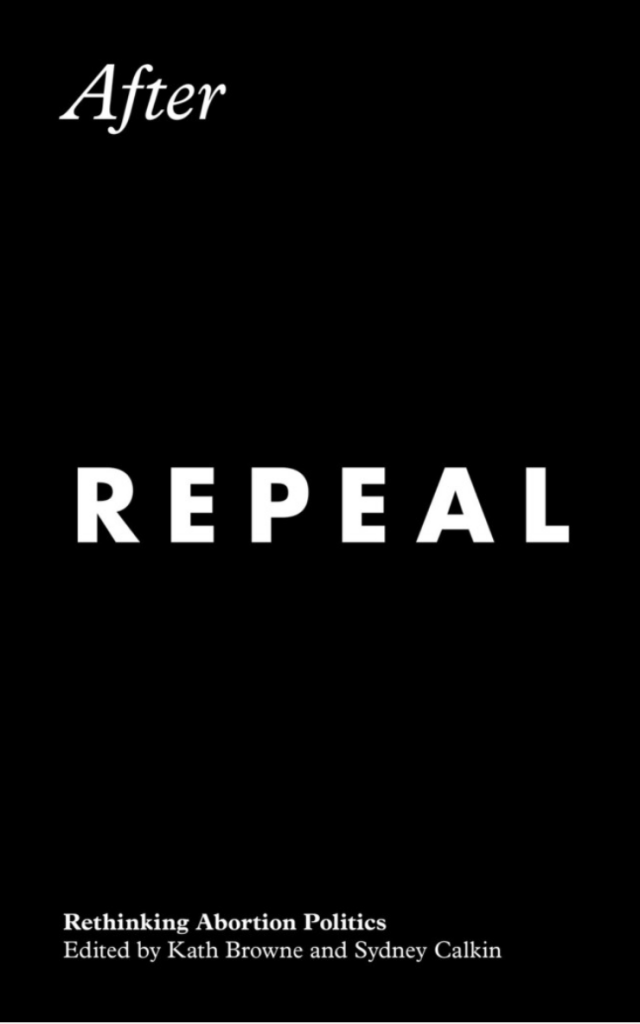
After Repeal: rethinking abortion politics. Edited by Kath Browne and Syndey Calkin.
On 31 January 2020 an important new book discussing a wide range of topics around the repeal of the Eighth Amendment was launched in Dublin: After Repeal edited by Kath Browne and Sydney Calkin

The Repeal of the 8th amendment on 25 May 2018 was a seminal moment in Irish history and an amazing moment, one that starkly illuminated the fact that we are no longer a country dominated by the Catholic Church. The dazzling victory felt even stronger than that of the same-sex marriage referendum. It was a hard-fought result, one that couldn’t have been achieved without mass participation in the repeal movement. Everywhere, but especially in urban and working class areas, the issue of abortion was discussed and women shared their experiences.

This was one of the crucial differences compared to previous efforts to liberalise Ireland’s severe abortion laws. The atmosphere of shame and silence that prevented the reality of the need for safe and legal abortions from being expressed was shattered by women having the confidence to speak out in a fashion that was unprecedented for Ireland. With sincerity and conviction, canvassers swayed those who held reservations into voting for repeal. As one of the canvassers in Dublin Bay North put it:

Personal stories and individual experiences that weren’t readily available on television or even on the web were key to the success of the campaign.

Editors Kath Browne and Sydney Calkin invited a range of contributors to write for an anthology that analyses the campaign and also the implications of the result for Irish society and, indeed, the international struggle for reproductive justice.

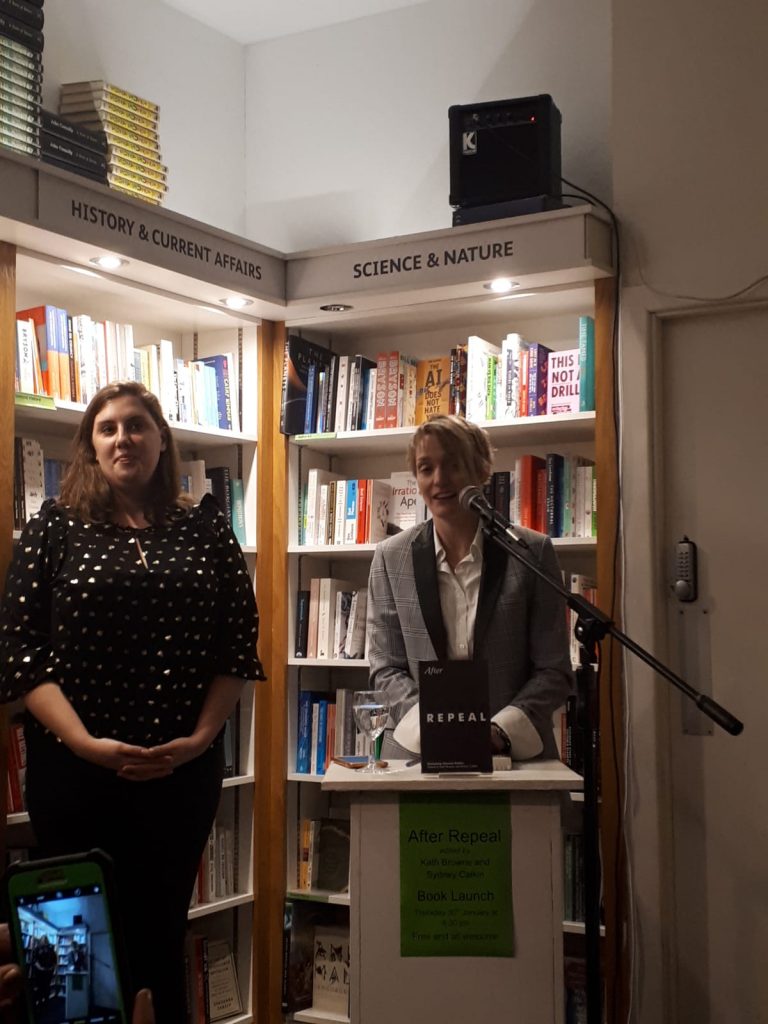
Sydney Calkin (L) and Kath Browne (R) at the launch on 31 January 2020 of their edited book, After Repeal. Kath Browne is at the podium, microphone in front of her. Behind them both are shelves of books.
Sydney Calkin (L) and Kath Browne (R) at the launch on 31 January 2020 of their edited book, After Repeal.

Different perspectives on the politics of Repeal are offered by Theresa Reidy, Linda Connolly, Fiona de Londras, Máiréad Enright, Sydney Calkin, Elżbieta Drążkiewicz-Grodzicka and Máire Ní Mhórdha. For analysis of the campaign itself, the book draws on Mary McGill’s reflections of events in rural Ireland and the Repeal story within the Irish language community is covered by a chapter from Lisa Nic an Bhreithimh. Lorna O’Hara discusses the power of the iconic ‘Repeal the 8th’ mural, while Eric Olund’s research is in regard to the press. The aftermath of Repeal and its potential consequences both here and internationally are discussed by Richard Scriven, Kath Browne, Catherine Jean Nash, Noëlle Cotter, Lisa Smyth and Dorota Szelewa.

Dublin Bay North during the Repeal the 8th campaign

There is something of an academic flavour to the book, but the editors are to be commended on their inclusivity and in particular the publication of ‘Campaigning for choice: canvassing as feminist pedagogy in Dublin Bay North’, a chapter by Niamh McDonald, Kate Antosik-Parsons, Karen E. Till, Jack Callan and Gerry Kearns. The framing of the chapter suggests that its value is in providing a case study of successful feminist pedagogy, but really, there is wealth of more general lessons that can be learned from the experience of Dublin Bay North Repeal group, ones that are important for wider campaigns and, indeed, our own socialist project. It helps that Independent Left’s own Niamh McDonald is a contributor to the chapter. Niamh was Chair of the Dublin Bay North Repeal the 8th Campaign and with her voice, along with others, we hear from working class women who shaped the outcome of the referendum.

Niamh McDonald, Independent Left and Chair of Dublin Bay North Repeal the 8th Group at the launch of After Repeal. She is standing at a podium, microphone in front of her. In the background are shelves full of books. She is holding up 'After Repeal' in one hand, the bottom of the book resting on the podium.
Niamh McDonald, Independent Left and Chair of Dublin Bay North Repeal the 8th Group at the launch of After Repeal

One of the challenges facing the group was in how to maximise the energy of the many people new to political activism with the experience of those who had years of experience in trying to bring about reproductive rights for women. They solved this with a number of strategies: there was a ‘buddy’ system, to team up those new and less confident about knocking on the doors of strangers with those who were familiar with such activity; they avoided a potentially patronising and top-down stultifying effect by placing an emphasis on the empowering of the new voices; the internal social media conversations were egalitarian and encouraging (i.e. were not heavily controlled by moderators); decision-making was transparent and democratic; activists with a political background were welcomed but no one party was given a pre-eminent role, finally, respect was reciprocal. Newer activists might say,

My buddy had been knocking on doors for months, and gave me great advice, and boosted my confidence. It also made me feel safe.’

While the more experienced activist could recognise that the enthusiasm of the new activist was encouraging and helped lift her, ‘on bad days.’

All in all, the campaign provides a model, not just for feminist pedagogy but a methodology for creating an inclusive grass-roots campaign. The success of this approach, the fact that Dublin Bay North Repeal retained members and grew to the point that 80 – 100 canvassers were assembling and knocking on doors every day, was decisive in bringing about one of the largest votes for Repeal in Ireland. Overly hierarchical organisations inevitably stifle people who want to express themselves but are not used to doing so. To win the argument around Repeal it was absolutely critical, however, that women of our community, of the working class, got to speak and got to be heard. As one canvasser summarised the situation: ‘our arguments were based on compassion and real life experience’. Real life experience was heard by canvassers, was brought into the campaign and shared, and working class women as canvassers themselves reflected the reality of the necessity of abortion rights.

Dublin Bay North Repeal activists were self-aware enough of the importance of their achievement that they consciously strove to preserve the lessons of the campaign by issuing a survey to members in the aftermath of the vote and with 125 responses, obtained essential feedback from which the lessons of the campaign could be drawn. Very much to the credit of the editors, these lessons have been included in After Repeal.

Some twenty-percent of the Dublin Bay North campaign members were male and among them and one of the founders of the group was Councillor John Lyons. The launch of the book during the election campaign is very timely, firstly because, as John Lyons put it in answer to a question on Twitter to all candidates from the @DBNRepeal account, there is still a lot to achieve:

An exchange of Tweets showing John Lyons giving his full support to the ongoing struggle for reproductive rights for women in Ireland in response to a question to all candidates in Dublin Bay North by DBN Repealers
John Lyons giving his full support to the ongoing struggle for reproductive rights for women in Ireland in response to a question to all candidates in Dublin Bay North by DBN Repealers

It took a huge effort to get the referendum and win it, but we aren’t done. We have a legislative review this year, people still travelling, maternity hospital ownership, we need exclusion zones, a countrywide service with no barriers to access. I want to see all goals achieved.

Secondly, it has emerged that the Green candidate, David Healy, is pro-life, voted against Repeal, and endorsed pro-life social media posts. It took some effort for this information to become public and it would be tragic if Dublin Bay North returned a majority of anti-choice TDs after such an inspiring campaign. Yes, climate change is a very urgent issue, but as Not Here Not Anywhere have shown, the left in the Dáil have just as good a record as the Greens on environmental issues and its therefore possible to express support for radical action on climate and the continuation of the struggle for reproductive rights in the general election.

A bar chart labelled Climate Score shows Fine Gael (2%), Labour (32%), Aontú (50%), Fianna Fáil (60), Sinn Féin (69) and the Green Party, Social Democrats, Solidarity-People Before Profit and Independents 4 Change all on 100%. Compiled by www.notherenotanywhere.com these percentages are of votes for action on climate change.
Analysis of Dáil voting records on climate issues by Not Here Not Anywhere shows the parties left of Labour have just as good a record as the Green Party

Kate Antosik-Parsons, contributor to the Dublin Bay North chapter in After Repeal expresses why she is voting for Councillor John Lyons in the general election of 2020.

Filed Under: All Posts, Reviews

Powerful teachers’ strike on 4 February 2020

30/01/2020 by Conor Kostick 1 Comment

A blackboard with thick white letters saying: STRIKE!
Teachers will be on strike 5 February 2020.
On 5 February 2020, 19,000 TUI members will strike and close over 400 second-level schools

On 4 February 2020, hundreds of second-level schools closed as a result of a strike by 19,000 teachers, members of the Teachers’ Union of Ireland (TUI). These teachers voted by a massive 92% to 8% to engage in a campaign of industrial action. The issue driving teachers to strike is a simple one: people doing exactly the same job should get the same pay. Yet this principle is violated throughout the public sector as a result of savage cuts imposed by the Fine Gael / Labour government that formed on 25 February 2011.

A two-tier pay system was put in place that punishes those who took up jobs from 1 January 2011 onwards, as a 10% reduction in basic pay was imposed on new teachers and all new entrants were obliged to start on the bottom point of the pay scale regardless of previous teaching experience. Additional cuts to certain allowances meant new teachers lost up to 15% of their pay. The pay gap in starting salaries between post-2011 teachers and those employed before 2011 is over €4,000 a year even when not taking into account the fact that before 2011 teachers started on the third point of their scale.

Councillor John Lyons talking to TUI pickets outside of Coláiste Dhúlaigh during the strike of 4 February 2020. John Lyons is on the left of the picture. Five teachers in thick coats and wearing wooly hats are holding placards: End Pay Discrimination Now, TUI Official Strike, Equal Pay for Equal work.
Councillor John Lyons talking to TUI pickets outside of Coláiste Dhúlaigh during the strike of 4 February 2020

Unity among teacher unions is the way to win pay-parity

There are three teaching unions in Ireland, the TUI, the ASTI (Association of Secondary Teachers in Ireland) and the INTO (Irish National Teachers’ Organisation), while the latter focus on primary education, they too have been trying to achieve pay parity, by taking a court case to the European Court of Justice, claiming discrimination on the grounds of age. This case was lost so now the hope of INTO members will be that their colleagues in second-level schools win their strike and therefore pave the way for all teachers to win back equal pay. The INTO should also now ballot for strike action on the issue.

For the ASTI, the situation is similar, in that these teachers too consider the issue of ending the two-tier pay system an urgent one, the union describing it as a ‘shocking stain’. Unfortunately for teachers as a whole, the ASTI and the TUI have, up to now, not stood together in tackling the issue.  The ASTI went into battle on the issue in 2016 and were knocked back, having to retreat with only small gains and having incurred punitive costs. The government imposed penalties on ASTI members for having ‘repudiated’ the public service agreement and these penalties amount to some €15million in lost increments and other benefits.

Naturally, ASTI members have a great deal of bitterness about this situation but Independent Left urge them to direct that bitterness at the government not their colleagues. Now is the perfect time to push forward on this issue. This is not so much because of the election – although there is no harm at all getting candidates to commit to restoring pay parity – but more because right throughout the public sector there is a growing mood for action on this issue. The nurses who struck in February 2019 made some gains and, perhaps more importantly, the government was sufficiently worried that they didn’t try to repeat the punishment of imposing penalties. They know public sector workers are much closer to a major revolt across the board than they were in 2016. Since the ASTI took the lead on the issue, three years of rising rents, medical costs, child care costs and a general increase in stressful living has changed the mood of other workers.

ASTI members should be proud of being the first into this battle and welcome the fact that reinforcements are now joining the cause. Ideally, all three teacher unions should co-ordinate strike action on this issue for the same day. At a minimum, teachers have to respect one another’s picket lines.

The ASTI, TUI and INTO leadership cannot officially call for members not to cross picket lines as it is illegal to do so (highlighting the importance of the demand by Councillor John Lyons, who is standing in Dublin Bay North for General Election 2020, that the 1990 Industrial Relations Act be abolished). Independent Left have no such constraint and as we take inspiration from the lives of James Connolly and Jim Larkin, we appreciate how essential is solidarity and respect for picket lines to winning strikes. Moreover, the ASTI have said:

the union will support any member who does not pass a picket should disciplinary action be threatened or taken against them.

They have also asked members not to undertake any duties performed by TUI members and this alone should be sufficient on health and safety grounds to cause many schools to close, even where the numbers of TUI strikers are small.

Independent Left support the TUI strike on 4 February 2020

Probably, over 400 schools will be closed by the strike of 4 February 2020, including the 260 Education and Training Boards’ schools. This strike is a powerful way to bring the campaign for pay parity forward and regardless of who forms the next government, the new cabinet will inherit real pressure to make concessions.

Councillor John Lyons joining the pickets at Coláiste Dhúlaigh during the strike of 4 February 2020. John Lyons is on the left, a male teacher is talking to him on the right, holding a green placard with white writing: end pay discrimination now. Behind him a female teacher is mid stride with a red placard and white writing: TUI OFFICIAL STRIKE.
Councillor John Lyons joining the pickets at Coláiste Dhúlaigh during the strike of 4 February 2020

From the point of view of parents, having to come up with a contingency arrangement for our children is a challenge. But it is very much in our interests to support the teachers. For one, the low pay in the sector is leaving schools short-staffed. Over ninety percent of secondary schools report difficulty filling posts. More generally, education is in desperate need of an injection of funding. And, of course, the demand of the teachers is an entirely fair one.

This is why Independent Left members went to the picket lines on 4 February to show our support for the striking teachers and we encourage parents and the public to do the same.

Strikes, especially general strikes, are the most effect form of protest we have.

TUI members at Donahies Community School talking to Councillor John Lyons on the day of their strike for equality in pay, 4 February 2020. Three women teachers and one man in thick jackets are stood in a circle around Councillor John Lyons who is gesturing. Behind them is a wall with a railing on which is a banner for day and evening classes at Donahies Community School.
TUI members at Donahies Community School talking to Councillor John Lyons on the day of their strike for equality in pay, 4 February 2020.
A railing with a banner: Enrolling Now! Day and Evening Classes. Adult Education at Donahies Community School. Below the banner are three TUI placards placed by teachers striking on 4 February 2020.
Independent Left support the teachers in their campaign to overcome the discrimination in pay towards those recruited after 2011.
John Lyons, Independent Left candidate for Dublin Bay North is pictured on the right of a frame that is mostly text. Workers' Rights. Abolish the 1990 Industrial Relations Act and replace it with a Fair Employment Act that guarantees: the rights of union access to all workers; the right to union recognition; full collective bargaining rights. A four day work week to reduce stress and improve quality of life. Solidarity with the French workers campaigning to retain their retirement age at 62. No increase to the pension age in Ireland, with the goal of bringing it down to 62 also.
Councillor John Lyons supports the repeal of the 1990 Industrial Relations Act, which hampers workers attempting to organise strikes.
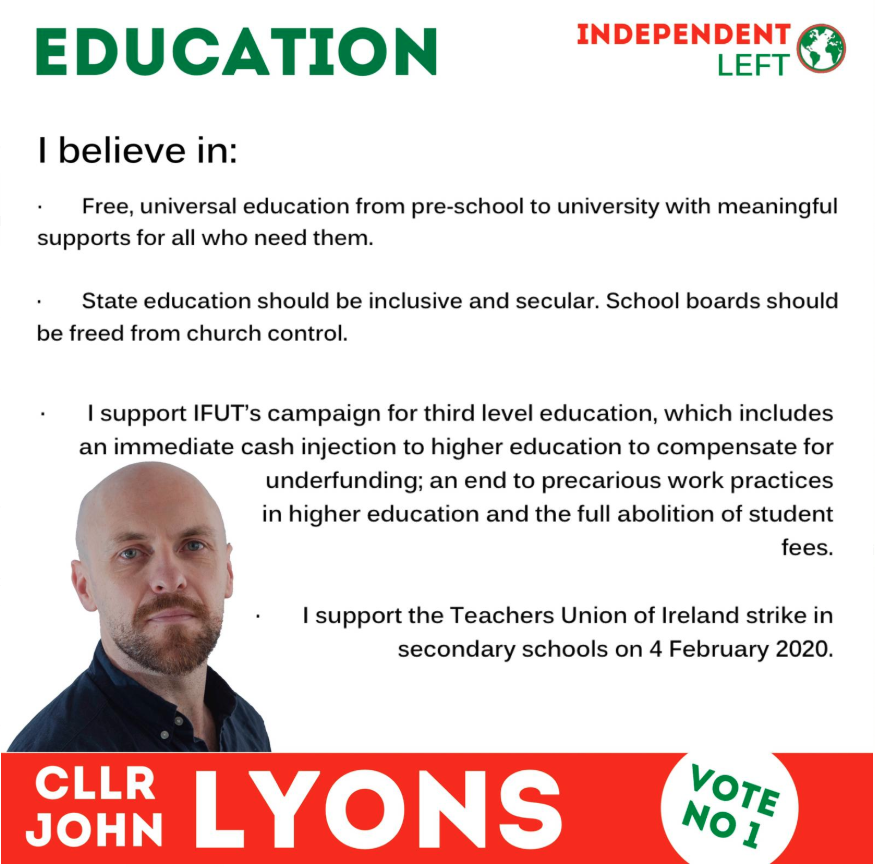
John Lyons, Independent Left candidate for Dublin Bay North is pictured on the right of a frame that is mostly text that has several demands concerning education and concludes: I support the Teachers Union of Ireland strike in secondary schools on 4 February 2020.
Councillor John Lyons, Independent Left candidate for Dublin Bay North in GE 2020 supports the TUI strike of 4 February 2020.

Our education system discriminates against working class communities

Supporting teachers in the struggle to win parity of pay and, indirectly, to improve recruitment and retention rates is just one facet of a radical overhaul of the education system that is needed. As John Lyons highlighted in his election 2020 campaign as candidate in Dublin Bay North, we still have far too many schools under church control. My son goes to one where the principal circulates material against same-sex relationships, material which sees diversity as a plot by the UN to reduce population growth! John Lyons also is drawing attention to the need for meaningful supports to be put in place to allow all children equality of access. Although the government boasts of increase employment for SNAs, the fact that SNA hours have been reduced and the number of children requiring support has increased means the overall service is a long way behind that of 2013, when the Fine Gael – Labour government slashed SNA hours. The recent changes to the resource allocation model of NCSE is a particular disaster for visually impaired children.

Just looking at the school buildings in different parts of the city and your intuition will tell you something is wrong in Irish education. If you stroll past Wesley fee-paying school, for example, you’ll see two resurfaced hockey pitches, two cricket pitches, another for soccer. No less than four for rugby and if you got a glimpse inside you’d see two basketball courts a major hall and a gym. In 2018, Wesley obtained €150,000 from Shane Ross from the Sports Capital Programme to for those resurfaced hockey pitch. And for our kids on Dublin’s north side? Typically they play soccer on tarmac or, as in my son’s school, in a car park.

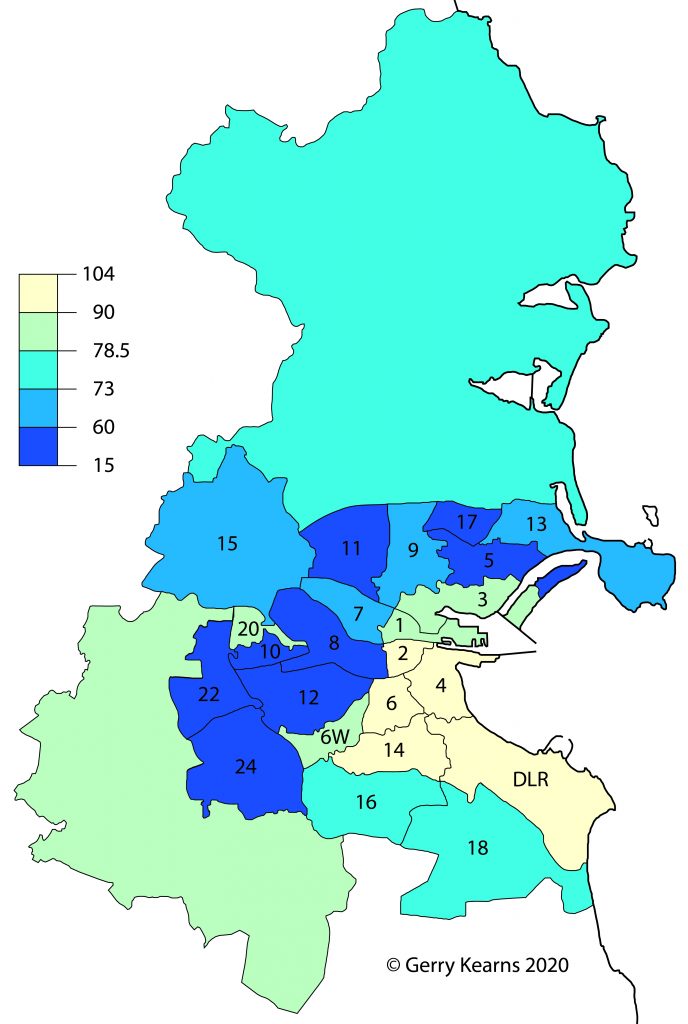
Research by Gerry Kearns, Professor of Human Geography, Maynooth University allows us to visualise the bias in education in Dublin. As he puts it:

There is a wedge of privilege extending southwards from the city centre. If we map the proportion of people going from school to college, the districts with the schools most likely to send students to college form a coherent band on the southside (Dublin postal districts 2, 4, 6, 6W and 14, and the local authority of Dún Laoghaire-Rathdown).

A map of Dublin and adjacent counties, with the postal boundaries drawn. D24, 22, 12, 10, 8, 11, 17 and 5 are dark blue, signalling the lowest rates of progress from second to third level education. D15, 7, 9 and 13 are light blue, indicating still very poor rates. D1, 3 and 6W are light green, above average and D2, 6, 4, 14 and DLR are yellow, showing very high progression rates. Copyright Gerry Kearns.
From school to university based on Irish Times feeder data (showing approximately the proportion of the student body going on to third level) Please respect the image copyright. It will be published in due course in chapter by Gerry Kearns, on Dublin as a city arranged by class.

This discrimination can be overcome, but not without a challenge to decades of neglect for our schools from Fine Gael and Fianna Fail and their coalition partners.

Filed Under: All Posts, Protests Ireland

Childcare Strike 2020 Dublin Wednesday 5 February Was a Huge Success

26/01/2020 by admin Leave a Comment

Independent Left support the planned childcare providers strike on Wednesday 5 February in Dublin. Here a female creche worker sits a table with three young children who have beakers in front of them and are looking at wooden toys on their hands. Foreground right  is a colourful blurry toy.
Independent Left joined the protest of childcare providers in Dublin on Wednesday 5 February 2020.

On Wednesday 5 February thousands of childcare workers went on strike to march in Dublin in protest at the crisis in childcare. Independent Left members fully supported this action. Yes, it was a challenge to arrange alternative childcare for the day but action was urgently needed and the march was a necessity. Not only did the protest show how powerful and united is the sector, but it was met with a hugely positive public response as we all know how the sector needs radical changes.

The state needs to follow the example from the rest of Europe and subsidise childcare, treating it as an essential service, not a for-profit sector.

The march was organised by the Early Years Alliance an organisation facilitated by SIPTU and consisting of workers, providers, unions and parents.

Little Learners Checklist at the Childcare demonstration 5 February 2020. A woman with a Little Learners flag hold a 'checklist' placard with a cross by all the issues of her concern.
Little Learners Checklist at the Childcare demonstration.

I spoke to a childcare worker who participated in the action and shared our childcare policy with her. Her description of her daily life provides a powerful illustration of why this strike was necessary.

My husband starts work at 7.30 a.m. so it’s my job to get the kids up and to school. I have two boys, eight years and three years. I drop my eight-year-old off at the school gates at 8.30 to hang around until 8.50: no other way to get him to school and me to work. I got stuck in traffic on the M50 on my way to work as a childworker. I’m very lucky that my three-year-old attends the same creche as me, so only one drop-off for me.

Today, I got to work with five minutes to spare; I’m usually fifteen minutes early, I have to be. Planning needs to be done, the classroom needs to be set up, etc. I bring my son to his classroom where two staff are already setting up the room, completing planning sheets and general organising of the room for the children’s arrival at 9 a.m. Their shift doesn’t start until 9, we only get paid from 9, yet they’ve been here at least twenty minutes setting up. They are very kind to take my son five minutes early so I can get to my classroom and begin my set up.

As the day goes on, we have a first aid incident. We have a child protection concern. I am organising a Together Old and Young visit to a local nursing home. I speak with a parent who is concerned about her child’s development, all within the first hour-and-a-half. We are told we are short staffed today and full time staff need to take a shorter lunch to accommodate. This is not a bad day, just a regular one in this line of work. I also have to discuss the upcoming protest with parents.

Overall, they are very sympathetic to our cause and those who are able to will arrange other means of childcare for Wednesday 5 February to alleviate some staff to attend the protest.

My shift finishes at 1 p.m. and I go to collect my son. But as usual I don’t leave my room on time because someone always needs something: a hug goodbye, a form signed, a conflict between children that needs resolution or even a staff member who needs to go and use the toilet!

I collect my son and he is full of smiles and chats about what he has done that day. He says a fond goodbye to his teachers as if they were his friends!

All of this is so important in our society and I am sick and tired of feeling the way I do in this sector. Yes, I love my job but hugs and smiles and a child’s positive progress doesn’t pay the bills… never even mind the cost of childcare.

Upon reading your article, admittedly, I had a chip on my shoulder, ready to read about ‘tax breaks’ and ‘extended ecce’. I was nicely surprised. It’s nice to see childcare workers being mentioned more than once and in a positive manner.

Zappone says I should join a union if I have a grievance… my problems are not with the management team of the creche, it’s with the state and the ridiculously high expectations they are putting on me and my colleagues.

Sixteen years I’m working in this sector and I’m losing faith.

Everything that is in the link you sent me is true. The whole sector needs an overhaul, childcare should never be for profit! In all the different positions I’ve had, the worst practice I’ve seen has been in private centres and it is not through the fault of the staff.

Change needs to happen it MUST be done in collaboration with the people who are actually on the ground working directly with the children. All these new schemes sound amazing, but when they are put into practice it just pushes us further and further to breaking point.

Thank you for giving me a bit of hope for the future of my profession.

Valuing Us is Valuing Children: placard on the childcare demonstration
 It's time for change: huge turnout for the childcare protest
It’s time for change: huge turnout for the childcare protest
Thousands marched for the childcare sector on 5 February 2020
Thousands marched for the childcare sector
John Lyons of Independent Left stands on the right of a group of childcare workers and parents at the demonstration of 5 February 2020. The demonstrators display a lot of red clothing and have placards around their necks proclaiming: loving my job won't pay my bills! We are professionals, treat us professionally.
John Lyons with childcare protesters 5 February 2020

Councillor John Lyons expressed his full support for the strike.

Parents shouldn’t be paying such high costs for childcare and staff should be given increased pay and a proper career path with full training. This campaign can win and the protest on 5 February is the right way to go about forcing the new government, whoever is in power, to listen and to respond.

A picture of Councillor John Lyons, standing beside text in bullet points:
I support the planned strike by childcare organisations on 5 February 2020. The EECE needs to begin at two years of age and double the hours to 30 per week available twelve months of the year. An increase for each child's capitation grant for accessing creches. A massive increase in investment: a minimum 1 per cent of our overall GDP is needed to create a fully functioning national childcare system. An increase in financial supports to long parents and migrant parents whom are most vulnerable to poverty and isolation. Government needs to create public creche facilities in local communities.
In general election 2020 Councillor John Lyons, standing for Independent Left in Dublin Bay North pledged his support for the Childcare Strike of 5 February and raised several demands on behalf of the sector.
Councillor John Lyons supporting the huge childcare sector march of 5 February 2020

Interview with a community childcare worker ahead of the strike of 5 February 2020

In advance of the strike by childcare workers, I spoke to ‘Anne-Marie’ who works in a community childcare centre.

NMcD: Why are you going on the protest?

A-M: I’m going on the protest to support the early years professionals in the community and private sectors who for years have been under huge pressure, who are not treated as professionals, who are expected to hold the rest of the country by looking after and educating the children; for children with additional needs; for afterschool clubs; for everybody.

For all these years we’ve got very little extra funding, we’ve got more people coming an assessing us and making sure we are doing our jobs. We have, I think, eight different government bodies that come in at the drop of a hat to see what we’re doing and to make sure we are doing everything right. And that’s fine, we’re all about good governance and transparency but it’s just constant.

Then there is new childcare funding, which came out in November, is making it even more difficult for parents and for services to be sustainable. Every couple of years funding gets changed and we never know from one year to the next year if we can be sustainable and continue to run the community service that we run. It’s not good.

We’re a community. So we are middle of the road paid, compared to the girls that are on ten Euro-something an hour but it’s below the Living Wage and it’s not good enough.

NMcD: It’s a community creche that you run here. We’re in an area of economic deprivation in north Dublin. Can you tell me the kind of service that you provide and support you give to families in the area and why it is important that we need to fund community creches?

A-M: This community service has been running for a long time in this area. Like all the other community services out there, particularly in areas with disadvantage, we have children with a lot of additional needs, not just official additional needs but because of their lifestyle and home circumstances. We’ve a lot of homeless children; children whose parents have experienced addiction; who are in recovery; young parents who have left school early. A lot of single mums. And that just puts extra pressure on the children, because of whatever’s going on at home. The children all come here and get a breakfast; they get a proper home-cooked meal. Not everybody is going home to a cooked meal with fresh fruit and vegetables every day. They are really cared for and looked after here. It is the home from home, well that’s what we want it to be. But it’s very difficult to provide that when your funding and constraints are there.

I think in an area like this it should be like a DEIS service, where we have additional staff to provide the care and support that the children need. We have a lot of parents that would come to the office looking for different supports, whether it’s things going on at home. It’s more than just drop your child and run out the door. We provide additional supports: we have a lot of children that are referred to social workers, public health nurses, Focus Ireland. We do support the whole family. We do refer children on to psychologists, speech therapists for additional supports. It’s constant it’s full on.

When you look at the funding over the last few years, for example, the ten years since they put up the ECCE scheme (that’s the three hour sessions per day for the pre-school groups), that’s for thirty-eight weeks per year. When that started ten years ago it was €64.50 per week per child, ten years later it is €69. So that’s an increase of four Euro fifty in ten years. That’s the equivalent of forty-five cent a year. Now we give the children breakfast, we give the children lunch, we have to pay the staff when they are on holiday because it is not covered by the funding, these staff possibly have to go and look for jobs in the summer or sign on in the summer, so that’s a lot of women – predominantly – who are signing on through the summer. We want permanent jobs, proper wages and we want support from the government to make that happen.

NMcD: In an ideal world, how would you like government support to run to make life easier?

A-M: At the moment the inspectors and regulation people that come out to see us are TUSLA, Pobal, Department of Education and Skills, Department of Health, the Revenue, Workplace relations, Building Control and Fire Control. So all these people can come at any point through the day when you are trying to support and look after children. Any of them can come in and look for a huge amount of paperwork. We need one government body to run us and support us and understand. There’s overlapping, so they are looking for that and then the next week someone else can come in the look for basically the same thing. We all want the same thing: we want children to reach their full potential.

Early intervention is the key. We have six children here with undiagnosed additional needs. We won’t get any AIM support staff to support these children until they are three. We have six children that are under two that, in our opinion, have additional needs. That puts extra pressure on staff in the room. Two members of staff with ten children in the room and there could be three or four children with additional needs. Nobody is recognising it. We all talk about early intervention but it’s not happening. If we had an extra member of staff in the room as the DEIS model, we could provide better care for the children.

NMcD: Would you say the waiting lists for children seeking early intervention affects your work as well?

A-M: Definitely. If we’ve got a child and the parent has maybe said, ‘I’m a bit worried about her speech’, it’s fourteen months on the waiting list, depending on when they go on it, then they have to go in for an assessment, then it could be another six months before they are seen and go through a stage of intervention. That child is nearly two years older at that stage. So if you saying it at two, two-and-a-half, that child is nearly at school before they are getting any intervention.

NMcD: And the formation of language is vital in the first three years?

A-M: The first three years is just massive for every area of the development of children. It gives them the bottom of the pyramid. It gives them the basic skills to build on over the years. People think that their child starts their education at school but they start during pregnancy and certainly during the first three years. That’s why it is essential. We have over a hundred children on our waiting list at the moment. We are a seventy children service. Most of those on the waiting list will never see the inside of this building because people stay for four or five years. We are one of the only services in this area that takes children under two. We take children from six months. That’s the early intervention that they need. We need extra staff in each room because the biggest cost to childcare is the staff, and even though they are paid way under what they should be paid, that’s the most important part of your money because ninety percent of your money goes on staff.

NMcD: A final question, how has the feedback been from the parents when they know you are closing on Wednesday for the protest?

A-M: A couple of them are disappointed because obviously they want continuous good quality care for their children. But most of them have been supportive because they understand, because they know us, know what we provide and how essential it is for their children’s development. Also for their own time, headspace and development. So some of the parents will be coming and marching with us. Which is great.

A notice from the wall of a childcare centre reads:
Reminder,
We will be closed all day on Wednesday 5th February for a staff meeting and to take part in the National Early Years Protest.
You are welcome to join us and the thousands of Early Years Professionals who are protesting due to the current childcare crisis in Ireland. We aim to provided professional, quality, affordable childcare in a sustainable, enriching learning environment. We need support from the government to do this!
Many parents supported the childcare strike of 5 February and came on the Dublin protest.

If the new government that forms after the election on 8 February does not respond to the sector, then another day of strikes and protests will be necessary.

Large strikes in Ireland as elsewhere are the most effective form of protest we have.

Filed Under: All Posts, Protests Ireland

  • « Go to Previous Page
  • Page 1
  • Interim pages omitted …
  • Page 13
  • Page 14
  • Page 15
  • Page 16
  • Page 17
  • Interim pages omitted …
  • Page 23
  • Go to Next Page »

Copyright © 2026 · Aspire Pro on Genesis Framework · WordPress · Log in