• Skip to primary navigation
  • Skip to main content
independent left logo

Independent Left

Environmentalism, socialism, freedom and equality. #liveablecity

  • About
  • Featured Articles
    • How Farming Must Change to Save the Planet
    • The Housing Crisis: Causes and Solutions
    • Socialism in Ireland
  • Contact Us
  • Podcast
  • Animal Rights
  • Archive
    • Irish Socialist History
    • Dublin City Council Housing
    • Ukraine
    • Protests Ireland
    • Reviews
    • Irish Political Parties
    • All Posts
    • Independent Left Policies
  • Why join?

Black Lives Matter: a view from the streets for Irish socialists

04/06/2020 by Conor Kostick 1 Comment

An interview with Paige Graffunder, Seattle 3 June 2020

“It’s going to escalate until the police are gone”: a massive revolt against murderous police racism rocks the USA.

Paige Graffunder is an activist in Seattle, involved with Revolution Books and Black Lives Matter Seattle.

For the benefit of socialists in Ireland, where many of us see events through official news channels, which never drill down enough, I’m hoping you can give our readers some insight into what’s happening on the ground. Maybe you could start by telling us who is actually organising the protests?

There’s a bunch of groups. Unfortunately, a lot of activism in the United States kinda exists in a ‘diaspora’, because as soon as you get too many people you immediately get labelled a terrorist organisation because we have a fascist in office. A lot of it has been Black Lives Matter, because Black Lives Matter is actually big enough in Seattle that they actually have an office. In general, it’s not really an organisation, it’s an ideal.

The primary motivation of Black Lives Matter is equality and equity for the black community: stop getting killed by a militarised police force; achieve more equal statistics for punishment on crime (63% of all violent crime in this country is committed by white people, yet 70% of the prison community is black). That’s their main focus but through that they’ve built this community system where everybody takes care of each other.

Black Lives Matter logo. A yellow image on a black background. A stylized left hand is clenched in a fist, around which like a halo is written: Black Lives Matter in an old 'zine font.
Black Lives Matter

So essentially, they’ve built socialism. Right now, for example, I’ve just got back from dropping off field medi-kits and water bottles and a bunch of other stuff to their office in Central District. They just provide so much to the community by way of support. Anyone who can help, does help.

And is Black Lives Matter aligned to the Democrats?

No, not at all, the Democrats hate us too. We’re leftist, without any particular political affiliation.

Roughly how many organisers would Black Lives Matter have in Seattle?

Personally, I know about twenty-five organisers for these particular protests but there are so many. And again, who is an organiser depends on who is stepping up to the plate. There’s no hierarchical leadership; it’s not really an organisation. It’s a community effort.

Presumably people who’ve never done anything like this before are getting involved.

Absolutely. As soon as they saw the first night of protest here (30 May 2020) in Seattle, which went very badly. There was four hours of totally peaceful protest; there was seven feet between the protesters and a line of police. The protesters were sitting down. Then, with literally no warning, there was no command, they just shot tear gas into it for no reason. That first protest was probably around a thousand people, but after seeing what happened, last night (2 June 2020) there were eight thousand people on the street. Bear in mind we had called May Day off – historically, Seattle has a riot every first of May, laughs – we cancelled that because of the coronavirus. But this is bringing people onto the street despite the virus.

Is there much of a socialist presence in these protests?

Here there is. We have the People’s Party and Socialist Alternative, both have a big membership and strong turnout. Councillor Kshama Sawant, has been out every day, she stays every day, which is awesome.

I was wondering whether this movement has been so explosive, not just because of the continual murders of black people by the police, but also because the black community has suffered more heavily from the virus, such as by not having access to the same level of health care?

Here’s the thing. This is one of those straw that breaks the camel’s back moments. The murder of George Floyd was awful and here, literally the week before, we had cops wrongfully and mistakenly enter an apartment building and kill a woman while she slept. This happens all the time. Plus, on top of five hundred years of slavery, segregation and oppression and coronavirus, the American medical system kills more black people than cops do. Their problems go largely ignored; they just don’t receive the same level of care.

Looking at this movement from the other side: are the authorities (with Trump at their head) going to regain control of the situation?

No. I don’t think so, because every time they escalate, it just draws more people. Nobody paid attention to the curfew. The curfew in Seattle is 7pm, although I need to explain more about this. The curfew does not apply if the protest is designated ‘peaceful’ because that would be a violation of First Amendment rights.

A line of heavily armoured police with batons is formed up on a street with shops in the background.
The more the police escalate the violence the more protestors take to the streets

There’s a lot of coverage of violence here. To what extent is that the work of protesters?

It’s not, not initially. And actually, they are caught on video and most of the time it’s undercover cops.

What steps are activists taking to try to cut down on arson and looting?

Seattle hasn’t had any arson around the actual protests since the first day. Protesters are not breaking into buildings or anything like that. Seattle is very good about listening; our whole thing here is anti-racist, anti-fascist, only Seattle. So the city is very good at listening to who needs to be listened to. When black organisers and people of colour say, ‘no, we’re not doing this and if you see someone doing this you must stop them,’ people listen.

Can we just focus on that? Because it seems to be a really important issue. Who has the authority to say to the demonstrators, ‘no, we’re not doing this’? And how do they communicate?

There’s not like a figurehead. There have been two people recently who have gotten in front of a megaphone more than others, but there have been some questions about their motives to do that because they have been unreasonably willing to listen to empty promises. The mayor, Jenny Durkan, came out yesterday and spoke to these two in front of the protest and they were like, ‘oh yeah we don’t want to see it get violent’. And the crowd were responding, ‘well then, deauthorise the use of CS gas, of tear gas.’ The Mayor turned around and she literally ran.

And when the crowd were, ‘fuck the police’, one of these ‘leaders’ told them to ‘shut the fuck up.’ So who is leading changes day by day and most of this information gets disseminated by social media. Enough people said, ‘listen to the black leaders,’ and now people listen. And they are listening to women, ninety-percent of the ‘leaders’ here are women.

And it’s really funny watching people get a crash course in revolutionary practices. I know more people who know how to de-arrest now than I ever did. I’m pretty sure that every housewife on my block knows how to put out a CS canister and what to do if you’re hit by a rubber bullet. I’ve personally instructed about a hundred people on how to do field sutures.

Please tell us more about your day, what’s your day like in this crisis?

I’m extremely medically fragile, so me being on the street is not a thing. I help in other ways. I’ve been making about a hundred to two hundred med kits every day. A wash kit, gauze, bandages, a field kit with sutures.

A friend and I built a script that takes all of the feeds from the traffic cameras. We can isolate certain blocks and streets so we can keep an eye on things aerially. Also we monitor the public scanner of the police. The cops here are covering their badge numbers and their body cameras are turned off. The National Guard were wearing their helmet cameras the first days they were here. They aren’t any more. So there’s not accountability. It’s our live feeds and traffic cameras against what they say and unfortunately, historically, that has gone very badly for us.

Is there anything you’ve seen that we wouldn’t have been able to view via our main TV channels?

There’s so much that you haven’t seen. For example in New York, cops have been mowing through the crowds as by orders of NYPD. I’ll share an audio file from a police scanner, of New York cops being authorised to drive through the crowd (press the image below).

And here’s a picture I took last night of a kid, probably sixteen or seventeen confronting some fifty cops. Sorry it’s not that clear because the camera was covered with CS gas.

It is night, a foggy camera (obscured by CS Gas) shows a young man facing a line of bright lights, which are being held by Seattle police.
Teenager confronts a line of cops 2 June 2020, Seattle

What’s happening with the activists who have been arrested?

Since Friday everyone who has been arrested has stayed in jail for the most part. They’ve closed the courthouse down and they are not holding bail hearings for non-violent offenders, so essentially people are being held, there’s nothing. Seattle doesn’t have a large jail so in the age of coronavirus, that’s really terrifying. We instruct everyone to write telephone numbers on their bodies, legal defence funds, but a lot of legal advocates are unable to get access to the courthouse. There are thousands of legal aid funds and people wanting to show solidarity with us can donate to https://bailfunds.github.io/.

Looking back at the late 60s, early 70s, the radicalised black movement, especially in the form of the Black Panthers, took bearing arms against the state about as far it could and ultimately got marginalised. How can it win this time?

Really, the Black Panthers were radicalised by the state. The Black Panthers started the free lunch programme. Everyone has this image of the Black Panthers running around with guns all the time, being intimidating. It’s not actually the case. The Black Panthers being armed was a response to the police state.

Yes, but if that happens again now, I think it will only ever be a small minority taking up arms and that it will lose.

I don’t think that’s actually the case. Even here, with our two socialist council members and $16 minimum wage, the logo for Seattle is ‘coffee and guns’. We have Starbucks and guns. Even here, if they start firing with live rounds instead of rubber bullets, well there’s more of us than there are of them. What are 700 cops going to do against ten thousand armed people?

Well, if the ten thousand are prepared to take over, that’s fine. My concern is that the strength of the spontaneity is also a weakness. What’s to stop it degenerating into something like the Weathermen?

Fair, but there is no way to overthrow something, to end a regime, without violence. Do you think the French walked up to Versailles and said, ‘pardon’?

I think there has to be a mass movement behind a successful insurrection. I’m trying to get a clearer picture of this movement. I’d just be worried that Trump will escalate the crisis and there will be saboteurs trying to create horrific examples so as to have a backlash. And in the past I feel that the American elite have learned to isolate radicals in this way. But your feeling is that if they start using live rounds the movement will hit back. Are we on the edge of such a scenario?

Any good will that the cops still have, if they take live fire at United States citizens, especially at the behest of the military and the national guard: it’s gone. Literally half of what Trump said yesterday was about using the Insurrection Act to deploy the regular military, not just the National Guard, into states without the permission of governors.

If that triggered a popular response and your ten thousand people swept away the police, what would happen next?

That’s a really hard question because of the diaspora of leadership. That becomes a problem because nobody has a single point to rally around. Seattle, however, has a pretty remarkable city council and more than normal activity when it comes to civic duty. Our voting is very high. So I can’t imagine that the city officials – who, with the exception of the Mayor, have been largely on the side of the protestors – would allow confusion to go on for too long.

What would victory look like? What would the protestors consider a victory?

Defunding of the police and a complete start from scratch. The cops in the US are descended from slave catchers and they haven’t stopped that. Enforcing a racist system makes you a racist. Without a complete dismantling of the system and rebuilding, this doesn’t get solved. I’m sure that’s not the goal for everyone but it is the goal for the majority of the people.

So jailing the cops concerned isn’t enough?

No, it’s too late for that. If they had done that at the beginning, most likely this wouldn’t be happening. But they didn’t.

A protestor holds up a green banner on which is written: We Demand Police Accountability.
The murder of George Floyd has triggered
a movement that challenges the entire
nature of the police

They waited until that cop’s life was in danger and then they arrested him to protected him. His wife left him to protect his assets. It’s so transparent that it’s almost laughable. Here, we were watching the protests last night and I had two live feeds, one from the ground and one from the air, plus the traffic cameras and every crowd member was staring down the cops, shouting, ‘you protect property, we protect the people.’

What’s going to happen next?

There’s big protests and there’s always little ones too. Today they are holding a specific rally to defund the police.

A flyer for a rally in Seattle to Defund Seattle Police, 3 June 2020

Are the police going to lose?

I honestly can’t imagine this going any other way. It’s going to escalate until the police are gone and it just gets worse every night they take unprovoked action, which is every night. And every day there’s more people on the protests.

Filed Under: All Posts, Protests Ireland

Review: Reading ‘Capitalism in the Web of Life’ by Jason W. Moore after COVID19

02/06/2020 by Ciarán O'Rourke Leave a Comment

A glass sand timer stands on the left of the image against a stark black background, resting on a white table. Inside the top half of the glass is a miniature tree in sandy soil. Underneath is the skyline of a modern city. The image evokes an impending collapse of the web of life by capitalism.
Entwined and destructive, capitalism undermines the web of life.

A few weeks into the current lockdown, as fatalities and reported cases of COVID19 were continuing to rise, news from the frontlines of Ireland’s food production and agri-sector began to arrive, casting an unsettling light on the many – and now overtly dangerous – levels of exploitation on which this cornerstone of the national economy is based.

First, in April, the public learned that Keelings had flown in (and lodged in shared accommodation) almost 200 casually contracted workers to shift the bulk of the coming season’s fruit for market: a decision that seemed deliberately to ignore the health and safety guidelines specified by the HSE’s emergency Coronavirus taskforce. Such a course of action was justified by Keelings on the basis of keeping domestic and global supply chains open, with little comment made as to the risks posed to the fruit-pickers themselves, their families, and, indeed, anyone in contact with them, as a result of company policy.

This reckless managerial focus – on meeting previously projected revenue margins, at workers’ expense and during a global pandemic – reared its head again in a similar, if even more disturbing, case of industrial recalcitrance in May, when an outbreak of the potentially lethal virus was recorded in a number of Irish meat factories. The sub-heading to The Guardian newspaper’s coverage of the scandal was appropriately ominous: ‘Workers share COVID19 fears over lack of social distancing, crowded accommodation and being forced to buy their own PPE [Personal Protective Equipment]’.

Viewed from high up on a gantry, white-coated workers are working on production lines of slabs of meat. An Irish meat plant: where despite the outbreak of COVID19 clusters, workers and animals were subject to 'business as usual' practices.
Irish meat plant: where despite the outbreak of COVID19 clusters, workers and animals were subject to ‘business as usual’ practices.

The story makes for difficult reading, exposing a culture of normalised exploitation and industrial slaughter, in which low-paid, poorly contracted migrant workers ‘feel intimidated and vulnerable’, unsure of their legal rights, and fearing for their medical safety, with one whistleblower also expressing his combined horror and sadness at the cruelty with which, even in normal circumstances, Irish cattle are butchered and turned into meat. In such a scenario, COVID19 posed an immediate threat to the life and health of factory employees; and yet the overall impression the interviews conveyed was that, from the point of view of both the workers and the animals they were dealing with, business as usual was a systematically ruthless and dehumanising affair.

Although occurring five years after the publication of Jason W. Moore’s book, both incidents could be cited as living (if also quite morbid) proof of the validity of his central argument: that ‘Capitalism is not an economic system; it is not a social system; it is a way of organizing nature.’ Cheap labour, migrant and working-class bodies, brutalised animals, rigorously schematised seasonal cycles, are all – equally and as a whole – fodder for the relentless pillage, the forever-primary drive for profit, that is capitalism’s life-in-the-world.

Capitalism in the Web of Life is a critique and revision of environmental concepts and approaches, rather than a miscellany of insights into present environmental struggles (as in Naomi Klein’s This Changes Everything: Capitalism vs The Climate, for example). Such a focus, however, is not necessarily negative: what Moore’s analysis lacks in activist-oriented urgency it arguably makes up for in the expansiveness of its critical scope. Moore’s writing is that of a sincere, discerning and formidable critic of ecological and political arrogance, both capitalistic and leftist; and crucially (against that most insidious of critical bugbears) he is methodical and convincing in suggesting an alternative series of attitudes and understandings.

The book cover of Capitalism in the Web of Life, by Jason W Moore. The book is facing a little to the right, so the spine can be seen and the V for Verso logo of the publisher. It is a simple cover with white writing on a black background. The only art is a white twisting column that suggests smoke rising from a fire.
Capitalism in the Web of Life, Jason W. Moore

As implied by the title, Moore sets out to dismantle the distinction between humanity and nature, industrial civilization and the environment, as binary, separate forces, and instead proposes a long-view and multi-faceted perspective: one that recognises how dependent human activities and power dynamics are on natural seasons, cycles, and ecosystems. We change them, Moore argues, and they change us, continuously: and it is on such a ‘world-ecology’ that the success of future efforts to disband and replace neoliberal civilization with radical and sustainable communities-in-process will depend. ‘A capitalist looks at a forest and sees dollar signs,’ Moore observes,

an environmentalist sees trees and birds and soils; a world-ecologist sees how humans and other species have co-produced the forest, and how that “bundled” forest simultaneously conditions and constrains capital today.

At first glance, the significance of such an argument may seem somewhat remote: an example of the kind of linguistic and theoretical tinkering that only an academic Marxist could afford to spend their time discussing or disputing. But as Moore’s analysis unfolds, its pertinence to contemporary anti-capitalist struggles is clear to see. ‘Yes, diseases make history,’ Moore notes, but only insofar as they (and the conditions that intensify their effects) are understood as ‘bound to commerce and empire’.

So today, as historian Mike Davis and others have also argued, the COVID19 pandemic itself may be viewed as having its origin in – its capacity to wreak so much damage stems from – the networks of relentless intervention and attempted control (over bodies both human and ‘natural’) that sustain the capitalist project globally. Broadly speaking, the same may be said of the climactic and civilisational dangers that accompany continued carbon emissions, or global warming. In Moore’s terminology, capitalism’s ‘way of organising nature’ is inherently destructive of the ‘web of life’ on which its own existence (along with everything else) depends. Or as Karl Marx observed:

All progress in capitalistic agriculture is a progress in the art, not only of robbing the labourer, but of robbing the soil; all progress in increasing the fertility of the soil for a given time, is a progress towards ruining the lasting sources of that fertility […] Capitalist production, therefore, develops technology, and the combining together of various processes into a social whole, only by sapping the original sources of all wealth: the soil and the labourer.

To his immense credit, Moore treats the latter perception less as an aphorism to be glibly quoted than as a key to a palpable, dialectical conflict in which we are, collectively, enmeshed. Likewise, recalling Marx’s earlier recognition of ‘the merciless vandalism’ with which land usage in both England and Germany had been standardised by way of ‘the expropriation of the great mass of the people from the soil’, Moore surveys the twenty-first-century vista of global, market-driven, genetically modified industrial agriculture as a field of combined ecological and material violence. He concludes:

We can say with some confidence that food – not just land – has become a central site of the world class struggle in a way that is entirely unprecedented, and unthinkable even three decades ago….. As neoliberalism’s [manufactured] definition of food has rolled out – shifting from the Green Revolution’s caloric metric to the ‘edible food-like substances’ that now line our supermarket shelves – it seems to have made food, and by extension nature, much more fundamental to the Old Left questions of liberté, égalité, fraternité than ever before. The class struggle of the twenty-first century will turn, in no small measure, upon how one answers the questions: What is food? What is nature? What is valuable?

So it is, Moore suggests, that campaigns for food justice, for ethical and non-industrialised farming, for environmental sustainability, for ecological restoration, all drive to the heart of the toxic, earth-spanning, wage-devouring monster that is the modern capitalistic world-order (or disorder). At the same time, these seemingly specialised movements challenge activists to sharpen our understanding of what we mean by – how we envision and situate ourselves, our resources and our relationships within – that horizon of political emancipation that draws us forward.

Moore’s critical perspective is illuminating, his meticulous dissection of capitalist accumulation most incisive when he relates his analysis to the tensions and contradictions of our present moment. Moore is refreshingly and emphatically opposed, for example, to the likes of Sir David Attenborough, for instance, who in an interview with the so-called Duke of Cambridge at the World Economic Forum at Davos last year stated that ‘the Anthropocene, or age of humans’ was effectively to blame for climate change.

William Windsor and David Attenborough seated at the World Economic forum. Attenborough is on the right and is making a point with raised hands in an animated gesture. Windsor looks like he is trying to contain a smirk. There is a backdrop of some large brown animals and a foreground of the tops of the heads of the audience.
David Attenborough and some inexpert but well-suited male at the World Economic Forum 2019.

‘The Anthropocene makes for an easy story’, Moore writes,

Easy, because it does not challenge the naturalized inequalities, alienation, and violence inscribed in modernity’s strategic relations of power and production. It is an easy story to tell because it does not ask us to think about these relations at all. The mosaic of human activity in the web of life is reduced to an abstract Humanity: a homogeneous acting unit. Inequality, commodification, imperialism, patriarchy, racial formations, and much more, have been largely removed from consideration. At best, these relations are acknowledged, but as after-the-fact supplements to the framing of the problem.

Such skepticism of ‘The Anthropocene’ and its eloquently embedded public advocates in the Euro-American climate movement is well-founded, as even a cursory examination reveals: of Attenborough himself, who previously has posited famine as an acceptable natural check to the supposed ‘disaster’ of ‘overpopulation’ in the global South, or a figure like Michael Moore, whose most recent film gives credence to the same Malthusian and racist world-view.

By contrast, Moore’s work correctly pins the blame for impending climate collapse on the the globe’s expropriators-in-chief and the systematised practices that serve them, insisting that the fight for an ecologically sustainable society and future is by nature a struggle against ‘[i]nequality, commodification, imperialism, patriarchy, racial formations, and much more’. Moore’s sober, but clear-eyed discovery is a valuable one: that we are both riven and empowered by our own interconnectedness; that with so much at stake, so much already lost and gone, disfigured and deranged, we still, together, have a world to win.

Filed Under: All Posts, Reviews

Ireland after COVID19: Unite the Union’s ‘Hope or Austerity’ road map

06/05/2020 by John Lyons Leave a Comment

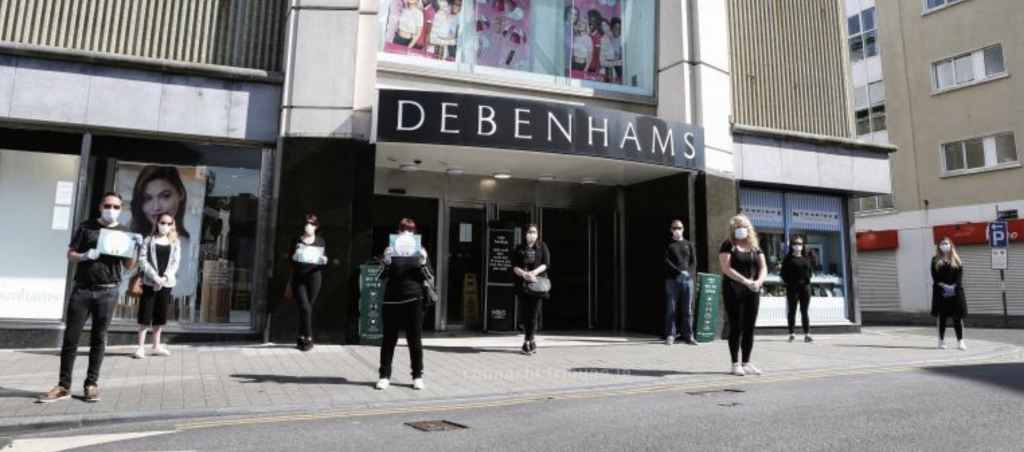
Nine workers, dressed in black, at least two metres apart, wearing masks are facing the camera outside of a Debenhams shop, beneath the store's sign, which is white writing on a black background.
Debenhams’s workers (members of Mandate) protest at shop closures and layoffs 21 April 2020

To date 3.6 million people worldwide have been infected by Covid-19, with over a quarter of a million (258,000) dying from the respiratory illness that attacks the lungs and airways. From December 2019 the virus travelled from its original source in southern China to all of Asia, Europe and the rest of the world in the space of two months, resulting in the World Health Organisation (WHO) declaring a global pandemic at the end of January. The pandemic has forced governments the world over to close their economies and lockdown their societies.

With more than four fifths of workers globally living in countries affected by full or partial lockdowns, a global public health crisis is leading to a global economic recession, with the International Labour Organisation stating that 6.7% of working hours globally have been wiped out in the second quarter of this year alone – equivalent to 195 million jobs worldwide. The global economy is in recession and may yet head into an economic depression.

Here in Ireland, north and south, there have been 22,248 confirmed Covid-19 cases and 1,375 deaths (6 May 2020). In the south we have spent the past five weeks effectively living in lockdown, instructed by state authorities to stay indoors, to go no further than a radius of 2km (now 5km as of 5 May) for our daily exercise and only engage in essential consumption – our weekly grocery shop.

The Irish economy has been deliberately shut down by the government: 598,000 people have lost their jobs, with another 427,000 people having their wages paid via a state subsidy; tax revenues are projected to shrink by 14 billion this year, and in their spring forecast the European Commission predicts that the Irish economy will shrink by 8% this year. It took more than two years during the last national crisis – the financial crisis of 2008 – for such numbers to develop, this time round it has happened in a little over two months.

The world has been rocked by the coronavirus, peoples’ lives have been turned upside down; shock, grief, fear and anxiety caused by pandemic and its economic consequences have left millions people reeling, with many feeling vulnerable and isolated. Ideal circumstances for the ruling class, the multinational corporations and their local political allies to take advantage and pursue a shock doctrine response to this global pandemic: to force the cost of the crisis onto the backs of the working class worldwide, to push more privatisation and deregulation, to further increase their wealth, power and influence.

We refuse to repeat the sacrifices of 2008

So whilst we have to remain physically distant we must remain socially close and politically critical. Some would want us to suspend not only our parliamentary democracy (with caretaker Fine Gael ministers last month bemoaning the convening of Dáil Éireann), but our critical faculties also. The old trick from the last crisis, the call to ‘don the green jersey’ in ‘the national interest’ as ‘we’re all in this together’ as a way to stifle criticism and suppress political debate has been used again during this crisis but this time it is not working.

People have lived with the consequences of the political decisions taken during the financial crisis of 2008 for more than a decade now, indeed the decade of austerity and the massive transfer of wealth from the working class to the rich resulted in the state being ill-prepared for the outbreak of such a pandemic and will likely mean that our societal and economic lockdown will last longer than many other countries.

The ease with which the cost of the financial crisis of 2008, resultant bank bailout and decade of austerity was foisted upon the people was in large part due to the lack of real opposition from the trade union movement. Insofar as there was opposition, small and sporadic though it was, it arose through the efforts of the small radical left parties. This was not effective in stopping the austerity. It was not until an alliance of trade unions, community groups and left parties formed to fight the water charges that a movement of critical size and power emerged to oppose one item on the austerity agenda.

This cannot be allowed to happen again. The trade union movement has to become the dominant force that shapes the response to the Covid-19 crisis to ensure that workers, families and communities throughout Ireland are not forced to pay for yet another crisis not our their making .

Unite the Union’s response to Ireland’s post COVID-19 economy

To that end, the Unite trade union recently commissioned the left-wing economist, writer and activist Conor McCabe to produce an analysis of what has happened to date and to sketch a socially just, economic fair and environmentally transformative pathway forward out of the economic and societal crisis we are currently living through, a document intended by the author to be ‘a tool to feed into the conversations we are having and the strategies and tactics we will pursue’ so that the Left does not ‘allow the right-wing and neoliberal voices in Ireland to dominate and shape the pathway out of the current crisis’.

You can read the Hope or Austerity document here.

Independent Left commends Unite for taking the initiative in commissioning the document Hope or Austerity as too often the Left is reactive rather than proactive. Indeed as the author notes ‘we cannot build the future we need unless we plan and fight for it’. In times of crisis we need clear thinking, critical analysis and robust debate, which this document provides.

Of course the crisis is evolving and as the author himself stated during a Unite May Day lecture it is a working document, written to feed into an on-going process of critical discussion and debate. There are parts that need expansion, like childcare and home care, and others that need to challenged, like the normalisation of the regressive and dysfunctional Local Property Tax.

Independent Left recommends a close reading of the document, welcomes the opening of discussion and aims to be a part of the comradely yet critical debates ahead as together we debate the best tactics and strategies to purse as we struggle for a better world.

Debenhams Workers in Ireland on Strike

A battle between Debenhams management and workers is a key one for all workers, at it is likely to shape the wider issues of who will pay for the impact of the COVID19 crisis on the economy.

On 9 April 2020, Debenhams Retail Ireland told 1,500 workers their jobs were gone as all 11 of its stores were closed. The company offered no redundancy.

The workforce is represented by Mandate, who have pointed out that the shops still have stock worth an estimated €25m and this should be sold to provide redundancy payments to the workers.

Mandate is demanding that more than a million items of stock currently in Debenham’s 11 closed Irish stores should be sold and the proceeds, estimated at €25m, distributed to former workers as part of a redundancy deal.

Even though it is extremely difficult to organise at a time of social distancing and closed stores, the workers voted to strike and deserve the support of all Irish workers.

Below is an interview with Councillor John Lyons and Debenhams’ strikers at the Henry Street Store, recorded 23 June 2020. The Debenhams workers are asking people to boycott the online sales of the company until the dispute is resolved.

Filed Under: All Posts, Independent Left Policies

Reading Lenin in the light of the collapse of the SWP and the ISO

22/04/2020 by Conor Kostick 3 Comments

A comparison of Tony Cliff’s Lenin: Building the Party with Paul Le Blanc’s Lenin and the Revolutionary Party

A clear, deep blue sky against which is a sunlit statue of Lenin, pointing to the viewer's left, palm open. His own left hand hold's the lapel of his coat for balance and his expression is determined. A 1954 Communist vision of Lenin.
The ISO self-destructed, the UK SWP shrank to a rump and the Irish SWP dissolved: what does that mean for the interpretation of Lenin that they shared, one derived from Tony Cliff’s book Lenin: Building the Party?

In 2013, not long after the British SWP went into dramatic convulsions over the way their party failed to support a young member in her allegation that a very much older and more senior member had raped her, I had reason to be in Chicago. While there I met up with the International Socialist Organisation (at the time a relatively successful example of a revolutionary party), gave a talk on Ireland’s revolutionary years and attended a dayschool of theirs on Lenin and the revolutionary party. The bookstall had copies of studies of Lenin by Lars Lih, Paul Le Blanc and Tony Cliff.

Anyone wanting to encourage the development of a revolutionary party has, of course, to form an opinion of Lenin. Before the ISO fell out with their British equivalents (i.e. the SWP), their approach to Lenin would have been profoundly if not exclusively shaped by the British SWP and in particular by the leading figure in that party, Tony Cliff. It interested me that the ISO had a wider outlook on the subject than was usual in the SWP and the enthusiasm of the bookstall organiser meant that I came away with a copy of Paul Le Blanc’s Lenin and the Revolutionary Party.

The cover of Paul Le Blanc's Lenin and the Revolutionary Party. A collage of a picture of Lenin speaking outdoors with a march of women workers. Black and white with a red bar dropping down from the top right corner with the author's name.
The cover of Paul Le Blanc’s Lenin and the Revolutionary Party

This book was first published in 1990 and I had never read it because having inhabited a rather closed-minded organization, I felt there was little that someone closely aligned to the politics of Ernest Mandel would have to say on the subject that would be useful. After all, as I was told and believed at the time, I had been guided in my understanding of Lenin by someone with vastly superior politics to those of Mandel: Tony Cliff. More than this, as an SWP organiser in the UK and then in Ireland I had always used Cliff’s Lenin: Building the Party as the essential text for explaining the theory behind SWP party-building methods to those members who I anticipated would go on to play leading roles in their branches and nationally.

A photo of the jacket of the 1986 edition of Tony Cliff's Lenin: Building the Party (Bookmarks). The title is in thick black letters across the middle of a white cover, beneath a picture of a barricade taken during the 1917 revolution. The word Lenin is in mauve, in. the bottom right corner.
1986 edition of Tony Cliff’s Lenin: Building the Party (Bookmarks)

The ISO – in the words of one of their organisers – said at the time that they drew on a canon of the best of other traditions and individuals to inform their attitude to Lenin and the lessons for today in regard to the revolutionary party. This sounded admirably open-minded. But I couldn’t help wondering if this willingness to promote other studies of Lenin than that of Cliff was, in fact, a watering down of the revolutionary Lenin in favour of a more Occupy-friendly version.

Given the 2019 collapse of the ISO, it is also reasonable to ask whether a move away from their traditional, if one-sided, reading of Lenin contributed to the crisis?

Then too, there was the 2018 submergence of the Irish SWP (I was a member at the time they voted to become a network within People Before Profit, yet I had no opportunity to vote on the decision; no documents were sent to me for consideration; no invitation was made for me to offer my views. I accidentally discovered from an online post that the party I thought I was a member of had gone). When you combine this with the self-destruction of the ISO and the rape-apologist behaviour of the UK SWP, the word ‘crisis’ is barely strong enough to encapsulate what has happened to parties of this type, who were once all thriving and united in a common organisation: the International Socialist Tendency.

It seemed evident to me that the failure of these parties meant that every aspect of SWP theory had to be looked at again with new eyes. Moreover – somewhat reluctantly, since it was time consuming – I felt that I had to make more of an effort to re-examine my attitude to Lenin. Without doing so, I was missing out in regard to developing my own understanding of the issues of party of class in an age when new means of communication mean some of the the old certainties, such as the essential role of the physical newspaper (a major topic in Cliff’s book), were fast becoming obsolete. So I reread Cliff and studied Le Blanc.

Side by side: Tony Cliff vs Paul Le Blanc on Lenin

The first thing to say about these books is that the story they tell is an inspiring one. Lenin became a Social Democrat (i.e. Marxist) in 1893, at the age of 23. Twenty-four years later, at 47, he led the successful Russian Revolution. Trotsky met revolutionaries in 1896 at the age of 17; he was 38 when he oversaw the October insurrection. Reading again the story of Lenin reminded me that when I became a revolutionary, during the great miner’s strike of 1984-5 in the UK, I thought that by now I would be living in a post-revolutionary era. After all, it took only twenty-four years for Lenin to go from next-to-nothing to the 1917 revolution.

It is worth noting that the experience of Western revolutionaries 1985 – 2020 has been a low-key one in comparison to the storms experienced by Lenin and Trotsky’s generation or that of the next. This, of course, is about to change and one reason why I’m delighted to have come through the experience of having COVID19 is because socialist politics are clearly going to be relevant in the 2020s.

At the deepest level, the crisis of the International Socialist Tendency is explained by this relative historical quiescence. Although the specific problems that arose in the UK and the USA deserve close analysis (with particular attention being paid to the question of who controlled their assets, worth a great deal), there’s a reasonable chance that the flaws in these parties and especially the emergence of a predatory male elite would not have become fatal had their members been engaged with the ebbs and flows of profound social upheavals such as those dealt with by Lenin. They would have been more deeply rooted in working class communities who would not tolerate the kinds of behaviour that ultimately brought them down.

Lenin’s efforts to build a revolutionary party from 1893 onwards are fascinating and deserving of scrutiny because they culminate in his having decisive influence over the October revolution of 1917. The twists and turns and dialectical inversions and leaps of the development of the Bolshevik party, even in the quiet years, are compelling to read about, because each argument at every stage really mattered. Each conference, debate, new pamphlet, new recruit, split, had consequences that rippled out over time to affect millions. Both books grasp this process well and while Le Blanc’s is the more scholarly in an academic sense, Cliff’s holds up surprisingly well in terms of the effort he made to contextualise each moment of the drama.

Neither author was able to access untranslated Russian source material directly. Cliff was perhaps the more eager to seize upon a tiny detail in a memoir to illuminate a particular moment. Le Blanc prefers to sum up contextual situations by reference to a secondary source, usually a work, to be fair, that is based on a detailed study of the Russian sources. Opening Lenin and the Revolutionary Party at random and finding an example, this type of statement is typical (p. 234): ‘As Hasegawa writes, “by the fall of 1916 the [Menshevik] workers’ group was obviously losing ground to the Bolsheviks and to regain its lost influence among the workers, the workers’ group turned leftward in December 1916.”’ This methodology is often unsatisfactory, as often the point being made by the secondary work comes across as an assertion without foundation. I wanted to see the primary evidence for the point being made.

Another difference between the books is that Le Blanc makes more of an effort to contrast his reading of Lenin with those of right wing or social democratic authors. This works to a certain extent, in ‘rescuing’ Lenin from the stereotype of the ruthless Machiavelli, but it surrounds the story with a commentary that is much less interesting than Cliff’s if your focus is the question: what does this all mean for revolutionaries today? In other words, there is no question but that Le Blanc’s is a much more helpful book for a student battling against ideologically driven attacks on Lenin. But for building the party, Cliff’s approach, potentially, has the advantage. At various points, Cliff puts the breaks on the narrative to digress with generalisations about party building and it is these generalisations that served for years to inform the practice of those on the SWP branch, district and national committees both in the UK and Ireland.

Cover of the 1994 pamphlet, The SWP versus Lenin by Ian Land. Mostly black, a white stencil of Lenin's face is in the lower two-thirds, with the details of the book at the top. Red, white and black colours only
Ian Land’s 1994 critique of Cliff’s view of Lenin remains the most insightful

I say ‘potentially’ because of course, the conclusions about the revolutionary party that Cliff drew do not, in fact, have the emancipatory power I once thought they did. Here, I think the best critique of Building the Party comes from Ian Land in 1994.

The cover of Lars Lih's Lenin Rediscovered. A Kandinsky background, mostly yellow, with the book details in a brown box in the centre upper half.
Lars Lih, Lenin Rediscovered

Lars Lih does an impressive job of overthrowing various paradigms concerning misrepresentations and misunderstandings of Lenin (not only those of Cliff), using 600 pages of densely sourced argument in his book Lenin Rediscovered. And that is very valuable. But to understand what particular lens was distorting Cliff’s view of Lenin you only need a few lines. In Cliff’s experience of leading the SWP, you had to battle hard for a new orientation for the party and the people you were battling against were those who had most immersed themselves in the old orientation. Your weapons? Exaggeration and youth. Cliff was expert in galvanising the openness of new members to new tactics to turn them against older members who might resist the new course.

So we learn this about the young Lenin from Cliff:

This readiness to bend the stick too far in one direction and then to go into reverse and bend it too far in the opposite direction was a characteristic that he retained throughout his life. It was already clearly apparent at this early stage of his development as a revolutionary leader.

Later, in discussing the rules of the party, Cliff wrote:

An overformal party structure inevitably clashes with two basic features of the revolutionary movement: (1) the unevenness in consciousness, militancy, and dedication of different parts of the revolutionary organisation; and (2) the fact that members who play a positive, vanguard role at a certain stage of the struggle fall behind at another.

If you are trying to explain to a party member why, having campaigned on a certain issue in a particular fashion, the party is now doing something radically different, these formulations are a great help. They address an important truth, which is that the currents of revolutionary politics are fast changing and the party has to be able to make swift turns and not be trapped, for example, by the moralism of a declining campaign, into substituting for a real movement. Nor must a revolutionary party be afraid of pouring every resource behind a critical strike, say. But Cliff’s formulations address this truth in a one-sided fashion.

Is it accurate to characterise Lenin as believing he was being excessive but that the outcome would justify his exaggerations? In other words, was Lenin willing to deliberately present a distorted picture of the world to win his perspective? In short, the answer is ‘no’. Le Blanc and Lars Lih and my own reading of Lenin’s works convince me that fundamentally at every stage Lenin believed that the truth was on his side, at least until events proved otherwise. Holding doggedly to a particular focus and task for the party is not the same as telling the party something which deep down, you do not actually believe, but which you consider expedient.

Here’s how one staunch defender of Cliff puts it in more recent times:

Cliff had learned from experience that shifting an organization of several thousand members (as oppose winning an academic or historical debate) from one strategic orientation and one way of working to another to meet the challenge of changed circumstances, required an almighty great tug on the relevant levers and, sometimes, a certain exaggeration. For Cliff achieving the desired end was more important than terminological exactitude or consistency and he rather thought, as do I, that Lenin felt the same way. http://johnmolyneux.blogspot.ie/2006/11/lihs-lenin-review-of-lars-t-lih-lenin.html

There is an evasion here. The argument is not whether Lenin was fussy about terminology but whether Lenin ever felt it necessary to deliberately exaggerate ‘to achieve the desired end.’ John Molyneux believes so. I do not. Lenin was fully aware the dialectics of revolutionary socialism do not allow for the separation of means and ends. The means you adopt will shape the end you arrive at. The moment you cease to tell the truth, no matter how unpalatable or how it works against the point you want to make, is the moment you abandon the prospect of realising a socialist society. I say this for entirely practical as well as moral reasons.

Secondly, look again at the question of party structure. It is an observable fact that all revolutionary parties are uneven, Cliff’s (1), but (2) is not as clear cut as it seems because it contains a value judgement. Who decides whether a member is falling behind? While another member is being ‘positive’? The true test has to be in regard to how effective the respective members are in changing the world. And judging that effectiveness is a complicated matter, where collective decision-making, honest accounting and democratic forms are essential. But in Cliff’s hands, this piece about rules can be read as follows: rules are all very well, but when some idiot is dragging the party down, it is necessary to find those who are getting results and use them to smash the conservatives, even if that means violating formalities.

Anyone expelled – or rapidly thrust from leading bodies within the SWP – by Cliff in the UK or Kieran Allen in Ireland will be familiar with what this depiction of Lenin meant in practice. But I think this depiction of Lenin also helps explain something of the attitude of those who have been in these parties for a long time and unfailingly endorse the initiatives of the leadership. Such long-term members have internalised the same ideas as profound revolutionary truths, which leads them to reason along the following lines: ‘I don’t want to be like the committee-men of 1905 who resisted the party’s turn to the class, therefore I will overcome my reservations and embrace the latest line. After all, this is the best way to test a perspective.’

Over time, the membership of the party learn to accept (and justify to themselves and others) that they have no meaningful input into the creation of new initiatives or the party’s position on crucial issues. This is in marked contrast to the vigorous and lively internal life of the pre-1917 Bolshevik party.

As a guide to the nature of a successful revolutionary party, Cliff’s interpretation of Lenin’s approach to rules only works if the party leader is always right. But who judges the judge? Who corrects the leadership when they are wrong? History? History has made its judgement upon Cliff’s party and its associates.

If Cliff’s Building the Party is flawed in this way, i.e. flawed at the points where it addresses the methodology of ‘stick bending’, is Le Blanc’s Lenin and the Revolutionary Party the better tool for guiding revolutionaries in the theory and practice of building the revolutionary party? I don’t believe so. In fact, despite the criticism I’ve just made, I’d rather give someone Cliff’s book, mainly because of its activist focus. Le Blanc’s is a very good history written by someone with a clear understanding of the political stakes in the various debates but it has half an eye on academia. This means the standard of scholarship is high, but at the cost of the book being less of a manual for revolutionaries. It also has some political weaknesses, perhaps the most important being the failure to articulate the full scope of Lenin’s anti-imperialism. The author has a soft spot for the Sandinistas, bringing them up to the level of the Bolsheviks, and also for Cuba. This means Lenin’s emphasis on not giving anti-imperialist movements ‘communist colouring’ is entirely lost.

Where does this leave me in regard to reading Lenin? I’m faced with a situation where an uncritical approach to Cliff’s works no longer serves, but where there is no obvious single alternative. Best, then, to read a variety of books from different perspectives and, of course, the works of Lenin himself.

Filed Under: All Posts

There are two worlds

11/04/2020 by Conor Kostick 2 Comments

A grey sky with a rainbow, which touches the roof of the Mater hospital, Dublin.
A rainbow over the Mater hospital ICU

There are two worlds.

In one, people try to occupy themselves at home, maybe spend time in the garden where the birds are so lively just now, or watch TV or – although I found my concentration levels weren’t up to it – do something creative.

The other is darker and consists of those with COVID19.

Having crossed the invisible barrier into the latter, I had an intense realisation of these two worlds as I walked my partner to the emergency tent at the Mater hospital. It was sunny, probably, and there were so many normal people around: a group of builders, smoking and chatting, united by their day-glo jackets; two hospital staff, ID badges swaying, smiling; a large man just standing there on the corner of the road and – evidently unconcerned by our masks and her being in a dressing gown – not inclined to move. We skirted him.

I squeezed her hand one last time and watched from the entrance as the two staff members took her details then brought her further in. It occurred to me that this might be my last ever sight of her, but I told myself not to be alarmed, that she was much safer in their ‘yellow’ ward than at home. That she was lucky, in fact, because perhaps soon they would be turning away people who need monitoring for lack of staff.

And then I went back to the car and the waiting kids, along a street with the other world all around me.

One in which the sun was probably shining.

Dawn, Easter Saturday and she’s home. I’m lying on a mattress outside her door, like Cú Chulainn at the threshold of his king, my namesake. Outside, a pigeon is asking over and over, ‘look, can we, tee de?’ When it stops, the far sweeter chirp of a robin takes its place, but so rapid is the robin’s voice that even Democritus would have struggled to understand him.

Ever since we hung out a bird feeder, we have had a pair of robins in our back yard. I’m sure they are nesting in the thick, thorny bush that I was supposed to trim. I’m glad I never got around to that task, because our neighbour has a very attentive cat, who likes to walk on the top of the wall. He cannot get past the overgrown bush, no matter how carefully he tries to place his paw.

Heart irregularity, high blood pressure. In need of several days of bed rest. But her lungs are fine. Well, pneumonia to be sure, but mild. So long as she can rest in quiet solitude, she should get through this. Quiet solitude. That’s why I sleep at the door, for while the elven-year-old and the eight-year-old understand and respect the rules, we have a three-year-old who does not understand boundaries.

She’s awake already and after considering my unexpected presence says, ‘I don’t want you there.’ When I fail to disappear, she begins crying. Like the dawn birds, there is a cycle to the cry. ‘I want my mummy’, over and over. Not too much of a shriek, more an unhappy insistence. Every five chants I offer an explanation that I know won’t be accepted, but perhaps my gentle tone of voice does some good because she settles.

It helps that the eight-year-old, having woken, announces that there are eighteen hours and seventeen minutes until Easter. He started that timer three days ago.

Delighted with the prospect of chocolate and understanding that it is imminent my three-year-old is immediately cheerful. And it makes me realise there is a power in her refusal to see boundaries. I just have to follow her and I will find the way back.

A path between trees, in the foreground it is light, in the distance it is dark. A little child is holding the hand of an adult at the boundary.

Filed Under: All Posts

  • « Go to Previous Page
  • Page 1
  • Interim pages omitted …
  • Page 11
  • Page 12
  • Page 13
  • Page 14
  • Page 15
  • Interim pages omitted …
  • Page 23
  • Go to Next Page »

Copyright © 2026 · Aspire Pro on Genesis Framework · WordPress · Log in