• Skip to primary navigation
  • Skip to main content
independent left logo

Independent Left

Environmentalism, socialism, freedom and equality. #liveablecity

  • About
  • Featured Articles
    • How Farming Must Change to Save the Planet
    • The Housing Crisis: Causes and Solutions
    • Socialism in Ireland
  • Contact Us
  • Podcast
  • Animal Rights
  • Archive
    • Irish Socialist History
    • Dublin City Council Housing
    • Ukraine
    • Protests Ireland
    • Reviews
    • Irish Political Parties
    • All Posts
    • Independent Left Policies
  • Why join?

Review: Ken Loach’s ‘Sorry We Missed You’

13/11/2019 by John Flynn Leave a Comment

By John Flynn

The redoubtable Ken Loach has followed up his Palm D’Or winning I, Daniel Blake with a devastating drama about a family struggling to make ends meet in a precarious working environment. Along with his longtime screenwriter Paul Laverty, Loach has crafted a very necessary film about working life for so many people today.

Ricky has gone from ‘shit job to shit job’ since the crash of 2008 derailed the family’s prospects. A constant plaintive refrain heard throughout the film by different family members is: ‘I just want to go back to the way things were’. Ricky takes a job as a self-employed delivery man believing (probably out of desperation) that it will finally give him the means to succeed. But, in order to put down the deposit on the van of £1000, he convinces his wife Abbie, a home carer on a zero-hours contract, to sell her car. From these desperate beginnings things soon begin to get worse. This brilliantly acted film will leave you emotionally spent as you watch this increasingly frazzled couple attempt to battle the exhaustion of long hours in high stress conditions and the fall-out of neglect at home.

There is a scene in the film that nicely weaves the personal with the political and provides a wider background to the film. Abbie is visiting Mollie, a favoured care recipient. Against the rules of the agency that she works for, (you’re not supposed to be friendly with your clients!) they are enjoying a fugitive moment of companionship sharing photographs with one another. Mollie shows her photos from the 1984 miners’ strike where she helped run the canteen. They are treasured memories of friendship and solidarity but from a tragic defeat for the labour movement. Abbie’s funny photographs are from her courtship with Ricky (at a rave), from a happy time when it seemed that they were going to buy their own home. But, the collapse of Northern Rock put an end to their hopes. It’s only in the photographs that Ricky and Abbie look happy. Now, they are exhausted and struggling to cope. A moment of marital intimacy is aborted because Abbie says she feels so sad she could cry for a week.

You always get a character in a Loach film who articulates very convincingly the point of view of the class enemy. Here, we have Moloney, ‘patron saint of nasty bastards’. He thinks that a company’s shareholders should erect a statue to him because he runs such a brutal operation for them. In the interview at the opening scene he gives Ricky some insidious language about this new economy, ‘you don’t work for us; you work with us’, but, before long, we see the brutal reality behind this rhetoric. Drivers are constantly monitored by their scanners, on severe time constraints, liable to sanctions, if they fail to meet targets. Ricky is horrified when his friend gives him a plastic bottle for emergency piss stops. But this is reality for the armies of delivery drivers frantically meeting the orders from companies like global giant Amazon. In an interview, scriptwriter Paul Laverty sardonically quipped, ‘I can’t imagine Jeff Bezos pissing in a plastic bottle because a meeting went on too long!’ When Ricky does need to use the bottle one time to relieve himself, he is savagely beaten and robbed. As he sits in the hospital waiting room with Abbie waiting to her from the X-ray results, Maloney rings him to inform him that he is liable for over £1500 because of the robbery. This, after he had incurred numerous sanctions after missing work because of domestic issues with his son, Seb. The reality of the new economy: all the costs to the worker.

Ricky and Abbie have two kids, Sebastian, the eldest and Liza Jane. Though Liza, Jane looks distraught at what is happening to her family (one terrible moment, when she bursts out crying after confessing to something is utterly heartrending), she is performing well in school. Sebastian, or Seb, is in trouble at school. He seems completely disabused of the entire system, and shoplifts spray paint for his graffiti art. The scenes with Sebastian and his friends are probably the only ones that point to self-activity or self-expression: Seb even sold his winter coat to purchase spray paint! When Sebastian gets arrested for shoplifting during a particularly fraught time for the family, Ricky collects him at the police station. Luckily, he meets a kindly copper who gives him a well-meaning talk about how fortunate he is to have a loving family and that he can get his life back together and be what he wants etc. The message of the film for me would imply that all this is well meaning nonsense. Sebastian’s graffiti collective is closer to some truth about class war politics than pieties about bootstraps and knuckling down.

Ken Loach’s Sorry We Missed You is a devastating critique of precarious work

It has always been a great strength of Loach that he manages to get such brilliant performances from inexperienced actors. The performances of the four main actors in Sorry We Missed You are superb, particularly in some emotionally fraught scenes. The cumulative effect of watching Ricky and Abbie struggle through the long working days (“What happened to the 8-hour day?” Mollie says at one point) and try to deal with the issues at home is really devastating. This is one of the most unflinching portrayals of working life ever seen on screen but also, one with an obviously deep sympathy for the characters. Ken Loach is one of the great socialist filmmakers.

So, it is probably surprising that the film ends on a note of such despair. I watched the film in the IFI with two friends and we were distraught at the end, in shock, could hardly look at one another. When you remember earlier Loach films also during times of defeat, like Riff Raff, there was some satisfaction when Robert Carlyle burned down the building site at the end in revenge against a brutal employer. Here, we don’t have that. I am thinking that Loach sees the total hopelessness of the current system and that it must go. But, destruction of this atomising system of colossal enrichment of the few is a collective project.
Filed Under: All Posts, Reviews

Google and Facebook workers’ protests grow

25/10/2019 by Conor Kostick Leave a Comment

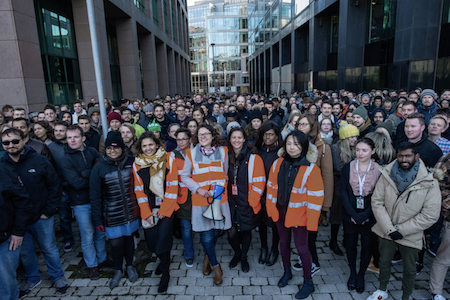
On 1 November 2018, workers at Google’s HQ in Dublin struck

Back in the late 1980s, after the defeat of the air traffic controllers in the USA and the miners in the UK, a great many activists gave up on their hopes that working class people could lead a revolt against capitalism. Andre Gorz, for example, had written a book, Adieux au proletariat (Farewell to the Working Class) which became popular on the left. His argument was that the traditional working class had changed in such a fundamental way that we would never again have the power to lead a transformation of society.

What the book (and those influenced by it) failed to appreciate is that the working class is always changing. Industries rise and fall, with consequences for patterns of employment. But the fact that all companies exploit their workers to maximise profits is a constant. And it is a constant that means after a new company has been running for a while, its employees will try to organise themselves.

Take Google and Facebook, two very important examples of new workforces, especially for Ireland. Right now there is major unrest by staff worldwide in these companies along with a drive to unionise.

The struggle for trade union rights at Google

At the end of October 2019, a row broke out at Google over a new tool for Chrome that automatically launches a pop-up when staff book a room capable of holding 100 people or more. Google says that it’s just a roadbump to stop unnecessary invitations but employees anonymously leaked news of this tool with the allegation that it was designed to warn management of attempts to hold organising meetings.

Workers have mocked the tool, circulating memes such as one showing Professor Dolores Umbridge teaching a defence against the Dark Arts class. Beneath her, it says: ‘Google decree number 24: no employee organization or meeting with over 100 participants may exist without the knowledge and approval of the high inquisitor.’ Another shows a bunch of male managers in suits laughing as one of them says: ‘and then we told them “we will not make it appear to you that we are watching out for your protected concerted activities” as we pushed a Chrome extension to report when someone makes a meeting with 100+ people.’

This came shortly after a meeting, 21 October 2019, in Switzerland, where for several months, over 2,000 Google staff had been attempting to organise a meeting addressed by the trade union Syndicom. Management attempted to thwart the meeting and at one point sent a message around to employees saying, “we’ll be cancelling this talk.”

In the end, some 40 workers insisted on their right to hear the union representative and this issue is likely to culminate in a fierce battle for recognition.

To some extent the drive to unionise was trigged by the massive walkout on 1 November 2018, a strike that was very well supported by Dublin Google workers at the Barrow Street headquarters. Google employs around 7,000 workers in Ireland. Over 20,000 workers in 47 countries held a wildcat strike to protest at massive severance payments made to male executives accused of sexual harassment.

Google workers have recently leaked information on issues they feel are morally wrong in the direction of the company, such as censored search engines for China; co-operation with armies, or with the fossil fuel industry.

On 25 November 2019, the New York Times reported that it had seen a memo where four Google workers associated with organising their colleagues were fired.

Facebook has over 4,000 employees in Ireland and here too there have been leaks, not least in regard to making contracts public. This has been an important contribution to a legal case against Google contracts where the plaintiffs want end to compulsory arbitration of workplace discrimination cases.

One Facebook worker described to Independent Left how the company started in Ireland in a non-traditional way, making an effort to create a team spirit through twenty-four hour, free access to a variety of food and drink, including a bar. But now, most of that has gone and the company manages its workers much like any other.

Life in Google and Facebook for workers is unrecognisable in the Hollywood versions of these companies (e.g. in The Social Network or The Internship).

What this discontent among workers in the giant tech companies shows is that although the decline of old industries can indeed shatter working class organisation and confidence for a few years, the rise of new ones (and, indeed, the return of confidence to traditional ones) brings back the fight to organise against exploitation and unfair practices.

And what this means for the big picture is that the potential for workers to lead a massive, fundamental change to how the world currently works is as great as ever.

Facebook Staff Protests Against Trump: Update 2 June 2020

It is not only the issues of working conditions that is driving Facebook workers to organise themselves. The wider social role played by Facebook is leading to its own workers attempting to instil ethical values on their practices. In particular, there is a growing desire by workers to curtail the use of Facebook by Donald Trump to promote his side of the growing social split in the US. Many staff held a virtual walkout on 1 June 2020 to challenge the way that the US President was using Facebook to spread misinformation and incite violence.

A tweet by Jason Toff (@jasontoff) which has 187k likes. It reads:
I work at Facebook and I am not proud of how we're showing up. The majority of coworkers I've spoken to feel the same way. We are making our voice heard.
It is dated 5.55am June 1, 2020.
Posts by Facebook workers concerned to implement an ethical policy about the use of the platform are gaining hundreds of thousands of likes.

A design manager tweeted:

I’m a FB employee that completely disagrees with Mark’s decision to do nothing about Trump’s recent posts, which clearly incite violence. I’m not alone inside of FB. There isn’t a neutral position on racism.

Placing a logo of a fist with a hart on their posts, another Facebook team joined the walkout en mass. It is widely reported that Trump spoke to Zuckenburg on Friday 29 May after Zuckenburg asked him to amend a post.

While the head of Facebook holds back from acting against Trump, his staff are sharing a quote from Anti-Apartheid leader Archbishop Desmond Tutu:

If you are neutral in situations of injustice, you have chosen the side of the oppressor.

Filed Under: All Posts, Protests Ireland

Amy Dunne: her bravery helped change Ireland’s abortion law

20/10/2019 by admin 1 Comment

By Niamh McDonald, Chairperson, Dublin Bay North ‘Together For Yes’ 

‘Repeal Changed My Life’

Portrait photograph of Amy Dunne. No background other than a blue sky. A confident, proud expression on her face.
Amy Dunne in 2019. Amy was ‘Miss D’ in the landmark ‘right to travel’ High Court abortion case of 2007. Pic: Arthur Carron

It is not easy to talk in public about personal experiences of abortion and enormous credit has to be given to those like Amy Dunne, who told their stories and helped change abortion law in Ireland.

Ireland’s long journey from being a country with strict anti-abortion laws to the success of the Repeal movement was not a gradual one.  Rather, after years when there was no movement on the issue, the country gained a much deeper national understanding of why women should have right to choose from particular cases.

The awful situation that a fourteen-year-old girl – Miss X – found herself in, having been raped and made pregnant in 1992 shook the country. Not only was she refused an abortion in Ireland, but the Irish courts initially refused to let her travel to England for an abortion. Only after a massive outcry and a march of over 10,000 people did the Supreme Court rule that abortion was legal if the woman’s life was at risk.

Students from 1992 sitting in the road in the Dail, behind a banner saying 'Abortion Information Now'. A highlighted square and arrow draws attention to where the image has been altered to cover up a phone number.
In 1992, newspapers didn’t even dare reproduce phone numbers of abortion information services. This, taken by Eric Luke, was doctored to remove the number before being published in the Irish Times.

Amy Dunne was threatened with a murder trial

Another such case was that of Miss D, who we now know as Amy Dunne. In October 2019, Amy told her story to RTÉ’s Sean O’Rourke. Unlike the X case, Amy wanted a baby but discovered in 2007, on her seventeenth birthday, that the baby had anencephaly. Her choice was to have an abortion, but because Amy was in temporary foster care, social workers were involved and the told her that she – along with anyone who travelled with her ­­– would ‘be done for murder’.

Amy refused to back down and took her case as far as the High Court in order obtain the right to travel to the UK (and her passport, which was being withheld from her).

In Liverpool, after induced labour, her baby, Jasmine, died. The experience has left her haunted. As Amy put it, ‘I would have lived with the regret of having an abortion but now that’s not what I have, I have a baby I carried, I have a connection, I have a grave, I’ve had a funeral. I have pictures, I have a child, I have memories. I have newspaper clippings.

‘I am forever haunted instead of just being able to go and do what I needed to do.’

The retelling of such a traumatic experience in public while trying to live with its consequences every day is a huge act of bravery and this bravery highlights the sheer cruelty of the actions of anti-choice bigots who still continue to bully pregnant people when they are at their most vulnerable.

Repealing the 8th was a huge achievement, one that was delivered thanks to the grassroots organisation of thousands of  women across the state. But the legislation is too narrow and restricted. People are still travelling for abortion healthcare, the lack of flexibility in the law means some migrants and people in Direct Provision are left without care.

Amy Dunne is in favour of exclusion zones around hospitals

We urgently need legislation for exclusion zones, a demand that Amy Dunne spoke in favour of. She said that seeing protests at hospitals made a difficult situation worse for a woman who has a hard choice to make, ‘I don’t think anyone should be allowed protest outside a hospital. Pro-life people should be ashamed of themselves. I think it’s sick – I think they have a mental illness. We all make decisions and they’re not made lightly.’

Fine Gael were happy to ride the Liberal repeal wave that was created by the hard work of grassroots activism but now when women and pregnant people need support these are sadly lacking

Filed Under: All Posts

Brexit: What Should Irish Socialists Say?

19/10/2019 by Conor Kostick 1 Comment

Short version: Independent Left advocate Remain.

At the time of writing, there is still a lot of uncertainty around whether and under what conditions the UK will leave EU. On Saturday 19 October, it seemed possible that Boris Johnson would just about get a Brexit deal through the UK parliament, only for him to be caught by surprise by an amendment (the Letwin amendment) that postponed a vote on Johnson’s Brexit package until a Withdrawal Agreement bill (WAB) was first agreed. The point being that MPs did not trust Johnson: so long as WAB was not passed, there was a danger of a No Deal crash out on 31 October.

Currently, even if Johnson does have the slender majority he needs to deliver Brexit in line with his agreement, there is still opportunity for UK MPs to amend the WAB, including by adding the idea that a second referendum has to be organised to endorse the deal. A new referendum was the demand of the huge (possibly as many as one million people) march in London on the same date.

What is certain is that if Brexit takes place – and especially if it’s the Johnson version – the UK leaving will be harmful for working class communities. In the UK itself, including Northern Ireland, Brexit would mean a rise in unemployment, a food and medicine crisis and an economic decline that some analysts anticipate will be worse than that of the 1930s. In Ireland, there are likely to be similar, if much less severe consequences. Here too, however, we are also going to face a government that will use Brexit, like it has used every crisis before now, as an excuse to strike down on working class people.

Remember how the Universal Social Charge was introduced by Fianna Fail’s Finance minister Brian Lenihan in 2010 as ‘a temporary measure’ to help Ireland cope with the financial crisis? Well, Brexit will be used in exactly the same way: even now Fine Gael are raising Brexit to justify their failure to properly fund essential services. The most recent budget is just the latest example of this approach.

For this reason alone, Irish socialists should advocate Remain. Moreover, there’s another way that the position of workers has already worsened as a result of the Brexit vote and that is because it has been accompanied by a rise in racism. Racists of all hues in the UK, including out-and-out fascists, greeted the result of the Brexit referendum with delight and there was an immediate upsurge of attacks on immigrants (a rise of 41% in what the UK police term ‘hate crimes’). In Ireland, we only experienced a ripple of this, but any growth in hostility to immigrants harms our ability to stand together and make progress on all the pressing issues that face us.

Does supporting Remain mean supporting the EU?

On the whole, with the important exception of Bernadette McAliskey, who quite rightly said, ‘politically the Right wing of British and European politics along with anti-immigration and naked racism has been strengthened by the Brexit victory,’ the Irish left were pro-Brexit at the time of the first referendum. It is understandable why. We shocked the establishment in 2001, when we were a successful part of the campaign against the Nice Treaty (opposing it largely because the treaty undermined Irish neutrality). The Irish conservative parties had to spend a lot of time and energy in pushing through the re-run in 2002. Again, the Lisbon Treaty of 2008 was rejected, with the left in tune with working class communities who mistrusted the proposed changes as likely to favour business over workers’ rights.

Given the EU had bullied Ireland into taking on the debts of their banks after the crash of 2009 and then tried to insist on us having water charges to pay for these massive debts, it’s no wonder that the Socialist Party, People Before Profit and many others on the left assumed that being in favour of Brexit was the natural continuation of an approach that – rightly – characterises the EU as being dominated by big business.

They were mistaken and deeply so.

Every referendum has to be judged on its merits and understood to be taking place at a particular moment in time. The UK one on Brexit had a very different dynamic to Nice and Lisbon. It was rapidly taken up by the anti-immigration UKIP and small parties even further to the right and then became all about immigration, particularly after the murder of Labour’s Jo Cox. Jo Cox was a prominent activist against Islamaphobia who was campaigning for Remain. She was killed by a man with fascist connections, who shouted “Britain first”.

Socialists who had a vote should have voted Remain, primarily in order to stand with the anti-racists.

There is no contradiction at all in advocating Remain for these reasons and still holding to a view that the EU is driven by big business. Because Brexit too is all about a big business agenda: the Conservative Brexiteers can hardly wait to tear up EU regulations protecting workers’ rights. They think realignment with the US and the far-east will prove more profitable than staying in the EU.

The old Socialist Workers Party that was, had a slogan, ‘neither Washington nor Moscow’ to indicate that in the Cold War it did not see it necessary to pick a side, when both sides were racing to oppress and exploit their populations. That’s the approach that socialists should take when the rows among a divided elite spill over into a referendum. The Irish version runs: feck ye both.

We don’t have a side between the EU and British businesses who think they are better off facing towards the US. But we do take sides against racism and we are rooted in communities that are going to suffer when Fine Gael wield the hammer, shouting ‘sorry, but Brexit’.

So Remain it is.

What should socialists do now about Brexit?

The Brexit vote is not a defiant working class refusing to be pushed into a Lisbon-type treaty. It’s the opposite: an anti-immigrant, right-wing vote. On the other hand, the Remain vote had as its largest component exactly the kind of people who make up the natural constituency for socialist parties: trade unionists, community activists and especially anti-racists.

The Ashcroft exit poll to the Brexit referendum was the most comprehensive poll at the time (12,000 people sampled). It shows that two out of three Labour voters voted Remain. A majority of people in work voted Remain. 67% of Asians voted Remain and 70% of Muslims. True, there were traditional Labour regions that voted leave, but no one argues that they did so for any other reason than being anti-immigrant. Their champion within the Labour Party, Stephen Kinnock, thinks Labour has to emphasise, ‘the value of place’ and the legitimacy of raising concerns about immigration.

Trying to appease racism never works. The more divided a working class community, the less able we are to win campaigns on all the issues affecting us.

Probably, the penny has begun to drop among Irish socialists that they have the wrong approach to Brexit and they are alienating themselves from core supporters.

Hopefully these parties change their approach. Although they have no culture of doing so, it would not harm these parties to acknowledge that supporting Brexit was a mistake but now, in the light of developments, they are for Remain. No harm at all. In fact, you win respect by honesty instead of evasive, never-wrong, politician-speak. We need to have the humility to acknowledge when we make mistakes, learn from them and move forward. No one is all-knowing, so we shouldn’t pretend to be so.

For our part, we are unambiguous. Independent Left are for Remain.

Filed Under: All Posts, Independent Left Policies

The Quiet Collapse of the Parnell Square Cultural Quarter

04/10/2019 by John Lyons 3 Comments

By Councillor John Lyons, Independent Left

Painted illustration of the north side of Parnell Square, Hugh Lane at the centre with imagined colourful stalls along a pedestrianised street.
The plan for beautiful new cultural quarter for Parnell Square is faltering due to the failure of the private-wealth approach

A beautiful new library, part of an ambitious new cultural quarter encompassing places for learning, literature, music, innovation and enterprise, inter-culturalism and design, to be located at Parnell Square Dublin 1, was in store for Dublin and Dubliners. The Central Library in the Ilac Shopping Centre has its charm but this new library was to be something else, a civic space fitting for a twenty-first century capital city, especially one designated UNESCO City of Literature.

The Parnell Square Cultural Quarter, a 11,000 m2 development comprising a new city library and a range of social and cultural facilities –  a music centre, a design space, an innovation hub, a business library, a 200 seat conference space, an education centre, a café and an exhibition area – was to be Dublin City Council’s major flagship development, regenerating the north inner city as well as providing a new focus and destination at the northern end of O’Connell Street.

The  proposed  development was to include  work  to  the  existing  Georgian  houses  at  23  to  28 Parnell  Square  North  as  well  as  a  dramatic  new  building  to  the  rear  of  these  houses.  It included  20 and 21 Parnell Square  North and would have seen the creation of a new public plaza along Parnell Square North. It was intended that Dublin City Gallery The Hugh Lane would form part of the overall  Parnell Square Cultural Quarter offering and its role and impact would be expanded by the development of the new facilities. Magnificent!

I have supported this wonderful civic vision for Parnell Square over the last five years but with one recurring reservation: the funding model deployed to transform the vision into a reality was predicated upon 55% of the entire cost of the project coming through philanthropic channels. Yes, the rich Irish elite were going to be approached to cough up some of the money they save through our rather elite-friendly taxation system.

Alas, it was not to be. Unlike the Scottish-American millionaire philanthropist Andrew Carnegie who provided £170,000 between 1897 and 1913 to fund an entire network of libraries in Ireland (some 80 in total, 63 of which are still standing today), the millionaires and billionaires in twenty-first century Ireland appear disinterested in the kind of philanthropic activity Carnegie was involved in over one hundred years ago.

Parnell Square Cultural Quarter too Dependent on Private Capital

“Destined to fail,” some said; “bizarre”, said others; “doomed”, declared many. “Why the hell can’t we just fund it ourselves?” asked many more.

The cost of the project was estimated (in August 2019) to be in the region of €131 million. According to Dublin City Council’s executive Owen Keegan, a “unique feature of this project  is that Kennedy Wilson Europe Limited agreed,  on a pro bono basis, to assist the delivery of the project by providing seed capital to get the project through design, costing and final planning, leading the effort  to  raise the required  level  of private donations to  fully  fund  the  project and providing expertise to assist in the management of the project.”

This strange funding structure would have seen 55% of that funding raised via philanthropic donation(s) secured through the efforts of one of the largest private property landlords in the city. The rich folk of the city, and perhaps the country, were going to don the blue jersey and stump up the millions, with Dublin City Council agreeing to finance the other 45%.

Agreeing to allow US property speculator Kennedy Wilson take responsibility for fundraising over 50% of the cost of the new Dublin City Library at Parnell Square appeared like a particularly unusual way for Dublin City Council to go about raising the capital funds required for one of the capital city’s cultural flagship developments.

During my five years to date as an elected representative on Dublin City Council, however, I have become used to proposals which involve a heavy dose of the private sector: from housing construction, waste collection, water and sanitation to grass-cutting, housing maintenance, the involvement of private contractors is ubiquitous. The city council’s capacity to deliver these services has shrivelled through years of austerity and privatisation.

When asked by myself and other elected representatives why we couldn’t fund the project fully ourselves, whilst pointing to the obvious dangers of relying on private donations to raise over half the cost of the development, we were assured by city council officials that this was the best way to go about it.

So the Parnell Square Foundation, comprised of City Council officials and Kennedy Wilson representatives was established in 2013 to oversee the project. And according to city council report from July 2019, “considerable  progress has been made  over the past seven years… In particular,  all  the required buildings  have  been  brought  into  City  Council  ownership,  substantial  support  for  the  City Council’s vision  for Parnell Square  North  has been generated,  a world class design  has  been procured and full planning permission for the proposed development has been obtained from An Bord Pleanála.”

But here comes the “however”: Dublin City Council manager Keegan goes on to state in the same report that, “I have now been  advised, following work undertaken by a consultant engaged  by  Kennedy Wilson on behalf of the Foundation, that the required private fundraising could take over 3 years and that there is no guarantee it will be successful.” (My italics). The consultant’s interim report identified a number of potential obstacles to a successful fundraising campaign for the project including the following:

– the scale of funding required for the project relative to the sums raised previously for cultural projects in Ireland from national and international donors,

–  the fact that the Foundation has no previous donor base to act as project champions,

–  the intense competition for  philanthropic funding from high profile national cultural projects based in Dublin, which have already secured significant State funding and

– the fact that libraries have a lower affinity score with private donors than the arts generally. 

The rich ain’t interested, national government is nowhere to be seen or heard, and so the city council is left to pick up the pieces. Predictable but nonetheless devastating for the city of Dublin.

What Happens Now for the Parnell Square Cultural Quarter?

So where to now? Keegan proposes to proceed with the new library but to delay the redevelopment of the five Georgian buildings which were to house the new Cultural Quarter Education Centre, the Music Centre, the Design Space, the InterCultural Hub and the public realm works, thus effectively abandoning the wonderful civic vision for Parnell Square in favour of a piecemeal development.

Just. Not. Good. Enough.

So I have tabled the following motion to Dublin City Council in the hope that the entire Parnell Square Cultural Quarter vision can be saved and developed as one project, as initially conceived:

The elected members of this city council call on national government to include in this year’s Dublin City Council Capital Programme the necessary central exchequer funding to ensure that the Parnell Square Cultural Quarter, Dublin City Council’s major flagship civic development, proceeds in its entirety as envisioned in the planning permission granted by An Bord Pleanala in May of this year, namely the entire 11,000m2 development comprising a new city library, a range of cultural, education, musical and exhibition spaces and the enhancement of the public realm.

For More Information on the Parnell Square Cultural Quarter, see here.

Filed Under: All Posts

  • « Go to Previous Page
  • Page 1
  • Interim pages omitted …
  • Page 7
  • Page 8
  • Page 9
  • Page 10
  • Page 11
  • Interim pages omitted …
  • Page 14
  • Go to Next Page »

Copyright © 2026 · Aspire Pro on Genesis Framework · WordPress · Log in