• Skip to primary navigation
  • Skip to main content
independent left logo

Independent Left

Environmentalism, socialism, freedom and equality. #liveablecity

  • About
  • Featured Articles
    • How Farming Must Change to Save the Planet
    • The Housing Crisis: Causes and Solutions
    • Socialism in Ireland
  • Contact Us
  • Podcast
  • Animal Rights
  • Archive
    • Irish Socialist History
    • Dublin City Council Housing
    • Ukraine
    • Protests Ireland
    • Reviews
    • Irish Political Parties
    • All Posts
    • Independent Left Policies
  • Why join?

Was Ursula Le Guin a Socialist?

04/01/2020 by Conor Kostick 2 Comments

A review of No Time to Spare

Ursula Le Guin in 2008. She has short, grey hair, a white top, black tunic and trousers. Her left hand on a table, her right holds several A4 pages and she is speaking against a background of books. Ursula Le Guin was sympathetic to socialism.
Ursula Le Guin was influenced by anarchism, described herself as a feminist and had an interest in socialism

From 2010 to her death in 2018, Ursula Le Guin composed blog posts for her website and a selection of these have been collected into a wonderful book, No Time to Spare. Many of the essays are beautiful accounts of moments in her life, with, for example, a most intense appreciation of the art of eating a soft-boiled egg for breakfast that serves as a lesson in mindfulness. Here, though, I want to focus on the political ideas of Le Guin that are explicit and implicit in many of the features.

In one essay where she addresses the question of socialism directly, Le Guin does so in the context of a comment about the alternatives to capitalism:

Some of the alternatives that existed in the past had promise; I think socialism did, and still does, but it was run off the rails by ambitious men using it as a means to power, and by the infection of capitalism — the obsession with growing bigger at all cost in order to defeat rivals and dominate the world.

Ursula Le Guin on socialism, from No Time to Spare

In this one, short paragraph are four hugely important ideas. Firstly, that socialism still has the potential to provide an alternative to capitalism. Second and third, that the reasons previous efforts to create socialism have failed are a) the desire for power and b) the infection of global capitalism. Fourthly, the gender of those who ran socialism off the rails was male.

Of these ideas the first is essential. Almost certainly the majority of people living on the planet right now would agree that the current economic system is deeply flawed. Hardly anyone, however, can agree on what the alternative should be. And this is largely due to the fact that socialism has been discredited. Yet unless the idea of socialism is revived our species is in great trouble, because anything other than a fundamental, radical, reorganisation of the world by workers will succumb to the pressures of trying to co-exist with capitalism.

The second, that it was the seduction of power that wrecked previous socialist projects, is entirely consistent with Le Guin’s core political beliefs, which were those of anarchism. Ursula Le Guin was always wary of defining herself politically, not through fear of alienating people by sounding too radical, but because she felt she lacked the expertise and devotion to activism to be a political authority. Her main passion and her decades of experience were in writing, both in composing beautiful works but also teaching and analysing literature.

The first edition cover of The Dispossessed by Ursula Le Guin. Her name is at the top in large yellow letters, then, smaller, the title in white. The entire background is orange with a figure of ambiguous gender silhouetted against a large orange planet, facing away from the reader, standing in a crater. In this novel, Le Guin began with the premise of an anarchist utopia.
Ursula Le Guin’s The Dispossessed explores a utopian world

The setting for one of Le Guin’s early novels, The Dispossessed, is that of a utopian world. In order to research that world, Le Guin read widely into anarchism: especially Kropotkin and a modern anarchist thinker, Murray Bookchin.

And it was the pacifist, rather than destructive, element within anarchism that appealed to Le Guin the most, as she explained in an interview.

I felt totally at home with (pacifist, not violent) anarchism, just as I always had with Taoism (they are related, at least by affinity.) It is the only mode of political thinking that I do feel at home with. It also links up more and more interestingly, these days, with behavioral biology and animal psychology (as Kropotkin knew it would.)

In Jacobin’s obituary of Le Guin, the novelist is described as being a historical materialist but this is too much of a stretch. An anarchist emphasis on the importance of power in politics is very clear in Le Guin’s thought. Even here, in this discussion about whether Le Guin was a socialist, it’s no accident that she puts the issue of power before the question of structure in signalling what went wrong for socialism in the past.

As an aside, many on the left interested in Science Fiction and Fantasy juxtapose the work of Le Guin, radical, feminist, anarchist and Tolkien, who they see as conservative and anti-working class. China Mieville, whose critique of Tolkien derives from the essay of another anarchist fantasy writer, Michael Moorcock, has been the standard bearer for this approach.

In my view, it is utterly mistaken. Le Guin herself was a huge champion of Tolkien and often spoke up for the literary merits of The Lord of the Rings, a book that despite enormous public enthusiasm, is usually under-appreciated by critics. And in The Lord of the Rings is a metaphor for the corrupting influence of power that is as pure as any in literature. The One Ring is the ultimate test of character and only those wise enough to reject it have any integrity, those who try to use it are doomed to become hollowed-out husks of their former selves.

Having placed an emphasis on the question of the destructive effects of the possession of power, which remains an important issue for the left, Le Guin also sees global capitalism as a key contributor to the failure of previous attempts to create socialism. This is a vital observation for the future too. Any attempt to introduce socialism in one jurisdiction is doomed: either pressure to compete in the world market or direct overthrow will end the effort. Fortunately, today, our world is so integrated globally that a socialist movement that really went down to alter the fundamentals of society would have an immediate and massive international impact, making it much more likely to transform the entire planet.

In unpacking Le Guin’s observation on the previous failure of socialism, one more point remains to be made, which is that she highlighted the fact that it was men who led the movement away from utopia. This is an historical observation as well as a reflection on Le Guin’s ‘steady, resolute, morally committed’ role in the feminist movement. She explicitly defined herself as a part of second wave feminism — the struggles of the late 1960s and early 1970s — and her writings throughout her entire life, both fictional and non-fictional, constantly returned to the subject of gender inequality.

It seems to me to be clear that Ursula Le Guin was very sympathetic to all alternatives to capitalism and while more inclined to describe herself as anarchist was definitely open to being persuaded about socialism. The revolutions and socialist movements she saw in her lifetime did not, however, provide a lot of evidence for the potential of socialism to deliver utopia. Personally, I think that potential is evident in all the great working class uprisings of the twentieth century, but you have to really drill down to the detail of the particular variants of socialism active in them to understand why, ultimately, none of them led to the disappearance of capitalism in favour of a sharing society.

Ursula Le Guin on dialectics and Taosim

The turquoise cover of No Time to Spare, a collection of blog essays written by Ursula Le Guin, which include her thoughts on socialism. Five leaves made of paper with illegible writing on them are drifting towards the bottom of the cover.
In No Time to Spare, Ursula Le Guin has essays that address her political thought, including socialism, anarchism and feminism

In No Time to Spare there is another subject that connects Le Guin’s intellectual makeup to socialism and it is the question of dialectics. For socialists, to be able to analyse political systems that are in motion and which can dramatically hit transformative tipping points is essential and the tool for doing this, dialectics, comes to us from a western tradition, originating with the early Greek philosophers and being developed especially by Hegel and Marx. But there is an even older tradition of dialectical thought rooted in ancient eastern societies.

When Le Guin wanted to explain some underlying connections between utopian and dystopian societies in literature, she first needed her readers to understand dialectics and she helped them do so by drawing on her deep engagement with Taoism. An interpreter of Lao Tzu’s sixth century BC Tao Te Ching, Le Guin used the yang-yin symbol to illustrate her point that every utopia contains a dystopia, every dystopia a utopia.

In the yang-yin symbol each half contains within it a portion of the other, signifying their complete interdependence and continual intermutability. The figure is static, but each half contains the seed of transformation. The symbol presents not a stasis but a process.

The yang-yin symbol, which for Ursula Le Guin is helpful in explaining dialectical interactions

In the many appreciations of Ursula Le Guin that have been written since her death (22 January 2018) this aspect to her thinking has usually been neglected, yet in my view it is fundamental to her thought.

The presence of a powerful and playful mind is evident throughout No Time to Spare and always Le Guin’s writing is informed by a sense of development and change, even in her own sentences as she formulates them. That’s why they are rich, truthful, convincing. When reading Le Guin, you feel the presence of someone who is not satisfied until she has expressed herself exactly as she intends. Someone who weighs the meaning of every word, every punctuation mark even.

Le Guin’s dialectical way of approaching any subject, even that of the behaviour of cats (she was a great cat lover and if you are the same, you’ll read some of these essays with enormous pleasure) means we never get a dry, linear, didactic essay. Always, they are rich, fecund and humorous.

Was Ursula Le Guin a socialist? She was. And she wasn’t.

In 2014, Ursula Le Guin attended the National Book Awards in the US where she was the recipient of the Medal for Distinguished Contribution to American Letters. During her speech she made a powerful point to those who feel there is no alternative to capitalism:

The profit motive is often in conflict with the aims of art. We live in capitalism. Its power seems inescapable. So did the divine right of kings. Any human power can be resisted and changed by human beings. Resistance and change often begin in art and very often in our art, the art of words.

Ursula Le Guin on resistance and change

Filed Under: All Posts, Reviews

Damien Dempsey Live

22/12/2019 by admin Leave a Comment

Damien Dempsey, wearing a black shirt and shitting in front of a microphone holding a guitar. His expression of one of intense feeling.
Damien Dempsey: a poetic and sincere voice of those who are struggling in Irish society and beyond

Review of the gig of 21 December 2019, Vicar Street, Dublin, by Aislinn Wallace and Niamh McDonald


Damien Dempsey has been a powerhouse on the Irish music scene for nearly two decades. He brings a voice to the struggles of those suffering in Irish society and beyond with poetry and sincerity. 
Damien’s Christmas Vicar Street gigs have become part of the Christmas calendar for many of his devoted fans. Saturday’s performance was no exception, with a packed-out venue. 
Damien has never been ambiguous about his politics and his music reflects this. The crowd in the gig represented all ages, with an overwhelming working-class representation and with people from all corners of the island. Hearing the whole audience sing out songs such as Colony highlights the level of consciousness Dempsey has raised in his loyal fans over the years.


From the stage: Damien Dempsey live

From the stage, Damien spoke openly about his own mental health struggles; he creates a space with his music to help break the stigmas around mental health and encourage people to talk openly about their own struggles. As two people in the middle of a crowded floor we observed so many resonating with this message as they openly sung along to Sing All Our Cares Away.

Close up of Damien Dempsey singing open-mouthed before a microphone, eyes closed with an intense expression.
Damien Dempsey: accessible and revolutionary


Not only does Damien sing about the scourge of mental health and its destruction to so many, he also brings a message of anti-racism and the importance of the power of women to his songs and gigs. His music talks about the gentrification of Dublin and beyond in the guise of a housing crisis at the expense and displacement of the working class.
Damien is known for his activist and solidarity work, from supporting the anti-water charges movement, to singing at the Moore Street occupation, as an activist in Apollo House and supporting Repeal. 
The range of influences in Damien’s music includes reggae, R&B, and Ireland’s folk tradition, fused to create a multi-dimensional sound, one that is accompanied by lyrics that convey a strong message of class politics in a way that everyone can relate to. 
The value and influence of an artist such as Damien Dempsey to working class struggles can’t be underestimated: like many others before him, Damo’s sincere and simple music raises issues that affect us all and vocalises the social and economic issues in a way that resonates widely with people.

It’s accessible and revolutionary at the same time. 

The left hand side of the image shows a striking, black and white portrait of Damien Dempsey, with a slight smile. On the right are tour dates: December 2019 ones in Vicar Street (the venue in yellow letters); a space then a block of six dates in April (green) 03 Bantry, 04 Drogheda. 05 Ratoath, 17 Dunmore East, 18 Co. Kildare, 19 Gweedore. Then a space and 14 March 2020 Electric Ballroom London (orange) and 10 July 2020 Iveagh Gardens (blue).
Damien Dempsey can be seen live in 2020 with six April dates in Ireland.

Damien Dempsey’s Soundcloud.

Filed Under: All Posts, Reviews

The UK election of 12 December 2019: what can the left learn?

17/12/2019 by Conor Kostick 2 Comments

A picture of Westminister Parliament from the south bank of the Thames, it is just after sunset and the building is lit up with yellow and orange light reflected on the water. This is where the Tory part will hold a majority in the light of the 12 December 2019 general election.
The results of the 12 December 2019 UK election were a huge blow for socialist ideas. What are the main lessons for the left?

With the decisive victory of Boris Johnson over Jeremy Corbyn, the left needs to come to terms with what was a crushing defeat for a political agenda that on paper was much closer to a radical socialist one than anything that has been on offer to the UK electorate for decades.

In the immediate aftermath of the Tory victory in the UK election of December 2019, very many left groups rushed out an analysis. And often this analysis boiled down to one takeaway message: if only Corbyn had adopted our politics, he could have won. Thus, for those who favoured a ‘Lexit’, a left support for Brexit, the problem for Labour was that they moved away from a position that respected the June 2016 Brexit referendum result to one that argued for more negotiations and possibly a second referendum. For left parties that were for Remain (and Independent Left are among them) the analysis runs the other way. Labour would have done much better had it been clearly and unambiguously the party of Remain.

Thus, the pain of the defeat is eased and the old certainties of these parties continue undisturbed.

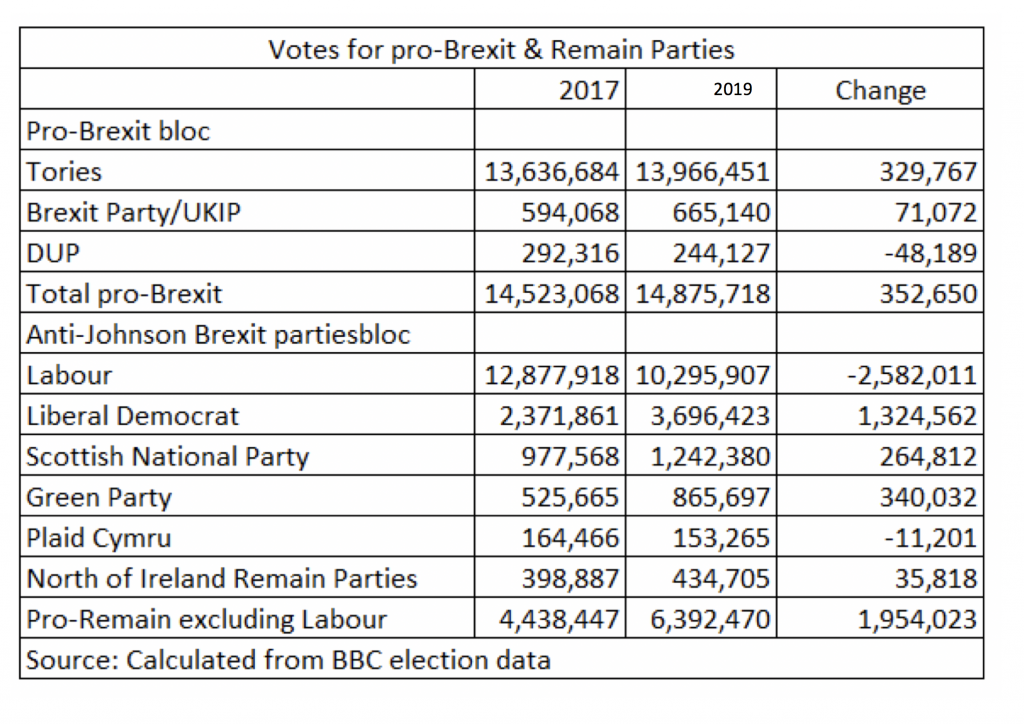
It could well be that had Labour caved in to the racism of the pro-Brexit side as figures such as Stephen Kinnock wanted, it might have done better. It could also be true that had Labour more firmly tried to rally the Remain population and say that it too would get Brexit done – by killing it off – Labour might well have improved its performance too (with Remain being the better option, both in terms of challenging anti-immigrant racism but also in electoral terms, as @johnross43 showed on his Twitter post).

A black and white table with four columns, on the left, a list of parties, arranged by whether pro-Brexit or Remain. Then their 2017 vote, then their vote in the election of 2019 and the final column being the difference.
Between 2017 and 2019, Labour lost approximately 2.58m votes to Remain parties and 0.35m to Pro-Brexit parties

How strange, that two positions in apparent opposition to each other might both be true. As is often the case with such conundrums, they represent half-grasped insights into a deeper dynamic that makes sense of them both.

What unites the two arguments (Labour should have been more for Brexit / Labour should have been more for Remain) is an electorate who desperately wanted an end to the protracted and painful divisions over Brexit. By trying to steer a middle course on Brexit, Labour offered months, if not years more, of a debate that to many was infuriating. Back to the EU for more negotiations, then a second referendum on the result of those negotiations. And no commitment to advocating for its deal in such a scenario. This was a line that could only be drawn mathematically: by finding the centre of gravity between competing forces and trying to balance them. Sometimes, this kind of politics, of finding a position that doesn’t alienate anyone too much, can work. De Valera was a master at it. But with Johnson knowing full well how disenchanted large swathes of the public were with the delay to Brexit, Labour’s position didn’t come across as far-sighted and statesmanlike, it seemed cowardly.

In hindsight, the parliamentary manoeuvres that prevented Johnson from crashing out in a no deal scenario do not look as clever as they appeared at the time. Yes, Johnson was boxed in, but all the time he was boxed in and being refused an election, he was gaining potential energy from massive discontent with further delays to Brexit, so that when the election came, he could spring forth, like a jack-in-the-box, crying, ‘get Brexit done’ and release that frustration.

My conclusion in regard to Brexit, the all important theme of the election, is that Labour, by half-moving to Remain took a very difficult position. To have won despite this sense that they were sitting on the fence would have required the public to be more concerned about other issues, such as the NHS than Brexit, which ultimately was not the case.

Was the Labour manifesto too radical in 2019?

Naturally, the right in the British Labour Party and the Irish too, have been quick to conclude that the December 2019 UK election proves that radical socialist policies are unelectable and that the UK Labour party should move back to the ‘centre’ ground of Blair and Brown. For ‘centre’, read neo-liberal, austerity politics.

The reality seems to have been a public – and especially working class communities — who much preferred Labour’s manifesto to that of the Tories. As one Labour canvasser wrote:

Once I had made common ground with people, I encountered no prejudice, and little rugged individualism. I did this by talking the language of class, which is something the left have not done well, even under Corbyn. When I asked them about public services, about the Labour manifesto and its promises, they were very enthused, and yes, even those people who had voted Tory or who were abstaining because they ‘hated all politicians’.

Fifty-nine percent of Labour voters said they: “preferred the promises made by the party I voted for more than the promises of other parties”, the second most popular reason for voting Labour (the first being that they trusted Labour’s motives more). Whereas for the Tory voter, it was not about policy, it was about Brexit. Labour’s policies were not vote losers, in fact they were vote-winning, especially among younger voters. The graphic about this is extraordinary.

As @electionmapsuk on Twitter noted last year based on polls, the Tories would win no seats if the only voters were those aged 18 – 24 and the Ashcroft survey after the election of 2019 bears this out.

A map of the UK with constituency boundaries, which is nearly entirely red except for Scotland, mostly pale yellow, and a dot of green in Wales with some dots of orange. It illustrates the fact that if voters in the UK in 2019 had been limited to the 18 - 24 year old group, Labour would have won 600 seats.
The astonishing picture if voters had been limited to the 18 – 24 year old group is that the Conservatives would have been wiped out entirely by that generation.

What hurt Labour beyond Brexit, was not the policies as such, but the questions around them. How much would they cost and, especially, how would Jeremy Corbyn deliver them? Wasn’t he just making promises for votes, the same as all politicians do?

Here there was a difference between Corbyn versus May in 2017 and Corbyn versus Johnson in 2019 and the difference was not just a matter of the relative strengths and weaknesses of the Tory leader. Corbyn had the better of both in terms of debating issues that working class communities care about. In 2019, however, he also bore the legacy of two years of parliamentary games, during which time the sense that he was different wore off.

Of course, there was a horrible smear campaign against Corbyn from the UK’s media. They were worse in 2019 than in 2017 and on the issue of anti-Semitism, utterly hypocritical given that anti-Semitism in the Tory party is far more prevalent than it is in the Labour Party. What gave Corbyn difficulty in resisting the media attacks this time around was in part that over the intervening months he became normalised as a politician. That’s something which is very difficult to avoid if you are the leader of the UK’s Labour Party. It is also fatal for someone whose main strength in resisting the Tory-controlled media messages is that of being the outsider, the anti-establishment figure, the person who actually is sincere about causes and willing to fight them.  In 2017, there was a sense that Corbyn was all these things and that rant and rave as the billionaire class might through its media channels, the people, and especially the younger people mobilised at massive, inspiring rallies by Momentum, could shrug it all off and sing his name with passion. Of course the media froth against Corbyn: he’s ours not theirs. He’s outside of the box.

In 2019, there were nowhere near the same levels of turnout for mass rallies to take Corbyn to heart and use alternative media to build a space for him that was free from control by the elites and one which could spread to politicise wider numbers. Corbyn had, by the logic of his role over the intervening months, to play the game of politics in the usual way, among the usual public schoolboys, in the usual chamber from where the voice of working class communities has largely been absent. He had become (and, of course, to a large extent has been all his life) that despised creature, a politician.

In 2019, Momentum played a magnificent role in terms of winning the battle on social media, even with a fraction of the budget available to the Tories. And one positive from this election result for all the left going forward would be to study Momentum’s productions and campaigns on Facebook, Twitter and Instragram. Yet the higher level of co-ordination and planning by Momentum activists in 2019 compared to 2017 was met by a less passionate response. Gone were the chaotic but electric mass rallies of the earlier election and in their place, much less inspiring events.

Labour’s 2019 manifesto was more left-wing than that of 2017 but the context of a weaker mass movement around Corbyn meant, with the exception of the promises around the NHS, it looked unconvincing. My second takeaway for the left from this election is that advocating socialist policies as a response to years of austerity is unproblematic. There’s no need to rush back to the centre. What matters are our connections to communities willing to be active participants in the process of winning the goals set out in manifestos. One demand arising from a politicised working class (e.g. abolish the Water Charges) is worth a dozen from a think-tank or 1930s transitional programme. And in the period between elections, if the left have not been focused on whatever options to campaign exist outside of parliament, then we do lack credibility if we suddenly promise a golden age of socialist policies come an election.

Can the left revive after the UK election of 2019?

Easily.

On the night, the UK election result felt like a terrible blow for the left. And it was. Once again, the right and especially the anti-immigrant racist feel triumphant. This is no light matter. Yet an election should be understood as a snapshot of feeling rather than a fundamental change in the social landscape. By which I mean, for example, that the defeat of the miners in 1984 – 5 was a far worse defeat than this election result. When the best-organised, most economically strategic group of workers are crushed and eventually laid off, it’s no wonder that in industry after industry, the axe subsequently comes down on workers’ incomes and rights.

An election result, even this one, where it was so polarised, changes very little in terms of the capacity of workers to mount campaigns and strikes. And when you consider that Labour was way ahead among voters aged 18 – 44 even in purely electoral terms, that indicates a comeback in the future.

Moreover, there are features of Johnson’s victory that mean his position is not as stable as having a big majority of MPs suggests. On his right, there is Nigel Farage. There is enormous mistrust and outright anger from the hardline Brexiters towards Johnson. Tactically, they had to retreat from challenging the Tories or split the vote and let Labour into government but they hated doing so and will be seeking ways to ‘reapply pressure’ on the Tories, as Farage put it soon after the election.

On Johnson’s left, within the Tory party, are those who do not want to make a dash out of Europe at the cost of severe trading penalties. In 2018, 45% of the UK’s exports were to EU countries (and 53% of imports). This means there is a sizeable number of people in business — the natural base for the Tories — who hate Brexit. They have come to terms with it, though, as judged by the bounce in Sterling and the UK’s stock market after the election. Given a divided consensus among the Tory party’s business network and a UK population who will experience all kinds of unexpected hardships once Brexit is concluded, there’s no doubt at all that the left will bounce back. And it doesn’t have to be a matter of waiting five years until the next election. Not only are there no shortage of issues for the left to campaign on right now in the UK, the frustration of the younger worker and of trade unionists as a result of this election mean that significant strikes and protest movements are very likely to spring up in 2020

Filed Under: All Posts, Irish Political Parties

Derek Mahon, A Poet of The Left

14/12/2019 by Ciarán O'Rourke 1 Comment

A portrait of Derek Mahon, poet, who describes himself as having a penchant for left-wing imagery. He is wearing a blue and purple vertical stripped shirt and is looking directly at the camera with a slight smile.
Derek Mahon: a poet of and for the political left

By Ciarán O’Rourke

‘I know the simple life / Would be right for me’, wrote Derek Mahon in Ovid in Tomis, ‘If I were a simple man.’ A glad complexity, it seems, is the order of the day; a dynamic interweaving of expression and insight evident throughout Mahon’s work, lending the poems both a clarity and a frequent mystery. ‘It is not sleep itself but dreams we miss’, Mahon posits (with aphoristic aplomb), ‘We yearn for that reality in this.’ Known for his intellectual force and technical fluency, and admired as a translator from multiple verse traditions, the Belfast-born poet was universally recognised in establishment literary circles as a leading figure of his generation and moment. Less mentioned, however, is that – in its breadth, emphasis, and overarching perspective – his work invites celebration and cultural co-optation by socialists, anarchists, and every species of utopian realist in between. For although formally traditional, his poems are critically incisive and, in brief, radically human to the core.

It’s a point that’s seldom heard, and so, perhaps in a small way, worth reiterating. Insofar as the ethical compass and content of Mahon’s poetry are discussed at all, the conversation tends to be couched in a discourse of reflexive academic qualification: so that the specific details of Mahon’s political commentary and commitment, at any one point in his poetic career, are presumed to be offset or made redundant by his aesthetic, philosophical, or even formal concerns at another. We are left with a ‘poet of divided affiliations’, who maintains ‘a cautious distance from schools and groups (whether literary or political)’, his stylistically graceful poems ‘characterised by indirection and obliquity’, even as they depict (occasionally) a ‘humanity… powerless against the inevitable forces [that] shape human life.’ We end up, in other words, with a political poet, but one whose work is said to exceed its own politics: thus transforming the latter into an empty category, rimmed by abstractions such as The Force of History or The Demands of his Time.

Such a trend, of course, arguably relates to culture in general, and not to the work of Mahon alone. It would certainly be a tempting thesis to explore: that in a neoliberal society, art and literature are circulated in order to be owned, to placate, or to make life as it is (exploitative and miserable as it may be for many) more liveable and not to subvert the tenets by which that society is organised. In which scenario, what we think of as literary criticism would in fact amount to nothing else than a series of discursive adjustments and revisions, a sort of academic vanishing trick whereby whatever creative radicalism was identified in an art-work, oeuvre, or historical moment would disappear as soon as it was declared. Sound familiar?

At any rate, for gentle-hearted heretics of all stripes – anti-establishmentarian in their politics, but nevertheless in need of the emotional and critical sustenance that literature provides – there is surely some merit in re-examining the work of poets, great and mighty, and the inherited assumptions that frame our encounters with them. In Mahon’s case, moreover – a writer who calls himself an ‘aesthete’ with a penchant ‘for left-wingery […] to which, perhaps naively, I adhere’ – doing so helps us to reach a fuller and clearer understanding not only of his literary back-catalogue, but of the power systems that rule and rack our present world. This may seem like high praise for one of Ireland’s more canonical of recent poets; but it’s also true.

Derek Mahon’s An Autumn Wind

Take Mahon’s book, An Autumn Wind, in which we find the artist’s inward vision turning to survey, with searing perception, a global vista defined in the main by corporate theft and murderous imperialism (headed by the USA). ‘The great Naomi Klein’, he wrote,

[…] condemns, in The Shock Doctrine,

the Chicago Boys, the World Bank and the IMF,

the dirty tricks and genocidal mischief

inflicted upon the weak

who now fight back.

Mahon’s praise (indeed, rather pointed name-dropping) of Naomi Klein surely gives credence to his self-proclaimed status as a political Leftist. But it also draws a question mark over the standard critical narrative outlined above. Far from deploring modernity in the abstract, shaped by some equally vague ‘inevitable forces’, Mahon’s verse here associates directly the neoliberal economic doctrines of ‘the Chicago Boys, the World Bank and the IMF’ with crimes against humanity, while also acknowledging both the theory and the praxis of resistance that such doctrines inadvertently generate (typified by Klein and by ‘the weak who now fight back’, respectively). It is difficult to imagine Seamus Heaney or Michael Longley, the two most-fêted of Mahon’s Irish contemporaries, even coming close to advancing such a perspective.

Derek Mahon the poet and the opponent of neoliberalism

It is notable, also, that the much-touted ‘concern for the ecological’ in Mahon’s later work exists, in the poem above, within an explicitly anti-capitalist paradigm. Close-focusing on a ‘hare in the corn / scared by the war machine / and cornered trembling in its exposed acre’, the piece in its closing stanza switches to a wide-angle lens, so to speak, and urges that in the next ‘spring, when a new crop begins to grow, / let it not be genetically modified / but such as the ancients sowed / in the old days : a possible retort to the criminal agri-policies of Monsanto. What’s certain, however, is that this is a poetry that arrays itself against (and takes aim at) neoliberalism per se – or what Mahon termed, in his resonantly titled poem, ‘Trump Time’, ‘the bedlam of acquisitive force / That rules us, and would rule the universe.’

Without wanting to over-extend the argument, there’s also a refreshing contemporaneity and excursive quality to Mahon’s range of reference here. Although he was indeed a literary practitioner combining ‘classical structure with contemporary concerns’ in his work (read great, white and male) – his ‘precursors’ including ‘Samuel Beckett, Louis MacNeice, the poets of Rome and Greece’ – in this instance Mahon openly, and quite self-consciously, took his cues from a feminist critic of modern capitalism, herself writing of a number of (highly gendered) grassroots movements, primarily in the Global South. Feminist icon he was not, but Mahon’s work at the very least pointed towards an intersectional understanding of economic exploitation and political struggle: as companion poems in the same volume (such as ‘Water’) arguably also testify.

Radical poet Derek Mahon reading from a book of his own poems held open in his left hand. His right is raised. He is smiling. A microphone is in front of him and behind him are curtains and the end of a bookcase  or cabinet with finely bound books.
Derek Mahon: a politically committed poet of the left

None of which is meant to create a further barrier between the so-called aesthetic merits and political commitments of Mahon’s work. If anything, it’s to argue that these qualities exist in continuity with one another, and to suggest some ways in which the overtly political interventions of Mahon’s verse may be seen to sharpen what one authority has described as the ‘crystalline clarity’ of its intellectual make-up, giving heft and consequence to the ‘sophisticated sound-patterning’ for which his poetry is so often admired. After all, Mahon’s bright-soaring, early imagination of an art drawn ‘From the pneumonia of the ditch, from the ague / Of the blind poet and the bombed-out town’ – one envisaged as bringing ‘The all-clear to the empty holes of spring, / Rinsing the choked mud, keeping the colours new’ – was always grounded not just in the sensations of a literate intellect, but in a sensibility disposed to compassionate identification with the realities of other people’s lives: in a word, to solidarity. For Mahon, equipped as a writer with the same ‘light meter and relaxed itinerary’ so beloved of countless literary fence-sitters, the urge that recurs most persistently is in fact ‘To do something’ – or ‘at least not to close the door again’ on those condemned to live ‘in darkness and in pain.’

On a final note: this short sketch has tried to claim Mahon was a poet of and for the political Left: a loose but very real community, whose existence is rarely questioned except by a few faction-feasting personages who are already in it. In doing so, however, we would do well to remember that the democratisation of power so often promised and struggled for by activists holds exciting possibilities for poetry, too: its creation, its reception, and (again) its circulation. As Mahon’s homage to Shane MacGowan implies, the list of great poets can and should be appreciated ‘together with the names Seeger and MacColl’: dissident troubadours both, generally lacking from Mahon’s academically prescribed influences. Art is what we make of it, in short, and the broader the field of shared endeavour, the better. So let the task be to reap and sow the commons of poetry and song, if for no other reason than to pay tribute to Mahon’s work and in the same spirit that the work itself proclaimed.

Filed Under: All Posts, Reviews

Bolivia’s Coup of November 2019: where did it go wrong for Evo Morales?

14/11/2019 by admin Leave a Comment

Evo Morales waving the colourful flag of the Movement Towards Socialism against a black, night-time background. He is smiling and so are the people around him, some of whom also wave flags and others have musical instruments.
Evo Morales: an indigenous, radical union leader whose compromises
with big business lost the support he needed to resist the coup of 10 November.

On Tuesday 12 November 2019, Jeanine Anez, a fierce, right-wing opponent of socialist Evo Morales, took power in Bolivia with the backing of the police and the military. This represents a setback for the working class and indigenous people of Bolivia (and beyond). It was a setback that could have been avoided and the main lesson is a simple one: socialists cannot succeed in bringing about lasting change from the top downwards.

In 2005, Evo Morales became Bolivia’s first ever elected indigenous President, he maintained this position for nearly fourteen years. How did an indigenous, radical union militant and leader of coca growers become the president of Bolivia?

This article seeks to explain the rise of Morales and the MAS party (movement towards socialism) government and the process of change it brought to the people of Bolivia and its economy. This explanation has to be found in a wider understanding of the history and politics of Latin America.

Latin America is one of the most unequal regions on the planet: according to Meirke Blofield’s 2011, The Great Gap: Inequality and the Politics of Redistribution in Latin America inequality in Latin America has been an entrenched characteristic since colonization, he states that in 2009, 189 million people in the region lived in poverty.

Latin America has a long history of reliance on world markets and transnational powers for its survival. Following a history of colonialism, in post-independence, Latin America prioritised exporting its vast abundance of natural resources over developing its economy domestically, leaving the region weak, underdeveloped and vulnerable to the boom and bust cycles of capitalism. The Great Depression of the 1930s hit the region very hard as demand for exports dramatically reduced.

World War II and the subsequent rebuilding years following the war created a stimulus to world trade internationally and Latin America’s exports began to rise. By 1955 manufacturing was ahead of agriculture in real GDP terms. Latin America adopted a form of Keynesian economics with welfare supports and social democracy. It wanted to turn from free market economics to focus on domestic development using Import Substitution Industrialisation (ISI) as a protection from the turbulent and at times devastating consequences of Laissez Faire economics.

ISI focused mainly on high export Tarriffs, domestic industrial growth as opposed to agriculture and saw a rapid growth in urban populations across the region, it shielded many from the full force of market demands through subsidies, it gave labour rights, gave land rights to indigenous groups and initiated public health, education and housing programs.

A square made out of coloured squares which run in diagonals: 1 yellow, bottom left; 2 orange; 3 red; 4 purple; 5 blue; 6 green; 7 white; 6 yellow; 5 orange; 4 red; 3 purple, 2 blue and 1 green, top right.
The Whipla: the flag of some native people of the Andes

While this protectionism gave some improvements to the quality of life it did not tackle the deeply entrenched inequality that remained a consistent across the region: those who mainly benefited were the formal work force, the middle class and the elite.

Latin America was still dependent on core countries for export and import, technical and intellectual know-how and loans to help cover the high costs of its welfare programme demands. In the 1970s, the global economy experienced another shock, in the form of an oil crisis and war in the Middle East.

The downturn affected the Latin American region in many ways, the revenue from and rate of exports reduced; the cost of imports increased; inflation across the region exploded, leading to an ever-increasing debt for every Latin American country. For example, in Bolivia the inflation rate in 1984 was at 1,300% by 1985 it was 11,805%. By 1983, total debt in Latin America was nearly 300 times the rate of its exports. The region had to turn to the International Monetary Fund for assistance in paying its soaring debt from international capital.

Loans from the IMF are significant for countries as they signal to international markets and lenders that the country is credit worthy. The IMF insist on neo-liberal structural reforms from a borrowing country: the IMF is the last resort for countries, they are rarely able to refuse.  Structural reforms consist of reducing state spending, privatisation of state assets and resources, also the privatisation of health, housing and education resources, a more precarious labour market with few labour laws, minimal welfare supports. This austerity often led to authoritarian regimes and military control in order to implement such goals.  As Jean Grugel wrote (in Grugel & Riggirozzi’s 2011 Governance after Neo-liberalism in Latin America):

By the early 1980s the social fabric of the region was in tatters, the horrors of civil war, military aggression and state sponsored repression created a willingness among ordinary people and their leaders not to push too far in the way of redistribution.

 A change in international relations and a horror at how the military regimes treated its citizens brought a third wave of democracy in Latin America in reaction to authoritarian control.

The third wave worked in two ways: through free market economics and liberal politics. This created a very minimalist form of democracy and its only requirement was free and fair elections. Neoliberalism believes in reduced state intervention and control that the free market can regulate itself and will eventually reduce inequality using trickle-down economics. It is in the context of this third wave that, despite its limitations, radical movements could begin to find political expression, including in Bolovia.

Bolivia has a wealth of natural resources including forestry, minerals, lithium and more recently, oil and natural gas reserves. Additionally, there are large swathes of agricultural land with a strong livestock industry and significant soya bean production. The wealth and development from these resources have never been equally distributed among all sectors of the Bolivian population.

According to Linda Farthing’s 2019 article, ‘An Opportunity Squandered? Elites, Social Movements and the Government of Evo Morales’, the elite within Bolivia have run the country in their own self-interest for over 200 years drawing from their own class to ensure the positions of the presidency, the senate and the judiciary were tightly within their power. 

The neo-liberal era in Bolivia did not reduce inequality; the New Economic Policy negotiated by the IMF was implemented by three consecutive right-wing state managers from 1985-2002. This shock treatment caused profound economic and political exclusion of popular sectors, threatening their very livelihood leaving them without defences.

Nevertheless, this inequality was challenged in a number of dramatic outbreaks of social struggle by workers and their allies. In 1952, for example, Bolivia experienced a social revolution.

Bolivia 1952, massive crowds of workers march behind white banners, the most prominent of which reads VIVA EL M.H.R.
A massive, workers-led revolution swept through Bolivia in 1952

The implementation of the New Economic Policy in the 1990s saw reforms in labour laws, reductions in mining, and an increase in gas production. The traditional unionised sectors from rural areas were destroyed.  People sought employment and began organising in more urban environs. The USA under the new economic regime were facilitated to destroy coca growing and coca farmers. This brought traditional union organisations, national liberation movements and indigenous groups together: earlier in the twentieth century, these groups did not have perceive common ground with each other. These challenges and new formations of popular sectors and their subsequent struggles against the New Economic Policy lay the foundations for the MAS party and the presidency of Evo Morales.

The period 2000 – 2002 saw powerful social movements such as the 2000 water war in Cochabamba, Aymara and a protest movement in Chapare of coca growers.

The original strategy of MAS was in extra-parliamentary activism, grounded in anti-neoliberal, anti-imperialist and rank and file democracy. Its power lay in the great number of different organisations involved in the party, including neighbourhood groups, unions, precariat workers, women’s groups and indigenous organisations. These groups were able to mobilise against neo-liberal reforms and eventually topple two successive right-wing presidents.

Jeffrey Webber’s 2017 The last day of Oppression and the First Day of the Same:  The politics and Economics of New Latin American Left, points out that Bolivia had a huge opportunity for fundamental, transformative and structural change from 2000-2005 as it was in a:

… revolutionary epoch this saw a combined rural and urban rebellion of a liberation struggle to end the interrelated process of class exploitation and racial oppression.

Post 2005, however, the class composition leadership layers of the party, its ideology and political strategy began to shift from a revolutionary organisation to a reformist outlook. When it began to contest elections and needed the middle-class urban voters, its leadership began to reflect an outlook formed more by the intelligentsia and middle class than that of workers.

The election of Evo Morales and the MAS party brought significant improvements to the lives of those who have suffered consistent inequality, poverty, racism, sexism and exclusion in Bolivia. According to Linda Farthing the victory of MAS expanded formal rights for women and indigenous people, leading to a significant increase of both within the MAS party and in positions of power in government.

Bolivia has seen one of the greatest drops in poverty: it has tripled the minimum wage, provided massive public investments in rural areas with new schools, hospitals and roads, and initiated the biggest land reform since the 1952 revolution. Despite opposition from the USA, MAS ensured that coca production became an indigenous right. The Morales leadership introduced a more radical constitution, voted on by referendum, his leadership brought a reduction in violence and a more stable situation for the majority of Bolivian people.

Yet Evo Morales’s administration failed to deliver on its more radical promises.

The domestic elite and transnational capital still had control of important sectors of the economy: banking, insurance and construction (mainly in LA Paz the capital and Santa Cruz the headquarters for the hydrocarbon and agribusiness sectors). After Morales’ first electoral victory to the presidency, the ruling elite still maintained power in the senate parliament.

The elites in La Paz initially resisted the new Morales regime, but the flow of capital from large government contracts and a limited expansion of state banking soon saw the economy thrive and profits grow and with that the La Paz elites were happy to cooperate.

The Santa Cruz elites, on the other hand, have always been part of the regional autonomy movement and have rebelled against central government whenever they have come under pressure to deliver to the state an increased share of the economy.  To thwart Morales, the Santa Cruz movement formed a coalition with three other regions with a neo-liberal ideology and a discourse of light skinned superiority. At its height, this coalition mobilised a million people, almost bringing the Morales government to crisis, but the rebellion didn’t last as Morales had the support of social movements across the country. The right did manage to gain concessions from Morales regarding land reform, which saw many of the elites keep illegally acquired lands.  Nor did Morales fully nationalise gas production, which had been an election promise, but managed to secure a much-improved deal which brought a huge amount of capital to government funds.

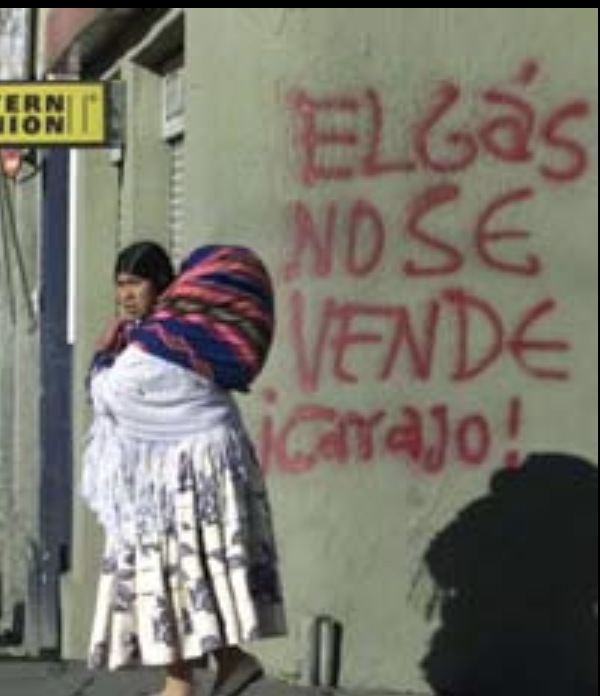
A woman, dressed in white with a large sack of made of purple cloth is walking past graffiti which translates as: Gas is not for sale, damnit!
An indigenous woman stands in front of graffiti that says: Gas is not for sale, damnit!

The process of change in Bolivia under the Morales government saw much improvement for many, but there came a point where its momentum towards change began to falter. Workers remained in precarious employment. The rate of unionisation dropped despite the country having a strong militant history of union organisation. Bolivia under Morales, despite the name of his party, was not a socialist state, the elite still owned vast swathes of land, foreign investment grew under Morales and this gaves the elite power and leverage. In short, the left administration scored some success but failed to deliver on its radical promises.

Morales continued to negotiate and work with domestic and foreign capital even after increasing his political power after the 2009 election. The process of change in Bolivia has not seen a socialist society emerge, nor could it when the strategy was to work with the local elites and global powers, to obtain the resources for reform.

Morales and twenty members of his administration had to flee for their lives to Mexico following threats from the army and police on 10 November 2019. Their ability to rouse the population and especially the working class against this coup had been deeply undermined by years of disenchantment as well as a perception of interference with the election of 20 October 2019 by Morales’ supporters.

Of course, Independent Left are against the coup and for a restoration of Morales. But we also have a wider vision.

Time again in Latin America and beyond the demands of capital have clashed with aims of governments that have declared themselves socialist. And every time, whether the Castro regime post-Cuban revolution, or that of the Sandinistas, governments that tried to manage their local part of a world capitalist system ultimately failed to transform society.

You cannot bring about socialism on behalf of the working class while in partnership with big business. Instead, we have to take over the workplaces and run them on entirely different lines, with entirely different goals and with very different politics to those of Morales.

Filed Under: All Posts

  • « Go to Previous Page
  • Page 1
  • Interim pages omitted …
  • Page 6
  • Page 7
  • Page 8
  • Page 9
  • Page 10
  • Interim pages omitted …
  • Page 14
  • Go to Next Page »

Copyright © 2026 · Aspire Pro on Genesis Framework · WordPress · Log in