• Skip to primary navigation
  • Skip to main content
independent left logo

Independent Left

Environmentalism, socialism, freedom and equality. #liveablecity

  • About
  • Featured Articles
    • How Farming Must Change to Save the Planet
    • The Housing Crisis: Causes and Solutions
    • Socialism in Ireland
  • Contact Us
  • Podcast
  • Animal Rights
  • Archive
    • Irish Socialist History
    • Dublin City Council Housing
    • Ukraine
    • Protests Ireland
    • Reviews
    • Irish Political Parties
    • All Posts
    • Independent Left Policies
  • Why join?

Socialism and Sinn Féin

14/07/2020 by Ciarán O'Rourke 1 Comment

SINN FÉIN LEADER Mary Lou McDonald standing outside of Leinster house, with her front bench party members distributed around her at a safe social distance. Many of them have their hands held in front of their bodies, as though choreographed.
Mary Lou McDonald announcing the Sinn Féin front bench 2 July 2020. The party is eager to participate in government.

“Sinn Fein has won the election,” declared party leader Mary Lou McDonald (with some justice) in early February, as results confirmed that for the first time in the history of the Irish State, neither Fianna Fail nor Fine Gael had achieved a clear majority or path to forming the next government, while “Ireland’s left-wing nationalist party” had witnessed an unprecedented surge in first-preference votes. Self-identified socialists, in some cases shocked by the “voter revolt” that had just occurred, took the opportunity to proclaim the return of radical politics to the realm, interpreting Sinn Fein’s electoral ascendancy as symptomatic of “a working-class backlash” against austerity and “a burning desire for radical change”, which the all-island party was in a unique position to deliver. “Sinn Féin’s ultimate aim is the creation of a thirty-two-county socialist republic”, read one commentary in the New York-based journal, Jacobin, which also praised “Sinn Féin, in particular” for channeling “discontented working-class nationalism in a progressive and anti-imperialist direction” in recent years. Hopes were high indeed.

As the new (if also somewhat familiar-looking) centre-right government has finally formed and is beginning to settle into its groove, now may be as good a moment as any to reflect on the election that was, and specifically the euphoric claims made for Sinn Fein as a force for progressive change. Bearing in mind that there are other, and arguably more important, ways of measuring radical and mass consciousness than votes (a point often ignored by the self-aggrandizing Left in general), it’s nevertheless true that Sinn Fein, running on a broadly worker-oriented, social democratic programme, received the endorsement of communities suffering the real-time effects of an engineered lack of adequate and affordable housing, healthcare (including childcare), education, and other basic services in the State. In other words, the Sinn Fein vote, and the accompanying leftward transfers, was one expression of a wider disaffection with neoliberal austerity and systematised inequality peddled by the two mainstream parties for years. Likewise, few would deny that concise, targeted, and eloquent media performances by Mary Lou McDonald throughout the election helped to boost the party’s profile – certainly compared to the smug, boy’s-club self-satisfaction exuded by Varadkar and Michael Martin, and perhaps also in light of the (at times hysterical) hostility shown to Sinn Fein by a number of media outlets.

Northern Ireland: Sinn Féin in government has not alleviated poverty
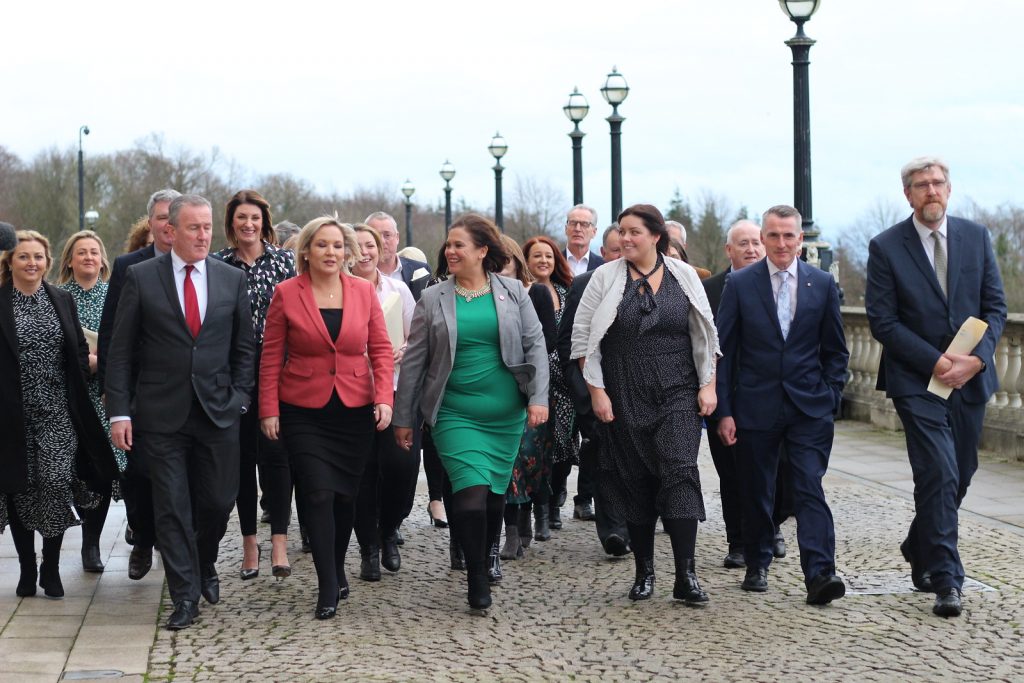
December 2019 and Sinn Féin leader Mary Lou McDonald alongside Deputy First Minister Michelle O'Neill pose with the newly appointed Ministers and Sinn Féin members of the Northern Ireland Assembly. They are walking on cobbled stones, all in suits, McDonald in a Green dress, O'Neill in a red jacket.
In December 2019 Sinn Féin resumed their role in the management of Northern Ireland and while the minsters and members posing with Deputy First Minister Michelle O’Neill and party leader Mary Lou McDonald appear cheerful, they preside over record poverty levels.

Significantly, the fact that over the past two decades Sinn Fein have been shopkeepers for austerity in Northern Ireland, where 300,000 people are now estimated to live in poverty, barely featured in the critiques levelled by Fianna Fail and Fine Gael against their emerging rival. Instead, both attempted to portray the party (whose most prominent spokespeople during the election included Eoin Ó’Broin and Pearse Doherty) as terrorists. “Outrage about the IRA looked strange”, one Sinn Fein organiser accurately noted, “when espoused by a government that wanted to commemorate the notorious ‘Black and Tans’ just months earlier.” This being said, the contradictions of Sinn Fein’s dual record, North and South, the at times considerable gaps between its rhetoric on the air and its record on the ground, are nonetheless live issues for any forward-looking Leftists, anticipating the political struggles to come.

Sinn Fein’s anti-racism and anti-imperialism, mentioned above, are arguably cases in point. To give credit where credit is due, in the context of rising xenophobic violence and fascist organising across Ireland, Leitrim TD Martin Kenny proved himself enough of an anti-racist to have a death-threat issued against him and an arson attack on his car 28 October 2019. His statements made a difference, and he wouldn’t have done so if there wasn’t some kind of anti-racist culture or tendency within Sinn Fein as a party.

Martin Kenny's car is barely visible inside a ball of bright yellow flame that is engulfing it and burning to a height of around 20 metres. On 28 October 2019, the car of Sinn Féin TD Martin Kenny was set on fire after he spoke out in support of people seeking asylum
On 28 October 2019, the car of Sinn Féin TD Martin Kenny was set on fire after he spoke out in support of people seeking asylum

Other individual examples could be cited to support this view. There is an obviously problematic element, however, in the (highly elitist) claim that Sinn Fein has uniquely and consistently channelled “discontented working-class nationalism in a progressive and anti-imperialist direction.” Such an argument sidesteps – perhaps deliberately obscures – the issue of Sinn Fein’s complicity, once again, in creating and upholding austerity programmes and accommodating themselves to political corruption of various kinds in the North, all of which surely deepens said working-class discontent. And as for the supposedly unwavering internationalism of Sinn Fein, such principles were notably absent in its decision to host a delegation of Israel’s murderously right-wing and racist Likud party, trading solidarity with Palestinian struggle for what was apparently a cheap PR effort to portray itself as a ‘peace-building’ organisation. “This is very disheartening to us here in Gaza,” said Haidar Eid (a university professor and member of the steering committee of the Palestinian Campaign for the Academic and Cultural Boycott of Israel) in the context of the continuing Israeli annexation, siege, and apartheid: “We call on Irish comrades to condemn these meetings in the strongest possible terms.”
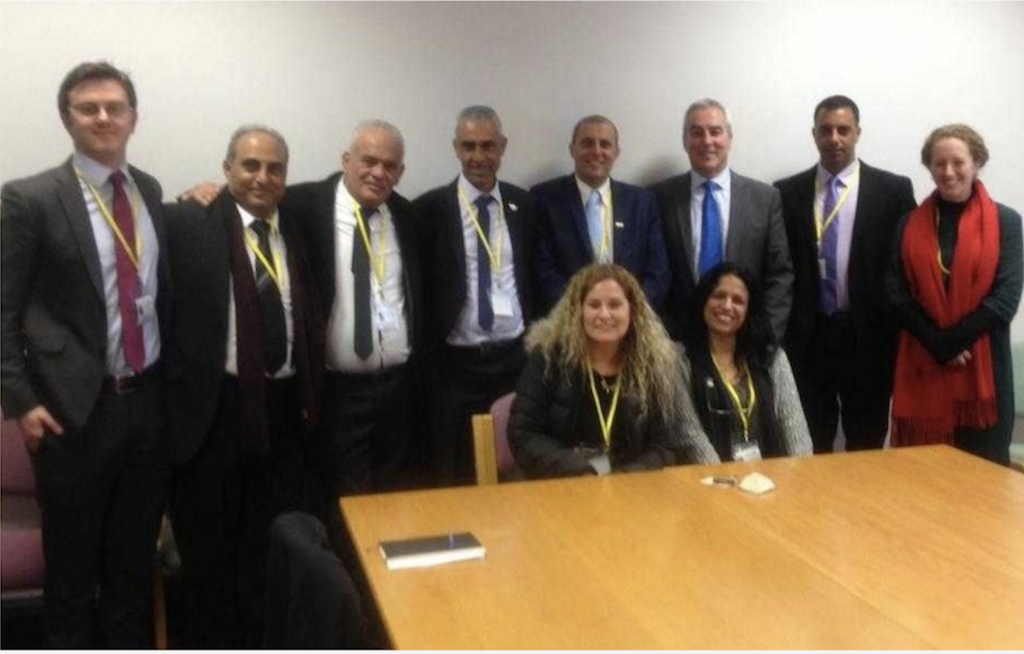
In June 2019 a delegation from Israel's Likud party visiting Belfast where they met with Sinn Féin members, including Pat Sheehan. Seven men with suits and ties stand at the back, one woman standing on the far right. Two women are seated at a polished wooden stable in front of the standing members of the delegation.
In June 2019 a delegation from Israel’s Likud party visiting Belfast where they met with Sinn Féin members, including Pat Sheehan.

While one may argue that no party gets it right all the time, but relies on the processes of democracy and transparency to hold it and its members to account, the lapses and discrepancies above are telling. This is particularly the case in view of Sinn Fein’s ever-developing habit (albeit one indulged equally by other tendencies of the Irish Left) of dismissing any party or electoral candidate that can be perceived as not adequately committed to the grand socialist project of getting Sinn Fein into government. “Honest questions [need] to be asked of the various left-wing independents” who supposedly encroached on Sinn Fein’s electoral turf during the 2020 election, we’ve ben told, while “the various Trotskyist parties” have also been criticised, fairly, for the overtly factional electoral strategies introduced in certain constituencies (including Dublin Bay North).

Voting records show that socialism comes second for Sinn Féin

Critique, of course, is a necessary part of the political fray, radical or otherwise. But the fact remains that “honest questions” could equally be asked (and have rarely been answered) of Sinn Fein regarding its penchant, both locally and nationally, for rejecting or abstaining on votes of key social concern, including public housing, and most recently the Special Criminal Court (which continues to be opposed by Amnesty International). Put bluntly, the party seems forever capable of conceding its political principles to appease or reinforce the consensus of the political establishment; in some instances (such as abortion rights and the campaign to repeal the eighth amendment), moreover, key political figures in the party have proven skilful in adjusting their profile to reflect the radical tide of public opinion, after the high-water mark has been reached. Observing this pattern, one writer dubbed this “The Adaptable Sinn Fein” syndrome.

The disconnect between rhetoric and reality often seems palpable, and never moreso than when party organisers remind their (considerable) audience that “left-republican politics is best practiced in communities, workplaces, and on the streets rather than in parliamentary chambers.” This is certainly true. But the fact remains that if, as a movement or organisation, your only presence in “communities, workplaces, and on the streets” is promoting your own brand or looking for votes, and if your party furthermore has a proven record of supporting centre-right policies, either as a coalition partner or by abstaining on crucial votes, then your politics comes dangerously close to pageantry. As the cases of Podemos in Spain and Syriza in Greece have shown, if your rhetoric and analysis are centred on socialist revolution, but your tactics and practical goals are designed primarily to increase your party’s chances of getting into government, no matter the cost, you can very easily end up by sending ‘the masses’ home to wait for a radical change that never quite happens: settling for social reforms that can easily reversed by the next centre-right (or even far-right) government that bulldozes in after you’ve failed to deliver, as occurred in Brazil, with the rise of Bolsonaro.

Can Sinn Fein’s socialism meet the demands for radical change slowly coming to the boil, North and South? Time will tell. But Leftists would do well to take heed of Sinn Féin’s 2020 spokesperson on Housing, Eoin Ó’Broin, when he drew the conclusion and caveat in 2009 that in the contest between the party’s republican and socialist tendencies, the latter had always been “relegated to a future point in the struggle, would always be underdeveloped, as the more immediate needs of the national struggle took precedence.”

Filed Under: All Posts, Irish Political Parties

Independent Left Reply to People Before Profit

02/07/2020 by admin 5 Comments

Socialists and left unity in Ireland 2020

To members of People Before Profit,

We commend your initiative, ‘let’s bring the left together to fight this government’.

Although the formation of a conservative government is a threat to working class communities, it is a threat that we can meet.

The fact that Fianna Fáil and Fine Gael have been obliged to come together is historic. For decades, the main voice of opposition to whichever of these parties has led a government was the other party. And as we are all well aware, this was no real opposition at all. Discontent was carefully channelled down pathways that were safe for the Irish elite. Now, however, there is an opportunity to escape into entirely new and radical ways of thinking about the world and to popularise socialist answers to a massive, global crisis.

Sinn Féin will be the largest voice of opposition. This is a significant step forward compared to the old Fianna Fáil and Fine Gael posturing. And because Sinn Féin connect to the same working class communities that we do, there will be plenty of opportunity to both work with them, but also alert our class to the limitations of that party and offer a much more fundamental, revolutionary, change than does Sinn Féin.

When the crisis of 2008 hit, we were not well placed to resist the ‘shock and awe’ policies that saddled Ireland with enormous debt and cowed the trade unions with the scale of cuts that both Fine Gael and Fianna Fáil agreed were necessary to save the Irish ‘economy’ (the wealth of the Irish elite).

The crisis of 2020 and 2021 will be worse, economically. But this time there is a very different mood in the country. One where people will question the government’s priorities and loyalty to an elite who have grown enormously wealthy over the past ten years. Young people, especially, have been emboldened by referendum victories.

A coherent socialist vision for a world in which the wealth is taken off the rich and large businesses to solve the needs of housing and healthcare is going to be crucial. A vision which can assist movements take off at the speed of the Black Lives Matter protests and amplify them when they do happen. Not just on the streets, as you point to, but also with the return of the mass strike: the most powerful form of protest we have.

The role of socialists within these movements must be democratic and open. We can learn from and be led by these new movements. Our spirit should be in keeping with the disability rights slogan of the 80s: “nothing about us without us”.

This vision, as you rightly say, has to be identified with, ‘fighting racism, sexism, homophobia and transphobia.’ Of course, too, socialists should be proudly identified with the campaigns of those with disabilities for equal access and equal opportunity and with the need to help farmers make the transition from a cruel and unhealthy livestock industry to a climate and animal-friendly one. We should demand that public services such as health are taken into full state control, as we have seen the possibilities of doing this during the COVID-19 crisis. We should fight for public housing on public land. We must resist cuts to youth and community services.

The endless growth required by a capitalist society cannot deliver us the technology we need to create a sustainable planet faster than it makes our planet uninhabitable. A society that prioritises money over welfare cannot be green.

With these goals in mind, we look forward to working with you and others in creating a fruitful conversation that does indeed bring the left together.

The members of Independent Left

On 8 July 2020, John Healy of NearFM’s Northside Today spoke to John Lyons, Independent Left, Dublin Bay North about Irish Socialism and Left Unity in Ireland for 2020.

Filed Under: All Posts, Irish Political Parties

Pulling down Statues in Ireland

01/07/2020 by admin 1 Comment

By Shane McNally

On 7 June 2020 the statue of Edward Colston in Bristol was toppled and then thrown in the harbour by Black Lives Matter Protestors

Black Lives Matter.

A call for something so simple such as the basic right to live should not need to be the cry of a movement in the twenty-first century, but it is. Black lives are treated as lesser lives: from the ingrained racism of individuals frothing at the mouth to insist ‘all lives matter’, to state sanctioned violence that kneels on the neck of the black body. Black lives are paid less, provided with less opportunity, are jailed more and die in greater numbers through austerity and marginalisation. The struggle of BLM is one of class and identity, the latter under assault by the multifaceted culture war that is contemporary identity politics. The former is attacked by the right in their targeting of class consciousness and solidarity on every front that is opened up.

The latest being statues.

Should Statues Be Pulled Down?

‘We view the past, and achieve our understanding of the past, only through the eyes of the present.’ Socialist historian, E.H. Carr.

Statues resonate as symbols of power and that which must be eulogised: what and who must be ingrained in memory. The function of statues is not just to remember a name but an action. And as statues have typically been raised by people who are carrying out their own acts of exploitation and injustice, they often obscure the past while preserving power structures in the present. The toppling of the Edward Colston Statue into the very harbour slave ships docked was an act of symbolism as much as one of anger. Colston was heavily involved in the slave trade, but the Victorian elite of Bristol who erected the statue in 1895 chose to hide this in favour of emphasising his philanthropy later in life. Nothing was mentioned of tens of thousands of slaves who died before they even reached American shores. The British Empire at this point in the late nineteenth century was reaching its apogee. The raising of such statues does not happen outside of history, but is inherently part of constructing the past.

As Ash Sarkar said on Novara’s #TyskySour, ‘statues don’t go up by accident’, they need to be maintained’ and in doing so they have a symbolic importance as well as a narrative.

Ash Sarkar tweet soon after the Colston statue was toppled in Bristol, 7 June 2020. @AyoCaesar 8.20pm: Chucking that statue in the harbour has educated more Brits on the history of the slave trade in this country than leaving it up for 150 odd years did. Can't argue with the end of season stats bro.
Ash Sarkar tweet soon after the Colston statue was toppled in Bristol, 7 June 2020.

‘Rhodes Must Fall’ was a campaign decades in the making, directed at another colonialist who had been elevated in the present. Cecil Rhodes was the individual whom Rhodesia was named after. He was ingrained into the fabric of colonial history and venerated in the centres of empires. The Rhodes Scholarship is one the most esteemed international scholarships. His name is embedded in the educational hierarchy. His statue and the scholarship carried out in his name, however, are attached to a man who believed in the greatness of the British Empire. Rhodes was a colonist and a racist who believed, ‘we are the first race in the world’.

High above the entrance to the Rhodes Building, Oriel College Cambridge is a statue to Cecil Rhodes. The image shows Rhodes in white stone against a yellow stone building with four lead-lined rectangular windows either side of him.
High above the entrance to the Rhodes Building,
Oriel College Cambridge is a statue to Cecil Rhodes.

It has taken decades for Rhodes to fall, but now as a result of protests stemming from the killing of George Floyd, Oriel College, Cambridge will decide by the end of this year the fate of the statue, crucially in consultation with the ‘Rhodes Must Fall’ group. Yet there are powerful figures on the opposite side. As recently as 2016, there were warnings from donors to Oriel College that if the statue was removed, up to £100 million in funding would be withdrawn. The rallying cry of these millionaires is that, ‘they are attempting to re-write history’. The contrary is true, the presence of Rhodes’ statue is a continual re-writing of history; it is a symbol of a patriarchal figure who bestows a prestigious scholarship on a select few, obfuscating the source of his wealth: extraction through colonialism.

As of 2013 at Rhodes University in South Africa, ‘83 percent of senior management staff remain white and 77 percent of “professionally qualified staff,” a category that includes academic teaching staff, are white.’ This is where the Rhodes Must Fall movement began, in an institution to this day that is hierarchically white. Rhodes’ message of ‘the first race’ in the world is perpetuated through social elites in the very lands stolen by the British Empire. The presence of his statue remaining legitimises this, as it silently articulates the message that we must look up to him and remember him as benevolent and a man to be deferred to. His statue is a symbol of oppression that continues to colonise the mind as well as placing the figure of Rhodes centre stage in some the most prestigious universities in the world.

Why is the Seán Russell statue, Dublin, being targeted?

Closer to home the ‘statue debate’ has opened up some new (old fronts) from bad faith actors. One such is the controversial statue of Seán Russell, a statue whose presence has been much debated in the past and which has a history of being defaced. The character of Russell is a complicated one: a revolutionary of 1916 who took charge of the IRA in the thirties; a decade that saw the rise of the Blue Shirts, a Conservative Catholic state, and a renewed violent push from the IRA. Russell sought assistance from both the Soviets and the Nazis in the thirties and died on a Nazi U-Boat returning from Germany. It is widely noted that Russell was a military man first and foremost and focused on Irish liberation. Historians agree on this. Russell was emblematic of an aspect of Ireland in the thirties and his statue that has always been a conduit for contemporary political narrative. The latest being Sinn Féin bashing from Fine Gael councillors. A new old story.

Bronze statue of Seán Russell, Fairview Park, Dublin. Russell is in a long coat and holding a hat in his left hand. He is on a plinth, facing to the viewer's right. Green trees fill the background.
Bronze statue of Seán Russell, Fairview Park, Dublin

‘Russell’s statue has been over the decades since its unveiling, been targeted by both the left and the right, being accused of both communism and fascism.’ A quote from the National Graves Association representative sums up this contested history concisely:

In recent years, there have been repeated attempts by some, in both, the Irish Media and establishment, to further this image of Seán Russell as a fascist. This is in fact a good example of revisionism at work. To criticise Russell as a Republican is fair enough if that’s one’s viewpoint. But false character assassination is entirely a different matter. That is both politically and historically, dishonest, immoral and underhanded. This is particularly the case when it comes from members of political groups with far, far closer historical links to Ireland’s fascists than any of Seán Russell’s comrades.

There is a debate to be had about statues in Ireland as a whole, but the controversy over the Russell statue is awash with bad faith arguments by Fine Gael to break up the front that has opened up with the international movement against symbols of racism and oppression. This only serves to dilute the reason for the questions being asked: statues are being torn down to put history to right, for restitution, for justice. A lot of the answers to these questions will not be binary, but complicated, such as statues of individuals involved in the founding of the state.

State Racism in Ireland is evident in Direct Provision

Ireland has statues and areas named after colonial oppressors; a bloody and messy foundation to the state that is rarely, if ever, brought up unless it is to muddy a contemporary political argument. What is also lost in all of this is that we actively oppress people who have migrated to this state on a daily basis through Direct Provision. Direct Provision is how we mistreat people who are migrants and those seeking asylum in contemporary Ireland. We don’t have statues of Colston, but corporate symbols.

History is certainly not binary and there are problematic individuals whose legacy liberals will often defend, using phrases about context and different times. That doesn’t answer why they need to be immortalized in prestigious institutions and centres of towns. What does begin to answer why these statutes take centre stage is that there are public spaces dominated by some of the most horrific tyrants in history. Figures such as King Leopold II, responsible for millions of deaths in the Belgian Congo in the most brutal and comprehensive extraction of resources, who has memorials and statues all over today’s Belgium. The current Black Lives Matter protests have spread and are turning the tide and Leopold’s statues being torn down. Every statue torn down or questioned is a strike against the layers of injustice that are present in everyday life, from tyrant to state-revered slave owner.

No statues of tyrants should be anywhere near public spaces. Tear down spaces and symbols of oppression and create spaces for all of the stories and lives that have been obliterated in the name of empire and capital. They offer nothing other than the legitimisation of past and current oppression. The function they serve is not for historical purposes, but for the retention of hierarchy and class division.

The most honest and justified action was dumping Colston in the river. That was making history and restoring narrative power to the oppressed. True solidarity with this movement in Ireland would be to pull down our own racist institutions. Statues are focal points of contested history, an ongoing battle in the class war.

Filed Under: All Posts, Protests Ireland

Black Lives Matter: a view from the streets for Irish socialists

04/06/2020 by Conor Kostick 1 Comment

An interview with Paige Graffunder, Seattle 3 June 2020

“It’s going to escalate until the police are gone”: a massive revolt against murderous police racism rocks the USA.

Paige Graffunder is an activist in Seattle, involved with Revolution Books and Black Lives Matter Seattle.

For the benefit of socialists in Ireland, where many of us see events through official news channels, which never drill down enough, I’m hoping you can give our readers some insight into what’s happening on the ground. Maybe you could start by telling us who is actually organising the protests?

There’s a bunch of groups. Unfortunately, a lot of activism in the United States kinda exists in a ‘diaspora’, because as soon as you get too many people you immediately get labelled a terrorist organisation because we have a fascist in office. A lot of it has been Black Lives Matter, because Black Lives Matter is actually big enough in Seattle that they actually have an office. In general, it’s not really an organisation, it’s an ideal.

The primary motivation of Black Lives Matter is equality and equity for the black community: stop getting killed by a militarised police force; achieve more equal statistics for punishment on crime (63% of all violent crime in this country is committed by white people, yet 70% of the prison community is black). That’s their main focus but through that they’ve built this community system where everybody takes care of each other.

Black Lives Matter logo. A yellow image on a black background. A stylized left hand is clenched in a fist, around which like a halo is written: Black Lives Matter in an old 'zine font.
Black Lives Matter

So essentially, they’ve built socialism. Right now, for example, I’ve just got back from dropping off field medi-kits and water bottles and a bunch of other stuff to their office in Central District. They just provide so much to the community by way of support. Anyone who can help, does help.

And is Black Lives Matter aligned to the Democrats?

No, not at all, the Democrats hate us too. We’re leftist, without any particular political affiliation.

Roughly how many organisers would Black Lives Matter have in Seattle?

Personally, I know about twenty-five organisers for these particular protests but there are so many. And again, who is an organiser depends on who is stepping up to the plate. There’s no hierarchical leadership; it’s not really an organisation. It’s a community effort.

Presumably people who’ve never done anything like this before are getting involved.

Absolutely. As soon as they saw the first night of protest here (30 May 2020) in Seattle, which went very badly. There was four hours of totally peaceful protest; there was seven feet between the protesters and a line of police. The protesters were sitting down. Then, with literally no warning, there was no command, they just shot tear gas into it for no reason. That first protest was probably around a thousand people, but after seeing what happened, last night (2 June 2020) there were eight thousand people on the street. Bear in mind we had called May Day off – historically, Seattle has a riot every first of May, laughs – we cancelled that because of the coronavirus. But this is bringing people onto the street despite the virus.

Is there much of a socialist presence in these protests?

Here there is. We have the People’s Party and Socialist Alternative, both have a big membership and strong turnout. Councillor Kshama Sawant, has been out every day, she stays every day, which is awesome.

I was wondering whether this movement has been so explosive, not just because of the continual murders of black people by the police, but also because the black community has suffered more heavily from the virus, such as by not having access to the same level of health care?

Here’s the thing. This is one of those straw that breaks the camel’s back moments. The murder of George Floyd was awful and here, literally the week before, we had cops wrongfully and mistakenly enter an apartment building and kill a woman while she slept. This happens all the time. Plus, on top of five hundred years of slavery, segregation and oppression and coronavirus, the American medical system kills more black people than cops do. Their problems go largely ignored; they just don’t receive the same level of care.

Looking at this movement from the other side: are the authorities (with Trump at their head) going to regain control of the situation?

No. I don’t think so, because every time they escalate, it just draws more people. Nobody paid attention to the curfew. The curfew in Seattle is 7pm, although I need to explain more about this. The curfew does not apply if the protest is designated ‘peaceful’ because that would be a violation of First Amendment rights.

A line of heavily armoured police with batons is formed up on a street with shops in the background.
The more the police escalate the violence the more protestors take to the streets

There’s a lot of coverage of violence here. To what extent is that the work of protesters?

It’s not, not initially. And actually, they are caught on video and most of the time it’s undercover cops.

What steps are activists taking to try to cut down on arson and looting?

Seattle hasn’t had any arson around the actual protests since the first day. Protesters are not breaking into buildings or anything like that. Seattle is very good about listening; our whole thing here is anti-racist, anti-fascist, only Seattle. So the city is very good at listening to who needs to be listened to. When black organisers and people of colour say, ‘no, we’re not doing this and if you see someone doing this you must stop them,’ people listen.

Can we just focus on that? Because it seems to be a really important issue. Who has the authority to say to the demonstrators, ‘no, we’re not doing this’? And how do they communicate?

There’s not like a figurehead. There have been two people recently who have gotten in front of a megaphone more than others, but there have been some questions about their motives to do that because they have been unreasonably willing to listen to empty promises. The mayor, Jenny Durkan, came out yesterday and spoke to these two in front of the protest and they were like, ‘oh yeah we don’t want to see it get violent’. And the crowd were responding, ‘well then, deauthorise the use of CS gas, of tear gas.’ The Mayor turned around and she literally ran.

And when the crowd were, ‘fuck the police’, one of these ‘leaders’ told them to ‘shut the fuck up.’ So who is leading changes day by day and most of this information gets disseminated by social media. Enough people said, ‘listen to the black leaders,’ and now people listen. And they are listening to women, ninety-percent of the ‘leaders’ here are women.

And it’s really funny watching people get a crash course in revolutionary practices. I know more people who know how to de-arrest now than I ever did. I’m pretty sure that every housewife on my block knows how to put out a CS canister and what to do if you’re hit by a rubber bullet. I’ve personally instructed about a hundred people on how to do field sutures.

Please tell us more about your day, what’s your day like in this crisis?

I’m extremely medically fragile, so me being on the street is not a thing. I help in other ways. I’ve been making about a hundred to two hundred med kits every day. A wash kit, gauze, bandages, a field kit with sutures.

A friend and I built a script that takes all of the feeds from the traffic cameras. We can isolate certain blocks and streets so we can keep an eye on things aerially. Also we monitor the public scanner of the police. The cops here are covering their badge numbers and their body cameras are turned off. The National Guard were wearing their helmet cameras the first days they were here. They aren’t any more. So there’s not accountability. It’s our live feeds and traffic cameras against what they say and unfortunately, historically, that has gone very badly for us.

Is there anything you’ve seen that we wouldn’t have been able to view via our main TV channels?

There’s so much that you haven’t seen. For example in New York, cops have been mowing through the crowds as by orders of NYPD. I’ll share an audio file from a police scanner, of New York cops being authorised to drive through the crowd (press the image below).

And here’s a picture I took last night of a kid, probably sixteen or seventeen confronting some fifty cops. Sorry it’s not that clear because the camera was covered with CS gas.

It is night, a foggy camera (obscured by CS Gas) shows a young man facing a line of bright lights, which are being held by Seattle police.
Teenager confronts a line of cops 2 June 2020, Seattle

What’s happening with the activists who have been arrested?

Since Friday everyone who has been arrested has stayed in jail for the most part. They’ve closed the courthouse down and they are not holding bail hearings for non-violent offenders, so essentially people are being held, there’s nothing. Seattle doesn’t have a large jail so in the age of coronavirus, that’s really terrifying. We instruct everyone to write telephone numbers on their bodies, legal defence funds, but a lot of legal advocates are unable to get access to the courthouse. There are thousands of legal aid funds and people wanting to show solidarity with us can donate to https://bailfunds.github.io/.

Looking back at the late 60s, early 70s, the radicalised black movement, especially in the form of the Black Panthers, took bearing arms against the state about as far it could and ultimately got marginalised. How can it win this time?

Really, the Black Panthers were radicalised by the state. The Black Panthers started the free lunch programme. Everyone has this image of the Black Panthers running around with guns all the time, being intimidating. It’s not actually the case. The Black Panthers being armed was a response to the police state.

Yes, but if that happens again now, I think it will only ever be a small minority taking up arms and that it will lose.

I don’t think that’s actually the case. Even here, with our two socialist council members and $16 minimum wage, the logo for Seattle is ‘coffee and guns’. We have Starbucks and guns. Even here, if they start firing with live rounds instead of rubber bullets, well there’s more of us than there are of them. What are 700 cops going to do against ten thousand armed people?

Well, if the ten thousand are prepared to take over, that’s fine. My concern is that the strength of the spontaneity is also a weakness. What’s to stop it degenerating into something like the Weathermen?

Fair, but there is no way to overthrow something, to end a regime, without violence. Do you think the French walked up to Versailles and said, ‘pardon’?

I think there has to be a mass movement behind a successful insurrection. I’m trying to get a clearer picture of this movement. I’d just be worried that Trump will escalate the crisis and there will be saboteurs trying to create horrific examples so as to have a backlash. And in the past I feel that the American elite have learned to isolate radicals in this way. But your feeling is that if they start using live rounds the movement will hit back. Are we on the edge of such a scenario?

Any good will that the cops still have, if they take live fire at United States citizens, especially at the behest of the military and the national guard: it’s gone. Literally half of what Trump said yesterday was about using the Insurrection Act to deploy the regular military, not just the National Guard, into states without the permission of governors.

If that triggered a popular response and your ten thousand people swept away the police, what would happen next?

That’s a really hard question because of the diaspora of leadership. That becomes a problem because nobody has a single point to rally around. Seattle, however, has a pretty remarkable city council and more than normal activity when it comes to civic duty. Our voting is very high. So I can’t imagine that the city officials – who, with the exception of the Mayor, have been largely on the side of the protestors – would allow confusion to go on for too long.

What would victory look like? What would the protestors consider a victory?

Defunding of the police and a complete start from scratch. The cops in the US are descended from slave catchers and they haven’t stopped that. Enforcing a racist system makes you a racist. Without a complete dismantling of the system and rebuilding, this doesn’t get solved. I’m sure that’s not the goal for everyone but it is the goal for the majority of the people.

So jailing the cops concerned isn’t enough?

No, it’s too late for that. If they had done that at the beginning, most likely this wouldn’t be happening. But they didn’t.

A protestor holds up a green banner on which is written: We Demand Police Accountability.
The murder of George Floyd has triggered
a movement that challenges the entire
nature of the police

They waited until that cop’s life was in danger and then they arrested him to protected him. His wife left him to protect his assets. It’s so transparent that it’s almost laughable. Here, we were watching the protests last night and I had two live feeds, one from the ground and one from the air, plus the traffic cameras and every crowd member was staring down the cops, shouting, ‘you protect property, we protect the people.’

What’s going to happen next?

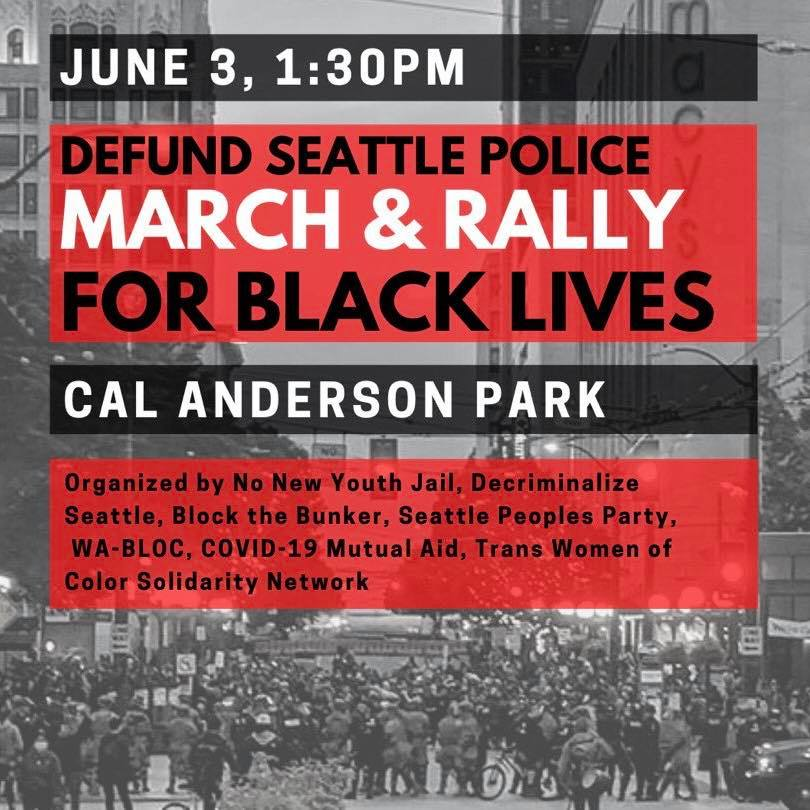
There’s big protests and there’s always little ones too. Today they are holding a specific rally to defund the police.

A flyer for a rally in Seattle to Defund Seattle Police, 3 June 2020

Are the police going to lose?

I honestly can’t imagine this going any other way. It’s going to escalate until the police are gone and it just gets worse every night they take unprovoked action, which is every night. And every day there’s more people on the protests.

Filed Under: All Posts, Protests Ireland

Review: Reading ‘Capitalism in the Web of Life’ by Jason W. Moore after COVID19

02/06/2020 by Ciarán O'Rourke Leave a Comment

A glass sand timer stands on the left of the image against a stark black background, resting on a white table. Inside the top half of the glass is a miniature tree in sandy soil. Underneath is the skyline of a modern city. The image evokes an impending collapse of the web of life by capitalism.
Entwined and destructive, capitalism undermines the web of life.

A few weeks into the current lockdown, as fatalities and reported cases of COVID19 were continuing to rise, news from the frontlines of Ireland’s food production and agri-sector began to arrive, casting an unsettling light on the many – and now overtly dangerous – levels of exploitation on which this cornerstone of the national economy is based.

First, in April, the public learned that Keelings had flown in (and lodged in shared accommodation) almost 200 casually contracted workers to shift the bulk of the coming season’s fruit for market: a decision that seemed deliberately to ignore the health and safety guidelines specified by the HSE’s emergency Coronavirus taskforce. Such a course of action was justified by Keelings on the basis of keeping domestic and global supply chains open, with little comment made as to the risks posed to the fruit-pickers themselves, their families, and, indeed, anyone in contact with them, as a result of company policy.

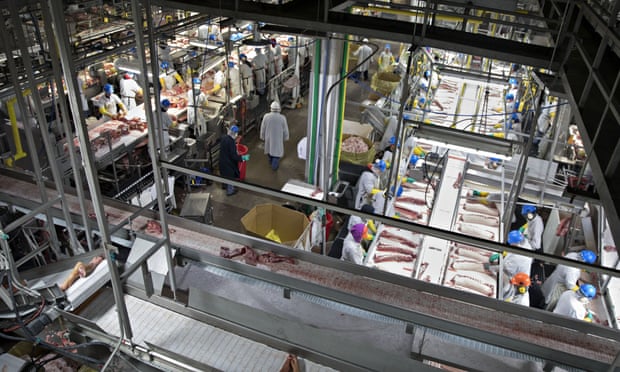
This reckless managerial focus – on meeting previously projected revenue margins, at workers’ expense and during a global pandemic – reared its head again in a similar, if even more disturbing, case of industrial recalcitrance in May, when an outbreak of the potentially lethal virus was recorded in a number of Irish meat factories. The sub-heading to The Guardian newspaper’s coverage of the scandal was appropriately ominous: ‘Workers share COVID19 fears over lack of social distancing, crowded accommodation and being forced to buy their own PPE [Personal Protective Equipment]’.

Viewed from high up on a gantry, white-coated workers are working on production lines of slabs of meat. An Irish meat plant: where despite the outbreak of COVID19 clusters, workers and animals were subject to 'business as usual' practices.
Irish meat plant: where despite the outbreak of COVID19 clusters, workers and animals were subject to ‘business as usual’ practices.

The story makes for difficult reading, exposing a culture of normalised exploitation and industrial slaughter, in which low-paid, poorly contracted migrant workers ‘feel intimidated and vulnerable’, unsure of their legal rights, and fearing for their medical safety, with one whistleblower also expressing his combined horror and sadness at the cruelty with which, even in normal circumstances, Irish cattle are butchered and turned into meat. In such a scenario, COVID19 posed an immediate threat to the life and health of factory employees; and yet the overall impression the interviews conveyed was that, from the point of view of both the workers and the animals they were dealing with, business as usual was a systematically ruthless and dehumanising affair.

Although occurring five years after the publication of Jason W. Moore’s book, both incidents could be cited as living (if also quite morbid) proof of the validity of his central argument: that ‘Capitalism is not an economic system; it is not a social system; it is a way of organizing nature.’ Cheap labour, migrant and working-class bodies, brutalised animals, rigorously schematised seasonal cycles, are all – equally and as a whole – fodder for the relentless pillage, the forever-primary drive for profit, that is capitalism’s life-in-the-world.

Capitalism in the Web of Life is a critique and revision of environmental concepts and approaches, rather than a miscellany of insights into present environmental struggles (as in Naomi Klein’s This Changes Everything: Capitalism vs The Climate, for example). Such a focus, however, is not necessarily negative: what Moore’s analysis lacks in activist-oriented urgency it arguably makes up for in the expansiveness of its critical scope. Moore’s writing is that of a sincere, discerning and formidable critic of ecological and political arrogance, both capitalistic and leftist; and crucially (against that most insidious of critical bugbears) he is methodical and convincing in suggesting an alternative series of attitudes and understandings.

The book cover of Capitalism in the Web of Life, by Jason W Moore. The book is facing a little to the right, so the spine can be seen and the V for Verso logo of the publisher. It is a simple cover with white writing on a black background. The only art is a white twisting column that suggests smoke rising from a fire.
Capitalism in the Web of Life, Jason W. Moore

As implied by the title, Moore sets out to dismantle the distinction between humanity and nature, industrial civilization and the environment, as binary, separate forces, and instead proposes a long-view and multi-faceted perspective: one that recognises how dependent human activities and power dynamics are on natural seasons, cycles, and ecosystems. We change them, Moore argues, and they change us, continuously: and it is on such a ‘world-ecology’ that the success of future efforts to disband and replace neoliberal civilization with radical and sustainable communities-in-process will depend. ‘A capitalist looks at a forest and sees dollar signs,’ Moore observes,

an environmentalist sees trees and birds and soils; a world-ecologist sees how humans and other species have co-produced the forest, and how that “bundled” forest simultaneously conditions and constrains capital today.

At first glance, the significance of such an argument may seem somewhat remote: an example of the kind of linguistic and theoretical tinkering that only an academic Marxist could afford to spend their time discussing or disputing. But as Moore’s analysis unfolds, its pertinence to contemporary anti-capitalist struggles is clear to see. ‘Yes, diseases make history,’ Moore notes, but only insofar as they (and the conditions that intensify their effects) are understood as ‘bound to commerce and empire’.

So today, as historian Mike Davis and others have also argued, the COVID19 pandemic itself may be viewed as having its origin in – its capacity to wreak so much damage stems from – the networks of relentless intervention and attempted control (over bodies both human and ‘natural’) that sustain the capitalist project globally. Broadly speaking, the same may be said of the climactic and civilisational dangers that accompany continued carbon emissions, or global warming. In Moore’s terminology, capitalism’s ‘way of organising nature’ is inherently destructive of the ‘web of life’ on which its own existence (along with everything else) depends. Or as Karl Marx observed:

All progress in capitalistic agriculture is a progress in the art, not only of robbing the labourer, but of robbing the soil; all progress in increasing the fertility of the soil for a given time, is a progress towards ruining the lasting sources of that fertility […] Capitalist production, therefore, develops technology, and the combining together of various processes into a social whole, only by sapping the original sources of all wealth: the soil and the labourer.

To his immense credit, Moore treats the latter perception less as an aphorism to be glibly quoted than as a key to a palpable, dialectical conflict in which we are, collectively, enmeshed. Likewise, recalling Marx’s earlier recognition of ‘the merciless vandalism’ with which land usage in both England and Germany had been standardised by way of ‘the expropriation of the great mass of the people from the soil’, Moore surveys the twenty-first-century vista of global, market-driven, genetically modified industrial agriculture as a field of combined ecological and material violence. He concludes:

We can say with some confidence that food – not just land – has become a central site of the world class struggle in a way that is entirely unprecedented, and unthinkable even three decades ago….. As neoliberalism’s [manufactured] definition of food has rolled out – shifting from the Green Revolution’s caloric metric to the ‘edible food-like substances’ that now line our supermarket shelves – it seems to have made food, and by extension nature, much more fundamental to the Old Left questions of liberté, égalité, fraternité than ever before. The class struggle of the twenty-first century will turn, in no small measure, upon how one answers the questions: What is food? What is nature? What is valuable?

So it is, Moore suggests, that campaigns for food justice, for ethical and non-industrialised farming, for environmental sustainability, for ecological restoration, all drive to the heart of the toxic, earth-spanning, wage-devouring monster that is the modern capitalistic world-order (or disorder). At the same time, these seemingly specialised movements challenge activists to sharpen our understanding of what we mean by – how we envision and situate ourselves, our resources and our relationships within – that horizon of political emancipation that draws us forward.

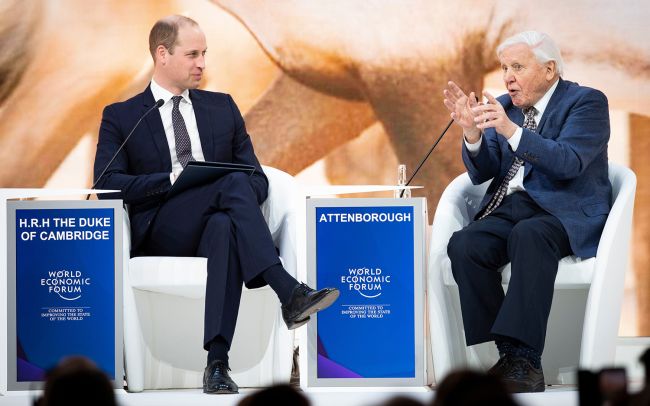
Moore’s critical perspective is illuminating, his meticulous dissection of capitalist accumulation most incisive when he relates his analysis to the tensions and contradictions of our present moment. Moore is refreshingly and emphatically opposed, for example, to the likes of Sir David Attenborough, for instance, who in an interview with the so-called Duke of Cambridge at the World Economic Forum at Davos last year stated that ‘the Anthropocene, or age of humans’ was effectively to blame for climate change.

William Windsor and David Attenborough seated at the World Economic forum. Attenborough is on the right and is making a point with raised hands in an animated gesture. Windsor looks like he is trying to contain a smirk. There is a backdrop of some large brown animals and a foreground of the tops of the heads of the audience.
David Attenborough and some inexpert but well-suited male at the World Economic Forum 2019.

‘The Anthropocene makes for an easy story’, Moore writes,

Easy, because it does not challenge the naturalized inequalities, alienation, and violence inscribed in modernity’s strategic relations of power and production. It is an easy story to tell because it does not ask us to think about these relations at all. The mosaic of human activity in the web of life is reduced to an abstract Humanity: a homogeneous acting unit. Inequality, commodification, imperialism, patriarchy, racial formations, and much more, have been largely removed from consideration. At best, these relations are acknowledged, but as after-the-fact supplements to the framing of the problem.

Such skepticism of ‘The Anthropocene’ and its eloquently embedded public advocates in the Euro-American climate movement is well-founded, as even a cursory examination reveals: of Attenborough himself, who previously has posited famine as an acceptable natural check to the supposed ‘disaster’ of ‘overpopulation’ in the global South, or a figure like Michael Moore, whose most recent film gives credence to the same Malthusian and racist world-view.

By contrast, Moore’s work correctly pins the blame for impending climate collapse on the the globe’s expropriators-in-chief and the systematised practices that serve them, insisting that the fight for an ecologically sustainable society and future is by nature a struggle against ‘[i]nequality, commodification, imperialism, patriarchy, racial formations, and much more’. Moore’s sober, but clear-eyed discovery is a valuable one: that we are both riven and empowered by our own interconnectedness; that with so much at stake, so much already lost and gone, disfigured and deranged, we still, together, have a world to win.

Filed Under: All Posts, Reviews

  • « Go to Previous Page
  • Page 1
  • Page 2
  • Page 3
  • Page 4
  • Page 5
  • Page 6
  • Interim pages omitted …
  • Page 14
  • Go to Next Page »

Copyright © 2024 · Aspire Pro on Genesis Framework · WordPress · Log in