• Skip to primary navigation
  • Skip to main content
independent left logo

Independent Left

Environmentalism, socialism, freedom and equality. #liveablecity

  • About
  • Featured Articles
    • How Farming Must Change to Save the Planet
    • The Housing Crisis: Causes and Solutions
    • Socialism in Ireland
  • Contact Us
  • Podcast
  • Animal Rights
  • Archive
    • Irish Socialist History
    • Dublin City Council Housing
    • Ukraine
    • Protests Ireland
    • Reviews
    • Irish Political Parties
    • All Posts
    • Independent Left Policies
  • Why join?

Features by Conor Kostick Independent Left

The Shock of Climate Change, the Awe of Geo-Engineering

17/09/2019 by Conor Kostick 2 Comments

A vast cloud of smoke issues from an active volcano; streams of lava pour from the cone.
Past volcanic eruptions serve as a warning against solar geoengineering

Even if human society immediately managed a complete stop to the emission of carbon, we will fail to achieve the target of the Paris Accord of 2016, of keeping the increase in planetary temperatures to under 2% above pre-industrial levels. And of course, carbon emissions, far from coming to an end are increasing. There is no doubt that dramatic climate change is underway and it is not slowing down.

We are in very big trouble as a species unless we invent miracle solution to global warming. And as the crisis crows, so does momentum behind a project that has striking parallels with the Manhattan Project, the 1941 assembly of scientists at Los Alamos that eventually led to nuclear strikes on Hiroshima and Nagasaki and the danger (that remains with us) of nuclear winter for the planet.

The risks of Geo-engineering

The project I’m referring to is that of Geo-engineering the planet’s atmosphere and in particular, the plan to apply the stratospheric aerosol injection (SAI) of chemical compounds. The idea is to pump sulphates (dust) into to the upper atmosphere so that solar radiation is back-scattered into space.

Behind the push for a Geo-engineered solution to global warming are backers such as the Bill Gates Foundation and the idea is gathering momentum. You can see the growing number of geo-engineering projects via map.geoengineeringmonitor.org, which shows that there were more than eight hundred projects in 2017 (compared to three hundred in 2012).

SAI is an idea that will work. We know it does because when, in the past, such as in 1815, massive volcanic eruptions blasted dust into the stratosphere, the next year or two saw global temperatures drop by as much as five per cent. SAI scientists are attempting to recreate the effect of these volcanoes artificially.

A cartoon of a volcano beside a ballon, both pushing dust above the stratosphere. Sunlight, drawn as a yellow arrow, partially bounces off the veil of dust.
Solar engineering mimics the effect of powerful volcanos
Source: https://commons.wikimedia.org/wiki/File:SPICE_SRM_overview.jpg

One of the parallels between the Geo-engineering drive and the Manhattan Project, is that several of the scientists involved in this research have claimed that the technology will never be used. They are developing the technology… ‘just in case’. But as the climate crisis unfolds, panic measures will be implemented and any new technology that we have available to address global warming will be considered in earnest, no matter now risky.

And there are massive risks with this apparent solution to global warming.

One important point to make about SAI is that it would not change the density of carbon in the atmosphere and therefore it would have no impact on effects such as the acidification of the seas. Secondly, SAI could allow companies and countries to avoid a fundamental solution to the burning of fossil fuels. In fact, petrochemical companies have expressed an interest in supplying the sulphates needed for the project, which would be paid-for by taxpayers. If implemented, SAI represents a huge win for them.

The most common objection to SAI geo-engineering is a strong one: how do we know what the consequence will be? Predictions of what will happen depend on computer models for the atmosphere and at the current time, these models are nowhere near accurate enough to be confident about the impact of SAI. Given that important global phenomena like the North Atlantic Oscillation and the El Niño-Southern Oscillation have yet to be successfully modeled, we just cannot predict what will happen on a global scale, let alone a regional scale. It is very likely that filling the stratosphere with sulphates will not only cool the planet but it will create major turbulence and extreme weather events. Particularly important here is the effect on rainfall: it is quite possible an overall cooling of the planet through SAI is accompanied by devastating floods and droughts at a regional level.

My own concern about SAI arises from my research into the societal consequences of major volcanic eruptions. Let’s suppose humanity starts on the SAI approach, we are then caught in a very dangerous situation, where every year we will have to keep up the practice filling the stratosphere with particles. And as soon as we stop, the underlying crisis of high planetary temperatures will reassert themselves. But what would happen if during this process a major volcano erupted? The dumping of tonnes of dust into the stratosphere on top of the human effort will have devastating consequences. There will be a year or two without summers, crop failure on a massive scale and enormous economic dislocation as planes are grounded for months.

I’m looking at the medieval world in particular, where life was far more precarious than our own. But we cannot be complacent about the potential for resilience today. Modern society in some ways is more vulnerable than that of our medieval predecessors. Just-in-time production and the inter-dependency of the world economy means that if international trade is grounded for several months, the consequences would be shocking.

After the 2010 Icelandic eruption of Eyjafjallajökull, air traffic was affected in some regions for up to a month. This was a volcanic eruption of about one tenth the size of those I’ve been researching in the historical record.

My point is that as the geo-engineering option becomes more appealing in the face of increasingly damaging consequences arising from global warming we will lose track of the bigger historical picture in the hope of a short-term fix. But what this wider perspective demonstrates is that sooner or later a major eruption will happen that brings its own challenges. And if we have already saturated the atmosphere artificially with sulphates when it does, we are going to bring about a year or two of unforeseen, incredibly cold years of massive economic dislocation and crop failure.

Awareness of the dangers of Geo-engineering needs to grow

There is no governing body that can stop a figure like Donald Trump from beginning this process. Geo-engineering on sufficient scale to cool the planet would cost about a billion dollars. That’s relatively cheap to implement. And this brings imperial considerations into play. There is nothing to stop a rich country, which also is relatively protected from unpredictable consequences from going ahead on their own. Nothing, that is, except the opposition of their own population. That’s why awareness of the dangers of geo-engineering needs to grow, especially among those protesting on 20 September.

This post was originally written for We Only Want the Earth, a Facebook page curated by Dave Lordan to build support for the global climate strike 20 September 2019.

You can download an academic chapter that deals with the topic in greater depth by clicking here.

And below is an interview between myself and Pat Kenny of Newstalk about the dangers of GeoEngineering:

Filed Under: All Posts, Independent Left Policies

Fifty Years After the Birth of the modern Irish Republican Army

02/09/2019 by Conor Kostick 2 Comments

In August 1969 British Army arrived in Northern Ireland and despite being called ‘peacekeepers’, soon began to police the nationalist community.

In Arundhati Roy’s 2011 Walking with the Comrades there is a moment where she recaps the stories of Ajitha and Laxmi, Maoist guerrillas in eastern India. They became fighters after the Salwa Judum, a state-supported militia, attacked their villages.

The Judum came to Korseel, her village, and killed three people by drowning them in a stream. Ajitha … watched them rape six women and shoot a man in this throat.

         Comrade Laxmi, who has a long, thick plait, tells me she watched the Judum burn thirty houses in her village, Jojor. “We had no weapons then,” she says, “we could do nothing but watch.”

         Arundhati Roy is not an advocate of a guerrilla strategy and therefore was torn when she heard about an execution of a leading member of a district council carried out by the Maoists:

         I feel I ought to say something at this point. About the futility of violence, about the unacceptability of summary executions. But what should I suggest they do? Go to court? Do a dharna in Jantar Mantar, New Delhi? A rally? A relay hunger strike? It sounds ridiculous. The promoters of the New Economic Policy­—who find it so easy to say “There Is No Alternative”—should be asked to suggest an alternative Resistance Policy. A specific one, to these specific people, in this specific forest. Here. Now.

Conor Kostick sat beside Arundhati Roy.
Conor Kostick and Arundhati Roy at the Kerela Literature Festival 2019.

         I was reminded of this passage when reading the August 2019 edition of An Phoblacht and its coverage of the fiftieth anniversary of the upsurge of loyalist attacks on catholics in Belfast and the subsequent appearance of the Provisional IRA. Between 14 and 18 August 1969, eight people were shot dead and around 2,000 families, mostly catholic, turned into refugees. An Phoblacht carries the experiences of some of these who suffered the loss of loved ones, not only from the loyalist mobs but also the involvement of the RUC and B Specials in the attacks. Nine-year-old Patrick Rooney, for example, was shot in his bed when armoured cars fired indiscriminately into Divis flats.

         Ann McLarnon talks about hearing an RUC officer call out to loyalist arsonists to, ‘leave the fenian bastards to us,’ shortly before her husband Sammy was shot dead looking out from his window, having just returned from trying to put out a fire in a neighbour’s house.

         Richard McAuley, a former political prisoner, recalled:

Those organising aid for the increasing numbers of refugees in St Teresa’s needed cars and volunteers to go down to the Clonard and lower Falls to help evacuate streets. It was believed more attacks would occur. I couldn’t drive but I had willing hands. I joined up with Joe Savage who had a mini and we went to Waterville Street at the back of Clonard Monastery to take away belongings and children and elderly folks. An hour or so later, a few yards just around the corner in Bombay Street, Fifteen-year-old Gerard McAuley was shot and killed by loyalists. Bombay Street was totally destroyed in a firestorm of petrol bombs.

The defining moment in the birth of the modern IRA was ‘the Battle of St Matthews’ which took place after dark on 27 June 1970 and lasted until about 3am. Although loyalist paramilitaries, without any restraint from the British Army, began an assault on the Short Strand from several directions, they were held up by republican fighters who earned the admiration of many of the residents. And reading about these events of fifty years ago, I was brought back to the similarity of the account in Walking with the Comrades.

Imagine the warm summer night, made hotter by the flames of burning houses. Imagine the sectarian mob at the end of your street, determined to get you out because of the community you belong to, and imagine too the real danger that someone you love is about to be killed. What course of action should you take? Go to court? Sit in protest at the doors of Westminster, London? A rally? A relay hunger strike? It sounds just as ridiculous as when Arundhati Roy posed these alternatives to herself. A different policy is needed in the here and now.

Hopefully, I won’t ever face such a situation, but they have happened often enough in modern history to make it likely they will recur again. An answer has to be given to the question of what should be done. And my answer is that yes, under such circumstances the besieged community should throw up barricades and defend themselves in arms if necessary. Unlike the majority of political parties competing for power in Ireland and in India today, who howl with outrage at any expression of support for the CPI (Maoist) and the IRA, I therefore have sympathy for and a sense of solidarity with, those who took up guns against mobs that had been organised (in both cases) to intimidate and crush those wanting equality and civil rights.

Does that mean I support violence as a political strategy? In short, no. There is an enormous difference between recognising that in a particular moment, for a few hours, a community might find it necessary to battle for survival and advocating that armed struggle is a way forward for that community in the longer term. It clearly isn’t. In the case of Ireland (which I’m more familiar with, but I think the same arguments apply to India and, indeed, elsewhere), although the Battle of St Matthews led to a rapid increase in recruits for the IRA, those who joined that organisation on the basis that it was the right way to bring about change in northern Ireland were making a mistake. Several mistakes in fact.

Firstly, it wasn’t ever going to win. Or even bring about modest reform. The famous German revolutionary socialist, Rosa Luxembourg, once made the point to her more conservative labour colleagues that by choosing the path of reform rather than revolution, they were in fact, turning away even from winning reforms. Why? Because concentrating on parliamentary activity comes at the cost of belittling the types of activity that does get results, namely mass popular protest: strikes, occupations, boycotts, etc. With the advantage of hindsight it is clear that the same argument applies to politics in Northern Ireland. Tremendous energy and sacrifice by nationalists was poured into waging a campaign of armed struggle, yet the local state could not be toppled that way and insofar as concessions to the demands of the civil rights movement were made, they came in response to the broader expressions of popular discontent. There are parallels with the Irish War of Independence (1919 – 1921), where even in that much more favourable situation for an armed campaign against the British Empire, it was popular militancy that undermined Britain’s ability to rule Ireland.

Secondly, and this is related, there is an elitism in the practice of organising armed resistance to a major state that eventually introduces authoritarianism and heirarchy into the relationship between the movement and its base. The pattern of admired fighters for freedom and liberation becoming a new set of rulers is not limited to examples from Ireland. It’s a world-wide pattern and it stems from the necessity of having a tight chain of command in a military organisation as well as from having a political goal that is not explicitly socialist and egalitarian. If someone is going to run the new state after it falls to a successful armed rebellion, then who will the new politicians and officials be? Those who see themselves as having carried the struggle forward on behalf of (rather than in step with) the people hardly ever then give up the power they have obtained.

Thirdly, it was — and still is — a mistake not to have a strategy for change that involves protestant workers. Throughout the existence of the Northern Irish state there have always been protestant workers opposed to loyalism. Often trade unionists, the ability of these workers to stand up to the sectarian thugs in the community around them has ebbed and flowed over time. Often the pattern is shaped by events in the south. The more catholic and conservative the southern state, the more it provides a warning to protestants not to demand any changes that might lead to Northern Ireland leaving the UK.

Right now, there are some favourable circumstances that make it a little easier for non-sectarian protestant workers to push back against loyalism (e.g. the fact that abortion is available in Ireland as is same-sex marriage. Brexit, too, is an opportunity to hammer home the anti-working class agenda of the DUP, making it a shame that People Before Profit can’t make the most of this, because they put themselves in the pro-Brexit camp). But even throughout the worst of the troubles, that anti-sectarian protestant constituency was present. And it was a constituency that was completely neglected by the IRA. Worse, the more that the military campaign veered off from defending communities under threat to bombing campaigns, the more working class opposition from within unionism was silenced.

With a generation having grown up after the cease fire in the north, it’s a lot easier today to appreciate these points than it would have been in 1970. Even so, when I read about the events of fifty years ago and ask myself the same questions that Arundahti Roy asks about the Indian Maoists, I think the answer is clear. Yes, there can be urgent situations where working class communities have to battle with arms in hand to save themselves but no, that can not be then generalised to being a strategy for socialism or even for more limited changes.

Filed Under: All Posts, Irish Political Parties

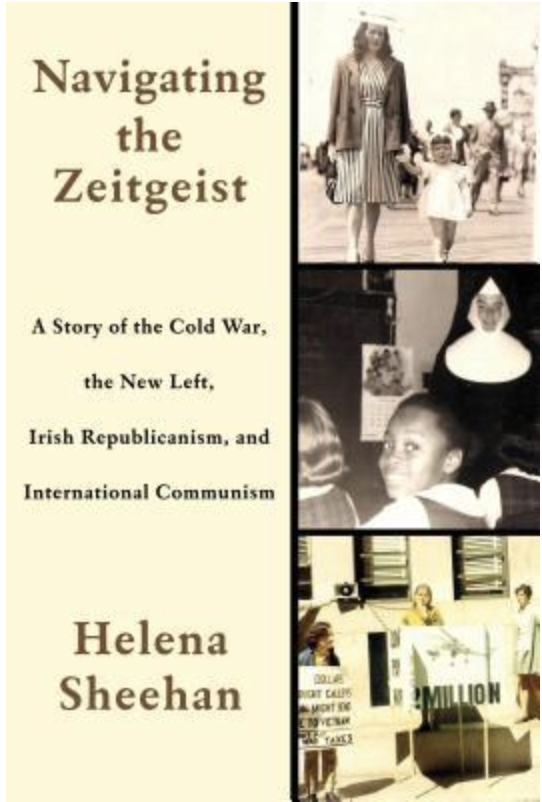
Review: Helena Sheehan: Navigating the Zeitgeist: A Story of the Cold War, the New Left, Irish Republicanism, and International Communism

14/07/2019 by Conor Kostick Leave a Comment

Everyone goes through a crisis of belief at some point in their lives. We grow up with certain views of the world presented to us and when they don’t fit experience, have to revise or abandon them. This process can be incredibly painful and in the case of Helena Sheehan, it’s hard to imagine a more total collapse and rebuilding than her journey from nun to communist. Her autobiography, therefore is an important book, not just for documenting her times and the very interesting circles she moved in but in allowing the reader to explore in some depth a crucial question for us all: how do I know my current belief system is right?

That’s a big question for anyone, but it’s especially important if you are going to devote years of your life to a particular political strategy and try to persuade others of it.

Helena Sheehan’s political trajectory, charted with complete honesty in this book, was from conservative Catholic, to the US New Left of the late 1960s, to Official Sinn Féin on her arrival in Ireland in 1972 and to the Communist Party of Ireland in 1975, which she left early in 1980. Joining the Labour Party in 1981, Helena helped found the Labour Left group and was close to Michael D. Higgins.

Cover of Navigating the Zeitgeist by Helena Sheehan

There’s plenty in the autobiography for those wanting to cherry pick her insights into characters like Seamus Costello, Tomás Mac Giolla, Betty Sinclair and Michael O’Riordan, but my interest is in the deeper story.

In 1965, having committed herself to the Sisters of St Joseph in Pennsylvania, Helena found herself at odds with the lifestyle of the order. In particular, watching news broadcasts on the march from Selma to Montgomery in spring 1965, she saw nuns participating and wondered why she couldn’t do the same. She taught, ‘We shall overcome’ to the kids in her class. In other words, it was waves of history (as she puts it) that tore her away and while a few years later, nuns left the order in droves, Helena was one of the first to do so.

The intellectual crisis this brought about, compounded by losing her teaching job for being too ‘controversial’ and falling out with her family, was nearly fatal:

I was alone and desperate as it was possible to be. My world was in ruins. In time, I would rebuild on new foundations. But between the collapse of one worldview and the construction of another, there was only an abyss. I often wonder where I found the strength to endure that emptiness.

Eventually, Helena found a way forward via philosophical existentialism to the radical left in Philadelphia (she was studying at Temple University) and by 1970 was deeply involved with city politics. This is a fascinating part of the book, depicting a non-stop lifestyle and a feverish intensity of revolutionary discussions and actions that has rarely been seen since. Helena was in constant discussion with Black Panthers, Students for a Democratic Society, anti-Vietnam protestors, members of the Weather Underground movement, Feminists, Gay rights activists, etc. Her background and intellectual rigour seems to have made her an extremely valuable activist, more able to connect the revolutionaries to wider audiences than many of her peers. And also to spot nonsensical posturing.

This is also the part of the book that in my view, most meets a challenge that she states in the preface, of wanting to connect the social and economic changes of her times with the experience of an individual. Her grasp of the totality of US society, allows her writing to be both wonderfully vivid at a personal level and at the same time to portray a massive systemic crisis. The same strengths are not evident in the sections on Ireland and the USSR, not because her beautiful writing style falters but because I don’t think, even now, reflecting on her life, she’s as clear about the nature of the social systems she’s writing about. These chapters lack her ability, for example, to juxtapose popular culture and sub-culture the way she does so brilliantly with the chapters on the USA.

And this brings me back to the question of belief systems. For a long time Helena was, to put it bluntly, a Stalinist, even after leaving the CPI. Since ‘Stalinist’ is an insulting term that evokes dictatorial practices and bullying, I need to state that Helena comes across as never anything but totally honest and someone who does not believe (as, alas, so many on the left seem to, even today) that there are situations where the ends justifies the means. As she quite rightly observes, ends and means are connected. Helena’s loyalty to the USSR was one of genuine intellectual conviction. Having studied Marxism of a certain type, seen its power, coherence and strength of insight, especially when compared to the anaemic philosophy she encountered while working on her PhD at TCD, Helena sincerely accepted that the USSR was socialist.

How does it happen that someone who has struggled to pick herself up from near death for having invested herself in one ideology (Catholicism) that came crashing down upon her, then adopted another that would do the same? The book stops in 1988, just before the fall of the Berlin wall, with a signal that this would be the second great intellectual crisis of her life. The cheap answer, which seems to have been thrown at her several times, is that this is just her nature, to uncritically commit to a big-picture ideology. From nun to communist is not such an extraordinary journey from this perspective.

Helena’s own rebuttal to that is that she’s acquired her second, communist, worldview after years of effort to achieve intellectual and moral clarity, whereas she stumbled into the first, unformed and driven by forces of which she was largely unconscious.

And yet.

Let’s agree that, broadly speaking, to be a socialist is a fine thing. Really, this is an inspiring book because it is about a life spent largely in causes that have improved the position of working people, of those nations resisting empires, and especially the position of women. Nevertheless, as soon as you think you have the full picture, worse, if you defer to someone else in your party you think has the full picture, you’re doomed to one day finding yourself articulating a view that no socialist should hold.

In Helena’s book, I don’t think she ever defers to someone in authority, except perhaps the dead authorities of brilliant thinkers. But I do think her model of Marxism is (at least for 1975 to 1988), ultimately, a sterile one, by which I mean the categories that Marxists use to discuss social structures (mode of production, surplus value, etc.) have been imposed on history rather than derived from it.

How do I know my current belief system is right? Because I’ve studied; I’ve fought; I’ve struggled to change the world; I’ve tested it constantly against unfolding events; I’ve had to build it up from the ruins of previous belief systems. That’s all impressive but it’s not enough. My view is that you also have to be open to the possibility that this hard-fought for model is wrong. It’s difficult, because the path to becoming a post-modernist (something that Helena despises, with good reason), begins with surrendering the primacy of your belief system.

Yet when I see a human being who clearly has great honesty and integrity fail to mention the Hungarian uprising of 1956 in her discussions of Eastern Europe; fail to support the Prague Spring or the early days of Solidarity in Poland and instead, describe her sojourns in the USSR largely in halcyon terms, I have to shake my head in dismay. Now the book only ends in 1988, so Helena’s current views might be much closer to mine on these issues (i.e. on the side of those who rose up against the rulers of Russia and the eastern block). But for me the most fascinating aspect of this candid auto-biography is that it makes you question your own understanding. Readers will ask themselves: if someone with Helena’s strengths can end up a Stalinist, then where am I heading?

It’s not easy, being ambitious and determined enough to believe the whole world can become a place of equality and freedom, yet modest enough to accept your current approach to achieving that goal could be flawed. Yet on reading this entertaining autobiography, it seems to me that’s the fast-flowing contradiction that socialists have to constantly navigate.

Filed Under: All Posts, Reviews

Independent Left’s response to gangland killings in Coolock and Darndale

05/06/2019 by Conor Kostick 1 Comment

Minister Charlie Flanagan visits Coolock and does nothing for the community
Millionaire Charlie Flanagan fails the young people of Coolock and Darndale

When young people from working class communities are drawn towards crime gangs, tragedy is never far away. On 25 May, Eoin Boylan, aged 22 was shot and killed in the residential area of Clonsaugh Avenue Coolock.

In May, Hamid Sanambar (42) was shot on Kilbarron Avenue, Coolock, the home of Sean Little (22), who was shot dead on Tuesday 21 May 2019. Jordan Davis (22) was shot dead in Darndale on 22 May, while earlier in the year, in a related assassination, Zach Parker (23) was killed in Swords. The fact that these lives were wasted is tragic and clearly too there is the risk that bystanders including children and the elderly will get caught up the feud, with the murders taking place in daylight on busy streets.

Independent Left councillor John Lyons calls a fully-funded multi-agency body

In an interview with RTE’s Sean O’Rourke, Independent Left councillor highlight the neglect of support for youth initiatives in Dublin’s north east and argued for greater resources for the area and the creation of a coherent, fully-funded multi-agency body similar to the North East Inner City (NEIC), to tackle and address the many issues involved in this murder.

What have the government to offer a traumatised community and a youth culture that celebrates gangsters? In the case of the Taoiseach, nothing at all. He said that, ‘as soon as I can find a little time’, he would visit Coolock and Kilmore West. When he wants to move fast, Leo Varadkar can make room in his diary, such as to meet with Donald Trump. Clearly, this crisis of gangland feuding is not a priority for him, nor for his ministers.

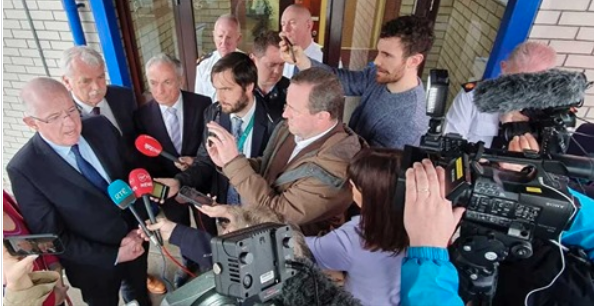
Although Justice Minister Charlie Flanagan came to Coolock Garda Station in May 2019, he had nothing to announce by way of a new package of assistance for the community. A small amount of investment in sports clubs, for example, goes a long way in terms of giving young people inspiring, constructive role models. We only have to look at Katie Taylor to see that.

Instead of bringing welcome news on the community support side, Flanagan told young people to ‘drop the bling’ and that criminal gangs were ‘all losers.’ If I were a teenager being told by a landlord worth over €3m to drop the bling and stay away from criminal gangs, my fury at his privileged arrogance would have me reaching for a milkshake.

In the UK, Nigel Farage was one of many far-right politicians targeted by ‘milkshaking’ in 2019

This is why Councillor John Lyons was absolutely right to describe the visit of Flanagan (and Richard Bruton and Finian McGrath) to Coolock as a shameful public relations stunt.

John Lyons called on the government to establish a taskforce for the Coolock area to address the ongoing gangland violence, and the many economic, social and educational inequalities that give rise to such activity: ‘It is hugely disappointing that the three government ministers had nothing of note to announce. We need a task-force established that will be responsible for monitoring the work of the various government departments, state agencies and community groups that have a role to play in tackling the many problems faced by people in the area.

‘I am sure that if the recent murders in Darndale and Kilmore had occurred in Dalkey or Killiney we would have seen a much swifter and more serious response from the government; instead, it takes government ministers a full week to visit the area and when they visit, they have nothing of value to say or announce. Shameful really, and not good enough for the communities directly affected by the recent violence.

‘So I am once again inviting An Taoiseach to find “a little time” to visit the area, meet with the various stakeholders in the community with a view to establishing a task-force for the area. The communities deserve a serious response from government, a response sadly lacking to date. The government must step up.’

In the coming days Councillor John Lyons and Niamh McDonald will be working together with community groups and sports organisations to formulate a serious response to the gangland crisis, one that can make a significant impact in the life paths of young people instead of attempting to dismiss them. To paraphrase the Sex Pistols, if you treat kids as morons, you create H Bombs.

While the contempt of millionaire, landlord politicians just makes the situation worse, Independent Left seeks to create a constructive path for the energy and passion of the young people of our community.

An election image for Dublin Bay North showing John Lyons and headlined crime. He calls for greater spending on schools and amenities and a local multi-agency task force.
In general election 2020 as candidate for Dublin Bay North, John Lyons called for increased spending on amenities and a multi-agency task force to tackle the growth in crime gangs.

Filed Under: All Posts, Independent Left Policies

Election Counts and Results Artane-Whitehall and Donaghmede 27 May

27/05/2019 by Conor Kostick 2 Comments

Election candidates from Artane-Whitehall discuss a recount
John Lyons and Niamh McDonald in discussion with the electoral officer during a recount

The second day of counting in the local elections confirmed our expectations from the first. For the Artane-Whitehall constituency, which includes Artane, Beaumont, Belcamp, Clonshaugh, Coolock, Darndale. Kilmore West, Santry and Whitehall, John Lyons retained his seat on Dublin City Council (despite a redrawn constituency). With the elimination of the independents Paul Clarke and Paddy Bourke, John pulled well clear of Fianna Fáil’s Racheal Batten, just (after a recount) 11 votes shy of a quota. Given that the top three candidates polled well ahead of Fianna Fáil and Fine Gael, it is clear that this is one of the most left wing of Dublin constituencies.

Artane Whitehall Count 5
The result of the fifth count for Artane-Whitehall

After his victory, Councillor John Lyons said:

I’m incredibly honoured that so many people on the Northside voted to endorse the Independent Left platform demanding action on climate change, more public and affordable housing, reform of local government, the remunicipalisation of waste services, enhanced public transport and cycling infrastructure, better community cleaning and a more affordable system of public childcare.
There is a lot more to say about what has happened over the last two days but for now, thank you to all who got involved, supported and voted for a radically different vision of Dublin, one that places people not profit at the heart of the city’s political decision-making processes.

John Lyons elected in count 6 of the Artane-Whitehall LEA following recount. His surplus of 385 will now be redistributed #LE19 #DCC19 pic.twitter.com/dud0NGrHHr

— Dublin City Council (@DubCityCouncil) May 26, 2019

It was an impressive result given the context of an election in which the socialist left on Dublin City Council and elsewhere struggled to hold their ground as the Greens made substantial gains (and Fianna Fáil made a slight recovery) and it testifies to the steady resistance of the community to the agenda of the government as well as an appreciation that Councillor John Lyons and his team have put their energies behind a whole range of local campaigns.

In the Donaghmede constituency, covering Ayrfield, Belmayne, Clarehall, Clongriffin, Donaghmede, Edenmore and Kilbarrack, where Niamh McDonald represented Independent Left, the election demonstrated that the constituency has challenges for socialists, with two Fianna Fail and one Fine Gael councillor elected out of the five positions. Donaghmede provides an example of the trend that was evident across the country, where the strong performance of a Green Party candidate, in this case Lawrence Hemmings, was reinforced by a steady accumulation of transfers.

Between the Social Democrat Paddy Monahan, Niamh McDonald and Solidarity’s Michael O’Brien there was a left seat in play until the very end. The transfers on the elimination of Labour’s Shane Folan make for interesting reading and decided the issue. Overwhelmingly, they went to the Green Party but also Labour voters showed a notable preference for Fine Gael and Fianna Fáil over Michael O’Brien.

Donaghmede count figures 27 May
The Donaghmede final count figures show how the Green Party took a seat at the expense of the left.

Given these figures, the fact that Nimah McDonald rallied nearly 600 first preference votes for Independent Left is a real achievement and again shows there is a strong base for future campaigns and resistance to the government in the Donaghmede area. And this, of course, is the crucial point. Across the country there will be several disappointed socialist candidates tonight, whose hopes of council seats disappeared in the light of the strong Green performance. Yet the overall message of this election is a positive one.

I think it would be fair to say that the message of the election is that the country has not bought into Fine Gael’s complacent story about Ireland’s progress. While Fine Gael, Finian McGrath and the other ‘independents’ may have created hundreds of new millionaires in the last three years (especially from the landlord class), their record on housing, the environment and health especially has been disastrous and not only for working class communities. The rise of the Green vote is a slap in the face to such complacency and expresses a desire for much more radical responses to climate change especially. This feeling is likely to feed into Ireland playing it’s part in a huge international protest about the climate on 20 September (a #globalclimateaction strike that we can start building for now) and into campaigns on housing.

So there’s every chance that in the coming months there will be plenty of opportunity for socialists, whether council members or not, to participate in campaigns, local and national, and while doing so, to emphasise that for lasting change, we need to look at a transformation that is far more profound than that which is on offer from the Greens.

All the political parties, including those of the left, are now rushing (insincerely in the case of Fine Gael and Fianna Fáil) to emphasise their environmental credentials. But the crucial point to be made to those who hope that the Green Party are going to offer a different approach is simple: they won’t. Whether or not the Greens have the best policies on housing, transport, climate change, etc. (and we are happy to adopt them if they do), the problem the Green Party faces is a deep-rooted acceptance of the current pro-business way in which the world is run.

In response to his own party member Saoirse McHugh saying she would resign from the Green Party if they went into coalition with Fine Gael or Fianna Fail, Ciaran Cuffe, the millionaire Green candidate for the Dublin constituency in the European elections, couldn’t even bring himself to rule out that option when asked about it today at the count centre. And he is looking distinctly uncomfortable with the question.

For Independent Left, it would have been easy to answer that question: not only would we never participate in such a coalition, but we are striving for a global change to how our planet is organised, one that abandons the race for private profit and instead makes decisions on the basis of equality, freedom and care for the needs of the many. In a word: socialism.

Filed Under: All Posts, Irish Political Parties

  • « Go to Previous Page
  • Page 1
  • Interim pages omitted …
  • Page 5
  • Page 6
  • Page 7
  • Page 8
  • Page 9
  • Go to Next Page »

Copyright © 2026 · Aspire Pro on Genesis Framework · WordPress · Log in