• Skip to primary navigation
  • Skip to main content
independent left logo

Independent Left

Environmentalism, socialism, freedom and equality. #liveablecity

  • About
  • Featured Articles
    • How Farming Must Change to Save the Planet
    • The Housing Crisis: Causes and Solutions
    • Socialism in Ireland
  • Contact Us
  • Podcast
  • Animal Rights
  • Archive
    • Irish Socialist History
    • Dublin City Council Housing
    • Ukraine
    • Protests Ireland
    • Reviews
    • Irish Political Parties
    • All Posts
    • Independent Left Policies
  • Why join?

Features by Conor Kostick Independent Left

The Biggest General Strike in Irish History

09/01/2020 by Conor Kostick 15 Comments

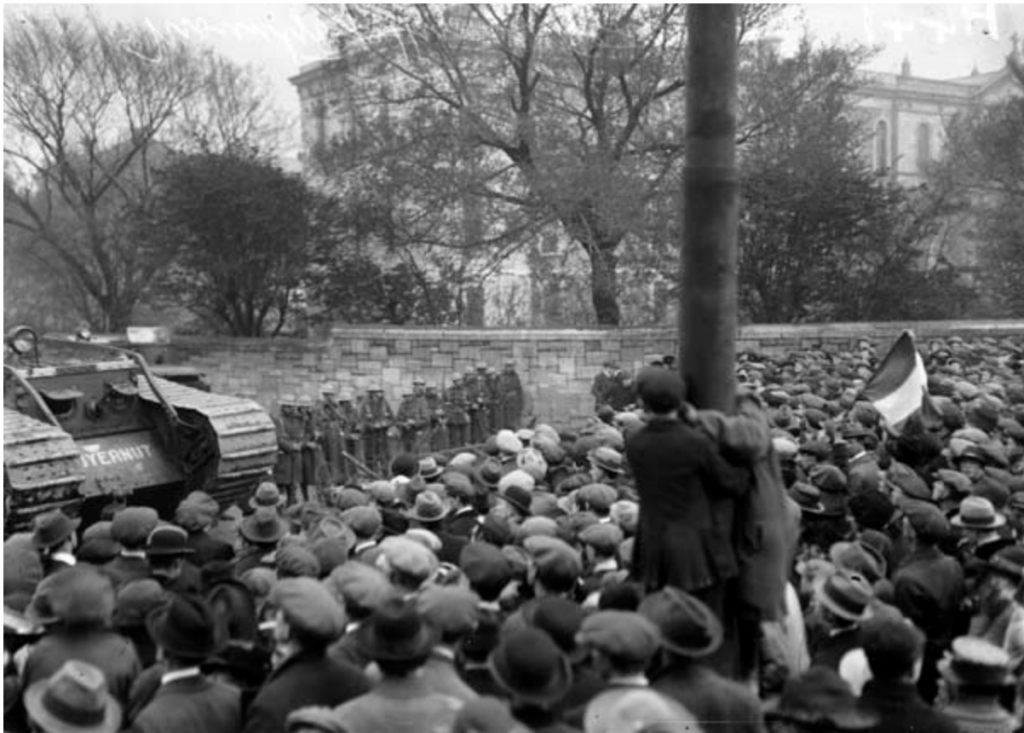
A black and white photograph taken during Ireland's biggest general strike. Against a background of the Mountjoy Prison a crowd on the right is faced off against a line of British soldiers and tank on the left. The crowd are mostly men but there are many women, all are wearing caps and hats. Two boys have climbed a pole to get a better view.
Huge crowds gathered outside the Mountjoy Prison in April 1920 during Ireland’s greatest general strike.

On Tuesday 13 April 1920 a general strike took place in Ireland that was by far the greatest strike in Irish history. All over the country there was a complete stoppage and not only that, in some regions and towns the workers took over the running of society, declaring ‘soviets’ and workers’ councils to be in charge. The aim of the strike was to secure the release of prisoners being held by the British authorities in Mountjoy Prison, Dublin and, after two days, the strike ended with a complete victory.

In the early part of 1920, an intense conflict was taking place ­– the War of Independence – between the imperial authorities of the British government and the vast majority of the Irish people. A radicalised Irish population had defeated the threat of conscription at the end of 1918, had voted overwhelmingly for Sinn Féin in the elections of December that year (a party that was determined to bring Ireland out of the empire), and were engaged in a mass popular undermining of all the systems of British rule, through strikes, boycotts and support for the guerrilla campaign of the Irish Republican Army.

On the other side, Britain was still at this time determined not to lose an inch of soil in Ireland. When it came to the conflict in Ireland, the main fear of the British cabinet was that should Ireland achieve independence, this would have disastrous consequences for the rest of the empire.

To quell the mass disobedience of the Irish population, the authorities began a campaign of repression and ‘reprisal’. As part of this campaign, sweeping arrests had resulted in over a hundred men being imprisoned at the Mountjoy without any charge or legal process being directed against them.

The Hunger Strike at Mountjoy Prison, April 1920

A determination sprang up among these prisoners to embark on a hunger strike in protest at their treatment. On 5 April 1920, a core group of thirty-six men refused food. These men were trade unionists, socialists and republicans, sometimes all three combined. Among them was the revolutionary socialist Jack Hedley, who had been arrested in Belfast (with a pamphlet by Lenin in his pocket). The Manchester Guardian’s reporter interviewed a participant of the hunger strike and described him as follows:

A young man, normally engaged as a trade union organiser and he may be taken as a type of the small but rapidly-growing band of idealists to whom the name of James Connolly is constant inspiration… he is as keen that the Irish nation should become a workers’ republic as that it should be a republic at all.

The next day, 6 April, thirty more men joined them as the republicans in the jail promoted the hunger strike. Each day, more prisoners took part, so that five days after the protest had begun there were 91 men on hunger strike in the Mountjoy prison.

Theirs was not just a passive campaign: while they had strength for it, the men broke all the furniture they could, including the doors, and damaged the interior walls. The IRA ordered their more experienced men who had been sentenced (and were in ‘A’ wing) to wreck their cells and bore through the walls from cell to cell. This was a ‘smash-up’ strike and the point was to ensure the hunger strikers could mix together and not be prevented from acting in unison by being locked into their cells. The participants were handcuffed and moved to ‘C’ wing, which they managed to damage significantly also. Those men who had not been identified and sentenced joined the hunger strike but not the smash-up strike. To keep morale high everyone sang socialist and rebel songs, concluding with the ‘Red Flag’.

Newspaper picture from 1920 of a tank and a think line of British Troops near Mountjoy Prison, April 1920.

It wasn’t long before a huge public reaction surged up in response to the hunger strike and it was one of determination to help the men. On Saturday 10 April, people thronged the jail, where an unsuccessful attempt to set fire to a tank took place and the same night the crowds tested the gates to the jail, which withstood their efforts to push against them.

Workers join the protests in large numbers

The following evening, Dublin’s dockers – who were in the middle of their own radical action, a refusal to export food to avert a possible famine – were joined by postal workers and others at the jail to once again attempt at a break-in to free their suffering comrades. British soldiers fixed bayonets and fired shots over their heads but the crowds did not move back. Ireland was on the cusp of witnessing a Bastille Day. Socialists were present, distributing leaflets appealing to the soldiers,  urging them not to attack the demonstrators. A critical moment was approaching. Would the crowds succeed in breaking in? Or would the British soldiers open fire, even at the cost of taking many civilian lives and the consequent political backlash that would accompany such an event?

A faded photograph taken outside the Mountjoy Prison during Ireland's great general strike of 1920. In the foreground are five British soldiers with characteristic Great War gear, including bowl-shaped helmets. They are facing away from the camera at crowd of civilians with animated expressions. Between them is a construction of wood and barbed wire.
Men and women strove to get past British troops and release hunger strikers from the Mountjoy Prison during the general strike of April 1920

The Dublin District Historical Record described the scene:

Rapidly constructed obstacles were soon trodden down by the leading ranks … being pressed from behind; even tanks were no obstacle. The troops thus found themselves in the unenviable position of either being overwhelmed or having to open fire on a somewhat passive, but advancing crowd of men and women.

Yet the pressure on the authorities and the possibility of their being caught up in a disastrous invasion of their prison was relieved by Sinn Féin members.

A colourised newspaper image of a huge crowd (on the right) facing a row of British soldiers (on the left). A narrow space exists between them with a row of men (and one woman) in civilian clothes but with leather jackets, facing the crowd.
Sinn Féin held back the crowds from confronting British soldiers protecting Mountjoy Prison.

Seán O’Mahony was a Sinn Féin organiser, businessman and hotel owner. He was a member of the Dáil and Dublin Corporation. Seeing a number of priests at the demonstration, O’Mahony got them to form a cordon at the front of the crowd and then pushed everyone back from the entrance, while shouting, ‘in the name of the Irish Republic, go away!’ This effort had the merit of avoiding bloodshed, but it left the soldiers untested as well as serving to ensure a popular insurrection against British rule did not begin that day. O’Mahony was no Desmoulins and he took it on himself to sustain this role.

A side street near Mountjoy Prison (background) is filled with people looking away from the camera towards the bared windows of the prison. This was the situation on Monday 12 April 1920 when the biggest general strike in Irish history took place.
As news of the 1920 hunger strike in Mountjoy Prison spread, all the streets around were filled with men and women protestors

The following day, one week after the hunger strike began, Monday 12 April 1920, a crowd of twenty-thousand men and women gathered around the jail, which remained in danger of being stormed by these huge numbers of protesters. A thin line of troops with fixed bayonets, as well as an armoured car, a rock in a sea of protesters, and the political impact of Sinn Féin’s intervention were all that held back the crowd (see video). There was no hope of moving any traffic in the streets around the prison. Inside the Mountjoy, the authorities were totally cut off and could only reach their superiors by telephone.

The IRA and Cumann na mBan mobilise at Mountjoy Jail

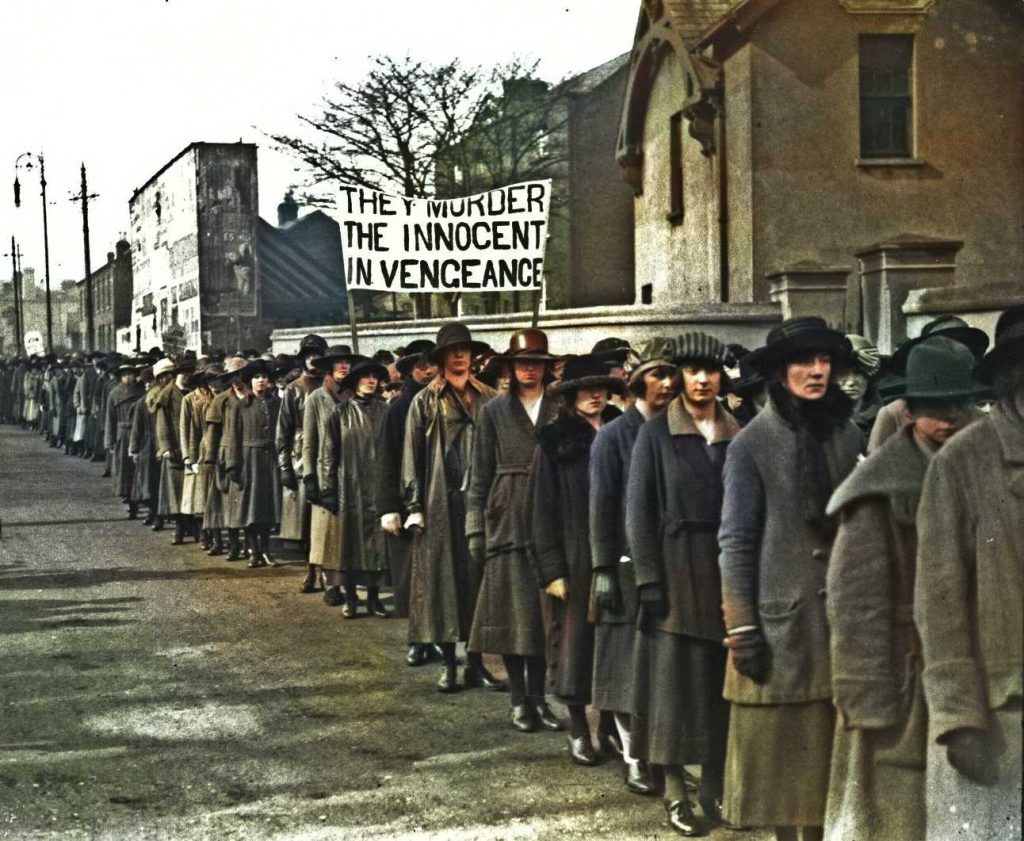
Colourised newspaper image of women in a long row, wearing coats and dark skirts. They are marching along a north Dublin street towards Mountjoy Jail and in the middle of the picture are women carrying a banner saying: They Murder the Innocent in Vengeance.
Cumann na mBan members formed up and marching to the Mountjoy Jail to support the hunger strikers.
A black and white picture taken during Ireland's biggest general strike, showing a British soldier standing to attention beside an early-looking armoured car, which seems to be a truck with a circular body adapted for defence. Two soldiers are emerging from the centre of the vehicle.
Armoured cars were rushed to Mountjoy Prison during the great general strike of April 1920

Frank Henderson, a commandant in the Dublin Brigade of the IRA recalled that the British soldiers were provocative and there was a real danger that the crowd would be fired upon. Henderson was put in charge of IRA activities outside the prison, with orders to not allow the IRA parties to be provoked by the British military and restrain the crowd from provoking the soldiers. The IRA had brought arms, however, revolvers in their pockets, and were ready to fire back should shooting begin. ‘The spirit of the orders was restraint unless fire was opened by the British.’

A large number of women fill a street near the Mountjoy Prison. One of them is holding a tricolour. Many of them have placards reading 'Mother of God Open the Prison Gates'. A small number of police look on from beside a wall on the far side of the crowd. Black and white, taken in April 1920 during Ireland's biggest general strike.
Cumann na mBan mobilised their members to carry placards and guard against the threat of violence by the British soldiers. Some of them were able to visit the hunger strikers and bring out valuable communications

A full mobilisation of Cumann na mBan took place and the women’s organisation was very active in parading with posters and providing ‘guard’ duty. On Tuesday 13 April, Marie Comerford obtained admission to visit Frank Gallagher and brought out news of the prisoner’s demands, information which was issued by Sinn Féin as a press release. But by Tuesday evening, the authorities had recovered their position by deploying an additional two tanks, a number of armoured cars, a great many more soldiers and rolls of barbed wire. They even had air support: the RAF flew close to the rooftops (in dangerous 50mph winds), to try to intimidate those filling the streets around the jail. These RAF missions were considered an innovation and a success, confirming to the authorities that, ‘aeroplanes could be used for clearing streets by dropping warning notices and, if necessary, using Lewis gunfire.’

The prison was safe.

Safe, but surrounded.

A sepia photograph of a large crowd in front of the gates of the Mountjoy Prison. All are facing away from the camera and most are men wearing cloth caps. Taken in April 1920 during Ireland's most radical general strike.
The streets around the Mountjoy Prison were completely blocked by crowds in April 1920

This was the context for Ireland’s biggest general strike.

The Irish labour movement resolved the crisis by taking decisive action. With the attention of the country focused on the prisoners in Mountjoy jail, the executive of the Irish Labour Party and Trade Union Council (ILPTUC) called for a national stoppage. Earlier, on Monday (12 April 1920), they had sent telegrams to the organisers of the ITGWU and placed a manifesto for a strike in the Evening Telegraph. The railworkers of the Great Southern and Midland Company began the general strike by halting all trains after 4.30pm on that day, all trains, that is, apart from those which were bringing the announcement of the general strike to the rest of the country.

Ireland’s greatest general strike begins 12 April 1920

The telegram sent all around the country that had a massive effect and launched Ireland’s greatest ever general strike from 12 April 1920 (Source: National Library of Ireland, William O’Brien collection)

Tuesday, 13 April 1920 saw a complete shutdown of all work in Ireland, along with massive local demonstrations and in some places, ‘soviet’ power. The reports that trade union officials sent back to their headquarters really convey in their own words just how effective was the strike and how wholehearted was the workers’ participation:

Galway:

Well, the Workers’ Council is formed in Galway, and it’s here to stay. God speed the day when such Councils shall be established all over Erin and the world, control the natural resources of the country, the means of production and distribution, run them as the worker knows how to run them, for the good and welfare of the whole community and not for the profits of a few bloated parasites. Up Galway!

Cavan Branch, ITGWU:

Wire received 6pm; meeting held,  strike agreed upon. Tues. – Cattle fair dispersed; shops closed; protest meeting held; resolution protests passed; red flags and mottoes ‘workers demand release of all Irish political prisoners’ prominently displayed… strike committee formed. Town Hall commandeered as headquarters …

Rathangan Branch, ITGWU

Our strike was carried through with great success. All work was at a standstill. The only work that was done was malthouse work. Myself and all our post staff was on strike. We picketed the town. Had all the shops closed for the two days. We allowed them to sell no drink, only groceries and provisions.

Castletownroche Branch, ITGWU

Acted on instructions issued on the Press, 13th inst. Wire received at 9.30, 13th inst. Flour mill men then out. Ordered them back to work – by great work I got them to go. The whole Branch acted like one man. Paraded 200 members through streets yesterday with the general public, under the Rebel Flag – and proud were they. A monster meeting followed. Branch pledged themselves no going back until their countrymen were released.

Tralee Branch, ITGWU

Your instructions re strike were carried out splendid. All organised labour responded. Meetings of protest were held. The Trades council was turned into a Workers Council who took full control of everything. We had our own police who kept order, saw that all business was suspended, issued permits for everything required. Pickets patrolled the streets. In fact the workers controlled all. Workers showed that they were highly organised and that they can carry out any orders at a moment’s notice.

Kilkenny Branch, ITGWU

I received President’s wire at 5.11 on Monday evening. I being the first to get intimation and as I could not get in touch with either the President or Secretary Workers Council I acted on my own and by the help of willing volunteers the strike was completely made public at 7 p.m., not a single man going to work on Tuesday or a single house of business opened either. It was really magnificent the response… I also wired the different branches in the county as far as I can learn the stoppage in those places also complete. As far as the public in this city state that the whole success of the stoppage is due to the prompt action of the members of this Union

Maryborough Branch, ITGWU

You may be interested to know that so far as Maryboro was concerned the strike was a great success. All our Branch members co-operated and we had a strike committee which regulated the closing of shops and opening of same for sale of food. We stopped motors and compelled them to get permits from strike committee. Also compelled stock owners to clear off the fair on Wednesday; ten minutes to get off the square. Our pickets allowed no drink to be sold, as far as we of the O.B.U. were concerned here we did our best.

Virginia Branch, ITGWU

We had a very enjoyable time in Virginia at the strike for the release of the Mountjoy prisoners. The Transport members all struck work, and all other labourers joined in with them. We got on to the business houses first. Got them all closed, with which we had not much trouble. We then held a meeting and put a picket on all roads leading to town and stopped all people pending special business. We celebrated the release of the prisoners with a parade through the town at 8 p.m., which over 100 took part, headed by the local Sinn Fein band.

Maynooth Branch, ITGWU

… It may be mentioned that, with one solitary exception, the procession was composed of workers only, which goes to show the sincerity of the mouthings of the bosses with Ireland a nation… The procession carrying the Tricolour and Red Flags made a most imposing display… Noteworthy by their absence on both days was the usual bodyguard of Irish Ireland and Workers Processions, the R.I.C. who by the way are now homeless in Maynooth.

Carrigallon Branch, ITGWU

You will be glad to hear our strike took place on Thursday last, the 15th inst. Our Branch, with Sinn Fein Club and Volunteers went out to a man. All trading and business was completely suspended for the whole day, the banks, post office, every shop in the town and all traffic was kept suspended. At 12 o’c. in dashing rain one hundred men marched to our red banner and the tricolour through the town and returning placed our colours on the high roof of the post office.

In Dublin, the Drapers’ Assistants’ Association was given information that several shops in Grafton street were attempting to remain open. They organised a sizeable flying picket, which went to the salubrious part of town, where they found that the information was incorrect. Everything was closed. All sailings from Dublin were halted. You could only obtain bread and milk from particular shops and vans which had agreed with the ILPTUC the basis on which they could deliver their goods, mainly for a limited period on the afternoon only. It helped alleviate concerns about hunger in the capital that boats returning with the day’s catch were obliged to just dump their haul on the North Wall and sell them off for what they could get.

The general strike of April 1920 leads to ‘soviets’ and workers’ councils across Ireland

In Waterford, reported the Manchester Guardian, ‘the City was taken over by a Soviet Commissar and three associates. The Sinn Féin mayor abdicated and the Soviet issued orders to the population which all had to obey. For two days, until a telegram arrived reporting the release of hunger strikers, the city was in the hands of these men.’ The same newspaper also gave a survey of the events of the day, ‘in most places the police abdicated and the maintenance of order was taken over by the local Workers’ Councils… In fact, it is no exaggeration to trace a flavour of proletarian dictatorship about some aspects of the strike.’

Freedom summed up the general strike with this observation: ‘never in history, I think, has there been such a complete general strike as is now for twenty-four hours taking place here in the Emerald Isle. Not a train or tram is running not a shop is open, not a public house nor a tobacconist; even the public lavatories are closed.’

From Kilmallock, East Limerick, came a report that vividly describes what workers’ control of a town looked like:

A visit to the local Town Hall – commandeered for the purpose of issuing permits – and one was struck by the absolute recognition of the soviet system – in deed if not in name. At one table sat a school teacher dispensing bread permits, at another a trade union official controlling the flour supply – at a third a railwayman controlling coal, at a fourth a creamery clerk distributing butter tickets… all working smoothly.

It was much more difficult for the strike to take hold in the north. The demand to release the prisoners was going to serve the nationalist cause and significantly weaken Britain’s ability to police the national movement if it won. Even so, in certain strategic industries like the railways, the strike was effective. Robert Kelly, for example, railworker organiser and member of Newry Brigade IRA successfully built the strike in that town.

It is clear that the lrish Labour Party and Trades Union Council (Labour and the trade union movement were united at the time) were hardly exaggerating when they summarised that:

Probably never has there been so sudden and dramatic a strike in the history of the Labour movement anywhere… Local Town Councils in many towns handed over the use the municipal buildings to the workers’ committees.

The Manchester Guardian also noted the significance of the workers’ council:

It is particularly interesting to note the rise of the Workers’ Councils in the country towns. The direction of affairs passed during the strike to these councils, which were formed not on a local but a class basis.

In the face of this incredible working class militancy and with the prospect of it deepening, the British authorities gave in. The first offer the governor made to the prisoners was that of a transfer to Wormwood Scrubs, which, they were told, would be accompanied by their being given political status. This, the prisoners refused. The second offer was to give the prisoners political status in Mountjoy Jail. This too, the prisoners refused. Peadar Clancy (second in command, Dublin Brigade) rejected it on behalf of the Volunteers. ‘I know the risk I’m taking but there are men here who must get out before they are recognised… the Castle isn’t done by a long chalk, but they’re done for the moment. The general strike has them beat.’

The British authorities are forced into a humiliating defeat by the power of the general strike

The most senior imperial figure in Ireland at the time was Field-Marshal Lord French. Seeking a resolution to the crisis, French sent for the constitutional nationalist and Lord Mayor of Dublin, Laurence O’Neill. O’Neill was visting the Mountjoy Prison at the time and left for the Viceregal Lodge where he met the newly arrived Commander in Chief of the British forces in Ireland, General Nevil Macready. It seemed that Macready was the right man for the job the British had in mind. In 1910, Macready had used the threat of shooting workers to prevent a miners’ strike in Wales. As a result, he had earned the nickname, ‘strike breaker.’ At first French and Macready presented O’Neill with a hard line coming from London. On the Monday the British government had made it clear that the demand to release the prisoners, ‘cannot be entertained.’ Bonar Law told the House of Commons: ‘A decision has been taken by the Government and I do not believe that there is any chance of its being reviewed.’

A portrait of Lord John French, Lord Lieutenant of Ireland in 1920. An elderly man with thick, white, dropping moustache, he looks at the camera with a serious expression. Upper body and head pictured. He is wearing a military jacket and overcoat.
Lord John French was the Lord Lieutenant of Ireland during the strike on behalf of the Mountjoy prisoners in 1920 and had to allow the men their freedom in a humiliating blow to British authority in Ireland.

‘Why don’t they eat,’ shouted an MP, to general merriment. The British establishment was complacent.

Forty-eight hours later, however, with the powerful general strike underway and many towns in Ireland under the control of workers’ councils, the authorities were wavering and when O’Neill proposed that the prisoners be released on parole for good behaviour, Macready and French accepted the idea.

The third offer to the prisoners, therefore, was put them with O’Neill’s return to the prison at 3pm on Wednesday 14 April: they could all leave the prison if they signed the parole form. Once again and despite suffering from the effects of their hunger strike (some of the men were never to fully recover), they said ‘no’.

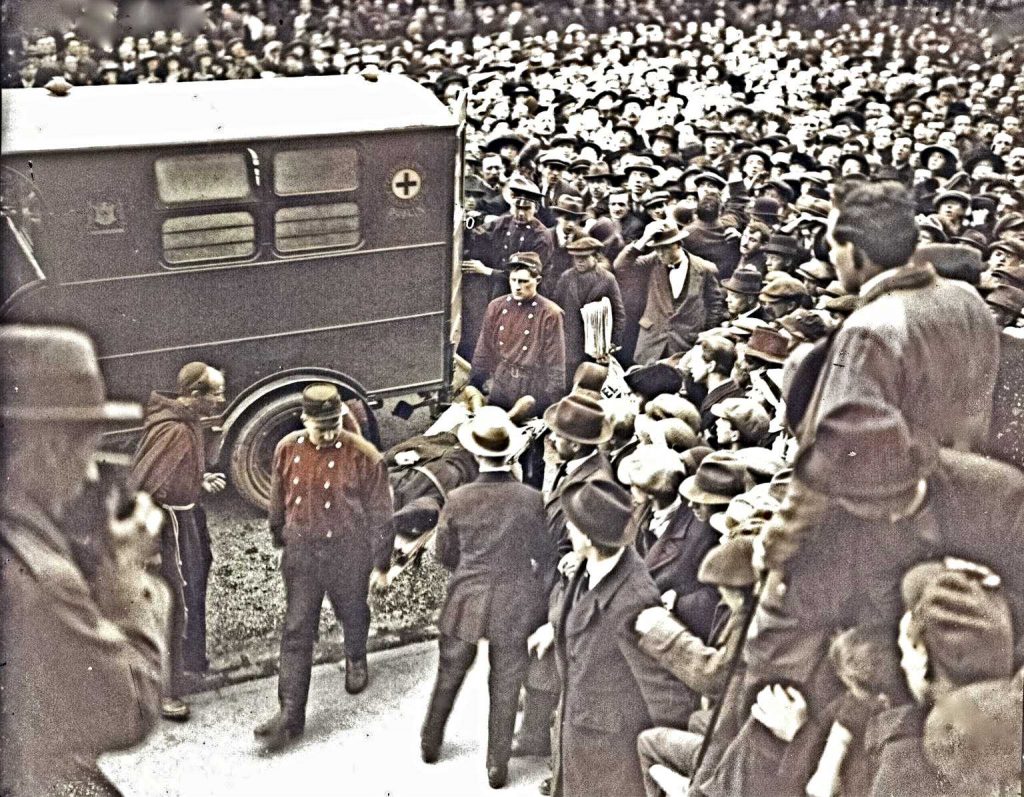
Enormous crowds celebrated the release of the hunger strikers from the Mountjoy Jail on Wednesday 14 April 1920. They were removed by ambulance to hospital. Slightly colourised newspaper picture, showing the ambulance with a huge crowd around it. Two ambulance staff carry a stretcher with a hunger striker on it.
Enormous crowds celebrated the release of the hunger strikers from the Mountjoy Jail on Wednesday 14 April 1920. They were removed by ambulance to hospital.

In a panic, with no help from telephone calls to London, from where the cabinet told him that he must decide for himself, Lord French contacted the jail and said that the prisoners could be released. Pathetic attempts were made to hide the extent of this defeat when the prison officials read the parole document out to each prisoner as he left. No one gave any pledge to recognise it and scornful of their warders, the emaciated hunger strikers were greeted with an intense surge of delight from the crowds, who although now allowed to come right up to the steps of the prison were careful to give the men room and assistance in reaching ambulances waiting to take them to hospital.

This was one of the most disastrous defeats ever experienced by the British authorities in Ireland and they were well aware of it. The London Morning Post described the scene as one of ‘unparalleled ignominy and painful humiliation.’ Subsequently, the official history of the Dublin garrison of the British army reported that the effect of the strike was to drive from the streets military and police secret services, who could now be identified by many of the released prisoners.

The release of the hunger strikers and the cancellation of policy… nullified the effect of the efforts made by the Crown Forces during the three preceding months. The situation reverted to that obtaining in January, 1920, and was further aggravated by the raised morale of the rebels, brought about by their ‘victory’ and a corresponding loss of morale on the part of troops and police.

What can be learned from the great general strike of 1920?

It is often argued that Ireland could not have been (and never will be) a socialist country because of the adherence of the population to national parties and to Catholicism. Typically, the events of 1916 – 1923, Ireland’s revolutionary years, are framed by narratives that make this assumption. What this misunderstands is the nature of revolutions. No revolution has ever taken place in which the revolutionaries started with complete independence from the values and institutions that they end up overthrowing. Always, it is a process of differentiation and development, of realisation, often of delighted surprise to the revolutionaries themselves (the reports from local trade unionists above have this quality). And this process is always uneven. In Ireland’s biggest ever general strike there were towns in which workers continued to offer a leading role in affairs to the clergy and to prominent nationalists and other towns, like Waterford and Galway, where the workers unhesitatingly took the lead and referred to the language of the Russian Revolution in doing so.

Unfortunately for the radical workers of 1920, their own organisations and leaders were far from eager to lead the movement towards a socialist Ireland. James Connolly was dead and Jim Larkin was in Sing Sing jail, leaving a generation of Labour and trade union leaders in charge whose values were closer to those of the modern Labour Party and ICTU than their socialist, former colleagues.

Rather than urge workers to draw revolutionary conclusions from the general strike, Ireland’s labour leaders hurried to discourage further general strikes and to keep the subsequent enthusiastic workers’ movement within boundaries acceptable to Sinn Féin. It was therefore left to conservative newspapers to draw the most important conclusion from the 1920 general strike.

The Daily News put the lesson like this:

Labour has become, quite definitely, the striking arm of the nation… It can justly claim that it alone possessed and was able to set in motion a machine powerful enough to save the lives of Irishmen when threatened by the British Government and that without this machine Dáil Éireann and all of Sinn Féin would have beaten their wings against the prison bars in vain.

Online talk, 13 April 2020, by Conor Kostick, on the hundredth anniversary of Ireland’s greatest general strike:

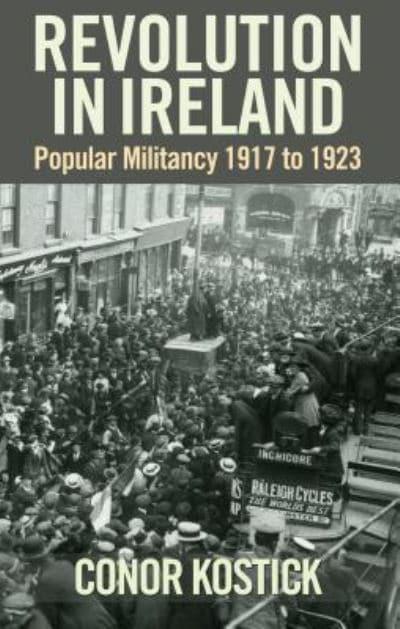
For more information about this strike and the wave of strikes and soviets during the period 1917 – 1923, see my book Revolution in Ireland.

Revolution in Ireland by Conor Kostick. Socialism in Ireland.

Filed Under: All Posts, Irish Socialist History

Was Ursula Le Guin a Socialist?

04/01/2020 by Conor Kostick 2 Comments

A review of No Time to Spare

Ursula Le Guin in 2008. She has short, grey hair, a white top, black tunic and trousers. Her left hand on a table, her right holds several A4 pages and she is speaking against a background of books. Ursula Le Guin was sympathetic to socialism.
Ursula Le Guin was influenced by anarchism, described herself as a feminist and had an interest in socialism

From 2010 to her death in 2018, Ursula Le Guin composed blog posts for her website and a selection of these have been collected into a wonderful book, No Time to Spare. Many of the essays are beautiful accounts of moments in her life, with, for example, a most intense appreciation of the art of eating a soft-boiled egg for breakfast that serves as a lesson in mindfulness. Here, though, I want to focus on the political ideas of Le Guin that are explicit and implicit in many of the features.

In one essay where she addresses the question of socialism directly, Le Guin does so in the context of a comment about the alternatives to capitalism:

Some of the alternatives that existed in the past had promise; I think socialism did, and still does, but it was run off the rails by ambitious men using it as a means to power, and by the infection of capitalism — the obsession with growing bigger at all cost in order to defeat rivals and dominate the world.

Ursula Le Guin on socialism, from No Time to Spare

In this one, short paragraph are four hugely important ideas. Firstly, that socialism still has the potential to provide an alternative to capitalism. Second and third, that the reasons previous efforts to create socialism have failed are a) the desire for power and b) the infection of global capitalism. Fourthly, the gender of those who ran socialism off the rails was male.

Of these ideas the first is essential. Almost certainly the majority of people living on the planet right now would agree that the current economic system is deeply flawed. Hardly anyone, however, can agree on what the alternative should be. And this is largely due to the fact that socialism has been discredited. Yet unless the idea of socialism is revived our species is in great trouble, because anything other than a fundamental, radical, reorganisation of the world by workers will succumb to the pressures of trying to co-exist with capitalism.

The second, that it was the seduction of power that wrecked previous socialist projects, is entirely consistent with Le Guin’s core political beliefs, which were those of anarchism. Ursula Le Guin was always wary of defining herself politically, not through fear of alienating people by sounding too radical, but because she felt she lacked the expertise and devotion to activism to be a political authority. Her main passion and her decades of experience were in writing, both in composing beautiful works but also teaching and analysing literature.

The first edition cover of The Dispossessed by Ursula Le Guin. Her name is at the top in large yellow letters, then, smaller, the title in white. The entire background is orange with a figure of ambiguous gender silhouetted against a large orange planet, facing away from the reader, standing in a crater. In this novel, Le Guin began with the premise of an anarchist utopia.
Ursula Le Guin’s The Dispossessed explores a utopian world

The setting for one of Le Guin’s early novels, The Dispossessed, is that of a utopian world. In order to research that world, Le Guin read widely into anarchism: especially Kropotkin and a modern anarchist thinker, Murray Bookchin.

And it was the pacifist, rather than destructive, element within anarchism that appealed to Le Guin the most, as she explained in an interview.

I felt totally at home with (pacifist, not violent) anarchism, just as I always had with Taoism (they are related, at least by affinity.) It is the only mode of political thinking that I do feel at home with. It also links up more and more interestingly, these days, with behavioral biology and animal psychology (as Kropotkin knew it would.)

In Jacobin’s obituary of Le Guin, the novelist is described as being a historical materialist but this is too much of a stretch. An anarchist emphasis on the importance of power in politics is very clear in Le Guin’s thought. Even here, in this discussion about whether Le Guin was a socialist, it’s no accident that she puts the issue of power before the question of structure in signalling what went wrong for socialism in the past.

As an aside, many on the left interested in Science Fiction and Fantasy juxtapose the work of Le Guin, radical, feminist, anarchist and Tolkien, who they see as conservative and anti-working class. China Mieville, whose critique of Tolkien derives from the essay of another anarchist fantasy writer, Michael Moorcock, has been the standard bearer for this approach.

In my view, it is utterly mistaken. Le Guin herself was a huge champion of Tolkien and often spoke up for the literary merits of The Lord of the Rings, a book that despite enormous public enthusiasm, is usually under-appreciated by critics. And in The Lord of the Rings is a metaphor for the corrupting influence of power that is as pure as any in literature. The One Ring is the ultimate test of character and only those wise enough to reject it have any integrity, those who try to use it are doomed to become hollowed-out husks of their former selves.

Having placed an emphasis on the question of the destructive effects of the possession of power, which remains an important issue for the left, Le Guin also sees global capitalism as a key contributor to the failure of previous attempts to create socialism. This is a vital observation for the future too. Any attempt to introduce socialism in one jurisdiction is doomed: either pressure to compete in the world market or direct overthrow will end the effort. Fortunately, today, our world is so integrated globally that a socialist movement that really went down to alter the fundamentals of society would have an immediate and massive international impact, making it much more likely to transform the entire planet.

In unpacking Le Guin’s observation on the previous failure of socialism, one more point remains to be made, which is that she highlighted the fact that it was men who led the movement away from utopia. This is an historical observation as well as a reflection on Le Guin’s ‘steady, resolute, morally committed’ role in the feminist movement. She explicitly defined herself as a part of second wave feminism — the struggles of the late 1960s and early 1970s — and her writings throughout her entire life, both fictional and non-fictional, constantly returned to the subject of gender inequality.

It seems to me to be clear that Ursula Le Guin was very sympathetic to all alternatives to capitalism and while more inclined to describe herself as anarchist was definitely open to being persuaded about socialism. The revolutions and socialist movements she saw in her lifetime did not, however, provide a lot of evidence for the potential of socialism to deliver utopia. Personally, I think that potential is evident in all the great working class uprisings of the twentieth century, but you have to really drill down to the detail of the particular variants of socialism active in them to understand why, ultimately, none of them led to the disappearance of capitalism in favour of a sharing society.

Ursula Le Guin on dialectics and Taosim

The turquoise cover of No Time to Spare, a collection of blog essays written by Ursula Le Guin, which include her thoughts on socialism. Five leaves made of paper with illegible writing on them are drifting towards the bottom of the cover.
In No Time to Spare, Ursula Le Guin has essays that address her political thought, including socialism, anarchism and feminism

In No Time to Spare there is another subject that connects Le Guin’s intellectual makeup to socialism and it is the question of dialectics. For socialists, to be able to analyse political systems that are in motion and which can dramatically hit transformative tipping points is essential and the tool for doing this, dialectics, comes to us from a western tradition, originating with the early Greek philosophers and being developed especially by Hegel and Marx. But there is an even older tradition of dialectical thought rooted in ancient eastern societies.

When Le Guin wanted to explain some underlying connections between utopian and dystopian societies in literature, she first needed her readers to understand dialectics and she helped them do so by drawing on her deep engagement with Taoism. An interpreter of Lao Tzu’s sixth century BC Tao Te Ching, Le Guin used the yang-yin symbol to illustrate her point that every utopia contains a dystopia, every dystopia a utopia.

In the yang-yin symbol each half contains within it a portion of the other, signifying their complete interdependence and continual intermutability. The figure is static, but each half contains the seed of transformation. The symbol presents not a stasis but a process.

The yang-yin symbol, which for Ursula Le Guin is helpful in explaining dialectical interactions

In the many appreciations of Ursula Le Guin that have been written since her death (22 January 2018) this aspect to her thinking has usually been neglected, yet in my view it is fundamental to her thought.

The presence of a powerful and playful mind is evident throughout No Time to Spare and always Le Guin’s writing is informed by a sense of development and change, even in her own sentences as she formulates them. That’s why they are rich, truthful, convincing. When reading Le Guin, you feel the presence of someone who is not satisfied until she has expressed herself exactly as she intends. Someone who weighs the meaning of every word, every punctuation mark even.

Le Guin’s dialectical way of approaching any subject, even that of the behaviour of cats (she was a great cat lover and if you are the same, you’ll read some of these essays with enormous pleasure) means we never get a dry, linear, didactic essay. Always, they are rich, fecund and humorous.

Was Ursula Le Guin a socialist? She was. And she wasn’t.

In 2014, Ursula Le Guin attended the National Book Awards in the US where she was the recipient of the Medal for Distinguished Contribution to American Letters. During her speech she made a powerful point to those who feel there is no alternative to capitalism:

The profit motive is often in conflict with the aims of art. We live in capitalism. Its power seems inescapable. So did the divine right of kings. Any human power can be resisted and changed by human beings. Resistance and change often begin in art and very often in our art, the art of words.

Ursula Le Guin on resistance and change

Filed Under: All Posts, Reviews

The UK election of 12 December 2019: what can the left learn?

17/12/2019 by Conor Kostick 2 Comments

A picture of Westminister Parliament from the south bank of the Thames, it is just after sunset and the building is lit up with yellow and orange light reflected on the water. This is where the Tory part will hold a majority in the light of the 12 December 2019 general election.
The results of the 12 December 2019 UK election were a huge blow for socialist ideas. What are the main lessons for the left?

With the decisive victory of Boris Johnson over Jeremy Corbyn, the left needs to come to terms with what was a crushing defeat for a political agenda that on paper was much closer to a radical socialist one than anything that has been on offer to the UK electorate for decades.

In the immediate aftermath of the Tory victory in the UK election of December 2019, very many left groups rushed out an analysis. And often this analysis boiled down to one takeaway message: if only Corbyn had adopted our politics, he could have won. Thus, for those who favoured a ‘Lexit’, a left support for Brexit, the problem for Labour was that they moved away from a position that respected the June 2016 Brexit referendum result to one that argued for more negotiations and possibly a second referendum. For left parties that were for Remain (and Independent Left are among them) the analysis runs the other way. Labour would have done much better had it been clearly and unambiguously the party of Remain.

Thus, the pain of the defeat is eased and the old certainties of these parties continue undisturbed.

It could well be that had Labour caved in to the racism of the pro-Brexit side as figures such as Stephen Kinnock wanted, it might have done better. It could also be true that had Labour more firmly tried to rally the Remain population and say that it too would get Brexit done – by killing it off – Labour might well have improved its performance too (with Remain being the better option, both in terms of challenging anti-immigrant racism but also in electoral terms, as @johnross43 showed on his Twitter post).

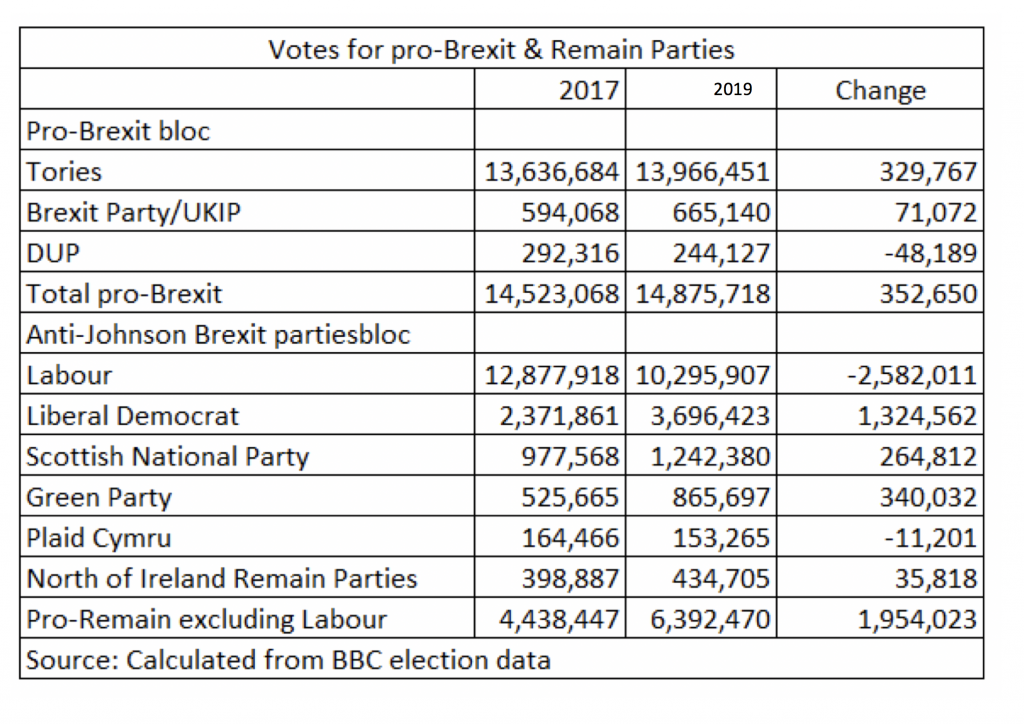
A black and white table with four columns, on the left, a list of parties, arranged by whether pro-Brexit or Remain. Then their 2017 vote, then their vote in the election of 2019 and the final column being the difference.
Between 2017 and 2019, Labour lost approximately 2.58m votes to Remain parties and 0.35m to Pro-Brexit parties

How strange, that two positions in apparent opposition to each other might both be true. As is often the case with such conundrums, they represent half-grasped insights into a deeper dynamic that makes sense of them both.

What unites the two arguments (Labour should have been more for Brexit / Labour should have been more for Remain) is an electorate who desperately wanted an end to the protracted and painful divisions over Brexit. By trying to steer a middle course on Brexit, Labour offered months, if not years more, of a debate that to many was infuriating. Back to the EU for more negotiations, then a second referendum on the result of those negotiations. And no commitment to advocating for its deal in such a scenario. This was a line that could only be drawn mathematically: by finding the centre of gravity between competing forces and trying to balance them. Sometimes, this kind of politics, of finding a position that doesn’t alienate anyone too much, can work. De Valera was a master at it. But with Johnson knowing full well how disenchanted large swathes of the public were with the delay to Brexit, Labour’s position didn’t come across as far-sighted and statesmanlike, it seemed cowardly.

In hindsight, the parliamentary manoeuvres that prevented Johnson from crashing out in a no deal scenario do not look as clever as they appeared at the time. Yes, Johnson was boxed in, but all the time he was boxed in and being refused an election, he was gaining potential energy from massive discontent with further delays to Brexit, so that when the election came, he could spring forth, like a jack-in-the-box, crying, ‘get Brexit done’ and release that frustration.

My conclusion in regard to Brexit, the all important theme of the election, is that Labour, by half-moving to Remain took a very difficult position. To have won despite this sense that they were sitting on the fence would have required the public to be more concerned about other issues, such as the NHS than Brexit, which ultimately was not the case.

Was the Labour manifesto too radical in 2019?

Naturally, the right in the British Labour Party and the Irish too, have been quick to conclude that the December 2019 UK election proves that radical socialist policies are unelectable and that the UK Labour party should move back to the ‘centre’ ground of Blair and Brown. For ‘centre’, read neo-liberal, austerity politics.

The reality seems to have been a public – and especially working class communities — who much preferred Labour’s manifesto to that of the Tories. As one Labour canvasser wrote:

Once I had made common ground with people, I encountered no prejudice, and little rugged individualism. I did this by talking the language of class, which is something the left have not done well, even under Corbyn. When I asked them about public services, about the Labour manifesto and its promises, they were very enthused, and yes, even those people who had voted Tory or who were abstaining because they ‘hated all politicians’.

Fifty-nine percent of Labour voters said they: “preferred the promises made by the party I voted for more than the promises of other parties”, the second most popular reason for voting Labour (the first being that they trusted Labour’s motives more). Whereas for the Tory voter, it was not about policy, it was about Brexit. Labour’s policies were not vote losers, in fact they were vote-winning, especially among younger voters. The graphic about this is extraordinary.

As @electionmapsuk on Twitter noted last year based on polls, the Tories would win no seats if the only voters were those aged 18 – 24 and the Ashcroft survey after the election of 2019 bears this out.

A map of the UK with constituency boundaries, which is nearly entirely red except for Scotland, mostly pale yellow, and a dot of green in Wales with some dots of orange. It illustrates the fact that if voters in the UK in 2019 had been limited to the 18 - 24 year old group, Labour would have won 600 seats.
The astonishing picture if voters had been limited to the 18 – 24 year old group is that the Conservatives would have been wiped out entirely by that generation.

What hurt Labour beyond Brexit, was not the policies as such, but the questions around them. How much would they cost and, especially, how would Jeremy Corbyn deliver them? Wasn’t he just making promises for votes, the same as all politicians do?

Here there was a difference between Corbyn versus May in 2017 and Corbyn versus Johnson in 2019 and the difference was not just a matter of the relative strengths and weaknesses of the Tory leader. Corbyn had the better of both in terms of debating issues that working class communities care about. In 2019, however, he also bore the legacy of two years of parliamentary games, during which time the sense that he was different wore off.

Of course, there was a horrible smear campaign against Corbyn from the UK’s media. They were worse in 2019 than in 2017 and on the issue of anti-Semitism, utterly hypocritical given that anti-Semitism in the Tory party is far more prevalent than it is in the Labour Party. What gave Corbyn difficulty in resisting the media attacks this time around was in part that over the intervening months he became normalised as a politician. That’s something which is very difficult to avoid if you are the leader of the UK’s Labour Party. It is also fatal for someone whose main strength in resisting the Tory-controlled media messages is that of being the outsider, the anti-establishment figure, the person who actually is sincere about causes and willing to fight them.  In 2017, there was a sense that Corbyn was all these things and that rant and rave as the billionaire class might through its media channels, the people, and especially the younger people mobilised at massive, inspiring rallies by Momentum, could shrug it all off and sing his name with passion. Of course the media froth against Corbyn: he’s ours not theirs. He’s outside of the box.

In 2019, there were nowhere near the same levels of turnout for mass rallies to take Corbyn to heart and use alternative media to build a space for him that was free from control by the elites and one which could spread to politicise wider numbers. Corbyn had, by the logic of his role over the intervening months, to play the game of politics in the usual way, among the usual public schoolboys, in the usual chamber from where the voice of working class communities has largely been absent. He had become (and, of course, to a large extent has been all his life) that despised creature, a politician.

In 2019, Momentum played a magnificent role in terms of winning the battle on social media, even with a fraction of the budget available to the Tories. And one positive from this election result for all the left going forward would be to study Momentum’s productions and campaigns on Facebook, Twitter and Instragram. Yet the higher level of co-ordination and planning by Momentum activists in 2019 compared to 2017 was met by a less passionate response. Gone were the chaotic but electric mass rallies of the earlier election and in their place, much less inspiring events.

Labour’s 2019 manifesto was more left-wing than that of 2017 but the context of a weaker mass movement around Corbyn meant, with the exception of the promises around the NHS, it looked unconvincing. My second takeaway for the left from this election is that advocating socialist policies as a response to years of austerity is unproblematic. There’s no need to rush back to the centre. What matters are our connections to communities willing to be active participants in the process of winning the goals set out in manifestos. One demand arising from a politicised working class (e.g. abolish the Water Charges) is worth a dozen from a think-tank or 1930s transitional programme. And in the period between elections, if the left have not been focused on whatever options to campaign exist outside of parliament, then we do lack credibility if we suddenly promise a golden age of socialist policies come an election.

Can the left revive after the UK election of 2019?

Easily.

On the night, the UK election result felt like a terrible blow for the left. And it was. Once again, the right and especially the anti-immigrant racist feel triumphant. This is no light matter. Yet an election should be understood as a snapshot of feeling rather than a fundamental change in the social landscape. By which I mean, for example, that the defeat of the miners in 1984 – 5 was a far worse defeat than this election result. When the best-organised, most economically strategic group of workers are crushed and eventually laid off, it’s no wonder that in industry after industry, the axe subsequently comes down on workers’ incomes and rights.

An election result, even this one, where it was so polarised, changes very little in terms of the capacity of workers to mount campaigns and strikes. And when you consider that Labour was way ahead among voters aged 18 – 44 even in purely electoral terms, that indicates a comeback in the future.

Moreover, there are features of Johnson’s victory that mean his position is not as stable as having a big majority of MPs suggests. On his right, there is Nigel Farage. There is enormous mistrust and outright anger from the hardline Brexiters towards Johnson. Tactically, they had to retreat from challenging the Tories or split the vote and let Labour into government but they hated doing so and will be seeking ways to ‘reapply pressure’ on the Tories, as Farage put it soon after the election.

On Johnson’s left, within the Tory party, are those who do not want to make a dash out of Europe at the cost of severe trading penalties. In 2018, 45% of the UK’s exports were to EU countries (and 53% of imports). This means there is a sizeable number of people in business — the natural base for the Tories — who hate Brexit. They have come to terms with it, though, as judged by the bounce in Sterling and the UK’s stock market after the election. Given a divided consensus among the Tory party’s business network and a UK population who will experience all kinds of unexpected hardships once Brexit is concluded, there’s no doubt at all that the left will bounce back. And it doesn’t have to be a matter of waiting five years until the next election. Not only are there no shortage of issues for the left to campaign on right now in the UK, the frustration of the younger worker and of trade unionists as a result of this election mean that significant strikes and protest movements are very likely to spring up in 2020

Filed Under: All Posts, Irish Political Parties

Google and Facebook workers’ protests grow

25/10/2019 by Conor Kostick Leave a Comment

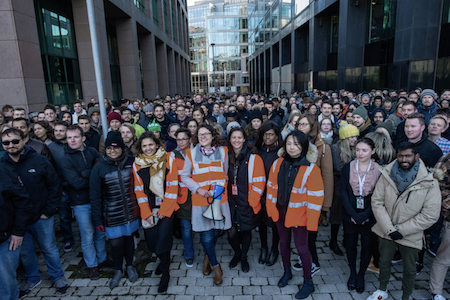
On 1 November 2018, workers at Google’s HQ in Dublin struck

Back in the late 1980s, after the defeat of the air traffic controllers in the USA and the miners in the UK, a great many activists gave up on their hopes that working class people could lead a revolt against capitalism. Andre Gorz, for example, had written a book, Adieux au proletariat (Farewell to the Working Class) which became popular on the left. His argument was that the traditional working class had changed in such a fundamental way that we would never again have the power to lead a transformation of society.

What the book (and those influenced by it) failed to appreciate is that the working class is always changing. Industries rise and fall, with consequences for patterns of employment. But the fact that all companies exploit their workers to maximise profits is a constant. And it is a constant that means after a new company has been running for a while, its employees will try to organise themselves.

Take Google and Facebook, two very important examples of new workforces, especially for Ireland. Right now there is major unrest by staff worldwide in these companies along with a drive to unionise.

The struggle for trade union rights at Google

At the end of October 2019, a row broke out at Google over a new tool for Chrome that automatically launches a pop-up when staff book a room capable of holding 100 people or more. Google says that it’s just a roadbump to stop unnecessary invitations but employees anonymously leaked news of this tool with the allegation that it was designed to warn management of attempts to hold organising meetings.

Workers have mocked the tool, circulating memes such as one showing Professor Dolores Umbridge teaching a defence against the Dark Arts class. Beneath her, it says: ‘Google decree number 24: no employee organization or meeting with over 100 participants may exist without the knowledge and approval of the high inquisitor.’ Another shows a bunch of male managers in suits laughing as one of them says: ‘and then we told them “we will not make it appear to you that we are watching out for your protected concerted activities” as we pushed a Chrome extension to report when someone makes a meeting with 100+ people.’

This came shortly after a meeting, 21 October 2019, in Switzerland, where for several months, over 2,000 Google staff had been attempting to organise a meeting addressed by the trade union Syndicom. Management attempted to thwart the meeting and at one point sent a message around to employees saying, “we’ll be cancelling this talk.”

In the end, some 40 workers insisted on their right to hear the union representative and this issue is likely to culminate in a fierce battle for recognition.

To some extent the drive to unionise was trigged by the massive walkout on 1 November 2018, a strike that was very well supported by Dublin Google workers at the Barrow Street headquarters. Google employs around 7,000 workers in Ireland. Over 20,000 workers in 47 countries held a wildcat strike to protest at massive severance payments made to male executives accused of sexual harassment.

Google workers have recently leaked information on issues they feel are morally wrong in the direction of the company, such as censored search engines for China; co-operation with armies, or with the fossil fuel industry.

On 25 November 2019, the New York Times reported that it had seen a memo where four Google workers associated with organising their colleagues were fired.

Facebook has over 4,000 employees in Ireland and here too there have been leaks, not least in regard to making contracts public. This has been an important contribution to a legal case against Google contracts where the plaintiffs want end to compulsory arbitration of workplace discrimination cases.

One Facebook worker described to Independent Left how the company started in Ireland in a non-traditional way, making an effort to create a team spirit through twenty-four hour, free access to a variety of food and drink, including a bar. But now, most of that has gone and the company manages its workers much like any other.

Life in Google and Facebook for workers is unrecognisable in the Hollywood versions of these companies (e.g. in The Social Network or The Internship).

What this discontent among workers in the giant tech companies shows is that although the decline of old industries can indeed shatter working class organisation and confidence for a few years, the rise of new ones (and, indeed, the return of confidence to traditional ones) brings back the fight to organise against exploitation and unfair practices.

And what this means for the big picture is that the potential for workers to lead a massive, fundamental change to how the world currently works is as great as ever.

Facebook Staff Protests Against Trump: Update 2 June 2020

It is not only the issues of working conditions that is driving Facebook workers to organise themselves. The wider social role played by Facebook is leading to its own workers attempting to instil ethical values on their practices. In particular, there is a growing desire by workers to curtail the use of Facebook by Donald Trump to promote his side of the growing social split in the US. Many staff held a virtual walkout on 1 June 2020 to challenge the way that the US President was using Facebook to spread misinformation and incite violence.

A tweet by Jason Toff (@jasontoff) which has 187k likes. It reads:
I work at Facebook and I am not proud of how we're showing up. The majority of coworkers I've spoken to feel the same way. We are making our voice heard.
It is dated 5.55am June 1, 2020.
Posts by Facebook workers concerned to implement an ethical policy about the use of the platform are gaining hundreds of thousands of likes.

A design manager tweeted:

I’m a FB employee that completely disagrees with Mark’s decision to do nothing about Trump’s recent posts, which clearly incite violence. I’m not alone inside of FB. There isn’t a neutral position on racism.

Placing a logo of a fist with a hart on their posts, another Facebook team joined the walkout en mass. It is widely reported that Trump spoke to Zuckenburg on Friday 29 May after Zuckenburg asked him to amend a post.

While the head of Facebook holds back from acting against Trump, his staff are sharing a quote from Anti-Apartheid leader Archbishop Desmond Tutu:

If you are neutral in situations of injustice, you have chosen the side of the oppressor.

Filed Under: All Posts, Protests Ireland

Brexit: What Should Irish Socialists Say?

19/10/2019 by Conor Kostick 1 Comment

Short version: Independent Left advocate Remain.

At the time of writing, there is still a lot of uncertainty around whether and under what conditions the UK will leave EU. On Saturday 19 October, it seemed possible that Boris Johnson would just about get a Brexit deal through the UK parliament, only for him to be caught by surprise by an amendment (the Letwin amendment) that postponed a vote on Johnson’s Brexit package until a Withdrawal Agreement bill (WAB) was first agreed. The point being that MPs did not trust Johnson: so long as WAB was not passed, there was a danger of a No Deal crash out on 31 October.

Currently, even if Johnson does have the slender majority he needs to deliver Brexit in line with his agreement, there is still opportunity for UK MPs to amend the WAB, including by adding the idea that a second referendum has to be organised to endorse the deal. A new referendum was the demand of the huge (possibly as many as one million people) march in London on the same date.

What is certain is that if Brexit takes place – and especially if it’s the Johnson version – the UK leaving will be harmful for working class communities. In the UK itself, including Northern Ireland, Brexit would mean a rise in unemployment, a food and medicine crisis and an economic decline that some analysts anticipate will be worse than that of the 1930s. In Ireland, there are likely to be similar, if much less severe consequences. Here too, however, we are also going to face a government that will use Brexit, like it has used every crisis before now, as an excuse to strike down on working class people.

Remember how the Universal Social Charge was introduced by Fianna Fail’s Finance minister Brian Lenihan in 2010 as ‘a temporary measure’ to help Ireland cope with the financial crisis? Well, Brexit will be used in exactly the same way: even now Fine Gael are raising Brexit to justify their failure to properly fund essential services. The most recent budget is just the latest example of this approach.

For this reason alone, Irish socialists should advocate Remain. Moreover, there’s another way that the position of workers has already worsened as a result of the Brexit vote and that is because it has been accompanied by a rise in racism. Racists of all hues in the UK, including out-and-out fascists, greeted the result of the Brexit referendum with delight and there was an immediate upsurge of attacks on immigrants (a rise of 41% in what the UK police term ‘hate crimes’). In Ireland, we only experienced a ripple of this, but any growth in hostility to immigrants harms our ability to stand together and make progress on all the pressing issues that face us.

Does supporting Remain mean supporting the EU?

On the whole, with the important exception of Bernadette McAliskey, who quite rightly said, ‘politically the Right wing of British and European politics along with anti-immigration and naked racism has been strengthened by the Brexit victory,’ the Irish left were pro-Brexit at the time of the first referendum. It is understandable why. We shocked the establishment in 2001, when we were a successful part of the campaign against the Nice Treaty (opposing it largely because the treaty undermined Irish neutrality). The Irish conservative parties had to spend a lot of time and energy in pushing through the re-run in 2002. Again, the Lisbon Treaty of 2008 was rejected, with the left in tune with working class communities who mistrusted the proposed changes as likely to favour business over workers’ rights.

Given the EU had bullied Ireland into taking on the debts of their banks after the crash of 2009 and then tried to insist on us having water charges to pay for these massive debts, it’s no wonder that the Socialist Party, People Before Profit and many others on the left assumed that being in favour of Brexit was the natural continuation of an approach that – rightly – characterises the EU as being dominated by big business.

They were mistaken and deeply so.

Every referendum has to be judged on its merits and understood to be taking place at a particular moment in time. The UK one on Brexit had a very different dynamic to Nice and Lisbon. It was rapidly taken up by the anti-immigration UKIP and small parties even further to the right and then became all about immigration, particularly after the murder of Labour’s Jo Cox. Jo Cox was a prominent activist against Islamaphobia who was campaigning for Remain. She was killed by a man with fascist connections, who shouted “Britain first”.

Socialists who had a vote should have voted Remain, primarily in order to stand with the anti-racists.

There is no contradiction at all in advocating Remain for these reasons and still holding to a view that the EU is driven by big business. Because Brexit too is all about a big business agenda: the Conservative Brexiteers can hardly wait to tear up EU regulations protecting workers’ rights. They think realignment with the US and the far-east will prove more profitable than staying in the EU.

The old Socialist Workers Party that was, had a slogan, ‘neither Washington nor Moscow’ to indicate that in the Cold War it did not see it necessary to pick a side, when both sides were racing to oppress and exploit their populations. That’s the approach that socialists should take when the rows among a divided elite spill over into a referendum. The Irish version runs: feck ye both.

We don’t have a side between the EU and British businesses who think they are better off facing towards the US. But we do take sides against racism and we are rooted in communities that are going to suffer when Fine Gael wield the hammer, shouting ‘sorry, but Brexit’.

So Remain it is.

What should socialists do now about Brexit?

The Brexit vote is not a defiant working class refusing to be pushed into a Lisbon-type treaty. It’s the opposite: an anti-immigrant, right-wing vote. On the other hand, the Remain vote had as its largest component exactly the kind of people who make up the natural constituency for socialist parties: trade unionists, community activists and especially anti-racists.

The Ashcroft exit poll to the Brexit referendum was the most comprehensive poll at the time (12,000 people sampled). It shows that two out of three Labour voters voted Remain. A majority of people in work voted Remain. 67% of Asians voted Remain and 70% of Muslims. True, there were traditional Labour regions that voted leave, but no one argues that they did so for any other reason than being anti-immigrant. Their champion within the Labour Party, Stephen Kinnock, thinks Labour has to emphasise, ‘the value of place’ and the legitimacy of raising concerns about immigration.

Trying to appease racism never works. The more divided a working class community, the less able we are to win campaigns on all the issues affecting us.

Probably, the penny has begun to drop among Irish socialists that they have the wrong approach to Brexit and they are alienating themselves from core supporters.

Hopefully these parties change their approach. Although they have no culture of doing so, it would not harm these parties to acknowledge that supporting Brexit was a mistake but now, in the light of developments, they are for Remain. No harm at all. In fact, you win respect by honesty instead of evasive, never-wrong, politician-speak. We need to have the humility to acknowledge when we make mistakes, learn from them and move forward. No one is all-knowing, so we shouldn’t pretend to be so.

For our part, we are unambiguous. Independent Left are for Remain.

Filed Under: All Posts, Independent Left Policies

  • « Go to Previous Page
  • Page 1
  • Interim pages omitted …
  • Page 4
  • Page 5
  • Page 6
  • Page 7
  • Page 8
  • Page 9
  • Go to Next Page »

Copyright © 2026 · Aspire Pro on Genesis Framework · WordPress · Log in