• Skip to primary navigation
  • Skip to main content
independent left logo

Independent Left

Environmentalism, socialism, freedom and equality. #liveablecity

  • About
  • Featured Articles
    • How Farming Must Change to Save the Planet
    • The Housing Crisis: Causes and Solutions
    • Socialism in Ireland
  • Contact Us
  • Podcast
  • Animal Rights
  • Archive
    • Irish Socialist History
    • Dublin City Council Housing
    • Ukraine
    • Protests Ireland
    • Reviews
    • Irish Political Parties
    • All Posts
    • Independent Left Policies
  • Why join?

Features by Conor Kostick Independent Left

Hoods Hoods Klan Interview

30/05/2023 by Conor Kostick 3 Comments

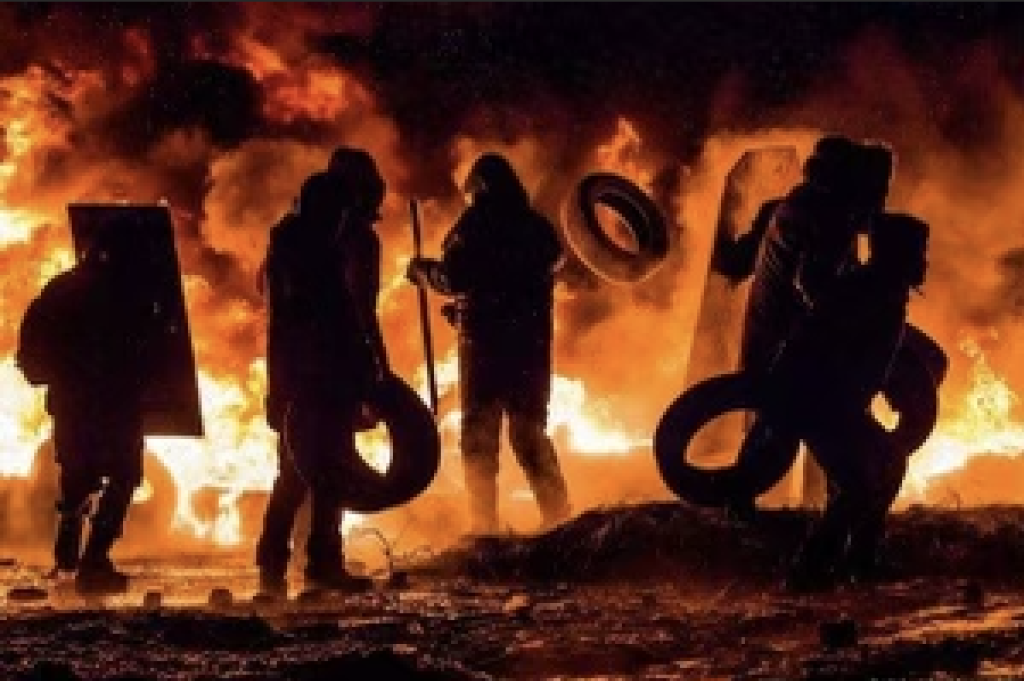
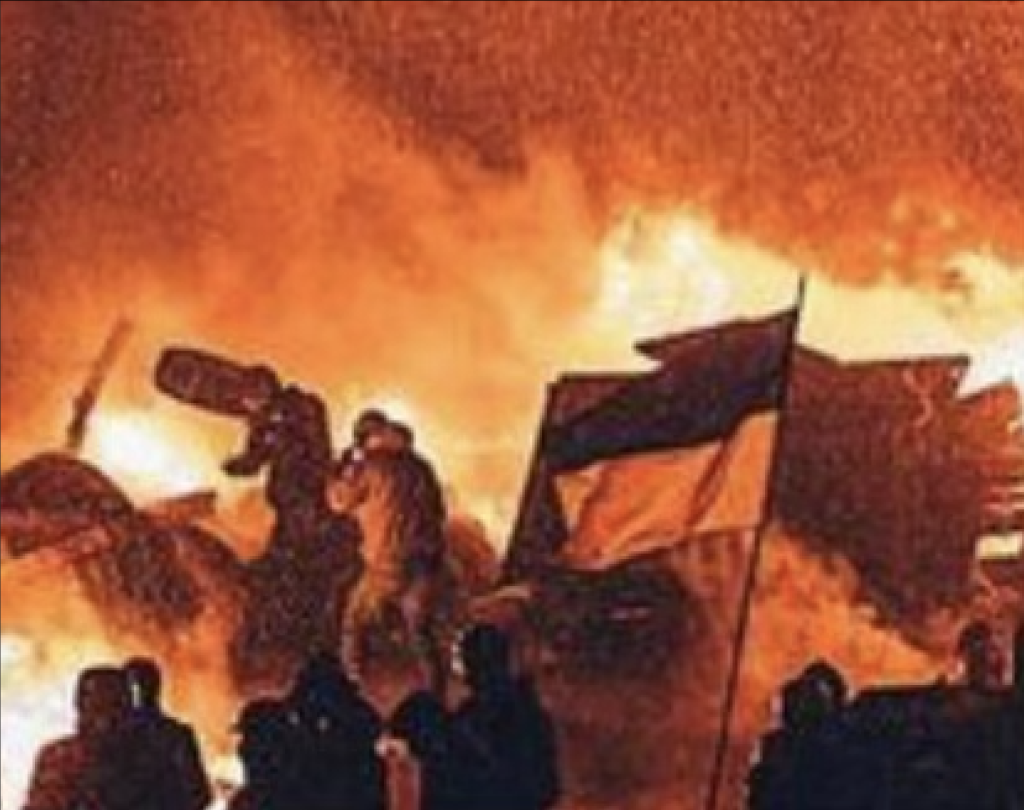
Hoods Hoods Klan: Interview: Eugene at the epicentre of clashes between protesters and police in Hrushevskoho street, Maidan Revolution, 2014
Hoods Hoods Klan: Interview: Eugene at the epicentre of clashes between protesters and police in Hrushevskoho street, Maidan Revolution, 2014.

I met Eugene at the Dublin Anarchist Bookfair, 2023. He came by the event and gave an impromptu talk at a panel on challenging imperialism. Afterwards, he agreed to meet me to be interviewed for the Independent Left website about his experiences with the Arsenal Kyiv, Hoods Hoods Klan, who have been the subject of a powerful documentary by Jake Hanrahan: Frontline Hooligan. I found what Eugene had to say inspiring and important for the future of the left internationally.

Eugene: My name is Eugene and I’m a member of the group of Arsenal Kyiv hooligans, who are called Hoods Hoods Klan. This organisation was founded in 2007 and I have had a connection with all of these lads since that time.

Conor: How did you meet them? How did you get started?

Eugene: Actually, we were a group of punk hardcore kids. At that time, football hooligans in Ukraine were right-wing: racists, Nazis, or something like that. And they always wanted to fight, especially against certain people like anti-fascists.

They went looking for anti-fascists for street violence because they need street violence. So they started to attack the punk gigs. And we wanted to protect the punk gigs, which were happening every single week. I was sixteen or seventeen at that time­; we were a young generation and we were Straight Edge. Straight Edge meant that we didn’t drink, didn’t smoke, didn’t fuck. And most of us did some sport. The older generation of Nazi skinheads were much more into alcohol; so we were much younger, but also fitter. We became a group of people who understood each other without any words. In any gig where someone said, “Boneheads,” we would group together and go outside on the street and look for right-wing hooligans. And then in 2004, some older anti-fascists, older than me, they understood that Arsenal Kyiv was the only team for us.

Hoods Hoods Klan Interview: logo
Hoods Hoods Klan Badge: No Fear No Weakness

Arsenal Kyiv had a huge working-class background, because the arsenal was one of the biggest manufacturing centres in Ukraine. It started in the eighteenth century or the seventeenth. And it was huge. The Arsenal Kyiv football team was founded in 1925, but they only played in the second, or maybe third, Soviet Union division. And in 1964 they ran out of money and stopped. But it was a really working-class football team. And then in 2001 the club was founded again and in 2004 a group of maybe just five or six anti-fascists from Kyiv started to support this team. And then our group, the Hoods Hoods Klan was founded in 2007. In 2007, it was maybe nine or ten people, something like that.

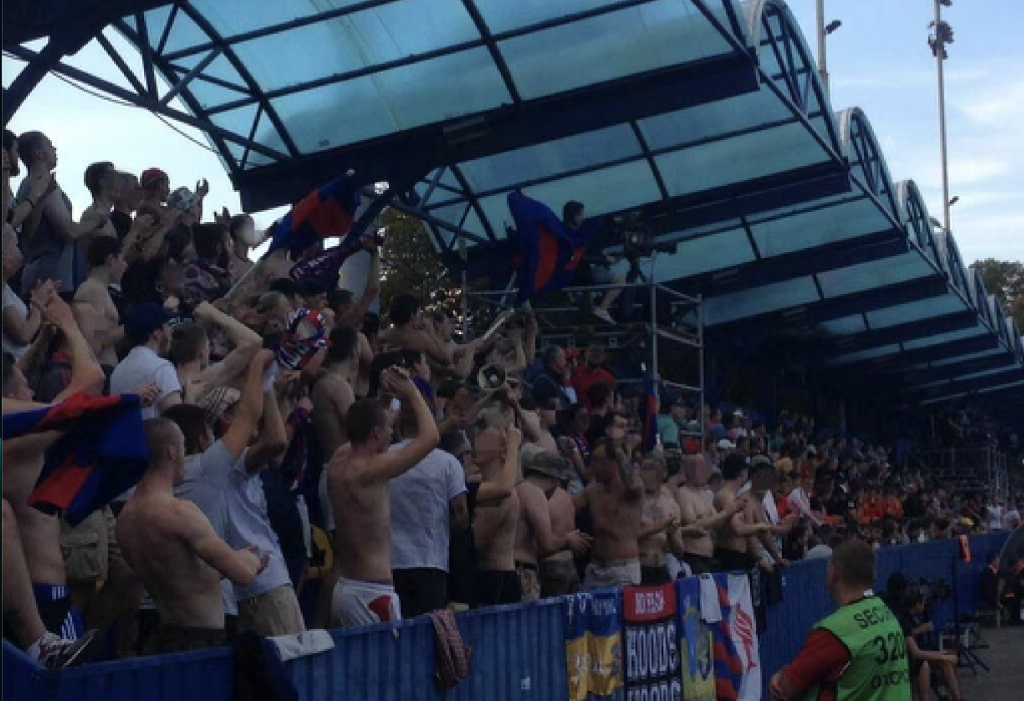
Hoods Hoods Klan Interview: Arsenal Kyiv firm
Hoods Hoods Klan Interview: Arsenal Kyiv

Year after year we gained more people because of Nazi attacks. Some people always want to offer protection and you’re very happy when you find someone who has the same ideas: anti-fascist, anti-racist and all the other positive values. There were a lot of people from the hardcore punk scene in the movement. It was one of real unity. So for example, I was living in Chernihiv, it’s the north part of Ukraine, but we had a strong connection with the guys from Kyiv. Five lads in my town started to do some hooligan things with the Hoods Hoods Klan because the bands from Kyiv played in my hometown, and the bands from Chernihiv played in Kyiv. We were young kids with the same ideas of anti-homophobia, anti-racism, anti-fascism, anti-terrorism, anti-imperialism.

I’m also vegan and there’s a lot of vegans in my group. Because my childhood was very political. So most of us, we’re like human rights and animal rights activists from the very beginning. When I was a kid, we had a Food Not Bombs in my hometown. I was the member of the Food Not Bombs group. We had everything in my childhood: Critical Mass; Food Not Bombs; all of the charity foundations; the eco campaigns; the animal liberation campaigns.

Hoods Hoods Klan Interview: Kyiv
Hoods Hoods Klan Interview: On the streets of Kyiv

Conor: It’s unusual for football hooligans to be revolutionaries.

Eugene: It’s a very unique thing for Eastern Europe, because most of the Eastern European hooligans are really right wing. And in Ukraine in 2008 most of the right wing hooligans united against us. We were against everyone and everyone was against us. We were the only group that fought against everyone many times. And many times we won the fights.

Conor: Did you earn respect from your enemies?

Eugene: Yes, I think a lot. We went out to fight even in smaller numbers, despite the fact that we knew that we could be defeated. And if we managed to fight with an equal number, most often we won. We call it the psychology of a winner. 

Even our women are brave. Today women from Arsenal Kyiv supporters are in the front line, like medics. If feminists in Ireland want to support women in the front line, I can say that we have this.

Conor: Was it dangerous?

Eugene: Street violence is always dangerous. At the same time, Hoods has always had a code of honour: we did not use knives, traumatic weapons or firearms in fights. Although, I confess that in 2012, in one of the street fights with right-wing hooligans, I was shot three times with a traumatic pistol. But I didn’t get hit. I think that with the help of force, we managed to convince the Nazis that they do not need to use knives or guns in fights. Because we were not afraid to use them in their direction. But we preferred fists.

Speaking of weapons, I will say that the Ukrainian neo-Nazis have always imitated their comrades-in-arms from Russia. Unfortunately in 2008 in Russia, the boneheads – Nazi skinheads – had a strong relationship with the FSB, which is the new KGB. And after the new presidential election in Russia, the Medvedev election of 2008, they wanted to show the Russian people that a strong power was needed. So the FSB did a deal with the boneheads and they started to kill the anti-fascists in Russia.

They killed Ivan Khutorskoy, Fyodor Filatov, and Ilya Dgaparidze. These were supporters of Arsenal Kyiv. And they killed Anastasia Baburova, she was journalist investigating Nazis and she was murdered on 19 January 2009 along with anti-Nazi lawyer Stanislav Markelov.

Conor: Did you have to fight for your life?

Eugene: Since 2005, I think, a lot of times I was fighting. I remember the time when I walked into a punk hardcore gig with my girlfriend and a group of Nazis, maybe seven, I don’t know, hit me first on the back of my head. One of them broke my eyebrow. I think they wanted to knock me down. But they couldn’t bring me down. I turned around and told them: go fuck yourself and they ran away. So, it was a quick fight and I think for me, everything started at that moment. You protect yourself. One memorable fight for me with Nazis in Ukraine was in 2018 at a hardcore punk gig. A group of Nazis tried to come in and I just came to them and asked, “What are you doing here?” And they were laughing, “We just want to watch the real gay, trans people: this scum.” And soon we’re just fighting, one by one, and it’s finished. They go away. If a Nazi or racist or homophobic person got inside the concert, we were there to protect our ideas.

Hoods Hoods Klan: Interview: Eugene at Maidan Revolution, 2014
Hoods Hoods Klan Interview: Eugene at Maidan Revolution, 2014.

Conor: You were involved in the Maidan uprising, right? Even though there was some far right involved in that as well?

Eugene: Far right? It’s a good question. I was in Maidan from the very, very first day. Maidan started as a student action. Students were in the city centre and the cops beat them. One of the students was my classmate, he’s not Nazi, I know him well. And the next day there were a million people in the city centre. There were no right-wing flags, just flags of Ukraine: no political parties. I’m someone who joined the Maidan movement and I can truly say that it was not a right-wing revolution.

We had online broadcasts from Maidan. So even if you’re working, you’re watching the revolution. I saw the cops were gathering to beat people and immediately we were there, like within twenty minutes I think. They were armed with guns and shooting. And they had the Crimean special forces. This was the first time that I saw cops firing guns.

Then we started to build barricades in Maidan. I was one of the very first people who were there at that time who started to build the barricades from all of the stuff that was there. I had just walked in there. Everyone from Kyiv was there. If you’re a Nazi, maybe you were there too, but there were no Celtic Cross or swastikas there. Actually, even if you had a t-shirt with Nazi symbols, we also had people who wore anarchist t-shirts or something like that. So if you can say that it was a Nazi revolution, I can say that it was an anarchist revolution. But you can’t say this about ninety-nine per cent of people, those who were just working-class people without right wing ideas.

One night there was a clash and fires in the street from Molotov cocktails and it was really cold – minus thirteen – everything was burning. And the cops tried to stop the fire with hoses and water and it was like you were covered in ice. Someone said that the Right Sector is coming.

Until midnight there were a lot of people there. But after the last metro train, it was down to just hundreds of people. And we are very lucky that a huge wind carried the smoke over the cops, and they didn’t know how many people were there because if they had seen how few we were, they would have killed us.

Someone nearby said, “Okay, right now the Right Sector would be help.” And for the next minute, me and my friend who is also antifascist, we were just laughing because the famous Right Sector turned out to be just fifteen-years-old kids with wooden shields. Maybe one per cent of the people that night were right wing, but there were even people of color there. It was a revolution of the Ukrainian people. All of the Ukraine people were there.

Hoods Hoods Klan Interview: the War with Russia

Conor: Russia responded to Maidan by attacking Ukraine. How did Hoods Hoods Klan react?

Eugene: In 2014, immediately after Maidan, Russia grabbed the Crimea. And then in May were battles in the Donetsk region and a couple of our lads were involved. It was a tragedy. There were huge losses for the Ukrainian army and two anarchist guys from Arsenal Kyiv were captured and they were put in prison. Russia occupied our land and my friend – his nickname is Doc – had an injury to his back from a rocket. He had called for medical help but the Russians put him in prison for three months. We collected money for him: I made t-shirts with his image and the line from our national anthem, We will allow no masters to rule us in our motherland. It’s a very anarchist line! After that, more of Hoods Hood Klan joined the army.

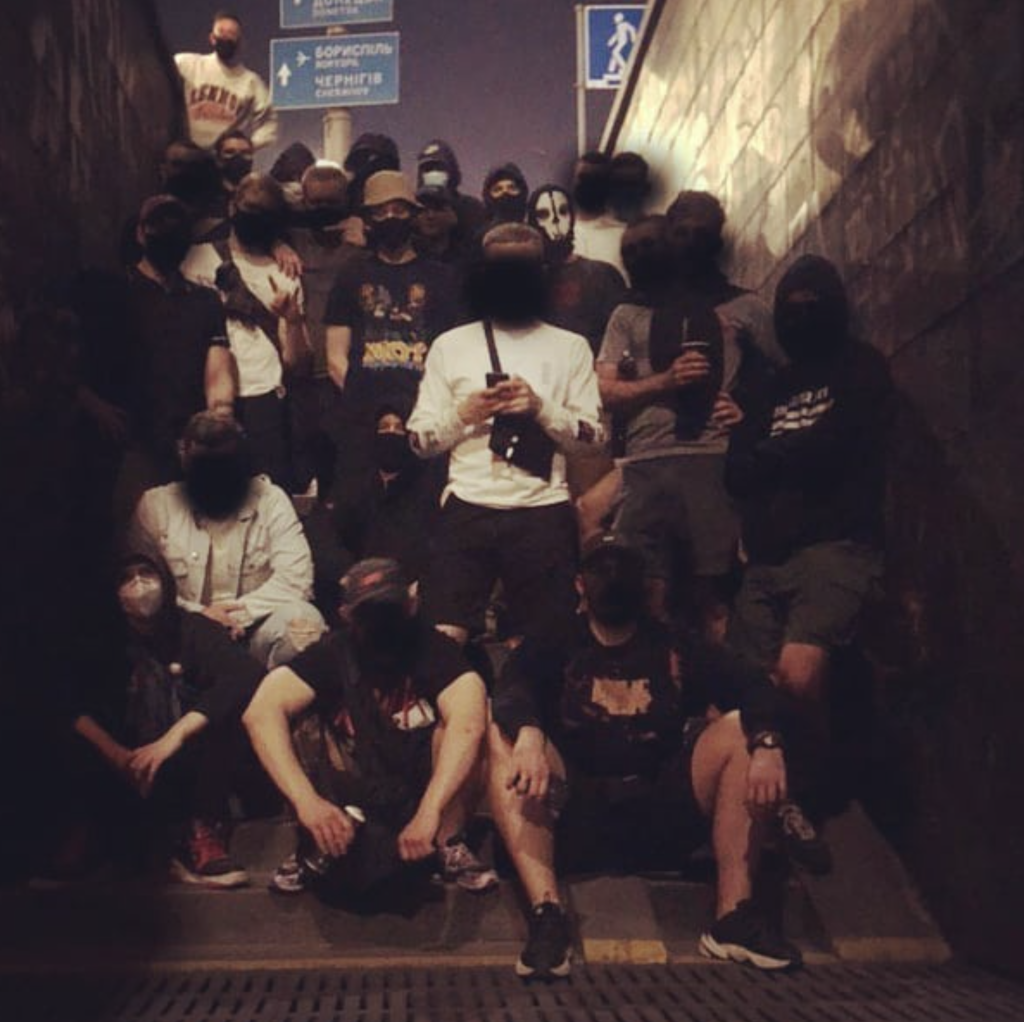
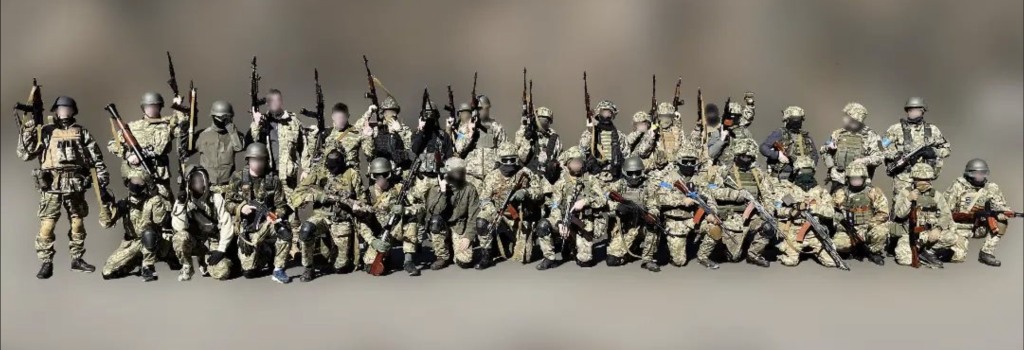
Hoods Hoods Klan Interview: geared up for war.
Hoods Hoods Klan geared up for war against the Russian invasion.

Conor: When you joined the Army, were you able to stay as the Hoods Hoods Klan? Were you able to stay anti-fascist or did you just have to go wherever you were told?

Eugene: You could stay as a group. Even right now. We are still anti racist, anti-homophobic, anti-imperialist, anti-authoritarian. And we are fighting against a government, Russia, which is a hundred per cent homophobic; a hundred percent imperialistic. I’d like to say they are racist but it’s not quite the right term. More accurate is that they are a hundred percent xenophobic. They are very chauvinistic and their idea is that there is no Ukrainian nation. Like Hitler wanted to say that there is no Jewish people. So Putin, maybe you saw the video two days ago?

Conor: The map?

Eugene: …he showed a seventeenth century map and said, “…there is no Ukrainian people at all.” It was funny, because in fact the map shows the opposite. But it shows Putin’s intention: to make Ukraine disappear. We are fighting against a chauvinistic, right-wing, terrorist country. So yes, we are still fighting with the same ideas we had fifteen years again.

Conor: Right now there are insurgents, Russian insurgents, trying to overthrow Putin. Some of them say that they’re football hooligans. And they are carrying out raids. One of these movements seems to be fascist, and another one seems to be a left movement. So how do you feel about that? Is it okay to be working with far-right units? Is there a kind of a truce between you and the fascists until you beat Russia? How does that work?

Eugene: Firstly, it’s important to say that these are Russian people fighting on their territory. I mean the fight against the Putin regime. Ukrainians just protect their own territory. At the moment, Ukrainian cities are being shelled by people of the same skin colour. As we understand, the Ukrainian army is at war with representatives of the same race. Therefore, it is ridiculous to talk about some kind of Racial Holy War. As we understand it, Ukrainian women and children were not raped by defenders of LGBT rights or feminism.  

In my opinion, the vast majority of the Russian military are homophobic and transphobic. I think that many Russians support the idea of the Russian world, being nationalists and xenophobes. One way or another, the ideas of Russian imperialism, chauvinism and even Ukrainophobia are close to many. The Russian state has long met all the signs of fascism. Therefore, it is difficult for me to understand the logic of those who fight against Russia and call themselves a Nazi or even a representative of the right ideology.

If these Russian movements say that they’re racist or fascist or right wing, I can say that I’m a hundred percent against their ideas. Because those are the values which we’re fighting against. If Russian fascists want to have a strong leader, they already have it. If they want to have the power of one religion, they already have it. There are no human rights at all in Russia. Ukraine is not perfect because it’s an eastern European country with the huge legacy of the USSR. And we still need to help with the free press. But at least we have some freedoms: in Russia, you can be in prison for fifteen years just because you call the war a war.

Conor: If Ukraine wins, do you think that Putin could be toppled? And do you think there is hope for the left in Ukraine?

Eugene: That is an interesting question. Yes. I think, yes. The majority of people, working-class people, are democratic people. For me Maidan was about fighting for freedom, fighting for human rights, fighting for liberation, fighting for equality, fighting for our ideas. I think it’s the younger generation of people who could go in the direction of socialist ideas. But still, we have the bad experience of the USSR. We need to know that actually you can be a progressive left, not an authoritarian left.

Conor: Not a communist left. Speaking of which, some of the left in Ireland and internationally, they don’t agree with Putin, obviously, but they see NATO as blame for the war and they refuse to support arming Ukraine. What do you think of that position?

Hoods Hoods Klan Interview: NATO

Eugene: This is different to Yugoslavia, where NATO really was fighting and was involved in the war. If you say we can’t have the weapons, well okay, how are you going to help us protect Ukraine without them? I remember the day when my home town was bombed from the air and my grandmother lost her memory. My life was ruined. It was the hardest day in my whole life. My parents had no electricity, no mobile connection, no internet. And of course no gas. They cooked food on the street. I remember how I felt when I couldn’t call them while knowing that the Russians were bombing my hometown, Chernihiv, from the air. In that small town seven hundred houses were destroyed; twenty-four from thirty-seven schools were bombed and thirty-four from fifty kindergartens. My uncle died during this occupation period, because he had no medicine.

We need weapons to protect ourselves, not to attack someone. Remember we asked for the skies to be closed and no one helped us. I think Putin uses this anti-NATO propaganda. Ukraine is being blamed for our connection with NATO. But it’s not like that: we just want to be able to protect civilians. This is attempted genocide against Ukrainian people, directed against the civilians. They’re fighting civilians. There are hundreds of martyrs in my home region: hundreds of rapes; hundreds murders of children and the elderly.

The left should be smarter than to blame the victims. We shouldn’t listen to Putin and his speeches about NATO. We should think more and read more.

Conor: And speak more to the Ukrainian left.

Eugene: Speak to Ukrainian people. What they are actually feeling at this moment. I had a call from my mother yesterday. She works with the people who lost houses, they’re refugees inside the country. Because Russians fight in the northern part of my region and two thousand families have left their homes, maybe forever. And she starts from work at 5:30am and it never finishes because it’s like every single day that people lose someone.

I lost my classmate in Bakhmut last month and every single day it happens. And you can ask my mom why she stopped her normal life so as to start to help these people. And where is NATO at this moment? I don’t know. Where is their invasion? Where is their threat to Russia?

Russia is the biggest danger and not just to Ukraine. It’s like Nazi Germany.

Conor: What do you think about Zelensky and his politics?

Eugene: I want to explain to you about the Ukrainian people. The Ukraine people are the real power in Ukraine. Not Zelensky. I think that most old-fashioned countries in the world, they still believe in politics like the United States, they still think politics is about presidents. Our army before 2014 was like the worst army in the world because after soviet corruption there was no technique, no interest from the people, nothing. If you are anarchist, you can understand me. People fight well not because they are told to but because you have someone you want to protect.

During Maidan, everyone began to fight for a better, freer Ukraine. There was no crime and it was very clean on Maidan, even though there were no police and no services. Can you imagine no cops in your town because all the cops were against you? This is the key, most important question. If there are no cops, why is there no crime? The answer is that we had groups in every zone in the city, in every block. And we protected our houses. We didn’t need the cops. We protected each other and shared the food.

And the same happened in 2022 during the invasion. In every single city it was the people who joined the Territorial Defence. No one told us to organise. You just did it. My mom and sister, they cooked food for the soldiers. My father made Molotov cocktails. I believe if that people can manage the tasks in a country, we don’t even need the president, to be honest. So Zelensky’s just a representative person, like the CEO of a company. That’s it. This is the answer about the Zelensky. The real power is not Zelensky: the real power is Ukrainian people.

It’s something new that the left in Europe can learn from. Even right now, the solidarity of people in Ukraine is coping with everything. It’s a very socialistic thing; a very anarchist thing.

Conor: What can we do to help?

Eugene: We have a group of anti-fascists on the front line. They still have a need for help. They think that the European left don’t care about this work. So if you can show them solidarity, that it’s actually important, it would be a huge help. Because we need cars, we need drones, we need body armour, we need a lot of medical equipment. We have a fundraiser for this. (PayPal xkemanx@gmail.com https://www.instagram.com/hoodshoodsklan/)

And if you really don’t want to support the front line, I have friends who help rebuild the houses in the Chernihiv region. (https://send.monobank.ua/jar/yrN9K9nJX https://www.instagram.com/varyalushchyk/) So that can be useful. Also, my sister, she’s a lawyer and she’s like a social worker helping the kindergartens and schools in my home family in Chernihiv (https://www.savedschools.in.ua/donate/). They also have a foundation to build the schools and kindergartens. There’s a lot of ways to help Ukraine.

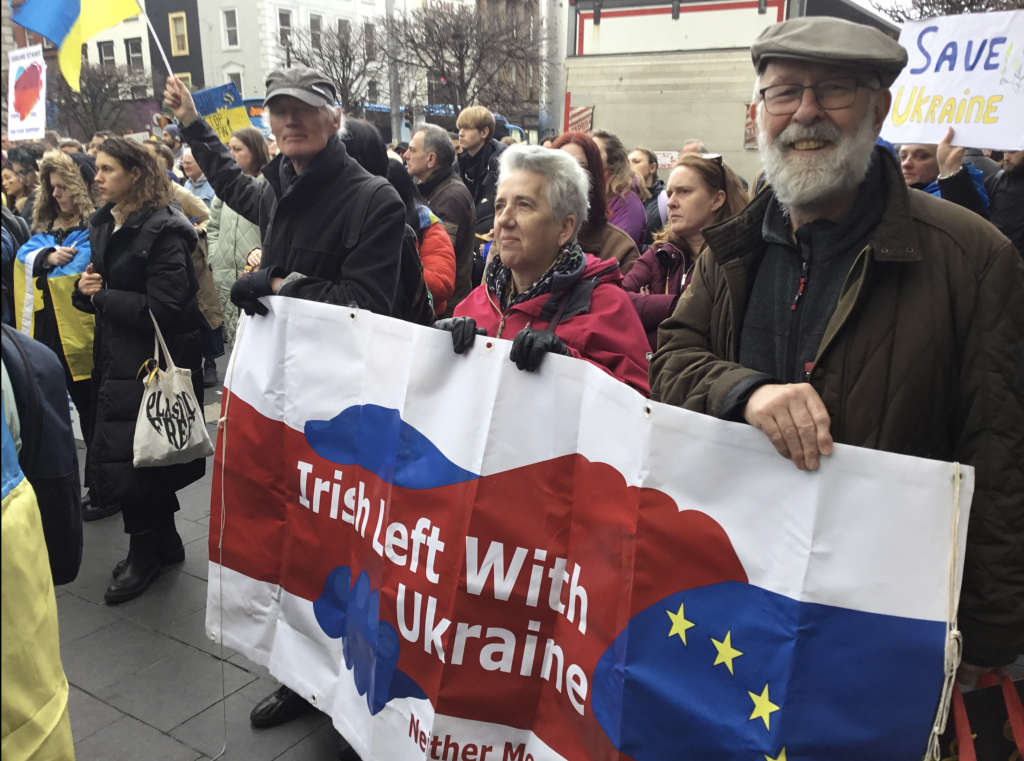
voices of resistance ILWU banner marching in solidarity with Ukraine

Conor: Irish Left with Ukraine is a grouping of trade unionists, socialists and anarchists, united behind the goal of getting solidarity for the Ukrainian left. We have a Twitter feed, a Facebook group and you can join by emailing irishleftwithukraine@gmail.com.

Filed Under: Ukraine

How Farming Must Change to Save the Planet

12/08/2022 by Conor Kostick 15 Comments

How Farming Must Change to Save the Planet Animal rights Eco Socialism

Agriculture has to change if we are to save the planet. The depth and scale of that change is enormous, far beyond that being proposed in any current agriculture transition plan. Sustainable farming that does not contribute to global warming, nor the mass extinction of species, let alone that treats other animals with the respect their sentience deserves, means adopting an approach that is completely opposed to market-driven agriculture. Not only that, at an even more fundamental level the change in farming practices needed to save the planet must overturn beliefs shaped by seven thousand years of agriculture.

Back in 1972, the anthropologist-turned-systems-theorist Gregory Bateson wrote that humanity was heading for catastrophe because our methods of production were constantly accelerating without any means of self-regulation. Unlike steam engines, which are designed with governors to release pressure before a runaway explosion takes place, modern agriculture has no failsafe.

Among his many prophetic statements, Bateson argued that if humans see themselves as outsiders, acting on the environment rather than sharing it with other minds (e.g. animals), we would be heading for certain extinction:

As you arrogate all mind to yourself, you will see the world around you as mindless and therefore not entitled to moral or ethical consideration. The environment will seem to be yours to exploit. Your survival unit will be you and your folks or conspecifics against the environment of other social units, other races and the brutes and vegetables.

If this is your estimate of your relation to nature and you have an advanced technology, your likelihood of survival will be that of a snowball in hell. You will die either of the toxic by-products of your own hate, or, simply, of over-population and overgrazing. The raw materials of the world are finite.

If I am right, the whole of our thinking about what we are and what other people are has got to be restructured. This is not funny, and I do not know how long we have to do it in. If we continue to operate on the premises that were fashionable in the pre-cybernetic era, and which were especially underlined and strengthened during the Industrial Revolution, which seemed to validate the Darwinian unit of survival, we may have twenty or thirty years before the logical reductio ad absurdum of our old positions destroys us. Nobody knows how long we have, under the present system, before some disaster strikes us, more serious than the destruction of any group of nations.

Gregory Bateson, Steps to An Ecology of Mind.

The Evidence that Farming has to Change

Modern agricultural business practices are calamitous and their consequences might have already brought us beyond the point of no return. They are a major contributor to facts like: the sea contains six times more plastic by mass than plankton; the global market for food has been concentrated to the point that 40% of the world’s people are dependent on food from other nations; crops have lost 75% of their genetic diversity since 1909, leading to devastating global outbreaks of plant diseases; just four companies control 90% of the world’s grain trade; in 2021, 41 million hectares of land were given over to producing food to be burned as biofuel; four billion people suffer water shortages for at least a month a year; desertification affects a third of the world’s population; and rainwater across the whole planet is now unsafe to drink.[1]

While Bateson’s prediction was based on a simple but powerful generalisation about systems without inbuilt mechanisms of self-correction, he did not provide specifics other than a case study of the insecticide DDT. DDT was discovered in 1939, leading to a massive commitment by industry to its production and thus its continued use long after the harmful consequences of using it were identified. It is easier to understand the particular farming practices that have driven us into an age of mass extinction from the standpoint of 2022 than it was in 1972 and these are identified and explained with great lucidity by George Monbiot in his 2022 book Regenesis.

Overall, the main problem with intense capitalist agriculture is that it has created a global monoculture in terms of diet and farming practice. Crop production has concentrated in certain regions: four countries harvest 76% of the maize exported to other countries. Five countries sell 77% of the world’s rice; five countries supply 65% of the wheat; three 86% of the world’s soyabeans.[2] Instead of a world where a great deal of self-sufficiency exists, we live in one highly dependent on international trade. And this means that vulnerability to shocks has increased.

Furthermore, as food culture converges on certain diets, so farming practices converge on the same methods, with the same seeds, equipment and chemicals. The suppliers of these universal means of farming have evolved to be immensely powerful multinationals with commensurate political power. Four companies control 90% of the world grain trade, a different four control 66% of agricultural chemicals, and three of these plus LimaGrain own 53% of the seed market. Three companies sell nearly half the world’s farm machinery. Four companies control 99% of the chicken-breeding market. Four firms run 75% of the world’s abattoirs. And so on for all livestock processing.[3]

It’s well known that wealth is concentrated into a few hands. The three wealthiest men in 2022 had $26.3bn, more than that of the poorest 222.4 million people combined.[4] What is less well appreciated is how handfuls of humans, members of the boards of these agricultural mega-businesses, control food production. Most have never even set foot on a farm.

And the farming landscape has been utterly transformed. If you ever pick up a child’s book with farm animals – the friendly pig, the happy cow, the rabbits and birds – the pictures are of fantasy realms that don’t exist. The last place you would want to take that child is to a modern farm: whether to acres of bleak fields with a lone tractor in the distance or to sheds with animals in stalls packed close together, feeding on soya products and waiting to be killed.

The issue of animal feed is crucial. While the planet is producing more calories of food than ever before (for now), humans are receiving less of it. The world’s livestock population is rising at about twice the increase in the human population. In the last 50 years the number of cattle has increased 15%, pigs 100% and chickens 500%.[5] These animals are consuming crops, mainly soya, and this rate of growth is unsustainable even if plant production continues to increase at current rates.

Moreover, we are likely to hit a ceiling in crop production, due to diminishing effectiveness of pesticides and fertilizer as well as global warming. Monbiot points out that when temperatures relative to moisture (called the wet-bulb temperature) reach a certain point, humans can’t function. We die of heat stress at a wet-bulb temperature of 35 degrees. This kind of temperature is being registered more and more, meaning that in regions like the Persian Gulf, India, Pakistan and the Gulf of Mexico, outdoor daytime work has to come to a halt.

As the planet heats up, dramatic weather events occur with greater frequency, with cyclones, hurricanes, droughts and floods disrupting the globalised food chain and market speculation then amplifying the difficulties.

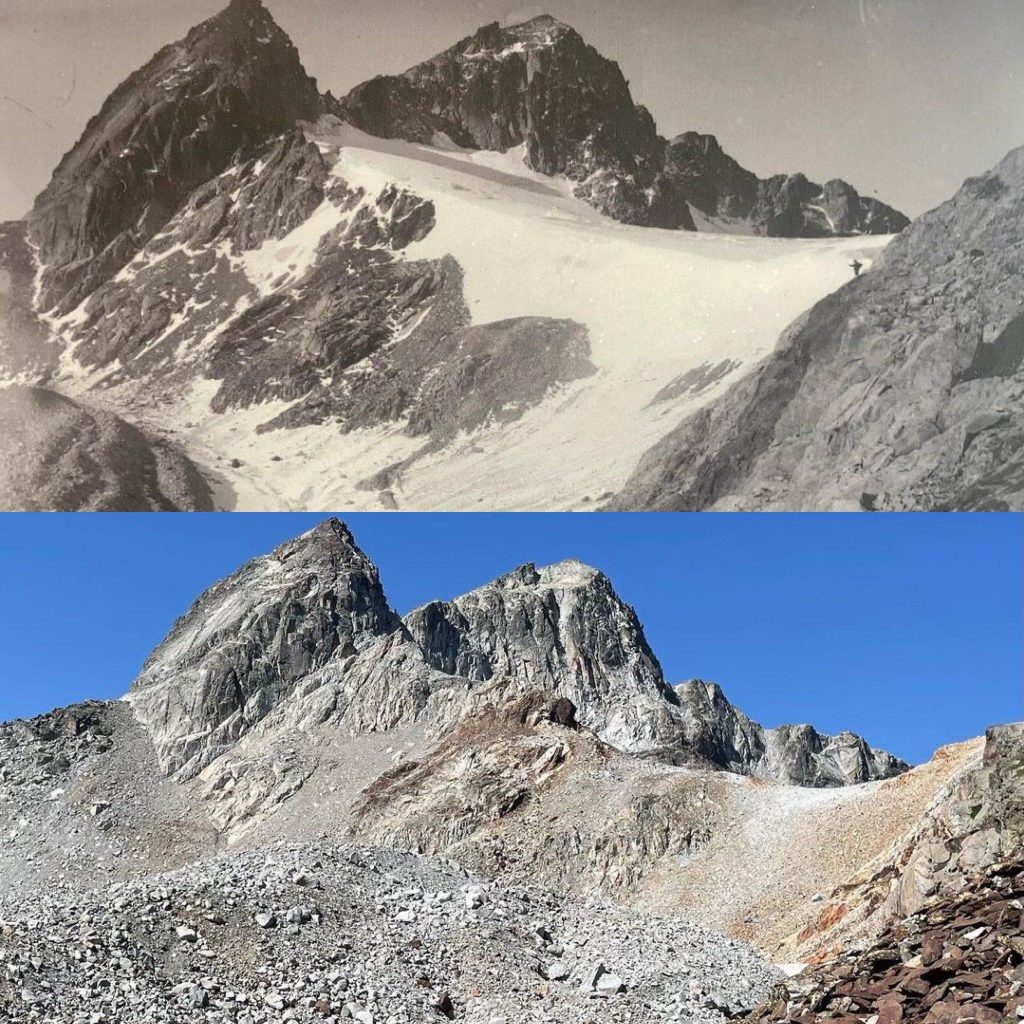
Another ceiling which we have bumped up against is that many countries rely on meltwater from glaciers to feed the rivers that irrigate their lands. These glaciers are rapidly disappearing or, as with the Gourgs Blancs in the Pyrenees, have already melted, never to return.

Glacier melt  Gourgs Blancs glacier 1910 above a picture taken 6 August 2022 Farming Must Change to Save the Planet
 Melt water from glaciers is drying up: Gourgs Blancs glacier 1910 above a picture taken 6 August 2022.

Agriculture Must Change to Save the World

Other dynamics at play which illustrate that Bateson’s predictions have come true include the rapid decrease in the effectiveness of antibiotics due to their overuse on farms (75% of antibiotics sold in the US and Europe go to farm animals); the extinction of life in fresh-water rivers due to slurry being washed into them from fields; Insectaggon (the collapse of insect life); and vast dead zones on the sea where oxygen has fallen below levels necessary for sea life. Probably this is due to oxygen being drawn out of the water by algae that has spread uncontrollably with all the fertilizer that is washed into the sea. Such algae stretches around a quarter of the planet.[6]

George Monbiot has a proposal for how farming must change to save the planet: we need to transition to the mass production of flour via microbial fermentation: protein from bacteria. This new technology, he says, represents ‘the beginning of the end of most agriculture.’ The reason for such a dramatic statement is that protein produced by growing bacteria requires only a tiny fraction of the land needed to make it by growing soya. Every 1,700 hectares of soya could be replaced by 1 hectare of fermenting bacteria. In theory, our needs could be met without farms, allowing huge tracts of land on the planet to be rewilded. Widespread adoption of bacteria-farming technology has the potential to provide the new chicken. Only, instead of 66 billion animals being killed a year (after a life of suffering), the basic staple protein block could be fermented from bacteria with no animal being constrained or harmed.

This welcome news, argues Monbiot, adopted as it becomes increasingly cost effective, will flip the way we farm, much as the advent of the pill changed western culture.

The pill accelerated the liberation of women. It intensified impatience with the status quo, hastening a transition that was already beginning to happen. It helped to drive a virtuous spiral of social change, making what was scarcely imaginable quickly seem inevitable.

As meat is challenged by plant proteins, then plant proteins are challenged by microbial proteins, and as farmfree products become cheaper, better and healthier than the food with which they compete, the existence of good alternatives will sharpen our growing disquiet with the treatment of livestock, the destruction of our life-support systems, and the pandemics caused by animal farming.

George Monbiot, Regenesis

It would be wonderful if this vision could be realised. And perhaps it will be. But to me it reads like wishful thinking. Monbiot is well aware that the agricultural mega-companies are powerful political opponents. As he points out, faced with the rise of non-meat products, legislators have been lobbied to ban terms like burger and sausage for foods that aren’t made from animals. Even the packaging styles of traditional foods have been protected. Just like with technologies that have threatened the car industry, the established interests – that is, the boards of the major food companies – will act strategically to continue to expand their organisations as effectively as they can, whether by using political influence or by taking over rival technologies in order to snuff them out.

Also, impressive as the potential savings in land use are by this technology, we don’t need it to avert the extinction catastrophe we are currently faced with. Simply addressing the shocking waste of land that arises from including meat in the human diet would be enough.

It is sometimes claimed that vegans are to blame for the destruction of the Amazon and biodiversity, because of all the soy grown in the deforested Amazon. But the reality is that a mere 4% of the soy grown globally is fed to humans. The vast majority of the soy grown globally is fed to factory farmed animals. The conversion rates from the feed grown specifically for nonhumans to produce meat and dairy to feed humans is pathetically low.

Chickens have the highest conversion ratios with 4.5 kilos of feed to produce edible kilo. For pigs it’s 9.4 kilos of feed edible kilo and for beef it is a lousy 25 kilos of feed per kilo of meat. But perhaps an even better measure is the energy captured by the plants and the protein they make that ends up on our plates that we could have otherwise captured with human edible plants. By that measure chickens still have the highest conversion with 11% of the calories and 20% of the protein in the feed ending up in the meat. Pigs aren’t far behind at 10% for calories and 15% of protein. But cattle are just awful at 1% of the calories and 4% of the protein in the animals feed ending up in the edible portion of the animal.

https://awfw.org/feed-ratios/

All told two-thirds of all of the energy in the plants humans harvest are used to feed animals, yet those animals only contribute 13% of the total food calories that people eat.

So Monbiot is right that ending the reliance on animal agriculture will allow for huge percentages of the ice-free land on the Earth to be rewilded, and allow biodiversity to thrive and avert the extinction catastrophe we’re currently faced with. But there’s no need to go developing any new technologies to do this. A wholefood plant-based diet takes up a fraction of the land, uses a fraction of the water, and is healthier for the environment, and better for human health.

Perhaps Monbiot’s enthusiasm for the bacteria fermentation technology is not so much based on the additional land it could free for rewilding as the hope that it might become prevalent without any other revolution being required, other than that which sometimes takes place within culture thanks to the dynamics of the global market. But I don’t believe that any new technology will come to save humanity and the millions of species we are exterminating unless we ourselves take control of production and quite deliberately and defiantly take that control away from the elites dominating agriculture.

This should not be read as an attack on farmers: they are caught up in a system that is making it increasingly difficult for small farmers especially to make a living. Farmers can be rescued from ruin and incentivised to help restore the land with the right societal changes and a just transition.

Which brings me to Marxism.

Does Marxism Show How Farming Must Change to Save the Planet?

If we are talking of class conflict, of us, the great majority, taking control of farming from them, the boards of the mega-corporations, then surely Marxism shows how to do this? For of all the alternative philosophies to market capitalism, Marxism appears to be the most radical. Yet even if we rescue the spirit of Marx’s writings from the actual experience of Communism by claiming that Stalin, Mao, et. al. crushed genuine revolutionaries to implement policies that were state capitalist, a problem remains.

Marx, like all of us, was a product of his time and place. In the way that he frames the argument against capitalism are assumptions that are very much derived from a post-Enlightenment tradition of Western philosophy. Marx saw the rise of international capitalism as calling forth extraordinary powers from the ground, but because of the fundamental flaws of the economic system, it would take revolution and working class power, followed by the abolition of all classes, to harness those powers so that humanity can realise its true potential.

Sounds good? Well, yes, except that the whole notion of the human mind as outside of nature and acting upon it is – as Bateson understood – liable to lead to humans seeing everything else around us as mindless and not deserving of ethical consideration.

In Capital I.8 while explaining how only labour adds value to a commodity, Marx wrote: ‘The coal burnt under the boiler vanishes without leaving a trace, so, too, the tallow with which the axles of wheels are greased.’ We live in times where the traces of burned coal are all too evident. As Timothy Morton observes about Marx, he was anthropocentric: the way to obtain knowledge of the world is from the standpoint of human activity, specifically economic activity. This anthropocentrism, argues Morton, is a bug in Marx which should be acknowledged and addressed rather than defended as if Capital were a sacred text.[8]

The brand of Eco-Socialism I’m familiar with in Ireland is explicitly Marxist (of the kind that says Marx was already on the case and anticipated both the environmental crisis and how to solve it). While supporting a transition from beef and dairy farming, these Eco-Socialists do not see animals as beings towards whom we should feel solidarity and with whom we should share the planet. In this they are accurately following the nineteenth century advocate of revolution, albeit at the cost of having genuinely revolutionary solutions for how to change agriculture to save the planet.

Marx wrote a famous passage in which his belief in the mindlessness of spiders and bees was clear:

A spider conducts operations that resemble those of a weaver, and a bee puts to shame many an architect in the construction of her cells. But what distinguishes the worst architect from the best of bees is this, that the architect raises his structure in imagination before he erects it in reality.

Karl Marx, Capital I.7.

This statement is an almost exact rephrasing of the idea of Descartes, that the difference between men [sic] and beasts is that the latter are like machines, acting without thought purely from the disposition of their organs. And it is an idea that is quite wrong, not only scientifically and morally, but also from the standpoint of bringing about revolution.

It’s increasingly evident that insects like spiders and bees are sentient. A recent paper found REM-like activity in the sleep patterns of spiders, while bees are, ‘clever, sentient, and unique beings.’ It’s even possible that the massive networks of certain types of fungi that spread out over acres of forestland and manage the chemistry of the trees above them have sentience.[9]

Once you accept that animals have sentience (even if you don’t accept the evidence for sentience in insects), then how can their mistreatment be justified? Necessarily, by having some kind of hierarchy of sentience with humans at the top. Rather like the origins of modern racism, which evolved to justify slavery by arguing black people were not fully human and therefore had no claim to equality with whites, those who stand over the farming of animals have to make an argument along the lines that, ‘well, yes, cattle, pigs and sheep are sentient, but they are at a lower level than humans. And you never see them on picket lines, so let’s change the human world first and then society will be more humane to animals.’

I’ll address the second part of that argument in the conclusion of this feature, but with regard to some kind of pyramid of sentience, it’s pure story telling. No one knows what it is like to be a fly. Perhaps Blake was right:

Seest thou the little winged fly, smaller than a grain of sand?

It has a heart like thee; a brain open to heaven & hell,

Withinside wondrous & expansive; its gates are not clos’d,

I hope thine are not: hence it clothes itself in rich array;

Hence thou art cloth’d with human beauty O thou mortal man.

William Blake, Milton I 20/22:27–30.

If you try to get humans to come out on top by organising the pyramid of sentience based on the extent to which an animal has neurons and connections in the brain, you have a problem, because humans are not at the top: the African elephant has three times the brain weight and number of neurons as a human.[10] You also have a problem arising from the following thought experiment. If aliens arrive on Earth with demonstrably greater brain matter than humans, does that give them the right to enslave and farm us for food? No? Then at what level of sentience do you lose that right? That’s a very difficult line to draw, especially when (as research into the social impact of Artificial Intelligence shows) we don’t have a successful model of what a mind is, even a human one. What we do know is that the part of the brain that is concerned with consciousness is about half a billion years old and shared with most vertebrates.[11]

How would we know, for instance, that cattle are the wrong side of a threshold for the exploitation of other sentient beings? The film Cow is extremely moving in this regard, because it is touching how the cattle in the film rejoice at being let out into fields. They skip and leap and dash away from the sheds in which they are usually constrained and later are clearly at peace, facing a deep red sunset.

There are no ethical grounds for our farming of animals and a truly revolutionary demand has to be to stop it altogether and treat all sentient life as non-human people. If humans have inherent rights – not rights given on the basis of passing some kind of test but rights that are intrinsic to being a human – then so do animals. As long-time animal rights advocate Tom Regan puts it:

Other animals have a life of their own that is of importance to them apart from their utility to us. They are not only in the world, they are aware of it, and also of what happens to them. And what happens to them matters to them. Each has a life that fares experientially better or worse for the one whose life it is. Like us they bring a unified psychological presence to the world. Like us they are somebodies, not some things. In these fundamental ways the non-human animals in labs and on farms for example are the same as human beings and so it is that the ethics of our dealings with them and with one another must rest on some of the same fundamental moral principals.

Adopting this approach also has revolutionary consequences that are more profound than those of the Marxist Eco-Socialists who would save the Earth… for humans. Once we lose a sense of companionship with animals and instead see ourselves as farmers with a mission to maximise the use of the land for the greatest possible outputs we can achieve, we are on the start of a journey of extinction for the reason that Bateson gives. Our goal should not be a revolution that leads to more efficient exploitation of the land than capitalism can achieve, but a radical rearrangement of our relationship to the land and to the other non-human beings of the planet.

It is perhaps because of the harmful consequences of an anthropocentric approach to the environment that for thousands of years early human societies moved back and forth and sideways in their farming practices. As Wengrow and Graeber have shown, the ‘severing’ (to use a term from Morton which is entirely compatible with their approach) was not a short, sharp moment in pre-history. It was not V. Gordon Childe’s agricultural revolution but a much more drawn out affair where we only settled into our disastrous exploitative relationship to animals and crops after considerable experimentation and social upheavals in which proto-rulers were often held in check or overthrown.[12]

The eventual predominance of settled farming also brought with it the development of rigid hierarchies and large-scale warfare. And these wars were possible, not only because the materials existed to make weapons as well as the social structures to coerce bodies of warriors to march against each other. But also because treating other beings as food to be farmed (as opposed to being killed out of necessity, with reverence and sacrifice to the gods for the crime) crosses a fundamental moral chasm that allows for the enslavement and murder of humans.

It has long been established that those who would harm animals would also find harming humans acceptable. In 1997, for example, a study sponsored by Northeastern University and the Massachusetts Society for the Prevention of Cruelty to Animals found that those who abused animals were five times as likely to harm other humans. Or to put it the other way around, if you wouldn’t hurt a fly, you certainly wouldn’t mutilate and execute a human being as we see happening in some appalling videos of Russian soldiers and their Ukrainian captives.

It is in this sense that an approach to changing farming practices based on treating non-humans as people is more revolutionary than demanding workers’ control over the farming industry. Of course, bring on the day when workers take over the means of production. But that day will be hastened and have the kind of transformative power that might yet save our species if the workers’ movement is inspired as much by a sense of solidarity with non-human beings as with each other.


[1] https://www.sciencedirect.com/science/article/abs/pii/S0025326X0100114X; George Monbiot, Regenesis (Dublin, 2022), pp. 34 – 5, 41, 47, 53; https://www.independent.co.uk/climate-change/news/rainwater-cause-cancer-forever-chemicals-pfas-b2137020.html.

[2] Regenesis, p. 33.

[3] Regenesis, pp. 35 – 6.

[4] https://www.oxfamireland.org/blog/inequality.

[5] Regenesis, p. 41.

[6] Regenesis, p. 71.

[7] https://awfw.org/feed-ratios/

[8] Timothy Morton, Humankind: Solidarity with Non-Human People.

[9] https://www.scientificamerican.com/article/spiders-seem-to-have-rem-like-sleep-and-may-even-dream1/; https://www.theguardian.com/environment/2022/jul/16/bees-are-really-highly-intelligent-the-insect-iq-tests-causing-a-buzz-among-scientists; Rupert Sheldrake, Entangled Life.

[10] https://www.ncbi.nlm.nih.gov/pmc/articles/PMC4053853/.

[11] Mark Solms, The Hidden Spring: A Journey to the Source of Consciousness.

[12] David Graeber & David Wengrow, The Dawn of Everything.

Independent Left have adopted an Animal Rights policy inspired by the goals of the National Animal Rights Assocation.

In August 2022, Independent Left hosted a Zoom meeting led by Laura Broxson, animal rights activist and founder of the National Animal Rights Association.

Filed Under: Animal Rights, Independent Left Policies

The Carpet Crawlers: the Meaning of the Lyrics

06/06/2022 by Conor Kostick 11 Comments

What is the meaning of The Carpet Crawlers? The Genesis song, whose lyrics were written by Peter Gabriel, has a dense, religious imagery leading to considerable discussion over the years as to what is the meaning of the The Carpet Crawlers lyrics. Here I’ll offer an interpretation that it is, at heart, addressing a terrible truth: that our world is hellish and those whom we believe we are following out of our own choice are keeping us trapped in illusion.

The Carpet Crawlers first appeared on the 1974 Genesis album, The Lamb Lies Down on Broadway. In writing The Carpet Crawlers, the lyrics came first. And this is important in any attempt to understand it. Often a band will start with the music and fit lyrics in to suit the music; with The Carpet Crawlers, Peter Gabriel came to his band members with the lyrics already written and they created the D, E-minor, F-sharp minor sequence against which Gabriel then spent ‘hours and hours’ developing the melody on an out-of-tune piano. The sense of movement in the song feels simplistic when you isolate the keyboard or drum parts, but combined with the vocal melody the song becomes complex, unpredictable (even after multiple listens), and builds in a sinister fashion.

After an early version of The Carpet Crawlers was written, Peter Gabriel decided to add more lines and, again, the rest of the band provided the music, although they were under the impression an instrumental part was required and were surprised to hear his new vocals.

The lyrics of The Carpet Crawlers describe a scene where the narrator is in a hellish and surreal environment wanting to get out. Everyone else is being encouraged to get out by working their way upwards towards heaven, but all is not what it seems. In fact, listening to those who pretend to know that you ‘have to get in to get out’ will only doom you to remain stuck.

A Close Examination of the Lyrics of The Carpet Crawlers

Thinking about the lyrics of The Carpet Crawlers in detail makes it more difficult to grasp the overall meaning of the song but also helps appreciate the skill, subversion, and powerful imagery of Gabriel’s lyrics.

The opening lines of The Carpet Crawlers introduce a first-person narrator, who in the The Lamb Lies Down on Broadway album is a character called Rael. Treating Carpet Crawlers as a self-contained work, the narrator could be any of us. At first, the narrator is aware of a pleasant, cocooning sensation.

There is lambswool under my naked feet

The wool is soft and warm

Gives off some kind of heat

The lamb is a traditional symbol of innocence: a newborn animal whose gentleness is the opposite of the ferocity of the tiger in William Blake’s Tyger, Tyger. All is not well, however. A disturbing sight now appears to indicate that close by to the narrator this mild heat turns into an inferno.

A salamander scurries into flame to be destroyed

Mythology portrays the salamander as a creature that can dance in flames. Nor is this just a tradition in legend. Aristotle believed that the salamander was proof that ‘animals do actually exist that fire cannot destroy’. Yet here the lizard ‘scurries’ toward its own death. This lyric indicates that far from being in a protective and gentle environment, our narrator is somewhere hellish, and this sense of uncanny dread is enhanced by the following lyric in The Carpet Crawlers.

Imaginary creatures are trapped in birth on celluloid

Whatever these imaginary creatures are, the cinematic presentation of their birth is made all the more troubling by the fact of their being caught in the agony of being born and unable to properly come into being.

The fleas cling to the golden fleece

Hoping they’ll find peace

Now we come to a crucial moment in our the experience of the song. The fleas are us. A somewhat disgusting association, perhaps, but with Gabriel taking delight in inverting tropes, these fleas are not simply pestilent bloodsuckers, but have potential. In particular here, they want only peace.

We live in the lambswool (golden coloured and described in a fashion to evoke the Golden Fleece of legend), which while seemingly offering warmth and protection cannot provide lasting happiness. Not only are there horrors beyond the safety of the wool, but even within the wool there is no hiding from our self-created miseries.

Each thought and gesture are caught in celluloid

There’s no hiding in memory

There’s no room to avoid

The Carpet Crawlers: the Meaning Within the Lyrics

The crawlers cover the floor in the red ochre corridor

For my second sight of people, they’ve more lifeblood than before

As the music of the song becomes darker and begins its long, slow build, the narrator views humanity from above, having this additional dimension from which to view the crawling fleas. The narrator can see our bloodsucking nature, as we draw sustenance from the red ochre corridor.

‘Red ochre’ is a carefully chosen colour and appears in the lyrics of The Carpet Crawlers not simply to make the line scan. Ochre is a clay and sand mix of yellow-to-orange colour; red ochre is closer to the colour of dried blood, because the clay contains iron oxide. When blood leaves the body, the iron in haemoglobin turns to iron oxide. Red ochre represents the blood, life-force.

The carpet crawlers meaning ochre
The carpet crawlers meaning red ochre
The red ochre colour of the corridor of The Carpet Crawlers was carefully chosen and is suggestive of a passage in the human body.

The environment sustaining humanity as we crawl along is womb-like, leading some people to interpret the lyrics of The Carpet Crawlers as a metaphor for birth: sperm have to get in to the egg to get out. There are definitely resonances with this idea in the song’s lyrics but since the core meaning of The Carpet Crawlers is that one can’t get out of hell by following the ‘callers’, then all the imagery to do with fertilisation and birth is best understood as reinforcing the main idea rather than being the main idea. If you follow the Mannichean argument below, then it makes sense that the dying crawlers should simultaneously be sperm, their light being trapped in  darkness by the act of fertilisation and condemned to rebirth in hell.

Moreover, while the place in which humanity is stuck is womb-like, it is also hellish. The relationship of the environment to the crawlers is not one of succour, peace, and maternal love; it is hostile and only provides blood because the fleas are biting into it.

The plight of humanity in The Carpet Crawlers is made clear in the following lines.

They’re moving in time to a heavy wooden door

Where the needle’s eye is winking, closing on the poor

The carpet crawlers heed their callers:

“We’ve got to get in to get out

We’ve got to get in to get out

We’ve got to get in to get out”

Drone-like, we have a shared rhythm as we move to a heavy wooden door that – by association with the Biblical idea that it is easier for a camel to pass through a needle than a rich man enter heaven – is heaven’s gate. The needle’s eye is winking, mockingly. And it is the poor who are excluded from this journey. Like with the salamander, this place is not what it seems. It is a mockery of the journey to heaven. Again too, there is a sexual aspect to the needle’s eye, which suggests the vulva.

According to Gnosticism, our current world is hell and we are deceived when we think the path to heaven consists in following the preaching of those telling us the god of this world is good (the truly good god exists elsewhere). These lines in The Carpet Crawlers are thoroughly Gnostic. A sense-dulling refrain that the way out of hell requires us to get past the door is causing us all to move as one in that direction. But should we be doing so when the anti-Biblical needle is winking at us?

Gnosticism and the Meaning of The Carpet Crawlers

From this point – the introduction of the idea that the callers are calling humanity to a route that promises escape from hell but which will not deliver it – the song drives forward with increasing intensity: via the drum beat, the plaintive guitar, the increasing volume of the keyboard arpeggios, and the exchange of vocals between Peter Gabriel and Phil Collins.

There’s only one direction in the faces that I see

It’s upward to the ceiling, where the chamber’s said to be

Like the forest fight for sunlight, that takes root in every tree

They are pulled up by the magnet, believing they’re free

The carpet crawlers heed their callers:

“We’ve got to get in to get out

We’ve got to get in to get out

We’ve got to get in to get out”

The narrator can see that the pull of the callers is upwards (the conventional direction for heaven) and a rumoured chamber exists there, full of promise. Note that the narrator is unsure whether the chamber is actually to be found there. Everyone believes they are freely choosing this path to the chamber, but like trees striving for sunlight or iron aligning to a magnet, we are allowing the callers to lead us without any real freedom on our part. We are trapped in an illusion but cannot see it.

The next line introduces a strangely modern cultural reference to what up to now has been a largely (with the exception of celluloid) timeless atmosphere.

Mild-mannered supermen are held in kryptonite

While one could imagine dozens of Clarke Kents fixed in place, the real meaning of this lyric is to challenge the idea from Nietzsche that with God dead, the way out of the restraints and limitations of existence is to become an Übermensch, a superhuman. But in the hellish world of our narrator those – cerebral rather than athletic – superhumans are just as trapped as everyone else.

And the wise and foolish virgins giggle with their bodies glowing bright

Through the door a harvest feast is lit by candlelight

It’s the bottom of a staircase that spirals out of sight

With these lines the lyrics of The Carpet Crawlers return to Christian imagery. The Biblical parable of the ten virgins – five wise, five foolish – is spoken by Christ when he is asked what sign will indicate the end of the world. Unlike the Biblical women, half of whom miss the crucial moment (the Day of Judgement) through being ill-prepared, in the song they are all aglow and inappropriately cheerful. Again, the route of our escape from hell is not what it seems. And this makes the ostensibly heaven-sent harvest festival and ascending staircase uninviting, despite the chant of the callers continuing to dominate the minds of the crawlers.

The carpet crawlers heed their callers:

“We’ve got to get in to get out

We’ve got to get in to get out

We’ve got to get in to get out”

The carpet crawlers meaning Wise and Foolish Virgins William Blake
The Parable of the Wise and Foolish Virgins (1822) by William Blake. Whereas Blake illustrates the apocalyptical meaning of the parable: that those who are unprepared will fall behind on the Day of Judgement, in The Carpet Crawlers they appear as ten cheerful women whose brightness is a lure towards a progress that is illusory.

The Final Images in the Lyrics of The Carpet Crawlers

The porcelain mannequin with shattered skin fears attack

And the eager pack lift up their pitchers, they carry all they lack

The liquid has congealed, which has seeped out through the crack

And the tickler takes his stickleback

Leaving aside the porcelain mannequin for the moment, our narrator witnesses the end of the journey of the carpet crawlers as they eagerly lift up their pitchers, whose contents are the lifeblood they will need having left their source of sustenance, the blood of the red ochre corridor. But the pitchers are broken, as Ecclesiastes 12:6 puts it when introducing the subject of death and the return of the dust of our bodies to earth. The lifeblood has seeped away and congealed.

At this point, the tickler takes his stickleback.

This final line before a long repetition of ‘we’ve got to get in to get out’ may seem humorous. Isn’t a tickle a pleasant experience? In fact this line is the awful climax of the song. No English child of Peter Gabriel’s generation will have grown up without attempting to catch sticklebacks, tiny fish which used to be abundant in fresh water. To tickle these fish is to wait for them to enter the trap of your hand and pluck them out of the water.

The carpet crawlers have been lured into the hands of death and a return to hell by the promise of the callers, along with a mistaken belief in the location of the escape chamber, as well as the illusions of the virgins, the candlelit harvest feast and the staircase.

What about the porcelain mannequin? It could well be the narrator, feeling vulnerable at the moment that the mass of crawlers leave the lambswool. An individual who has become a mannequin has had their unique features replaced by generic forms, making them able to represent all humans. A mannequin is designed to be moveable by others and an already shattered porcelain one is particularly vulnerable to harm. It would be frighting to be a porcelain mannequin and part company with the mass movement of the people around you because you intuit their final destination is not what it seems. That fear might bind you to their collective folly.

The proximity of the sound of ‘mannequin’ to ‘Manichaeism’ suggests an alternative reading of the line: that the porcelain mannequin is the Prince of Darkness, Satan. Manichaeism was the Gnostic-inspired religion that believed that it was necessary to release the light within us and become free from rebirth and pain. From this perspective, the porcelain mannequin who fears attack is the Prince of Darkness, the ruler of Earth, a hellish realm. He is fragile and vulnerable to the collective action of the carpet crawlers, should they ever change direction, for we carry light within us and for all our faults – every one of them on view – we carry the answer as to how to get out within ourselves.

If the porcelain mannequin is Satan, he need not worry. He can reabsorb our light (our death also being a moment of fertilisation to bind our light into the material world once more), causing us to be reborn in darkness, thanks to the assistance of the callers and their illusory religion.

And the tickler takes his stickleback

The pull of the music, which peaks after these lines during the repetition of We’ve got to get in to get out, implies the increasing pull of that argument, and reinforces how impossibly difficult it is to resist submission to that refrain and thus defeat.

Why are the lyrics of The Carpet Crawlers so powerful?

Peter Gabriel has a strong engagement with William Blake, the revolutionary poet, something that was evident in his setting Songs of Innocence and Experience to music for the millennium, with performances eight times a day in the Greenwich marquee. And while there are no direct references to Blake in The Carpet Crawlers there do seem to be some in Supper’s Ready, Gabriel’s other lyrical masterpiece for Genesis.

Peter Gabriel took a Blakeian approach to writing the lyrics of The Carpet Crawlers in this sense: he drew on Christian imagery and mythic creatures of his own invention to condemn orthodox religion and the way that people become trapped in the illusion that they are freely following the philosophies that bind them. It takes a prophet to write a song like Carpet Crawlers and I think that reading Blake helped Gabriel assume that mantle, at least in 1974.

As with all prophetic writing, the lyrics of The Carpet Crawlers affect us because they are addressing a fundamental truth. There is something real and important about the nature of human experience that is touched on here. And that’s why our bodies shiver on listening to the song, regardless of the extent to which we comprehend the exact meaning of The Carpet Crawlers.

Humanity is living in hell and is constantly recreating the conditions of our immiseration by callers who think they know how to direct us to heaven. And while atheists and materialists baulk at the thought that the Prince of Darkness orchestrates all this, just ask yourself, what if that evil god was Mammon? If you lived in a world that sacrificed everything to the pursuit of profit, while telling you everything was going to end well, what would that world look like?

The hell of the carpet crawlers.

Conor Kostick is the author of the international bestseller Epic , in which the people of a dystopian world are obliged to play a fantasy RPG for their living. Conor Kostick’s science fiction can be read on Substack.

Epic by Conor Kostick is dystopian like the atmosphere of Carpet Crawlers

Filed Under: Reviews

Evasions on the Left over Ukraine

26/04/2022 by Conor Kostick 22 Comments

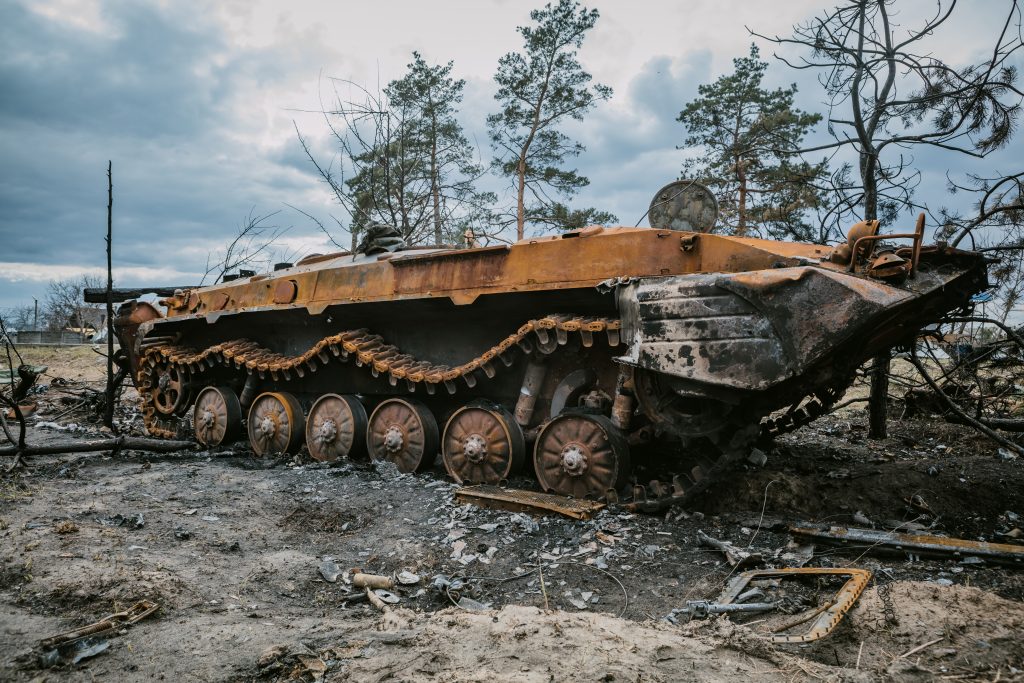
KYIV REGION, UKRAINE 05.04.2022 Russian BMP-2 burned by Ukrainian army
Burned out Russian BMP-2, 5 April 2022: Ukraine needs modern weapons to defeat the Russian invasion

Wars are not light topics that can be dispensed of with simple formulas. I, for one, cannot imagine how the success of Russia would further the cause of democracy and socialism around the world. If you do, then say so, openly, so it can be debated in public. But don’t falsify tradition and history and hide behind pathetic slogans. To paraphrase Marx, we Marxists disdain to conceal our views and aims.

John Ganz, Ben Burgis’s Bad History: Jacobin’s anti-Jacobins

There is a type of left argument around the war in Ukraine which has arisen in the West. It is one that condemns Putin’s invasion, but refuses to offer practical support to the people of Ukraine in resisting that invasion. It is the position one can read in Jacobin, or in statements by Chomsky, Corbyn, and the Stop the War Coalition in the UK. In Ireland we have the same type of response to the Russian invasion of Ukraine from People Before Profit and the Socialist Party of Ireland.

I will use the label Evasionist Left for this approach. It’s not clear how representative this trend is internationally, as many on the left do pro-actively support the resistance in Ukraine, e.g. parties such Razem in Poland; those associated with the Fourth International like Left Bloc and the Danish Red Green Alliance; and the main left party in Japan, the Japanese Communist Party.

Of course, there are pro-Russian figures around too, who claim to be on the left: although why anyone would want to be associated with Putin makes no sense. Russia is not in any way a socialist society. In fact, as Russian socialist Ilya Budraitskis puts it, Putin can be understood to be developing a new form of fascism. Explicitly pro-Putin figures are relatively rare on the left, and while they are busy sharing Russian propaganda, are not hugely influential. The left arguments I want to address here are those of the groups and their supporters who express opposition to Putin, but who refuse to take any steps towards bringing about a military defeat for the Russian invasion and in particular, are strongly opposed to the people of Ukraine obtaining arms from the West.

The groups supporting the Evasionist Left position seem to be basing their approach on two ideas: 1) Support for the resistance in Ukraine is support for NATO and 2) The war in Ukraine is an ‘inter-imperialist war’. My goal is to argue that these ideas are wrong and that if you take them seriously, you will find yourself on Putin’s side in the war. Often, when I try to discuss these points with their supporters, I hear only silence when I ask them to really think through the consequences of their formulations. But the war itself allows for no evasion.

Typical of the Evasionist Left position are features that speak out against the war in Ukraine and all wars, such as the Irish People Before Profit statement: No To War. Oppose Putin’s Invasion. Stop NATO Expansion. As with many articles by Jacobin and Stop the War (UK), the line taken by this statement is that Putin’s invasion should be condemned but the US are to be condemned equally.

The article concludes: “The real hope lies in an anti-war movement that crosses the border of East and West and opposes both Putin and NATO. We salute the actions of the Irish Anti-War Movement in calling people out to protest. We urge the international movement that came together to oppose the Gulf War in the past to rise again against the twin aggressors of Putin and NATO.”

World peace arising from a mass movement from below East and West would be lovely, but what is evaded here is the question of whether the left should support Ukrainian military resistance to the invasion. “Opposing the war” is a comfortable position to adopt if you are on the other side of Europe to the columns of Russian soldiers. But what does this conclusion mean for the people of Ukraine? Perhaps it means they should not fight back? Or perhaps there is room for supporting armed resistance to the Russian invasion, if it is decoupled from NATO? The point here is that in many cases, no one knows what it means. This is not a position that informs the people of Ukraine or those who want to express solidarity with them of what to do.

While we strive for international uprisings against war, should we want the people of Ukraine to defeat the Russian invaders in the meantime? Should we support or sabotage NATO armaments moving to Ukraine? Should we send money and perform solidarity actions that will allow Ukrainian anarchists and socialists to further their military resistance to the invasion? Or should we discourage them from fighting back, because they are unwitting tools of NATO?

These practical questions are a good way to judge the two key formulations that the Evasionist Left are using. And yet Marx’s claim that socialists don’t hide their views doesn’t seem to apply on the topic of Ukraine, where it’s difficult indeed to ascertain how these questions would be answered. Just to be clear, my own answers and those of Independent Left (and many other socialists and anarchists in Ireland) are yes, a victory for Ukraine against Russia would be the best outcome for the left and the world generally and yes, we should support the people of Ukraine getting arms from wherever they can, including from NATO. As Taras Bilous, editor of the left-wing Ukrainian magazine Commons, puts it, “the Western left, which criticizes military aid to Ukraine are outrageous. Do they want us to fight with bows and arrows when we have shot all our bullets? Do they want the Russians to kill as many Ukrainians as possible? That there were more Bucha’s?”

Based on the limited number of publications and occasional social media post, including exchanges with me, many Evasionist Left supporters do not in fact welcome the Ukrainian resistance, do not support people like Taras Bilous in their efforts to defend their cities. And to justify this they have advanced the two arguments above. These slogans are crucial to the orientation of the Evasionist position, and I believe they are quite wrong.

1. Support for the resistance in Ukraine is support for NATO.

A rather bad-faith version of this argument was visible after a UCU-supported demonstration on 9 April 2022 in the UK, in which a call for victory to the Ukrainian people was described as being “for NATO intervention in Ukraine”.

Such comments echoed the misleading headline by the UK’s Socialist Worker reporting on the demonstration, where they interpreted the call for arming the Ukrainian people to be a call for NATO escalation. To say that the people of Ukraine need arms is not at all the same as saying NATO should send troops to fight in the war.

A Russian convoy is approaching your town. The people around you join the Ukraine territorial defence to fight, several of them form their own socialist and anarchist units which you have the option of joining. But those internationally making the same arguments as above say, “No. Don’t escalate. It will lead to more war horror. And potentially nuclear war. Instead, let’s appeal to the Russian anti-war movement to save us.”

The position of these ‘left’ activists brings peace, but it’s the peace of a Putin victory, which not only means your town witnesses hellish scenes of rape and murder, that you could perhaps have prevented, but it also undermines peace for the future. Because understandably, when scenes of slaughtered civilians reach neighbouring countries there is a massive clamour for NATO assistance. Moreover, Putin will have concluded that after Syria and Ukraine, he can push on again, because fear of the horror of war, especially nuclear war, means the western left would prefer his victory to the victory of the resistance. And the Russian anti-war movement, that might have flourished as the Russian army was stalled and thrown back, is crushed by the wave of nationalism around the victorious Putin.

Fortunately, we are not yet in this scenario, above all because of the determination of the people of Ukraine not to surrender to the Russian invaders. Within the resistance to the invasion, the left are able to play an independent role. Here’s how Vitaliy Dudin, head of the Ukrainian democratic socialist organisation, Sotsyalnyi Rukh (Social Movement), described the situation from Cherkasy, Ukraine, on 6 April 6 2022:

“Some Social Movement activists, as well as many trade union members, have joined the TD as volunteers. It is worth mentioning that dozens of anarchists and socialists have formed their own unit within the TD, called the Resistance Committee.

“Secondly, a lot of leftists are helping as volunteers to supply the army or satisfy people’s humanitarian needs. One of the most effective initiatives in this regard is Operation Solidarity, which has managed to provide supplies to the militant left. We are also working to meet the needs of trade union members serving in the army.

“We have also worked with the nurses’ NGO Be Like Nina and helped them obtain medicines for hospitals that are taking care of wounded soldiers.

“Third, we see that a lot of people are protesting the invaders in occupied cities. We aren’t involved in such activity, but we support it. Of course, it is very dangerous because peaceful protests can be shot down by armed Russian soldiers. Such resistance proves that people are against the ‘liberation’ that seeks to turn their cities into grey-zones.

“Fourth, we as Social Movement continue to act as a political organisation. We seek to counter Russian propaganda and call on our people to fight for a free and fair Ukraine.”

By contrast, if the politics of the war in the Ukraine are resolved by the Evasionist Left approach, then we will see a Putin victory. You can’t negotiate any settlement with Putin, even a bad one for Ukraine that nevertheless de-escalates the threat of nuclear war, unless you stop his army and force him to realise he can’t implement his plan to eradicate Ukraine as an independent nation.

There is a better-faith version of the argument against NATO weapons going to Ukraine, which is to say, “I do want Ukrainians to defend themselves, but I don’t trust the US. Whenever they arm a side in a war, they have their own imperialist goals.” This observation about the US is, of course, correct, but do you really think people in Ukraine, especially the left, are under any illusions about the US interests at play? There’s a patronising assumption here that those demanding arms to prevent Russian soldiers from murdering their friends and families are dupes of US intelligence.

Similarly, I’ve heard socialists in Ireland say, “we have to weigh up different dynamics here, on the one hand, Russian imperialism, for sure; but on the other, US interests.”

If Ukraine is to defeat Russia the people there obviously need modern weapons. Anarchists have described how they are currently having to use machine guns from 1944.

A 1944 Maxim gun. Ukrainian anarchists and socialists fighting independently within Ukraine’s territorial defence are desperate for better weapons.

If you are someone who wants Russia to be defeated, but doesn’t want NATO armaments to arrive in Ukraine, you really need to think this through. Are you asking communities to defeat the Russian soldiers using only home-made Molotov cocktails and Second World War weapons? This seems to be the position of the Socialist Party of Ireland, who at least do support workers in Ukraine arming themselves. At the same time, however, their supporters are told: “In the Western capitalist countries opposition to NATO militarism and expansionism must always be a central feature of our propaganda, even where this is not currently the mood among the mass of workers. We stand against all military intervention on the part of U.S. and Western imperialism — this includes opposition to the provision of weaponry by NATO powers to the Ukrainian military. This in and of itself increases the threat of the conflict escalating more widely.”

Similarly, in a feature on 25 April 2022, Ukraine: The United States are now fighting a proxy war with Russia Kieran Allen (Socialist Workers Network, Ireland) argues that the Ukrainian people, “have every right to resist”, yet is opposed to them using NATO weapons.

It’s not at all unreasonable to keep an eye on what the US is up to. No doubt there are US hawks who are thinking now would be a perfect time to take Russia on and smash Putin’s army while he’s weak. We should oppose US intervention of troops, ships, and aircraft, mainly because of the risk of nuclear war but also because of their own imperialist record. But that’s not happening right now: yes, NATO countries are supplying weapons to Ukraine but at the time of writing they have not entered the war with Russia with their own armed forces. Sitting on the fence now in fear of what the US might do in future, again means not supporting those currently fighting the Russian soldiers. The same question faces the good faith left person as the bad: when the Russian convoy is approaching your town, do you fight back militarily? You can’t say, “well, there’s a balance of imperial interests to consider and I’m going to be neutral until I get non-NATO weapons.” That neutrality will be finished by a Russian bullet to the head to you and anyone else you have persuaded of your position.

Moreover, those trying to dress up this recognition of the interplay of rival imperialisms as if it’s something new are missing the obvious point that throughout the twentieth and twenty-first centuries, US and Russian imperialism always backed any movement that was fighting their rival. So when Solidarnosc rose up against the Communist Polish government in 1980-1, the CIA rushed to fund and influence the union. That didn’t stop it being a genuine mass movement which socialists of the type now adopting the Evasionist position recognised and supported.

Finally, on the legitimacy of the people of Ukraine taking advantage of inter-imperialist rivalry to obtain arms from NATO, there are very clear left precedents. For those of the Evasionist Left viewpoint who are champions of Lenin, it is worth noting Lenin’s response when France and Britain offered to give military aid to Russia to fight Germany, when he wrote: “Please add my vote in favour of taking potatoes and weapons from the Anglo-French imperialist robbers.”

He later explained:

The North Americans in their war of liberation against England at the end of the eighteenth century got help from Spain and France, who were her competitors and just as much colonial robbers as England. It is said that there were ‘Left Bolsheviks’ to be found who contemplated writing a ‘learned work’ on the ‘dirty deal’ of these Americans.

2. The war in Ukraine is an ‘inter-imperialist war’.

A second justification for not supporting the people of Ukraine fighting back against Russia is based on the idea of ‘revolutionary defeatism’. The tone here for Rebel in Ireland was set by an article by Kieran Allen, entitled, James Connolly and War.

The parallels with World War One in 1914 are striking. Then and now it was the weaker imperial power than began a new era of global conflict. In 1914, it was Austria who made the first moves. Today it is Russia, a country with a  commodity driven economy and a GDP that is one tenth that of the USA.

Just as James Connolly concentrated on challenging the propaganda of the Irish National Party and Britain, argues Allen, so socialists today should be revolutionary defeatists and recognise the main enemy is at home. Which means Irish socialists should concentrate on furthering the class war in Ireland.

Allen doesn’t spell out what revolutionary defeatism actually means in the context of the war in Ukraine: and the reason is surely that to publicly embrace the implications of his approach would be to declare that a Putin victory is the better outcome for those in the West. Again, let’s go back to the situation where a Russian column is approaching your town. A revolutionary defeatist position means that you should never give support to ‘our side’ in the war, even if that results in the other side obtaining military victories. That was the position of Karl Leibknecht in Germany and the Bolsheviks in Russia. They really did mean that they preferred to see their own countries defeated than support their own national elites in their war aims. And they were right. But transpose this policy to the soil of Ukraine and revolutionary defeatism can only mean a refusal to join the resistance and a refusal to support Zelensky, even if that means Russian victories.

The Evasionist Left position of condemning the Russian invasion, declaring support for the right of the people of Ukraine to fight back, yet taking a ‘defeatist’ approach toward Ukraine means giving no practical support for the resistance to the invasion. It is quite consistent with not wanting arms to get to Ukraine. Our main enemy (they say) is at home. It is our job to stop NATO. That might feel very principled from afar but it abandons the left in Ukraine and the population more generally to military defeat, with all that means for the massacres of civilians and the strengthening of Putin.

This is the contradictory but inevitable outcome of a flawed analysis. And the analysis is flawed for the simple reason that the Russian invasion of Ukraine is nothing like the outbreak of the First World War. Within a week of Austria’s declaration of war against Serbia in 1914, all the European imperial powers were in a full-blooded war against one another. From the Russian invasion until now, we have not witnessed the equivalent to French and British armies crashing up against the German army.

The more obvious parallel to make with James Connolly’s world is that of British rule in Ireland. For centuries Britain tried to rule Ireland directly, eradicating the Irish language and crushing Irish culture. This is a clear parallel with Russia’s history in regard to Ukraine. Just as Connolly was right to take German weapons to support an armed rising against the British empire, so the Ukrainian people are right to take weapons from wherever they can to rise against the Russian empire.

In a related feature based on the same defeatist idea, John Molyneux argues the left should not support sanctions against Russia. Sanctions, he says, are a feature of NATO’s war against Russian. They are, “an integral part of a political offensive waged by one of the imperialist blocs in this conflict – the bloc which, as internationalist socialists and opponents of all imperialism East and West, we have a particular duty to oppose because they are the bloc to which our ruling class is affiliated.”

Again, the analysis is that this war is not one of Russian imperialism attempting to crush a smaller neighbouring nation but an inter-imperialist war in which the main enemy is at home. In which case, one should not call for sanctions against Russia, because Russia is not the main enemy for the Western left: NATO is. Yet let’s go back to our approaching Russian convoy once more. Are there sanctions which will help stop that convoy reaching its target town in Ukraine? Yes, plenty of them. A good example is the closure of the tank factory at Uralvogonzavod:

Western sanctions can halt the Russian army

And another, potentially even more decisive closure arose on the basis of a fire at the Dmitrievsky Chemical Plant, Russia’s only internal source for vital chemicals.

The fire at the Dmitrievsky Chemical Plant threatens to leave Russia without additives needed for advanced rocket and jet fuels; treatments and solvents for servicing metal parts; core input chemicals for explosive and solvents, traces and washes needed to manufacture electronics and circuits. So long as sanctions prevent these from being delivered at scale, Russian military efforts will be seriously hampered.

Not all sanctions are appropriate, some are less concerned with assisting Ukraine than developing Western business advantages. But when the people of Ukraine call for Western sanctions focused on stopping the Russian war machine, they are right to do so, and the left should listen to them and support them. Ironically, the Evasionist Left position in fact supports sanctions against Ukraine, applauding actions such as those of workers at Pisa Airport, Italy, who refused to load weapons and explosives destined for Ukrainian forces. By hindering the military resistance in Ukraine and refusing all sanctions against Russia, the practical effect of the Evasionist Left is to align their political energies with a victory for Putin.

Both Anti-Imperialist and Inter-Imperialist?

In an article of 19 September 2022, Paul Murphy, an Irish TD and member of RISE, offered an analysis that attempted to bridge the position between those supporting Ukraine’s right to resist the invasion and those in the west who see NATO, not Putin, as the main enemy here. His conclusion was:

It means socialists must attempt to disentangle, to the degree possible, the legitimate resistance to Russian imperialist invasion, and the inter-imperialist conflict which we oppose.

It means supporting the right of Ukrainian people to resist. We don’t blame people in Ukraine for getting weaponry from wherever they can source it, but we do encourage them to operate on the basis of complete independence from NATO. If such genuinely independent forces existed, socialists could even fundraise to send them weapons. However, those of us living in the western camp, the dominant imperialist bloc in the world, cannot support NATO forces pouring weapons into Ukraine in the pursuit of an inter-imperialist conflict, risking an escalatory spiral that could lead to armageddon. We should support the Russian anti-war movement and demand the immediate withdrawal of Russian forces from Ukraine.

If a pure, revolutionary workers movement existed in Ukraine that was genuinely independent of NATO then RISE would not only support them, but would even fundraise for their weapons. It’s good to have such revolutionary credentials. Unfortunately for the actually existing socialists in Ukraine, such as Taras Bilous and those linked below, they aren’t sufficiently anti-NATO or in some other unstated way fail to pass the RISE test. Still, at least they aren’t to blame for their decision to fire guns and other weaponry supplied by the West and that will no doubt be comfort to their troubled consciences.

This ‘test-the-left’ position is evasionist in regard to the question of whether a victory for Ukraine under the neo-liberal Zelensky is preferable to a victory for Russia (or a peace with Russia having made territorial gains). The answer that Murphy skirts around seems to be ‘no’, because of the inter-imperialist aspect of the conflict. To achieve a Ukrainian victory risks armageddon.

The mistake here is to see the activity of the US and its goals in regard to Ukraine as being on a par to the those of Putin. There is a vast difference between the two. This is not a symmetrical inter-imperialist war where victory for either side would make no difference to the lives of Ukrainians and the fate of the world more generally. This is an imperialist invasion by Russia, where the defeat of Russia is by far the best outcome for everyone who dreams of a “just and humane world” as Boris Kagarlitsky puts it.

Victory for Russia or a settlement that gives it control of Ukrainian territory leads to ruthless military rule over the conquered people; it plays into the hands of the far right world wide; it increases the possibility of other land grabs by militarily strong powers; and, in particular, it keeps Putin in power. Defeat for Russia retains the space in Ukraine for trade unionists, social rights activists, and civil society generally to organise. It also has the potential to unleash revolution in Russia. Kagarlitsky believes, plausibly, that the defeat of Russia will bring about the end of Putin and deep changes in Russia.

Yes, defeat for Russia means temporary gains for the US but a free Ukraine would not be a satellite of the US, its people would not be under military rule and it might not even become a member of NATO. Moreover, as Kagarlitsky warns, there are those in the West who are deeply uneasy about the prospect of revolution in Russia. They would prefer Putinism without this particular Putin to a popular revolt.

The RISE position of seeing the war as both inter-imperialist and anti-imperialist separates that organisation from the Ukrainian left and any anti-imperialist revolts that develop as a result of Ukrainian military victory.

Can we draw any lessons for the international left?

The contradiction in the Evasionist Left position – ‘we condemn Russia but we don’t support arming the resistance in Ukraine’ – is an unstable one. Some members put more weight on the condemnation of Russia than others. Some even state online that they would welcome a victory for Ukraine. On the whole, though, the leadership of these parties place their emphasis on why we should not support Ukraine. Hopefully, the members who want to see Ukraine survive and throw out the Russian invaders will push back their leadership on the two formulations above (that support for Ukraine is support for NATO, and that it is an inter-imperialist war), that directly oppose support for the resistance.

There’s a lesson here for the left in how the wrong positions have been arrived at, which is that we are witnessing the consequence of a top-down approach to socialist politics rather than a bottom up. The reason I have repeatedly asked the reader to imagine the approach of a Russian column of tanks and to think through your response is that this is exactly how billions of people have thought about these issues. The majority of the world’s working class empathise with the people of Ukraine, who before Putin’s invasion were bringing their kids to school, going to work, planning their weekly shop, collecting the kids, going to the playground, chatting with friends. They were exactly like us and then the hell of war descended on them from Russia.

The left can influence this public feeling of solidarity for Ukraine by making points about Western hypocrisy on refusing to cancel Ukraine’s debt; on refugees, on Palestine, and yes, on the imperialist role of NATO. But the best way to do that is to amplify the voices of Ukrainian socialists and anarchists who are putting their lives in the front lines against Putin’s army. This ‘bottom up’ approach listens to the people of Ukraine and if you are on the left, to the voices of anarchists and socialists, such as: diary of an anarchist in Ukraine; also https://commons.com.ua/en/left-west-must-rethink/; or https://freedomnews.org.uk/…/interview-operation…/; or http://www.europe-solidaire.org/spip.php?article62209 or http://www.europe-solidaire.org/spip.php?article61988. 

The Evasionist Left model is a top down one, where the leadership derive their positions based on past experience and their reading of canonical Marxists texts, then the party apparatus delivers the position to the members. This means blunders are inevitable.

The Evasionist Left are in the process of making a serious mistake now and one where the equivocation of condemning Putin while not supporting the military resistance of the Ukrainian people cannot be sustained. There can be no hiding from the question of what to do when the Russian soldiers are coming. And if you are a member of one of these parties or organisations who thinks the Ukrainian people are right to fight back, then you have your own battle to avoid your party coming out of this war with a lasting reputation for having adopted a position whose practical consequence was to disarm those facing the Russian invasion.

Filed Under: All Posts, Ukraine

The Western Left and Russian Imperialism

16/03/2022 by Conor Kostick 4 Comments

The left and Russian Imperialism: the people of Ukraine preparing Molotov cocktails.
The Left and Russian Imperialism: residents of Uzhhorod, Ukraine, 28 February 2022, making Molotov cocktails. The international left should be doing all it can to assist the people of Ukraine defend themselves.

Day and night, gunfire could be heard. There was no public transport. Knocked-out Russian tanks stood raggedly about the streets, while others rumbled continually up and down. Shattered buildings with gaping holes cast grotesque shadows across hundreds of bodies lying in the streets amid the broken glass, empty cartridges and other debris. Occasionally, a van with a Red Cross flag or a lorry-load of ‘freedom fighters’ would go crunching by. Some food shops were open. The cinemas, theatres, and restaurants were closed. In the ferment of activity, there was no time or thought for entertainment.

Andy Anderson, Hungary ’56

In 1956, Russian tanks and troops carried out a massive assault on Hungary. After a first wave had stalled, a second wave involving around 6,000 tanks succeeded in occupying the main cities of the country, abducting the Premier, Imre Nagy, and crushing the popular ‘soviets’ that had sprung up to co-ordinate resistance to the invasion.

This was a watershed moment for the left internationally. Until 1956, mass communist parties retained thousands of supporters in most countries. It was still possible to believe—if you didn’t examine the evidence too closely—that Russia was not an imperialist power but rather a state that for all its faults had held back fascism and Western aggression.

Today it should not really be necessary to make the case among the left that Russia is an imperial power. The evidence has been available for decades. Yet the left, at least the Western left I am familiar with, has so declined in the clarity of its thinking and in moral principles that the generation of revolutionaries who rose in ’68 and won young radicals away from Communism towards international socialism – figures such as Tariq Ali – are not even calling for Putin’s army to be thrown out of Ukraine.

The Left and Imperialism

Around the time of the Great War, the left understood the nature of imperialism. For Luxemburg, imperialism was a by-product of a relentless thirst by capital for surplus value. For Lenin, imperialism was the highest stage of capitalism. For Bukharin, it was the result of competition being eliminated between companies within a state only to reappear as competition between states. And for James Connolly, imperialism was a desperate drive to obtain new markets by aging capitalism.

By any of these definitions (and none are up-to-date, we need new ones that reflect modern conditions) Russia is a major imperialist power. After the Second World War, Russia subordinated the countries behind the Iron Curtain to its own drive to compete in four ways: direct theft of factories, which were dismantled and moved to Russian territory; the purchase of raw materials and goods at strong-armed prices; ‘joint’ companies which sent the lion’s share of profits to Russia but expected the satellite country to underwrite any losses; and ‘collectivisation’—the formation of Russian-led state farms.

No wonder the people in these countries – who were deprived of the right to strike, to form trade unions, or express critical ideas – wanted to escape Russian control. No wonder that they repeatedly rose up in their millions, such as in Hungary 1956, Czechoslovakia in 1968, and Poland in 1980. When the opportunity came in 1989 to get rid of both Russian control and their own local Communist rulers, of course the people did so. The mass movements of that year were entirely understandable and justified. The fact that the ‘free’ market of Western-style capitalism failed to bring about prosperity proves nothing positive about Russian control over Eastern Europe, but only that capitalism is a failed system worldwide, whatever particular garb it wears (including the twist that people wielding red flags and carrying pictures of Marx should become the ruling elite).

Justified Resistance to Russian Imperialism

Ukraine 2022 should be seen in this context of justified resistance to Russian imperialism.

Worldwide, there should be left solidarity movements for Ukraine as there were for Hungary and Czechoslovakia. Internationally the socialist left should be blossoming. By supporting the resistance of the Ukrainian people and demanding the withdrawal of Russian troops as well as pointing out that the capitalist system of ruthless competition will lead to more wars unless humanity gets out of the social vice we are trapped in, the left could revive across the planet. Millions of people are coming to realise the real danger the system we live in poses and are looking for alternatives.

Yet, in the west at least, the left is in the process of making a mess of what should be a simple task. Where are the big anti-imperialist marches like we saw in the build up to the US invasion of Iraq in 2003? Why are the left’s media filled with more posts about the US than Russia? Or maps of NATO expansion? Where is the amplification of the voices of our comrades on the front lines in Ukraine? Our anarchist and socialist comrades are fighting Russian imperialism and for a transformation of Ukraine, and they are reaching out to us for solidarity.

Why is the Western left ambiguous about wanting a defeat for Russia?

I believe that the reason for the current fumble by the Western left is that they have a mindset that prevents them from making sense of the obvious. There shouldn’t be any doubt about the fact we are witnessing a popular uprising against an empire. Instead, the left see fascists and dupes of NATO everywhere in Ukraine, even when the left in Ukraine is shouting to us that this isn’t the case.

Naturally, the Stalinist and Maoist left are for a Russian victory. I’m not addressing them. They are walking cadavers who ache to be dominated, mouthing statements fed to them by their masters. They have nothing to offer in regard to an international left revival. I’m writing this feature for a different audience: those currently wondering why Western anti-war organisations led by the left are not doing more to assist those fighting in Ukraine.

Part of the answer, I think, is that this left is moribund and has been for some years.

As Stalinism began to break up after ’56, the New Left adopted the attitude that both US imperialism and Russian imperialism were equally dangerous. But the counter culture that scorned capitalist values and the inspiring prospect of the possibility of international socialism both faded towards the middle of the 1970s. The genuinely revolutionary left was stranded high on a beach while the tide of working class revolt withdrew. To survive for all these decades, most of the left found their own rock pool to hide in and they became sects. Without the reality check provided by being rooted in working class communities, and without a connection to a mass movement of radical workers, they lost something essential: the spirit of questioning everything and debating freely (there was a darker side to this too, in the appearance of abusive hierarchies forming within several far left groups).

The left and Russian imperialism
Uzhhorod, Ukraine, 2 March 2022, the people are issued arms and given basic training. The war against the Russian invasion becomes a people’s war.
The left and Russian Imperialism: anarchists joining the resistance
The left are able to join the popular resistance with their own organisations. They are not dupes of NATO but have resolved to play their part in the national struggle against Russian imperialism. They deserve our support.

When you read the writings of Ukrainian socialists and anarchists  today, it is striking how consequential they are. They write about the results of decisions and their real, practical outcomes (which are not always for the best). Theory for the Western left, on the other hand, has degenerated into performance at conferences and second rate expositions of the canonical texts of Marxism. No one is ever called to account for their views, and where leading members of the Western left have articulated positions that don’t stand the test of time, such embarrassments are simply removed from party history.

Yet a spirit of free thinking and lively debate is needed on the left, now more than ever. No social theory is so perfect that it is accurate and actionable for decades. Specifically, in regard to the issue of Russian imperialism, there was a contradiction in the theoretical tools of the Trotskyist left that means allowing elder gurus to formulate current policy unchallenged leads to the current problem.

After the rise of Hitler and the defeat of the Spanish revolution of 1936–9 (both decisively influenced by the positions taken by the German and Spanish Communist Party) Trotsky was convinced that Stalinism was absolutely counter-revolutionary. Yet at the same time he believed there were positive features of Russian society, such as the nationalised economy, that the new rulers of Russia had yet to overturn. Trotsky was murdered by a Stalinist in 1940, so he didn’t live to see a post-war state of affairs that would have forced him to face the following contradiction in his thoughts about Russia: given that in Hungary, Poland, Czechoslovakia, etc., industry was nationalised as a result of the arrival of the Red Army, then either such nationalisations are not necessarily a step towards socialism, or Stalinism is not always counter-revolutionary.

Some of the Trotskyist left opted for believing that Stalinism can be positive, sometimes, despite itself (just watch the knots they will get into if Putin nationalises the airlines and banks). Others went the other way, such as the SWP in the UK, which saw state capitalism as in no way superior to free market capitalism. Yet even in the case of the SWP a softness towards Stalinism was revealed – particularly by those who later broke away to found Counterfire – when they thought it clever to join with George Galloway and form Respect Party. An abandonment by the radical left of the spirit of independence from all imperial agendas, in favour of a geo-political approach of picking the lesser evil is at the heart of their weakness at this defining moment. We are at the beginning of a new era of imperialist wars and we have to do better than ‘lesser evil’ politics, because they betray those fighting against empire and for social change.

Today, the Stop the War Coalition in the UK embodies the weakness of a Western left that had the potential to rally people to the side of the Ukraine socialists and anarchists who are fighting against Russia. Stop the War is dominated by former Stalinists, Trotskyists and SWP members who have found themselves in agreement that the main enemy to organise against is the US and NATO even in a situation where it is Russia invading another country . The Trotskyists can only maintain their alliance with the Stalinists by muting any criticism of Russia, or support for the Ukrainian resistance.

For some years before this war in Ukraine, the signs were clear that left-wingers of this type were moving away from a policy of listening to people engaged in real conflict with imperialism and towards an armchair geo-political analysis focused on finding out what the US agenda was in any situation and choosing the other side. When it came to the destruction of Syria, Stop the War did nothing to oppose Russia’s crushing of a popular uprising and, indeed, drove away those attending rallies on the topic of Syria who were looking for support against Russian backing of Assad. Over the course of six years in Syria, Russia killed 23,000 Syrian civilians, tested 320 weapons systems and gave combat experience to 85% of its officers.

I see this generation – the Tariq Alis, the Jeremy Corbyns – as they themselves must once have seen the leaders of Western Communist parties. As a result of their ‘campism’ (i.e. picking a camp that isn’t the US, no matter how anti-working class), they are incapable of giving the anti-war movement the energy and focus on Ukrainian left activists it needs. Corbyn often has a platform with Jacobin, the US left magazine, and that magazine too fails to amplify the voice of the Ukrainian left. Almost certainly, this is because Jacobin does not discuss the question of Russian imperialism but argues instead that this war is the product of decades of NATO expansionism. In its coverage of Ukraine so far, the magazine has limited itself to pointing to the hypocrisy of Western elites. The Democratic Socialists of America, the largest socialist organisation in the USA, has a similar view.

Similarly incapable of being able to rise to the occasion are those who cannot commit themselves to offering solidarity with the Ukrainian left in their time of need, because they see resistance to Russia as strengthening NATO.

For groups like People Before Profit in Ireland, this is not a war of liberation by a small nation against an imperial power, because if so, the Irish tradition of James Connolly’s working-class based opposition to the British Empire would be entirely relevant (as it is, including the validity of obtaining arms from Germany). No, for them, this is an inter-imperialist conflict:

Putin’s actions are being used by military hawks in the US to whip up an atmosphere for war. The US military was humiliated by their defeat in Afghanistan and are determined to re-assert their ‘leadership’ over the Western world by posing as its defenders. This is why they have done everything possible to whip up tensions. They have sent an extra 5,000 soldiers to Poland and have been systematically supplying the Ukrainian army with missiles.

Again, for them, this war is all about the agenda of the US rather than a national liberation struggle against imperialism..

When prominent PBP members frame the war in a way that presents it merely a matter of Putin versus NATO, they write out of the picture the Ukrainian left and, indeed, the entire Ukrainian people, who have as much right to an independent country free from Russia as Ireland does in respect to Britain.

James O'Toole's tweet shows how some of the western left don't advocate the defeat of Russian imperialism
When it comes to the Western left and Russian imperialism, there are many who see the war in Ukraine not as a battle for the liberation of the country from empire but as an inter-imperialist war, such as James O’Toole of People Before Profit, Ireland.

Clearly, a stronger opposition to Russian imperialism needs to be voiced by the Western left at this time. There are signs that this is taking place. In the UK the executive of the trade union Unite have taken a better position on the conflict, perhaps because its members have taken solidarity action in not unloading Russian oil. For the statement of Independent Left on the conflict see the link. And for English language socialists wanting to connect with the left in Ukraine and give them support, we recommend the work of the Ukraine Solidarity Campaign.

The Western left and Russian imperialism FAQ

Is Ukraine fascist?

No, that’s Putin’s pretext for the invasion. There are a small number of Nazis in Ukraine (they won 2% of the vote in the 2019 election) and they have less of a presence in the military than they did in the events of 2014. Russia, too, has fascist organisations and countries like the USA have larger numbers of fascists. When asked was Putin’s De-Nazification of the Ukraine welcome, Kyiv’s Chief Rabbi said, “I don’t know what he’s talking about. In terms of antisemitism, we’re very secure here.”

Should the Western left want to see a defeat for Russia in the war in Ukraine?

Yes. This should be obvious and as instinctive as supporting oppressed people anywhere in the world. This a crucial test of whether the left is at all relevant more generally. And unfortunately, much of the Western left is in the processing of failing it and failing the Ukraine resistance.

Will NATO benefit if Russia is defeated?

Possibly. But then, if Russia wins, that will create a massive upsurge of a desire for a greater NATO presence and more US armaments among the countries adjacent to Russia. This question has become the primary one for the much of the Western left but it should be secondary to the more fundamental question: are you on the side of the people facing the Russian invasion?

But what about Palestine?

Many of those raising the issue of Palestine in the context of the war in Ukraine are doing so in bad faith. They don’t want to admit to preferring a Russian victory to a Ukrainian one; rather than acknowledge this politically unpalatable position, they draw attention to the double standards of Western governments and some media outlets, which do not champion Palestine with a fraction of the energy they are devoting to Ukraine. Yes, of course the left should recognise the cause of the Palestinians as a just one. But where do you stand on the question of Ukraine?

What does Noam Chomsky say about the war in Ukraine?

You can read this for yourself in his interview here. He’s another of those on the left who see the war as a geopolitical conflict between NATO and Russia, leaving out Ukrainian people themselves. Dismissing the possibility and even the desirability of a victory for Ukraine, Chomsky argues that concessions to Putin’s goals are necessary.

What Can Socialists in the West do to help the left in Ukraine?

Above all, the Western left needs to get off the fence and start listening to their comrades who are battling Russian tanks and troops – without supporting NATO – and champion their cause against the Russian invasion. Independent Left are channeling our support through the Ukraine Solidarity Campaign, who have strong contacts among trade unionists, socialists and anarchists in Ukraine.

They have a crowdfunder campaign here.

Filed Under: Independent Left Policies, Ukraine

  • « Go to Previous Page
  • Page 1
  • Page 2
  • Page 3
  • Page 4
  • Interim pages omitted …
  • Page 9
  • Go to Next Page »

Copyright © 2024 · Aspire Pro on Genesis Framework · WordPress · Log in