
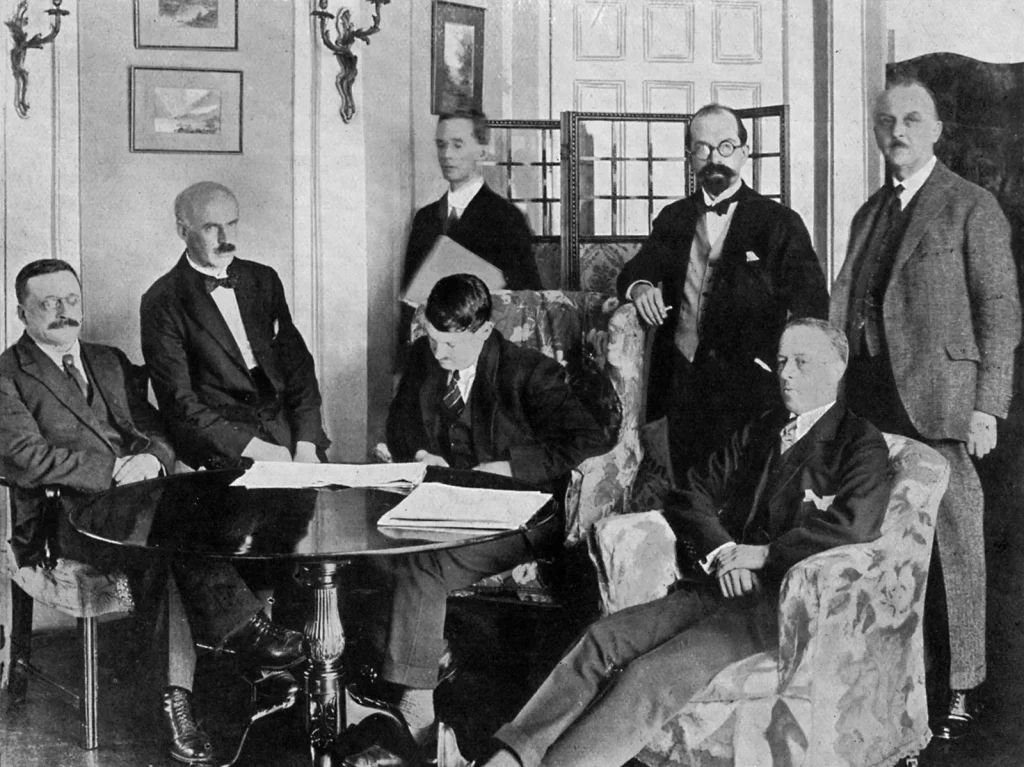
At noon on 11 July 1921, a truce came into effect between the republican movement in Ireland and the British government, allowing for negotiations that led to the Anglo-Irish Treaty of December 1921. That treaty resulted in six counties of Ireland remaining as part of the British Empire and decades of oppression of the minority Catholic population.
According to Richard Boyd Barret of People Before Profit, on 12 November 2026, this historical example is relevant to Ukraine today and in particular, answers the question of whether Ukraine should give up occupied territory as part of a peace deal: ‘When this country signed a peace agreement with Britain, we didn’t give up our aspiration to unite this country.
‘We did recognise that the military conflict was going absolutely nowhere. The same clearly applies, except on a bigger scale in Ukraine, with hundreds of thousands dead on both sides and there is really no movement. The military road has been a disaster, but we need to look at peace and negotiation.’
The Irish radical left traditionally has been against the partition of Ireland arising from the Anglo-Irish Treaty, going back to James Connolly, who although he did not live to see the Treaty, was alive when the partition of Ireland began to become a serious prospect. Connolly, writing in 1914, pointed to the disastrous example of Poland, which was ‘Torn asunder by the brute force of their alien oppressors, its unity ruthlessly destroyed.’ And his conclusion was that ‘Such a scheme… would mean a carnival of reaction both North and South, would set back the wheels of progress, would destroy the oncoming unity of the Irish Labour movement and paralyse all advanced movements whilst it endured.
‘To it Labour should give the bitterest opposition, against it Labour in Ulster should fight even to the death, if necessary.’
When the Treaty was signed, Countess Markievicz described it as a ‘deliberate attempt to set up a privileged class’ and Big Jim Larkin was also against it, wanting to undermine it through working class methods of protest rather than taking up arms.
So it is quite a significant departure from the usual radical left perspective on the Treaty for Richard to align himself with a position that sounds much like that of Michael Collins, rather than that of Markievicz or Larkin. Michael Collins was the Bonapartist figure of the time, indispensable to the Irish elite but not part of the elite, who was for the Treaty (and willing to start a civil war to enforce it) and who was key to accepting the Treaty, even while not giving up Ireland’s aspiration to unity.
Someone should ask Richard this question: if you were negotiating the Anglo-Irish Treaty of 1921, would you sign it to save lives? Even at the cost of partition?
If the answer is yes, which it seems to be from the Irish Times interview, then this might be Richard working through the logic of playing the pacifist card.
What he hasn’t worked through, though, is how he can use Irish events at all to help understand what the left should advocate for in Ukraine today. People Before Profit believe that the conflict in Ukraine is an inter-imperialist war (NATO vs Russia) and therefore that Ukraine’s aims and Putin’s are equally bad (on the same day as his Irish Times interview, Richard even went so far as to say on RTÉ radio that the current war was ‘Zelensky’s War’).
In the Irish case, no one claims Ireland was a proxy for Germany and that Irish people were risking their lives in an uneven conflict as dupes of German manipulation. We all understand that Irish people were fighting to escape the empire and determine their own fate. In that context, Connolly’s analysis was right and the partition of Ireland was worth opposing. It only looks otherwise if you are viewing the 1919-21 period through the distorting lenses of glasses you’ve picked up labelled ‘inter-imperialist war’. Once you realise this is a mistake, I don’t think you have any grounds for revising the normally accepted anti-Treaty position of the Irish left and this is so obvious that I predict Richard will have to backtrack from the attempted analogy.
There are people who can make the analogy with Irish events without ending up sounding like Michael Collins, and we are the anarchists and socialists and non-aligned activists in Irish Left With Ukraine. For us, this is not Zelensky’s War. It is an invasion by an imperial power, with the goal not only of obtaining crucial economic resources but of crushing trade unions, women’s organisations, LGBTQ+ rights, and all the other civil rights that were setting a destabilising example to Russia’s dictatorship.
Much worse than Richard’s position on the partition of Ireland is his neglect of the very constituency he claims to represent: the working class. It’s not at all difficult to go on fact-finding journeys or even have online conversations with workers and civil rights activists from Ukraine. And as soon as you listen to what our fellow workers have to say, you realise how patronising it is of People Before Profit (in this case, the RISE wing) to say that the “Ukrainian working class is, overwhelmingly, a tool of its ruling classes in this war.” The dismissal of millions of people fighting for their lives and for the kinds of rights – to be in independent trade unions, to be able to vote in free elections, to be in ecological and LGBTQ+ activist groups, etc. – is offensive, outrageous and simply an assertion that PBP would like to be true, because they know that to listen to such voices would collapse their political stance like a bubble being burst.
They won’t want to listen, for instance, to Social Movement’s recent criticism of People Before Profit, which I’m proud to share below.
What lies behind the “anti-imperialism” of the Irish left?
Ireland’s left proposes a Ukraine “peace” its own rebels never accepted
14 November 2026
The Irish Times article of 12 November 2026 [1] is a telling example of how part of the Irish “left”, under the guise of neutrality, love of peace and anti-imperialism, in effect promotes narratives that benefit the Kremlin. Richard Boyd-Barrett, a People Before Profit TD (member of the Dáil, the lower house of the Irish parliament), says that the war is “going nowhere”, that Ireland should be offering peace, and that Ukraine must recognise that military resistance is futile.
But let us apply the same logic to the history of Ireland. Should the Irish, for the sake of peace, have laid down their arms, remained within the British Empire and abandoned rebellion and the struggle for independence [2]? Should pressure have been put not on the British authorities, who crushed uprisings, executed people by firing squad, threw them into prison and carried out punitive operations, but on the Irish who refused to submit? By that logic, the guilty party in the conflict would not be those who occupied and oppressed, but those who resisted.
That, in effect, is what is being demanded of Ukraine today. Russia occupies territory, destroys cities, abducts children and systematically bombs civilian infrastructure. Yet instead of demands addressed to Moscow to end its aggression, Ukrainians are urged to give up their resistance, and support for their defence is labelled “escalation”.
It is particularly telling that People Before Profit and the Ireland-Palestine Solidarity Campaign combined, at the same rally, slogans calling for a boycott of Israel and the fight against apartheid with demands to end military support for Ukraine. In both cases the same logic can be traced: resistance to Russian imperialism is declared “escalation”, while Russian aggression itself is presented as a conflict that has supposedly simply reached a stalemate. Such an approach can hardly be called consistent left internationalism, since it blurs the responsibility of the aggressor and in effect shifts it onto those who are defending themselves.
At the same time, the very forces that loudly criticise Trump’s policies and the United States are promoting a position that objectively coincides with the interests of the current US administration: weakening Ukraine, reducing pressure on Russia and opening the way to restoring trade relations, notably in the gas sector. According to Reuters and other media, in October 2026 Trump’s special envoy and son-in-law Jared Kushner held talks with Kirill Dmitriev, who is close to Putin, on the possible involvement of an American investor in the Nord Stream pipelines [3]. These are schemes that could allow American capital to profit from the resumption of Russian gas supplies to Europe once a peace agreement is concluded. It turns out, then, that some of Ireland’s “anti-imperialists”, who oppose American influence, at the same time support a position in which Ukrainian territories and people’s lives become the object of deals made to restore trade with Russia.
When, in 2026, a politician offers Ukraine a “peace” that in effect means recognising Russia’s territorial conquests, and justifies it by Irish neutrality, the outcome is to strengthen the aggressor at the expense of the state that is defending itself. It matters little whether this is a conscious political position or an unwillingness to apply one’s own anti-imperialist principles consistently.
Genuine left internationalism means supporting the right of oppressed peoples to self-determination and their resistance to imperialism. This applies to the Irish in their struggle against the British Empire and to Ukrainians in their struggle against the Russian one. One cannot demand that Ukrainians capitulate by invoking neutrality while considering the Irish struggle for independence just. Whoever demands of Ukraine what they never demanded of Irish rebels applies double standards. And whoever, under anti-American slogans, supports deals that benefit the Kremlin and part of American capital displays a contradiction between their own rhetoric and their political position.
Peace without justice is not peace but capitulation under another name. The Irish once understood this well. It is strange that part of their “left” today has forgotten it.
From Ukraine to Palestine: Why Double Standards Have No Left Sign
- Author: Manen
- The entry was published: 20.11.2026
The “Social Movement” consistently condemns both Russian and Israeli aggression. We proceed from a simple principle:
“From Ukraine to Palestine, all occupations are criminal.”
That is why we demand sanctions and international pressure on states that wage wars of aggression, regardless of who their allies are and under what slogans they justify their actions. At the same time, we are concerned that among those who consistently support the Palestinians’ right to armed resistance, there are also those who deny Ukrainians the same right when it comes to Russian aggression.
Among some of the Irish left today, we observe just such a contradiction. The protest on November 12 in Dublin, organized by the Irish Anti-War Movement with the support of the Ireland-Palestine Solidarity Campaign during the European Political Community summit, was indicative . About a thousand people took to the streets, speaking out against further military funding for Europe, increased spending on NATO, and the militarization of Ireland. However, the protest was not limited to these issues: one of the main speakers, People Before Profit MP Richard Boyd-Barrett , declared that the war in Ukraine “is leading nowhere” and that Ireland should advocate for peace, not further funding for the war. Moreover, he suggested that Ukraine should focus on the Anglo-Irish Treaty of 1921, effectively allowing territorial concessions for the sake of stopping hostilities. It is precisely such a position, which, instead of demanding that Russia stop its aggression, invites Ukraine to come to terms with its consequences, that arouses justified criticism.
Against this background, the position of another representative of People Before Profit, MP Paul Murphy , who has also repeatedly spoken out about the war in Ukraine, is indicative. In particular, after Volodymyr Zelenskyy’s speech in the Irish Parliament in April 2022, Murphy explained why his party members did not support calls for stronger sanctions against Russia. He stated that they stand with the Ukrainians in the fight against the Russian imperialist invasion, but at the same time added : “We cannot welcome calls for new sanctions that harm ordinary Russians and only strengthen the Putin regime inside the country.” This argument is especially interesting when compared to how Murphy calls on the Irish government to act against Israel.
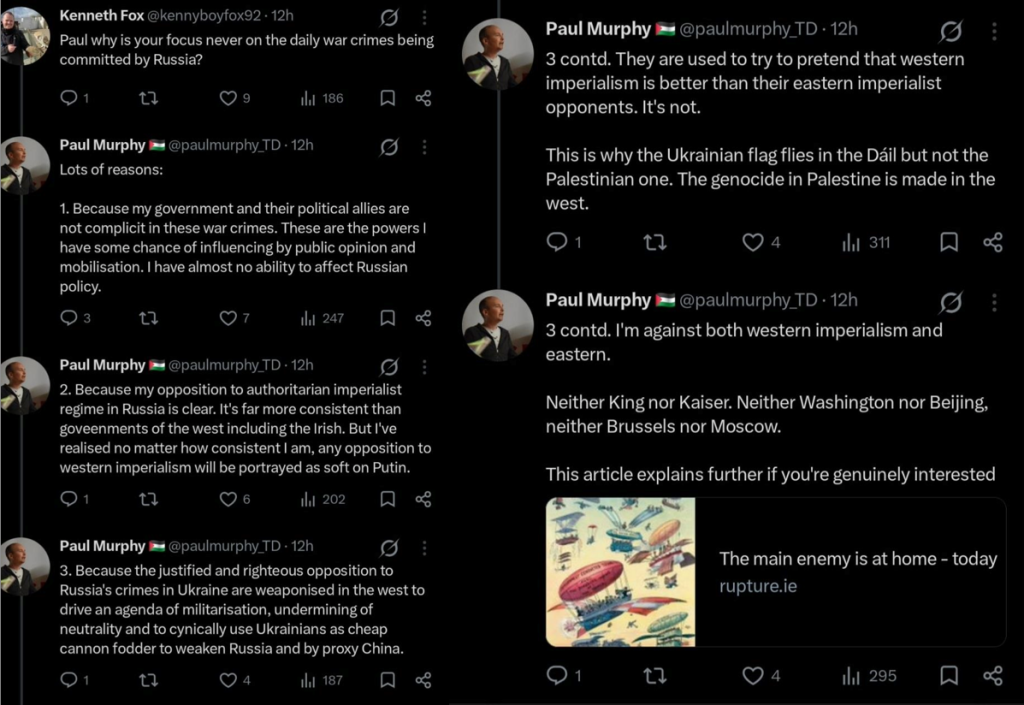
But in the case of Israel, Mr. Murphy does not limit himself to considerations about the possible harm of sanctions for ordinary citizens. He advocates for full economic sanctions, the expulsion of the Israeli ambassador and the severance of trade relations. In particular, People Before Profit has achieved the introduction of comprehensive sanctions against Israel, comparing them to the measures that were applied against apartheid in South Africa. Murphy also demands that the Minister of Finance withdraw state investments from Palantir, a company involved in the activities of the Israeli army. That is, he quite rightly believes that Ireland should use the political and economic levers available to it to put pressure on the aggressor state. We share this approach. However, it is unclear why it ceases to act when it comes to Russia.
This inconsistency is also noticeable in Murphy’s position on sanctions. The Irish government should put pressure on Moscow, in particular through the Aughinish Alumina plant, owned by the Russian company Rusal, associated with Oleg Deripaska (we wrote about this earlier – ed.). The investigation by The Irish Times and OCCRP found that significant volumes of alumina produced at the plant were supplied to Russian aluminum enterprises, whose products, through intermediaries, ended up in arms manufacturers.
So the argument that sanctions harm ordinary people and at the same time strengthen an authoritarian regime, it uses to defend Russia, but does not apply to Israel. Why is economic pressure necessary in one case, but unacceptable in another?
At the same time, the question arises of whose interests such a policy might serve. According to Reuters, in October 2026, Trump’s special envoy and his son-in-law Jared Kushner discussed with Putin’s adviser Kirill Dmitriev the involvement of an American investor in Nord Stream. The scheme was about a scheme under which American capital could earn on the resumption of Russian gas supplies to Europe after a peace agreement was concluded.
It is the leftists who criticize American policy and the influence of big business who should be especially attentive to such processes. Instead, they propose cutting aid to Ukraine, which effectively means supporting Putin’s demand to withdraw Ukrainian troops from Donbas, which Russia is unable to completely seize by military means. At the same time, Ukraine is ready for a ceasefire along the current front line.
We do not claim that Murphy or his party members are consciously working for the Kremlin or specifically advocating a pro-Russian position. However, the consequences of their policies coincide with the interests of Moscow and part of American capital, and it is for these consequences that they must bear political responsibility. They recognize the right of the Palestinians to resist, while they question the right of the Ukrainians to resist. They consider the Irish struggle for independence to be just, but they propose completely different rules for the Ukrainians.
True left internationalism does not divide occupations into “ours” and “others’,” since its foundation is solidarity with the oppressed and opposition to imperialism, regardless of where it comes from: Russia, Israel, or the United States. A peace that demands that the occupied abandon resistance cannot be just. It is just capitulation by another name. The Irish once understood well the price of such “peaceful” logic. It is a pity that some of their leftists today have forgotten this.
Leave a Reply