• Skip to primary navigation
  • Skip to main content
independent left logo

Independent Left

Environmentalism, socialism, freedom and equality. #liveablecity

  • About
  • Featured Articles
    • How Farming Must Change to Save the Planet
    • The Housing Crisis: Causes and Solutions
    • Socialism in Ireland
  • Contact Us
  • Podcast
  • Animal Rights
  • Archive
    • Irish Socialist History
    • Dublin City Council Housing
    • Ukraine
    • Protests Ireland
    • Reviews
    • Irish Political Parties
    • All Posts
    • Independent Left Policies
  • Why join?

Ukraine: Voices of Resistance and Solidarity

27/02/2023 by admin 3 Comments

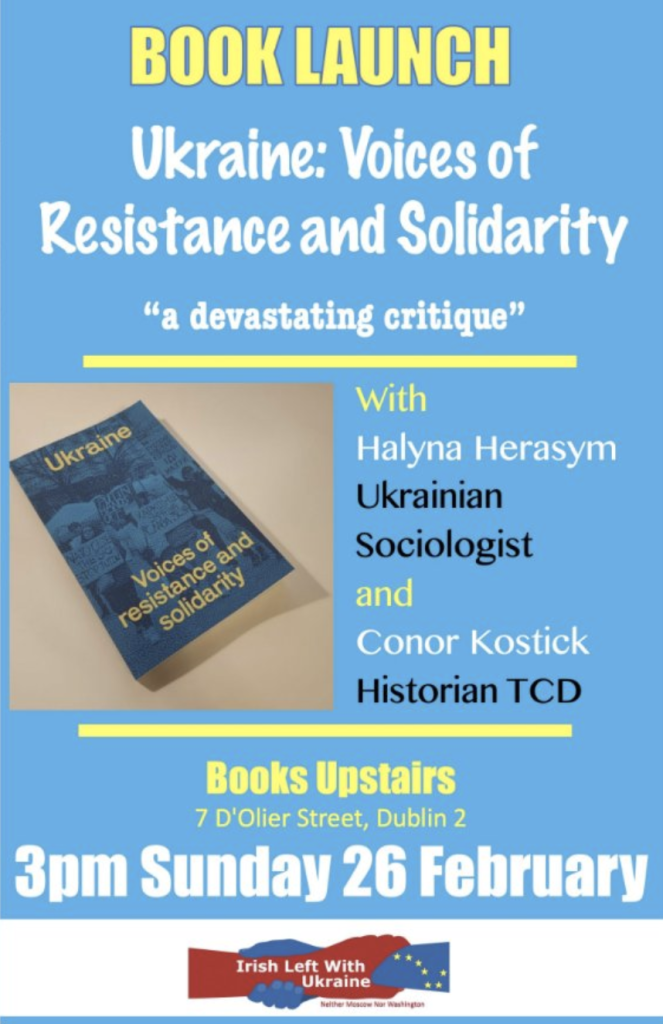
Ukraine Book Launch Voices of Resistance and Solidarity
Irish book launch of Ukraine: Voices of Resistance and Solidarity

Ukraine: Voices of Resistance and Solidarity is a book edited by Fred Leplat and Chris Ford, published by Resistance Books and Ukraine Solidarity campaign. It contains essays by Mick Antoniw, Welsh Labour MP; John-Paul Himka, history professor; Taras Bilous, activist for Sotsialnyi Rukh / Social Movement; Yuliya Yurchenko activist for Ukraine Solidarity Campaign and Sotsialnyi Rukh / Social Movement; Oksana Dutchak, co-editor of Spilne/ Commons; Viktoriia Pihul, Ukrainian feminist; Nataliya Levytska, Deputy Chair of the Confederation of Free Trade Unions of Ukraine; Vitalii Dudin president of Sotsialnyi Rukh / Social Movement; Bogdan Ferens, founder of the Social Democratic Platform; Eric Toussaint, spokesperson of the CADTM International; Ilya Budraitskis, activist in the Russian Socialist Movement; Niko Vorobyov, Russian-British freelance journalist; Gilbert Achcar, Lebanese socialist; Simon Pirani professor of modern languages and cultures; Stephen R. Shalom, editor of New Politics; and Dan La Botz, editor of New Politics.

Ukraine: Voices of Resistance and Solidarity is an important publication that achieves two fundamental tasks: it amplifies the voices of Ukrainian socialists, feminists and trade unionists; and it refutes the arguments that many on the left internationally deploy to excuse their failure to support the Ukrainian resistance.

On 26 February 2023, Ukraine: Voices of Resistance and Solidarity had its Irish book launch, hosted by Irish Left With Ukraine. The two speakers were Conor Kostick, a founding member of ILWU and Halyna Herasym, a Ukrainian sociologist currently based at UCD.

A full recording of the two speeches and the introduction by chair Noirin Greene, former SIPTU national equality officer can be watched below:

Transcript of the booklaunch Ukraine: Voices of Resistance and Solidarity

Noirín Greene, former SIPTU national equality officer:

So the first person I want to introduce is Conor Kostick, who a lot of you already know. Conor is an Irish historian and writer living in Dublin. He the author of many lauded works of history and fiction and has received special recognition for his significant contribution to writing for children in Ireland. And I think that’s very admirable thing to do, Conor.

Conor was editor of the Socialist Worker in Ireland, twice chairperson of the Irish Writers Union and is a board member of the National Library of Ireland. As a historian, Conor’s awards include a gold medal from Trinity College, Dublin and fellowships from the Irish Research Council and the University of Nottingham. There’s also a great deal more, I’m seeing, Conor, but as I say, I’m only five minutes so I cut it all short. So thank you and I’ll ask Conor to give his address. Thank you.

Conor Kostick, novelist and historian:

I’m very glad to be asked to launch this book. I think it’s a really important book and it achieved two fundamentally important goals. One is it amplifies the voices coming from Ukraine, and two, it deals with the arguments that we’ve been facing since this war began. And just to go over those two points, it’s hard to underestimate the importance of hearing voices from Ukraine. The great failing of the left internationally, and we see it here in Ireland, is that it doesn’t start with the experience of people in Ukraine. Instead, they start from various different positions. They look at their political interests, their networks, and they come up with formulations about the situation in Ukraine that are back to front. And they end up, as we’ve seen recently, making all sorts of calls that have no bearing on what has actually happened in this last year.

They don’t think about, they don’t empathize with the experience of the people who are just living just like we were with the same nuances of politics, people struggling for a better world in against neoliberal agendas and so on. And suddenly bang! This massive, massive transformation of their lives, this deterioration of their lives, this horrific war. So I think to start with the experience of people in Ukraine means you don’t go as far wrong. And what this book does is it gives us the voice of the left in Ukraine. This is really important, because just like in Ireland, just like in any country, there’s a rich left tradition in Ukraine, there’s trade unionists, feminists, LGBTQ+ activists, socialists, anarchists, of course, every variation of political party that exists on the left elsewhere, exists in Ukraine. So why don’t we talk to them? Why don’t we start by saying, “What’s your experience? What do you want us to do? How can we show our solidarity with you?”

And when you start like that, you can very quickly arrive at the importance of arguing for Ukraine’s rights, self-determination, because nobody on the left Ukraine has the positions that we hear being articulated by the Irish Left. Here groups like People Before Profit, The Socialist Party, the Socialist Workers Network, let alone the more sort of communist parties, they don’t make it clear that people of Ukraine have the right to resist. No, they say that, “yes, Ukraine has the right to self-determination, and they are against Putin (I will get to Putin), but they don’t have the right to take arms from the West. That’s a big mistake. They can’t have mines cleared by Irish trained people, because that’s a threat to Irish neutrality.” So they come up with these positions that are, I’ve described as a evasionist, because it’s fine to say, “We’re in favor of peace.” Everybody wants peace, but they won’t say that the peace now is going to involve occupation of Ukrainian territory.

It’s going to mean the crushing of the left. I mean, there’s no question that whenever Russia occupies territory, it smashes the left. There’s no trade union activity in Russian occupied area. The trade unions are banned. The activists like Taras says in his essay here, Taras Bilous of Social Movement, he had to make a decision about whether to stay in Kiev at the start. And people were saying to him, “If you stay, you’ll get killed,” because it looked like the Russians were going to take Kyiv. And they are killing the civilians, yes. But they’re also targeting activists. Russia has a very conservative agenda so much that really, I’ll just come into this in a minute, the real far right position on this war is to support Russia. And that’s happening internationally, because as Putin sees it, by having gay rights and so on, the West is needs putting in its place and he’s trying to stop this.

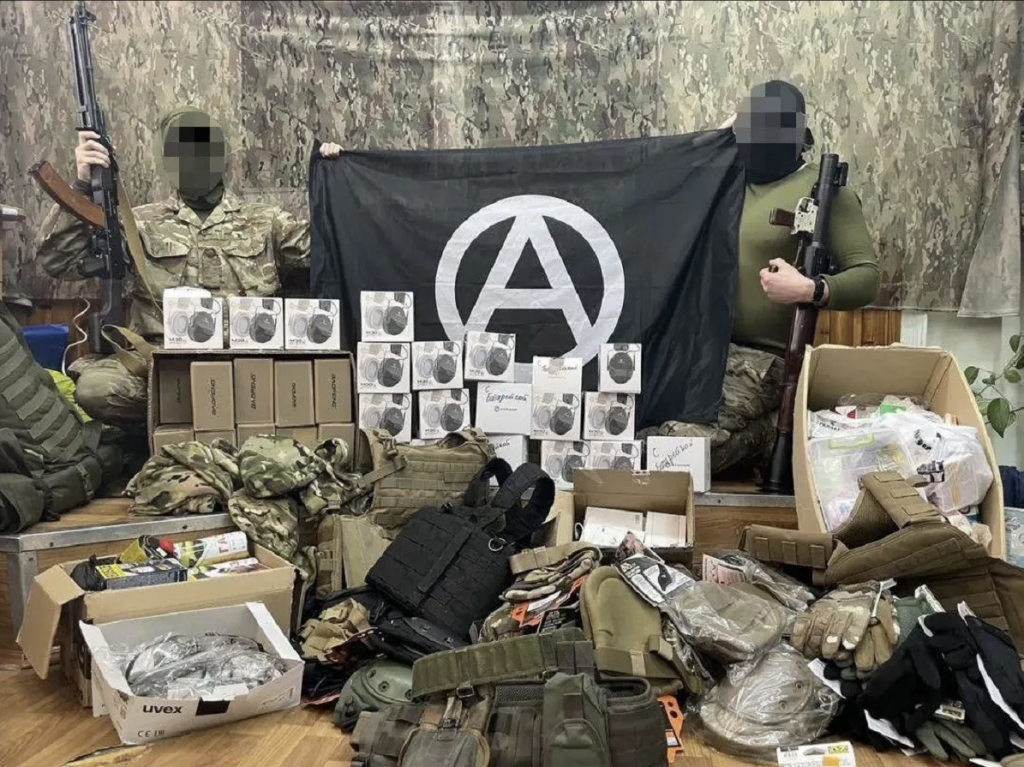
The stakes of this war are very high, because there’s a world historic momentum that we’ve also had in Ireland towards same-sex marriage and abortion and so on. And the far right internationally, the conservatives internationally, hate this. Victory for Putin is all about this kind of taking away of democracy, taking away civil rights. So what’s happening in Ukraine is absolutely vital. And Taras made the decision to stay. A lot of the socialists in Ukraine are right now in the front lines. An anarchist group I know are raising money to get night vision goggles. So they are physically putting themselves in the frontline. And as they say in the book, they’re very clear, they’re not doing this for NATO and they’re not doing this even for Zelensky, although they support the Zelensky government under these circumstances, they’re doing it because if Russia wins, all the space for left organizing is eradicated.

At least if Ukraine wins, they can then have a discussion about what post-war Ukraine looks like, how trade unionists can fight for their rights. But that fight won’t happen if they lose. When I’ve tried to raise this with the Irish Left, what I find is they cannot bring themselves to listen to the voices of the Ukrainian left. It’s like trying to bring two magnets of the same polarity together. They just slide away rather than connect. They never ever platform and address the positions of the Ukrainian left. And I’m not saying they have to agree with them. What’s really shocking about this current moment in history in Ireland is that the left here are silencing the left in Ukraine, I think deliberately so, because people like Irish Left in the Ukraine have made it clear that we’re in contact with the Ukrainian left, we would give them speakers. They don’t want to know, because as soon as they admit that there is a Ukrainian left that you should talk to and listen to, even if you disagree with them, then their arguments collapse.

I managed to get one of them online to start a bit of a discussion which he quickly ran away from. But he said, “The people you’re amplifying with this book, (and also who we’ve been in touch with since start of the war), are a terribly small minority.” It’s what he said. Now first of all, that’s simply not true. Social Movement is a modest enough organization. But here in this book we hear from trade unions representing millions of Ukrainian workers, really big representative movements, feminists representing thousands of activists. So it’s simply not true. But even if it were true, I asked him, “How many people in Ukraine support your position that Ukraine is right to have independence, Putin is wrong, but that they’re not allowed to have Western weapons?” Not one person supports that, because it’s idiotic. If Ukraine has the right to self-discrimination, then it has the right to arm, people have the right to get arms from wherever they can.

And there’s a long history of this, of independence movements gaining arms from wherever they can. Which brings me to another point. Let me just give you a quick example of what you can read about from this book. The kind of voice that deserves to be amplified, that deserves to be heard here and is being, I think, deliberately silenced by the Irish Left. This is from a feminist organization, an interview with Viktoriia Pihul. At the moment there are people going around and saying we want peace, which is fine, but the implicit message is that we’re willing to accept that Russia occupies the positions it’s got at the moment and the equivalent ‘peace now’ argument has happened with regards to feminism.

So we have a western feminist manifesto that calls for an end to war, but doesn’t say anything about whether Ukrainian women should fight for independence. This is Vuktoriia’s response, “We’ve seen many pacifist statements by western feminists, including their manifesto. In the face of war and daily deaths of our women and children we are critical of this position.” That’s a massive understatement. She must be seething at that position, but anyway. “In this context, I am part of a working group of Ukrainian feminists who have written the Ukrainian Feminist Manifesto. We call for support for Ukrainian women including our rights for armed resistance. What I mean here is succumbing to geopolitical reasoning and geopolitical thinking and withdrawing from the conflict by condemning all sides is not a workable position. We must clearly distinguish the rapist from the victim and help the victim to assert her right to exist and be a subject.” Terrific; short; powerful in just those few lines. That really makes the point more clearly than what I’ve been saying. We have to distinguish the rapists and the victims, it’s as simple as that.

The Russians are the rapists. Ukrainians are the victims. Which side are you on? Of course, you should be on the side of the victims. It’s shocking that there are so many people who cannot see it that simply and clearly and cannot recognize the experience of Ukrainians. And this has practical consequences of course, not only in that trade unions here and elsewhere have given practical solidarity to our fellow trade unionists and activists and feminists in Ukraine. But also even just for marches like the other day. The Irish Left With Ukraine, we can go to these marches, we have comradeship with the people on the marches. We can have a conversation with anybody on the marches. The rest of the Irish left, they don’t go to them, because their positions would just be treated with scorn at the best. So they’re cutting themselves off.

The Irish left, which should be so vibrantly engaged with Ukrainian left – and we’ve met people from Ukraine through these activities who are revolutionaries and Marxists and feminists of course ­– should all be comrades together and that’s not happening except thanks to Irish Left With Ukraine and through Irish trade unions. Many trade unions here have much better position than the local left parties. So that’s the side of the book that amplifies the voices from Ukraine. So you cannot underestimate how valuable that is. And then the other thing that the book does is go through many of the arguments we’ve been facing and deals with them at a sort of theoretical level, but also drawing on their experience. And I won’t go through all the arguments, but I just take on the one argument that the book helps us answer, which is the question of whether the conflict in Ukraine in an inter-imperialist war, a proxy war?

Because if it is, then we don’t want to get involved. We don’t want take sides. And that’s the position of People Before Profit, the Socialist Party and the others: “all countries have got the right to self-determination. But supporting Ukraine to defeat Russia would mean supporting America’s goals and therefore we’re not going actually give any practical support to the Ukrainian resistance.” So that’s the key argument and the book gives us really good answers. People have really looked at this. There’s a very good essay that points out really since 1900 there has not been a war anywhere in the world that has not had inter imperialist dynamics to it. Of course, if a small nation is rising up against American domination, Russia is interested in that. It weakens America, great. If a small nation is rising up against Russian domination, America’s interested in that. That’s happened throughout the whole of the twentieth century.

And in fact they don’t have this in the book, but we know from Ireland, we know from our history how it happened. In 1916 Germany shipped 20,000 rifles, a million rounds of ammunition on the Aud to help the rebels here. Roger Casement came in a U-boat. He was given a submarine from Germany. Should he not have had that submarine? Should we have not had those guns? Of course, Germany had an interest to weaken Britain. James Connolly knew that as soon as we take German weapons, there’s going to be the equivalent to People Before Profit saying, “It’s an imperialist war. You’re supporting Germany.” So he had a big banner made: we serve neither King nor Kaiser, but Ireland. Yeah, we’ll take the guns, but we’re not serving the Kaiser. There’s no quid pro quo. And that’s the position of the left in Ukraine.

“Yeah, we’ll have your Apache helicopters and we’ll have your HIMARS, we’ll have all that. We need that. We absolutely need that. Otherwise, we could lose.” And, by the way, unfortunately it’s a very difficult military situation right now. They absolutely need this kind of equipment. It doesn’t mean we’re necessarily for NATO. And even if it did, the slogan, the right to self-determination of Ukraine, means nothing if they cannot choose to join NATO. I don’t want them join NATO. Taras Bilous doesn’t want to join NATO, the trade unionists, the feminists in here don’t want to join NATO. But if they choose to join NATO, that’s their choice.

If they don’t have a choice about joining NATO, they don’t have self-determination. So you cannot make your support conditional, you can’t say, “well I’m hesitant, because they might join NATO.” Tough luck. If you believe a country has a right to self-determination, then it has the right to make choices you don’t agree with. In Ireland we’ve had loads of referendum we’ve lost, the left has lost, but at least we’re making our own decisions about whether to be in Europe or not.

The left, if it loses the argument about NATO in Ukraine, it will nevertheless carry on arguing into the future. But it cannot make those arguments unless it’s free of Russian troops. So that’s the crucial point about these proxy wars. And we’ve seen from Vietnam where Russia and China armed the Vietnamese, but the left had no problem recognizing that the Vietnamese had the right to throw out the American supported government. And on the other side of the equation, some of you remember Solidarnosc, the independent trade union that flourished in Poland in 1980. Well the CIA got straight behind that, because they wanted to weaken Russia. Thatcher and Reagan feted the Solidarnosc leaders. It didn’t stop it being a genuine mass movement that socialists would support. So just because the inter imperialist powers are jockeying for position around a movement, that can’t let you determine what your position is. Your position has to start from the core principle. There is a rapist, there is a victim. Where am I standing? You start there and you can’t go wrong.

And yes of course, you’re going to see the other side jockeying for position, but the revolutionary victory, the resistance, the people’s struggle does more for making the world a better place than to let Russia win on the grounds that otherwise the US stands to gain.

And just finally just say something on the far right: the argument has been coming from Russia that Ukraine is fascist. And as this book makes absolutely clear, fascism is a problem in Ukraine, but it’s a diminishing one from its height in 2014. They got less than two and a half percent in the election in 2019. They got no parliamentary representatives elected and the left in Ukraine don’t swallow that excuse about the far right. They need independence and they will deal with the far right. That’s their problem to deal with.

And of course, the other side is easily more identifiable with its links to the far right. I mean, there are Russian activists who describe Putin as fascist and they might not be wrong as sort of neo-fascist. When you look at the big rallies the uncanny language that so echoes Hitler. But while there are nuances about what is a fascist movement and what is just a brutal dictatorship with state forces, the excuse about fascism should be laid to rest. There’s no justification for the evasion of Ukraine on those grounds.

So those are my takeaways from the book, really powerful important book. And the more it can get read, the better.

Noirín Greene:

Well done, Conor, for giving us an overview, your insight of what’s in this magnificent book. And I hope because of your address, it doesn’t put people off buying it. Don’t think you’ve read it all, because you are certainly haven’t. It’s a fabulous, fabulous inspirational book. I know my only job was to introduce the speakers, but digressing slightly, I loved your reference to the banner which was shown over Liberty Hall. We serve neither King nor Kaiser, and that wonderful photograph of the mobilization of the citizens army. We took their weapons, who took any support from wherever they can get it. Just before I go, I know Danigan will be summing up I think at the end. If I could just ask you, giving you notice, maybe you could say a little bit about the Irish Left with Ukraine and how people can join up and what you can do next.

I do want to say that I think the time, and I think Conor mentioned that all the references that are in this wonderful book, the time for the what aboutery. I’m allowed to say pissed off, aren’t I? [inaudible 00:20:07]. Really pissed off when you’re trying to have this discussion with people on, they call it the broad left about what is happening in Ukraine and how we should support the people there in Ukraine. And this is what aboutery goes on and on and the but word. And to be quite honest with you, I think a year later it’s over. I think people need to join up, sign up and do the right thing. I know most of the people and all of you, we are on the right side and that’s all that needs to be known. So anyways, that’s my little digression.

I’m not sure I’m supposed to do that. It gives me great pleasure to afford a very warm welcome to Halyna Herasym. I hope I pronounced all of that right and just a little tiny little bit of background on, because I am limited in time. Halyna move to Ireland in 2020 from her home, and I hope I’m right on this, in the western part of Ukraine to study for her PhD in UCD School of Sociology. And little did she know that when she left her family and friends behind to complete her studies in Ireland, that her beloved Ukraine would be ravished by the terror of the Russian invasion.

Halyna will tell us about her experiences as a Ukrainian living in Ireland. And I think Conor’s stressed that earlier, that’s the people that we really need to be listening to and her reaction to the news of the invasion by Russia, by living in Ireland and her shock and concerns for her family and friends left behind in Ukraine. Also, some of the harrowing stories, because I did listen to your interview with the Irish Times and I would recommend that you certainly try and do that. I think it’s on YouTube and she’s heard of just some of the atrocities that are unfolding every day. Wasn’t just at the start, it wasn’t just in the middle, it’s still going on that have been committed by Russian forces in the occupied territories in this illegal war. And I’m sure that you will have a lot more to tell us. So very hearty welcome to her. Thank you.

Halyna Herasym, Ukrainian socialist:

Thank you, Conor. I have some large shoes to fill now after your wonderful presentation. So I want to start with a little story of one of the authors of this book, Taras Bilous was mentioned by Conor. So he’s about my age. He is a Ukrainian left activist who was fighting for workers right, for the rights of women, for the rights of LGBTQ community for quite some time now. He’s an editor of Commons Journal, the left-wing Ukrainian Journal, and he has a very peculiar biography that I think highlights the struggle of Ukrainians very well. So Taras was born in [inaudible 00:23:10] region, which is the far, far eastern part of Ukraine. And once we were together at an event where we had to speak Russian. I myself was born in western part of Ukraine as Maria already told us and my Russian is not very good. For me it’s absolutely second, third language. I knew Polish at the time better than I knew Russian.

And I was like, “Whoops, I’m in trouble.” So I had to make my presentation in Russian. I was like, “Jesus, I probably have done not very good.” And then it was Taras’ turn and I never spoke to Taras in Russian obviously. We always communicated in Ukrainian and then it was his turn and I realized that my Russian is not the worst in that room. Taras’ accent was bad and it showed that he wasn’t very fluent in Russian. I think his biography and the way he stands for his conviction highlights that many divisions within Ukrainian society are not as they see it from the outside. Taras is a very sweet, very peaceful person, very patient for… I couldn’t be that patient to save my life, to be honest. He’s always very willing to go out of his way to have a genuine discussion, even with the people he knows that they would disagree with him and sometimes even with danger to himself.

So of all the people who would be patiently trying to persuade some activists on the right side, for instance, Taras would be the one who would be patient with talking to them. And he would be the last person that you would imagine taking up arms and going to fight in the battle. But when the Russian invasion began last year, Taras decided to stay and fight. So yeah, I think his biography and his character depicts very well the experiences of so many Ukrainian people. It depicts that the story of Ukrainian society is way more complicated than simplistic divisions like West and East Russian speakers, Ukrainian speakers and so on and so on and so on. When I read this book, I could really feel the frustration of another author Oksana [inaudible 00:25:46], also sociologist from Ukraine whose husband currently is fighting in war. They have two children and she had to flee, because they lived in Kiev.

Her husband is, he’s also from the western part of Ukraine and he is a wonderful, absolutely wonderful writer. I encourage you to look him up. I think some of his writing pieces were featured in New Yorker. His name’s [inaudible 00:26:13]. He’s an absolutely wonderful writer who spent quite some time sometime traveling, trying to learn about his home country, about Ukraine and writing reports about what he had seen. His book, [inaudible 00:26:29] Ukraine, is really inspiring and it tells those stories like the one of Taras about just some people living, going about their lives, being open and having discussions with him on his way, absolutely wonderfully. He also did participate, had been participating in left-wing politics for a long time, I think more than 10 years now in Ukraine and publishing his books. And Oksana in this book had written this article on 10 terrible leftist arguments about Ukraine.

And you can sense her frustration, you can sense her anger. And she even mentioned that hearing some of these arguments, she feels emotions that she’s ashamed of because these arguments make her so angry. And I can honestly relate to that, because unfortunately with many left-wing activists, and not only in Ireland, all around the world, you can feel like you’re invisible. So you are talking and you’re not being heard as a Ukrainian, it’s like this invisible veil comes between you and the person you are trying to talk to. And this lack of acknowledgement of your agency is honestly very frustrating sometimes because again, it is a very diminishing experience to be honest, when the people do not act as if you are there equal. They are trying to persuade you that, oh, this is all like a NATO rules or whatever. You are just are just being brainwashed.

I’m sorry people. I have a very good education. I am smart, adult human being. I’m capable of coming to my own conclusions about the situation and I do know quite a bit about the situation on the ground. So I can hear, I can feel Oksana’s frustration and I’m really delighted that right now I have an opportunity to present these Ukrainian voices and Oksana’s voice in particular here. In my research, I have two streams of research, one of them is I’m researching funeral culture in Ireland here. So I learned quite a bit about the Irish society, but the other stream of my research is dedicated to social movements in Ukraine. And I’m focusing on what I’m calling social dreaming. So social dreaming is these desires and dreams and visions of Ukrainian society, which are lived, which Ukrainian society is trying to make true through social participation, through political participation, through their everyday experience.

This is something that we have seen during your Madam protest in 2013, ’14. This is something we are seeing now society, regardless of their political views, left and right and centrist people and people who are not that interested in politics, to be honest. They’re coming together in order to realize the dream of just society with a rule of law where they have the right to decide for themselves what they’re doing. And I’ve been interviewing a lot of Ukrainian activists in the course of my research and that’s something I been amazed again, being Ukrainian, being a part of this social movement. But I still, I am amazed time and again with this determination, with this desire to make the world of your dreams where you can realize the justice, when you can see how your rights are coming to reality. I’m amazed by that determination, that feeling less willingness to work towards that, time and again.

And here in Ireland, I feel like this research on social dreaming is becoming for me more important than ever, because in Ukraine right now, and even before, we had so many predecessors who wanted to see that [inaudible 00:31:15] world, that world they’re envisioning for themselves. As Conor wonderfully mentioned, we have seen the solidarity movement in Poland. We have seen so many anti-colonial moments all around the globe. So in the course of my life and the life of my generations, we had so many people to look up to. So many people who were fighting to build that [inaudible 00:31:41] and more righteous world if you will. I had this discussion today that people of Ireland a 100 years were also so wonderfully mentioned by Conor. They didn’t have somebody to look up to. They had to envision their own future. They had to envision that world where they would have that right for self-determination to decide their own fate for themselves.

I think that what this book can provide for the world and for the left all over the world is this social dream, this opportunity to think out of this world, I don’t know, Cold War mindset. This opportunity to get out of that pattern of thinking America is bad, America is a superpower. We should be standing against everybody and everything America stands for and major stands for and so on and so forth. I think that this book and the voices of Ukrainian people in general can provide this opportunity for all the left all around the globe to see something new, to step outside of the box and to build more robust solidarities, which are not limited by political naming, by things that are using clever rhetorical figures to present themselves as if they’re just, or if they are promoting somebody’s rights. I think this is a very powerful opportunity to have this kind of thinking to go into this stream of social dreaming and political imagination and build this [inaudible 00:33:40] and more robust world where solidarity grows together. Thank you.

Noirín Greene:

Thank you, Halyna, that was very wonderful. Very colorful use of words in your vision as well. I particularly liked that we need to think outside the box, especially older people as well. And those that are in bureaucratic organizations or considered themselves the old left political people. I particularly liked where you said the social, socialist dream for not just the future of Ukraine, but for around the world. And I think of anybody is in any doubt as to how to get inspiration, again, I’m plugging it again, this book is just fabulous, because you have the feminist thinking in it. You have trade unionist thinking in it, and you have political with big peace and small peace and middle peace items and articles in this book. So I would again encourage you to do that.

Irish Left With Ukraine

This book launch was one of several events organised by Irish Left With Ukraine at the time of the anniversary of the Russian invasion of Ukraine.
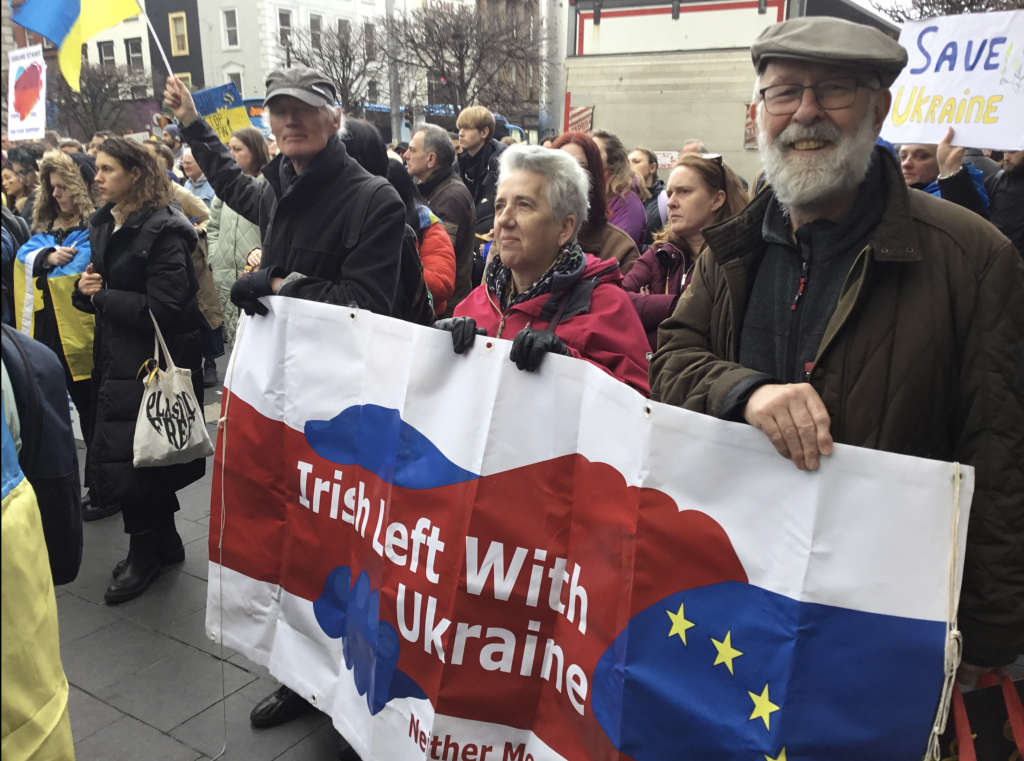
voices of resistance ILWU banner marching in solidarity with Ukraine

If you would like to get in touch with Irish Left With Ukraine, please email irishleftwithukraine@gmail.com.
Filed Under: All Posts, Ukraine

Resolution on the War of Sotsialnyi Rukh (Social Movement Ukraine)

10/10/2022 by admin 2 Comments

Independent Left are glad to reproduce the English-language version of a resolution on the war with Russia adopted by of Sotsialnyi Rukh (Social Movement Ukraine) at their convention in September 2022. This is an extremely important resolution for the whole of the left internationally, because it demonstrates that there is a left in Ukraine who are both against the Russian invasion and the neo-liberal policies of their own goverment.

The resolution also draws attention to the fact that far from Ukraine being fascist, the struggle for independence has a strong working class, democratic character, much like the national liberation struggles of the past, including in Ireland.

The ‘evasionist’ left internationally have a blind spot when it comes to the Ukranian left, because it does not suit their position of refusing to support a victory for Ukraine over Russia to acknowledge that the position of socialists and anarchists in Ukraine is to defeat Russia as part of the movement towards a more humane, socialist world.

Resolution: The War and the Future of Ukraine and the Left Movement


The people of Ukraine have been facing hard challenges, yet they have proven their ability to fight for the right to decide on their own fate, and their determination to defend the country and to end the war as soon as possible. The authorities and representatives of market-fundamentalist ideology, together with big business, keep pushing through an economic model focused on benefiting a minority at the expense of the welfare of the absolute majority. In this model, workers are completely subservient to the will of their employers, while social and regulatory functions of the state are abolished for the sake of “business needs”, “competition” and “free market”.

Our country deserves a post-war arrangement, in which decent work, a reliable system of social protection, affordable education, housing, and medicine become a priority. Ukrainians have already seen how essential for surviving can be public enterprises such as the state-owned Ukrzaliznytsia, and have also felt how painful deregulation of food, housing and fuel prices can be.

A party is needed to implement an alternative vision of Ukraine — democratic, social, and socialist.

This party would protect and unite the working class and the unprivileged, those who now lack political representation and suffer from constant abuse. Such a party must protect the absolute majority of the working population from the employers’ dictate.

The ultimate goal of such a political force must be the emancipation of humankind and the radical democratization of economic, political, national, and social life. The party would advocate the transfer of power over the economy from private owners and corporate management to labor collectives and communities. Decision-making and the distribution of economic goods must be in the interest of the entire community, not the capital owners. To do this, the economy must be built on the basis of public
rather than private ownership.

With the outbreak of the war, the oligarchs and other major capitalists have fled the state. It was the common people, including organized workers, representing the largest part of the civil society, who stood up to defend the country. Unfortunately, despite the fact that the working class constitutes the core of the Ukrainian resistance to Russian imperialism, our authorities continue to push through legislation aimed at limiting its involvement in decision-making, thus provoking further social conflicts, undermining defense capacities, and attacking the democratic rights of the majority for the protection of the dominant minority. Anti-social decisions are justified by military necessity, although in practice most of the successful war economy cases in the world were based on the principles of the social state and social dialogue.

The war has created new forms of self-organization and grassroots politics. The mobilization of the nation for the liberation war strengthened people’s sense of a common cause and made them realize that it is thanks to ordinary people, not oligarchs or business, that this country exists. The war radically changed social and political life in Ukraine, and we must not allow these new forms of social organization to be destroyed, but, on the contrary, expand them.

A positive sign was the widespread support for the demand to write off Ukraine’s foreign debt, which led to its eventual freezing, and the support of the largest global trade unions and democratic left parties for demands to supply Ukraine with weapons and fight against anti-labor laws.

The time has come for a change in Ukrainian politics. We call for a new, mass party that will represent organized labor, grassroot and democratic movements united around a radical project of transforming society on the basis of comprehensive liberation, public property and democracy.

Until recently, many in the world underestimated Ukraine and overlooked the subjectivity of its people. Now that the country in all its linguistic, ethnic and cultural diversity has united for an armed fight for the right to decide on its own destiny through its own forms of self-organization, it is time to explain to our business and political elites that it is not them but the people of labor who constitute the Ukrainian nation that must decide how we build our country.

“Sotsialnyi Rukh” believes that the priorities in the struggle for this have to be:

1 Complete victory and security for Ukraine

The Russian army must be defeated now, this is a prerequisite for the democratic and social development of both our country and the world.
Preserving independence and democracy will require, first and foremost, the development of its own defense capabilities. On this basis, a new international security system must be built to effectively counter any manifestations of imperialist aggression in the world. Ukraine needs a program to restore industrial production and science-intensive defense and related industries.

2. Socially oriented reconstruction of Ukraine


Neoliberal forces are trying to impose their vision of post-war Ukraine, a country belonging to big business, not to its people, and having neither social protection nor guarantees. Unlike that, we believe it is necessary to advocate for the reconstruction that emphasizes progressive development of the living standards of the majority of the population, and of our social infrastructure, provision of economic guarantees.

Reconstruction must be ecological, social, decentralized and democratic, inclusive and feminist.


In particular, the nationalization of key enterprises under workers and public control is necessary.


Besides, we deem crucial and advocate for the implementation of open accounting in all enterprises, regardless of ownership, involvement of workers in their management, creation of separate elected bodies and committees to exercise this right. Corrupt schemes of transferring offshore profits from exports of iron ore, metal, and agricultural products must be taxed. In general, taxation has to be progressive to finance the social sphere and development of the economy. Another step should be introduction of indicative and direct planning for a structured, stable and more complete development of the economy. 

Commercial secrets must be abolished. In Ukraine, there can be only one type of secrets, military ones, access to which is regulated by the state, while all other information about the work of enterprises, organisations, and state agencies should be open to all citizens.


No less important is overcoming mobbing and bullying at work, ensuring availability of shelters to victims of domestic violence, combating gendered violence, fighting for safe and stable living conditions for women, trans persons and non-binary persons, ensuring equality in the military and the workplace, stricter accountability for hate crimes, and increasing representation of all social groups in government.

3. Social democratization


Democratization of all levels of life, eliminating the influence of money and big business on politics, increasing the representation and importance of trade unions, national minorities and communities in power and their full involvement in decision-making. Owners of capital and persons funded by them cannot be people’s deputies or hold positions in public and municipal services.

War makes it necessary to limit certain rights and freedoms in order to protect independence and democracy. However, we must demand that such restrictions are clearly justified, so that they will not be used for the abuse of power where there is no military necessity.

Representatives of local communities, in particular of territorial defense units, must be directly involved in providing security and law and order, while their activity must be democratically and transparently regulated in the public interest.

Social democratization also means protection of labor rights according to the best standards existing in European countries, limitation of a working day length, and adoption of the law on labor inspection. 

We need to transform the migration policies to easen access to residence and prevent undignified treatment of foreigners.

Affordable energy-efficient and social housing, protection of tenants’ rights, rent control, developing urban infrastructure, and greening cities are a must. Expanding self-governance in cities, introducing elements of direct democracy, development of public transport and limiting usage of the private one are other essential steps to take.

Moreover, the development of student self-government is crucial. Students should be involved in the decision-making process at universities and other places of study, and develop a network of independent student unions.

Equally important is the preservation and development of the Ukrainian healthcare system. Reforms based on competition and market principles rather than on accessibility and quality of services have to end. Funding has to be increased along with modernization and guaranteeing stable and decent wages for employees of the sphere. Access to medicines should be free, commercialization of medicine has to stop.

4. Identity and inclusiveness


The new Ukrainian identity, which is being born before our eyes, is multi-ethnic and multicultural, because most Ukrainians, who now defend our country, are at least bilingual. The multilingualism and diversity of Ukrainian national culture must be preserved and developed, focusing on the Ukrainian language becoming a universal means of exchange and production of knowledge in all areas of public life, culture, science, and technology. The entire cultural heritage of humankind should not only
become available in Ukrainian, but Ukrainian should also be used to produce advanced works of literature and art, scientific and technical knowledge of a global level.

It is necessary to ensure the development of Ukrainian culture and language in all their diversity, socially oriented Ukrainianization, based on decent and competent public funding of education, publishing, popularization of science, festivals, cultural projects, cinema, etc.

The influence of the Ukrainian language should be nurtured in all fields of knowledge, to prevent it from being supplanted by the world’s more widely used international languages. Fortunately, Ukrainian is not only the language of our history, but also the language of modern science, technology, production and defense. The national revival of Ukraine is impossible without the comprehensive development of all spheres of social life, including those of high-tech production, engineering, and fundamental research.

Certainly, involvement of national minorities in politics and guaranteeing their cultural rights, development and protection of cultures with fewer speakers have to be a part of the national revival.

Struggle for liberation and the policy of rootedness is for all ethnicities of Ukraine, which includes involving their communities in the representative bodies with real political influence, proportional funding of cultural institutions and language development with a considerable compensation for the lack of a nation-state.

5. International solidarity against imperialism and climate catastrophe

Although Ukraine is the largest country on the European continent, it is thrown to the periphery of regional politics. Having no influence on decision-making, it is reduced to a marketplace for European states.

The growing contradictions between the centers of capital accumulation in the world capitalist system will not stop even after the complete destruction of Russian imperialist power. The left in Europe and around the world turned out to be helpless and disoriented when the Russian aggression in Ukraine occured. Unless the international socialist movement realizes mistakes it has made and builds a new, truly internationalist cooperation and coordination, we simply have no chance of preventing the growth of inter-imperialist struggle in the future.

The climate catastrophe unfolding before our eyes demands urgent action. Humanity must mobilize resources for the immediate and complete rejection of hydrocarbon fuel. The complete rejection of Russian oil and natural gas must be accompanied by the development of renewable energy sources, but also of nuclear energy, without which mankind cannot make it for now. All transport must be converted to electric traction as fast as possible with emphasis placed on the development of public and cable transport, rather than of private and battery-powered one. It is necessary to widely
implement electric heating systems, such as heat pumps. The use of wood should be reduced and measures to protect forests taken.

In general, necessary steps include radical revision of the relationship between human and nature, environmental regulation of enterprises, a resolute departure from the principles of unlimited development to environmentally-oriented sustainable one, significant funding for measures to improve the condition of the environment and combat climate catastrophe.

6. A world free for creativity and knowledge

Access to knowledge must be free and available to everyone. Everyone must have the best possible conditions for learning and pursuing their own creative and research interests. The system of privatizing intellectual property rights should be completely abolished and replaced by a system of public authorship, public recognition and remuneration of creators rather than businessmen appropriating other people’s works. Quality mass education with both traditional and online methods and smaller class sizes should be developed. Higher education should be free for all. Private
schooling should be banned and instead investment in public education has to be motivated.

Increased funding, expansion of research and development, especially in technical and defense industries go without saying.

Let’s protect the victory of the people of Ukraine from its privatization by oligarchs!

  • rev.org.ua 
  • facebook.com/social.ruh
  • (063)195-41-94

Filed Under: Ukraine

Evasions on the Left over Ukraine

26/04/2022 by Conor Kostick 22 Comments

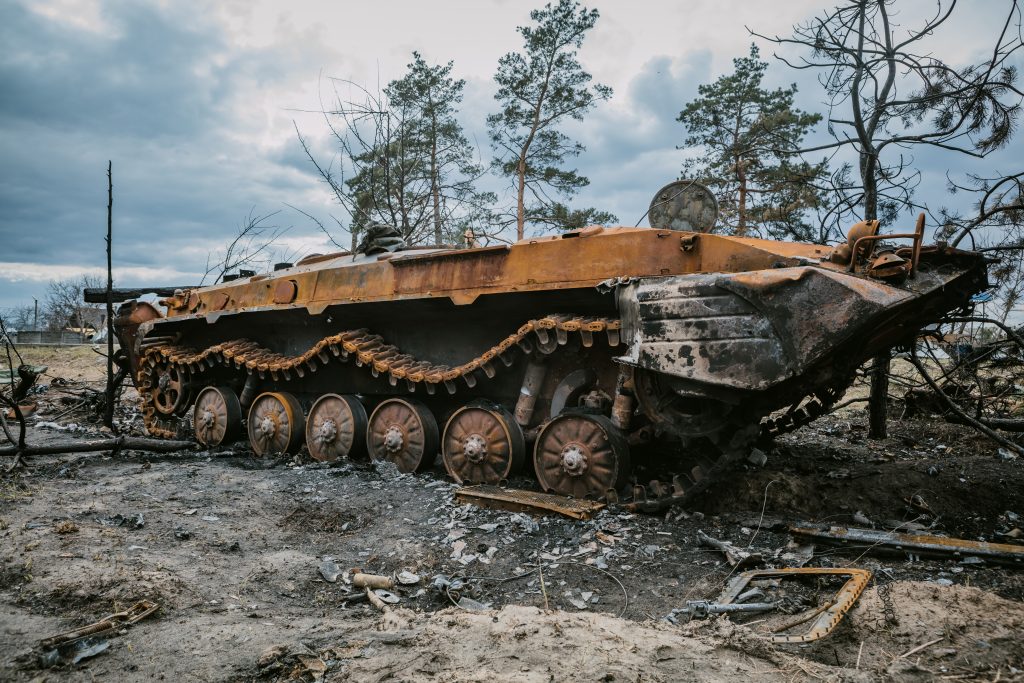
KYIV REGION, UKRAINE 05.04.2022 Russian BMP-2 burned by Ukrainian army
Burned out Russian BMP-2, 5 April 2022: Ukraine needs modern weapons to defeat the Russian invasion

Wars are not light topics that can be dispensed of with simple formulas. I, for one, cannot imagine how the success of Russia would further the cause of democracy and socialism around the world. If you do, then say so, openly, so it can be debated in public. But don’t falsify tradition and history and hide behind pathetic slogans. To paraphrase Marx, we Marxists disdain to conceal our views and aims.

John Ganz, Ben Burgis’s Bad History: Jacobin’s anti-Jacobins

There is a type of left argument around the war in Ukraine which has arisen in the West. It is one that condemns Putin’s invasion, but refuses to offer practical support to the people of Ukraine in resisting that invasion. It is the position one can read in Jacobin, or in statements by Chomsky, Corbyn, and the Stop the War Coalition in the UK. In Ireland we have the same type of response to the Russian invasion of Ukraine from People Before Profit and the Socialist Party of Ireland.

I will use the label Evasionist Left for this approach. It’s not clear how representative this trend is internationally, as many on the left do pro-actively support the resistance in Ukraine, e.g. parties such Razem in Poland; those associated with the Fourth International like Left Bloc and the Danish Red Green Alliance; and the main left party in Japan, the Japanese Communist Party.

Of course, there are pro-Russian figures around too, who claim to be on the left: although why anyone would want to be associated with Putin makes no sense. Russia is not in any way a socialist society. In fact, as Russian socialist Ilya Budraitskis puts it, Putin can be understood to be developing a new form of fascism. Explicitly pro-Putin figures are relatively rare on the left, and while they are busy sharing Russian propaganda, are not hugely influential. The left arguments I want to address here are those of the groups and their supporters who express opposition to Putin, but who refuse to take any steps towards bringing about a military defeat for the Russian invasion and in particular, are strongly opposed to the people of Ukraine obtaining arms from the West.

The groups supporting the Evasionist Left position seem to be basing their approach on two ideas: 1) Support for the resistance in Ukraine is support for NATO and 2) The war in Ukraine is an ‘inter-imperialist war’. My goal is to argue that these ideas are wrong and that if you take them seriously, you will find yourself on Putin’s side in the war. Often, when I try to discuss these points with their supporters, I hear only silence when I ask them to really think through the consequences of their formulations. But the war itself allows for no evasion.

Typical of the Evasionist Left position are features that speak out against the war in Ukraine and all wars, such as the Irish People Before Profit statement: No To War. Oppose Putin’s Invasion. Stop NATO Expansion. As with many articles by Jacobin and Stop the War (UK), the line taken by this statement is that Putin’s invasion should be condemned but the US are to be condemned equally.

The article concludes: “The real hope lies in an anti-war movement that crosses the border of East and West and opposes both Putin and NATO. We salute the actions of the Irish Anti-War Movement in calling people out to protest. We urge the international movement that came together to oppose the Gulf War in the past to rise again against the twin aggressors of Putin and NATO.”

World peace arising from a mass movement from below East and West would be lovely, but what is evaded here is the question of whether the left should support Ukrainian military resistance to the invasion. “Opposing the war” is a comfortable position to adopt if you are on the other side of Europe to the columns of Russian soldiers. But what does this conclusion mean for the people of Ukraine? Perhaps it means they should not fight back? Or perhaps there is room for supporting armed resistance to the Russian invasion, if it is decoupled from NATO? The point here is that in many cases, no one knows what it means. This is not a position that informs the people of Ukraine or those who want to express solidarity with them of what to do.

While we strive for international uprisings against war, should we want the people of Ukraine to defeat the Russian invaders in the meantime? Should we support or sabotage NATO armaments moving to Ukraine? Should we send money and perform solidarity actions that will allow Ukrainian anarchists and socialists to further their military resistance to the invasion? Or should we discourage them from fighting back, because they are unwitting tools of NATO?

These practical questions are a good way to judge the two key formulations that the Evasionist Left are using. And yet Marx’s claim that socialists don’t hide their views doesn’t seem to apply on the topic of Ukraine, where it’s difficult indeed to ascertain how these questions would be answered. Just to be clear, my own answers and those of Independent Left (and many other socialists and anarchists in Ireland) are yes, a victory for Ukraine against Russia would be the best outcome for the left and the world generally and yes, we should support the people of Ukraine getting arms from wherever they can, including from NATO. As Taras Bilous, editor of the left-wing Ukrainian magazine Commons, puts it, “the Western left, which criticizes military aid to Ukraine are outrageous. Do they want us to fight with bows and arrows when we have shot all our bullets? Do they want the Russians to kill as many Ukrainians as possible? That there were more Bucha’s?”

Based on the limited number of publications and occasional social media post, including exchanges with me, many Evasionist Left supporters do not in fact welcome the Ukrainian resistance, do not support people like Taras Bilous in their efforts to defend their cities. And to justify this they have advanced the two arguments above. These slogans are crucial to the orientation of the Evasionist position, and I believe they are quite wrong.

1. Support for the resistance in Ukraine is support for NATO.

A rather bad-faith version of this argument was visible after a UCU-supported demonstration on 9 April 2022 in the UK, in which a call for victory to the Ukrainian people was described as being “for NATO intervention in Ukraine”.

Such comments echoed the misleading headline by the UK’s Socialist Worker reporting on the demonstration, where they interpreted the call for arming the Ukrainian people to be a call for NATO escalation. To say that the people of Ukraine need arms is not at all the same as saying NATO should send troops to fight in the war.

A Russian convoy is approaching your town. The people around you join the Ukraine territorial defence to fight, several of them form their own socialist and anarchist units which you have the option of joining. But those internationally making the same arguments as above say, “No. Don’t escalate. It will lead to more war horror. And potentially nuclear war. Instead, let’s appeal to the Russian anti-war movement to save us.”

The position of these ‘left’ activists brings peace, but it’s the peace of a Putin victory, which not only means your town witnesses hellish scenes of rape and murder, that you could perhaps have prevented, but it also undermines peace for the future. Because understandably, when scenes of slaughtered civilians reach neighbouring countries there is a massive clamour for NATO assistance. Moreover, Putin will have concluded that after Syria and Ukraine, he can push on again, because fear of the horror of war, especially nuclear war, means the western left would prefer his victory to the victory of the resistance. And the Russian anti-war movement, that might have flourished as the Russian army was stalled and thrown back, is crushed by the wave of nationalism around the victorious Putin.

Fortunately, we are not yet in this scenario, above all because of the determination of the people of Ukraine not to surrender to the Russian invaders. Within the resistance to the invasion, the left are able to play an independent role. Here’s how Vitaliy Dudin, head of the Ukrainian democratic socialist organisation, Sotsyalnyi Rukh (Social Movement), described the situation from Cherkasy, Ukraine, on 6 April 6 2022:

“Some Social Movement activists, as well as many trade union members, have joined the TD as volunteers. It is worth mentioning that dozens of anarchists and socialists have formed their own unit within the TD, called the Resistance Committee.

“Secondly, a lot of leftists are helping as volunteers to supply the army or satisfy people’s humanitarian needs. One of the most effective initiatives in this regard is Operation Solidarity, which has managed to provide supplies to the militant left. We are also working to meet the needs of trade union members serving in the army.

“We have also worked with the nurses’ NGO Be Like Nina and helped them obtain medicines for hospitals that are taking care of wounded soldiers.

“Third, we see that a lot of people are protesting the invaders in occupied cities. We aren’t involved in such activity, but we support it. Of course, it is very dangerous because peaceful protests can be shot down by armed Russian soldiers. Such resistance proves that people are against the ‘liberation’ that seeks to turn their cities into grey-zones.

“Fourth, we as Social Movement continue to act as a political organisation. We seek to counter Russian propaganda and call on our people to fight for a free and fair Ukraine.”

By contrast, if the politics of the war in the Ukraine are resolved by the Evasionist Left approach, then we will see a Putin victory. You can’t negotiate any settlement with Putin, even a bad one for Ukraine that nevertheless de-escalates the threat of nuclear war, unless you stop his army and force him to realise he can’t implement his plan to eradicate Ukraine as an independent nation.

There is a better-faith version of the argument against NATO weapons going to Ukraine, which is to say, “I do want Ukrainians to defend themselves, but I don’t trust the US. Whenever they arm a side in a war, they have their own imperialist goals.” This observation about the US is, of course, correct, but do you really think people in Ukraine, especially the left, are under any illusions about the US interests at play? There’s a patronising assumption here that those demanding arms to prevent Russian soldiers from murdering their friends and families are dupes of US intelligence.

Similarly, I’ve heard socialists in Ireland say, “we have to weigh up different dynamics here, on the one hand, Russian imperialism, for sure; but on the other, US interests.”

If Ukraine is to defeat Russia the people there obviously need modern weapons. Anarchists have described how they are currently having to use machine guns from 1944.

A 1944 Maxim gun. Ukrainian anarchists and socialists fighting independently within Ukraine’s territorial defence are desperate for better weapons.

If you are someone who wants Russia to be defeated, but doesn’t want NATO armaments to arrive in Ukraine, you really need to think this through. Are you asking communities to defeat the Russian soldiers using only home-made Molotov cocktails and Second World War weapons? This seems to be the position of the Socialist Party of Ireland, who at least do support workers in Ukraine arming themselves. At the same time, however, their supporters are told: “In the Western capitalist countries opposition to NATO militarism and expansionism must always be a central feature of our propaganda, even where this is not currently the mood among the mass of workers. We stand against all military intervention on the part of U.S. and Western imperialism — this includes opposition to the provision of weaponry by NATO powers to the Ukrainian military. This in and of itself increases the threat of the conflict escalating more widely.”

Similarly, in a feature on 25 April 2022, Ukraine: The United States are now fighting a proxy war with Russia Kieran Allen (Socialist Workers Network, Ireland) argues that the Ukrainian people, “have every right to resist”, yet is opposed to them using NATO weapons.

It’s not at all unreasonable to keep an eye on what the US is up to. No doubt there are US hawks who are thinking now would be a perfect time to take Russia on and smash Putin’s army while he’s weak. We should oppose US intervention of troops, ships, and aircraft, mainly because of the risk of nuclear war but also because of their own imperialist record. But that’s not happening right now: yes, NATO countries are supplying weapons to Ukraine but at the time of writing they have not entered the war with Russia with their own armed forces. Sitting on the fence now in fear of what the US might do in future, again means not supporting those currently fighting the Russian soldiers. The same question faces the good faith left person as the bad: when the Russian convoy is approaching your town, do you fight back militarily? You can’t say, “well, there’s a balance of imperial interests to consider and I’m going to be neutral until I get non-NATO weapons.” That neutrality will be finished by a Russian bullet to the head to you and anyone else you have persuaded of your position.

Moreover, those trying to dress up this recognition of the interplay of rival imperialisms as if it’s something new are missing the obvious point that throughout the twentieth and twenty-first centuries, US and Russian imperialism always backed any movement that was fighting their rival. So when Solidarnosc rose up against the Communist Polish government in 1980-1, the CIA rushed to fund and influence the union. That didn’t stop it being a genuine mass movement which socialists of the type now adopting the Evasionist position recognised and supported.

Finally, on the legitimacy of the people of Ukraine taking advantage of inter-imperialist rivalry to obtain arms from NATO, there are very clear left precedents. For those of the Evasionist Left viewpoint who are champions of Lenin, it is worth noting Lenin’s response when France and Britain offered to give military aid to Russia to fight Germany, when he wrote: “Please add my vote in favour of taking potatoes and weapons from the Anglo-French imperialist robbers.”

He later explained:

The North Americans in their war of liberation against England at the end of the eighteenth century got help from Spain and France, who were her competitors and just as much colonial robbers as England. It is said that there were ‘Left Bolsheviks’ to be found who contemplated writing a ‘learned work’ on the ‘dirty deal’ of these Americans.

2. The war in Ukraine is an ‘inter-imperialist war’.

A second justification for not supporting the people of Ukraine fighting back against Russia is based on the idea of ‘revolutionary defeatism’. The tone here for Rebel in Ireland was set by an article by Kieran Allen, entitled, James Connolly and War.

The parallels with World War One in 1914 are striking. Then and now it was the weaker imperial power than began a new era of global conflict. In 1914, it was Austria who made the first moves. Today it is Russia, a country with a  commodity driven economy and a GDP that is one tenth that of the USA.

Just as James Connolly concentrated on challenging the propaganda of the Irish National Party and Britain, argues Allen, so socialists today should be revolutionary defeatists and recognise the main enemy is at home. Which means Irish socialists should concentrate on furthering the class war in Ireland.

Allen doesn’t spell out what revolutionary defeatism actually means in the context of the war in Ukraine: and the reason is surely that to publicly embrace the implications of his approach would be to declare that a Putin victory is the better outcome for those in the West. Again, let’s go back to the situation where a Russian column is approaching your town. A revolutionary defeatist position means that you should never give support to ‘our side’ in the war, even if that results in the other side obtaining military victories. That was the position of Karl Leibknecht in Germany and the Bolsheviks in Russia. They really did mean that they preferred to see their own countries defeated than support their own national elites in their war aims. And they were right. But transpose this policy to the soil of Ukraine and revolutionary defeatism can only mean a refusal to join the resistance and a refusal to support Zelensky, even if that means Russian victories.

The Evasionist Left position of condemning the Russian invasion, declaring support for the right of the people of Ukraine to fight back, yet taking a ‘defeatist’ approach toward Ukraine means giving no practical support for the resistance to the invasion. It is quite consistent with not wanting arms to get to Ukraine. Our main enemy (they say) is at home. It is our job to stop NATO. That might feel very principled from afar but it abandons the left in Ukraine and the population more generally to military defeat, with all that means for the massacres of civilians and the strengthening of Putin.

This is the contradictory but inevitable outcome of a flawed analysis. And the analysis is flawed for the simple reason that the Russian invasion of Ukraine is nothing like the outbreak of the First World War. Within a week of Austria’s declaration of war against Serbia in 1914, all the European imperial powers were in a full-blooded war against one another. From the Russian invasion until now, we have not witnessed the equivalent to French and British armies crashing up against the German army.

The more obvious parallel to make with James Connolly’s world is that of British rule in Ireland. For centuries Britain tried to rule Ireland directly, eradicating the Irish language and crushing Irish culture. This is a clear parallel with Russia’s history in regard to Ukraine. Just as Connolly was right to take German weapons to support an armed rising against the British empire, so the Ukrainian people are right to take weapons from wherever they can to rise against the Russian empire.

In a related feature based on the same defeatist idea, John Molyneux argues the left should not support sanctions against Russia. Sanctions, he says, are a feature of NATO’s war against Russian. They are, “an integral part of a political offensive waged by one of the imperialist blocs in this conflict – the bloc which, as internationalist socialists and opponents of all imperialism East and West, we have a particular duty to oppose because they are the bloc to which our ruling class is affiliated.”

Again, the analysis is that this war is not one of Russian imperialism attempting to crush a smaller neighbouring nation but an inter-imperialist war in which the main enemy is at home. In which case, one should not call for sanctions against Russia, because Russia is not the main enemy for the Western left: NATO is. Yet let’s go back to our approaching Russian convoy once more. Are there sanctions which will help stop that convoy reaching its target town in Ukraine? Yes, plenty of them. A good example is the closure of the tank factory at Uralvogonzavod:

Western sanctions can halt the Russian army

And another, potentially even more decisive closure arose on the basis of a fire at the Dmitrievsky Chemical Plant, Russia’s only internal source for vital chemicals.

The fire at the Dmitrievsky Chemical Plant threatens to leave Russia without additives needed for advanced rocket and jet fuels; treatments and solvents for servicing metal parts; core input chemicals for explosive and solvents, traces and washes needed to manufacture electronics and circuits. So long as sanctions prevent these from being delivered at scale, Russian military efforts will be seriously hampered.

Not all sanctions are appropriate, some are less concerned with assisting Ukraine than developing Western business advantages. But when the people of Ukraine call for Western sanctions focused on stopping the Russian war machine, they are right to do so, and the left should listen to them and support them. Ironically, the Evasionist Left position in fact supports sanctions against Ukraine, applauding actions such as those of workers at Pisa Airport, Italy, who refused to load weapons and explosives destined for Ukrainian forces. By hindering the military resistance in Ukraine and refusing all sanctions against Russia, the practical effect of the Evasionist Left is to align their political energies with a victory for Putin.

Both Anti-Imperialist and Inter-Imperialist?

In an article of 19 September 2022, Paul Murphy, an Irish TD and member of RISE, offered an analysis that attempted to bridge the position between those supporting Ukraine’s right to resist the invasion and those in the west who see NATO, not Putin, as the main enemy here. His conclusion was:

It means socialists must attempt to disentangle, to the degree possible, the legitimate resistance to Russian imperialist invasion, and the inter-imperialist conflict which we oppose.

It means supporting the right of Ukrainian people to resist. We don’t blame people in Ukraine for getting weaponry from wherever they can source it, but we do encourage them to operate on the basis of complete independence from NATO. If such genuinely independent forces existed, socialists could even fundraise to send them weapons. However, those of us living in the western camp, the dominant imperialist bloc in the world, cannot support NATO forces pouring weapons into Ukraine in the pursuit of an inter-imperialist conflict, risking an escalatory spiral that could lead to armageddon. We should support the Russian anti-war movement and demand the immediate withdrawal of Russian forces from Ukraine.

If a pure, revolutionary workers movement existed in Ukraine that was genuinely independent of NATO then RISE would not only support them, but would even fundraise for their weapons. It’s good to have such revolutionary credentials. Unfortunately for the actually existing socialists in Ukraine, such as Taras Bilous and those linked below, they aren’t sufficiently anti-NATO or in some other unstated way fail to pass the RISE test. Still, at least they aren’t to blame for their decision to fire guns and other weaponry supplied by the West and that will no doubt be comfort to their troubled consciences.

This ‘test-the-left’ position is evasionist in regard to the question of whether a victory for Ukraine under the neo-liberal Zelensky is preferable to a victory for Russia (or a peace with Russia having made territorial gains). The answer that Murphy skirts around seems to be ‘no’, because of the inter-imperialist aspect of the conflict. To achieve a Ukrainian victory risks armageddon.

The mistake here is to see the activity of the US and its goals in regard to Ukraine as being on a par to the those of Putin. There is a vast difference between the two. This is not a symmetrical inter-imperialist war where victory for either side would make no difference to the lives of Ukrainians and the fate of the world more generally. This is an imperialist invasion by Russia, where the defeat of Russia is by far the best outcome for everyone who dreams of a “just and humane world” as Boris Kagarlitsky puts it.

Victory for Russia or a settlement that gives it control of Ukrainian territory leads to ruthless military rule over the conquered people; it plays into the hands of the far right world wide; it increases the possibility of other land grabs by militarily strong powers; and, in particular, it keeps Putin in power. Defeat for Russia retains the space in Ukraine for trade unionists, social rights activists, and civil society generally to organise. It also has the potential to unleash revolution in Russia. Kagarlitsky believes, plausibly, that the defeat of Russia will bring about the end of Putin and deep changes in Russia.

Yes, defeat for Russia means temporary gains for the US but a free Ukraine would not be a satellite of the US, its people would not be under military rule and it might not even become a member of NATO. Moreover, as Kagarlitsky warns, there are those in the West who are deeply uneasy about the prospect of revolution in Russia. They would prefer Putinism without this particular Putin to a popular revolt.

The RISE position of seeing the war as both inter-imperialist and anti-imperialist separates that organisation from the Ukrainian left and any anti-imperialist revolts that develop as a result of Ukrainian military victory.

Can we draw any lessons for the international left?

The contradiction in the Evasionist Left position – ‘we condemn Russia but we don’t support arming the resistance in Ukraine’ – is an unstable one. Some members put more weight on the condemnation of Russia than others. Some even state online that they would welcome a victory for Ukraine. On the whole, though, the leadership of these parties place their emphasis on why we should not support Ukraine. Hopefully, the members who want to see Ukraine survive and throw out the Russian invaders will push back their leadership on the two formulations above (that support for Ukraine is support for NATO, and that it is an inter-imperialist war), that directly oppose support for the resistance.

There’s a lesson here for the left in how the wrong positions have been arrived at, which is that we are witnessing the consequence of a top-down approach to socialist politics rather than a bottom up. The reason I have repeatedly asked the reader to imagine the approach of a Russian column of tanks and to think through your response is that this is exactly how billions of people have thought about these issues. The majority of the world’s working class empathise with the people of Ukraine, who before Putin’s invasion were bringing their kids to school, going to work, planning their weekly shop, collecting the kids, going to the playground, chatting with friends. They were exactly like us and then the hell of war descended on them from Russia.

The left can influence this public feeling of solidarity for Ukraine by making points about Western hypocrisy on refusing to cancel Ukraine’s debt; on refugees, on Palestine, and yes, on the imperialist role of NATO. But the best way to do that is to amplify the voices of Ukrainian socialists and anarchists who are putting their lives in the front lines against Putin’s army. This ‘bottom up’ approach listens to the people of Ukraine and if you are on the left, to the voices of anarchists and socialists, such as: diary of an anarchist in Ukraine; also https://commons.com.ua/en/left-west-must-rethink/; or https://freedomnews.org.uk/…/interview-operation…/; or http://www.europe-solidaire.org/spip.php?article62209 or http://www.europe-solidaire.org/spip.php?article61988. 

The Evasionist Left model is a top down one, where the leadership derive their positions based on past experience and their reading of canonical Marxists texts, then the party apparatus delivers the position to the members. This means blunders are inevitable.

The Evasionist Left are in the process of making a serious mistake now and one where the equivocation of condemning Putin while not supporting the military resistance of the Ukrainian people cannot be sustained. There can be no hiding from the question of what to do when the Russian soldiers are coming. And if you are a member of one of these parties or organisations who thinks the Ukrainian people are right to fight back, then you have your own battle to avoid your party coming out of this war with a lasting reputation for having adopted a position whose practical consequence was to disarm those facing the Russian invasion.

Filed Under: All Posts, Ukraine

The Western Left and Russian Imperialism

16/03/2022 by Conor Kostick 4 Comments

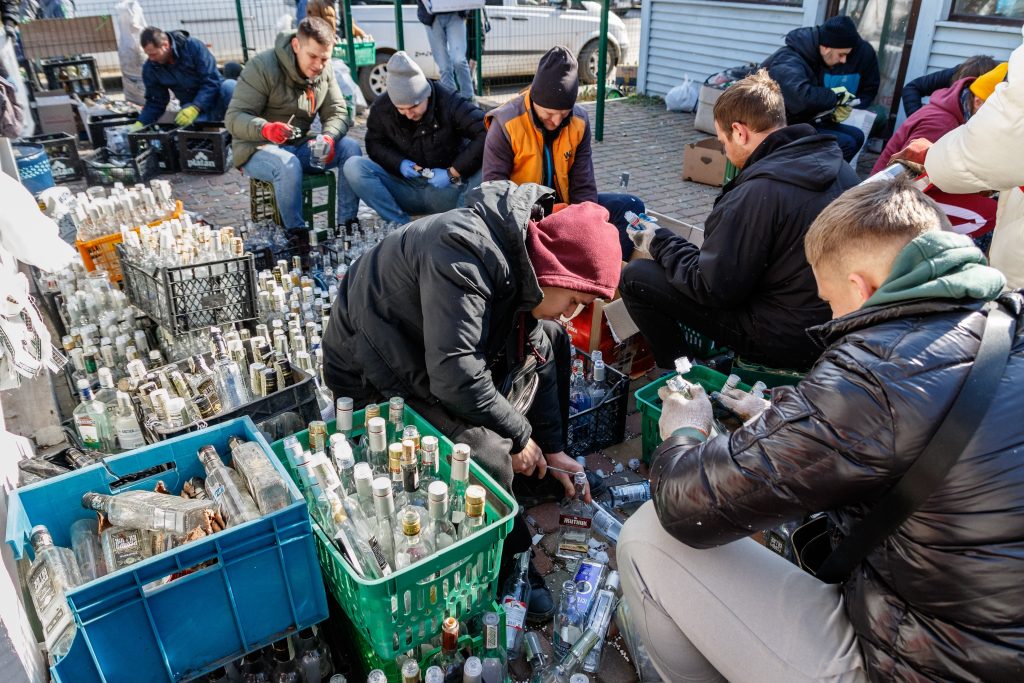
The left and Russian Imperialism: the people of Ukraine preparing Molotov cocktails.
The Left and Russian Imperialism: residents of Uzhhorod, Ukraine, 28 February 2022, making Molotov cocktails. The international left should be doing all it can to assist the people of Ukraine defend themselves.

Day and night, gunfire could be heard. There was no public transport. Knocked-out Russian tanks stood raggedly about the streets, while others rumbled continually up and down. Shattered buildings with gaping holes cast grotesque shadows across hundreds of bodies lying in the streets amid the broken glass, empty cartridges and other debris. Occasionally, a van with a Red Cross flag or a lorry-load of ‘freedom fighters’ would go crunching by. Some food shops were open. The cinemas, theatres, and restaurants were closed. In the ferment of activity, there was no time or thought for entertainment.

Andy Anderson, Hungary ’56

In 1956, Russian tanks and troops carried out a massive assault on Hungary. After a first wave had stalled, a second wave involving around 6,000 tanks succeeded in occupying the main cities of the country, abducting the Premier, Imre Nagy, and crushing the popular ‘soviets’ that had sprung up to co-ordinate resistance to the invasion.

This was a watershed moment for the left internationally. Until 1956, mass communist parties retained thousands of supporters in most countries. It was still possible to believe—if you didn’t examine the evidence too closely—that Russia was not an imperialist power but rather a state that for all its faults had held back fascism and Western aggression.

Today it should not really be necessary to make the case among the left that Russia is an imperial power. The evidence has been available for decades. Yet the left, at least the Western left I am familiar with, has so declined in the clarity of its thinking and in moral principles that the generation of revolutionaries who rose in ’68 and won young radicals away from Communism towards international socialism – figures such as Tariq Ali – are not even calling for Putin’s army to be thrown out of Ukraine.

The Left and Imperialism

Around the time of the Great War, the left understood the nature of imperialism. For Luxemburg, imperialism was a by-product of a relentless thirst by capital for surplus value. For Lenin, imperialism was the highest stage of capitalism. For Bukharin, it was the result of competition being eliminated between companies within a state only to reappear as competition between states. And for James Connolly, imperialism was a desperate drive to obtain new markets by aging capitalism.

By any of these definitions (and none are up-to-date, we need new ones that reflect modern conditions) Russia is a major imperialist power. After the Second World War, Russia subordinated the countries behind the Iron Curtain to its own drive to compete in four ways: direct theft of factories, which were dismantled and moved to Russian territory; the purchase of raw materials and goods at strong-armed prices; ‘joint’ companies which sent the lion’s share of profits to Russia but expected the satellite country to underwrite any losses; and ‘collectivisation’—the formation of Russian-led state farms.

No wonder the people in these countries – who were deprived of the right to strike, to form trade unions, or express critical ideas – wanted to escape Russian control. No wonder that they repeatedly rose up in their millions, such as in Hungary 1956, Czechoslovakia in 1968, and Poland in 1980. When the opportunity came in 1989 to get rid of both Russian control and their own local Communist rulers, of course the people did so. The mass movements of that year were entirely understandable and justified. The fact that the ‘free’ market of Western-style capitalism failed to bring about prosperity proves nothing positive about Russian control over Eastern Europe, but only that capitalism is a failed system worldwide, whatever particular garb it wears (including the twist that people wielding red flags and carrying pictures of Marx should become the ruling elite).

Justified Resistance to Russian Imperialism

Ukraine 2022 should be seen in this context of justified resistance to Russian imperialism.

Worldwide, there should be left solidarity movements for Ukraine as there were for Hungary and Czechoslovakia. Internationally the socialist left should be blossoming. By supporting the resistance of the Ukrainian people and demanding the withdrawal of Russian troops as well as pointing out that the capitalist system of ruthless competition will lead to more wars unless humanity gets out of the social vice we are trapped in, the left could revive across the planet. Millions of people are coming to realise the real danger the system we live in poses and are looking for alternatives.

Yet, in the west at least, the left is in the process of making a mess of what should be a simple task. Where are the big anti-imperialist marches like we saw in the build up to the US invasion of Iraq in 2003? Why are the left’s media filled with more posts about the US than Russia? Or maps of NATO expansion? Where is the amplification of the voices of our comrades on the front lines in Ukraine? Our anarchist and socialist comrades are fighting Russian imperialism and for a transformation of Ukraine, and they are reaching out to us for solidarity.

Why is the Western left ambiguous about wanting a defeat for Russia?

I believe that the reason for the current fumble by the Western left is that they have a mindset that prevents them from making sense of the obvious. There shouldn’t be any doubt about the fact we are witnessing a popular uprising against an empire. Instead, the left see fascists and dupes of NATO everywhere in Ukraine, even when the left in Ukraine is shouting to us that this isn’t the case.

Naturally, the Stalinist and Maoist left are for a Russian victory. I’m not addressing them. They are walking cadavers who ache to be dominated, mouthing statements fed to them by their masters. They have nothing to offer in regard to an international left revival. I’m writing this feature for a different audience: those currently wondering why Western anti-war organisations led by the left are not doing more to assist those fighting in Ukraine.

Part of the answer, I think, is that this left is moribund and has been for some years.

As Stalinism began to break up after ’56, the New Left adopted the attitude that both US imperialism and Russian imperialism were equally dangerous. But the counter culture that scorned capitalist values and the inspiring prospect of the possibility of international socialism both faded towards the middle of the 1970s. The genuinely revolutionary left was stranded high on a beach while the tide of working class revolt withdrew. To survive for all these decades, most of the left found their own rock pool to hide in and they became sects. Without the reality check provided by being rooted in working class communities, and without a connection to a mass movement of radical workers, they lost something essential: the spirit of questioning everything and debating freely (there was a darker side to this too, in the appearance of abusive hierarchies forming within several far left groups).

The left and Russian imperialism
Uzhhorod, Ukraine, 2 March 2022, the people are issued arms and given basic training. The war against the Russian invasion becomes a people’s war.
The left and Russian Imperialism: anarchists joining the resistance
The left are able to join the popular resistance with their own organisations. They are not dupes of NATO but have resolved to play their part in the national struggle against Russian imperialism. They deserve our support.

When you read the writings of Ukrainian socialists and anarchists  today, it is striking how consequential they are. They write about the results of decisions and their real, practical outcomes (which are not always for the best). Theory for the Western left, on the other hand, has degenerated into performance at conferences and second rate expositions of the canonical texts of Marxism. No one is ever called to account for their views, and where leading members of the Western left have articulated positions that don’t stand the test of time, such embarrassments are simply removed from party history.

Yet a spirit of free thinking and lively debate is needed on the left, now more than ever. No social theory is so perfect that it is accurate and actionable for decades. Specifically, in regard to the issue of Russian imperialism, there was a contradiction in the theoretical tools of the Trotskyist left that means allowing elder gurus to formulate current policy unchallenged leads to the current problem.

After the rise of Hitler and the defeat of the Spanish revolution of 1936–9 (both decisively influenced by the positions taken by the German and Spanish Communist Party) Trotsky was convinced that Stalinism was absolutely counter-revolutionary. Yet at the same time he believed there were positive features of Russian society, such as the nationalised economy, that the new rulers of Russia had yet to overturn. Trotsky was murdered by a Stalinist in 1940, so he didn’t live to see a post-war state of affairs that would have forced him to face the following contradiction in his thoughts about Russia: given that in Hungary, Poland, Czechoslovakia, etc., industry was nationalised as a result of the arrival of the Red Army, then either such nationalisations are not necessarily a step towards socialism, or Stalinism is not always counter-revolutionary.

Some of the Trotskyist left opted for believing that Stalinism can be positive, sometimes, despite itself (just watch the knots they will get into if Putin nationalises the airlines and banks). Others went the other way, such as the SWP in the UK, which saw state capitalism as in no way superior to free market capitalism. Yet even in the case of the SWP a softness towards Stalinism was revealed – particularly by those who later broke away to found Counterfire – when they thought it clever to join with George Galloway and form Respect Party. An abandonment by the radical left of the spirit of independence from all imperial agendas, in favour of a geo-political approach of picking the lesser evil is at the heart of their weakness at this defining moment. We are at the beginning of a new era of imperialist wars and we have to do better than ‘lesser evil’ politics, because they betray those fighting against empire and for social change.

Today, the Stop the War Coalition in the UK embodies the weakness of a Western left that had the potential to rally people to the side of the Ukraine socialists and anarchists who are fighting against Russia. Stop the War is dominated by former Stalinists, Trotskyists and SWP members who have found themselves in agreement that the main enemy to organise against is the US and NATO even in a situation where it is Russia invading another country . The Trotskyists can only maintain their alliance with the Stalinists by muting any criticism of Russia, or support for the Ukrainian resistance.

For some years before this war in Ukraine, the signs were clear that left-wingers of this type were moving away from a policy of listening to people engaged in real conflict with imperialism and towards an armchair geo-political analysis focused on finding out what the US agenda was in any situation and choosing the other side. When it came to the destruction of Syria, Stop the War did nothing to oppose Russia’s crushing of a popular uprising and, indeed, drove away those attending rallies on the topic of Syria who were looking for support against Russian backing of Assad. Over the course of six years in Syria, Russia killed 23,000 Syrian civilians, tested 320 weapons systems and gave combat experience to 85% of its officers.

I see this generation – the Tariq Alis, the Jeremy Corbyns – as they themselves must once have seen the leaders of Western Communist parties. As a result of their ‘campism’ (i.e. picking a camp that isn’t the US, no matter how anti-working class), they are incapable of giving the anti-war movement the energy and focus on Ukrainian left activists it needs. Corbyn often has a platform with Jacobin, the US left magazine, and that magazine too fails to amplify the voice of the Ukrainian left. Almost certainly, this is because Jacobin does not discuss the question of Russian imperialism but argues instead that this war is the product of decades of NATO expansionism. In its coverage of Ukraine so far, the magazine has limited itself to pointing to the hypocrisy of Western elites. The Democratic Socialists of America, the largest socialist organisation in the USA, has a similar view.

Similarly incapable of being able to rise to the occasion are those who cannot commit themselves to offering solidarity with the Ukrainian left in their time of need, because they see resistance to Russia as strengthening NATO.

For groups like People Before Profit in Ireland, this is not a war of liberation by a small nation against an imperial power, because if so, the Irish tradition of James Connolly’s working-class based opposition to the British Empire would be entirely relevant (as it is, including the validity of obtaining arms from Germany). No, for them, this is an inter-imperialist conflict:

Putin’s actions are being used by military hawks in the US to whip up an atmosphere for war. The US military was humiliated by their defeat in Afghanistan and are determined to re-assert their ‘leadership’ over the Western world by posing as its defenders. This is why they have done everything possible to whip up tensions. They have sent an extra 5,000 soldiers to Poland and have been systematically supplying the Ukrainian army with missiles.

Again, for them, this war is all about the agenda of the US rather than a national liberation struggle against imperialism..

When prominent PBP members frame the war in a way that presents it merely a matter of Putin versus NATO, they write out of the picture the Ukrainian left and, indeed, the entire Ukrainian people, who have as much right to an independent country free from Russia as Ireland does in respect to Britain.

James O'Toole's tweet shows how some of the western left don't advocate the defeat of Russian imperialism
When it comes to the Western left and Russian imperialism, there are many who see the war in Ukraine not as a battle for the liberation of the country from empire but as an inter-imperialist war, such as James O’Toole of People Before Profit, Ireland.

Clearly, a stronger opposition to Russian imperialism needs to be voiced by the Western left at this time. There are signs that this is taking place. In the UK the executive of the trade union Unite have taken a better position on the conflict, perhaps because its members have taken solidarity action in not unloading Russian oil. For the statement of Independent Left on the conflict see the link. And for English language socialists wanting to connect with the left in Ukraine and give them support, we recommend the work of the Ukraine Solidarity Campaign.

The Western left and Russian imperialism FAQ

Is Ukraine fascist?

No, that’s Putin’s pretext for the invasion. There are a small number of Nazis in Ukraine (they won 2% of the vote in the 2019 election) and they have less of a presence in the military than they did in the events of 2014. Russia, too, has fascist organisations and countries like the USA have larger numbers of fascists. When asked was Putin’s De-Nazification of the Ukraine welcome, Kyiv’s Chief Rabbi said, “I don’t know what he’s talking about. In terms of antisemitism, we’re very secure here.”

Should the Western left want to see a defeat for Russia in the war in Ukraine?

Yes. This should be obvious and as instinctive as supporting oppressed people anywhere in the world. This a crucial test of whether the left is at all relevant more generally. And unfortunately, much of the Western left is in the processing of failing it and failing the Ukraine resistance.

Will NATO benefit if Russia is defeated?

Possibly. But then, if Russia wins, that will create a massive upsurge of a desire for a greater NATO presence and more US armaments among the countries adjacent to Russia. This question has become the primary one for the much of the Western left but it should be secondary to the more fundamental question: are you on the side of the people facing the Russian invasion?

But what about Palestine?

Many of those raising the issue of Palestine in the context of the war in Ukraine are doing so in bad faith. They don’t want to admit to preferring a Russian victory to a Ukrainian one; rather than acknowledge this politically unpalatable position, they draw attention to the double standards of Western governments and some media outlets, which do not champion Palestine with a fraction of the energy they are devoting to Ukraine. Yes, of course the left should recognise the cause of the Palestinians as a just one. But where do you stand on the question of Ukraine?

What does Noam Chomsky say about the war in Ukraine?

You can read this for yourself in his interview here. He’s another of those on the left who see the war as a geopolitical conflict between NATO and Russia, leaving out Ukrainian people themselves. Dismissing the possibility and even the desirability of a victory for Ukraine, Chomsky argues that concessions to Putin’s goals are necessary.

What Can Socialists in the West do to help the left in Ukraine?

Above all, the Western left needs to get off the fence and start listening to their comrades who are battling Russian tanks and troops – without supporting NATO – and champion their cause against the Russian invasion. Independent Left are channeling our support through the Ukraine Solidarity Campaign, who have strong contacts among trade unionists, socialists and anarchists in Ukraine.

They have a crowdfunder campaign here.

Filed Under: Independent Left Policies, Ukraine

Independent Left Statement on Ukraine

03/03/2022 by admin 3 Comments

Independent Left Statement on Ukraine
Popular resistance in Ukraine can defeat Putin’s imperialist assault

Independent Left condemns the Russian invasion of Ukraine; Putin’s war is an imperialist adventure. We support the demand for complete withdrawal of Russian forces from all of Ukraine. 

We support the right of the Ukrainian people to resist the Russian invasion by all means necessary – armed and civil resistance. We defend the right of the Ukrainian working class to arm themselves so as to resist conquest by the Russian army. If they are able to do so, despite extraordinary disparity of military equipment, the defeat of the Russian army will inspire resistance to imperialism of all forms, whether US-led, Chinese-led, or by any other major power tempted to use force to further their interests.

This is not a defensive war, but an offensive war, by one of the world’s imperialist powers; a power which has engaged in numerous military interventions to secure wealth and strategic influence, including the defeat of the Syrian people’s revolution and the recent suppression of the working class revolt in Kazakhstan.

We support the brave anti-war movement in Russia, a movement which will grow in proportion to the resistance of the Ukranian people to the invasion. The defeat of the Russian army in Ukraine will be a victory for the Russian working class because it will advance the prospect of the fall of the right-wing regime, authoritarian Putin regime, and of the oligarchic capitalism on which it is based.  We reject any attempt to blame the Russian people as a whole for this ruling class adventure, and while we support any measure that weakens the Russian ruling elite, we oppose any international sanctions solely designed to punish the Russian working class. We oppose the militarisation of Europe by NATO which is an instrument of American imperialism. It should be noted that Ukraine is not a member of NATO and that there was little prospect of it joining, and that NATO has made it clear it will not intervene directly. At this point NATO is not at war in Ukraine, so we reject abstract sloganeering by those whose focus on NATO leads them to be equivocal, or even opposed to the victory of the Ukrainian resistance.

Like all anti-imperial wars throughout history, there is a left and a right within the Ukrainian resistance. Without in any way putting conditions on our support for the goal of defeating the Russian invasion, we call on all socialists and trade unionists to organise active support for Ukrainian working class communities and organisations in their efforts to resist imperialism by donating or fundraising for their victory through the Ukraine Solidarity Campaign.

For our feature on the failure of the ‘evasionist’ left to support Ukraine’s struggle for self-determination, see here.

A link to the leaflet we gave out with United Left With Ukraine.

Independent Left Support the Fight Against Russian Imperialism

A Public Meeting with a speaker from Ukraine Solidarity Campaign was held on Wednesday 9 March 8pm.

The Ukraine Solidarity Campaign have a crowdfunder campaign.

Filed Under: Independent Left Policies, Ukraine

  • « Go to Previous Page
  • Page 1
  • Page 2

Copyright © 2026 · Aspire Pro on Genesis Framework · WordPress · Log in