• Skip to primary navigation
  • Skip to main content
independent left logo

Independent Left

Environmentalism, socialism, freedom and equality. #liveablecity

  • About
  • Featured Articles
    • How Farming Must Change to Save the Planet
    • The Housing Crisis: Causes and Solutions
    • Socialism in Ireland
  • Contact Us
  • Podcast
  • Animal Rights
  • Archive
    • Irish Socialist History
    • Dublin City Council Housing
    • Ukraine
    • Protests Ireland
    • Reviews
    • Irish Political Parties
    • All Posts
    • Independent Left Policies
  • Why join?

Black Lives Matter: a view from the streets for Irish socialists

04/06/2020 by Conor Kostick 1 Comment

An interview with Paige Graffunder, Seattle 3 June 2020

“It’s going to escalate until the police are gone”: a massive revolt against murderous police racism rocks the USA.

Paige Graffunder is an activist in Seattle, involved with Revolution Books and Black Lives Matter Seattle.

For the benefit of socialists in Ireland, where many of us see events through official news channels, which never drill down enough, I’m hoping you can give our readers some insight into what’s happening on the ground. Maybe you could start by telling us who is actually organising the protests?

There’s a bunch of groups. Unfortunately, a lot of activism in the United States kinda exists in a ‘diaspora’, because as soon as you get too many people you immediately get labelled a terrorist organisation because we have a fascist in office. A lot of it has been Black Lives Matter, because Black Lives Matter is actually big enough in Seattle that they actually have an office. In general, it’s not really an organisation, it’s an ideal.

The primary motivation of Black Lives Matter is equality and equity for the black community: stop getting killed by a militarised police force; achieve more equal statistics for punishment on crime (63% of all violent crime in this country is committed by white people, yet 70% of the prison community is black). That’s their main focus but through that they’ve built this community system where everybody takes care of each other.

Black Lives Matter logo. A yellow image on a black background. A stylized left hand is clenched in a fist, around which like a halo is written: Black Lives Matter in an old 'zine font.
Black Lives Matter

So essentially, they’ve built socialism. Right now, for example, I’ve just got back from dropping off field medi-kits and water bottles and a bunch of other stuff to their office in Central District. They just provide so much to the community by way of support. Anyone who can help, does help.

And is Black Lives Matter aligned to the Democrats?

No, not at all, the Democrats hate us too. We’re leftist, without any particular political affiliation.

Roughly how many organisers would Black Lives Matter have in Seattle?

Personally, I know about twenty-five organisers for these particular protests but there are so many. And again, who is an organiser depends on who is stepping up to the plate. There’s no hierarchical leadership; it’s not really an organisation. It’s a community effort.

Presumably people who’ve never done anything like this before are getting involved.

Absolutely. As soon as they saw the first night of protest here (30 May 2020) in Seattle, which went very badly. There was four hours of totally peaceful protest; there was seven feet between the protesters and a line of police. The protesters were sitting down. Then, with literally no warning, there was no command, they just shot tear gas into it for no reason. That first protest was probably around a thousand people, but after seeing what happened, last night (2 June 2020) there were eight thousand people on the street. Bear in mind we had called May Day off – historically, Seattle has a riot every first of May, laughs – we cancelled that because of the coronavirus. But this is bringing people onto the street despite the virus.

Is there much of a socialist presence in these protests?

Here there is. We have the People’s Party and Socialist Alternative, both have a big membership and strong turnout. Councillor Kshama Sawant, has been out every day, she stays every day, which is awesome.

I was wondering whether this movement has been so explosive, not just because of the continual murders of black people by the police, but also because the black community has suffered more heavily from the virus, such as by not having access to the same level of health care?

Here’s the thing. This is one of those straw that breaks the camel’s back moments. The murder of George Floyd was awful and here, literally the week before, we had cops wrongfully and mistakenly enter an apartment building and kill a woman while she slept. This happens all the time. Plus, on top of five hundred years of slavery, segregation and oppression and coronavirus, the American medical system kills more black people than cops do. Their problems go largely ignored; they just don’t receive the same level of care.

Looking at this movement from the other side: are the authorities (with Trump at their head) going to regain control of the situation?

No. I don’t think so, because every time they escalate, it just draws more people. Nobody paid attention to the curfew. The curfew in Seattle is 7pm, although I need to explain more about this. The curfew does not apply if the protest is designated ‘peaceful’ because that would be a violation of First Amendment rights.

A line of heavily armoured police with batons is formed up on a street with shops in the background.
The more the police escalate the violence the more protestors take to the streets

There’s a lot of coverage of violence here. To what extent is that the work of protesters?

It’s not, not initially. And actually, they are caught on video and most of the time it’s undercover cops.

What steps are activists taking to try to cut down on arson and looting?

Seattle hasn’t had any arson around the actual protests since the first day. Protesters are not breaking into buildings or anything like that. Seattle is very good about listening; our whole thing here is anti-racist, anti-fascist, only Seattle. So the city is very good at listening to who needs to be listened to. When black organisers and people of colour say, ‘no, we’re not doing this and if you see someone doing this you must stop them,’ people listen.

Can we just focus on that? Because it seems to be a really important issue. Who has the authority to say to the demonstrators, ‘no, we’re not doing this’? And how do they communicate?

There’s not like a figurehead. There have been two people recently who have gotten in front of a megaphone more than others, but there have been some questions about their motives to do that because they have been unreasonably willing to listen to empty promises. The mayor, Jenny Durkan, came out yesterday and spoke to these two in front of the protest and they were like, ‘oh yeah we don’t want to see it get violent’. And the crowd were responding, ‘well then, deauthorise the use of CS gas, of tear gas.’ The Mayor turned around and she literally ran.

And when the crowd were, ‘fuck the police’, one of these ‘leaders’ told them to ‘shut the fuck up.’ So who is leading changes day by day and most of this information gets disseminated by social media. Enough people said, ‘listen to the black leaders,’ and now people listen. And they are listening to women, ninety-percent of the ‘leaders’ here are women.

And it’s really funny watching people get a crash course in revolutionary practices. I know more people who know how to de-arrest now than I ever did. I’m pretty sure that every housewife on my block knows how to put out a CS canister and what to do if you’re hit by a rubber bullet. I’ve personally instructed about a hundred people on how to do field sutures.

Please tell us more about your day, what’s your day like in this crisis?

I’m extremely medically fragile, so me being on the street is not a thing. I help in other ways. I’ve been making about a hundred to two hundred med kits every day. A wash kit, gauze, bandages, a field kit with sutures.

A friend and I built a script that takes all of the feeds from the traffic cameras. We can isolate certain blocks and streets so we can keep an eye on things aerially. Also we monitor the public scanner of the police. The cops here are covering their badge numbers and their body cameras are turned off. The National Guard were wearing their helmet cameras the first days they were here. They aren’t any more. So there’s not accountability. It’s our live feeds and traffic cameras against what they say and unfortunately, historically, that has gone very badly for us.

Is there anything you’ve seen that we wouldn’t have been able to view via our main TV channels?

There’s so much that you haven’t seen. For example in New York, cops have been mowing through the crowds as by orders of NYPD. I’ll share an audio file from a police scanner, of New York cops being authorised to drive through the crowd (press the image below).

And here’s a picture I took last night of a kid, probably sixteen or seventeen confronting some fifty cops. Sorry it’s not that clear because the camera was covered with CS gas.

It is night, a foggy camera (obscured by CS Gas) shows a young man facing a line of bright lights, which are being held by Seattle police.
Teenager confronts a line of cops 2 June 2020, Seattle

What’s happening with the activists who have been arrested?

Since Friday everyone who has been arrested has stayed in jail for the most part. They’ve closed the courthouse down and they are not holding bail hearings for non-violent offenders, so essentially people are being held, there’s nothing. Seattle doesn’t have a large jail so in the age of coronavirus, that’s really terrifying. We instruct everyone to write telephone numbers on their bodies, legal defence funds, but a lot of legal advocates are unable to get access to the courthouse. There are thousands of legal aid funds and people wanting to show solidarity with us can donate to https://bailfunds.github.io/.

Looking back at the late 60s, early 70s, the radicalised black movement, especially in the form of the Black Panthers, took bearing arms against the state about as far it could and ultimately got marginalised. How can it win this time?

Really, the Black Panthers were radicalised by the state. The Black Panthers started the free lunch programme. Everyone has this image of the Black Panthers running around with guns all the time, being intimidating. It’s not actually the case. The Black Panthers being armed was a response to the police state.

Yes, but if that happens again now, I think it will only ever be a small minority taking up arms and that it will lose.

I don’t think that’s actually the case. Even here, with our two socialist council members and $16 minimum wage, the logo for Seattle is ‘coffee and guns’. We have Starbucks and guns. Even here, if they start firing with live rounds instead of rubber bullets, well there’s more of us than there are of them. What are 700 cops going to do against ten thousand armed people?

Well, if the ten thousand are prepared to take over, that’s fine. My concern is that the strength of the spontaneity is also a weakness. What’s to stop it degenerating into something like the Weathermen?

Fair, but there is no way to overthrow something, to end a regime, without violence. Do you think the French walked up to Versailles and said, ‘pardon’?

I think there has to be a mass movement behind a successful insurrection. I’m trying to get a clearer picture of this movement. I’d just be worried that Trump will escalate the crisis and there will be saboteurs trying to create horrific examples so as to have a backlash. And in the past I feel that the American elite have learned to isolate radicals in this way. But your feeling is that if they start using live rounds the movement will hit back. Are we on the edge of such a scenario?

Any good will that the cops still have, if they take live fire at United States citizens, especially at the behest of the military and the national guard: it’s gone. Literally half of what Trump said yesterday was about using the Insurrection Act to deploy the regular military, not just the National Guard, into states without the permission of governors.

If that triggered a popular response and your ten thousand people swept away the police, what would happen next?

That’s a really hard question because of the diaspora of leadership. That becomes a problem because nobody has a single point to rally around. Seattle, however, has a pretty remarkable city council and more than normal activity when it comes to civic duty. Our voting is very high. So I can’t imagine that the city officials – who, with the exception of the Mayor, have been largely on the side of the protestors – would allow confusion to go on for too long.

What would victory look like? What would the protestors consider a victory?

Defunding of the police and a complete start from scratch. The cops in the US are descended from slave catchers and they haven’t stopped that. Enforcing a racist system makes you a racist. Without a complete dismantling of the system and rebuilding, this doesn’t get solved. I’m sure that’s not the goal for everyone but it is the goal for the majority of the people.

So jailing the cops concerned isn’t enough?

No, it’s too late for that. If they had done that at the beginning, most likely this wouldn’t be happening. But they didn’t.

A protestor holds up a green banner on which is written: We Demand Police Accountability.
The murder of George Floyd has triggered
a movement that challenges the entire
nature of the police

They waited until that cop’s life was in danger and then they arrested him to protected him. His wife left him to protect his assets. It’s so transparent that it’s almost laughable. Here, we were watching the protests last night and I had two live feeds, one from the ground and one from the air, plus the traffic cameras and every crowd member was staring down the cops, shouting, ‘you protect property, we protect the people.’

What’s going to happen next?

There’s big protests and there’s always little ones too. Today they are holding a specific rally to defund the police.

A flyer for a rally in Seattle to Defund Seattle Police, 3 June 2020

Are the police going to lose?

I honestly can’t imagine this going any other way. It’s going to escalate until the police are gone and it just gets worse every night they take unprovoked action, which is every night. And every day there’s more people on the protests.

Filed Under: All Posts, Protests Ireland

Powerful teachers’ strike on 4 February 2020

30/01/2020 by Conor Kostick 1 Comment

A blackboard with thick white letters saying: STRIKE!
Teachers will be on strike 5 February 2020.
On 5 February 2020, 19,000 TUI members will strike and close over 400 second-level schools

On 4 February 2020, hundreds of second-level schools closed as a result of a strike by 19,000 teachers, members of the Teachers’ Union of Ireland (TUI). These teachers voted by a massive 92% to 8% to engage in a campaign of industrial action. The issue driving teachers to strike is a simple one: people doing exactly the same job should get the same pay. Yet this principle is violated throughout the public sector as a result of savage cuts imposed by the Fine Gael / Labour government that formed on 25 February 2011.

A two-tier pay system was put in place that punishes those who took up jobs from 1 January 2011 onwards, as a 10% reduction in basic pay was imposed on new teachers and all new entrants were obliged to start on the bottom point of the pay scale regardless of previous teaching experience. Additional cuts to certain allowances meant new teachers lost up to 15% of their pay. The pay gap in starting salaries between post-2011 teachers and those employed before 2011 is over €4,000 a year even when not taking into account the fact that before 2011 teachers started on the third point of their scale.

Councillor John Lyons talking to TUI pickets outside of Coláiste Dhúlaigh during the strike of 4 February 2020. John Lyons is on the left of the picture. Five teachers in thick coats and wearing wooly hats are holding placards: End Pay Discrimination Now, TUI Official Strike, Equal Pay for Equal work.
Councillor John Lyons talking to TUI pickets outside of Coláiste Dhúlaigh during the strike of 4 February 2020

Unity among teacher unions is the way to win pay-parity

There are three teaching unions in Ireland, the TUI, the ASTI (Association of Secondary Teachers in Ireland) and the INTO (Irish National Teachers’ Organisation), while the latter focus on primary education, they too have been trying to achieve pay parity, by taking a court case to the European Court of Justice, claiming discrimination on the grounds of age. This case was lost so now the hope of INTO members will be that their colleagues in second-level schools win their strike and therefore pave the way for all teachers to win back equal pay. The INTO should also now ballot for strike action on the issue.

For the ASTI, the situation is similar, in that these teachers too consider the issue of ending the two-tier pay system an urgent one, the union describing it as a ‘shocking stain’. Unfortunately for teachers as a whole, the ASTI and the TUI have, up to now, not stood together in tackling the issue.  The ASTI went into battle on the issue in 2016 and were knocked back, having to retreat with only small gains and having incurred punitive costs. The government imposed penalties on ASTI members for having ‘repudiated’ the public service agreement and these penalties amount to some €15million in lost increments and other benefits.

Naturally, ASTI members have a great deal of bitterness about this situation but Independent Left urge them to direct that bitterness at the government not their colleagues. Now is the perfect time to push forward on this issue. This is not so much because of the election – although there is no harm at all getting candidates to commit to restoring pay parity – but more because right throughout the public sector there is a growing mood for action on this issue. The nurses who struck in February 2019 made some gains and, perhaps more importantly, the government was sufficiently worried that they didn’t try to repeat the punishment of imposing penalties. They know public sector workers are much closer to a major revolt across the board than they were in 2016. Since the ASTI took the lead on the issue, three years of rising rents, medical costs, child care costs and a general increase in stressful living has changed the mood of other workers.

ASTI members should be proud of being the first into this battle and welcome the fact that reinforcements are now joining the cause. Ideally, all three teacher unions should co-ordinate strike action on this issue for the same day. At a minimum, teachers have to respect one another’s picket lines.

The ASTI, TUI and INTO leadership cannot officially call for members not to cross picket lines as it is illegal to do so (highlighting the importance of the demand by Councillor John Lyons, who is standing in Dublin Bay North for General Election 2020, that the 1990 Industrial Relations Act be abolished). Independent Left have no such constraint and as we take inspiration from the lives of James Connolly and Jim Larkin, we appreciate how essential is solidarity and respect for picket lines to winning strikes. Moreover, the ASTI have said:

the union will support any member who does not pass a picket should disciplinary action be threatened or taken against them.

They have also asked members not to undertake any duties performed by TUI members and this alone should be sufficient on health and safety grounds to cause many schools to close, even where the numbers of TUI strikers are small.

Independent Left support the TUI strike on 4 February 2020

Probably, over 400 schools will be closed by the strike of 4 February 2020, including the 260 Education and Training Boards’ schools. This strike is a powerful way to bring the campaign for pay parity forward and regardless of who forms the next government, the new cabinet will inherit real pressure to make concessions.

Councillor John Lyons joining the pickets at Coláiste Dhúlaigh during the strike of 4 February 2020. John Lyons is on the left, a male teacher is talking to him on the right, holding a green placard with white writing: end pay discrimination now. Behind him a female teacher is mid stride with a red placard and white writing: TUI OFFICIAL STRIKE.
Councillor John Lyons joining the pickets at Coláiste Dhúlaigh during the strike of 4 February 2020

From the point of view of parents, having to come up with a contingency arrangement for our children is a challenge. But it is very much in our interests to support the teachers. For one, the low pay in the sector is leaving schools short-staffed. Over ninety percent of secondary schools report difficulty filling posts. More generally, education is in desperate need of an injection of funding. And, of course, the demand of the teachers is an entirely fair one.

This is why Independent Left members went to the picket lines on 4 February to show our support for the striking teachers and we encourage parents and the public to do the same.

Strikes, especially general strikes, are the most effect form of protest we have.

TUI members at Donahies Community School talking to Councillor John Lyons on the day of their strike for equality in pay, 4 February 2020. Three women teachers and one man in thick jackets are stood in a circle around Councillor John Lyons who is gesturing. Behind them is a wall with a railing on which is a banner for day and evening classes at Donahies Community School.
TUI members at Donahies Community School talking to Councillor John Lyons on the day of their strike for equality in pay, 4 February 2020.
A railing with a banner: Enrolling Now! Day and Evening Classes. Adult Education at Donahies Community School. Below the banner are three TUI placards placed by teachers striking on 4 February 2020.
Independent Left support the teachers in their campaign to overcome the discrimination in pay towards those recruited after 2011.
John Lyons, Independent Left candidate for Dublin Bay North is pictured on the right of a frame that is mostly text. Workers' Rights. Abolish the 1990 Industrial Relations Act and replace it with a Fair Employment Act that guarantees: the rights of union access to all workers; the right to union recognition; full collective bargaining rights. A four day work week to reduce stress and improve quality of life. Solidarity with the French workers campaigning to retain their retirement age at 62. No increase to the pension age in Ireland, with the goal of bringing it down to 62 also.
Councillor John Lyons supports the repeal of the 1990 Industrial Relations Act, which hampers workers attempting to organise strikes.
John Lyons, Independent Left candidate for Dublin Bay North is pictured on the right of a frame that is mostly text that has several demands concerning education and concludes: I support the Teachers Union of Ireland strike in secondary schools on 4 February 2020.
Councillor John Lyons, Independent Left candidate for Dublin Bay North in GE 2020 supports the TUI strike of 4 February 2020.

Our education system discriminates against working class communities

Supporting teachers in the struggle to win parity of pay and, indirectly, to improve recruitment and retention rates is just one facet of a radical overhaul of the education system that is needed. As John Lyons highlighted in his election 2020 campaign as candidate in Dublin Bay North, we still have far too many schools under church control. My son goes to one where the principal circulates material against same-sex relationships, material which sees diversity as a plot by the UN to reduce population growth! John Lyons also is drawing attention to the need for meaningful supports to be put in place to allow all children equality of access. Although the government boasts of increase employment for SNAs, the fact that SNA hours have been reduced and the number of children requiring support has increased means the overall service is a long way behind that of 2013, when the Fine Gael – Labour government slashed SNA hours. The recent changes to the resource allocation model of NCSE is a particular disaster for visually impaired children.

Just looking at the school buildings in different parts of the city and your intuition will tell you something is wrong in Irish education. If you stroll past Wesley fee-paying school, for example, you’ll see two resurfaced hockey pitches, two cricket pitches, another for soccer. No less than four for rugby and if you got a glimpse inside you’d see two basketball courts a major hall and a gym. In 2018, Wesley obtained €150,000 from Shane Ross from the Sports Capital Programme to for those resurfaced hockey pitch. And for our kids on Dublin’s north side? Typically they play soccer on tarmac or, as in my son’s school, in a car park.

Research by Gerry Kearns, Professor of Human Geography, Maynooth University allows us to visualise the bias in education in Dublin. As he puts it:

There is a wedge of privilege extending southwards from the city centre. If we map the proportion of people going from school to college, the districts with the schools most likely to send students to college form a coherent band on the southside (Dublin postal districts 2, 4, 6, 6W and 14, and the local authority of Dún Laoghaire-Rathdown).
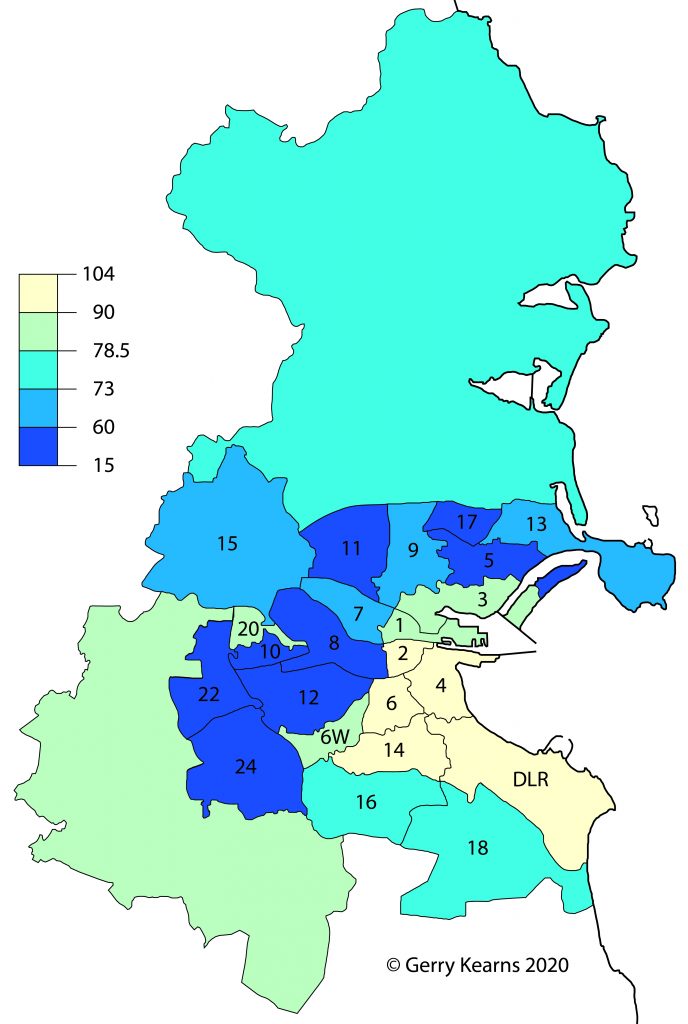
A map of Dublin and adjacent counties, with the postal boundaries drawn. D24, 22, 12, 10, 8, 11, 17 and 5 are dark blue, signalling the lowest rates of progress from second to third level education. D15, 7, 9 and 13 are light blue, indicating still very poor rates. D1, 3 and 6W are light green, above average and D2, 6, 4, 14 and DLR are yellow, showing very high progression rates. Copyright Gerry Kearns.
From school to university based on Irish Times feeder data (showing approximately the proportion of the student body going on to third level) Please respect the image copyright. It will be published in due course in chapter by Gerry Kearns, on Dublin as a city arranged by class.

This discrimination can be overcome, but not without a challenge to decades of neglect for our schools from Fine Gael and Fianna Fail and their coalition partners.

Filed Under: All Posts, Protests Ireland

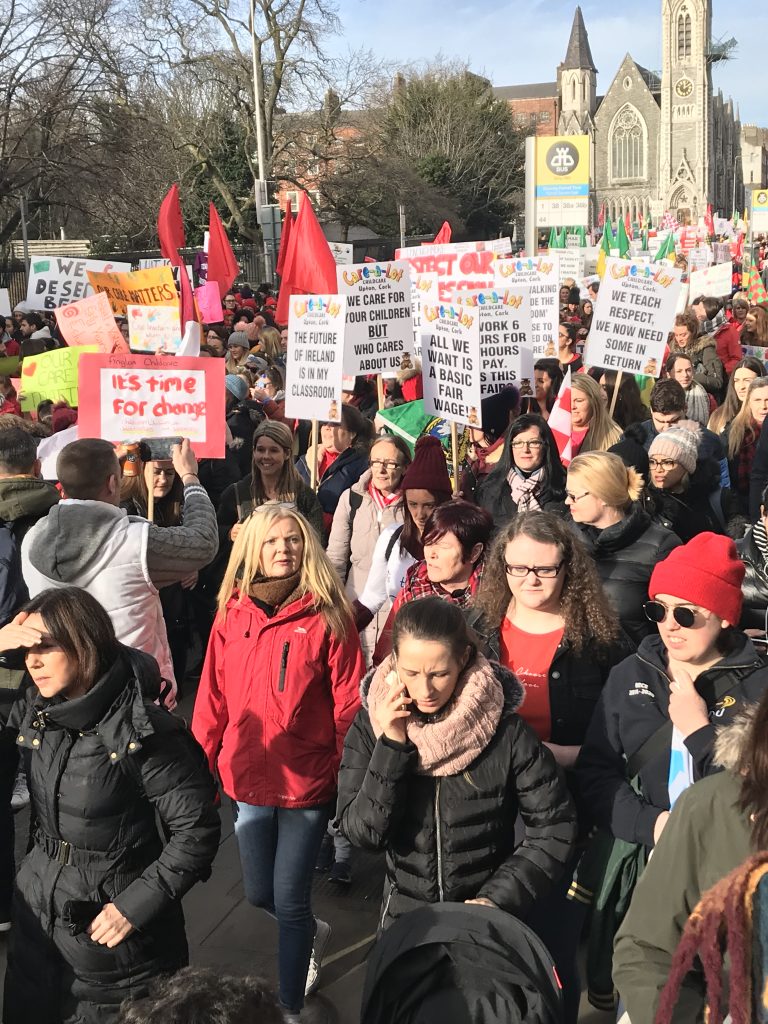
Childcare Strike 2020 Dublin Wednesday 5 February Was a Huge Success

26/01/2020 by admin Leave a Comment

Independent Left support the planned childcare providers strike on Wednesday 5 February in Dublin. Here a female creche worker sits a table with three young children who have beakers in front of them and are looking at wooden toys on their hands. Foreground right  is a colourful blurry toy.
Independent Left joined the protest of childcare providers in Dublin on Wednesday 5 February 2020.

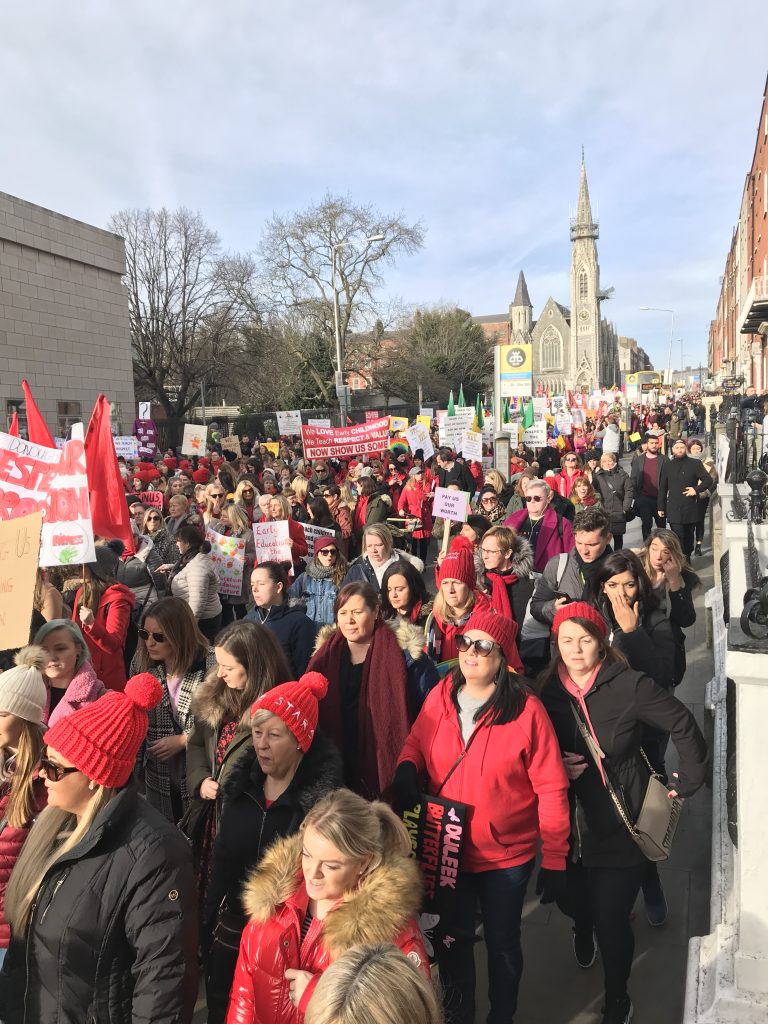
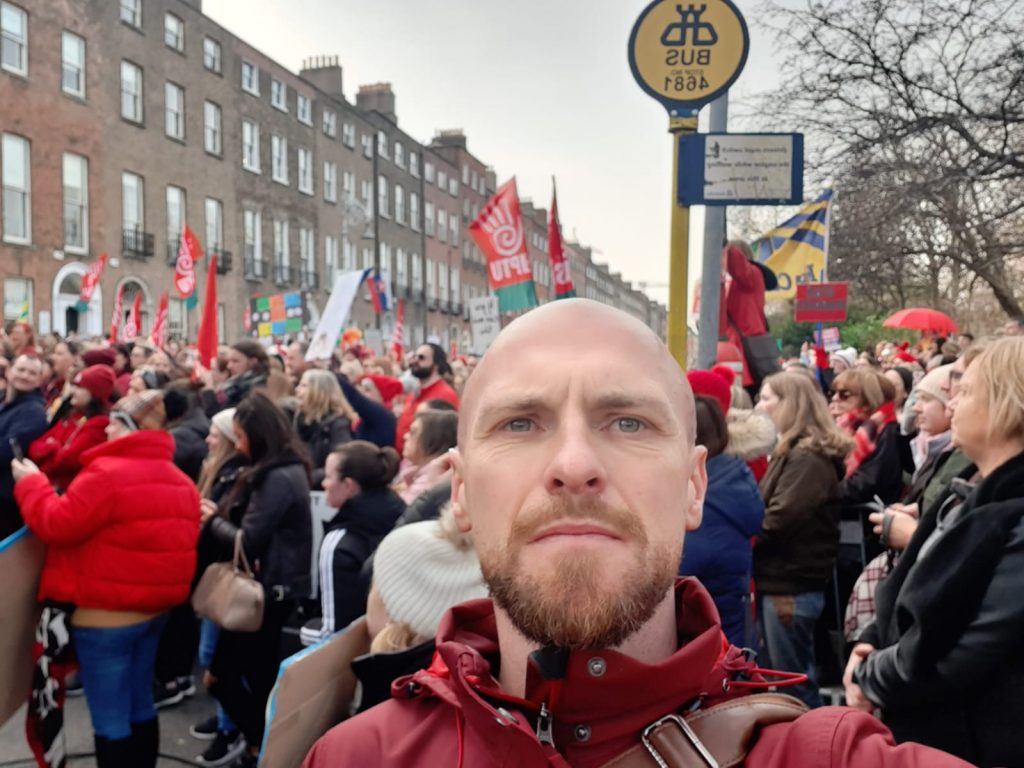
On Wednesday 5 February thousands of childcare workers went on strike to march in Dublin in protest at the crisis in childcare. Independent Left members fully supported this action. Yes, it was a challenge to arrange alternative childcare for the day but action was urgently needed and the march was a necessity. Not only did the protest show how powerful and united is the sector, but it was met with a hugely positive public response as we all know how the sector needs radical changes.

The state needs to follow the example from the rest of Europe and subsidise childcare, treating it as an essential service, not a for-profit sector.

The march was organised by the Early Years Alliance an organisation facilitated by SIPTU and consisting of workers, providers, unions and parents.

Little Learners Checklist at the Childcare demonstration 5 February 2020. A woman with a Little Learners flag hold a 'checklist' placard with a cross by all the issues of her concern.
Little Learners Checklist at the Childcare demonstration.

I spoke to a childcare worker who participated in the action and shared our childcare policy with her. Her description of her daily life provides a powerful illustration of why this strike was necessary.

My husband starts work at 7.30 a.m. so it’s my job to get the kids up and to school. I have two boys, eight years and three years. I drop my eight-year-old off at the school gates at 8.30 to hang around until 8.50: no other way to get him to school and me to work. I got stuck in traffic on the M50 on my way to work as a childworker. I’m very lucky that my three-year-old attends the same creche as me, so only one drop-off for me.

Today, I got to work with five minutes to spare; I’m usually fifteen minutes early, I have to be. Planning needs to be done, the classroom needs to be set up, etc. I bring my son to his classroom where two staff are already setting up the room, completing planning sheets and general organising of the room for the children’s arrival at 9 a.m. Their shift doesn’t start until 9, we only get paid from 9, yet they’ve been here at least twenty minutes setting up. They are very kind to take my son five minutes early so I can get to my classroom and begin my set up.

As the day goes on, we have a first aid incident. We have a child protection concern. I am organising a Together Old and Young visit to a local nursing home. I speak with a parent who is concerned about her child’s development, all within the first hour-and-a-half. We are told we are short staffed today and full time staff need to take a shorter lunch to accommodate. This is not a bad day, just a regular one in this line of work. I also have to discuss the upcoming protest with parents.

Overall, they are very sympathetic to our cause and those who are able to will arrange other means of childcare for Wednesday 5 February to alleviate some staff to attend the protest.

My shift finishes at 1 p.m. and I go to collect my son. But as usual I don’t leave my room on time because someone always needs something: a hug goodbye, a form signed, a conflict between children that needs resolution or even a staff member who needs to go and use the toilet!

I collect my son and he is full of smiles and chats about what he has done that day. He says a fond goodbye to his teachers as if they were his friends!

All of this is so important in our society and I am sick and tired of feeling the way I do in this sector. Yes, I love my job but hugs and smiles and a child’s positive progress doesn’t pay the bills… never even mind the cost of childcare.

Upon reading your article, admittedly, I had a chip on my shoulder, ready to read about ‘tax breaks’ and ‘extended ecce’. I was nicely surprised. It’s nice to see childcare workers being mentioned more than once and in a positive manner.

Zappone says I should join a union if I have a grievance… my problems are not with the management team of the creche, it’s with the state and the ridiculously high expectations they are putting on me and my colleagues.

Sixteen years I’m working in this sector and I’m losing faith.

Everything that is in the link you sent me is true. The whole sector needs an overhaul, childcare should never be for profit! In all the different positions I’ve had, the worst practice I’ve seen has been in private centres and it is not through the fault of the staff.

Change needs to happen it MUST be done in collaboration with the people who are actually on the ground working directly with the children. All these new schemes sound amazing, but when they are put into practice it just pushes us further and further to breaking point.

Thank you for giving me a bit of hope for the future of my profession.

Valuing Us is Valuing Children: placard on the childcare demonstration
 It's time for change: huge turnout for the childcare protest
It’s time for change: huge turnout for the childcare protest
Thousands marched for the childcare sector on 5 February 2020
Thousands marched for the childcare sector
John Lyons of Independent Left stands on the right of a group of childcare workers and parents at the demonstration of 5 February 2020. The demonstrators display a lot of red clothing and have placards around their necks proclaiming: loving my job won't pay my bills! We are professionals, treat us professionally.
John Lyons with childcare protesters 5 February 2020

Councillor John Lyons expressed his full support for the strike.

Parents shouldn’t be paying such high costs for childcare and staff should be given increased pay and a proper career path with full training. This campaign can win and the protest on 5 February is the right way to go about forcing the new government, whoever is in power, to listen and to respond.

A picture of Councillor John Lyons, standing beside text in bullet points:
I support the planned strike by childcare organisations on 5 February 2020. The EECE needs to begin at two years of age and double the hours to 30 per week available twelve months of the year. An increase for each child's capitation grant for accessing creches. A massive increase in investment: a minimum 1 per cent of our overall GDP is needed to create a fully functioning national childcare system. An increase in financial supports to long parents and migrant parents whom are most vulnerable to poverty and isolation. Government needs to create public creche facilities in local communities.
In general election 2020 Councillor John Lyons, standing for Independent Left in Dublin Bay North pledged his support for the Childcare Strike of 5 February and raised several demands on behalf of the sector.
Councillor John Lyons supporting the huge childcare sector march of 5 February 2020

Interview with a community childcare worker ahead of the strike of 5 February 2020

In advance of the strike by childcare workers, I spoke to ‘Anne-Marie’ who works in a community childcare centre.

NMcD: Why are you going on the protest?

A-M: I’m going on the protest to support the early years professionals in the community and private sectors who for years have been under huge pressure, who are not treated as professionals, who are expected to hold the rest of the country by looking after and educating the children; for children with additional needs; for afterschool clubs; for everybody.

For all these years we’ve got very little extra funding, we’ve got more people coming an assessing us and making sure we are doing our jobs. We have, I think, eight different government bodies that come in at the drop of a hat to see what we’re doing and to make sure we are doing everything right. And that’s fine, we’re all about good governance and transparency but it’s just constant.

Then there is new childcare funding, which came out in November, is making it even more difficult for parents and for services to be sustainable. Every couple of years funding gets changed and we never know from one year to the next year if we can be sustainable and continue to run the community service that we run. It’s not good.

We’re a community. So we are middle of the road paid, compared to the girls that are on ten Euro-something an hour but it’s below the Living Wage and it’s not good enough.

NMcD: It’s a community creche that you run here. We’re in an area of economic deprivation in north Dublin. Can you tell me the kind of service that you provide and support you give to families in the area and why it is important that we need to fund community creches?

A-M: This community service has been running for a long time in this area. Like all the other community services out there, particularly in areas with disadvantage, we have children with a lot of additional needs, not just official additional needs but because of their lifestyle and home circumstances. We’ve a lot of homeless children; children whose parents have experienced addiction; who are in recovery; young parents who have left school early. A lot of single mums. And that just puts extra pressure on the children, because of whatever’s going on at home. The children all come here and get a breakfast; they get a proper home-cooked meal. Not everybody is going home to a cooked meal with fresh fruit and vegetables every day. They are really cared for and looked after here. It is the home from home, well that’s what we want it to be. But it’s very difficult to provide that when your funding and constraints are there.

I think in an area like this it should be like a DEIS service, where we have additional staff to provide the care and support that the children need. We have a lot of parents that would come to the office looking for different supports, whether it’s things going on at home. It’s more than just drop your child and run out the door. We provide additional supports: we have a lot of children that are referred to social workers, public health nurses, Focus Ireland. We do support the whole family. We do refer children on to psychologists, speech therapists for additional supports. It’s constant it’s full on.

When you look at the funding over the last few years, for example, the ten years since they put up the ECCE scheme (that’s the three hour sessions per day for the pre-school groups), that’s for thirty-eight weeks per year. When that started ten years ago it was €64.50 per week per child, ten years later it is €69. So that’s an increase of four Euro fifty in ten years. That’s the equivalent of forty-five cent a year. Now we give the children breakfast, we give the children lunch, we have to pay the staff when they are on holiday because it is not covered by the funding, these staff possibly have to go and look for jobs in the summer or sign on in the summer, so that’s a lot of women – predominantly – who are signing on through the summer. We want permanent jobs, proper wages and we want support from the government to make that happen.

NMcD: In an ideal world, how would you like government support to run to make life easier?

A-M: At the moment the inspectors and regulation people that come out to see us are TUSLA, Pobal, Department of Education and Skills, Department of Health, the Revenue, Workplace relations, Building Control and Fire Control. So all these people can come at any point through the day when you are trying to support and look after children. Any of them can come in and look for a huge amount of paperwork. We need one government body to run us and support us and understand. There’s overlapping, so they are looking for that and then the next week someone else can come in the look for basically the same thing. We all want the same thing: we want children to reach their full potential.

Early intervention is the key. We have six children here with undiagnosed additional needs. We won’t get any AIM support staff to support these children until they are three. We have six children that are under two that, in our opinion, have additional needs. That puts extra pressure on staff in the room. Two members of staff with ten children in the room and there could be three or four children with additional needs. Nobody is recognising it. We all talk about early intervention but it’s not happening. If we had an extra member of staff in the room as the DEIS model, we could provide better care for the children.

NMcD: Would you say the waiting lists for children seeking early intervention affects your work as well?

A-M: Definitely. If we’ve got a child and the parent has maybe said, ‘I’m a bit worried about her speech’, it’s fourteen months on the waiting list, depending on when they go on it, then they have to go in for an assessment, then it could be another six months before they are seen and go through a stage of intervention. That child is nearly two years older at that stage. So if you saying it at two, two-and-a-half, that child is nearly at school before they are getting any intervention.

NMcD: And the formation of language is vital in the first three years?

A-M: The first three years is just massive for every area of the development of children. It gives them the bottom of the pyramid. It gives them the basic skills to build on over the years. People think that their child starts their education at school but they start during pregnancy and certainly during the first three years. That’s why it is essential. We have over a hundred children on our waiting list at the moment. We are a seventy children service. Most of those on the waiting list will never see the inside of this building because people stay for four or five years. We are one of the only services in this area that takes children under two. We take children from six months. That’s the early intervention that they need. We need extra staff in each room because the biggest cost to childcare is the staff, and even though they are paid way under what they should be paid, that’s the most important part of your money because ninety percent of your money goes on staff.

NMcD: A final question, how has the feedback been from the parents when they know you are closing on Wednesday for the protest?

A-M: A couple of them are disappointed because obviously they want continuous good quality care for their children. But most of them have been supportive because they understand, because they know us, know what we provide and how essential it is for their children’s development. Also for their own time, headspace and development. So some of the parents will be coming and marching with us. Which is great.

A notice from the wall of a childcare centre reads:
Reminder,
We will be closed all day on Wednesday 5th February for a staff meeting and to take part in the National Early Years Protest.
You are welcome to join us and the thousands of Early Years Professionals who are protesting due to the current childcare crisis in Ireland. We aim to provided professional, quality, affordable childcare in a sustainable, enriching learning environment. We need support from the government to do this!
Many parents supported the childcare strike of 5 February and came on the Dublin protest.

If the new government that forms after the election on 8 February does not respond to the sector, then another day of strikes and protests will be necessary.

Large strikes in Ireland as elsewhere are the most effective form of protest we have.

Filed Under: All Posts, Protests Ireland

Google and Facebook workers’ protests grow

25/10/2019 by Conor Kostick Leave a Comment

On 1 November 2018, workers at Google’s HQ in Dublin struck

Back in the late 1980s, after the defeat of the air traffic controllers in the USA and the miners in the UK, a great many activists gave up on their hopes that working class people could lead a revolt against capitalism. Andre Gorz, for example, had written a book, Adieux au proletariat (Farewell to the Working Class) which became popular on the left. His argument was that the traditional working class had changed in such a fundamental way that we would never again have the power to lead a transformation of society.

What the book (and those influenced by it) failed to appreciate is that the working class is always changing. Industries rise and fall, with consequences for patterns of employment. But the fact that all companies exploit their workers to maximise profits is a constant. And it is a constant that means after a new company has been running for a while, its employees will try to organise themselves.

Take Google and Facebook, two very important examples of new workforces, especially for Ireland. Right now there is major unrest by staff worldwide in these companies along with a drive to unionise.

The struggle for trade union rights at Google

At the end of October 2019, a row broke out at Google over a new tool for Chrome that automatically launches a pop-up when staff book a room capable of holding 100 people or more. Google says that it’s just a roadbump to stop unnecessary invitations but employees anonymously leaked news of this tool with the allegation that it was designed to warn management of attempts to hold organising meetings.

Workers have mocked the tool, circulating memes such as one showing Professor Dolores Umbridge teaching a defence against the Dark Arts class. Beneath her, it says: ‘Google decree number 24: no employee organization or meeting with over 100 participants may exist without the knowledge and approval of the high inquisitor.’ Another shows a bunch of male managers in suits laughing as one of them says: ‘and then we told them “we will not make it appear to you that we are watching out for your protected concerted activities” as we pushed a Chrome extension to report when someone makes a meeting with 100+ people.’

This came shortly after a meeting, 21 October 2019, in Switzerland, where for several months, over 2,000 Google staff had been attempting to organise a meeting addressed by the trade union Syndicom. Management attempted to thwart the meeting and at one point sent a message around to employees saying, “we’ll be cancelling this talk.”

In the end, some 40 workers insisted on their right to hear the union representative and this issue is likely to culminate in a fierce battle for recognition.

To some extent the drive to unionise was trigged by the massive walkout on 1 November 2018, a strike that was very well supported by Dublin Google workers at the Barrow Street headquarters. Google employs around 7,000 workers in Ireland. Over 20,000 workers in 47 countries held a wildcat strike to protest at massive severance payments made to male executives accused of sexual harassment.

Google workers have recently leaked information on issues they feel are morally wrong in the direction of the company, such as censored search engines for China; co-operation with armies, or with the fossil fuel industry.

On 25 November 2019, the New York Times reported that it had seen a memo where four Google workers associated with organising their colleagues were fired.

Facebook has over 4,000 employees in Ireland and here too there have been leaks, not least in regard to making contracts public. This has been an important contribution to a legal case against Google contracts where the plaintiffs want end to compulsory arbitration of workplace discrimination cases.

One Facebook worker described to Independent Left how the company started in Ireland in a non-traditional way, making an effort to create a team spirit through twenty-four hour, free access to a variety of food and drink, including a bar. But now, most of that has gone and the company manages its workers much like any other.

Life in Google and Facebook for workers is unrecognisable in the Hollywood versions of these companies (e.g. in The Social Network or The Internship).

What this discontent among workers in the giant tech companies shows is that although the decline of old industries can indeed shatter working class organisation and confidence for a few years, the rise of new ones (and, indeed, the return of confidence to traditional ones) brings back the fight to organise against exploitation and unfair practices.

And what this means for the big picture is that the potential for workers to lead a massive, fundamental change to how the world currently works is as great as ever.

Facebook Staff Protests Against Trump: Update 2 June 2020

It is not only the issues of working conditions that is driving Facebook workers to organise themselves. The wider social role played by Facebook is leading to its own workers attempting to instil ethical values on their practices. In particular, there is a growing desire by workers to curtail the use of Facebook by Donald Trump to promote his side of the growing social split in the US. Many staff held a virtual walkout on 1 June 2020 to challenge the way that the US President was using Facebook to spread misinformation and incite violence.

A tweet by Jason Toff (@jasontoff) which has 187k likes. It reads:
I work at Facebook and I am not proud of how we're showing up. The majority of coworkers I've spoken to feel the same way. We are making our voice heard.
It is dated 5.55am June 1, 2020.
Posts by Facebook workers concerned to implement an ethical policy about the use of the platform are gaining hundreds of thousands of likes.

A design manager tweeted:

I’m a FB employee that completely disagrees with Mark’s decision to do nothing about Trump’s recent posts, which clearly incite violence. I’m not alone inside of FB. There isn’t a neutral position on racism.

Placing a logo of a fist with a hart on their posts, another Facebook team joined the walkout en mass. It is widely reported that Trump spoke to Zuckenburg on Friday 29 May after Zuckenburg asked him to amend a post.

While the head of Facebook holds back from acting against Trump, his staff are sharing a quote from Anti-Apartheid leader Archbishop Desmond Tutu:

If you are neutral in situations of injustice, you have chosen the side of the oppressor.

Filed Under: All Posts, Protests Ireland

Ireland’s Climate Strike 20 September 2019

21/09/2019 by admin Leave a Comment

Young people in Ireland played their part in the massive world-wide strike against Climate Change on 20 September 2019. The energy and determination as well as the frustration of the participants was evident in the chants and slogans on the placards.

Fair play to the anonymous students who posted on Reddit that they had to go against the principal to participate:

Obviously have to keep this anonymous so I wont say what school but today out school refused to let us out of school for a few hours to the protests for climate change
I think this is a joke like seriously. It was only from 12-3 like its ridiculous. The school didn’t even mention it to us at all that this was happening or suggested we take part in it ourselves.
Needless to say we weren’t taking this shit so we grouped together and about 80-100 students rushed out the doors and ran to protest anyways.

Here are some of the images and videos from the day.

Participants in Belfast for Climate Strike 20 September 2019
Dublin protesters turned out in huge numbers, here marching along the west side of Merrion Square (photo credit: Conor Healy)

View of the 20 September 2019 climate strike, from above, south side of Merrion Square, Dublin.

The Irish Times concentrated on very young protesters but nevertheless captured the sense of determination as well as anxiety among protesters in their coverage of the climate strike in Dublin 20 September.

Gathering for the 20 September climate strike, Galway.
Grand Parade Cork, 20 September 2019, another large turnout as part of Ireland’s support for the climate strike.
The famous ‘Free Derry’ wall, painted over to support the climate strike of 20 September 2019 (and a march on 21 September).

Filed Under: All Posts, Protests Ireland

  • « Go to Previous Page
  • Page 1
  • Page 2

Copyright © 2024 · Aspire Pro on Genesis Framework · WordPress · Log in