• Skip to primary navigation
  • Skip to main content
independent left logo

Independent Left

Environmentalism, socialism, freedom and equality. #liveablecity

  • About
  • Featured Articles
    • How Farming Must Change to Save the Planet
    • The Housing Crisis: Causes and Solutions
    • Socialism in Ireland
  • Contact Us
  • Podcast
  • Animal Rights
  • Archive
    • Irish Socialist History
    • Dublin City Council Housing
    • Ukraine
    • Protests Ireland
    • Reviews
    • Irish Political Parties
    • All Posts
    • Independent Left Policies
  • Why join?

Left Politics Ireland

The Independent Left archive of features concerning political parties in Ireland, especially those concerned with left politics Ireland.

Pro-Life Fianna Fáil Mayor of Dublin elected with the support of the Greens and Social Democrats

25/02/2020 by Conor Kostick 1 Comment

At a special meeting of Dublin City Council, a pro-Life Fianna Fáil Mayor, Tom Brabazon, was elected on 24 February 2020 with the support of the Green Party and the Social Democrats. Picture of the front of City Hall, Dublin, with a blue Dublin City flag flying above the building. It is a grey day with a white sky above the pale stone building.
At a special meeting of Dublin City Council, a pro-Life Fianna Fáil Mayor, Tom Brabazon, was elected on 24 February 2020 with the support of the Green Party and the Social Democrats

On 24 February 2020, Raheny Fianna Fáil councillor Tom Brabazon was elected Lord Mayor of Dublin at a special meeting of Dublin City Council. His victory came in a vote of 34 to 26 (three absences) against independent candidate Anthony Flynn. In 2015, Tom Brabazon let slip an extremely conservative view of women, when he wrote an article for the Northside People against gender quotas in politics and said, ‘we should want real women with real life experience of the education system, the workplace, childbirth, childcare…’ He went further on the Sean O’Rourke show on RTÉ (9 March 2015), saying that women who had actually given birth were best placed to discuss abortion.
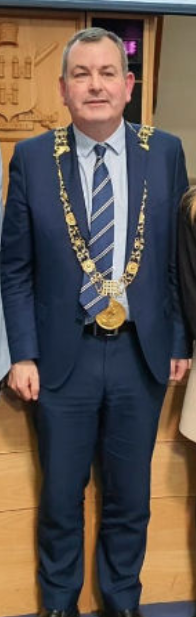
Tom Brabazon in a blue suit, wearing the Mayoral chains of office for Dublin City and while wearing a smile, looking a little uneasy, with clenched right fist and hunched shoulders.
Tom Brabazon, Lord Mayor of Dublin from 24 February 2020, thanks to the votes of the parties in the ‘Dublin Agreement’

Immediately, this drew a huge reaction from women who considered themselves perfectly real without having to give birth or raise children.

Slapped on the wrist by Micheál Martin, Brabazon issued an apology and retreated to the extent that he said he did not intend to be hurtful. The new Lord Mayor did not, however, revise his core conservative beliefs in regard to women and this became apparent during the Repeal campaign. On 5 October 2015 and again on 6 March 2017, Brabazon voted against a DCC motion that called on the government to hold a referendum to repeal the 8th amendment of the Constitution. During the campaign he put his name to a Pro-Life statement in support of the ‘No’ position.

Independent Left’s Niamh McDonald said, ‘As the chair of Dublin Bay North Repeal group I am disgusted that such a man was voted in as Lord Mayor. His past history and comments have shown him not to be in favour of women’s empowerment or women’s equality. Dublin constituencies voted overwhelmingly for women and pregnant people to have reproductive choices and if our new lord Mayor had his way this would never have become a reality.

‘What I feel is a real betrayal of the Repeal movement comes from those parties such as the Social Democrats, Greens and Labour who were active in the Repeal campaign in Dublin Bay North and beyond, who have now agreed to Tom Brabazon’s nomination and who have voted him in. These parties won votes from the Repeal campaign in order to get elected and have now used those votes go against this movement.

‘Repealing the 8th was only half of the battle to ensure everybody has reproductive justice. Our current legislation is too conservative and narrow, it excludes many in society who are already marginalised. At a minimum, we need exclusion zones and to end the three day waiting period.

‘We have a review of the current legislation in less than two years and we need representatives who are willing to stand up to those who want to remove the gains we have made and also who will fight for more.’

Brabazon’s conservative family values fit with his connections to the previous generation of Fianna Fáil politicians. A strong supporter of former Taoiseach Charles Haughey, Brabazon tried to challenge the popular perception of Haughey as corrupt by proposing that Dublin’s port tunnel be named in Haughey’s honour: ‘You would like to think that somebody whose public life was dominated by goodness would have a memorial,’ said Brabazon in 2006, apparently without smirking.

Why did the Greens and Social Democrats vote Fianna Fáil?

After the local government elections of 2019, Fianna Fáil did a deal with Labour, the Green Party and the Social Democrats to get control of Dublin City Council. “The Dublin Agreement 2019 – 2024” is the excuse that the Greens and the SocDems (Labour don’t seem to feel the need to excuse voting for Brabazon) are now giving for their support for Tom Brabazon as Lord Mayor of Dublin. The agreement itself is ten pages of dry, well-intentioned phrases. But the practical action arising from the document does not serve the real needs of the people of Dublin, nor our desire for urgent action on housing. This agreement allowed the sell-off of public land like O’Devaney Gardens and the wasting of millions on a white-water rafting facility.

Many people who voted for Green and Social Democrat candidates in general election 2020 just cannot understand why these parties would support Fianna Fáil in general and an anti-woman figure in particular. The vote on 24 February 2020 in Dublin’s council chamber seemed to completely contradict the spirit of ‘vote left, transfer left’ that swept through working class communities in the general election. It would have been easy, in the light of the general election results, for the Greens, Labour and the SocDems to leave the Dublin Agreement, saying that it was clear there was now a mandate for change. No doubt far more of their supporters would have agreed with such a stand than will agree with their vote for Tom Brabazon.

The explanation for the apparent contradiction in the behaviour of these parties is to be found in their history and their politics. Elsewhere in Europe, Greens can be found who are definitely on the left and side with working class communities but in Ireland that has never been the case. The Irish Green Party is a particularly conservative one, highly networked to Irish business (Ciaran Cuffe is a millionaire who notoriously held shares in General Electric, Chevron Texaco, Merck, Citigroup, Abbott Laboratories and Johnson & Johnson before this information became public). With honourable exceptions, they have often been hesitant on the struggle for abortion rights, preferring silence to leading the way towards change, and while their decision to run David Healy, a candidate with pro-life views, in Dublin Bay North was terrible, it was their attempt to escape the issue when it was raised that is the real indicator of their weakness in this regard. Although the general election campaign raised hopes that the Green Party had changed since its shocking, anti-working class performance in coalition with Finna Fáil 2007 – 2011, essentially, it has not. Its commitment to helping run Irish and international capitalism as a context for its policies means that even on issues to do with climate action, it will do little more than provide cosmetic, trivial changes.

As for the Social Democrats, they were born from a split from the Labour Party and have the same politics as Labour except with a pleasant purple colour-scheme and a lack of support from trade unions. They too start from a premise that they must be ‘responsible’ in respect to the economy and that any changes on behalf of working class communities can only be introduced insofar as such changes are acceptable to the wealthy and the owners of businesses and property. This attempt to mediate between us and the rich wasn’t particularly successful for Labour even in times of prosperity, where there was a certain amount of space for improved spending on housing and health. Sitting on the fence can be tricky and it is particularly difficult to be on a fence that is wobbling. In the 2020s, politics is highly polarised, such as is evident in the vast difference in beliefs between Bernie Saunders and Donald Trump in the USA. And what the vote for Dublin Mayor demonstrates is that when forced to come off the fence, the Social Democrats (just as with Labour) will jump down on the side of the elite.

What does the Dublin Mayoral Vote show for the future of Irish politics?

At the time the vote for Mayor of Dublin was made, the national picture was unclear, with Fianna Fáil and Fine Gael looking to form a government that excluded Sinn Féin, one that would need a willing partner or two from among the smaller parties. While the Social Democrats ruled out joining that particular combination, they conspicuously did not rule out joining with either Fianna Fáil or Fine Gael in a different alignment. The Green Party are equally willing to participate in government alongside one of the right wing parties. Whatever combination of parties eventually emerges to create the Irish government (or, if there is another general election), we can draw a number of conclusions from the vote for Tom Brabazon.

Firstly, the exciting and positive vote for change in general election 2020 is only the beginning of a process of a widescale move to the left in Ireland (and especially in working class communities). As people who want decisive and urgent action on climate, housing and health see that the Social Democrats and Greens (and Labour) won’t take that action, it’s likely that parties to the left of these will grow.

Secondly, even if we had a left government that was trying to tackle these challenges in a manner that – for once – favoured working class communities, the Greens and the Social Democrats would not make for reliable partners. Probably, a government reliant on them would face the same issues that Syriza in Greece faced in 2015. When international pressure from businesses and powerful politicians came to hammer down on Greece, the left government caved in and backtracked on all its radical ideas. If the Greens and the Social Democrats can’t even bring themselves to stand up to Fianna Fáil in Dublin City Council and ditch the Dublin Agreement and a pro-Life Mayoral candidate in favour of a housing activist (Anthony Flynn), we aren’t going to see Che Guevara-style t-shirts being worn of SocDem and Green Party leaders. They are bound to give in to the demands of landlords and business.
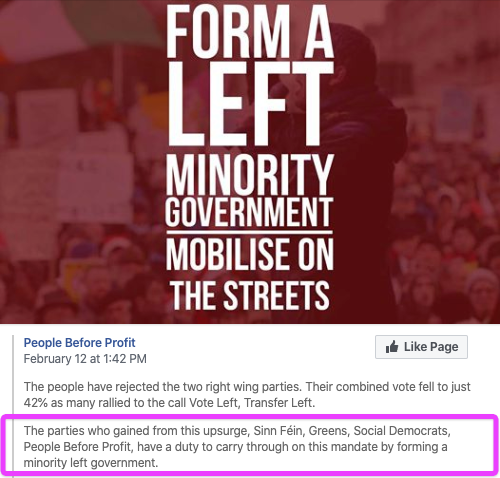
A screenshot from 12 February 2020 from People Before Profit's Facebook feed, with the headline: Form a Left Minority Government - Mobilise on the Streets.
On 12 February 2020, People Before Profit posted on Facebook that it was their duty to join with Sinn Féin, Greens and Social Democrats in forming a left minority government

Thirdly, on a smaller point but one that might prove important in the long term, the results of the election led to a difference in approach on the socialist left. While People Before Profit considered it a duty to enter a left government alongside the Greens and Social Democrats, the Socialist Party and Paul Murphy (RISE) were, quite rightly, more cautious. Supporting such a government from the outside is much better than being part of it. As soon as even a small strike or protest breaks out against the government, if you were outside of government you’d have your hands free to support the protest. If you were inside, you’d have to bring the government down, which might not be the worst outcome (the worst outcome would be if you sacrificed the cause of the protestors to your presence in government) but it would make it look like you were dishonest in your negotiations around the program for government.

Finally, and the most important conclusion for us in Independent Left, is that the campaigns for change that are bubbling away in Ireland, such as over childcare, pay equality and housing, must continue. It doesn’t matter that there isn’t a government. Even a ‘left’ minister might fail us, while the caretaker ministers and the senior civil servants can be forced by successful strikes and protests to implement the changes we need. Waiting for a Sinn Féin-lead government could take months and ultimately could lead nowhere. In the meantime, we can use the boost provided by the election and especially the demoralisation among Fine Gael and their supporters to galavanise existing campaigns and launch new ones.
Filed Under: All Posts, Irish Political Parties

What can we learn from election 2020 and the Dublin Bay North results?

11/02/2020 by Conor Kostick 5 Comments

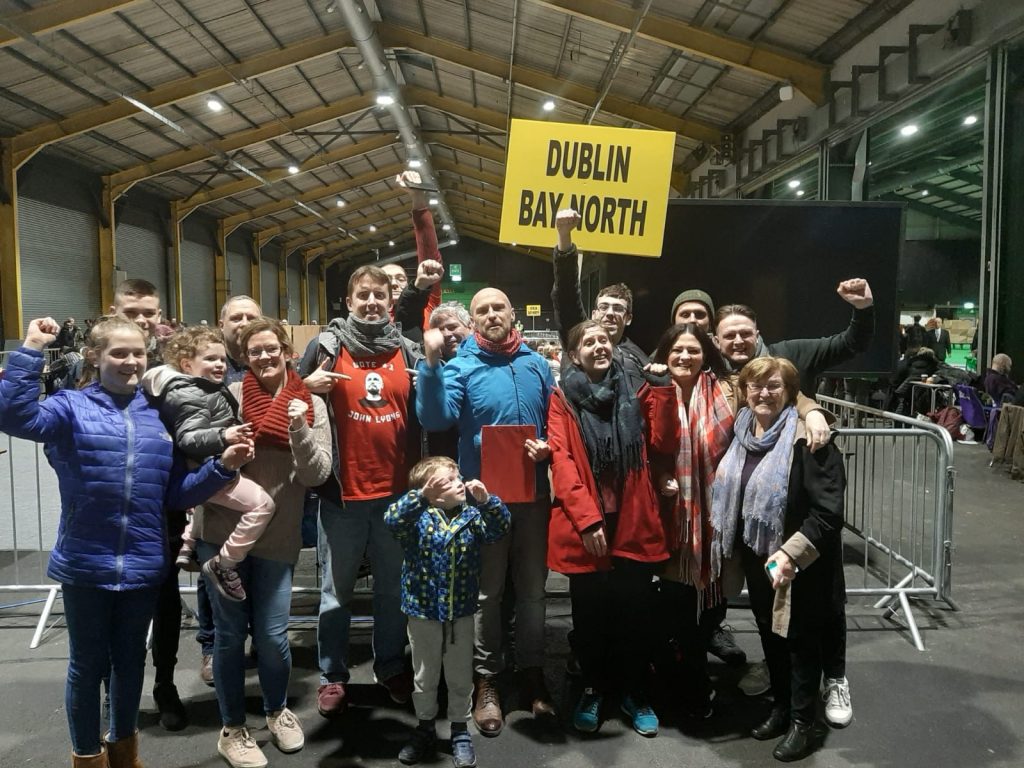
Inside the RDS stand a group of Independent Left supporters, smiling, fists raised, many of them wearing red 'Vote No.1 John Lyons' T-shirts. In the centre, in a blue coat, is John Lyons. On his left is Niamh McDonald. Behind them is a yellow placard from the RDS count centre saying: Dublin Bay North.
Independent Left had a vibrant and energetic campaign in Election 2020, Dublin Bay North

Fine Gael called this election and rubbed their hands with excitement. Full employment, Leo Varadkar looking great in dealings with Boris Johnson over Brexit, property incomes soaring. What could possibly go wrong?

Pretty much everything that can go wrong when you live in a champagne bubble and have no insight into the struggle of those on medium and low incomes. You speak with complacency and in ignorance, you are contemptuous of the electorate and you think, ‘a future to look forward to’ is a clever slogan.

Ireland has 78,000 millionaires in 2020 and they certainly have a future to look forward to. For the rest of us, unless something changes, we can only see more pain over the fact our incomes are eaten up by mortgages and rents; more difficulty accessing health services our families need, with longer waiting times; and more deprivation and anti-social activity in our neglected communities.

There was a roar of anger released in this election and it was channelled behind Sinn Féin. Sinn Féin are a working class party in the sense that their activists are generally drawn from the working class and they know the challenges working people face. So their policies and their articulation of that roar led them to becoming the lightning rod for our fury at Fine Gael and also at Fianna Fáil. We hadn’t forgotten who landed us with massive tax burdens by bailing out their banker friends and who backed Fine Gael with ‘confidence and supply’.

Understanding the rise of the Sinn Féin vote

Our class found a way to lash out at Fine Gael and Fianna Fáil and it was through Sinn Féin, whose spokespeople did a great job of expressing how we felt and offering well-informed refutations of right wing lies (remember how Leo Varadakar said during a TV debate that the rent freeze in Berlin hadn’t worked? It has been agreed but hasn’t come in yet). Even though the large newspapers and television stations did all they could to hammer down the Sinn Féin vote in the last days of the campaign, the electorate in working class areas wasn’t budging.

Some of the tallies as the boxes opened were incredible. Eighty, ninety percent Sinn Féin and just handfuls of votes for the right wing parties.

The transformation of the Irish political landscape in election 2020 is exciting for those of us on the left and humiliating for Fine Gael and Fianna Fáil.

In Dublin Bay North, as elsewhere, at first it seemed as though the socialist voice of the working class was going to also be swept away by the growth of the Sinn Féin vote. The Green vote too, might have been a challenge for socialists (although it was more of a challenge for Labour and other middle-ground and middle class parties). But as the counts went on, the transfers from Sinn Féin were strongly to the left, much more so than had been anticipated, although there were some losses to the presence of radical socialists in the Dáil and as activists with the advantages that being a TD brings to helping organise campaigns. We were sorry to see Ruth Coppinger and Séamus Healy lose their seats but delighted that after a difficult looking start, on the whole, the socialist left held their ground. In fact, we should have gained a seat in Dublin Bay North and at the expense of Seán Haughey of Fianna Fáil, who before the election had been a twenty-to-one favourite.

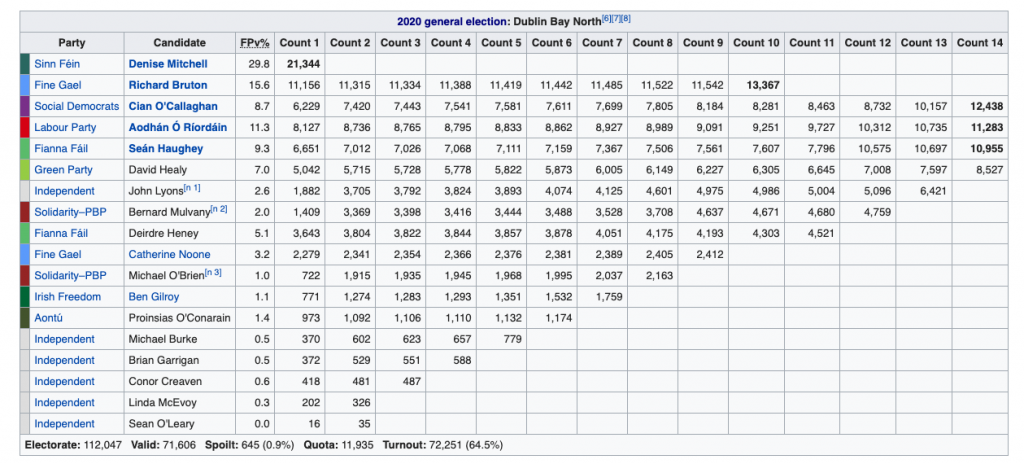
A list of candidates from Dublin Bay North and the details of all fourteen counts of Election 2020. The top candidates, in order of their first preference vote, were Denise Mitchell, Sinn Féin (21,344); Richard Bruton, Fine Gael (11,156); Cian O'Callaghan, Social Democrats (6,229); Aodhán Ó Riodáin, Labour (8,127); Seán Haughey, Fianna Fáil (6,651); David Healy, Green Party (5,042); John Lyons, Independent Left (1,882).
Fianna Fáil failed to get a quota in Dublin Bay North and Haughey staggered over the line only by being deemed elected on the elimination of the Green Party

It must have come as an unpleasant shock for Fianna Fáil that far from winning a second seat, Seán Haughey was down at 6,651 first preferences and ultimately, even after 13 rounds of transfers, couldn’t get a quota. Our own first preference vote was a disappointment, at only 1,882 for our candidate Councillor John Lyons. This seemed to be at odds with the very strong energy for change we’d been encountering on the doorsteps but the transfers of poll-topping Denise Mitchell for Sinn Féin clarified what had happened. There was indeed a massive vote against the establishment and for the left but it had first found a channel in Sinn Féin.

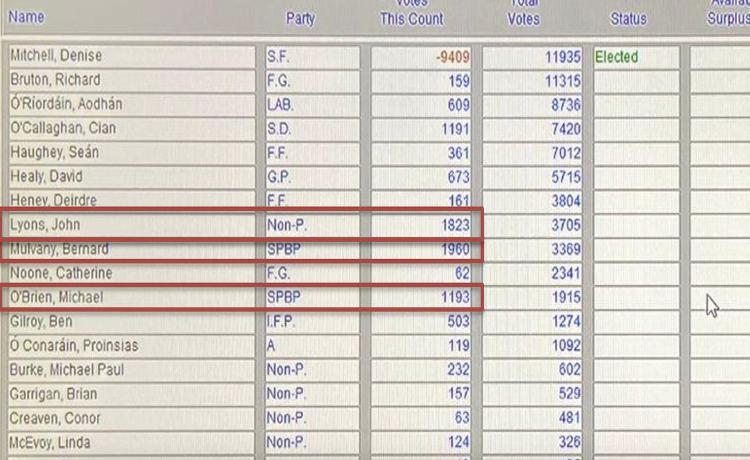
A photo taken of the large screen at the RDS on the day of the count, 10 February 2020, for Dublin Bay North and the transfer of Sinn Féin Denis Mitchell's surplus. Highlighted in red boxes are three candidates John Lyons, Independent Left, who gained 1,823 votes, Bernard Mulvany, SPBP, who gained 1,960 votes and Michael O'Brien, SPBP who gained 1,193 votes. Between them the socialist left could have won a seat on these figures had they not split the vote.

The split left vote saved Haughey’s seat

Elsewhere, the huge Sinn Féin transfers were bringing in candidates of the left and that should have been the case in Dublin Bay North too. Except that that the nearly 5,000 transfers for socialists got split three ways. Instead of one candidate reaching around 9,000 votes and pushing Haughey into sixth place by the end of the election, the Fianna Fáil candidate got lucky. Inevitably, transfers get diluted: even between members of the same party, 50 – 60% is typical. So around half of the votes expressing a desire by working class communities to vote Sinn Féin then vote left were thrown away and in the end, John Lyons, the best placed of the socialists, went out on the thirteenth count with 6,421.

In advance of the next general election, there needs to be a good-faith conversation among the potential left candidates about local government and Dáil seats, in the hope of avoiding this situation arising again.

Positive outcomes for Independent Left from GE2020

Despite the fact that John Lyons did not win Independent Left’s first ever Dáil seat, there are a lot of positives from the election for our small party. With no national presence, financial support, media presence or infrastructure we ran a fantastic campaign which in other circumstances would have brought about a shock for the right and a terrific victory. It helped that our election material was absolutely in tune with our audience. Our theme was ‘a tale of two cities’ and we both listened to and helped articulate the feeling that while the very rich and the landlords were getting richer, the rest of us were being left behind.

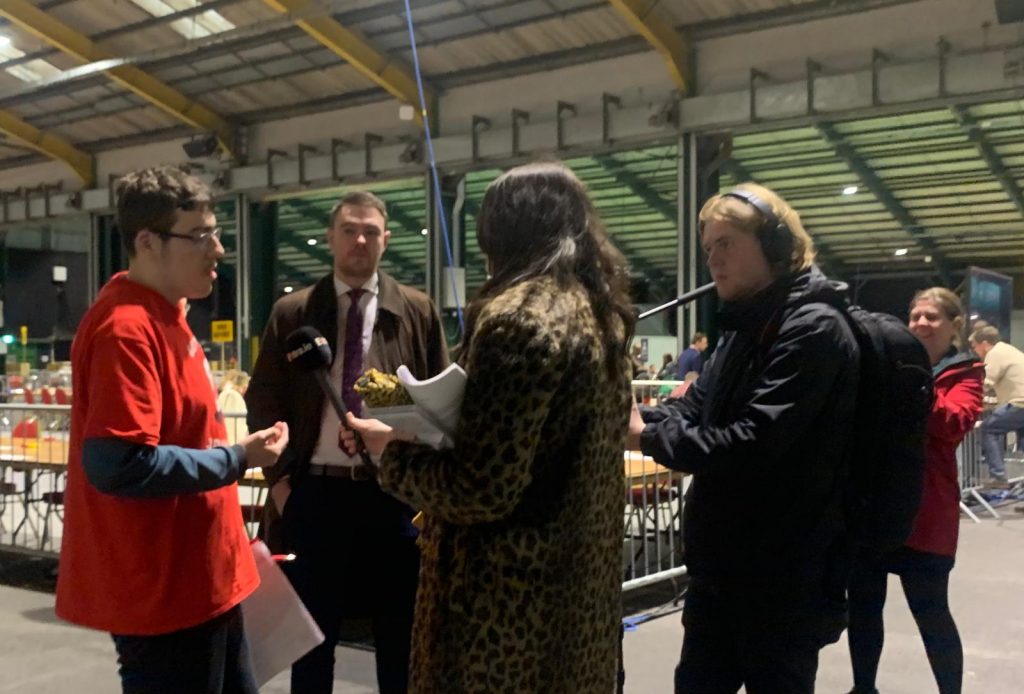
Eóghan Richard Ó'nia  in a red, 'Vote No 1 John Lyons' t-shirt is on the left, one hand raised, explaining to a journalist while another journalist watches and a third films with a camera, that the two party political system in Ireland is over.
Eóghan Richard Ó’nia of Independent Left, explaining to the media why the two-party system is gone for good

We got energy too, from the Childcare Strike and the Teachers’ Strike, which we connected to in Dublin Bay North with a lively contingent on the childcare march and support for the picket lines at the schools around the constituency.

Another big positive for us was meeting new people who have joined Independent Left and have added to our mix of socialists, environmentalists, trade unionists, parents, students, young and old. We are still a project that is evolving but it was really interesting to see how the joint effort of the election brought out a variety of skills and expertise among us and also bonded us in the common effort. Modern socialist parties can be a lot more freeform, dynamic, lively and conversational than the traditional model of a small, centralised handful of people with years of expertise directing everyone else. Facebook groups, WhatsApp groups, etc. allow for everyone to have an opinion and – in our case – a lot of laughs too. If you have been supporting Independent Left in this campaign, you’d be welcome to join us.

What will happen next in Irish politics after GE2020?


Nationally, a discussion is taking place about government formation and it seems that Sinn Féin are positioning themselves to enter government with Fianna Fáil and a smaller party or two. Probably, there is a huge debate within Sinn Féin about this and we hope that the anti-Fianna Fáil voices win. Why? Because Fianna Fáil might well offer a border poll. they might even allow Sinn Féin to introduce a rent freeze, which of course would be very welcome. But the price for these would be too high, because the wealth of the very rich and especially corporations would be untouchable, because it would be business as usual in every other regard. Worse, it would disillusion those people who made the effort to vote for change. While Independent Left have been offering hope, diversity and solidarity within working class communities and trying to direct the alienation people feel against the real causes of this, the system we live under, there was a far right presence in this election who offered despair, division and a violent, racist and homophobic turning inwards of our communities. They will try to capitalise on the sense of betrayal if Sinn Féin backed a Fianna Fáil government.

But isn’t the alternative a Fianna Fáil and Fine Gael government? Wouldn’t that be worse? Actually no, it wouldn’t. Because the ability of any government to impose policies that harm working class communities is set by the willingness of people to stand up and organise and resist the government. We defeated the water charges and with a popular Sinn Féin party in opposition, we can not only throw back anything the government brings at us, workers can push now for pay equality, pay increases, while working class communities can challenge for more resources. This is a much better scenario and one that has a very strong prospect of leading to a left of centre government next time around, than one where for the sake of a few policy gains the excitement currently alive in working class communities subsides into apathy and disillusionment.

Regardless of how the political consequences of election 2020 develop nationally, Independent Left have emerged from the election as a stronger force in Dublin Bay North and we look forward to playing our part in the campaigns to come.

Message from John Lyons to his supporters after the count for Dublin Bay North on Sunday 11 February 2020.

Filed Under: All Posts, Irish Political Parties

Election 2020: the view from Dublin Bay North

24/01/2020 by Conor Kostick 2 Comments

Councillor John Lyons running for election in Dublin Bay North, pictured in the evening on a ladder, smiling as he lifts a post with a large poster of his head and shoulders, on which is written Vote No.1, Cllr John Lyons, Independent Left.
Councillor John Lyons is running for Independent Left in Dublin Bay North and has a real chance of a seat.

Nine days into the campaign, how does the picture look for Independent Left?

When senior Fine Gael members took the decision to dissolve the Dáil on 14 January and began campaigning for a general election campaign they were feeling complacent. The other parties were looking towards a May date and were caught without election materials to hand, while Leo Varadkar had his posters up before the election had officially begun. The timing seemed right, not least because Fine Gael anticipated benefiting from the fact that Varadkar appeared impressive beside Boris Johnson in the negotiations around Brexit and the Northern Assembly was up and running again, with the Irish government having played a part in this.

Moreover, in the champagne bubble that surrounds Fine Gael, the world looks extremely positive: the number of millionaires in Ireland has increased by a third since 2013, to 78,000 and these millionaires are paying income tax at the same rate as people earning the average wage. Many of Ireland’s wealthy are landlords (a third of Fine Gael and Fianna Fail TDs are landlords) and are enjoying a growth in their incomes from tenants who are desperately squeezed. In North County Dublin, average rents rose by 5.6% in 2019 to €1,728, having risen by 11% in 2018.

With unemployment below 5% and economic growth levels relatively healthy compared to the rest of Europe (around 5% in 2019 and a predicted 4% for 2020), Fine Gael strategists rubbed their hands and set out for what they assumed would be a very good election for them.

In fact, it is going to be a very bad one.

The problem with elections, from a Fine Gael and Fianna Fail point of view, is that you have to go outside the champagne bubble and listen to voices that don’t normally concern you. And while the 78,000 millionaires are powerful voices and highly networked to these parties in the day-to-day running of Irish society, they are vastly outnumbered when an election takes place.

Fine Gael suffering a backlash in Dublin Bay North

By now, Fine Gael have discovered that there exists a huge body of people who far from enjoying increased prosperity are suffering enormously. For the majority of people in Ireland in 2020, life is extremely stressful. Yes, we have jobs. But the money we earn disappears into rents and mortgages, into childcare, into bills, including medical ones when the services we need urgently aren’t there. Everywhere, there is pressure on our living standards and obvious neglect of public services, especially health, education and transport. And alongside these very immediate causes of stress is the wider issue of a planet that is getting distinctly warmer and jeopardising our futures and that of our children.

Not one person has mentioned Brexit or the Northern Assembly in our canvassing. We hear awful stories of long waits for health services, which bear out the figures that, for example, that Dublin North has 2,400 children on the waiting list for speech and language therapy (in contrast to the waiting list of 10 for Dun Laoghaire, and 0 for Dublin South East).

The anger at Fine Gael is palpable and while Richard Bruton’s seat is safe (Dublin Bay North has its affluent areas and in a constituency that voted heavily for Same Sex Marriage and Repeal, the government might get some credit for those referenda), he won’t be able to bring home Catherine Noone.

Fianna Fail share the blame for deprivation and neglect in parts of the constituency

A lot of the same anger is directed at Fianna Fail too, understandably given the ‘confidence and supply’ agreement that meant Fianna Fail propped up Fine Gael. It’s very common to hear a mistrust of politicians all together from those we canvass. And for communities in Dublin Bay North that have experienced far more than a decade of neglect such anger is entirely justified. In the circles that Fine Gael and Fianna Fail move, there is no consequence for creating pockets of real poverty, desperately poor services, feeble civic amenities, or schools deprived of facilities. For the rest of us, an approach which has favoured the wealthy has resulted in very severe consequences. There has been a rise in drug use and in the appeal of criminal gangs for young, disenfranchised people. Many people have said they are afraid to go out of their homes and there are parents in parts of Dublin Bay North that simply cannot let their children run out and play, instead they take buses to get to safer areas. And since Fianna Fail are as complicit in the creation of these circumstances as Fine Gael, they are not likely to be able to bring in Deirdre Heney, though Sean Haughey is certain to keep his seat.

Is there a seat for Independent Left in Dublin Bay North?

With both Finian McGrath and Tommy Broughan retiring, the consensus among the political correspondents of RTE and the Irish Times is that this will boost Labour and the Social Democrats relative to everyone else. Yet from our canvassing and from what we can learn from the 2016 election, it seems like Councillor John Lyons of Independent Left is currently best placed to appeal to those who voted Tommy Broughan and has a lot to offer those who voted Finian McGrath. The two independents were very different of course. Tommy Broughan was a Labour Party TD opposed to coalition with Fine Gael and who – quite rightly – on 1 December 2011 stood firm on the issue of not extending the ruinous bank guarantee scheme. As a result, he was expelled from Labour and subsequently worked with left independents like Joan Collins, Catherine Connolly, Clare Daly, Maureen O’Sullivan, Thomas Pringle, and Mick Wallace, with whom he formed the Independents4Change technical group in the Dáil.

On a whole range of policies around housing and health and especially on the principle of not going into government with Fine Gael or Fianna Fail, Tommy Broughan is far more closely aligned with John Lyons than Aodhán Ó Ríordáin (Labour) and Cian O’Callaghan (Social Democrats). A consistent theme of Tommy Broughan’s political career was the need to challenge the two main parties of the right and this has to be reflected in the values of his voters. 

By contrast, Finian McGrath obviously did believe it worthwhile to join with Fine Gael in government. It’s not at all clear, however, that his voters would agree that this was a success. Not only has Finian McGrath to share responsibility for the housing crisis and the failure to reduce hospital waiting lists, but even in his own remit, as Minister for State for Disability Issues, his record cannot be considered a success. The one section in Irish society for whom employment did not rise under the Fine Gael-led government is that of people with disability, two-thirds of whom do not have jobs. In primary and secondary education, while the number of SNA employed has risen, their hours have been reduced, and along with the fact that the number of children in need of support have increased, the situation for children with special needs is worse than at any time since the savage Fine Gael-Labour cuts to their service of 2013.

From the transfer patterns of the 2016 election, it is likely that many of Finian McGrath’s voters would be disappointed in his decision to join a Fine Gael-led government and his record when in cabinet. Only dribbles of transfers came his way when Stephanie Regan and Naoise Ó Muiri of Fine Gael were eliminated and there was no obvious gain either for Finian McGrath from the elimination of Deirdre Heney of Fianna Fail. His former voters certainly seem likely to favour the non-government parties but it’s not clear at this point that they will focus on Labour and the Social Democrats, more likely is that they will spready fairly evenly, also coming in part to John Lyons, Denise Mitchell (Sinn Féin) and David Healy (Green Party). Which brings us to the Greens.

Have the Green Party made a terrible mistake in Dublin Bay North?

Given the surge in support for the Green Party in Dublin, it’s understandable that Paddy Power would make David Healy a 2/9 favourite to win a seat in Dublin Bay North. David Healy is the Green Party’s spokesperson on climate and that is definitely an important issue for people we have been talking to. Our own view is that the Green Party will not deliver a radical enough solution to significantly alter Ireland’s contribution to global warming. Partly, this is because they are ready to go into coalition with Fine Gael or Fianna Fail, despite some internal opposition but also because their big idea is a heavy carbon tax, which is not going to be a socially just way of tackling climate change. Even so, the Green Party are set to do well as an expression of people’s concern about the state of the planet.

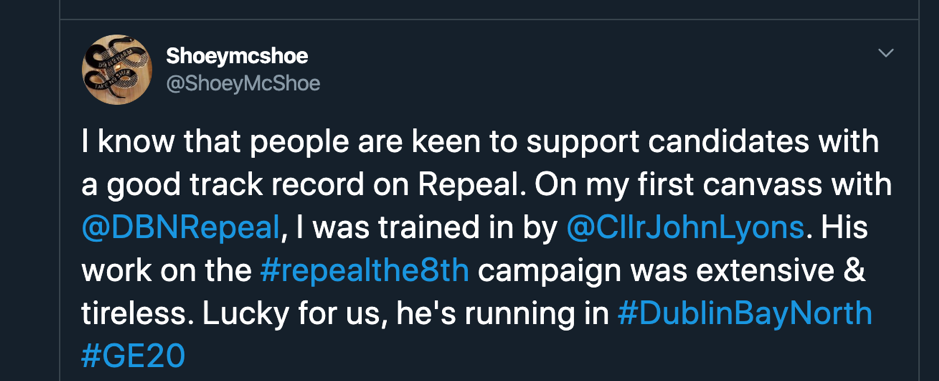
Yet the candidate they have selected for Dublin Bay North is out of line with the official Green Party policy and with voters here in one very important way: he was against the Repeal of the Eighth amendment, voted ‘no’ and expressed support for the ‘no’ position at the time. Dublin Bay North had the second highest turnout in the country for that referendum and with 74.69% yes, was one of the strongest regions for repeal. By contrast with David Healy, John Lyons assisted in the formation of Dublin Bay North’s Repeal the 8th campaign, and, as one person put it on Twitter, was tireless in working for that campaign.

A screenshot of a Tweet (in dark mode) which reads: I know that people are keen to support candidates with a good track record on Repeal. On my first canvass with @DBNRepeal, I was trained in by @CllrJohnLyons. His work on the #repealthe8th campaign was extensive & tireless. Lucky for us he's running in #DublinBayNorth #GE20
One of many tweets highlighting the pro-choice record of Councillor John Lyons of Independent Left, a candidate in the General Election 2020 in Dublin Bay North

Kate Antosik-Parsons of the Dublin Bay North Repeal the 8th Campaign explains why she will be giving her number one vote to Councillor John Lyons.

The Green Party had other potential candidates for the constituency of Dublin Bay North and ought to have been set to take a seat at this point in the campaign. Now, however, there will be hundreds of voters who are unsure about returning an anti-choice candidate, no matter how supportive they are of other Green policies.

What is the likely result in general election 2020 in Dublin Bay North?

The constituency has five seats. With Sinn Féin running a strong campaign nationally and having just the one candidate in Dublin Bay North this time, Denise Mitchell will consolidate her seat. Richard Bruton (Fine Gael) will do well and be elected after the elimination of Catherine Noone. Sean Haughey will probably improve on Richard Bruton’s 2016 performance and take the top spot, not only because of the indication of the national polls, but last time around Avril Power took some of the Fianna Fail vote.

There will then be two seats left and our estimate is that three candidates will be close: John Lyons, David Healy and Aodhán Ó Ríordáin, with Cian O’Callaghan a little bit off the pace. The main difficulty Aodhán Ó Ríordáin has is not only the awful record of Labour when in government, which people haven’t forgotten, but the fact that the national party is so anxious to position itself as respectable and responsible, that they have policies to the right of Fianna Fail, who cynically know when to make promises on housing and health that they won’t deliver on.

Whereas Independent Left have no fear of offending developers and those pushing for privatisation of health, or those on high incomes who we would tax for the resources that public services need, Labour are looking anxiously over at these same people in the hope of appeasing them.

For that reason, we are backing ourselves to win a seat and for the Green Party to edge out Labour, despite the fact that David Healy was on the wrong side of the Repeal referendum.

Thomas Daly of Darndale FC, endorsing Councillor John Lyons for Dublin Bay North in election 2020.

Filed Under: All Posts, Irish Political Parties

The UK election of 12 December 2019: what can the left learn?

17/12/2019 by Conor Kostick 2 Comments

A picture of Westminister Parliament from the south bank of the Thames, it is just after sunset and the building is lit up with yellow and orange light reflected on the water. This is where the Tory part will hold a majority in the light of the 12 December 2019 general election.
The results of the 12 December 2019 UK election were a huge blow for socialist ideas. What are the main lessons for the left?

With the decisive victory of Boris Johnson over Jeremy Corbyn, the left needs to come to terms with what was a crushing defeat for a political agenda that on paper was much closer to a radical socialist one than anything that has been on offer to the UK electorate for decades.

In the immediate aftermath of the Tory victory in the UK election of December 2019, very many left groups rushed out an analysis. And often this analysis boiled down to one takeaway message: if only Corbyn had adopted our politics, he could have won. Thus, for those who favoured a ‘Lexit’, a left support for Brexit, the problem for Labour was that they moved away from a position that respected the June 2016 Brexit referendum result to one that argued for more negotiations and possibly a second referendum. For left parties that were for Remain (and Independent Left are among them) the analysis runs the other way. Labour would have done much better had it been clearly and unambiguously the party of Remain.

Thus, the pain of the defeat is eased and the old certainties of these parties continue undisturbed.

It could well be that had Labour caved in to the racism of the pro-Brexit side as figures such as Stephen Kinnock wanted, it might have done better. It could also be true that had Labour more firmly tried to rally the Remain population and say that it too would get Brexit done – by killing it off – Labour might well have improved its performance too (with Remain being the better option, both in terms of challenging anti-immigrant racism but also in electoral terms, as @johnross43 showed on his Twitter post).

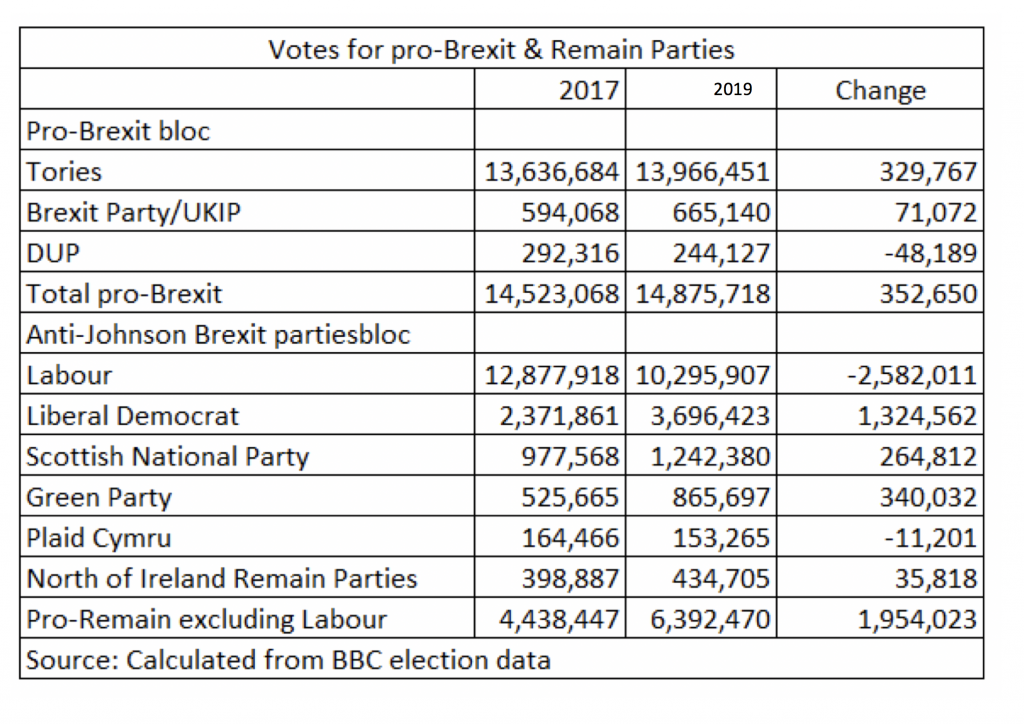
A black and white table with four columns, on the left, a list of parties, arranged by whether pro-Brexit or Remain. Then their 2017 vote, then their vote in the election of 2019 and the final column being the difference.
Between 2017 and 2019, Labour lost approximately 2.58m votes to Remain parties and 0.35m to Pro-Brexit parties

How strange, that two positions in apparent opposition to each other might both be true. As is often the case with such conundrums, they represent half-grasped insights into a deeper dynamic that makes sense of them both.

What unites the two arguments (Labour should have been more for Brexit / Labour should have been more for Remain) is an electorate who desperately wanted an end to the protracted and painful divisions over Brexit. By trying to steer a middle course on Brexit, Labour offered months, if not years more, of a debate that to many was infuriating. Back to the EU for more negotiations, then a second referendum on the result of those negotiations. And no commitment to advocating for its deal in such a scenario. This was a line that could only be drawn mathematically: by finding the centre of gravity between competing forces and trying to balance them. Sometimes, this kind of politics, of finding a position that doesn’t alienate anyone too much, can work. De Valera was a master at it. But with Johnson knowing full well how disenchanted large swathes of the public were with the delay to Brexit, Labour’s position didn’t come across as far-sighted and statesmanlike, it seemed cowardly.

In hindsight, the parliamentary manoeuvres that prevented Johnson from crashing out in a no deal scenario do not look as clever as they appeared at the time. Yes, Johnson was boxed in, but all the time he was boxed in and being refused an election, he was gaining potential energy from massive discontent with further delays to Brexit, so that when the election came, he could spring forth, like a jack-in-the-box, crying, ‘get Brexit done’ and release that frustration.

My conclusion in regard to Brexit, the all important theme of the election, is that Labour, by half-moving to Remain took a very difficult position. To have won despite this sense that they were sitting on the fence would have required the public to be more concerned about other issues, such as the NHS than Brexit, which ultimately was not the case.

Was the Labour manifesto too radical in 2019?

Naturally, the right in the British Labour Party and the Irish too, have been quick to conclude that the December 2019 UK election proves that radical socialist policies are unelectable and that the UK Labour party should move back to the ‘centre’ ground of Blair and Brown. For ‘centre’, read neo-liberal, austerity politics.

The reality seems to have been a public – and especially working class communities — who much preferred Labour’s manifesto to that of the Tories. As one Labour canvasser wrote:

Once I had made common ground with people, I encountered no prejudice, and little rugged individualism. I did this by talking the language of class, which is something the left have not done well, even under Corbyn. When I asked them about public services, about the Labour manifesto and its promises, they were very enthused, and yes, even those people who had voted Tory or who were abstaining because they ‘hated all politicians’.

Fifty-nine percent of Labour voters said they: “preferred the promises made by the party I voted for more than the promises of other parties”, the second most popular reason for voting Labour (the first being that they trusted Labour’s motives more). Whereas for the Tory voter, it was not about policy, it was about Brexit. Labour’s policies were not vote losers, in fact they were vote-winning, especially among younger voters. The graphic about this is extraordinary.

As @electionmapsuk on Twitter noted last year based on polls, the Tories would win no seats if the only voters were those aged 18 – 24 and the Ashcroft survey after the election of 2019 bears this out.

A map of the UK with constituency boundaries, which is nearly entirely red except for Scotland, mostly pale yellow, and a dot of green in Wales with some dots of orange. It illustrates the fact that if voters in the UK in 2019 had been limited to the 18 - 24 year old group, Labour would have won 600 seats.
The astonishing picture if voters had been limited to the 18 – 24 year old group is that the Conservatives would have been wiped out entirely by that generation.

What hurt Labour beyond Brexit, was not the policies as such, but the questions around them. How much would they cost and, especially, how would Jeremy Corbyn deliver them? Wasn’t he just making promises for votes, the same as all politicians do?

Here there was a difference between Corbyn versus May in 2017 and Corbyn versus Johnson in 2019 and the difference was not just a matter of the relative strengths and weaknesses of the Tory leader. Corbyn had the better of both in terms of debating issues that working class communities care about. In 2019, however, he also bore the legacy of two years of parliamentary games, during which time the sense that he was different wore off.

Of course, there was a horrible smear campaign against Corbyn from the UK’s media. They were worse in 2019 than in 2017 and on the issue of anti-Semitism, utterly hypocritical given that anti-Semitism in the Tory party is far more prevalent than it is in the Labour Party. What gave Corbyn difficulty in resisting the media attacks this time around was in part that over the intervening months he became normalised as a politician. That’s something which is very difficult to avoid if you are the leader of the UK’s Labour Party. It is also fatal for someone whose main strength in resisting the Tory-controlled media messages is that of being the outsider, the anti-establishment figure, the person who actually is sincere about causes and willing to fight them.  In 2017, there was a sense that Corbyn was all these things and that rant and rave as the billionaire class might through its media channels, the people, and especially the younger people mobilised at massive, inspiring rallies by Momentum, could shrug it all off and sing his name with passion. Of course the media froth against Corbyn: he’s ours not theirs. He’s outside of the box.

In 2019, there were nowhere near the same levels of turnout for mass rallies to take Corbyn to heart and use alternative media to build a space for him that was free from control by the elites and one which could spread to politicise wider numbers. Corbyn had, by the logic of his role over the intervening months, to play the game of politics in the usual way, among the usual public schoolboys, in the usual chamber from where the voice of working class communities has largely been absent. He had become (and, of course, to a large extent has been all his life) that despised creature, a politician.

In 2019, Momentum played a magnificent role in terms of winning the battle on social media, even with a fraction of the budget available to the Tories. And one positive from this election result for all the left going forward would be to study Momentum’s productions and campaigns on Facebook, Twitter and Instragram. Yet the higher level of co-ordination and planning by Momentum activists in 2019 compared to 2017 was met by a less passionate response. Gone were the chaotic but electric mass rallies of the earlier election and in their place, much less inspiring events.

Labour’s 2019 manifesto was more left-wing than that of 2017 but the context of a weaker mass movement around Corbyn meant, with the exception of the promises around the NHS, it looked unconvincing. My second takeaway for the left from this election is that advocating socialist policies as a response to years of austerity is unproblematic. There’s no need to rush back to the centre. What matters are our connections to communities willing to be active participants in the process of winning the goals set out in manifestos. One demand arising from a politicised working class (e.g. abolish the Water Charges) is worth a dozen from a think-tank or 1930s transitional programme. And in the period between elections, if the left have not been focused on whatever options to campaign exist outside of parliament, then we do lack credibility if we suddenly promise a golden age of socialist policies come an election.

Can the left revive after the UK election of 2019?

Easily.

On the night, the UK election result felt like a terrible blow for the left. And it was. Once again, the right and especially the anti-immigrant racist feel triumphant. This is no light matter. Yet an election should be understood as a snapshot of feeling rather than a fundamental change in the social landscape. By which I mean, for example, that the defeat of the miners in 1984 – 5 was a far worse defeat than this election result. When the best-organised, most economically strategic group of workers are crushed and eventually laid off, it’s no wonder that in industry after industry, the axe subsequently comes down on workers’ incomes and rights.

An election result, even this one, where it was so polarised, changes very little in terms of the capacity of workers to mount campaigns and strikes. And when you consider that Labour was way ahead among voters aged 18 – 44 even in purely electoral terms, that indicates a comeback in the future.

Moreover, there are features of Johnson’s victory that mean his position is not as stable as having a big majority of MPs suggests. On his right, there is Nigel Farage. There is enormous mistrust and outright anger from the hardline Brexiters towards Johnson. Tactically, they had to retreat from challenging the Tories or split the vote and let Labour into government but they hated doing so and will be seeking ways to ‘reapply pressure’ on the Tories, as Farage put it soon after the election.

On Johnson’s left, within the Tory party, are those who do not want to make a dash out of Europe at the cost of severe trading penalties. In 2018, 45% of the UK’s exports were to EU countries (and 53% of imports). This means there is a sizeable number of people in business — the natural base for the Tories — who hate Brexit. They have come to terms with it, though, as judged by the bounce in Sterling and the UK’s stock market after the election. Given a divided consensus among the Tory party’s business network and a UK population who will experience all kinds of unexpected hardships once Brexit is concluded, there’s no doubt at all that the left will bounce back. And it doesn’t have to be a matter of waiting five years until the next election. Not only are there no shortage of issues for the left to campaign on right now in the UK, the frustration of the younger worker and of trade unionists as a result of this election mean that significant strikes and protest movements are very likely to spring up in 2020

Filed Under: All Posts, Irish Political Parties

Fifty Years After the Birth of the modern Irish Republican Army

02/09/2019 by Conor Kostick 2 Comments

In August 1969 British Army arrived in Northern Ireland and despite being called ‘peacekeepers’, soon began to police the nationalist community.

In Arundhati Roy’s 2011 Walking with the Comrades there is a moment where she recaps the stories of Ajitha and Laxmi, Maoist guerrillas in eastern India. They became fighters after the Salwa Judum, a state-supported militia, attacked their villages.

The Judum came to Korseel, her village, and killed three people by drowning them in a stream. Ajitha … watched them rape six women and shoot a man in this throat.

         Comrade Laxmi, who has a long, thick plait, tells me she watched the Judum burn thirty houses in her village, Jojor. “We had no weapons then,” she says, “we could do nothing but watch.”

         Arundhati Roy is not an advocate of a guerrilla strategy and therefore was torn when she heard about an execution of a leading member of a district council carried out by the Maoists:

         I feel I ought to say something at this point. About the futility of violence, about the unacceptability of summary executions. But what should I suggest they do? Go to court? Do a dharna in Jantar Mantar, New Delhi? A rally? A relay hunger strike? It sounds ridiculous. The promoters of the New Economic Policy­—who find it so easy to say “There Is No Alternative”—should be asked to suggest an alternative Resistance Policy. A specific one, to these specific people, in this specific forest. Here. Now.

Conor Kostick sat beside Arundhati Roy.
Conor Kostick and Arundhati Roy at the Kerela Literature Festival 2019.

         I was reminded of this passage when reading the August 2019 edition of An Phoblacht and its coverage of the fiftieth anniversary of the upsurge of loyalist attacks on catholics in Belfast and the subsequent appearance of the Provisional IRA. Between 14 and 18 August 1969, eight people were shot dead and around 2,000 families, mostly catholic, turned into refugees. An Phoblacht carries the experiences of some of these who suffered the loss of loved ones, not only from the loyalist mobs but also the involvement of the RUC and B Specials in the attacks. Nine-year-old Patrick Rooney, for example, was shot in his bed when armoured cars fired indiscriminately into Divis flats.

         Ann McLarnon talks about hearing an RUC officer call out to loyalist arsonists to, ‘leave the fenian bastards to us,’ shortly before her husband Sammy was shot dead looking out from his window, having just returned from trying to put out a fire in a neighbour’s house.

         Richard McAuley, a former political prisoner, recalled:

Those organising aid for the increasing numbers of refugees in St Teresa’s needed cars and volunteers to go down to the Clonard and lower Falls to help evacuate streets. It was believed more attacks would occur. I couldn’t drive but I had willing hands. I joined up with Joe Savage who had a mini and we went to Waterville Street at the back of Clonard Monastery to take away belongings and children and elderly folks. An hour or so later, a few yards just around the corner in Bombay Street, Fifteen-year-old Gerard McAuley was shot and killed by loyalists. Bombay Street was totally destroyed in a firestorm of petrol bombs.

The defining moment in the birth of the modern IRA was ‘the Battle of St Matthews’ which took place after dark on 27 June 1970 and lasted until about 3am. Although loyalist paramilitaries, without any restraint from the British Army, began an assault on the Short Strand from several directions, they were held up by republican fighters who earned the admiration of many of the residents. And reading about these events of fifty years ago, I was brought back to the similarity of the account in Walking with the Comrades.

Imagine the warm summer night, made hotter by the flames of burning houses. Imagine the sectarian mob at the end of your street, determined to get you out because of the community you belong to, and imagine too the real danger that someone you love is about to be killed. What course of action should you take? Go to court? Sit in protest at the doors of Westminster, London? A rally? A relay hunger strike? It sounds just as ridiculous as when Arundhati Roy posed these alternatives to herself. A different policy is needed in the here and now.

Hopefully, I won’t ever face such a situation, but they have happened often enough in modern history to make it likely they will recur again. An answer has to be given to the question of what should be done. And my answer is that yes, under such circumstances the besieged community should throw up barricades and defend themselves in arms if necessary. Unlike the majority of political parties competing for power in Ireland and in India today, who howl with outrage at any expression of support for the CPI (Maoist) and the IRA, I therefore have sympathy for and a sense of solidarity with, those who took up guns against mobs that had been organised (in both cases) to intimidate and crush those wanting equality and civil rights.

Does that mean I support violence as a political strategy? In short, no. There is an enormous difference between recognising that in a particular moment, for a few hours, a community might find it necessary to battle for survival and advocating that armed struggle is a way forward for that community in the longer term. It clearly isn’t. In the case of Ireland (which I’m more familiar with, but I think the same arguments apply to India and, indeed, elsewhere), although the Battle of St Matthews led to a rapid increase in recruits for the IRA, those who joined that organisation on the basis that it was the right way to bring about change in northern Ireland were making a mistake. Several mistakes in fact.

Firstly, it wasn’t ever going to win. Or even bring about modest reform. The famous German revolutionary socialist, Rosa Luxembourg, once made the point to her more conservative labour colleagues that by choosing the path of reform rather than revolution, they were in fact, turning away even from winning reforms. Why? Because concentrating on parliamentary activity comes at the cost of belittling the types of activity that does get results, namely mass popular protest: strikes, occupations, boycotts, etc. With the advantage of hindsight it is clear that the same argument applies to politics in Northern Ireland. Tremendous energy and sacrifice by nationalists was poured into waging a campaign of armed struggle, yet the local state could not be toppled that way and insofar as concessions to the demands of the civil rights movement were made, they came in response to the broader expressions of popular discontent. There are parallels with the Irish War of Independence (1919 – 1921), where even in that much more favourable situation for an armed campaign against the British Empire, it was popular militancy that undermined Britain’s ability to rule Ireland.

Secondly, and this is related, there is an elitism in the practice of organising armed resistance to a major state that eventually introduces authoritarianism and heirarchy into the relationship between the movement and its base. The pattern of admired fighters for freedom and liberation becoming a new set of rulers is not limited to examples from Ireland. It’s a world-wide pattern and it stems from the necessity of having a tight chain of command in a military organisation as well as from having a political goal that is not explicitly socialist and egalitarian. If someone is going to run the new state after it falls to a successful armed rebellion, then who will the new politicians and officials be? Those who see themselves as having carried the struggle forward on behalf of (rather than in step with) the people hardly ever then give up the power they have obtained.

Thirdly, it was — and still is — a mistake not to have a strategy for change that involves protestant workers. Throughout the existence of the Northern Irish state there have always been protestant workers opposed to loyalism. Often trade unionists, the ability of these workers to stand up to the sectarian thugs in the community around them has ebbed and flowed over time. Often the pattern is shaped by events in the south. The more catholic and conservative the southern state, the more it provides a warning to protestants not to demand any changes that might lead to Northern Ireland leaving the UK.

Right now, there are some favourable circumstances that make it a little easier for non-sectarian protestant workers to push back against loyalism (e.g. the fact that abortion is available in Ireland as is same-sex marriage. Brexit, too, is an opportunity to hammer home the anti-working class agenda of the DUP, making it a shame that People Before Profit can’t make the most of this, because they put themselves in the pro-Brexit camp). But even throughout the worst of the troubles, that anti-sectarian protestant constituency was present. And it was a constituency that was completely neglected by the IRA. Worse, the more that the military campaign veered off from defending communities under threat to bombing campaigns, the more working class opposition from within unionism was silenced.

With a generation having grown up after the cease fire in the north, it’s a lot easier today to appreciate these points than it would have been in 1970. Even so, when I read about the events of fifty years ago and ask myself the same questions that Arundahti Roy asks about the Indian Maoists, I think the answer is clear. Yes, there can be urgent situations where working class communities have to battle with arms in hand to save themselves but no, that can not be then generalised to being a strategy for socialism or even for more limited changes.

Filed Under: All Posts, Irish Political Parties

  • « Go to Previous Page
  • Page 1
  • Page 2
  • Page 3
  • Go to Next Page »

Copyright © 2024 · Aspire Pro on Genesis Framework · WordPress · Log in