• Skip to primary navigation
  • Skip to main content
independent left logo

Independent Left

Environmentalism, socialism, freedom and equality. #liveablecity

  • About
  • Featured Articles
    • How Farming Must Change to Save the Planet
    • The Housing Crisis: Causes and Solutions
    • Socialism in Ireland
  • Contact Us
  • Podcast
  • Animal Rights
  • Archive
    • Irish Socialist History
    • Dublin City Council Housing
    • Ukraine
    • Protests Ireland
    • Reviews
    • Irish Political Parties
    • All Posts
    • Independent Left Policies
  • Why join?

Ciarán O’Rourke's features and reviews for Independent Left

Irish writers show solidarity with jailed Indian poet Varavara Rao

19/07/2020 by Ciarán O'Rourke 5 Comments

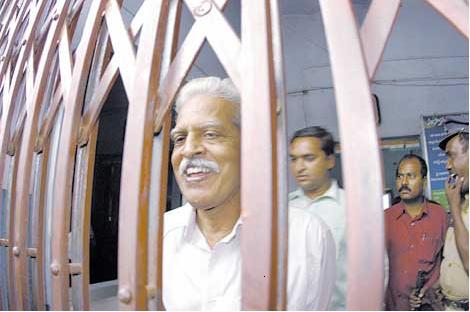
A smiling poet, Marxist and Telangana activist Varavara Rao looks out from behind shutters. Rao has been arrested multiple times by the Indian state but his most recent imprisonment has led to his contracting COVID19.
Poet, Marxist and Telangana activist Varavara Rao pictured behind bars in 2006. Rao has been arrested multiple times by the Indian state but his most recent imprisonment has led to his contracting COVID19.

The Indian poet Varavara Rao was arrested and jailed in the aftermath of a violent protest at Bhima Koregan on 1 January 2018. Alongside ten other defendants, Varavara Rao denies all the charges raised against him. The elderly poet contracted COVID-19 while in prison and has been over two years in jail under appalling conditions without trial.

‘In India,’ Arundhati Roy wrote in 2002, ‘if you are a butcher or a genocidist who happens to be a politician, you have every reason to be optimistic.’ Roy was referring to Narendra Modi, then the head of the state of Gujarat, and now (proving Roy’s characteristic clarity of political perception prophetic) the national prime minister. Modi was implicated in the notorious 2002 Gujarat riots, in which at least 1,000 Muslims were killed.

Modi’s leadership of India since 2014 has realised on a new scale violent doctrines of Hindu nationalism and caste supremacy, alongside the corporate- and elite-oriented evisceration of the public sphere that Roy could discern in outline in the form of Modi the administrator and pogromist years ago. Modi is head of the Bharatiya Janata Party (BJP), the parliamentary wing of an extreme Hindu nationalist mass movement, the Rashtriya Swayamsevak Sangh (RSS), considered by historian Benjamin Zachariah to be ‘the longest running fascist organization in the world.’

Today in India, nine people own as much as the combined wealth of the bottom five hundred million; small farmers unable to survive in competition with agri-giants like Monsanto are killing themselves in their tens of thousands every year; eight million indigenous peoples currently face forced displacement from their lands and forests by order of the Supreme Court; Muslims are demonised by the State and targeted in street-level, paramilitary violence by Hindu nationalists; while Kashmir remains under increasingly trigger-happy military occupation. Capitalism in India (as elsewhere) is nourished and sustained by a combination of state-sanctioned terror, environmental and nationalist violence, and a versatile discourse (developed by the BJP) of toxic and divisive patriotism. And that was before the catastrophe of Covid-19 arrived, presenting the opportunity, as Naomi Klein has observed, for a ‘pandemic shock doctrine‘ to be implemented.

Modi’s reign has also witnessed the dogged persecution of artists and intellectuals considered to be enemies of the BJP programme. Eighty-one-year-old Marxist and Telugu-language poet, Varavara Rao, described by supporters as now suffering from ‘deteriorating’ health and acutely vulnerable to the Coronavirus, has been imprisoned without bail since 2018: ostensibly on the charge of conspiring to assassinate Modi himself, the embodiment (as ‘strongman’) of the Hindu nationalist state in all its free-market extremism and sectarian thuggery, its vitriol and paranoia. As is true of Kurdish and Palestinian artists incarcerated for the supposedly seditious content of their works by self-described democracies – Turkey and Israel, respectively – Rao is emblematic of an art that by its very existence speaks truth to power, and, like a human mirror, exposes the ugliness and brutality by which that power maintains itself in reality. He is a poet who refuses to cater to the self-glorifying, chauvinist fantasies of national destiny that the leaders of the Indian state concoct.
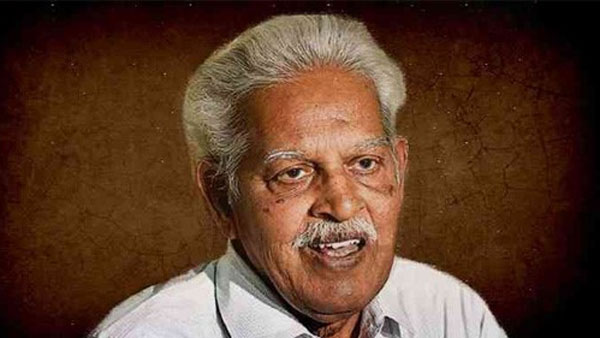
Varavara Rao pictured against a brown and amber wall. He is grey-haired, grey-moustached and is smiling, looking at someone to the right of the camera. Taken before his imprisonment in 2018, he is in good health.
Varavara Rao before imprisonment in 2018 under very harsh conditions has threatened his life.

Yelling against

The blood stained hands

Should be at the top of your voice

Rao declares in one of his most resonant poems, which goes on to suggest that the artist who can:

Come out with plain speak

That touches the heart

… will have paid some service to the human project. For Rao, crucially, this project is intrinsically revolutionary and emancipatory, as his own founding of Virasam – the Revolutionary Writers Association and his lifelong championing of the rights (as well as the languages and traditions) of indigenous and other minority populations evidences. Rao, in his poetry as in his politics, represents exactly that diversity and cultural openness, that outward-looking creativity and commitment to connection and understanding, that is the antithesis of the BJP (and other similar authoritarian, free-market and proto-fascist forces across the globe). Indeed, his poems and example may be seen as testament to, as alternative expressions of, the spirit of collective good and mutual aid that has been adopted in action by volunteers in the state of Kerala, who in cooperation with Communist and Leftist organisations have self-organised for the welfare and safety of their communities throughout the period of the pandemic. Rao’s work has always anticipated and affirmed the radical, human potential that the collective action of these volunteers has now made manifest.

In happier days (2006), Varavara Rao was at liberty to write and rally against injustice.

Likewise, in their own way the international campaigns in solidarity with Rao demonstrate the possibility that such values exist, and that such modes of collective organisation as those above may be replicated, in other communities and situations around the globe. Including here, in Ireland, where the current centre-right coalition government has already indicated its disdain for the security and rights of low-wage, essential workers, hinting at the further defunding of the public (including culture, Irish-language, and heritage) sphere. The leader of the Irish Green Party sleeps, while the increasingly visible racism, fascism, and homophobia of the grassroots far-right threatens to normalise the idea of bigoted whiteness as the mark of ‘Irish’ identity. Against such developments, communities on the ground, artists among them, should be unafraid of learning from Rao’s work and “Yelling […] at the top of your voice” for inclusivity, mutuality, and radical democracy as the basis of our life in common.

The biography of Varavara Rao

For a full account of the life, poetry and activism of Varavara Rao, please read The Making of Varvara Rao by his nephew, N. Venugopal.

Gabriel Rosenstock speaks out on behalf of Varavara Rao

Such themes also animate Gabriel Rosenstock’s dual-language poem of support for Rao.

Gabriel Rosenstock has collaborated with artist Masood Hussain to create poem-videos in solidarity with Varavara Rao.
Flowers for Varavara Rao, Bláthanna do Varavara Rao by Gabriel Rosenstock
The Isle of Light (for Varavara Rao) Inis an tSolais (do Varavara Rao) by Gabriel Rosenstock

LITIR CHUN NA hINDIA

(An file Teileagúise Varavara Rao i bpríosún)

A India!

An mbíonn meangadh ar bhéal an bhandé Saraswati

Nuair a chuireann tú do chuid filí i bpríosún

Speabhraídí orthu, buailte ag an gCóivid,

Ina suí i lochán fuail?

A India!

An sásta atá Saraswati?

       A Varavara Rao, seolaim chugat na briathra seo

       Is mé ag súil go lonróidís

        Ina ndeannach scaipthe

        A mbéarfaidh ga gréine orthu –

A India! An ligeann tú do sholas na camhaoire

Teacht isteach ina chillín gan cuardach a dhéanamh air

Nó solas na gealaí

Nó na réaltaí i gcéin?

A India!

Éagann meangadh beannaitheach Saraswati Ar a béal

LETTER TO INDIA

(On the imprisonment of Telugu-language poet Varavara Rao)

India!

Does the goddess Saraswati smile

When you imprison your poets

When, Covid-stricken, they hallucinate

Sitting in a puddle of urine?

India!

Is Saraswati pleased?

       Varavara Rao, I send you these words

       That they might glow

       Like scattered motes of dust

       Caught in fleeting sunshine –

Oh, India! Do you allow

The light of dawn to enter his cell without being searched

Or the light of the moon

Or distant stars?

India!

Saraswati’s beatific smile Is fading on her lips.

Gabriel Rosenstock is a poet, haikuist, tankaist and activist who works primarily in the Irish language. Curator of the Irish writers’ contribution to the Kerala Literature Festival 2018, where Ireland was the guest of honour, Gabriel has strong links to India’s community of writers, poets and activists.

He has put out this call to individuals, groups and schools:

It would be a consolation, indeed, if people took a few minutes today to write to him – whatever your walk of life. Send him a letter, a poem, a gift, a book – anything. If you know of any group –  a school, for instance – that would send him a ‘Get Well’ card, such a gesture would be very helpful as he is being held in conditions which have worsened his many ailments.

The address to write to is: P Varavara Rao, Under-Trial prisoner, MB-238, Cell No. 2, Circle No. HP-I, Taloja Centra Prison, Kharghar, Navi Mumbai, Maharashtra, India – 410210.
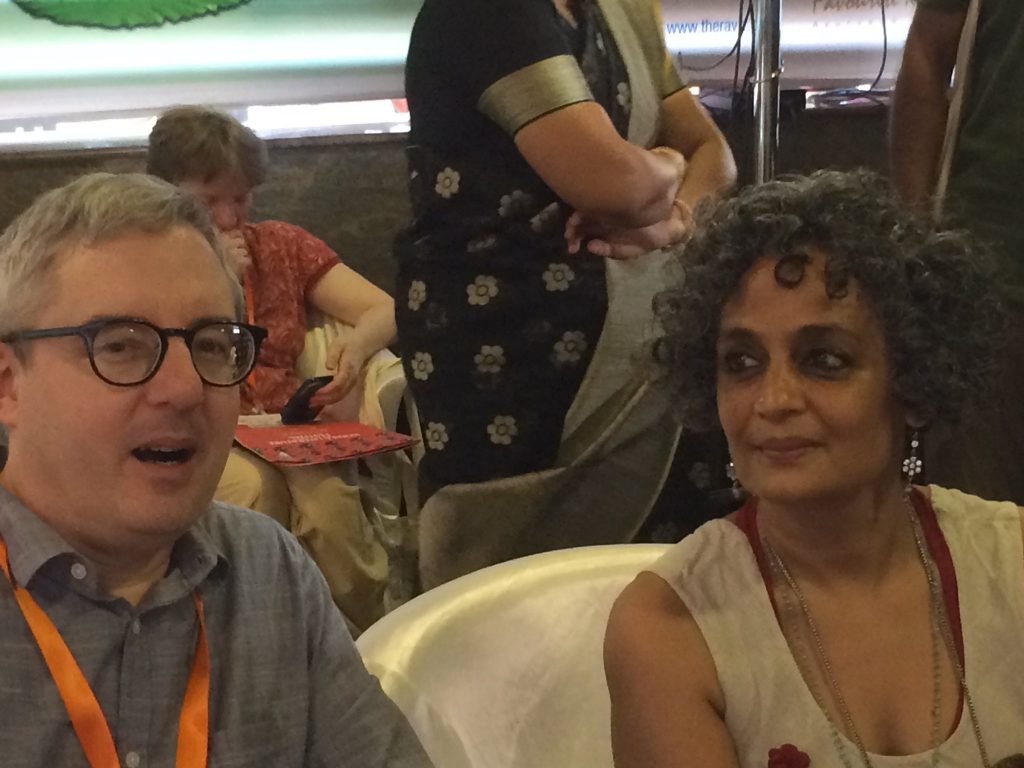
Conor Kostick alongside Arundhati Roy at the Kerala Literature Festival 2018

One of the other Irish writers who participated at the Kerala Literature Festival in 2018 is Independent Left’s Conor Kostick. Conor is the Disputes Officer of the Irish Writers Union and raised the case of Varavara Rao at the executive as a clear example of state persecution against a poet, one that deserves a response from the whole community of Irish writers, both to condemn the treatment of Varavara Rao and to express solidarity with the embattled writer.

The Irish Writers Union joined with the Board of Scottish PEN, Wales PEN Cymru, PEN America, PEN Canada and others in signing an appeal for the urgent release of Varavara Rao.

Pen International and Varavara Rao

Pen International’s writers in prison committee has been active on Varavara Rao’s case. 

They plan to publish Gabriel Rosenstock’s poem Letter to India, which has also been translated into Greek.

ΕΠΙΣΤΟΛΗ ΣΤΗΝ ΙΝΔΙΑ

(Για τη φυλάκιση του ποιητή της γλώσσας

Τέλουγκου, Βάραβάρα Ράο)

Ινδία!

Χαμογελά η θεά Σαράσβατι

Όταν φυλακίζεις τους ποιητές σου

Όταν, γεμάτοι Covid, έχουν παραισθήσεις

Καθισμένοι σε μια λίμνη από ούρα;

Ινδία!

Είναι η Σαράσβατι ευχαριστημένη;

Βάραβάρα Ράο, σου στέλνω αυτές τις λέξεις

που μπορεί να λάμψουν

σαν σκόρπιοι κόκκοι άμμου

στο φευγαλέo φως του ήλιου –

Ω, Ινδία! Aφήνεις

Το φως της αυγής να μπει στο κελί του χωρίς να

ελεγχθεί

Ή το φως της σελήνης

Ή τα μακρινά άστρα;

Ινδία!

Το μακάριο χαμόγελο της Σαράσβατι

Σβήνει στα χείλη της.

(Greek version: Sarah Thilykou)

Sarah Thilykou is a poet, editor and translator from Thessaloniki, Greece.
Filed Under: All Posts, Protests Ireland

Socialism and Sinn Féin

14/07/2020 by Ciarán O'Rourke 1 Comment

SINN FÉIN LEADER Mary Lou McDonald standing outside of Leinster house, with her front bench party members distributed around her at a safe social distance. Many of them have their hands held in front of their bodies, as though choreographed.
Mary Lou McDonald announcing the Sinn Féin front bench 2 July 2020. The party is eager to participate in government.

“Sinn Fein has won the election,” declared party leader Mary Lou McDonald (with some justice) in early February, as results confirmed that for the first time in the history of the Irish State, neither Fianna Fail nor Fine Gael had achieved a clear majority or path to forming the next government, while “Ireland’s left-wing nationalist party” had witnessed an unprecedented surge in first-preference votes. Self-identified socialists, in some cases shocked by the “voter revolt” that had just occurred, took the opportunity to proclaim the return of radical politics to the realm, interpreting Sinn Fein’s electoral ascendancy as symptomatic of “a working-class backlash” against austerity and “a burning desire for radical change”, which the all-island party was in a unique position to deliver. “Sinn Féin’s ultimate aim is the creation of a thirty-two-county socialist republic”, read one commentary in the New York-based journal, Jacobin, which also praised “Sinn Féin, in particular” for channeling “discontented working-class nationalism in a progressive and anti-imperialist direction” in recent years. Hopes were high indeed.

As the new (if also somewhat familiar-looking) centre-right government has finally formed and is beginning to settle into its groove, now may be as good a moment as any to reflect on the election that was, and specifically the euphoric claims made for Sinn Fein as a force for progressive change. Bearing in mind that there are other, and arguably more important, ways of measuring radical and mass consciousness than votes (a point often ignored by the self-aggrandizing Left in general), it’s nevertheless true that Sinn Fein, running on a broadly worker-oriented, social democratic programme, received the endorsement of communities suffering the real-time effects of an engineered lack of adequate and affordable housing, healthcare (including childcare), education, and other basic services in the State. In other words, the Sinn Fein vote, and the accompanying leftward transfers, was one expression of a wider disaffection with neoliberal austerity and systematised inequality peddled by the two mainstream parties for years. Likewise, few would deny that concise, targeted, and eloquent media performances by Mary Lou McDonald throughout the election helped to boost the party’s profile – certainly compared to the smug, boy’s-club self-satisfaction exuded by Varadkar and Michael Martin, and perhaps also in light of the (at times hysterical) hostility shown to Sinn Fein by a number of media outlets.

Northern Ireland: Sinn Féin in government has not alleviated poverty

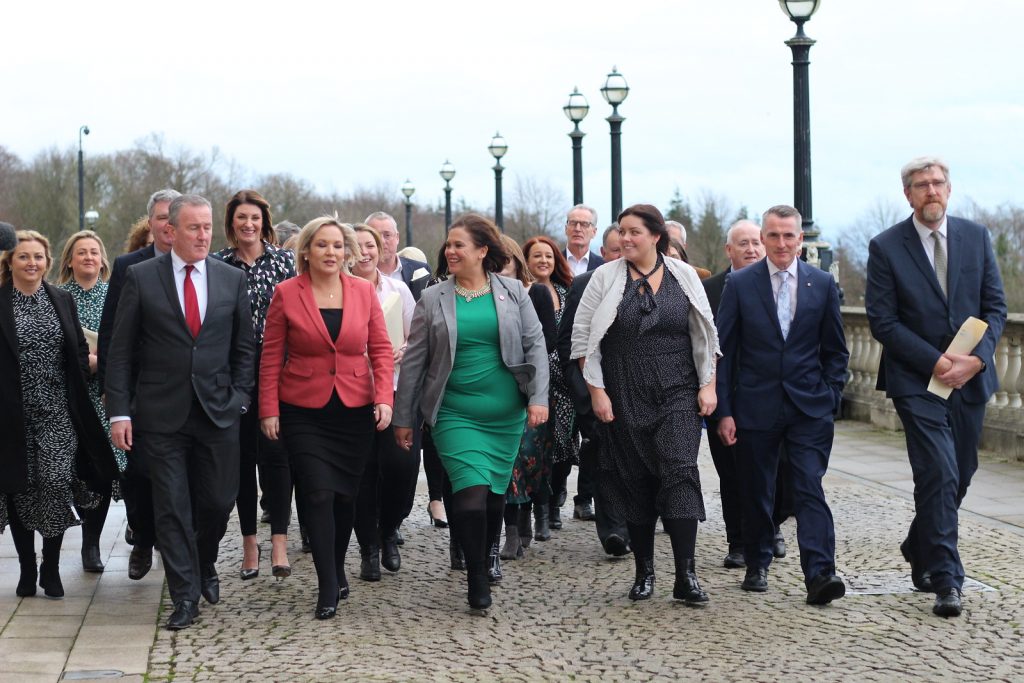
December 2019 and Sinn Féin leader Mary Lou McDonald alongside Deputy First Minister Michelle O'Neill pose with the newly appointed Ministers and Sinn Féin members of the Northern Ireland Assembly. They are walking on cobbled stones, all in suits, McDonald in a Green dress, O'Neill in a red jacket.
In December 2019 Sinn Féin resumed their role in the management of Northern Ireland and while the minsters and members posing with Deputy First Minister Michelle O’Neill and party leader Mary Lou McDonald appear cheerful, they preside over record poverty levels.

Significantly, the fact that over the past two decades Sinn Fein have been shopkeepers for austerity in Northern Ireland, where 300,000 people are now estimated to live in poverty, barely featured in the critiques levelled by Fianna Fail and Fine Gael against their emerging rival. Instead, both attempted to portray the party (whose most prominent spokespeople during the election included Eoin Ó’Broin and Pearse Doherty) as terrorists. “Outrage about the IRA looked strange”, one Sinn Fein organiser accurately noted, “when espoused by a government that wanted to commemorate the notorious ‘Black and Tans’ just months earlier.” This being said, the contradictions of Sinn Fein’s dual record, North and South, the at times considerable gaps between its rhetoric on the air and its record on the ground, are nonetheless live issues for any forward-looking Leftists, anticipating the political struggles to come.

Sinn Fein’s anti-racism and anti-imperialism, mentioned above, are arguably cases in point. To give credit where credit is due, in the context of rising xenophobic violence and fascist organising across Ireland, Leitrim TD Martin Kenny proved himself enough of an anti-racist to have a death-threat issued against him and an arson attack on his car 28 October 2019. His statements made a difference, and he wouldn’t have done so if there wasn’t some kind of anti-racist culture or tendency within Sinn Fein as a party.

Martin Kenny's car is barely visible inside a ball of bright yellow flame that is engulfing it and burning to a height of around 20 metres. On 28 October 2019, the car of Sinn Féin TD Martin Kenny was set on fire after he spoke out in support of people seeking asylum
On 28 October 2019, the car of Sinn Féin TD Martin Kenny was set on fire after he spoke out in support of people seeking asylum

Other individual examples could be cited to support this view. There is an obviously problematic element, however, in the (highly elitist) claim that Sinn Fein has uniquely and consistently channelled “discontented working-class nationalism in a progressive and anti-imperialist direction.” Such an argument sidesteps – perhaps deliberately obscures – the issue of Sinn Fein’s complicity, once again, in creating and upholding austerity programmes and accommodating themselves to political corruption of various kinds in the North, all of which surely deepens said working-class discontent. And as for the supposedly unwavering internationalism of Sinn Fein, such principles were notably absent in its decision to host a delegation of Israel’s murderously right-wing and racist Likud party, trading solidarity with Palestinian struggle for what was apparently a cheap PR effort to portray itself as a ‘peace-building’ organisation. “This is very disheartening to us here in Gaza,” said Haidar Eid (a university professor and member of the steering committee of the Palestinian Campaign for the Academic and Cultural Boycott of Israel) in the context of the continuing Israeli annexation, siege, and apartheid: “We call on Irish comrades to condemn these meetings in the strongest possible terms.”

In June 2019 a delegation from Israel's Likud party visiting Belfast where they met with Sinn Féin members, including Pat Sheehan. Seven men with suits and ties stand at the back, one woman standing on the far right. Two women are seated at a polished wooden stable in front of the standing members of the delegation.
In June 2019 a delegation from Israel’s Likud party visiting Belfast where they met with Sinn Féin members, including Pat Sheehan.

While one may argue that no party gets it right all the time, but relies on the processes of democracy and transparency to hold it and its members to account, the lapses and discrepancies above are telling. This is particularly the case in view of Sinn Fein’s ever-developing habit (albeit one indulged equally by other tendencies of the Irish Left) of dismissing any party or electoral candidate that can be perceived as not adequately committed to the grand socialist project of getting Sinn Fein into government. “Honest questions [need] to be asked of the various left-wing independents” who supposedly encroached on Sinn Fein’s electoral turf during the 2020 election, we’ve ben told, while “the various Trotskyist parties” have also been criticised, fairly, for the overtly factional electoral strategies introduced in certain constituencies (including Dublin Bay North).

Voting records show that socialism comes second for Sinn Féin

Critique, of course, is a necessary part of the political fray, radical or otherwise. But the fact remains that “honest questions” could equally be asked (and have rarely been answered) of Sinn Fein regarding its penchant, both locally and nationally, for rejecting or abstaining on votes of key social concern, including public housing, and most recently the Special Criminal Court (which continues to be opposed by Amnesty International). Put bluntly, the party seems forever capable of conceding its political principles to appease or reinforce the consensus of the political establishment; in some instances (such as abortion rights and the campaign to repeal the eighth amendment), moreover, key political figures in the party have proven skilful in adjusting their profile to reflect the radical tide of public opinion, after the high-water mark has been reached. Observing this pattern, one writer dubbed this “The Adaptable Sinn Fein” syndrome.

The disconnect between rhetoric and reality often seems palpable, and never moreso than when party organisers remind their (considerable) audience that “left-republican politics is best practiced in communities, workplaces, and on the streets rather than in parliamentary chambers.” This is certainly true. But the fact remains that if, as a movement or organisation, your only presence in “communities, workplaces, and on the streets” is promoting your own brand or looking for votes, and if your party furthermore has a proven record of supporting centre-right policies, either as a coalition partner or by abstaining on crucial votes, then your politics comes dangerously close to pageantry. As the cases of Podemos in Spain and Syriza in Greece have shown, if your rhetoric and analysis are centred on socialist revolution, but your tactics and practical goals are designed primarily to increase your party’s chances of getting into government, no matter the cost, you can very easily end up by sending ‘the masses’ home to wait for a radical change that never quite happens: settling for social reforms that can easily reversed by the next centre-right (or even far-right) government that bulldozes in after you’ve failed to deliver, as occurred in Brazil, with the rise of Bolsonaro.

Can Sinn Fein’s socialism meet the demands for radical change slowly coming to the boil, North and South? Time will tell. But Leftists would do well to take heed of Sinn Féin’s 2020 spokesperson on Housing, Eoin Ó’Broin, when he drew the conclusion and caveat in 2009 that in the contest between the party’s republican and socialist tendencies, the latter had always been “relegated to a future point in the struggle, would always be underdeveloped, as the more immediate needs of the national struggle took precedence.”

Filed Under: All Posts, Irish Political Parties

Review: Reading ‘Capitalism in the Web of Life’ by Jason W. Moore after COVID19

02/06/2020 by Ciarán O'Rourke Leave a Comment

A glass sand timer stands on the left of the image against a stark black background, resting on a white table. Inside the top half of the glass is a miniature tree in sandy soil. Underneath is the skyline of a modern city. The image evokes an impending collapse of the web of life by capitalism.
Entwined and destructive, capitalism undermines the web of life.

A few weeks into the current lockdown, as fatalities and reported cases of COVID19 were continuing to rise, news from the frontlines of Ireland’s food production and agri-sector began to arrive, casting an unsettling light on the many – and now overtly dangerous – levels of exploitation on which this cornerstone of the national economy is based.

First, in April, the public learned that Keelings had flown in (and lodged in shared accommodation) almost 200 casually contracted workers to shift the bulk of the coming season’s fruit for market: a decision that seemed deliberately to ignore the health and safety guidelines specified by the HSE’s emergency Coronavirus taskforce. Such a course of action was justified by Keelings on the basis of keeping domestic and global supply chains open, with little comment made as to the risks posed to the fruit-pickers themselves, their families, and, indeed, anyone in contact with them, as a result of company policy.

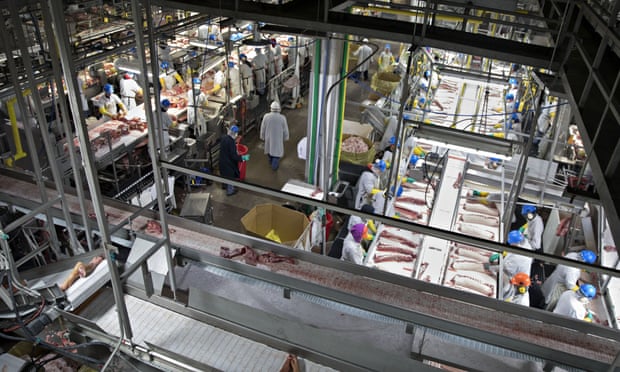
This reckless managerial focus – on meeting previously projected revenue margins, at workers’ expense and during a global pandemic – reared its head again in a similar, if even more disturbing, case of industrial recalcitrance in May, when an outbreak of the potentially lethal virus was recorded in a number of Irish meat factories. The sub-heading to The Guardian newspaper’s coverage of the scandal was appropriately ominous: ‘Workers share COVID19 fears over lack of social distancing, crowded accommodation and being forced to buy their own PPE [Personal Protective Equipment]’.

Viewed from high up on a gantry, white-coated workers are working on production lines of slabs of meat. An Irish meat plant: where despite the outbreak of COVID19 clusters, workers and animals were subject to 'business as usual' practices.
Irish meat plant: where despite the outbreak of COVID19 clusters, workers and animals were subject to ‘business as usual’ practices.

The story makes for difficult reading, exposing a culture of normalised exploitation and industrial slaughter, in which low-paid, poorly contracted migrant workers ‘feel intimidated and vulnerable’, unsure of their legal rights, and fearing for their medical safety, with one whistleblower also expressing his combined horror and sadness at the cruelty with which, even in normal circumstances, Irish cattle are butchered and turned into meat. In such a scenario, COVID19 posed an immediate threat to the life and health of factory employees; and yet the overall impression the interviews conveyed was that, from the point of view of both the workers and the animals they were dealing with, business as usual was a systematically ruthless and dehumanising affair.

Although occurring five years after the publication of Jason W. Moore’s book, both incidents could be cited as living (if also quite morbid) proof of the validity of his central argument: that ‘Capitalism is not an economic system; it is not a social system; it is a way of organizing nature.’ Cheap labour, migrant and working-class bodies, brutalised animals, rigorously schematised seasonal cycles, are all – equally and as a whole – fodder for the relentless pillage, the forever-primary drive for profit, that is capitalism’s life-in-the-world.

Capitalism in the Web of Life is a critique and revision of environmental concepts and approaches, rather than a miscellany of insights into present environmental struggles (as in Naomi Klein’s This Changes Everything: Capitalism vs The Climate, for example). Such a focus, however, is not necessarily negative: what Moore’s analysis lacks in activist-oriented urgency it arguably makes up for in the expansiveness of its critical scope. Moore’s writing is that of a sincere, discerning and formidable critic of ecological and political arrogance, both capitalistic and leftist; and crucially (against that most insidious of critical bugbears) he is methodical and convincing in suggesting an alternative series of attitudes and understandings.

The book cover of Capitalism in the Web of Life, by Jason W Moore. The book is facing a little to the right, so the spine can be seen and the V for Verso logo of the publisher. It is a simple cover with white writing on a black background. The only art is a white twisting column that suggests smoke rising from a fire.
Capitalism in the Web of Life, Jason W. Moore

As implied by the title, Moore sets out to dismantle the distinction between humanity and nature, industrial civilization and the environment, as binary, separate forces, and instead proposes a long-view and multi-faceted perspective: one that recognises how dependent human activities and power dynamics are on natural seasons, cycles, and ecosystems. We change them, Moore argues, and they change us, continuously: and it is on such a ‘world-ecology’ that the success of future efforts to disband and replace neoliberal civilization with radical and sustainable communities-in-process will depend. ‘A capitalist looks at a forest and sees dollar signs,’ Moore observes,

an environmentalist sees trees and birds and soils; a world-ecologist sees how humans and other species have co-produced the forest, and how that “bundled” forest simultaneously conditions and constrains capital today.

At first glance, the significance of such an argument may seem somewhat remote: an example of the kind of linguistic and theoretical tinkering that only an academic Marxist could afford to spend their time discussing or disputing. But as Moore’s analysis unfolds, its pertinence to contemporary anti-capitalist struggles is clear to see. ‘Yes, diseases make history,’ Moore notes, but only insofar as they (and the conditions that intensify their effects) are understood as ‘bound to commerce and empire’.

So today, as historian Mike Davis and others have also argued, the COVID19 pandemic itself may be viewed as having its origin in – its capacity to wreak so much damage stems from – the networks of relentless intervention and attempted control (over bodies both human and ‘natural’) that sustain the capitalist project globally. Broadly speaking, the same may be said of the climactic and civilisational dangers that accompany continued carbon emissions, or global warming. In Moore’s terminology, capitalism’s ‘way of organising nature’ is inherently destructive of the ‘web of life’ on which its own existence (along with everything else) depends. Or as Karl Marx observed:

All progress in capitalistic agriculture is a progress in the art, not only of robbing the labourer, but of robbing the soil; all progress in increasing the fertility of the soil for a given time, is a progress towards ruining the lasting sources of that fertility […] Capitalist production, therefore, develops technology, and the combining together of various processes into a social whole, only by sapping the original sources of all wealth: the soil and the labourer.

To his immense credit, Moore treats the latter perception less as an aphorism to be glibly quoted than as a key to a palpable, dialectical conflict in which we are, collectively, enmeshed. Likewise, recalling Marx’s earlier recognition of ‘the merciless vandalism’ with which land usage in both England and Germany had been standardised by way of ‘the expropriation of the great mass of the people from the soil’, Moore surveys the twenty-first-century vista of global, market-driven, genetically modified industrial agriculture as a field of combined ecological and material violence. He concludes:

We can say with some confidence that food – not just land – has become a central site of the world class struggle in a way that is entirely unprecedented, and unthinkable even three decades ago….. As neoliberalism’s [manufactured] definition of food has rolled out – shifting from the Green Revolution’s caloric metric to the ‘edible food-like substances’ that now line our supermarket shelves – it seems to have made food, and by extension nature, much more fundamental to the Old Left questions of liberté, égalité, fraternité than ever before. The class struggle of the twenty-first century will turn, in no small measure, upon how one answers the questions: What is food? What is nature? What is valuable?

So it is, Moore suggests, that campaigns for food justice, for ethical and non-industrialised farming, for environmental sustainability, for ecological restoration, all drive to the heart of the toxic, earth-spanning, wage-devouring monster that is the modern capitalistic world-order (or disorder). At the same time, these seemingly specialised movements challenge activists to sharpen our understanding of what we mean by – how we envision and situate ourselves, our resources and our relationships within – that horizon of political emancipation that draws us forward.

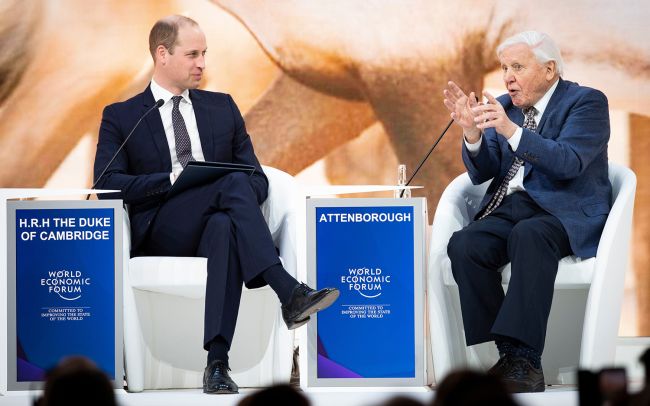
Moore’s critical perspective is illuminating, his meticulous dissection of capitalist accumulation most incisive when he relates his analysis to the tensions and contradictions of our present moment. Moore is refreshingly and emphatically opposed, for example, to the likes of Sir David Attenborough, for instance, who in an interview with the so-called Duke of Cambridge at the World Economic Forum at Davos last year stated that ‘the Anthropocene, or age of humans’ was effectively to blame for climate change.

William Windsor and David Attenborough seated at the World Economic forum. Attenborough is on the right and is making a point with raised hands in an animated gesture. Windsor looks like he is trying to contain a smirk. There is a backdrop of some large brown animals and a foreground of the tops of the heads of the audience.
David Attenborough and some inexpert but well-suited male at the World Economic Forum 2019.

‘The Anthropocene makes for an easy story’, Moore writes,

Easy, because it does not challenge the naturalized inequalities, alienation, and violence inscribed in modernity’s strategic relations of power and production. It is an easy story to tell because it does not ask us to think about these relations at all. The mosaic of human activity in the web of life is reduced to an abstract Humanity: a homogeneous acting unit. Inequality, commodification, imperialism, patriarchy, racial formations, and much more, have been largely removed from consideration. At best, these relations are acknowledged, but as after-the-fact supplements to the framing of the problem.

Such skepticism of ‘The Anthropocene’ and its eloquently embedded public advocates in the Euro-American climate movement is well-founded, as even a cursory examination reveals: of Attenborough himself, who previously has posited famine as an acceptable natural check to the supposed ‘disaster’ of ‘overpopulation’ in the global South, or a figure like Michael Moore, whose most recent film gives credence to the same Malthusian and racist world-view.

By contrast, Moore’s work correctly pins the blame for impending climate collapse on the the globe’s expropriators-in-chief and the systematised practices that serve them, insisting that the fight for an ecologically sustainable society and future is by nature a struggle against ‘[i]nequality, commodification, imperialism, patriarchy, racial formations, and much more’. Moore’s sober, but clear-eyed discovery is a valuable one: that we are both riven and empowered by our own interconnectedness; that with so much at stake, so much already lost and gone, disfigured and deranged, we still, together, have a world to win.

Filed Under: All Posts, Reviews

Review: An Indigenous Peoples’ History of the United States by Roxanne Dunbar-Ortiz

03/03/2020 by Ciarán O'Rourke 1 Comment

The cover of Roxanne Dunbar-Ortiz's An Indigenous Peoples' History of the United States. A cloudy sky, distant horizon and savanna on which is the faded US flag form the background to the text.
Dunbar-Ortiz’s research speaks to a number of political realities – especially racism – that have evolved in the years since publication in 2014

Speaking in the extended aftermath of the so-called Indian Removal Act of 1830, Andrew Jackson, the slave-owning US president famed for his previous (and merciless) warfare against Creek and Seminole tribes in the American South, laid out the case for indigenous extermination. ‘They have neither the intelligence, the industry, the moral habits, nor the desire of improvement which are essential to any favorable change in their condition,’ he claimed, concluding that as the many native communities of the South were now ‘established in the midst of another and a superior race, and without appreciating the causes of their inferiority or seeking to control them, they must necessarily yield to the force of circumstances and ere long disappear.’ By the end of Jackson’s second term of office, ‘the force of circumstances’ – implemented by a combination of wild-firing federal troops and unrestrained settler militias – had resulted in the violent relocation of almost sixty thousand indigenous people from their land and homes to regions west of the Mississippi river, in what historians (shy of the term ethnic cleansing) oftenrefer to as the ‘Trail of Tears’.

‘All the presidents after Jackson march in his footsteps,’ Dunbar-Ortiz by contrast observes in An Indigenous Peoples’ History of the United States, a powerful chronicle of native life and struggle over the approximately five centuries of European colonization that witnessed the shaping of the USA as we know it. ‘Consciously or not,’ Dunbar-Ortiz writes, America’s ‘ruling class’ has consistently imitated the task Jackson set for his own administration: how (in her words) ‘to reconcile democracy and genocide and characterize it as freedom for the people.’ Tellingly, Jackson’s portrait today graces the modern $20 US dollar bill, while the nation’s current commander-in-chief has praised him as a political forefather to his own brand of toxic, bigoted, wealth-wielding populism.

In Jackson’s era as now, however, the imperialistic arrogance of the US government was met with (at times brilliantly effective) resistance; and it is one of the many merits of Dunbar-Ortiz’s historical account to foreground the continuous uprisings of indigenous peoples, as well as the persistence and diversity of indigenous cultures, in the face of intensifying colonial aggression. Cataloguing the relentless and self-heroising savagery of US policies (federal and settler alike) towards indigenous populations, her narrative in the process shakes loose many of the foundational assumptions on which American politics and historiography has traditionally been built. Eloquently, meticulously, and with an almost devastating critical focus, she not only dissects the doctrines of manifest destiny (the right to colonize Westwards) and civilizing mission (the right to whitewash such colonization, and expand it globally), but also probes inherited concepts concerning property, the use and ownership of land, industrial development, and the like. ‘The Haudenosaunee peoples,’ she notes of the alliance of tribes spanning the Great Lakes and the St Lawrence River to the Atlantic, and as far south as the Carolinas,

avoided centralized power by means of a clan-village system of democracy based on collective stewardship of the land. Corn, the staple crop, was stored in granaries and distributed equitably in this matrilineal society by the clan mothers, the oldest women from every extended family.

As here, throughout her account Dunbar-Ortiz refuses to fossilise indigenous traditions, writing instead as if the same modes and formations of communal organisation were living possibilities (and perhaps they are). In a similar fashion, we encounter Tecumseh: a Shawnee warrior and one of the key figures of an indigenous confederacy formed in the early nineteenth century to resist the decrees and incursions of the US government and speculators. ‘The way, the only way to stop this evil’, he is recorded as saying,

… is for the red people to unite in claiming a common and equal right in the land, as it was at first, and should be now, for it was never divided, but belongs to all. Sell a country?! Why not sell the air, the great sea, as well as the earth? Did not the Great Spirit make them all for the use of his children?

Such episodes hold up a mirror to the many, violent commodifications of capitalist society – modern and historical – exposing its delusions, as well as its frequent brutality (Tecumseh himself was eventually killed in 1813).

As with issues of land and property, the question of class – of who works, who gains, and how these social relations are developed and enforced over time – is latent in much of the story that Dunbar-Ortiz returns to the record, and sometimes openly bares its fangs. ‘Although a man of war,’ she writes, General Philip Sheridan of the Union Army ‘was an entrepreneur at heart’; she quotes Sheridan in a letter to Ulysses S. Grant in 1867, ‘We are not going to let a few thieving, ragged Indians stop the progress of [the railroads].’ Systematic, sustained colonial violence was the pre-condition for capitalist accumulation in the emerging republic; tracing the profit motive through its history is to discover, again and again, the stench of scorched earth and race hatred that made many of its most esteemed emissaries rich, from the oil and railroad baron, John D. Rockefeller, to industrialist and Wall Street tycoon, J.P. Morgan.

Sheridan himself is an unsettlingly emblematic figure in this narrative. The originator of the genocidal aphorism that the only good Indian is a dead Indian, this ‘entrepreneur at heart’ was born to Irish parents who fled serf-like rural poverty in Cavan for America in the early nineteenth century. As such, Sheridan was never fully accepted as an equal by the political and military elites who nonetheless praised his uncompromising zeal as a commander and, indeed, his later supposed achievements as an environmentalist (he championed the founding of Yellowstone National Park, after having forcibly cleared the same region of its original inhabitants). This dynamic is evident in Abraham Lincoln’s aloof and subtly eugenicist description of the fast-rising officer: as a ‘brown, chunky little chap, with a long body, short legs, not enough neck to hang him, and such long arms that if his ankles itch he can scratch them without stooping.’

Sepia portrait of General Philip Sheridan of the Union army. He is looking past the right shoulder of the viewer, wearing a Union army jacket with two stars conspicuous on the left shoulder, which is nearest the viewer, as he is posed at an angle. He is bearded and has a thick moustache.
General Philip Sheridan of the Union army

Sheridan’s case was in many ways typical. In the second half of the nineteenth century, some of the most ruthless regiments and settler militias of the emerging United States – responsible for the murder, mutilation, and destruction of thousands of indigenous tribes and villages – were lead and stocked by Irish emigrants, themselves (like their relatives in Ireland) very often racialised as un-human or sub-human in popular and press culture. One result, as David Roediger has written, is that ‘politicians of Irish and Scotch-Irish heritage’ in the same period worked diligently to disseminate ‘the idea that a new white American race, decidedly inclusive of the Irish, had superseded the Anglo-Saxon race as the benchmark of fitness for citizenship’ in the new democracy: setting the terms of a discourse with which white nationalists and supremacists, including the likes of Steven Bannon, still engage. Such themes are of course particularly resonant in Ireland today, which in recent months has witnessed a surge in racist mobilising and violence deliberately designed to appeal to a (diffuse, but insidious) tradition that ties Irishness to notions of white supremacist victimhood. Some awareness of the history of these ideological postures is arguably more necessary than ever. As Dunbar-Ortiz summarises, ‘living persons’ may not be ‘responsible for what their ancestors did,’ but ‘they are responsible for the society they live in, which is a product of that past.’

Time and again, in fact, we are reminded that populations dehumanised, displaced, and even exterminated by colonial dogmas and military directives have participated, in one form or another, in the ethnic cleansing and conquest of indigenous communities elsewhere: communities with whom, superficially at least, they would appear to share common cause. On this last point, she is unflinchingly factual, observing that former slaves and freedom fighters of colour in the American Civil War, for example, joined (and were deliberately stationed by federal authorities on) the frontlines of anti-guerilla campaigns against native communities, an apparent contradiction that adds an edge to Bob Marley’s song on the same subject, ‘Buffalo Soldier’. Likewise earlier, during the Spanish campaigns of the sixteenth century, we learn that ‘Cortés and his two hundred European mercenaries could never have overthrown the [Aztec] Mexican state without the Indigenous insurgency he co-opted’. In this case, however, one of the great strengths of Dunbar-Ortiz’s account is her equally clear-eyed perception that ‘resistant peoples’ hoping ‘to overthrow [an] oppressive regime’, should not be blamed for, their cause cannot be used to excuse, the ‘genocidal’ aims of the ‘gold-obsessed Spanish colonizers or the European institutions that backed them.’ By persuasion, force, or guile, every colonial enterprise in history has enlisted sections of the populations it sought to subjugate for the furtherance of its aims (exploiting existing divisions in order to secure whatever form of hegemonic power best favoured its own perceived interests); the racist, resource-hungry killing machine of the Spanish conquest was no exception to this pattern.

Although completed in 2014, Dunbar-Ortiz’s research and approach nevertheless speak to a number of political realities that have evolved in the years since. Reading so unified an account of indigenous life and struggle, indeed, it’s difficult not to interpret the extreme levels and incidence of violence against indigenous women in the US today (‘one in three Native American women has been raped or experienced attempted rape, and the rate of sexual assault on Native American women is more than twice the national average’) as a continuation of a history of state formation for which the murder and brutalisation of native women and children specifically was standard procedure: whether in crimes such as the Sand Creek Massacre of 1864 (one of several atrocities that Dunbar-Ortiz rightly posits as precursors to later chapters in America’s imperial story, including the Mai Lai Massacre of 1968) or through federally implemented separation and re-education policies (forcing children into missionary, abuse-laden institutes) of the early twentieth century.

A red banner fills the bottom half of the image with the words: Defend the Sacred. Holding it are members of the Sioux community and behind them a crowd. The issue concerns the Dakota Access pipeline, North Dakota.
Protesters near the the Sioux reservation, Standing Rock, opposed to the Dakota Access pipeline, North Dakota

Dunbar-Ortiz’s prose is also palpably sensitive to the ‘centuries of resistance and storytelling passed through the generations’ of indigenous communities, reminding readers that for native tribes still living under conditions of imposed marginality and social invisibility, ‘[s]urviving genocide’ is itself a form ‘dynamic, not passive’ resistance. From which vantage-point, the Wet’suwet’en nation’s ongoing, militant opposition to the Canadian government’s decision to install a gas infrastructure on their land – like the Standing Rock Sioux Tribe’s resistance (beginning in 2016) to the Dakota Access Pipeline in the US – may be seen as part of the long, many-seasoned trajectory of indigenous self- and environmental protection that Dunbar-Ortiz outlines: protection in the face of settler-colonialist state projects that have always regarded such actions as illegitimate, such communities as disposable. As the preface has it, everything in this ‘history is about the land: who oversaw and cultivated it, fished its waters, maintained its wildlife; who invaded and stole it; how it became a commodity (‘real estate’) broken into pieces to be bought and sold on the market.’ In that respect, the struggle goes on, drawing on traditions that books like this keep fresh in the memory, vivid as spring.

Filed Under: All Posts, Reviews

Derek Mahon, A Poet of The Left

14/12/2019 by Ciarán O'Rourke 1 Comment

A portrait of Derek Mahon, poet, who describes himself as having a penchant for left-wing imagery. He is wearing a blue and purple vertical stripped shirt and is looking directly at the camera with a slight smile.
Derek Mahon: a poet of and for the political left

By Ciarán O’Rourke

‘I know the simple life / Would be right for me’, wrote Derek Mahon in Ovid in Tomis, ‘If I were a simple man.’ A glad complexity, it seems, is the order of the day; a dynamic interweaving of expression and insight evident throughout Mahon’s work, lending the poems both a clarity and a frequent mystery. ‘It is not sleep itself but dreams we miss’, Mahon posits (with aphoristic aplomb), ‘We yearn for that reality in this.’ Known for his intellectual force and technical fluency, and admired as a translator from multiple verse traditions, the Belfast-born poet was universally recognised in establishment literary circles as a leading figure of his generation and moment. Less mentioned, however, is that – in its breadth, emphasis, and overarching perspective – his work invites celebration and cultural co-optation by socialists, anarchists, and every species of utopian realist in between. For although formally traditional, his poems are critically incisive and, in brief, radically human to the core.

It’s a point that’s seldom heard, and so, perhaps in a small way, worth reiterating. Insofar as the ethical compass and content of Mahon’s poetry are discussed at all, the conversation tends to be couched in a discourse of reflexive academic qualification: so that the specific details of Mahon’s political commentary and commitment, at any one point in his poetic career, are presumed to be offset or made redundant by his aesthetic, philosophical, or even formal concerns at another. We are left with a ‘poet of divided affiliations’, who maintains ‘a cautious distance from schools and groups (whether literary or political)’, his stylistically graceful poems ‘characterised by indirection and obliquity’, even as they depict (occasionally) a ‘humanity… powerless against the inevitable forces [that] shape human life.’ We end up, in other words, with a political poet, but one whose work is said to exceed its own politics: thus transforming the latter into an empty category, rimmed by abstractions such as The Force of History or The Demands of his Time.

Such a trend, of course, arguably relates to culture in general, and not to the work of Mahon alone. It would certainly be a tempting thesis to explore: that in a neoliberal society, art and literature are circulated in order to be owned, to placate, or to make life as it is (exploitative and miserable as it may be for many) more liveable and not to subvert the tenets by which that society is organised. In which scenario, what we think of as literary criticism would in fact amount to nothing else than a series of discursive adjustments and revisions, a sort of academic vanishing trick whereby whatever creative radicalism was identified in an art-work, oeuvre, or historical moment would disappear as soon as it was declared. Sound familiar?

At any rate, for gentle-hearted heretics of all stripes – anti-establishmentarian in their politics, but nevertheless in need of the emotional and critical sustenance that literature provides – there is surely some merit in re-examining the work of poets, great and mighty, and the inherited assumptions that frame our encounters with them. In Mahon’s case, moreover – a writer who calls himself an ‘aesthete’ with a penchant ‘for left-wingery […] to which, perhaps naively, I adhere’ – doing so helps us to reach a fuller and clearer understanding not only of his literary back-catalogue, but of the power systems that rule and rack our present world. This may seem like high praise for one of Ireland’s more canonical of recent poets; but it’s also true.

Derek Mahon’s An Autumn Wind

Take Mahon’s book, An Autumn Wind, in which we find the artist’s inward vision turning to survey, with searing perception, a global vista defined in the main by corporate theft and murderous imperialism (headed by the USA). ‘The great Naomi Klein’, he wrote,

[…] condemns, in The Shock Doctrine,

the Chicago Boys, the World Bank and the IMF,

the dirty tricks and genocidal mischief

inflicted upon the weak

who now fight back.

Mahon’s praise (indeed, rather pointed name-dropping) of Naomi Klein surely gives credence to his self-proclaimed status as a political Leftist. But it also draws a question mark over the standard critical narrative outlined above. Far from deploring modernity in the abstract, shaped by some equally vague ‘inevitable forces’, Mahon’s verse here associates directly the neoliberal economic doctrines of ‘the Chicago Boys, the World Bank and the IMF’ with crimes against humanity, while also acknowledging both the theory and the praxis of resistance that such doctrines inadvertently generate (typified by Klein and by ‘the weak who now fight back’, respectively). It is difficult to imagine Seamus Heaney or Michael Longley, the two most-fêted of Mahon’s Irish contemporaries, even coming close to advancing such a perspective.

Derek Mahon the poet and the opponent of neoliberalism

It is notable, also, that the much-touted ‘concern for the ecological’ in Mahon’s later work exists, in the poem above, within an explicitly anti-capitalist paradigm. Close-focusing on a ‘hare in the corn / scared by the war machine / and cornered trembling in its exposed acre’, the piece in its closing stanza switches to a wide-angle lens, so to speak, and urges that in the next ‘spring, when a new crop begins to grow, / let it not be genetically modified / but such as the ancients sowed / in the old days : a possible retort to the criminal agri-policies of Monsanto. What’s certain, however, is that this is a poetry that arrays itself against (and takes aim at) neoliberalism per se – or what Mahon termed, in his resonantly titled poem, ‘Trump Time’, ‘the bedlam of acquisitive force / That rules us, and would rule the universe.’

Without wanting to over-extend the argument, there’s also a refreshing contemporaneity and excursive quality to Mahon’s range of reference here. Although he was indeed a literary practitioner combining ‘classical structure with contemporary concerns’ in his work (read great, white and male) – his ‘precursors’ including ‘Samuel Beckett, Louis MacNeice, the poets of Rome and Greece’ – in this instance Mahon openly, and quite self-consciously, took his cues from a feminist critic of modern capitalism, herself writing of a number of (highly gendered) grassroots movements, primarily in the Global South. Feminist icon he was not, but Mahon’s work at the very least pointed towards an intersectional understanding of economic exploitation and political struggle: as companion poems in the same volume (such as ‘Water’) arguably also testify.

Radical poet Derek Mahon reading from a book of his own poems held open in his left hand. His right is raised. He is smiling. A microphone is in front of him and behind him are curtains and the end of a bookcase  or cabinet with finely bound books.
Derek Mahon: a politically committed poet of the left

None of which is meant to create a further barrier between the so-called aesthetic merits and political commitments of Mahon’s work. If anything, it’s to argue that these qualities exist in continuity with one another, and to suggest some ways in which the overtly political interventions of Mahon’s verse may be seen to sharpen what one authority has described as the ‘crystalline clarity’ of its intellectual make-up, giving heft and consequence to the ‘sophisticated sound-patterning’ for which his poetry is so often admired. After all, Mahon’s bright-soaring, early imagination of an art drawn ‘From the pneumonia of the ditch, from the ague / Of the blind poet and the bombed-out town’ – one envisaged as bringing ‘The all-clear to the empty holes of spring, / Rinsing the choked mud, keeping the colours new’ – was always grounded not just in the sensations of a literate intellect, but in a sensibility disposed to compassionate identification with the realities of other people’s lives: in a word, to solidarity. For Mahon, equipped as a writer with the same ‘light meter and relaxed itinerary’ so beloved of countless literary fence-sitters, the urge that recurs most persistently is in fact ‘To do something’ – or ‘at least not to close the door again’ on those condemned to live ‘in darkness and in pain.’

On a final note: this short sketch has tried to claim Mahon was a poet of and for the political Left: a loose but very real community, whose existence is rarely questioned except by a few faction-feasting personages who are already in it. In doing so, however, we would do well to remember that the democratisation of power so often promised and struggled for by activists holds exciting possibilities for poetry, too: its creation, its reception, and (again) its circulation. As Mahon’s homage to Shane MacGowan implies, the list of great poets can and should be appreciated ‘together with the names Seeger and MacColl’: dissident troubadours both, generally lacking from Mahon’s academically prescribed influences. Art is what we make of it, in short, and the broader the field of shared endeavour, the better. So let the task be to reap and sow the commons of poetry and song, if for no other reason than to pay tribute to Mahon’s work and in the same spirit that the work itself proclaimed.

Filed Under: All Posts, Reviews

  • « Go to Previous Page
  • Page 1
  • Page 2

Copyright © 2024 · Aspire Pro on Genesis Framework · WordPress · Log in