• Skip to primary navigation
  • Skip to main content
independent left logo

Independent Left

Environmentalism, socialism, freedom and equality. #liveablecity

  • About
  • Featured Articles
    • How Farming Must Change to Save the Planet
    • The Housing Crisis: Causes and Solutions
    • Socialism in Ireland
  • Contact Us
  • Podcast
  • Animal Rights
  • Archive
    • Irish Socialist History
    • Dublin City Council Housing
    • Ukraine
    • Protests Ireland
    • Reviews
    • Irish Political Parties
    • All Posts
    • Independent Left Policies
  • Why join?

Bolivia’s Coup of November 2019: where did it go wrong for Evo Morales?

14/11/2019 by admin Leave a Comment

Evo Morales waving the colourful flag of the Movement Towards Socialism against a black, night-time background. He is smiling and so are the people around him, some of whom also wave flags and others have musical instruments.
Evo Morales: an indigenous, radical union leader whose compromises
with big business lost the support he needed to resist the coup of 10 November.

On Tuesday 12 November 2019, Jeanine Anez, a fierce, right-wing opponent of socialist Evo Morales, took power in Bolivia with the backing of the police and the military. This represents a setback for the working class and indigenous people of Bolivia (and beyond). It was a setback that could have been avoided and the main lesson is a simple one: socialists cannot succeed in bringing about lasting change from the top downwards.

In 2005, Evo Morales became Bolivia’s first ever elected indigenous President, he maintained this position for nearly fourteen years. How did an indigenous, radical union militant and leader of coca growers become the president of Bolivia?

This article seeks to explain the rise of Morales and the MAS party (movement towards socialism) government and the process of change it brought to the people of Bolivia and its economy. This explanation has to be found in a wider understanding of the history and politics of Latin America.

Latin America is one of the most unequal regions on the planet: according to Meirke Blofield’s 2011, The Great Gap: Inequality and the Politics of Redistribution in Latin America inequality in Latin America has been an entrenched characteristic since colonization, he states that in 2009, 189 million people in the region lived in poverty.

Latin America has a long history of reliance on world markets and transnational powers for its survival. Following a history of colonialism, in post-independence, Latin America prioritised exporting its vast abundance of natural resources over developing its economy domestically, leaving the region weak, underdeveloped and vulnerable to the boom and bust cycles of capitalism. The Great Depression of the 1930s hit the region very hard as demand for exports dramatically reduced.

World War II and the subsequent rebuilding years following the war created a stimulus to world trade internationally and Latin America’s exports began to rise. By 1955 manufacturing was ahead of agriculture in real GDP terms. Latin America adopted a form of Keynesian economics with welfare supports and social democracy. It wanted to turn from free market economics to focus on domestic development using Import Substitution Industrialisation (ISI) as a protection from the turbulent and at times devastating consequences of Laissez Faire economics.

ISI focused mainly on high export Tarriffs, domestic industrial growth as opposed to agriculture and saw a rapid growth in urban populations across the region, it shielded many from the full force of market demands through subsidies, it gave labour rights, gave land rights to indigenous groups and initiated public health, education and housing programs.

A square made out of coloured squares which run in diagonals: 1 yellow, bottom left; 2 orange; 3 red; 4 purple; 5 blue; 6 green; 7 white; 6 yellow; 5 orange; 4 red; 3 purple, 2 blue and 1 green, top right.
The Whipla: the flag of some native people of the Andes

While this protectionism gave some improvements to the quality of life it did not tackle the deeply entrenched inequality that remained a consistent across the region: those who mainly benefited were the formal work force, the middle class and the elite.

Latin America was still dependent on core countries for export and import, technical and intellectual know-how and loans to help cover the high costs of its welfare programme demands. In the 1970s, the global economy experienced another shock, in the form of an oil crisis and war in the Middle East.

The downturn affected the Latin American region in many ways, the revenue from and rate of exports reduced; the cost of imports increased; inflation across the region exploded, leading to an ever-increasing debt for every Latin American country. For example, in Bolivia the inflation rate in 1984 was at 1,300% by 1985 it was 11,805%. By 1983, total debt in Latin America was nearly 300 times the rate of its exports. The region had to turn to the International Monetary Fund for assistance in paying its soaring debt from international capital.

Loans from the IMF are significant for countries as they signal to international markets and lenders that the country is credit worthy. The IMF insist on neo-liberal structural reforms from a borrowing country: the IMF is the last resort for countries, they are rarely able to refuse.  Structural reforms consist of reducing state spending, privatisation of state assets and resources, also the privatisation of health, housing and education resources, a more precarious labour market with few labour laws, minimal welfare supports. This austerity often led to authoritarian regimes and military control in order to implement such goals.  As Jean Grugel wrote (in Grugel & Riggirozzi’s 2011 Governance after Neo-liberalism in Latin America):

By the early 1980s the social fabric of the region was in tatters, the horrors of civil war, military aggression and state sponsored repression created a willingness among ordinary people and their leaders not to push too far in the way of redistribution.

 A change in international relations and a horror at how the military regimes treated its citizens brought a third wave of democracy in Latin America in reaction to authoritarian control.

The third wave worked in two ways: through free market economics and liberal politics. This created a very minimalist form of democracy and its only requirement was free and fair elections. Neoliberalism believes in reduced state intervention and control that the free market can regulate itself and will eventually reduce inequality using trickle-down economics. It is in the context of this third wave that, despite its limitations, radical movements could begin to find political expression, including in Bolovia.

Bolivia has a wealth of natural resources including forestry, minerals, lithium and more recently, oil and natural gas reserves. Additionally, there are large swathes of agricultural land with a strong livestock industry and significant soya bean production. The wealth and development from these resources have never been equally distributed among all sectors of the Bolivian population.

According to Linda Farthing’s 2019 article, ‘An Opportunity Squandered? Elites, Social Movements and the Government of Evo Morales’, the elite within Bolivia have run the country in their own self-interest for over 200 years drawing from their own class to ensure the positions of the presidency, the senate and the judiciary were tightly within their power. 

The neo-liberal era in Bolivia did not reduce inequality; the New Economic Policy negotiated by the IMF was implemented by three consecutive right-wing state managers from 1985-2002. This shock treatment caused profound economic and political exclusion of popular sectors, threatening their very livelihood leaving them without defences.

Nevertheless, this inequality was challenged in a number of dramatic outbreaks of social struggle by workers and their allies. In 1952, for example, Bolivia experienced a social revolution.

Bolivia 1952, massive crowds of workers march behind white banners, the most prominent of which reads VIVA EL M.H.R.
A massive, workers-led revolution swept through Bolivia in 1952

The implementation of the New Economic Policy in the 1990s saw reforms in labour laws, reductions in mining, and an increase in gas production. The traditional unionised sectors from rural areas were destroyed.  People sought employment and began organising in more urban environs. The USA under the new economic regime were facilitated to destroy coca growing and coca farmers. This brought traditional union organisations, national liberation movements and indigenous groups together: earlier in the twentieth century, these groups did not have perceive common ground with each other. These challenges and new formations of popular sectors and their subsequent struggles against the New Economic Policy lay the foundations for the MAS party and the presidency of Evo Morales.

The period 2000 – 2002 saw powerful social movements such as the 2000 water war in Cochabamba, Aymara and a protest movement in Chapare of coca growers.

The original strategy of MAS was in extra-parliamentary activism, grounded in anti-neoliberal, anti-imperialist and rank and file democracy. Its power lay in the great number of different organisations involved in the party, including neighbourhood groups, unions, precariat workers, women’s groups and indigenous organisations. These groups were able to mobilise against neo-liberal reforms and eventually topple two successive right-wing presidents.

Jeffrey Webber’s 2017 The last day of Oppression and the First Day of the Same:  The politics and Economics of New Latin American Left, points out that Bolivia had a huge opportunity for fundamental, transformative and structural change from 2000-2005 as it was in a:

… revolutionary epoch this saw a combined rural and urban rebellion of a liberation struggle to end the interrelated process of class exploitation and racial oppression.

Post 2005, however, the class composition leadership layers of the party, its ideology and political strategy began to shift from a revolutionary organisation to a reformist outlook. When it began to contest elections and needed the middle-class urban voters, its leadership began to reflect an outlook formed more by the intelligentsia and middle class than that of workers.

The election of Evo Morales and the MAS party brought significant improvements to the lives of those who have suffered consistent inequality, poverty, racism, sexism and exclusion in Bolivia. According to Linda Farthing the victory of MAS expanded formal rights for women and indigenous people, leading to a significant increase of both within the MAS party and in positions of power in government.

Bolivia has seen one of the greatest drops in poverty: it has tripled the minimum wage, provided massive public investments in rural areas with new schools, hospitals and roads, and initiated the biggest land reform since the 1952 revolution. Despite opposition from the USA, MAS ensured that coca production became an indigenous right. The Morales leadership introduced a more radical constitution, voted on by referendum, his leadership brought a reduction in violence and a more stable situation for the majority of Bolivian people.

Yet Evo Morales’s administration failed to deliver on its more radical promises.

The domestic elite and transnational capital still had control of important sectors of the economy: banking, insurance and construction (mainly in LA Paz the capital and Santa Cruz the headquarters for the hydrocarbon and agribusiness sectors). After Morales’ first electoral victory to the presidency, the ruling elite still maintained power in the senate parliament.

The elites in La Paz initially resisted the new Morales regime, but the flow of capital from large government contracts and a limited expansion of state banking soon saw the economy thrive and profits grow and with that the La Paz elites were happy to cooperate.

The Santa Cruz elites, on the other hand, have always been part of the regional autonomy movement and have rebelled against central government whenever they have come under pressure to deliver to the state an increased share of the economy.  To thwart Morales, the Santa Cruz movement formed a coalition with three other regions with a neo-liberal ideology and a discourse of light skinned superiority. At its height, this coalition mobilised a million people, almost bringing the Morales government to crisis, but the rebellion didn’t last as Morales had the support of social movements across the country. The right did manage to gain concessions from Morales regarding land reform, which saw many of the elites keep illegally acquired lands.  Nor did Morales fully nationalise gas production, which had been an election promise, but managed to secure a much-improved deal which brought a huge amount of capital to government funds.
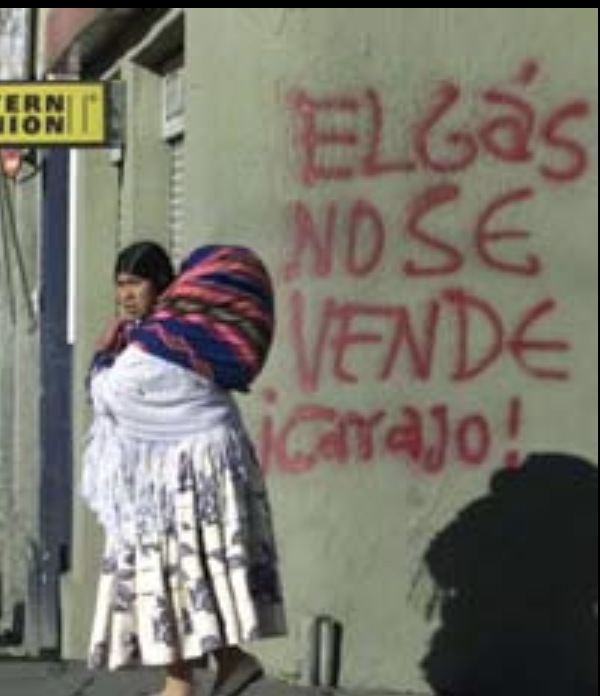
A woman, dressed in white with a large sack of made of purple cloth is walking past graffiti which translates as: Gas is not for sale, damnit!
An indigenous woman stands in front of graffiti that says: Gas is not for sale, damnit!

The process of change in Bolivia under the Morales government saw much improvement for many, but there came a point where its momentum towards change began to falter. Workers remained in precarious employment. The rate of unionisation dropped despite the country having a strong militant history of union organisation. Bolivia under Morales, despite the name of his party, was not a socialist state, the elite still owned vast swathes of land, foreign investment grew under Morales and this gaves the elite power and leverage. In short, the left administration scored some success but failed to deliver on its radical promises.

Morales continued to negotiate and work with domestic and foreign capital even after increasing his political power after the 2009 election. The process of change in Bolivia has not seen a socialist society emerge, nor could it when the strategy was to work with the local elites and global powers, to obtain the resources for reform.

Morales and twenty members of his administration had to flee for their lives to Mexico following threats from the army and police on 10 November 2019. Their ability to rouse the population and especially the working class against this coup had been deeply undermined by years of disenchantment as well as a perception of interference with the election of 20 October 2019 by Morales’ supporters.

Of course, Independent Left are against the coup and for a restoration of Morales. But we also have a wider vision.

Time again in Latin America and beyond the demands of capital have clashed with aims of governments that have declared themselves socialist. And every time, whether the Castro regime post-Cuban revolution, or that of the Sandinistas, governments that tried to manage their local part of a world capitalist system ultimately failed to transform society.

You cannot bring about socialism on behalf of the working class while in partnership with big business. Instead, we have to take over the workplaces and run them on entirely different lines, with entirely different goals and with very different politics to those of Morales.

Filed Under: All Posts

Amy Dunne: her bravery helped change Ireland’s abortion law

20/10/2019 by admin 1 Comment

By Niamh McDonald, Chairperson, Dublin Bay North ‘Together For Yes’ 

‘Repeal Changed My Life’

Portrait photograph of Amy Dunne. No background other than a blue sky. A confident, proud expression on her face.
Amy Dunne in 2019. Amy was ‘Miss D’ in the landmark ‘right to travel’ High Court abortion case of 2007. Pic: Arthur Carron

It is not easy to talk in public about personal experiences of abortion and enormous credit has to be given to those like Amy Dunne, who told their stories and helped change abortion law in Ireland.

Ireland’s long journey from being a country with strict anti-abortion laws to the success of the Repeal movement was not a gradual one.  Rather, after years when there was no movement on the issue, the country gained a much deeper national understanding of why women should have right to choose from particular cases.

The awful situation that a fourteen-year-old girl – Miss X – found herself in, having been raped and made pregnant in 1992 shook the country. Not only was she refused an abortion in Ireland, but the Irish courts initially refused to let her travel to England for an abortion. Only after a massive outcry and a march of over 10,000 people did the Supreme Court rule that abortion was legal if the woman’s life was at risk.

Students from 1992 sitting in the road in the Dail, behind a banner saying 'Abortion Information Now'. A highlighted square and arrow draws attention to where the image has been altered to cover up a phone number.
In 1992, newspapers didn’t even dare reproduce phone numbers of abortion information services. This, taken by Eric Luke, was doctored to remove the number before being published in the Irish Times.

Amy Dunne was threatened with a murder trial

Another such case was that of Miss D, who we now know as Amy Dunne. In October 2019, Amy told her story to RTÉ’s Sean O’Rourke. Unlike the X case, Amy wanted a baby but discovered in 2007, on her seventeenth birthday, that the baby had anencephaly. Her choice was to have an abortion, but because Amy was in temporary foster care, social workers were involved and the told her that she – along with anyone who travelled with her ­­– would ‘be done for murder’.

Amy refused to back down and took her case as far as the High Court in order obtain the right to travel to the UK (and her passport, which was being withheld from her).

In Liverpool, after induced labour, her baby, Jasmine, died. The experience has left her haunted. As Amy put it, ‘I would have lived with the regret of having an abortion but now that’s not what I have, I have a baby I carried, I have a connection, I have a grave, I’ve had a funeral. I have pictures, I have a child, I have memories. I have newspaper clippings.

‘I am forever haunted instead of just being able to go and do what I needed to do.’

The retelling of such a traumatic experience in public while trying to live with its consequences every day is a huge act of bravery and this bravery highlights the sheer cruelty of the actions of anti-choice bigots who still continue to bully pregnant people when they are at their most vulnerable.

Repealing the 8th was a huge achievement, one that was delivered thanks to the grassroots organisation of thousands of  women across the state. But the legislation is too narrow and restricted. People are still travelling for abortion healthcare, the lack of flexibility in the law means some migrants and people in Direct Provision are left without care.

Amy Dunne is in favour of exclusion zones around hospitals

We urgently need legislation for exclusion zones, a demand that Amy Dunne spoke in favour of. She said that seeing protests at hospitals made a difficult situation worse for a woman who has a hard choice to make, ‘I don’t think anyone should be allowed protest outside a hospital. Pro-life people should be ashamed of themselves. I think it’s sick – I think they have a mental illness. We all make decisions and they’re not made lightly.’

Fine Gael were happy to ride the Liberal repeal wave that was created by the hard work of grassroots activism but now when women and pregnant people need support these are sadly lacking

Filed Under: All Posts

New Playground For Kilbarrack

01/10/2019 by admin Leave a Comment

After a long struggle, Kilbarrack finally has a new area for children to play in

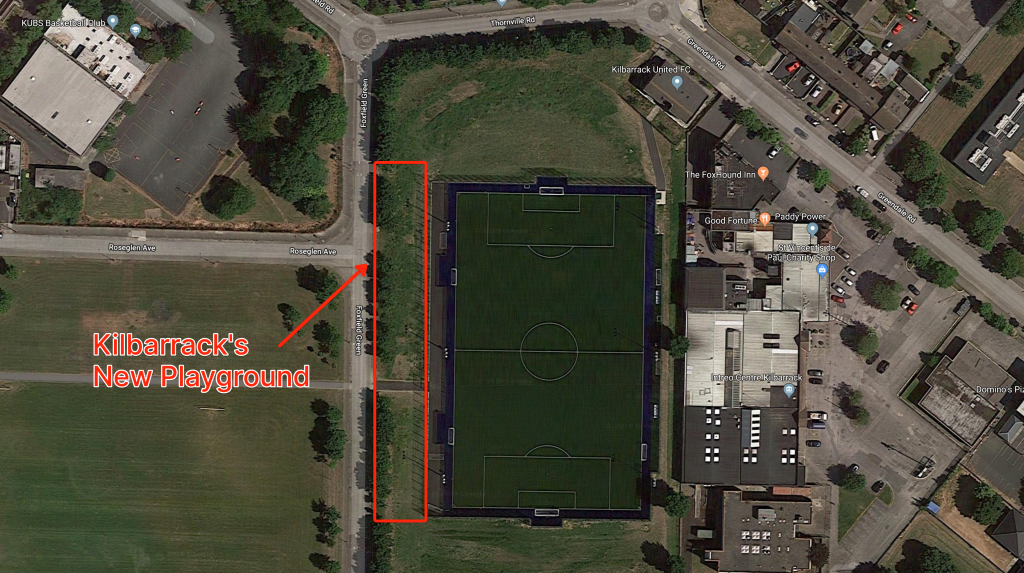
After a protracted effort that began more than twenty years ago, there is finally a new children’s playground in Kilbarrack in front of the Kilbarrack All Weather pitch facing on to Greendale Road at the top of Thornville Road.

Satellite map showing the location of Kilbarrack's new playground as a red rectangle
Map showing the location of Kilbarrack’s new playground

A significant role in advocating for the playground was played by the Kilbarrack Coast Community Programme (KCCP), who are rightly proud and delighted with the result. After organising several meetings in the community around the issue of the playground, KCCP elected two representatives (Lenann Clarke and Stephen Hutton) who made a presentation to Dublin City councillors and officials, members of the Northern Area Committee.

On foot of this campaign, funding was allocated to the new playground and the process of planning went ahead.

It was still a massive task, however, to actually get the playground built.

And to make matters worse in 2016, KCCP lost a safe space for children’s play when a new fence was put up right outside their exit, creating a prison-like atmosphere.  In response, a fantastic video, produced and directed by Tiernan Williams called Kilbarrack’s Ode to Bansky was released in August 2016.

Later in 2016, Amy Fogarty launched an online petition that gathered 688 signatories and in October that year she was told:

In response to your query I can inform you that I am currently working on developing a playground analysis of the North Central Area for the purpose of identifying deficits in play facilities for this area. This is due to be presented at the next North Central Area Committee meeting. However, current records indicate that Kilbarrack has been identified as a deficit area according to Parks Strategy playground analysis. ‘Roseglen’ open space has been identified as a potential location for a new playground but as yet a delivery programme has to be identified following review of completed playground analysis for this area. I will get back to you with an update in the coming weeks. 

Unfortunately, this did not result in a prompt build and despite several positive announcements, the process dragged on until now.

Finally able to announce the new playground KCCP said:

Two Dublin City Councillors were particularly supportive of our campaign – Councillor John Lyons and Councillor Mícheál Mac Donncha The playground may not be perfect and may need improvements but for a community that has been waiting for so long it is a great first step.

The work is nearing completion and KCCP have invited suggestions on necessary improvements: please email info@kccp.net or ring Marian 01-8324516

Council John Lyons was equally delighted.

 There is now a new playground in Kilbarrack. Happy to see that the community’s effort and persistence over a very long time has paid off!

Let’s hope that the kids in the area love it and use it as much as their hearts desire.

Filed Under: All Posts, Dublin City Council Housing

New Stardust Fire Inquest for Victims of 1981

26/09/2019 by admin 1 Comment

It is three years since the Attorney General of the day decided that a new Stardust Fire inquest into the deaths of the 48 young people who perished in the 1981 nightclub fire should be held and yet the families still wait.

For more than forty-one years the families and friends of the victims and the survivors have been fighting for the truth of what happened to their loved ones on that Valentine’s Night in Artane and why. Campaigning for truth and justice for more than four decades, these heroic people have faced heartbreak and pain, frustration and suffering, insult and injury as successive governments and civil servants brushed them off.

No one has ever been held responsible for the worst fire disaster in the state’s history.

The latest delay and cause of frustration was the attempt by Eamon Butterly, general manager of the Stardust nightclub on the night of the fire and son of the nightclub owner and Fianna Fail associate Patrick Butterly, to prevent a finding of “unlawful killing” being available to the coroner, Dr. Myra Cullinane.

But on 2 November 2022 Mr Justice Charles Meenan in the High Court ruled “unlawful killing” should be available to the jury in the inquests.

‘The ruling is very welcome. We have been fighting for these inquests to get
underway since 2019,’ Maurice McHugh, who along with his wife Phyliss, lost their only daughter Caroline aged 17 in the fire, told The Irish Times.

‘What we want to achieve is to know how the fire started that night, what happened to our children. We hope to get started now and get answers.’

Over the last two years, fourteen pre-Inquest hearings have taken place and now that Butterly’s legal challenge to the process has concluded, the fifteenth hearing scheduled to take place at 2pm on 23 November 2022 at The Pillar Room, Rotunda Foundation, Parnell Square East, Dublin 1 could well be the first day of the official inquests.

The Long Road to Justice for the Victims of the Stardust Tragedy

All the pain we’ve been put through, all the stuff we’ve gone through for the truth. This is what we fought for, campaigned for, and what we wanted.

This is how Selina McDermott greeted the news on 25 September 2019 that there will be a new inquest in to the Stardust fire. Selina’s sister Marcella (16) and her brothers, George (19) and William (22) died on the night of 14 February 1981 at the Valentine’s Day disco at the Stardust nightclub, Artane. In all, 48 people died that night with another 11 badly disfigured, 214 physically injured and hundreds, too, traumatised ever since.

Starting in a first-floor storeroom, a fire that night developed rapidly, in part because despite a lack of planning-permission, flammable materials were present in great quantity, including nearly 250kg of cooking oil in five drums. Although the Fire Brigade were alerted in minutes a blast of heat and the melting of ceiling material, followed by the lights going out created a catastrophic situation.

Stardust Fire inquest. Eamon Butterly owns the Butterly Business Park, which is the modern site of the Stardust fire of 1981. The picture is evening and shows a two story building with a large front entrance, above which the word Butterly is spelled out in glowing pale lights.
The Butterly Business Park, owned by Eamon Butterly, the site of the Stardust Fire of 1981

Most of the dead and injured came from Artane, Kilmore and greater Coolock, where the community has never ceased to suffer. Not only because of the pain of the losses, but also because of the way in which our political and legal system has failed us.

Independent Left Councillor John Lyons’ response to the announcement of the new inquests was to welcome it as hugely important but he added that this should never have taken so long.

The families of the victims and the survivors of the worst fire disaster in the history of the Irish state have been through hell and back many times over the last thirty eight years, from the initial political cover up by way of the Keane tribunal to years of political indifference, and the more recent con job that was the McCartan Report, which can only be described as a disgraceful insult, the families kept fighting, kept demanding answers as to how forty eight young people died in that building.

They have been vindicated by the decision of the Attorney General to open up new inquests into the forty eight deaths. But the survivors and the families and friends of the victims should not have had to wait nearly four decades to get the answers they deserve. If the fire had taken place in Blackrock rather than Artane, there is no way that people would be left waiting so long for justice. The working class communities of Coolock and Artane know this to be true as the treatment they have received from the Irish state, successive Fianna Fail and Fine Gael-Labour Party has been nothing short of a scandal.

The fact that the Keane tribunal of 1981 found that the fire was probably caused by arson – a finding that was always disputed and eventually ruled out – meant that the owners, the Butterly family not only escaped compensation claims and therefore proper accountability for their actions, which included the obstruction of fire exits, but they were awarded IR£580,000 in compensation.

The Stardust had been developed without planning permission and the fire authorities had denied Paddy Butterly permission to retain the club unless he installed another fire escape.

Although a 633-page was sent by the Gardai to the DPP, the only person to face charges arising from the tragedy was John Keegan, whose two daughters died that night, for confronting Paddy Butterly.

Eamon Butterly Has a Lot of Questions to Answer at a New Stardust Fire Inquest

The Butterly family were – and probably still are – highly networked politically. In his memoirs, published just for family and friends but leaked, Paddy Butterly reveals that a former economic advisor to Labour Tanaiste Dick Spring worked for the family for two years. While he was Minister for Industry and Commerce, Fianna Fáil’s Kevin Boland had a chat over coffee with Paddy Butterly nearly every morning. “We were all Finna Failers”, reports Butterly, and adds that Fianna Fáil Taoiseach Jack Lynch asked Butterly to join Taca, their party fundraising group for wealthy businessmen.

‘‘What you had these people for,” explains Butterly, “was to help get things. I don’t mean by giving them money. But if you wanted to know something about your business or you wanted someone who could do something, you didn’t get the answers by writing into the papers. You asked these people.”

The injustice of the treatment of the Stardust families and their lack of access to political power in comparison to the situation of the Butterly’s explains why it has taken so long to obtain this inquest. And why it has been such an uphill struggle.

When, in 2006, Eamon Butterly, owner of the Stardust, opened The Silver Swan pub in the business park where the fire took place, protesters played the following Christy Moore song for ten weeks outside the bar, every night between six and eight pm.

They Never Came Home, was released in 1985 and was banned, with Christy Moore being found guilty of contempt of court for having written it. It remains a powerful statement on a terrible tragedy and a political system that has only contempt for working class communities.

They Never Came Home Lyrics

Christy Moore

St Valentine's day comes around once a year,
All our thought turn to love as the day it draws near,
When sweethearts and darlings, husbands and wives,
Pledge love and devotion for the rest of their lives.
As day turns to evening soon night-time does fall,
Young people preparing for the Valentine's Ball,
As the night rings with laughter some people still mourn
The 48 children who never came home.
Have we forgotten the suffering and pain
The survivors and victims of the fire in Artane,
The mothers and fathers forever to mourn
The 48 children who never came home.
Down to the Stardust they all made their way
The bouncers stood back as they lined up to pay
The records are spinning there's dancing as well
Just how the fire started sure no one can tell.
In a matter of seconds confusion did reign
The room was in darkness fire exits were chained
The firefighters wept for they could not hide,
Their anger and sorrow for those left inside.
Have we forgotten the suffering and pain
The survivors and victims of the fire in Artane,
The mothers and fathers forever to mourn
The 48 children who never came home.
All around the city the bad news it spread
There's a fire in the Stardust there's 48 dead
Hundreds of children are injured and maimed
And all just because the fire exits were chained.
Our leaders were shocked, grim statements were made
They she'd tears in the graveyard as the bodies were laid
The victims have waited in vain for 4 years
It seems like our leaders she'd crocodile tears.
Have we forgotten the suffering and pain
The survivors and victims of the fire in Artane,
The mothers and fathers forever to mourn
The 48 children who never came home.
Half a million was spent on solicitor's fees,
A fortune to the owner and his family
It's hard to believe not one penny came
To the working class people who suffered the pain.
Days turn to weeks and weeks turn to years
Our laws favour the rich or so it appears
A woman still waits for her lads to come home
Injustice breeds anger and that's what's been done.
Have we forgotten the suffering and pain
The survivors and victims of the fire in Artane,
The mothers and fathers forever to mourn
The 48 children who never came home.

Antoinette Keegan, who lost two sisters in the Stardust disaster, asked people to give John Lyons (Independent Left) their number one vote in Dublin Bay North in the general election of 2020.

John has been very, very helpful to us, been a huge support, given us a lot of time and effort. He’s been on the campaign for a long, long time. He has been fantastic for justice for Stardust and also other issues in the community. Please give him your number one vote.

Antoinette Keegan, member of the Justice for the Stardust 48 group.

’48 by Gemma Kane was a powerful play about the Stardust tragedy

Actor and playright Gemma Kane has a personal connection to the disaster at the Stardust, her parents were there that night (and escaped). ’48 is told through the perspectives of four people who – with a lot of humour – share their lives and dreams in the run up to their fateful night out.

The cast were Gemma Kane, Emily Fox, Laurence Falconer and Niall O’Brien, the play was directed by Clare Maguire and produced by Ali Fox. It was shown on 12 February and 13 February 2020 in the Axis Theatre, Ballymun.

Gemma Kane, Emily Fox, Laurence Falconer  and Niall O’Brien are sitting on a stone wall under some trees. They are dressed in 80s clothes, as the characters from '48, a play about the Stardust tragedy.
Gemma Kane, Emily Fox, Laurence Falconer and Niall O’Brien: the cast of ’48, a play about the Stardust fire.

39th Anniversary Vigil of the Stardust Tragedy

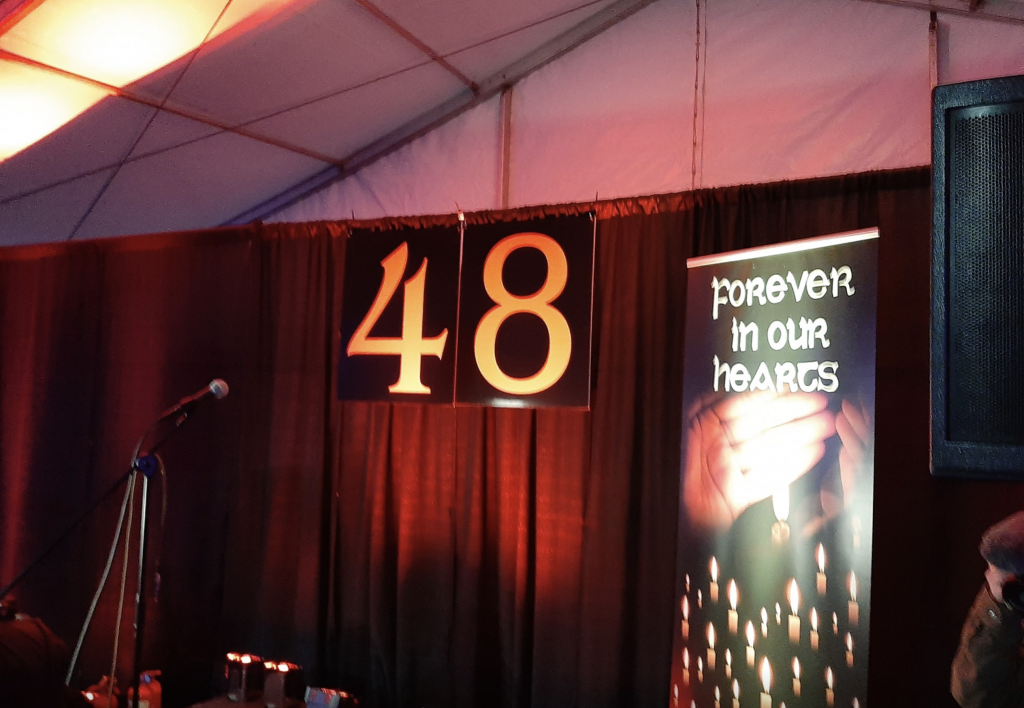
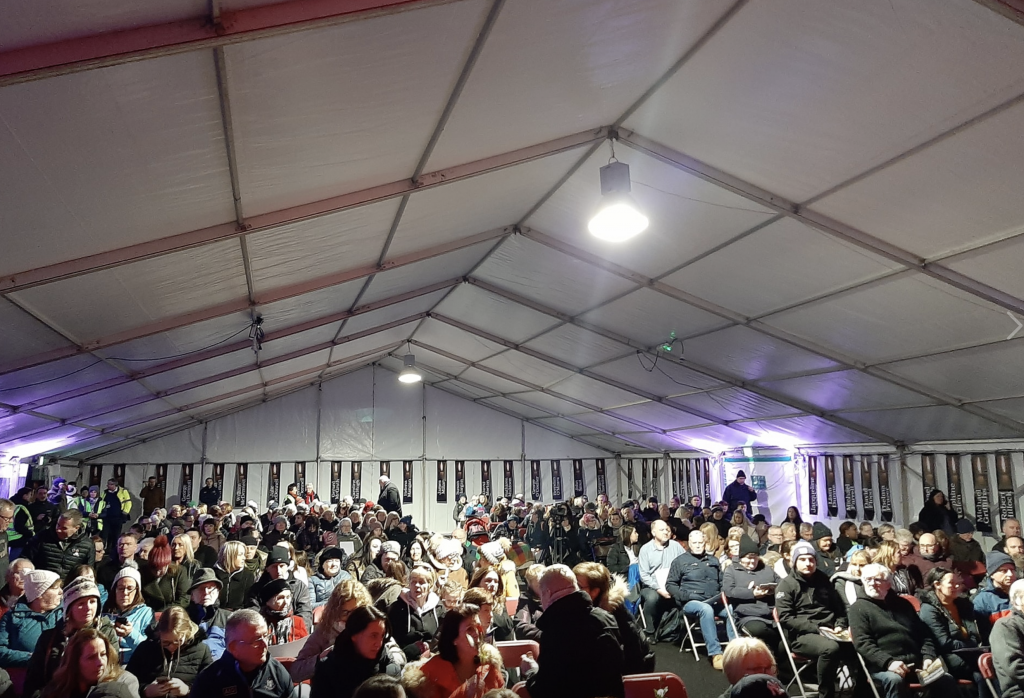
On 13 February 2020, a vigil was held to commemorate the Stardust tragedy. Singer Christy Moore, longstanding supporter of the Stardust families, attended, along with North Dublin Gospel-Choir, Eamon Dunphy and Charlie Bird. Dublin City Council supported the event and provided a marquee outside the former Stardust venue at Butterly Business Park on the Kilmore Road in Artane.

Justice for the Stardust48

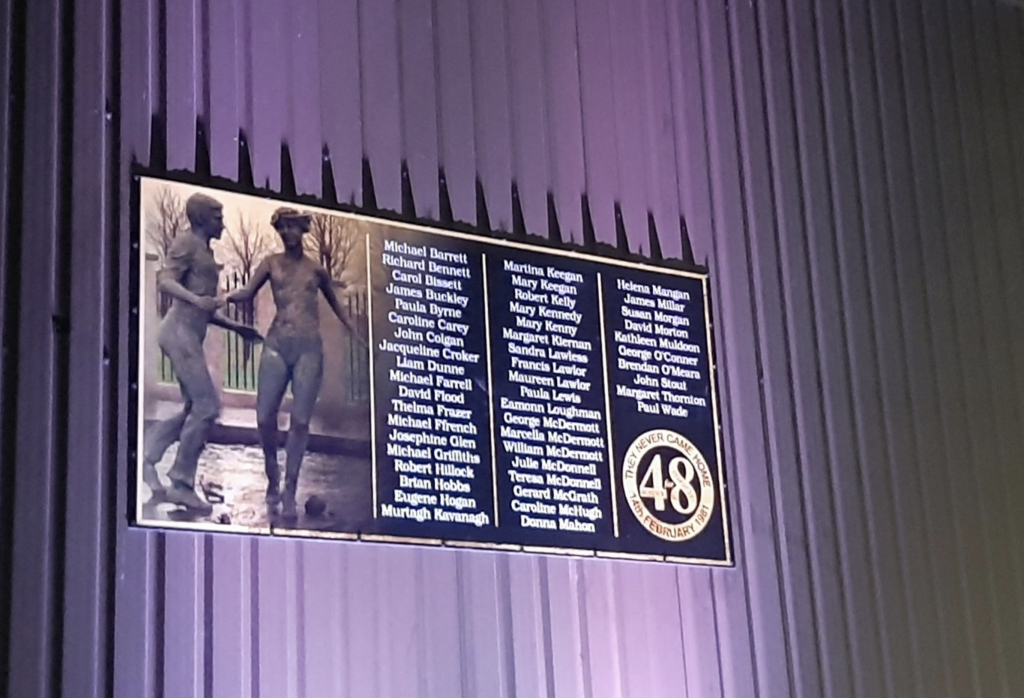
Stardust Fire Inquest. A plaque to remember the 48 victims who lost their lives in the Stardust - Michael Barrett, Richard Bennett, Carol Bissett, Jimmy Buckley, Paula Byrne, Caroline Carey, John Colgan, Jacqueline Croker, Liam Dunne, Michael Farrell, David Flood, Thelma Frazer, Michael French, Josephine Glen, Michael Griffiths, Robert Hillick, Brian Hobbs, Eugene Hogan, Murtagh Kavanagh, Martina Keegan, Mary Keegan, Robert Kelly, Mary Kennedy, Mary Kenny, Margaret Kiernan, Sandra Lawless, Francis Lawlor, Maureen Lawlor, Paula Lewis, Eamon Loughman, George McDermott, Marcella McDermott, William McDermott, Julie McDonnell, Teresa McDonnell, Gerard McGrath, Caroline McHugh, Donna Mahon, Helena Mangan, James Millar, Susan Morgan, David Morton, Kathleen Muldoon, George O'Connor, Brendan O'Meara, John Stout, Margaret Thornton, Paul Wade.
Memorial Plaque to the Stardust 48
Stardust Fire Inquest. The stage at the marquee for the 13 February 2020 memorial event for the Stardust 48. It shows a microphone, a red curtain and in front of it in large yellow figures: 48. A pop-up banner on the right of the pictures says: forever in our hearts.
The stage at the marquee for the 13 February 2020 memorial event for the Stardust 48.
Stardust Fire Inquest. A full marquee at the moving Stardust 48 memorial, 13. February 2020. The picture shows a marquee with temporary lighting and chairs, It is full with people standing at the back.
A full marquee at the moving Stardust fire memorial, 13 February 2020.

Filed Under: All Posts

Ireland’s Climate Strike 20 September 2019

21/09/2019 by admin Leave a Comment

Young people in Ireland played their part in the massive world-wide strike against Climate Change on 20 September 2019. The energy and determination as well as the frustration of the participants was evident in the chants and slogans on the placards.

Fair play to the anonymous students who posted on Reddit that they had to go against the principal to participate:

Obviously have to keep this anonymous so I wont say what school but today out school refused to let us out of school for a few hours to the protests for climate change
I think this is a joke like seriously. It was only from 12-3 like its ridiculous. The school didn’t even mention it to us at all that this was happening or suggested we take part in it ourselves.
Needless to say we weren’t taking this shit so we grouped together and about 80-100 students rushed out the doors and ran to protest anyways.

Here are some of the images and videos from the day.

Participants in Belfast for Climate Strike 20 September 2019
Dublin protesters turned out in huge numbers, here marching along the west side of Merrion Square (photo credit: Conor Healy)

View of the 20 September 2019 climate strike, from above, south side of Merrion Square, Dublin.

The Irish Times concentrated on very young protesters but nevertheless captured the sense of determination as well as anxiety among protesters in their coverage of the climate strike in Dublin 20 September.

Gathering for the 20 September climate strike, Galway.
Grand Parade Cork, 20 September 2019, another large turnout as part of Ireland’s support for the climate strike.
The famous ‘Free Derry’ wall, painted over to support the climate strike of 20 September 2019 (and a march on 21 September).

Filed Under: All Posts, Protests Ireland

  • « Go to Previous Page
  • Page 1
  • Interim pages omitted …
  • Page 4
  • Page 5
  • Page 6
  • Page 7
  • Go to Next Page »

Copyright © 2026 · Aspire Pro on Genesis Framework · WordPress · Log in