• Skip to primary navigation
  • Skip to main content
independent left logo

Independent Left

Environmentalism, socialism, freedom and equality. #liveablecity

  • About
  • Featured Articles
    • How Farming Must Change to Save the Planet
    • The Housing Crisis: Causes and Solutions
    • Socialism in Ireland
  • Contact Us
  • Podcast
  • Animal Rights
  • Archive
    • Irish Socialist History
    • Dublin City Council Housing
    • Ukraine
    • Protests Ireland
    • Reviews
    • Irish Political Parties
    • All Posts
    • Independent Left Policies
  • Why join?

Independent Left statement on the launch of Le Chéile

04/12/2020 by admin 2 Comments

They Shall Not Pass Battle of Cable Street Independent Left and Le Chéile
Counter-prostesting is essential in the battle against fascism: such as at the 1936 Battle of Cable Street

The growth of fascism in 2020 was a disturbing development in Irish politics and one that needed a coherent response from the left. Fascists were able to capitalise on discontent at the COVID restrictions and insert themselves into anti-mask protests. At the same time, socialists, appreciating that anti-mask is anti-worker and insisting that the government did not cave in to pressures from businesses to sacrifice the vulnerable, were hampered in both protesting and mobilising against the fascists. We complied with measures to restrict the growth in COVID cases. The fascists did not.

A few skirmishes took place in which the fascists injured participants of small counter-protests and were becoming increasingly confident. A growth in fascism does not just represent a distant threat, it always leads to an immediate increase in attacks on the people they target in order to divide working class communities.

Anti-Fascist Action decided it was necessary to check the fascist rallies and successfully mobilised against the National Party on 10 October 2020. While many commentators wrung their hands and condemned the counter-protest, we stood on the side of AFA in regard to seeing the humiliation of the National Party (who would be better called the Nazi Party) and their retreat under the protection of the Gardaí as an important check on the fascists. There is plenty of evidence it damaged their morale and capacity to mobilise.

So when leading People Before Profit members initiated a conversation about creating a new anti-fascist alliance, we were keen to participate. Initially, there was a lot of positive energy about the new organisation, which would come to be called Le Chéile, not least because when asked would this organisation be genuinely owned by all the participants, we were assured by the People Before Profit TDs that it would.

It seemed to us that this movement had the potential to bring even more people onto the streets when another moment came in which it was necessary to turn out to stop a fascist event: that it could be the kind of vigorous ‘fighting’ united front of all those who would be victims of fascist growth that Trotsky envisaged was necessary to stop the rise of Hitler.

Anti Nazi League Ireland 1991
Back in the day: Richard Boyd Barrett willing to confront fascists under a clear Anti-Nazi League message

Of course there were differences expressed at the meetings, including over the question of whether there should be counter mobilisations against fascists. Independent Left members and others present recall the conclusion of this discussion being that while the new organisation would not publicly call for counter-mobilisations, it would not rule them out.

While we saw some limitations in Le Chéile, we were willing to play our part in participating in the alliance until today, 3 December 2020. Disappointingly, we found that the launch statement included the following crucial line: “it is not the aim of Le Chéile to organise counter-protests to far-right rallies.”

Indeed? Well, it certainly was our aim all along and that of some of the others present at the meetings. It came as a surprise to see this position (one which raises the question of who made that the policy of the alliance and when?). 

A launch that was anxious to communicate this non-confrontational message, whether approved of by everyone concerned or not, undermines our confidence in Le Chéile as being the right way to go about stopping the growth of fascism. We think it best to spend our energy at a grassroots level, resisting the infiltration of fascists in our communities.

Good luck to the new alliance, genuinely. There is a role to be played in having musicians and actors and politicians speak out against fascism, to have them perform anti-racists gigs, hold carnivals, readings, etc. This is important activity. But it isn’t enough.

Two wings of an anti-fascist movement checked the National Front in the UK in the 1970s: one embodied the spirit that ‘they shall not pass’, which was most evident at the Battle of Lewisham; the other was a cultural marginalisation of fascist values. The recent documentary White Riot shows the valuable work done at that time by Rock Against Racism. We hope Le Chéile will be able to deliver on that cultural side of things.

Independent Left Le Chéile: Battle of Lewisham
The Battle of Lewisham 1977: another powerful response to the growth of fascism

We appeal to members of Le Chéile: please consider the historical experience of anti-fascist movements and be less equivocal about the need to support counter-protests. Hopefully, you’ll join them in the future. If not, then please don’t sit on the fence when figures like Mick Clifford weigh in against those of us who take to the streets to scatter the fascists while we can.

And to People Before Profit members who agree with us, there is still time to change the approach of your party. We would very much welcome unity with you, not to pose together in front of the cameras, but arm-in-arm on the streets.

You can contact Independent Left in confidence by emailing conor@independentleft.ie 

Filed Under: Independent Left Policies

Independent Left Reply to People Before Profit

02/07/2020 by admin 5 Comments

Socialists and left unity in Ireland 2020

To members of People Before Profit,

We commend your initiative, ‘let’s bring the left together to fight this government’.

Although the formation of a conservative government is a threat to working class communities, it is a threat that we can meet.

The fact that Fianna Fáil and Fine Gael have been obliged to come together is historic. For decades, the main voice of opposition to whichever of these parties has led a government was the other party. And as we are all well aware, this was no real opposition at all. Discontent was carefully channelled down pathways that were safe for the Irish elite. Now, however, there is an opportunity to escape into entirely new and radical ways of thinking about the world and to popularise socialist answers to a massive, global crisis.

Sinn Féin will be the largest voice of opposition. This is a significant step forward compared to the old Fianna Fáil and Fine Gael posturing. And because Sinn Féin connect to the same working class communities that we do, there will be plenty of opportunity to both work with them, but also alert our class to the limitations of that party and offer a much more fundamental, revolutionary, change than does Sinn Féin.

When the crisis of 2008 hit, we were not well placed to resist the ‘shock and awe’ policies that saddled Ireland with enormous debt and cowed the trade unions with the scale of cuts that both Fine Gael and Fianna Fáil agreed were necessary to save the Irish ‘economy’ (the wealth of the Irish elite).

The crisis of 2020 and 2021 will be worse, economically. But this time there is a very different mood in the country. One where people will question the government’s priorities and loyalty to an elite who have grown enormously wealthy over the past ten years. Young people, especially, have been emboldened by referendum victories.

A coherent socialist vision for a world in which the wealth is taken off the rich and large businesses to solve the needs of housing and healthcare is going to be crucial. A vision which can assist movements take off at the speed of the Black Lives Matter protests and amplify them when they do happen. Not just on the streets, as you point to, but also with the return of the mass strike: the most powerful form of protest we have.

The role of socialists within these movements must be democratic and open. We can learn from and be led by these new movements. Our spirit should be in keeping with the disability rights slogan of the 80s: “nothing about us without us”.

This vision, as you rightly say, has to be identified with, ‘fighting racism, sexism, homophobia and transphobia.’ Of course, too, socialists should be proudly identified with the campaigns of those with disabilities for equal access and equal opportunity and with the need to help farmers make the transition from a cruel and unhealthy livestock industry to a climate and animal-friendly one. We should demand that public services such as health are taken into full state control, as we have seen the possibilities of doing this during the COVID-19 crisis. We should fight for public housing on public land. We must resist cuts to youth and community services.

The endless growth required by a capitalist society cannot deliver us the technology we need to create a sustainable planet faster than it makes our planet uninhabitable. A society that prioritises money over welfare cannot be green.

With these goals in mind, we look forward to working with you and others in creating a fruitful conversation that does indeed bring the left together.

The members of Independent Left

On 8 July 2020, John Healy of NearFM’s Northside Today spoke to John Lyons, Independent Left, Dublin Bay North about Irish Socialism and Left Unity in Ireland for 2020.

Filed Under: All Posts, Irish Political Parties

Pulling down Statues in Ireland

01/07/2020 by admin 1 Comment

By Shane McNally

On 7 June 2020 the statue of Edward Colston in Bristol was toppled and then thrown in the harbour by Black Lives Matter Protestors

Black Lives Matter.

A call for something so simple such as the basic right to live should not need to be the cry of a movement in the twenty-first century, but it is. Black lives are treated as lesser lives: from the ingrained racism of individuals frothing at the mouth to insist ‘all lives matter’, to state sanctioned violence that kneels on the neck of the black body. Black lives are paid less, provided with less opportunity, are jailed more and die in greater numbers through austerity and marginalisation. The struggle of BLM is one of class and identity, the latter under assault by the multifaceted culture war that is contemporary identity politics. The former is attacked by the right in their targeting of class consciousness and solidarity on every front that is opened up.

The latest being statues.

Should Statues Be Pulled Down?

‘We view the past, and achieve our understanding of the past, only through the eyes of the present.’ Socialist historian, E.H. Carr.

Statues resonate as symbols of power and that which must be eulogised: what and who must be ingrained in memory. The function of statues is not just to remember a name but an action. And as statues have typically been raised by people who are carrying out their own acts of exploitation and injustice, they often obscure the past while preserving power structures in the present. The toppling of the Edward Colston Statue into the very harbour slave ships docked was an act of symbolism as much as one of anger. Colston was heavily involved in the slave trade, but the Victorian elite of Bristol who erected the statue in 1895 chose to hide this in favour of emphasising his philanthropy later in life. Nothing was mentioned of tens of thousands of slaves who died before they even reached American shores. The British Empire at this point in the late nineteenth century was reaching its apogee. The raising of such statues does not happen outside of history, but is inherently part of constructing the past.

As Ash Sarkar said on Novara’s #TyskySour, ‘statues don’t go up by accident’, they need to be maintained’ and in doing so they have a symbolic importance as well as a narrative.

Ash Sarkar tweet soon after the Colston statue was toppled in Bristol, 7 June 2020. @AyoCaesar 8.20pm: Chucking that statue in the harbour has educated more Brits on the history of the slave trade in this country than leaving it up for 150 odd years did. Can't argue with the end of season stats bro.
Ash Sarkar tweet soon after the Colston statue was toppled in Bristol, 7 June 2020.

‘Rhodes Must Fall’ was a campaign decades in the making, directed at another colonialist who had been elevated in the present. Cecil Rhodes was the individual whom Rhodesia was named after. He was ingrained into the fabric of colonial history and venerated in the centres of empires. The Rhodes Scholarship is one the most esteemed international scholarships. His name is embedded in the educational hierarchy. His statue and the scholarship carried out in his name, however, are attached to a man who believed in the greatness of the British Empire. Rhodes was a colonist and a racist who believed, ‘we are the first race in the world’.

High above the entrance to the Rhodes Building, Oriel College Cambridge is a statue to Cecil Rhodes. The image shows Rhodes in white stone against a yellow stone building with four lead-lined rectangular windows either side of him.
High above the entrance to the Rhodes Building,
Oriel College Cambridge is a statue to Cecil Rhodes.

It has taken decades for Rhodes to fall, but now as a result of protests stemming from the killing of George Floyd, Oriel College, Cambridge will decide by the end of this year the fate of the statue, crucially in consultation with the ‘Rhodes Must Fall’ group. Yet there are powerful figures on the opposite side. As recently as 2016, there were warnings from donors to Oriel College that if the statue was removed, up to £100 million in funding would be withdrawn. The rallying cry of these millionaires is that, ‘they are attempting to re-write history’. The contrary is true, the presence of Rhodes’ statue is a continual re-writing of history; it is a symbol of a patriarchal figure who bestows a prestigious scholarship on a select few, obfuscating the source of his wealth: extraction through colonialism.

As of 2013 at Rhodes University in South Africa, ‘83 percent of senior management staff remain white and 77 percent of “professionally qualified staff,” a category that includes academic teaching staff, are white.’ This is where the Rhodes Must Fall movement began, in an institution to this day that is hierarchically white. Rhodes’ message of ‘the first race’ in the world is perpetuated through social elites in the very lands stolen by the British Empire. The presence of his statue remaining legitimises this, as it silently articulates the message that we must look up to him and remember him as benevolent and a man to be deferred to. His statue is a symbol of oppression that continues to colonise the mind as well as placing the figure of Rhodes centre stage in some the most prestigious universities in the world.

Why is the Seán Russell statue, Dublin, being targeted?

Closer to home the ‘statue debate’ has opened up some new (old fronts) from bad faith actors. One such is the controversial statue of Seán Russell, a statue whose presence has been much debated in the past and which has a history of being defaced. The character of Russell is a complicated one: a revolutionary of 1916 who took charge of the IRA in the thirties; a decade that saw the rise of the Blue Shirts, a Conservative Catholic state, and a renewed violent push from the IRA. Russell sought assistance from both the Soviets and the Nazis in the thirties and died on a Nazi U-Boat returning from Germany. It is widely noted that Russell was a military man first and foremost and focused on Irish liberation. Historians agree on this. Russell was emblematic of an aspect of Ireland in the thirties and his statue that has always been a conduit for contemporary political narrative. The latest being Sinn Féin bashing from Fine Gael councillors. A new old story.

Bronze statue of Seán Russell, Fairview Park, Dublin. Russell is in a long coat and holding a hat in his left hand. He is on a plinth, facing to the viewer's right. Green trees fill the background.
Bronze statue of Seán Russell, Fairview Park, Dublin

‘Russell’s statue has been over the decades since its unveiling, been targeted by both the left and the right, being accused of both communism and fascism.’ A quote from the National Graves Association representative sums up this contested history concisely:

In recent years, there have been repeated attempts by some, in both, the Irish Media and establishment, to further this image of Seán Russell as a fascist. This is in fact a good example of revisionism at work. To criticise Russell as a Republican is fair enough if that’s one’s viewpoint. But false character assassination is entirely a different matter. That is both politically and historically, dishonest, immoral and underhanded. This is particularly the case when it comes from members of political groups with far, far closer historical links to Ireland’s fascists than any of Seán Russell’s comrades.

There is a debate to be had about statues in Ireland as a whole, but the controversy over the Russell statue is awash with bad faith arguments by Fine Gael to break up the front that has opened up with the international movement against symbols of racism and oppression. This only serves to dilute the reason for the questions being asked: statues are being torn down to put history to right, for restitution, for justice. A lot of the answers to these questions will not be binary, but complicated, such as statues of individuals involved in the founding of the state.

State Racism in Ireland is evident in Direct Provision

Ireland has statues and areas named after colonial oppressors; a bloody and messy foundation to the state that is rarely, if ever, brought up unless it is to muddy a contemporary political argument. What is also lost in all of this is that we actively oppress people who have migrated to this state on a daily basis through Direct Provision. Direct Provision is how we mistreat people who are migrants and those seeking asylum in contemporary Ireland. We don’t have statues of Colston, but corporate symbols.

History is certainly not binary and there are problematic individuals whose legacy liberals will often defend, using phrases about context and different times. That doesn’t answer why they need to be immortalized in prestigious institutions and centres of towns. What does begin to answer why these statutes take centre stage is that there are public spaces dominated by some of the most horrific tyrants in history. Figures such as King Leopold II, responsible for millions of deaths in the Belgian Congo in the most brutal and comprehensive extraction of resources, who has memorials and statues all over today’s Belgium. The current Black Lives Matter protests have spread and are turning the tide and Leopold’s statues being torn down. Every statue torn down or questioned is a strike against the layers of injustice that are present in everyday life, from tyrant to state-revered slave owner.

No statues of tyrants should be anywhere near public spaces. Tear down spaces and symbols of oppression and create spaces for all of the stories and lives that have been obliterated in the name of empire and capital. They offer nothing other than the legitimisation of past and current oppression. The function they serve is not for historical purposes, but for the retention of hierarchy and class division.

The most honest and justified action was dumping Colston in the river. That was making history and restoring narrative power to the oppressed. True solidarity with this movement in Ireland would be to pull down our own racist institutions. Statues are focal points of contested history, an ongoing battle in the class war.

Filed Under: All Posts, Protests Ireland

Childcare Strike 2020 Dublin Wednesday 5 February Was a Huge Success

26/01/2020 by admin Leave a Comment

Independent Left support the planned childcare providers strike on Wednesday 5 February in Dublin. Here a female creche worker sits a table with three young children who have beakers in front of them and are looking at wooden toys on their hands. Foreground right  is a colourful blurry toy.
Independent Left joined the protest of childcare providers in Dublin on Wednesday 5 February 2020.

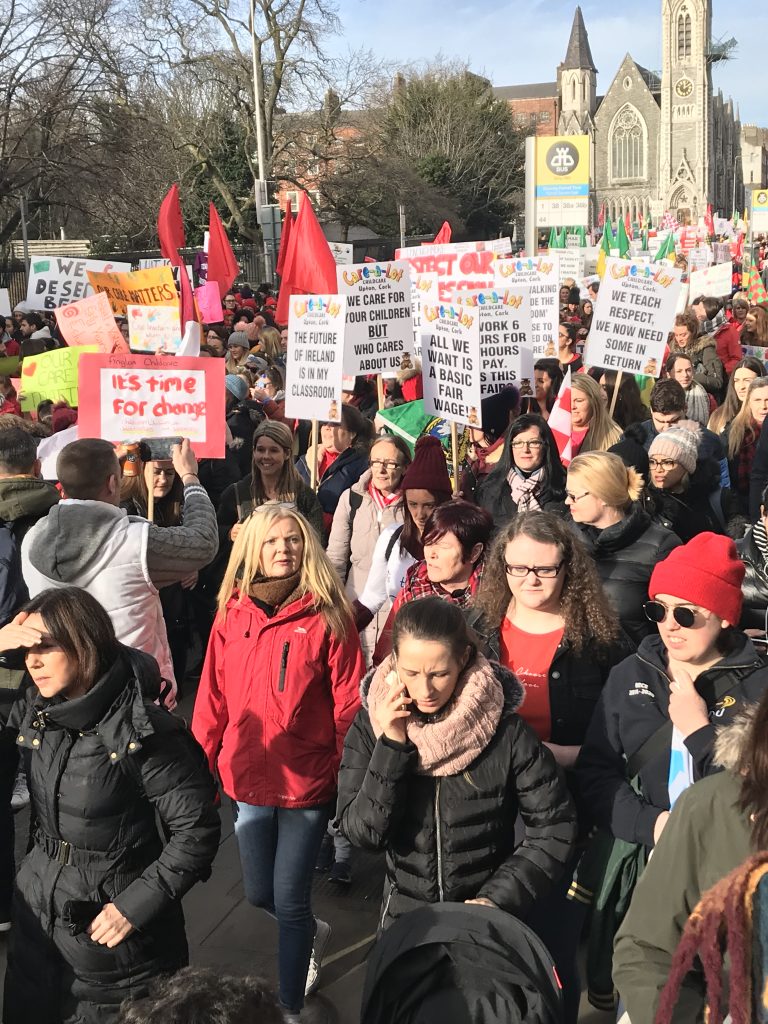
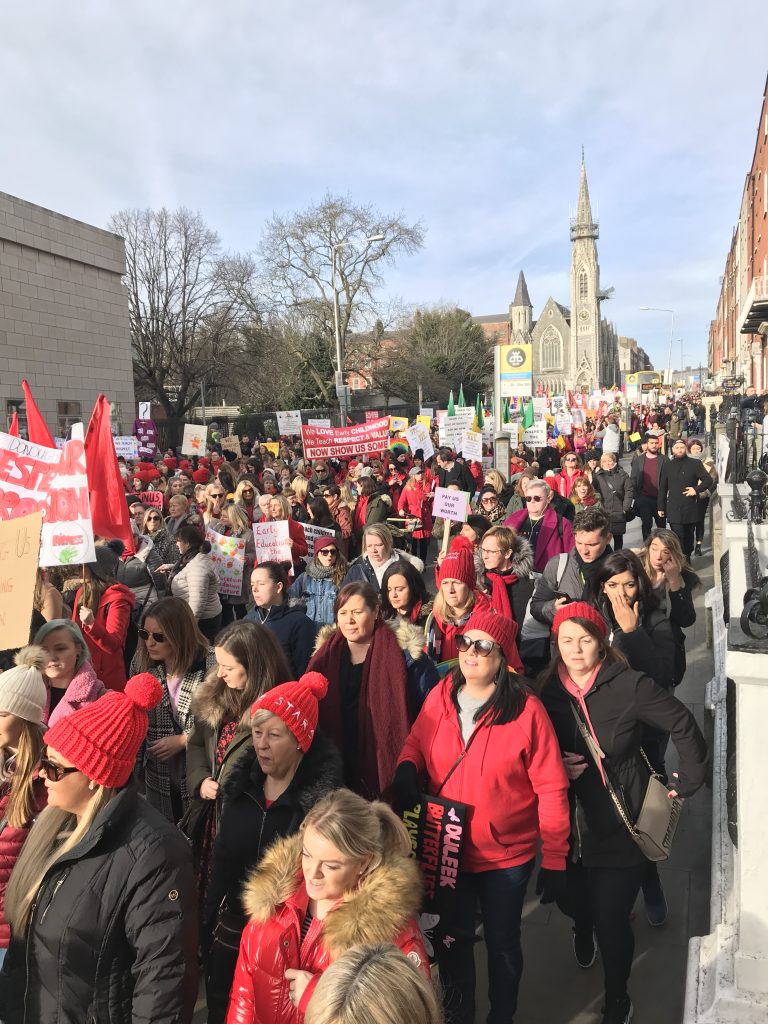
On Wednesday 5 February thousands of childcare workers went on strike to march in Dublin in protest at the crisis in childcare. Independent Left members fully supported this action. Yes, it was a challenge to arrange alternative childcare for the day but action was urgently needed and the march was a necessity. Not only did the protest show how powerful and united is the sector, but it was met with a hugely positive public response as we all know how the sector needs radical changes.

The state needs to follow the example from the rest of Europe and subsidise childcare, treating it as an essential service, not a for-profit sector.

The march was organised by the Early Years Alliance an organisation facilitated by SIPTU and consisting of workers, providers, unions and parents.

Little Learners Checklist at the Childcare demonstration 5 February 2020. A woman with a Little Learners flag hold a 'checklist' placard with a cross by all the issues of her concern.
Little Learners Checklist at the Childcare demonstration.

I spoke to a childcare worker who participated in the action and shared our childcare policy with her. Her description of her daily life provides a powerful illustration of why this strike was necessary.

My husband starts work at 7.30 a.m. so it’s my job to get the kids up and to school. I have two boys, eight years and three years. I drop my eight-year-old off at the school gates at 8.30 to hang around until 8.50: no other way to get him to school and me to work. I got stuck in traffic on the M50 on my way to work as a childworker. I’m very lucky that my three-year-old attends the same creche as me, so only one drop-off for me.

Today, I got to work with five minutes to spare; I’m usually fifteen minutes early, I have to be. Planning needs to be done, the classroom needs to be set up, etc. I bring my son to his classroom where two staff are already setting up the room, completing planning sheets and general organising of the room for the children’s arrival at 9 a.m. Their shift doesn’t start until 9, we only get paid from 9, yet they’ve been here at least twenty minutes setting up. They are very kind to take my son five minutes early so I can get to my classroom and begin my set up.

As the day goes on, we have a first aid incident. We have a child protection concern. I am organising a Together Old and Young visit to a local nursing home. I speak with a parent who is concerned about her child’s development, all within the first hour-and-a-half. We are told we are short staffed today and full time staff need to take a shorter lunch to accommodate. This is not a bad day, just a regular one in this line of work. I also have to discuss the upcoming protest with parents.

Overall, they are very sympathetic to our cause and those who are able to will arrange other means of childcare for Wednesday 5 February to alleviate some staff to attend the protest.

My shift finishes at 1 p.m. and I go to collect my son. But as usual I don’t leave my room on time because someone always needs something: a hug goodbye, a form signed, a conflict between children that needs resolution or even a staff member who needs to go and use the toilet!

I collect my son and he is full of smiles and chats about what he has done that day. He says a fond goodbye to his teachers as if they were his friends!

All of this is so important in our society and I am sick and tired of feeling the way I do in this sector. Yes, I love my job but hugs and smiles and a child’s positive progress doesn’t pay the bills… never even mind the cost of childcare.

Upon reading your article, admittedly, I had a chip on my shoulder, ready to read about ‘tax breaks’ and ‘extended ecce’. I was nicely surprised. It’s nice to see childcare workers being mentioned more than once and in a positive manner.

Zappone says I should join a union if I have a grievance… my problems are not with the management team of the creche, it’s with the state and the ridiculously high expectations they are putting on me and my colleagues.

Sixteen years I’m working in this sector and I’m losing faith.

Everything that is in the link you sent me is true. The whole sector needs an overhaul, childcare should never be for profit! In all the different positions I’ve had, the worst practice I’ve seen has been in private centres and it is not through the fault of the staff.

Change needs to happen it MUST be done in collaboration with the people who are actually on the ground working directly with the children. All these new schemes sound amazing, but when they are put into practice it just pushes us further and further to breaking point.

Thank you for giving me a bit of hope for the future of my profession.

Valuing Us is Valuing Children: placard on the childcare demonstration
 It's time for change: huge turnout for the childcare protest
It’s time for change: huge turnout for the childcare protest
Thousands marched for the childcare sector on 5 February 2020
Thousands marched for the childcare sector
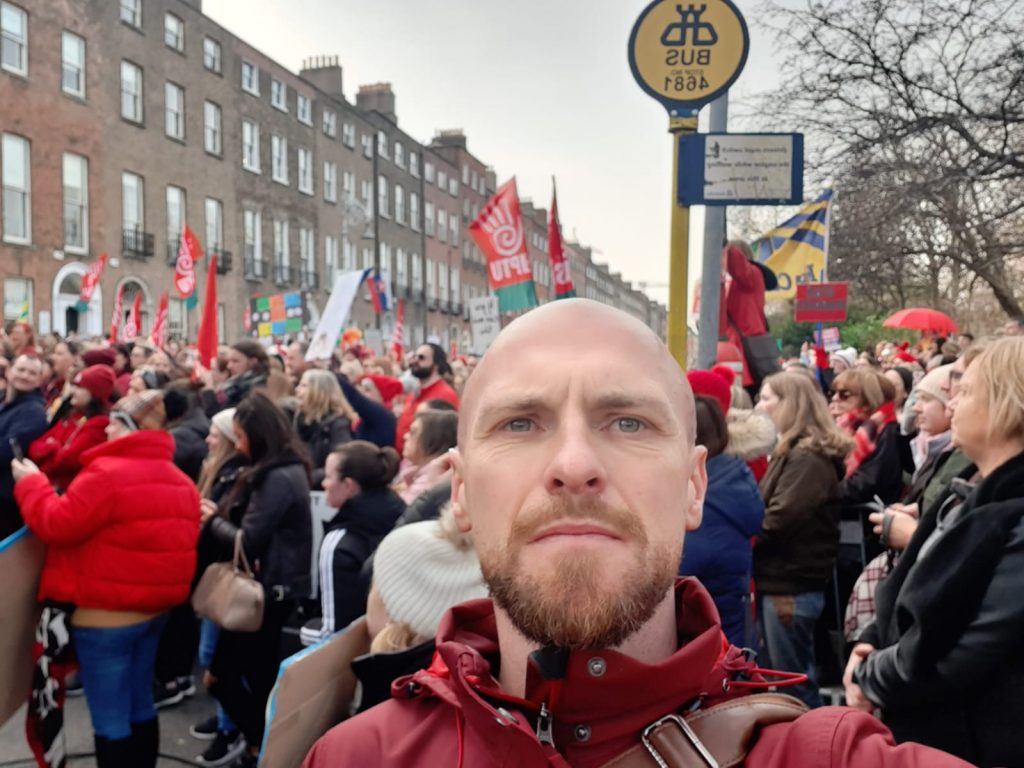
John Lyons of Independent Left stands on the right of a group of childcare workers and parents at the demonstration of 5 February 2020. The demonstrators display a lot of red clothing and have placards around their necks proclaiming: loving my job won't pay my bills! We are professionals, treat us professionally.
John Lyons with childcare protesters 5 February 2020

Councillor John Lyons expressed his full support for the strike.

Parents shouldn’t be paying such high costs for childcare and staff should be given increased pay and a proper career path with full training. This campaign can win and the protest on 5 February is the right way to go about forcing the new government, whoever is in power, to listen and to respond.

A picture of Councillor John Lyons, standing beside text in bullet points:
I support the planned strike by childcare organisations on 5 February 2020. The EECE needs to begin at two years of age and double the hours to 30 per week available twelve months of the year. An increase for each child's capitation grant for accessing creches. A massive increase in investment: a minimum 1 per cent of our overall GDP is needed to create a fully functioning national childcare system. An increase in financial supports to long parents and migrant parents whom are most vulnerable to poverty and isolation. Government needs to create public creche facilities in local communities.
In general election 2020 Councillor John Lyons, standing for Independent Left in Dublin Bay North pledged his support for the Childcare Strike of 5 February and raised several demands on behalf of the sector.
Councillor John Lyons supporting the huge childcare sector march of 5 February 2020

Interview with a community childcare worker ahead of the strike of 5 February 2020

In advance of the strike by childcare workers, I spoke to ‘Anne-Marie’ who works in a community childcare centre.

NMcD: Why are you going on the protest?

A-M: I’m going on the protest to support the early years professionals in the community and private sectors who for years have been under huge pressure, who are not treated as professionals, who are expected to hold the rest of the country by looking after and educating the children; for children with additional needs; for afterschool clubs; for everybody.

For all these years we’ve got very little extra funding, we’ve got more people coming an assessing us and making sure we are doing our jobs. We have, I think, eight different government bodies that come in at the drop of a hat to see what we’re doing and to make sure we are doing everything right. And that’s fine, we’re all about good governance and transparency but it’s just constant.

Then there is new childcare funding, which came out in November, is making it even more difficult for parents and for services to be sustainable. Every couple of years funding gets changed and we never know from one year to the next year if we can be sustainable and continue to run the community service that we run. It’s not good.

We’re a community. So we are middle of the road paid, compared to the girls that are on ten Euro-something an hour but it’s below the Living Wage and it’s not good enough.

NMcD: It’s a community creche that you run here. We’re in an area of economic deprivation in north Dublin. Can you tell me the kind of service that you provide and support you give to families in the area and why it is important that we need to fund community creches?

A-M: This community service has been running for a long time in this area. Like all the other community services out there, particularly in areas with disadvantage, we have children with a lot of additional needs, not just official additional needs but because of their lifestyle and home circumstances. We’ve a lot of homeless children; children whose parents have experienced addiction; who are in recovery; young parents who have left school early. A lot of single mums. And that just puts extra pressure on the children, because of whatever’s going on at home. The children all come here and get a breakfast; they get a proper home-cooked meal. Not everybody is going home to a cooked meal with fresh fruit and vegetables every day. They are really cared for and looked after here. It is the home from home, well that’s what we want it to be. But it’s very difficult to provide that when your funding and constraints are there.

I think in an area like this it should be like a DEIS service, where we have additional staff to provide the care and support that the children need. We have a lot of parents that would come to the office looking for different supports, whether it’s things going on at home. It’s more than just drop your child and run out the door. We provide additional supports: we have a lot of children that are referred to social workers, public health nurses, Focus Ireland. We do support the whole family. We do refer children on to psychologists, speech therapists for additional supports. It’s constant it’s full on.

When you look at the funding over the last few years, for example, the ten years since they put up the ECCE scheme (that’s the three hour sessions per day for the pre-school groups), that’s for thirty-eight weeks per year. When that started ten years ago it was €64.50 per week per child, ten years later it is €69. So that’s an increase of four Euro fifty in ten years. That’s the equivalent of forty-five cent a year. Now we give the children breakfast, we give the children lunch, we have to pay the staff when they are on holiday because it is not covered by the funding, these staff possibly have to go and look for jobs in the summer or sign on in the summer, so that’s a lot of women – predominantly – who are signing on through the summer. We want permanent jobs, proper wages and we want support from the government to make that happen.

NMcD: In an ideal world, how would you like government support to run to make life easier?

A-M: At the moment the inspectors and regulation people that come out to see us are TUSLA, Pobal, Department of Education and Skills, Department of Health, the Revenue, Workplace relations, Building Control and Fire Control. So all these people can come at any point through the day when you are trying to support and look after children. Any of them can come in and look for a huge amount of paperwork. We need one government body to run us and support us and understand. There’s overlapping, so they are looking for that and then the next week someone else can come in the look for basically the same thing. We all want the same thing: we want children to reach their full potential.

Early intervention is the key. We have six children here with undiagnosed additional needs. We won’t get any AIM support staff to support these children until they are three. We have six children that are under two that, in our opinion, have additional needs. That puts extra pressure on staff in the room. Two members of staff with ten children in the room and there could be three or four children with additional needs. Nobody is recognising it. We all talk about early intervention but it’s not happening. If we had an extra member of staff in the room as the DEIS model, we could provide better care for the children.

NMcD: Would you say the waiting lists for children seeking early intervention affects your work as well?

A-M: Definitely. If we’ve got a child and the parent has maybe said, ‘I’m a bit worried about her speech’, it’s fourteen months on the waiting list, depending on when they go on it, then they have to go in for an assessment, then it could be another six months before they are seen and go through a stage of intervention. That child is nearly two years older at that stage. So if you saying it at two, two-and-a-half, that child is nearly at school before they are getting any intervention.

NMcD: And the formation of language is vital in the first three years?

A-M: The first three years is just massive for every area of the development of children. It gives them the bottom of the pyramid. It gives them the basic skills to build on over the years. People think that their child starts their education at school but they start during pregnancy and certainly during the first three years. That’s why it is essential. We have over a hundred children on our waiting list at the moment. We are a seventy children service. Most of those on the waiting list will never see the inside of this building because people stay for four or five years. We are one of the only services in this area that takes children under two. We take children from six months. That’s the early intervention that they need. We need extra staff in each room because the biggest cost to childcare is the staff, and even though they are paid way under what they should be paid, that’s the most important part of your money because ninety percent of your money goes on staff.

NMcD: A final question, how has the feedback been from the parents when they know you are closing on Wednesday for the protest?

A-M: A couple of them are disappointed because obviously they want continuous good quality care for their children. But most of them have been supportive because they understand, because they know us, know what we provide and how essential it is for their children’s development. Also for their own time, headspace and development. So some of the parents will be coming and marching with us. Which is great.

A notice from the wall of a childcare centre reads:
Reminder,
We will be closed all day on Wednesday 5th February for a staff meeting and to take part in the National Early Years Protest.
You are welcome to join us and the thousands of Early Years Professionals who are protesting due to the current childcare crisis in Ireland. We aim to provided professional, quality, affordable childcare in a sustainable, enriching learning environment. We need support from the government to do this!
Many parents supported the childcare strike of 5 February and came on the Dublin protest.

If the new government that forms after the election on 8 February does not respond to the sector, then another day of strikes and protests will be necessary.

Large strikes in Ireland as elsewhere are the most effective form of protest we have.

Filed Under: All Posts, Protests Ireland

Damien Dempsey Live

22/12/2019 by admin Leave a Comment

Damien Dempsey, wearing a black shirt and shitting in front of a microphone holding a guitar. His expression of one of intense feeling.
Damien Dempsey: a poetic and sincere voice of those who are struggling in Irish society and beyond

Review of the gig of 21 December 2019, Vicar Street, Dublin, by Aislinn Wallace and Niamh McDonald


Damien Dempsey has been a powerhouse on the Irish music scene for nearly two decades. He brings a voice to the struggles of those suffering in Irish society and beyond with poetry and sincerity. 
Damien’s Christmas Vicar Street gigs have become part of the Christmas calendar for many of his devoted fans. Saturday’s performance was no exception, with a packed-out venue. 
Damien has never been ambiguous about his politics and his music reflects this. The crowd in the gig represented all ages, with an overwhelming working-class representation and with people from all corners of the island. Hearing the whole audience sing out songs such as Colony highlights the level of consciousness Dempsey has raised in his loyal fans over the years.


From the stage: Damien Dempsey live

From the stage, Damien spoke openly about his own mental health struggles; he creates a space with his music to help break the stigmas around mental health and encourage people to talk openly about their own struggles. As two people in the middle of a crowded floor we observed so many resonating with this message as they openly sung along to Sing All Our Cares Away.

Close up of Damien Dempsey singing open-mouthed before a microphone, eyes closed with an intense expression.
Damien Dempsey: accessible and revolutionary


Not only does Damien sing about the scourge of mental health and its destruction to so many, he also brings a message of anti-racism and the importance of the power of women to his songs and gigs. His music talks about the gentrification of Dublin and beyond in the guise of a housing crisis at the expense and displacement of the working class.
Damien is known for his activist and solidarity work, from supporting the anti-water charges movement, to singing at the Moore Street occupation, as an activist in Apollo House and supporting Repeal. 
The range of influences in Damien’s music includes reggae, R&B, and Ireland’s folk tradition, fused to create a multi-dimensional sound, one that is accompanied by lyrics that convey a strong message of class politics in a way that everyone can relate to. 
The value and influence of an artist such as Damien Dempsey to working class struggles can’t be underestimated: like many others before him, Damo’s sincere and simple music raises issues that affect us all and vocalises the social and economic issues in a way that resonates widely with people.

It’s accessible and revolutionary at the same time. 

The left hand side of the image shows a striking, black and white portrait of Damien Dempsey, with a slight smile. On the right are tour dates: December 2019 ones in Vicar Street (the venue in yellow letters); a space then a block of six dates in April (green) 03 Bantry, 04 Drogheda. 05 Ratoath, 17 Dunmore East, 18 Co. Kildare, 19 Gweedore. Then a space and 14 March 2020 Electric Ballroom London (orange) and 10 July 2020 Iveagh Gardens (blue).
Damien Dempsey can be seen live in 2020 with six April dates in Ireland.

Damien Dempsey’s Soundcloud.

Filed Under: All Posts, Reviews

  • « Go to Previous Page
  • Page 1
  • Interim pages omitted …
  • Page 3
  • Page 4
  • Page 5
  • Page 6
  • Page 7
  • Go to Next Page »

Copyright © 2026 · Aspire Pro on Genesis Framework · WordPress · Log in